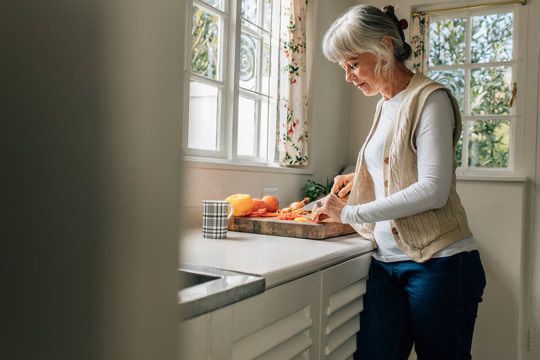
The Day I Chose Myself
At sixty years old, I woke to darkness on what should have been a celebration. The house was silent except for the hum of the refrigerator and my own shallow breathing. I dressed quietly, carefully, afraid to disturb anyone. My fingers found the worn fabric of an old robe—the last gift from someone who once loved me—and I made my way to the kitchen to begin what I’d done every morning for five years.
What happened that day would change everything. But first, I had to serve one more meal.
The Breaking Point
The kitchen had become my prison, though I’d built it myself with love and duty. Three different breakfasts every morning: pancakes for my son Ryan, green smoothies for my daughter-in-law Megan, scrambled eggs for my grandson Leo. Each meal prepared with muscle memory, each bite taken for granted.
The sizzle of batter hitting the hot griddle echoed in the pre-dawn quiet. I should have known better. I should have worked more quietly.
“You old hag, making all that noise so early in the morning. Are you trying to keep people from sleeping?”
Megan’s voice shot down from upstairs like an arrow. The slap of her slippers on the stairs announced her arrival before she burst through the kitchen door, a white face mask making her look ghostly in the dim light.
“Today is my—” I started.
“Who cares what day it is?” She cut me off, her mask crinkling with annoyance. “I have an important meeting at nine. What if the smell gets on my suit?”
I turned down the heat and transferred the pancakes silently. A drop of hot oil splattered onto my hand, leaving a red mark I barely felt anymore. Pain had become so familiar.
“The plumber is coming today. Stay home to wait for him,” Megan continued, peeling off her mask. “For lunch, I want grilled salmon. Don’t use too much salt. And make extra dishes for dinner—my parents are coming.”
The spatula slipped from my fingers, clattering into the pan. “Today is my sixtieth birthday.”
She raised an eyebrow as if I’d said something absurd. “So? Is being sixty some big accomplishment? The average life expectancy is over eighty now. You’ve got a long way to go.”
My son Ryan appeared moments later, eyes glued to his phone. “Mom, where’s my coffee?”
“Almost ready,” I said automatically, moving to the coffee maker.
“Hurry up. I’m in a rush.” He didn’t look up. “Oh, and buy extra seafood tonight. My father-in-law likes lobster.”
I studied my son’s profile—the same face I’d kissed goodnight for years, the boy who once used his allowance to buy me birthday cards. Now he couldn’t even remember what day it was. The red circle on the calendar mocked me from across the room.
“Ryan,” I called his childhood nickname softly.
“Mom, can you please not nag me when I’m busy?” He frowned, gulping his coffee and heading upstairs without a second glance.
I stood in the middle of my kitchen—forty years I’d spent in front of stoves like this one—and felt my legs go weak. On the calendar, I’d written “Helen’s 60th birthday” in my own handwriting. They’d all looked right past it.
The Silence
After they left, I cleaned the breakfast dishes while a talk show played on television. An elderly woman was tearfully complaining about her ungrateful son. I turned off the TV, and the silence became deafening.
From the back of a closet, I pulled out my late husband’s photograph. Arthur had been dead for five years now. In the picture, he was forever fifty-five, his eyes gentle, his smile knowing.
“Arthur, if only you were still here,” I whispered. I remembered his last words: “Helen, after I’m gone, you have to live for yourself.” At the time, I couldn’t imagine how. Now, I understood he’d seen the truth about this family long before I had.
For lunch, I made myself a simple bowl of noodles. When the plumber arrived and saw me alone, he asked casually, “Ma’am, where are your kids?”
“At work,” I managed a smile.
“Isn’t it your birthday today?” He pointed to the calendar. “My grandma turned sixty last year, and our whole family—more than twenty of us—threw her a huge backyard barbecue.”
I had no words. After he left, I sat in front of Arthur’s picture and finally broke down. Sixty years old should mean being surrounded by loved ones, enjoying a peaceful retirement. Instead, I was an unpaid servant, invisible except when needed.
As I walked to the market later, I passed a park where seniors were line dancing, their faces glowing with joy and freedom. My phone buzzed with a text from Ryan: “Mom, make a few extra dishes tonight. My in-laws will be here at seven. Megan wants shrimp scampi, no spicy peppers.”
I didn’t reply. At the CVS, I stopped and stared at the sleeping pills in the window display for a long, long time.
“Ma’am, can I help you?” a young clerk called cheerfully.
“No, thank you,” I said quickly, my heart pounding as I hurried away.
At the market, I mechanically selected ingredients while memories assaulted me: Megan dumping my cooking into the trash, saying even a dog wouldn’t eat it. Ryan growing more impatient with me, as if speaking to me was charity. Leo starting to imitate his mother, calling me “old thing.”
“Helen! Helen!” A familiar voice broke through my dark thoughts. My old colleague Ruth stood before me, five years my senior but looking younger and more vibrant than I felt.
“I heard today is your sixtieth birthday,” she said, taking my hand. “Why are you buying groceries alone? Didn’t your son throw you a party?”
“They’re busy with work,” I lied.
“Busy, my foot.” Ruth scoffed. “My boy used to be like that too. Then I moved into a senior living community, and now he visits me every other week.”
“A senior living community?”
“Willow Creek. The facilities are fantastic,” Ruth lowered her voice. “A lot of residents there moved in because they couldn’t stand their kids anymore. You should visit sometime. We’re looking for someone who knows how to cook.”
Her words planted seeds in my mind. Live for yourself. Leave this house. The thoughts grew like wildfire.
The Final Feast
I prepared dinner with more force than usual, chopping vegetables as if I could slice away my grievances, boiling soup as if I could dissolve my anger. At six-thirty, when everyone arrived and gathered in the living room with laughter that excluded me, I made my decision.
From the back of a drawer, I took out an old digital voice recorder—something Arthur had used for his last wishes. I pressed record and slipped it into my pocket.
“Mom, what’s taking so long?” Ryan called with clear impatience.
“Coming,” I said, taking a deep breath.
The dining room table seated six, with my spot at the far end near the kitchen door—always ready to jump up for refills. I placed the grilled salmon in the center, the fish head pointing toward my father-in-law out of respect for tradition. Even on my birthday, which no one remembered.
“Mom, where’s my red wine?” Ryan frowned. “Didn’t I ask you to chill a bottle?”
“I forgot. I’ll get it now.”
Behind me, Megan snickered. “She’s getting so forgetful. Can’t even remember one simple thing. Ryan, I told you we should have hired a maid instead of relying on this free labor.”
My hand tightened on the refrigerator handle. Free labor. That’s what five years of service had earned me.
I returned with the wine and poured for everyone, saving myself a small glass last. As I finally moved to sit, Megan spoke again.
“Where’s the soup? It’s a cold night, and there isn’t even hot soup.”
“It’s in the kitchen—”
“Never mind. I’ll get it myself,” she sighed dramatically. “If I wait for you, everything will be in slow motion.”
The dining room fell awkwardly silent except for the television. My grandson Leo suddenly shouted, “Grandma, I want shrimp!”
I stood to move the platter closer, but he pushed it away. “I don’t want you to peel it. It’s dirty. I want Mommy to do it.”
“Leo, how can you talk to your grandma like that?” Ryan’s mild rebuke meant nothing. He immediately returned to his conversation.
Megan returned with the soup, smiling. “Leo’s right. Old people have more germs on their hands. It’s unhygienic.” She pulled on disposable gloves and began peeling shrimp for my grandson. “Here you go, sweetie.”
I sat untouching my food, already full of anger. The recorder in my pocket felt like burning coal.
“Oh, by the way, Helen,” my mother-in-law suddenly turned to me. “I hear it’s your birthday today.”
My heart leaped. Finally, someone remembered.
“Yes, it is,” my voice trembled.
“Oh, perfect.” She turned to Megan. “Why don’t you bring out that cake you bought? It’ll save us a trip.”
Megan reluctantly retrieved a small cardboard box from the refrigerator and tossed it in front of me. “It was on sale at the supermarket. It’ll have to do.”
With shaking hands, I opened the box. Inside was a misshapen cake with collapsed frosting and a half-rotten strawberry. The price tag read: “Special $15. Limited time offer.”
“Mom, don’t be offended,” Ryan finally glanced at me. “Megan meant well.”
Meant well. My sixtieth birthday, and this was their good intention. A discounted, deformed, palm-sized cake.
“Thank you,” I said mechanically, feeling something inside me shatter completely.
They sang a half-hearted line of “Happy Birthday,” each took a small bite of cake, then pushed their plates aside. Mine sat untouched, slowly melting into sugary liquid—just like my life, collapsing silently.
Dinner continued with their laughter and Christmas vacation plans. No one asked if I wanted to go. I spun between kitchen and dining room like a top, the recorder capturing every order, every harsh word.
After dinner, they moved to the living room, leaving the mess for me. As I cleared dishes, one sentence cut through their laughter:
“Ryan, your mother is becoming more and more useless. Why don’t we just send her to a nursing home?” Megan’s voice was casual, discussing me like I was furniture to be discarded. “My cousin said the one on the east side of town is pretty good. Only three thousand a month.”
The plate nearly slipped from my hands.
“We’ll see,” Ryan’s voice was full of evasion. “She can still work now. We can talk about it when she really can’t move anymore.”
“By then it’ll be too late. Good nursing homes have waiting lists,” Megan pressed. “Besides, this house isn’t that big. When Leo gets older, he’ll need his own room.”
I held my breath, waiting for my son to defend me. Would he remember this house was bought with his father’s and my life savings? Would he remember when his startup failed, I sold my gold bracelets to help him?
“Fine, fine. You handle it,” Ryan’s reply was a knife through my heart.
In that moment, I understood completely. I was nothing more than a burden to be discarded when convenient.
The Recording
After cleaning the kitchen, I returned to my room and locked the door. I played back the recording—my daughter-in-law’s cruelty, my son’s indifference, the in-laws’ hypocrisy, my grandson’s disrespect—all documented clearly.
I pulled out an old suitcase and began packing. There wasn’t much: a few old clothes, cloth shoes, a photo album, and a small wooden box containing my dowry—a pair of silver bracelets, the only valuable thing my mother had left me. When Ryan’s business failed, I’d sold my gold bracelets to help him, but I’d secretly kept these, thinking I’d save them for a future granddaughter-in-law. Now that wasn’t necessary.
I sat at my desk and wrote three letters: one to my son explaining why I was leaving, one to my daughter-in-law about respect, and one to my grandson hoping he wouldn’t become like his parents.
At eleven p.m., I found Ryan alone in the living room, documents spread before him. He frowned when he saw me.
“Mom, why are you still up?”
“Ryan, I need to talk to you.”
“Now? I’m busy. I have an important contract tomorrow.”
“Just five minutes.” I sat across from him. “Today was my sixtieth birthday.”
He froze, expression awkward. “Oh, right. Happy birthday. That cake—Megan, she—”
“It doesn’t matter.” I cut him off. “Ryan, do you remember when you were ten and had a fever of 104? I carried you on my back and ran three miles to the hospital.”
“Mom, why are you bringing this up?” His impatience showed.
“Do you remember when you were in college and liked that girl? I worked two jobs for three months to save money for her gift.”
“That’s ancient history.”
“Do you remember when your father was sick? I took care of him alone for two years until he died.” My voice trembled. “Where were you?”
“I was overseas for a project.” His face changed. “Mom, what are you trying to say?”
“I’m saying I’m tired. I’m sixty years old. I want to live for myself for once.”
He looked at me like I was crazy. “What do you mean?”
“I’m leaving first thing tomorrow morning.”
“Leaving where? A nursing home? Don’t take Megan’s words to heart—”
“Not a nursing home,” I stood. “To a place where I don’t have to walk on eggshells.”
He laughed. “Mom, you’re sixty years old. Where could you possibly go? Stop being dramatic. You have to take Leo to school tomorrow.”
I didn’t answer. I just returned to my room, leaving him bewildered. This was the first time I’d ever fought back. The first time I’d said no. Beyond the fear, I felt a strange sense of release.
The Departure
At dawn, I woke and dressed in my warmest clothes. I placed the three letters under my pillow, left the voice recorder and silver bracelets next to the house keys on the dresser—my parting gifts so he could hear the truth.
I dragged my suitcase to the front door and looked back at the house I’d lived in for twenty years. Every object held memories, but none could hold me back.
“Mom, what are you doing?” Ryan’s voice came from the stairs, making me jump. He stood in his pajamas, staring at my suitcase.
“I told you last night. I’m leaving.”
“You’re serious?” He rushed down, taking stairs two at a time. “Where? Why?”
“To a place where I’m respected.” I looked him straight in the eye. “As for why, you’ll understand after you listen to that recorder.”
“What recorder? Mom, are you getting senile?” He reached for me, but I dodged.
“Ryan.” I rarely used his full name. “From the day you were born, I gave you everything. After your father died, I transferred the house to your name. I used all my retirement savings to support this household. For five years, I’ve served you three—and what I get is being called senile.”
He was stunned. “You—just calm down. Did Megan say something? You know how she is. She speaks before she thinks, but she doesn’t have a bad heart.”
“Doesn’t have a bad heart?” I laughed coldly. “She dumps my cooking in the trash, calls me an old hag, plans to send me to a nursing home. Is that not having a bad heart?”
His face turned red, then pale. “She didn’t mean—”
“Then what did she mean? And you—have you ever said a word in my defense?”
Megan’s voice came from upstairs. “Ryan, what’s all the noise?”
“It’s nothing,” he called up, then lowered his voice. “Mom, let’s go inside and talk. We don’t want the neighbors to hear.”
“There’s no need.” I pulled open the door. Cold air rushed in. “I’ve called a car.”
“Mom.” He grabbed my suitcase. “You can’t just leave. What about Leo? Who’s going to make his breakfast? Who’s taking him to school?”
That last sentence broke me. I yanked the suitcase back with all my strength, voice trembling with rage. “Even now, all you think about is who will serve your son? Ryan, I am not a slave to this family.”
“What’s going on?” Megan descended the stairs in a silk robe. Seeing my suitcase, her eyebrows shot up. “Well, well, what’s this drama? Running away from home?”
“Megan, that’s enough,” Ryan snapped—rare for him. He turned to me. “Mom, please calm down. Let’s talk.”
“Talk?” I laughed through tears. “For five years, has anyone talked to me? Has anyone asked what I want to eat, where I want to go, what I want for my birthday?”
Megan scoffed. “You’re sixty years old acting like a teenager demanding romance. Isn’t having a roof and food enough?”
“Megan—” Ryan glared.
“Am I wrong?” She crossed her arms. “Old lady, if you want to leave, fine. But first tell us how we’ve mistreated you. Did we not feed you? Did we not clothe you?”
I looked at this woman with perfect makeup and expensive clothes—the woman I’d sold my dowry to help my son marry, the person I’d served like a queen every day.
“You didn’t mistreat me,” I said calmly. “You just never treated me like a human being.”
I dragged my suitcase out. Ryan ran after me barefoot.
“Mom, it’s snowing. Where can you go?”
“Let go.” I shook him off. “Ruth told me about a senior living community. I’m going to check it out.”
“A senior living community?” Megan’s eyes lit up with interest. “Which one? What are the conditions? How much per month?”
I ignored her and walked to the elevator. Ryan followed.
“Mom, don’t be rash. At least wait until the snow stops.”
The elevator door opened. I stepped inside and pressed the button for the ground floor. In the final moment before the door closed, I said, “There are letters under the pillow and a recorder with bracelets on the dresser. Listen to it and think.”
As the elevator descended, my heart felt lighter than it had in years. For the first time in five years, I’d made a decision for myself. I’d fought back against unfair treatment. The feeling was surprisingly good.
New Beginnings
The taxi was waiting at the complex entrance. The driver helped me load my suitcase.
“Where to, ma’am?”
“Willow Creek Senior Living,” I said, my voice trembling as I spoke the address.
As we drove through familiar streets—the supermarket, the park, Leo’s school—places that had made up my entire world became part of my past.
“Visiting family, ma’am?” the driver asked.
“No,” I said, watching the falling snow. “I’m going to start a new life.”
The car stopped before a red-brick building with “Willow Creek” standing out brightly. Ruth appeared with an umbrella.
“Helen, you really came,” she said warmly, taking my suitcase. “Come on, let’s see the room. There’s a sunny single that just opened up.”
The lobby was warm and welcoming. Several seniors played chess, read, and knitted. They all nodded and smiled at me—natural, easy respect I hadn’t felt at home in years.
Ruth showed me around: activity room, dining hall, library. “A doctor comes weekly for checkups, and we have a social event monthly. Oh, do you play bridge? We’ve been looking for a fourth.”
I smiled. “My real skill is cooking.”
“Fantastic!” Her eyes lit up. “We desperately need a good cook. If you’re willing, you could organize a cooking club. We’d all chip in for ingredients.”
The single room exceeded my expectations: a bed, desk, wardrobe, television, private bathroom. Everything I needed. Outside the window was a small garden, snow-covered now but promising beauty in spring.
“So, what do you think?” Ruth asked hopefully.
“It’s wonderful,” I said, running my hand along the windowsill as sunlight streamed through the glass, warming my skin.
“You’ve decided to stay?”
I took a deep breath and nodded. At sixty years old, I finally had a space completely my own—a place where I didn’t have to walk on eggshells.
Rebuilding
The paperwork was simple. I paid a three-month deposit with money from selling my silver bracelets. The community director was kind. When she heard about my cafeteria experience, she immediately invited me to help improve their dining services and teach cooking classes.
“Helen, we desperately need an experienced chef like you,” she said enthusiastically.
I readily agreed. It felt wonderful to be needed, to be valued.
At lunch, several elderly ladies warmly invited me to sit with them. They chatted away, asking about my background and work.
“I used to work at the textile mill,” I said shyly. “Later in the cafeteria, then I retired to care for my grandson.”
“How old is your grandson?” a woman with silver hair asked.
“Eight,” I replied, a sudden pang of sadness hitting me. Was Leo out of school yet? Who was picking him up? Who was making his dinner?
“Missing your grandson?” Ruth sensed my mood and gently patted my hand. “It’s always like this at first. Gets better. Besides, you can visit anytime.”
My phone rang. It was Ryan.
“Mom, are you really there? I just listened to the recording. I had no idea Megan said those things—”
“It was all recorded,” I said calmly.
“Mom, I’m sorry. I really didn’t know. Please come back. We can talk—”
“No,” I said, looking out at the snow. “I’m happy here.”
“But Leo keeps asking where Grandma went. He really misses you.”
My heart softened at the mention of my grandson but hardened just as quickly. “Ryan, I love you and Leo. But first, I am a person with dignity. If you want to see me, come here. But I won’t go back to being your unpaid maid.”
Long silence. Finally: “Mom, I’ll bring Leo to see you tomorrow.”
After hanging up, the ladies at my table looked at me with understanding and approval.
“Good for you,” Ruth said, putting fish on my plate. “When children are ungrateful, we old folks have to stand up for ourselves.”
“Was I too harsh?” I asked quietly. “Leo is still so young.”
“Harsh?” An elderly woman with glasses scoffed. “When my daughter kicked me out, that was harsh. If you don’t set boundaries now, you’ll have even less standing later.”
That afternoon, I joined the craft class and learned decorative knot-making. My fingers weren’t nimble, but I slowly got the hang of it. In the evening, I watched TV and chatted with other ladies, listening to their stories. Some had been cast aside by children. Some chose to move out. Some had no children at all. I wasn’t alone—so many seniors fighting to live with dignity.
Before bed, I stood by the window looking at city lights twinkling in the snow. My phone buzzed with texts from Ryan: “Mom, Dad agreed to let me visit him weekly. Today we made braised pork together. He said my technique was pretty good.”
Then Megan: “Helen, I practiced all afternoon and finally made decent dumplings. Leo said they’re better than the cafeteria’s.”
Looking at these messages, I smiled as I fell asleep. Perhaps change was really possible.
Reconciliation
Over the following months, life transformed in ways I’d never imagined. My cooking classes became popular. I taught twice weekly, earning $200 per session. The community director invited me to consult on menu planning. A local newspaper featured my story—how I went from downtrodden mother-in-law to culinary expert.
The article caught attention citywide. Media outlets requested interviews. The Council on Aging invited me to be a senior dignity ambassador. I even began compiling a cookbook of traditional family recipes.
“Helen, you’re going to be famous,” Sarah, my new assistant, said excitedly, showing me the publisher’s layout for my cookbook.
Meanwhile, my family was changing too. Ryan visited weekly, sometimes with Leo, sometimes alone. He’d listened to the recording, read my letters, and found his father’s old diary. The truth had opened his eyes.
Megan started therapy to address her own family trauma. She apologized tearfully, explaining how watching her mother mistreat her grandmother had shaped her behavior. I taught her to make dumplings, and slowly, cautiously, we rebuilt trust.
Most surprisingly, Ryan reconnected with his own father, George, my estranged husband at Green Mountain Nursing Home. After years of silence, father and son began learning traditional cooking together, healing their relationship through shared recipes.
One weekend, they invited me to a parent-child event at Leo’s school—a dumpling-making contest. Our family worked together: I rolled wrappers, Ryan seasoned filling, Megan and Leo folded dumplings. We won first prize.
“Grandma is the best!” Leo jumped up and down, holding our trophy.
Looking at their happy faces, I realized this was what family meant—not obligation and resentment, but mutual respect and genuine care.
Full Circle
By winter, my cookbook was published to strong sales. “Grandma Helen’s Kitchen” videos gained over 100,000 followers online. I appeared on the provincial TV station’s New Year’s special, sharing traditional recipes and my story of transformation.
The recognition felt surreal—sixty years old, and people finally valued my knowledge and skills. But the greatest gift was watching my family heal.
On New Year’s Eve, we all gathered at Ryan’s house. George came from his nursing home, looking vibrant. Ryan and Megan worked together seamlessly in the kitchen. Leo set the table like a little adult.
“Dinner’s ready,” Ryan announced, bringing out fortune chicken made from George’s secret recipe.
We sat together, raised our glasses, and watched fireworks through the window. My son stood for a toast.
“Mom, I’d like to thank you. This year you taught me how to be a son, a father, and a better person.”
“It’s the holidays. Why so serious?” I said, embarrassed, but my eyes filled with tears.
“I want to toast Grandma too,” Leo mimicked, raising his juice. “Grandma is the best.”
“Helen—” George also stood, voice choked. “I’m sorry for all the years of hardship.”
Looking at everyone I loved in this room, I let the tears flow. The past year flashed before me: the humiliation of my birthday, the courage to leave, the new life at Willow Creek, the media attention, the emotional reconciliation.
“All right, enough sad talk on the holidays,” I said, wiping tears and raising my glass. “To our family. Cheers.”
“Happy New Year!” Everyone chimed in, glasses clinking.
After dinner, we made dumplings together for good luck. George and Ryan discussed their plans for opening a traditional restaurant. Megan and Leo carefully folded dumplings while I supervised. The TV host began the countdown.
“Five—four—three—two—one—Happy New Year!”
Outside, fireworks lit the sky. Ryan brought out a gift box.
“Mom, your New Year’s gift.”
Inside was a shiny golden key.
“It’s the key to the restaurant,” he explained. “You’ll always be our chief consultant.”
“And this—” Leo handed me a handmade card with “Grandma, I love you” written in crooked letters.
“Helen,” George said mysteriously. “I’ve applied for a couple’s room at the nursing home. It’ll be ready in spring.”
I looked at him in surprise, then at my son’s family. They were all smiling, eyes full of hope.
“Are you all plotting against me?” I pretended anger but couldn’t help smiling.
“Please consider it, Mom,” Ryan said softly. “Dad’s getting older and needs someone. Besides, you can teach classes and film videos anywhere.”
I looked at George’s hopeful eyes and remembered our youthful promise to grow old together, sunbathing and reminiscing. A promise delayed but not forgotten.
“I’ll think about it,” I said. But in my heart, I already had the answer.
The Answer
Spring arrived at Willow Creek with cherry blossoms and new growth. I continued teaching my classes, filming videos, and enjoying friendships with the other seniors. But something was missing.
One morning, I woke to find George standing outside my door, leaning on his cane, holding a single flower.
“I came to properly ask this time,” he said softly. “Helen, will you move into the couple’s room with me? Will you give this old fool another chance?”
I looked at the man I’d loved for over forty years—the father of my son, my partner through joy and hardship. We’d been separated by pride and pain, but perhaps it was time to come home to each other.
“Yes,” I said simply, taking his hand. “Let’s spend our remaining years together.”
Ryan and Megan helped me move into the couple’s room at Green Mountain. It was larger, brighter, with space for both our belongings and memories. Leo visited every weekend, learning recipes and stories from both his grandparents.
My cooking classes continued, now at Green Mountain. My videos kept growing. My cookbook became a bestseller. Ryan and Megan’s restaurant opened, featuring traditional dishes from our family recipes.
But the greatest achievement was this: I’d learned to live for myself while still loving my family. I’d set boundaries that demanded respect. I’d shown Leo—and everyone watching—that seniors deserve dignity, that age brings wisdom worth celebrating, that it’s never too late to choose yourself.
One year after my sixtieth birthday, on my sixty-first, my entire family gathered at the restaurant—three generations around one table. They presented me with a beautiful cake, sang with genuine joy, and Ryan stood to speak.
“Mom, one year ago you taught us the hardest lesson: that love without respect is worthless. Thank you for having the courage to leave. Thank you for teaching us how to be better. Happy birthday.”
I cut the cake with George by my side, Leo holding my hand, Ryan and Megan smiling with tears in their eyes. This was the birthday I’d dreamed of—not because of the cake or gifts, but because of the genuine love and respect surrounding me.
At sixty-one, I’d finally found my voice. I’d built a life of purpose and dignity. I’d healed my family by first healing myself.
The restaurant’s walls displayed photos from “Grandma Helen’s Kitchen”—images of our family cooking together, laughing, learning, growing. Each picture told the story of transformation, of broken relationships rebuilt stronger than before.
As we raised our glasses in a final toast, I looked around the table at the faces I loved most in this world. My journey had been painful, but it led me here—to this moment of genuine connection, mutual respect, and unconditional love.
“To family,” I said, my voice steady and clear. “And to never forgetting that we all deserve to be treated with dignity.”
“To family,” they echoed.
Outside, spring rain began to fall, washing away the last remnants of winter. Inside, we were warm, together, and finally, truly whole.
At sixty-one years old, I’d learned the most important lesson of all: that sometimes you have to leave home to save it, that sometimes you have to choose yourself first before you can truly love others, and that it’s never, ever too late to begin again.
THE END