THE INHERITANCE
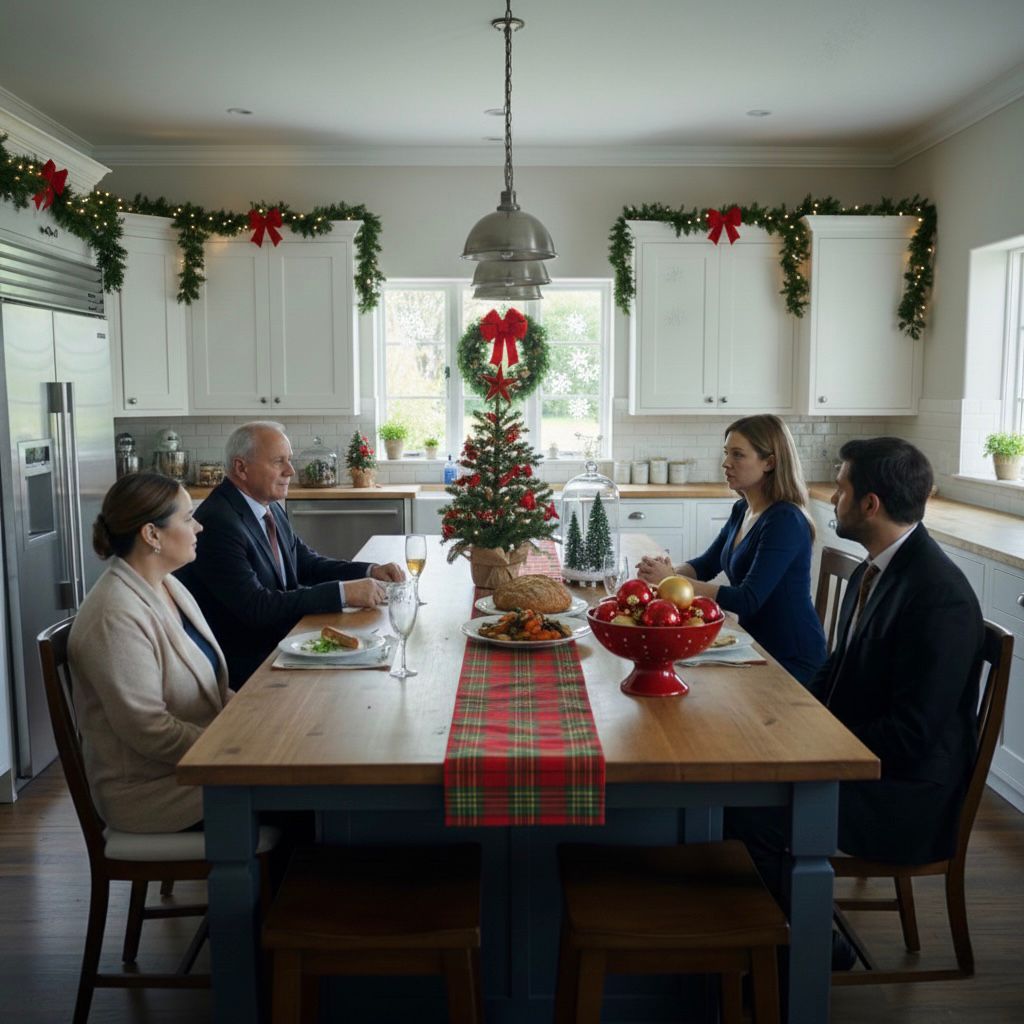
The dining room hummed with anticipation that evening, the kind of electric silence that precedes announcements everyone already knows are coming. I sat in my usual chair—the one closest to the kitchen, the one no one ever fought over—watching the crystal chandelier cast fractured light across faces I’d known my entire life. Some were blood relatives. Others had simply been around long enough to feel like family. All of them wore the same expression: eager validation for a decision that had been made long before anyone arrived.
My mother had outdone herself with the presentation. The mahogany table gleamed beneath carefully arranged place settings, each napkin folded into perfect triangles. A centerpiece of white roses—my grandmother’s favorite, though no one but me seemed to remember that detail—sat between the good china we only used for special occasions. The air smelled of her famous pot roast, the one she made when she wanted evenings to feel important, to feel like they mattered in ways that would be remembered.
Through the window behind my father’s head, I could see the Florida sunset painting the sky in shades of burnt orange and deep purple. Somewhere out there were the eight rental properties everyone had gathered to discuss. Small houses, most of them, scattered across three counties. The kind of properties that didn’t look like much from the street but had quietly generated income for decades. My grandmother had bought them one by one, back when Florida real estate was something you could still afford on a teacher’s pension and careful saving.
She’d been gone for three months now. Long enough for the grief to settle into something manageable, but not long enough for anyone to stop using her memory as justification for whatever they wanted to believe.
I hadn’t expected to feel this calm.
For weeks leading up to this dinner, I’d imagined different versions of how the evening might unfold. In some scenarios, I stood up and made a speech. In others, I stayed silent and simply left. I’d practiced both responses in my bathroom mirror, watching my own face to see which version looked more like someone who had moved past caring. But now that the moment had finally arrived, I felt neither angry nor vindicated. Just quietly aware that some stories take years to write their final chapters, and this one had been unfolding since long before anyone realized there was a plot.
My brother arrived late, as he always did, making an entrance rather than simply walking into a room. He wore a blazer I didn’t recognize—something expensive, probably purchased specifically for this occasion. His hair was styled in that effortlessly casual way that actually requires significant effort. He worked in commercial real estate now, or at least that’s what he told people at parties. From what I understood, he mostly worked adjacent to commercial real estate, in some capacity that involved a lot of lunches and very few actual transactions.
But he looked the part. He always had.
“Sorry I’m late,” he announced to the room, though his tone suggested he wasn’t sorry at all. “Traffic on I-95 was insane.”
My mother rose to kiss his cheek. My father stood to shake his hand. Various relatives called out greetings, reassured him that he hadn’t missed anything important, asked how business was going. He answered each question with the practiced ease of someone who’d learned early that confidence could substitute for actual accomplishment, at least in rooms like this one.
He sat directly across from me, which felt appropriate somehow. We’d been sitting across from each other our entire lives—at family dinners, at graduations, at every milestone and gathering—occupying the same spaces but inhabiting completely different stories about what those spaces meant.
“Teagan,” he acknowledged me with a nod, the way you might greet a coworker you see every day but don’t really know.
“Marcus,” I replied, matching his tone exactly.
My father cleared his throat, preparing to speak, but Marcus raised a hand. “Actually, Dad, if you don’t mind, I’d like to say something first.”
The room shifted. Heads turned. Drinks were set down. Someone’s phone buzzed and was hastily silenced. This was it—the moment everyone had been waiting for, even though they all pretended not to know what was coming.
My brother has always understood the value of timing, of holding a room’s attention, of making announcements feel like they were spontaneous rather than carefully rehearsed. He stood slowly, deliberately, like a politician about to deliver news that would change everything. His hand reached for his glass, and he tapped it gently with his fork, though the room had already fallen silent.
“I know we’re all here because of Grandma Betty,” he began, his voice taking on that solemn tone people use when they’re about to say something they don’t actually feel sad about. “She was an incredible woman who built something real in this state. Something that’s going to support this family for generations.”
Heads nodded. Someone murmured agreement. My mother dabbed at her eyes with the napkin she’d unfolded specifically for this purpose.
“And Mom and Dad have had to make some really difficult decisions about how to preserve her legacy,” Marcus continued. “They’ve thought about this carefully. They’ve considered what’s best for the family, what’s best for the properties, and what Grandma Betty would have wanted.”
He paused for effect. The chandelier above him caught the light from his watch—also new, also expensive. I wondered if he’d bought it specifically to wear tonight, to look like the kind of person who should inherit eight rental properties.
“So I’m honored to announce that Mom and Dad have decided to transfer all eight rental houses to me.”
The room erupted exactly as I’d known it would. Applause broke out from multiple directions. My cousin James whistled loudly. My aunt Patricia actually stood up, as if this were a graduation ceremony. My mother was openly crying now, and my father wore the expression of a man who’d just made the smartest decision of his life.
Marcus grinned, soaking in the approval, his chest expanding with the kind of pride that comes from being publicly validated in front of everyone who matters. He raised his glass higher.
“Teagan, I know you understand this is what’s best for everyone. The properties need someone who can really manage them, someone who’s in the business, someone who—” he paused, searching for diplomatic phrasing, “someone who’s going to stay in Florida and really commit to the family legacy.”
The implication hung in the air like smoke. I’d left. I’d gone to college in Massachusetts, then graduate school, then built a career in another state entirely. I’d chosen my own path instead of the one that had been laid out for me, and now that decision was being reframed as abandonment, as evidence that I didn’t care about family, about legacy, about anything that mattered to the people in this room.
More applause. More agreement. Someone clapped me on the shoulder in what I think was meant to be a gesture of comfort, as if I were the one who needed consoling because I wasn’t receiving assets I’d never asked for in the first place.
I didn’t move.
I didn’t stand.
I didn’t raise my glass or smile or play along with the script everyone else seemed to be following.
I just watched my brother’s face, watched the triumph playing out across his features, watched him turn to my father with that look that said we did it, we pulled it off, she doesn’t even care.
And that’s when I spoke.
“Dad,” I said, my voice cutting through the celebration like a door closing on a party I’d never been invited to in the first place. “You really don’t know, do you?”
The room didn’t go silent all at once. It was more like watching dominoes fall—conversations dropping off one by one, heads turning, the collective realization spreading that something unexpected was happening, something that wasn’t part of the carefully choreographed evening everyone had agreed to perform.
My father’s face went still in a way I’d only seen a handful of times in my life. The kind of stillness that comes right before understanding, right before the moment when everything you thought you knew rearranges itself into a completely different picture.
“Know what?” Marcus asked, his fork frozen halfway to his mouth, his victory smile faltering at the edges.
I reached down beside my chair, where I’d carefully placed a fireproof folder two hours earlier, before anyone else arrived. I’d carried that folder with me for over two years, keeping it safe, keeping it private, waiting for a moment I’d hoped would never actually come. I’d wanted to believe that my family would surprise me, that they’d prove wrong all the quiet suspicions I’d been carrying. But here we were, and the folder felt heavier than it should have, weighted with the kind of truth that changes everything.
“Grandma Betty,” I said quietly, looking directly at my father, “changed her will fourteen months before she died.”
The silence that followed wasn’t dramatic. It was almost gentle, like the moment after you say something you can’t take back and the world hasn’t quite figured out how to respond yet.
My mother’s hand went to her throat. Marcus set down his fork with a soft clink against the china. My father’s expression moved through several emotions too quickly for me to name them all.
“That’s impossible,” Marcus said, but his voice had lost its confidence. “We saw the will. The lawyer read it to us.”
“You saw a will,” I corrected. “You saw the will she wrote twelve years ago, when she was first diagnosed with diabetes and wanted to get her affairs in order. The will that left everything split between Dad and Uncle Robert, to be distributed to the grandchildren as they saw fit.”
I opened the folder carefully, revealing documents I’d memorized months ago but had never shown to anyone. Letters. Legal paperwork. Notarized signatures. A paper trail that told a completely different story than the one everyone had been celebrating for the past ten minutes.
“But Grandma Betty called me in November, two years ago,” I continued. “She asked me to come visit her in Florida. Just me. She said she wanted to talk about something important, something she couldn’t discuss over the phone.”
I could see my father’s jaw tightening, could see him trying to calculate what this meant, how bad it might be. My mother had gone pale. Marcus looked between me and our parents like he was watching a tennis match he hadn’t realized he was playing in.
“She told me she’d been watching,” I said. “Watching how this family worked, watching who showed up, watching who called just to talk versus who called to ask for money. She told me she was tired of pretending she didn’t see the difference.”
My aunt Patricia started to speak, but I continued before she could interrupt.
“She said that over the past five years, Marcus had called her exactly eight times. Every single call was to ask for a loan. Every single time, she gave him money, and every single time, he promised to pay it back. None of those promises were kept.”
Marcus’s face flushed. “That’s not—she offered—”
“She kept records,” I said, pulling out a small notebook filled with my grandmother’s careful handwriting. Dates. Amounts. Notes about what each loan was supposedly for. “Car repairs. Business startup costs. Medical bills. Fifteen thousand dollars total. She never asked you to repay it because she loved you, but she wasn’t stupid. She knew the difference between helping family and being used.”
I turned the page.
“She also knew that Dad had been skimming rental income for three years. Small amounts at first. Then larger ones. She had an accountant review all the books after she noticed some discrepancies.”
My father stood up so fast his chair nearly fell backward. “That is a goddamn lie, Teagan. I managed those properties for her, I kept them running—”
“You took forty-two thousand dollars,” I said, my voice steady. “Over three years. Always round numbers, always from properties she rarely checked on personally. Your own mother’s properties.”
The folder had more. Bank statements my grandmother had requested. Emails she’d saved. A entire timeline of small betrayals that individually might have been explained away but together formed a pattern impossible to deny.
“So she called me,” I said. “And she asked me what I thought she should do. Not because I was her favorite—I wasn’t. But because I was the only one who had never asked her for anything. The only one who called on Sundays just to check in. The only one who remembered that she liked mystery novels and sent her new ones when they came out. The only one who showed up to her book club meetings when no one else in the family could be bothered.”
I pulled out the revised will, professionally printed, properly notarized, absolutely legal.
“She left the eight rental properties in a trust,” I said. “Managed by me. All income goes directly toward maintenance, property taxes, and a college fund for future grandchildren—actual grandchildren, not you, Marcus, since you’re not going to suddenly become younger. The properties cannot be sold without approval from three independent trustees she appointed. No one in this room has any claim to them except as potential beneficiaries of the educational trust, and only if they meet specific academic and ethical criteria Grandma Betty outlined.”
The room had moved past silence into something else entirely. Shock. Disbelief. The particular kind of chaos that comes when people realize they’ve been performing for an audience that left the theater hours ago.
“But Dad told us—” Marcus started.
“Dad told you what he wanted to be true,” I said. “He told you what made him look good, what made this family’s story make sense. He either never saw the revised will, or he saw it and decided to pretend it didn’t exist, hoping that if he announced the old version loudly enough, reality would somehow cooperate.”
I looked at my father then, really looked at him, and saw something I’d never quite allowed myself to see before. Not malice. Not even greed, exactly. Just… entitlement. The bone-deep belief that things should go a certain way because they’d always gone that way, and any evidence to the contrary must be a mistake someone else made.
“I kept this quiet for two years,” I said. “After Grandma died, I kept waiting for you to mention the new will. I thought maybe you’d received a copy, maybe the lawyer had contacted you. I gave you months to say something, to acknowledge what she’d actually wanted. I told myself that if you brought it up, if you showed any indication that you were going to honor her real wishes, I’d work with you. I’d find a way to make this easier.”
My mother was crying again, but these tears were different from before.
“But you didn’t,” I continued. “You planned this whole dinner. You invited everyone we know. You set up this theatrical moment where Marcus gets publicly crowned as the golden child, where I get reminded one more time that I don’t quite measure up, that leaving Florida meant leaving behind any claim to being real family.”
I stood up then, carefully placing the folder on the table in front of my father.
“So here’s what’s actually going to happen,” I said. “These properties are in my name, held in trust according to Grandma Betty’s explicit instructions. There’s a management company already in place—I set it up eight months ago. All rental income is being properly tracked and distributed according to the trust terms. Every single dollar is accounted for.”
Marcus was staring at the documents like they were written in a language he couldn’t read.
“You’re welcome to contact the lawyer whose information is on page fourteen,” I said. “He has copies of everything. He’ll confirm that this is all completely legal and final. Grandma Betty was of sound mind when she made these changes. Three doctors certified it. There’s no ambiguity here.”
I picked up my purse from the back of my chair.
“I hope the pot roast was good,” I said. “I’m sure Mom worked hard on it. She always does.”
I walked toward the door, and no one tried to stop me. No one seemed capable of movement or speech. The room that had been so full of celebration ten minutes earlier now felt like a museum dedicated to a victory that had never actually happened.
But then my father’s voice cut through the silence.
“You did this on purpose,” he said. His voice was shaking. “You let us plan this whole evening, let us invite everyone, let Marcus stand up and make a fool of himself, just so you could humiliate us.”
I turned back.
“No, Dad,” I said quietly. “I let you do this on purpose. I let you build this entire fantasy because I wanted to see if you’d do it. If you’d really stand in front of everyone we know and pretend Grandma didn’t make her wishes crystal clear. If you’d really ignore her final decisions just because they didn’t match the story you wanted to tell.”
I looked around the room one last time—at the relatives who’d cheered for my brother, at the family who’d never quite seen me as essential, at the people who’d gathered to celebrate a transfer of wealth that was never going to happen.
“She loved you,” I said to my father. “Right up until the end, she loved you. But she loved her legacy more. She loved the idea that her hard work, her careful saving, her decades of sacrifice might actually help people who needed it, people who would use it to build something real rather than just coasting on inheritance.”
My hand was on the doorknob when Marcus finally found his voice.
“You’re really going to do this?” he asked. “You’re really going to take everything?”
“I’m not taking anything,” I said. “I’m honoring Grandma Betty’s wishes. There’s a difference, but I don’t expect you to understand it right now.”
I opened the door, and Florida’s humid evening air rushed in, carrying the scent of jasmine and cut grass and all the things I’d once associated with home.
“The trust documentation includes a provision,” I said, pausing in the doorway. “If any family member wants to contest the will, the entire trust gets donated to the Florida Education Foundation. Grandma Betty was very clear about that. So you can lawyer up if you want, but you’ll just be ensuring that none of us ever benefit from her work.”
I took one step outside, then turned back one final time.
“I’ll be staying at the Hampton Inn near the airport if anyone wants to have an actual conversation about this. Not an argument. Not an ambush. A conversation. I fly out tomorrow at noon.”
No one said anything.
I hadn’t expected them to.
I drove away from that house—the house where I’d spent every Christmas, every Thanksgiving, every milestone of my childhood—and I didn’t feel triumphant. I felt tired. Tired of being underestimated. Tired of watching my family mistake favoritism for wisdom. Tired of knowing that the people who were supposed to love me most had spent decades seeing me as less important simply because I didn’t demand attention the way my brother did.
My phone started buzzing before I’d driven three miles. Text messages. Voicemails. A few from relatives, more from my mother, several from Marcus. I let them accumulate, watching the numbers climb on my screen, knowing that none of them would say what I needed to hear.
The Hampton Inn’s lobby was quiet when I checked in. The night clerk didn’t ask why I was staying at a hotel in my hometown, and I was grateful for that small mercy. My room was generic in that comforting way hotel rooms are—nothing personal, nothing weighted with history, just a bed and a shower and a TV that I had no intention of turning on.
I sat on the edge of the mattress and finally opened the messages.
Marcus’s texts were predictable: anger, denial, accusations that I’d manipulated Grandma Betty, threats to contest the will even though I’d just explained why that would backfire. My mother’s messages were more complex—hurt mixed with confusion, questions about when I’d known, pleas for me to come back and “talk this through as a family.”
But it was my father’s voicemail that made me set the phone down and close my eyes.
“Teagan,” his voice said, rough with something that might have been emotion or might have been anger—with him, it was always hard to tell the difference. “Your grandmother… she didn’t understand. She was sick at the end, she wasn’t thinking clearly. We can fix this. We can make this right. Just… come back. Let’s talk about this like adults.”
Even now, even after everything, he was trying to rewrite the story. Trying to make my grandmother’s careful, deliberate decisions sound like the confused wanderings of a sick mind. Trying to find a narrative where he was still right, still in control, still the patriarch whose word should be final.
I deleted the voicemail.
Around midnight, my phone rang with an unfamiliar number. I almost didn’t answer, but something made me pick up.
“Teagan?” a woman’s voice said. “This is Patricia. Your aunt.”
“I know who you are,” I said.
There was a pause, the awkward kind where someone is trying to figure out how to say something they know won’t be received well.
“I wanted to apologize,” she said finally. “For cheering. For… going along with all of it. I knew something felt wrong, but I didn’t think it was my place to question it.”
“Okay,” I said, because I didn’t know what else to say.
“Your grandmother was a remarkable woman,” Patricia continued. “She talked to me sometimes, you know. Toward the end. She told me she was proud of you. That you’d built a life on your own terms. That you’d never once made her feel like a bank account with a pulse.”
My throat tightened.
“I just wanted you to know that,” Patricia said. “That someone saw it. That it mattered.”
We talked for another twenty minutes. Not about the properties or the will or the dinner that had imploded so spectacularly. Just about Grandma Betty. About her book club, her terrible jokes, the way she used to hum while she gardened. About the person she was when no one was asking her for anything.
When I finally hung up, I felt something shift inside me. Not quite peace, but something adjacent to it. A sense that maybe this hadn’t been about winning or losing, about getting revenge or teaching lessons. Maybe it had just been about honoring someone who’d spent her whole life being practical and careful and clear-eyed about the people she loved.
The next morning, I checked out of the hotel at 10 AM. My flight wasn’t until noon, but I wanted to drive by one of the rental properties before I left. The first house Grandma Betty had bought, the one that had started everything.
It was a small house on a quiet street in a neighborhood that had been gradually improving for twenty years. The yard was neatly maintained. The shutters had been recently painted. Through the front window, I could see children’s toys scattered across a living room floor—evidence of a family living there, building a life there, probably with no idea that the property they were renting had just been at the center of a family drama that would reshape everyone involved.
I sat in my car across the street and imagined my grandmother buying this house forty years ago. Imagined her looking at the same street, seeing potential instead of problems, making a decision that would ripple forward through decades.
She’d built something real. Something that would outlast arguments and hurt feelings and disappointed expectations. Something that could help people long after everyone at last night’s dinner was gone.
My phone rang. My father’s name appeared on the screen.
I let it ring.
Three days later, back in my own apartment in Massachusetts, I received a certified letter from my father’s attorney. It was carefully worded, professional, outlining his intention to contest the will on grounds of “undue influence and mental incompetence.” The letter suggested that I had manipulated my grandmother during a vulnerable time, that the revised will didn’t reflect her true intentions, that a lengthy legal battle would be in no one’s best interest.
I forwarded the letter to the trust’s attorney with a brief note: “Please proceed with the donation clause as outlined in the trust documents.”
Two hours later, I received a frantic call from my brother.
“You can’t do this,” Marcus said, his voice high and strained. “Dad’s going to drop the contest. He didn’t understand what the clause meant. Please, Teagan, don’t donate everything. Just… let’s talk about this.”
“We’ve talked,” I said. “Last night at dinner, we talked. With our actions, with our choices, with everything we decided to say and not say. We talked very clearly.”
“But the foundation—all of it—you’re really going to give away millions in property value just to make a point?”
“I’m going to honor Grandma Betty’s wishes,” I said. “Which she made very clear. Attack the will, lose everything. Those were her terms, not mine.”
“This is insane. You’re destroying the family over—”
“Over what, Marcus? Over finally being taken seriously? Over expecting Dad to honor his own mother’s decisions? Over wanting just once for this family to see me as something other than the spare child who was never quite good enough to matter?”
Silence on the other end.
“Dad’s withdrawing the contest,” Marcus finally said. “I just wanted you to know. Before you… before anything becomes permanent.”
I hung up without responding.
The email from my father’s attorney arrived an hour later, confirming the withdrawal and including what I can only describe as the world’s most grudging apology.
Over the following months, I settled into the quiet work of managing the trust. The management company I’d hired was competent and ethical. Rental income was steady. The college fund grew slowly but surely, accumulating in an account that would someday help a grandchild I might never meet attend a university without crushing debt.
I thought about my grandmother often during those months. About the conversations we’d had toward the end of her life, when she was clear-eyed about what her family had become and realistic about how her money would be used if she left it in the wrong hands.
“I’m not angry with them,” she’d told me once, sitting on her back porch while Florida’s afternoon rain drummed against the screens. “I just see them clearly. And once you see people clearly, you have to make decisions based on who they are, not who you wish they were.”
That clarity had felt like a gift at the time, but also like a burden. Because once you see your family clearly, you can’t unsee it. You can’t go back to pretending that love is the same thing as respect, that showing up is the same thing as caring, that blood relation automatically means understanding.
My mother reached out six months after the dinner. A carefully worded email, not quite an apology but not quite not an apology either. She wrote about family, about moving forward, about how everyone had been under stress and said things they didn’t mean. She didn’t mention the properties or the trust or the dinner itself. Just suggested we meet for coffee next time I was in Florida.
I didn’t respond immediately. I sat with the email for several days, reading it multiple times, trying to figure out what she actually wanted versus what she was willing to say directly.
Eventually, I wrote back. A short message. Friendly but boundaried. Yes, we could meet for coffee. No, I wouldn’t be discussing the trust or reconsidering any decisions. Just coffee. Just conversation. Just two people trying to figure out if there was still something between them worth maintaining.
We met on a Tuesday afternoon at a café she’d suggested. My mother looked older than I remembered, more tired. Or maybe I was just seeing her differently now, without the filter of daughterly obligation that had softened everything for so many years.
We talked about safe topics. Her garden. My work. The weather. The new restaurant that had opened downtown. We were careful with each other, like diplomats from countries with complicated histories, neither of us willing to trigger the war that had barely been avoided.
As I was leaving, she touched my arm.
“She talked about you a lot at the end,” my mother said quietly. “Your grandmother. She said you reminded her of herself when she was younger. Before she learned to be… smaller. Less direct.”
I nodded, not trusting myself to speak.
“I think she wanted different things for you,” my mother continued. “Than what she ended up wanting for herself.”
It wasn’t an apology. It wasn’t an acknowledgment of anything specific. But it was something. A crack in the facade. A small admission that maybe, possibly, the story we’d all been telling wasn’t the only story that could be told.
I hugged my mother goodbye, and something in the embrace felt different. Not healed, exactly. But not quite as broken as it had been.
I don’t talk to my father. I don’t talk to my brother. The silence between us has calcified into something permanent, and I’m learning to be okay with that. Some relationships don’t survive honesty. Some families only function when everyone agrees to the same fiction.
But I manage my grandmother’s properties. I send updates to the trust’s board quarterly. I watch the college fund grow, knowing that someday, some kid who works hard and dreams beyond their circumstances will get an education they couldn’t otherwise afford.
And I think about my grandmother, who spent her whole life being practical and careful and clear-eyed about the people she loved. Who built something real out of nothing. Who understood that legacy isn’t about who gets what when you die—it’s about what you create that outlasts all the arguments and hurt feelings and disappointed expectations.
That’s the story I choose to tell myself. Not about winning or losing, about revenge or justice, but about clarity. About seeing people as they are and making decisions based on that reality instead of on the fantasy of who you wish they would be.
And in the quiet moments, when I’m alone with my thoughts and the weight of all these decisions, I think maybe that’s what she wanted me to learn all along.
Not how to manage properties.
Not how to execute a will.
But how to honor yourself when everyone around you is asking you to be smaller, quieter, less complicated.
How to stand in a room full of people who don’t see you and refuse to disappear.
How to walk away from a dinner table covered in broken expectations and still know, deep in your bones, that you did the right thing.
THE END