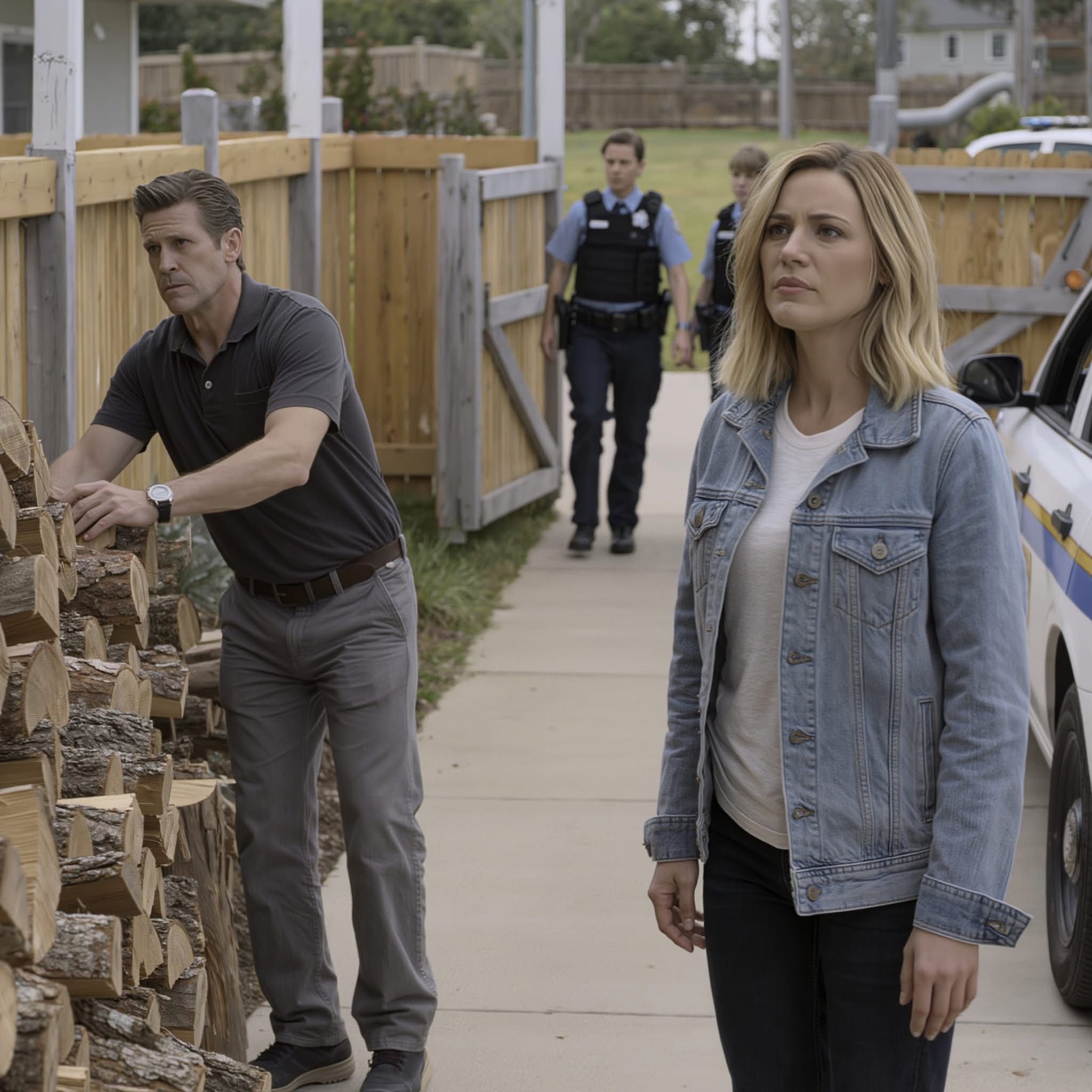
HOA Karen Kept Stealing My Firewood — So I Replaced It with Hollow Logs Filled with Gunpowder!
Some neighborhoods are built on trust. Others are built on rules so thick you can’t see the people underneath. Maple Ridge Estates was the latter—at least until one autumn night when someone’s fireplace roared louder than physics should allow. What happened that evening changed everything: the HOA, the neighbors, and one very confident woman who thought stealing was acceptable as long as it served “community standards.”
This is the story of how a widowed engineer, a tyrannical board president, and a carefully engineered lesson in consequence turned a silent cul-de-sac into something resembling actual community. But I’m getting ahead of myself. Let me start at the beginning, back when my biggest concern was keeping my woodpile stacked and my weekends peaceful.
Part One: The Kingdom of Clipboard and Compliance
I moved to Maple Ridge two years after my wife died. The grief counselor suggested routine. A friend suggested distance. I chose both and found a modest two-story in a subdivision where the lawns looked like they’d been trimmed with surgical instruments and the HOA guidelines ran longer than most insurance policies.
My name is Tom Thompson—widower, freelance mechanical engineer, a man more comfortable with torque wrenches than small talk. I’m fifty-eight, gray at the temples, calloused in the hands, mild in politics but uncompromising about the proper way to organize a tool shed. After Claire passed, the house we’d shared for thirty years felt too big and too quiet, every corner a museum of memories I wasn’t ready to curate.
So I sold it. Packed my tools, my smoker, my collection of half-finished projects, and moved somewhere nobody knew me as “Claire’s Tom” or “the guy whose wife had cancer.” Maple Ridge promised peace through predictability. There were rules about fence height, mailbox color, acceptable shrubbery, and the precise shade of beige your shutters could be. I figured if I followed the rules, people would leave me alone. I was half right.
My backyard became my sanctuary. A vegetable garden that mostly produced tomatoes and good intentions. A smoker built from a salvaged barrel that could make brisket weep. A tool shed organized with the precision of a man who believes chaos can be defeated one labeled drawer at a time. And a woodpile—my pride—stacked each autumn with the geometric satisfaction of Tetris played in three dimensions.
I liked splitting logs. Still do. There’s an honesty to it that people lack. You swing an axe at oak, the oak doesn’t pretend to be pine. It doesn’t argue or manipulate or send you passive-aggressive emails. It splits or it doesn’t, and either way, you know where you stand. In the eighteen months since Claire died, I’d split enough cord wood to heat a small village. Most of it I gave away. The rest I burned slowly, watching flames the way other men watch television.
The neighbors were decent, mostly. The Millers next door—Janet and Bob—baked compulsively and had never met a holiday they couldn’t turn into twelve dozen cookies. They kept me fed through that first winter when I forgot that grocery stores existed and meals were supposed to happen more than once a day.
Old Mr. Jenkins, three houses down, watered his roses at dawn like a man performing a sacred ritual. He’d wave from his garden, shears in hand, and sometimes wander over with cuttings and advice I pretended to understand. “Prune in February, not March,” he’d say, and I’d nod as if I knew what that meant for anything other than roses.
There were others: the Rodriguezes with their fleet of teenagers and a basketball hoop that squeaked like a distressed bird; the Chens who ran marathons and made the rest of us feel personally attacked by their discipline; the Patels whose Diwali decorations made the whole street look like a celebration was happening even when it wasn’t.
For a while, Maple Ridge sounded like sprinklers at six a.m., garage doors sighing closed, the distant bark of dogs negotiating territory, and the occasional shout of children who hadn’t yet learned that volume was a violation of subsection four, paragraph B. It was boring. I liked boring. Boring felt safe.
Then Karen Whitmore bought the colonial two doors down, and boring evacuated the premises.
The Arrival of Authority
Karen was fifty-three, blonde in that aggressive way that requires maintenance and supervision, and possessed a walk that suggested every sidewalk was a personal runway. She dressed like she was perpetually on her way to a deposition: blazers in jewel tones, slacks with creases you could cut yourself on, heels that clicked against pavement with the authority of a gavel.
Within three weeks, she was president of the HOA. I don’t remember an election. I don’t remember voting. But suddenly there were new signs at the subdivision entrance, a glossy newsletter in everyone’s mailbox, and a meeting schedule that felt more aggressive than the previous administration’s annual potluck-and-complaint session.
Karen’s presidency had themes: Accountability. Standards. Excellence. Community Pride. She said these words the way evangelists say “salvation”—as if repetition could make them true. Her first initiative was a “visual compliance audit,” which turned out to be Karen walking the neighborhood with a camera, a clipboard, and the kind of smile that apologizes in advance for the pain it’s about to cause.
I received my first violation notice on a Tuesday.
“Mr. Thompson,” it began, in a font that looked like it charged by the hour. “Your woodpile, while functional, violates community aesthetic standards as outlined in Section 7, Paragraph 12C: ‘Outdoor storage must not be visible from primary street views or disrupt neighborhood visual harmony.'”
I read it twice. Then I walked outside and looked at my woodpile. It sat behind my shed, tucked against the back fence, barely visible unless you stood in the street and craned your neck at an angle that suggested you were looking for problems rather than stumbling upon them.
I called the HOA office. A pleasant woman named Doris answered.
“Hi, this is Tom Thompson. I got a notice about my woodpile?”
“Oh yes,” Doris said, and I could hear the sympathy in her voice. “Mrs. Whitmore has been very thorough.”
“It’s behind my shed. You can’t see it from the street.”
“She mentioned certain angles,” Doris said carefully. “And concerns about symmetry.”
“Symmetry.”
“I’m just reading the notes, Mr. Thompson.”
“It’s firewood, Doris. For burning. In winter. When it’s cold.”
“You have ten days to relocate it or face a $250 fine,” she said, apologetic but official. “I’m sorry. I don’t write the rules.”
I thanked her and hung up. Then I went outside and stared at my woodpile with the confusion of a man being told his shirt offends someone else’s shoes. I didn’t move it. I stacked it tighter, tucked it further behind the shed, and told myself that compliance would satisfy the beast.
It did not.
The Theft Begins
It started subtly, the way most violations of trust do. One morning I looked at the woodpile and thought, “Didn’t that reach higher yesterday?” I blamed my memory. Grief does funny things to perception. You lose track of days, meals, where you put your keys. Why not logs?
But I’ve been an engineer for thirty-five years. My brain counts things automatically: bolts in a jar, tiles on a ceiling, logs in a stack. Two days later, I counted. Twenty logs short. I recounted. Still twenty.
I checked the gate—latched but not locked, because who locks a gate in a subdivision where people walk their dogs at ten p.m. and children sell lemonade on Saturday mornings? I checked the ground. Faint drag marks in the grass. Boot prints, maybe. Hard to tell.
Three nights later, another dozen logs vanished. This time I found a heel print near the back fence—narrow, pointed, pressed into the soft earth beside my tomatoes. Not a sneaker. Not a work boot. A heel. The kind of shoe you wear when you want people to hear you coming.
I installed a motion-sensor light above the shed. The first night it scared a raccoon so badly I felt guilty. The second night it caught nothing. On the third night, at 11:47 p.m., it blazed on like a small sun.
I reached the back window in time to see a figure slip through the gate—medium height, quick movements, a flashlight beam cutting through my yard like an uninvited argument. I saw the glint of something metallic, possibly a zipper, and the unmistakable shape of someone loading logs into their arms with the confidence of a person who believes permission is implied by desire.
In the morning, I checked the pile. Five logs gone. I walked the grass by the gate and found fresh tracks: two heel prints, one sneaker print (probably from steadying), and the faint scrape of something being dragged. I also found something else—a monogrammed scarf, pale blue with the initials K.W. caught on the fence post.
Karen Whitmore. HOA President. Keeper of standards. Thief.
I didn’t confront her. Not yet. Confrontation is a tool best used when you’ve finished measuring. Instead, I went to the hardware store and bought two small outdoor cameras—battery-powered, night-vision-capable, cloud-connected. One went above the shed trained on the woodpile. One went low and hidden near the gate, angled to catch faces.
The setup cost me two hundred dollars and an afternoon. Worth every penny.
The Footage
Two nights later, my phone buzzed at 12:14 a.m. Motion alert. I opened the app and watched in real-time as Karen Whitmore—blazer swapped for a beige coat, heels swapped for boots, but unmistakably her—crept through my backyard gate with a flashlight and a canvas bag.
The camera captured everything in crisp, accusatory detail. She surveyed the woodpile like a prospector evaluating a claim. She selected logs carefully, testing their weight, rejecting a few, loading others. At one point, she turned directly toward the camera, and the night vision caught her face in full: calm, entitled, faintly bored, as if stealing firewood was a chore she’d added to her evening routine between flossing and checking email.
She whispered to herself—I turned up the volume later and heard it clearly: “He won’t miss it. It’s for the community anyway.”
The community. That word again. Any time someone uses “community” to justify taking what isn’t theirs, you know you’re dealing with a particular kind of tyrant—the kind who believes righteousness is a permit.
She made three trips, loading logs into the back of her SUV. The license plate was visible in the second clip: vanity plates reading “PREZH0A.” Subtle.
I saved the footage to three separate drives and the cloud. Then I went back to bed and slept better than I had in weeks.
The Community Meeting
The monthly HOA meeting happened to fall two days later. I’d never attended—listening to neighbors argue about the acceptable height of ornamental grasses sounded like a uniquely modern form of torture. But that afternoon, I marked my calendar, ironed a shirt, and arrived early.
The clubhouse was beige and generic, the kind of room designed to host both wedding receptions and municipal hearings without committing to joy or justice. Folding chairs, fluorescent lights, a folding table at the front with three chairs and a gavel that looked like it had never been used.
Karen sat in the center, flanked by Doris (looking uncomfortable) and Mrs. Beasley, the treasurer, a woman whose face suggested she’d been auditing moral failures since the Eisenhower administration. Karen had a mug that read “BOSS LADY” in glittering letters and a smile that could’ve stripped paint.
I took a seat in the front row. She noticed. Her smile tightened.
“Welcome, everyone,” she began, rapping the gavel once. “Tonight we have several matters to address, beginning with continued non-compliance issues.”
I raised my hand.
“Yes, Mr. Thompson?” she said, sweet as poisoned honey.
“Just a question. When you documented my woodpile this week, did you happen to observe any unusual activity?”
Her smile flickered. “I’m not sure what you mean.”
“Strange,” I said pleasantly. “Because I documented unusual activity. Someone’s been stealing my firewood. Caught them on camera. Funny thing—looked a lot like you.”
The room went silent in that delicious way that happens when scandal is about to be served. Karen’s face cycled through expressions: confusion, anger, dismissal, calculation.
“That’s absurd,” she said.
“Is it?” I pulled out my phone. “Would the board like to see the footage?”
Mrs. Beasley leaned forward, suddenly interested. Doris looked like she wanted to disappear. Karen stood, voice sharp. “Cameras are a violation of privacy.”
“Not when they’re on my property, facing my property, catching people trespassing on my property.” I held up the phone. “Want to watch? The part where you said ‘it’s for the community’ is particularly compelling.”
“This is harassment,” she hissed.
“This is documentation,” I said. “Would you like me to call the police, or shall we handle this internally?”
She grabbed her purse and her gavel and stormed toward the door, pausing just long enough to point a finger at me like a malfunctioning compass. “You’ll regret this.”
The door slammed. The room exhaled. Mrs. Beasley adjusted her glasses. “Well,” she said slowly, “that was illuminating.”
A retired attorney named Wilson, who’d been silent in the back row, raised his hand. “I believe we’ll need an emergency session to discuss board conduct. Mr. Thompson, would you be willing to share that footage with the board?”
“Happily,” I said.
The meeting adjourned. Neighbors clustered around me, some curious, some supportive, some just thrilled to have witnessed HOA drama that didn’t involve them. Janet Miller handed me a cookie. “Tom,” she said, grinning, “you just became a legend.”
“I just want my firewood back,” I said.
“You’re getting way more than that,” she said.
Part Two: The Education
For three days, silence. No letters. No violations. No midnight flashlight patrols. I almost missed the predictability of her tyranny.
Then a new citation appeared on my door: “Outdoor security cameras visible from street view; violation of privacy standards and aesthetic guidelines.”
I laughed so hard I had to sit down. She’d been caught stealing and her response was to fine me for the cameras that caught her. It was breathtaking in its audacity—like being mugged and then receiving a bill for the inconvenience of being robbed.
Fine, I thought. If documentation doesn’t teach the lesson, perhaps demonstration will.
I should explain something about myself. I’ve spent thirty-five years designing mechanical systems: industrial equipment, safety mechanisms, automated shut-offs. My career has been a long negotiation with physics, chemistry, and the fundamental principle that actions have consequences. I don’t design things to harm people. I design things to work predictably, to fail safely, and occasionally, to educate.
In my workshop, buried under old blueprints and a half-built bookshelf, I found three decoy logs—a winter project from years ago when Claire thought we should make decorative “fire logs” for people who didn’t have fireplaces. I’d bored them out with a lathe, capped them with real bark, made them light enough to carry but convincing enough to fool a casual inspection.
Perfect.
I spent an afternoon modifying them. Inside each hollow log, I placed a small pyrotechnic charge—nothing dangerous, no shrapnel, no incendiary potential. Think of those novelty fireworks that make a loud bang and a lot of smoke but couldn’t hurt you if you held them in your hand. I sealed them carefully, tested the timing, ensured the reaction would be contained, noisy, and smoky but fundamentally harmless. The goal wasn’t injury. The goal was consequence—loud, unavoidable, and educational.
I marked the decoy logs subtly on the ends with a small notch, then added them to the top of my woodpile, arranged just so. Then I waited.
Two nights passed. On the third, at 11:52 p.m., my phone buzzed. Motion alert. I opened the app and watched Karen Whitmore return to the scene of her ongoing crime, flashlight in hand, canvas bag ready.
She examined the pile, selected logs, loaded her bag. Two of my decoys made it into her collection. She returned for a second load. The third decoy joined the others. She whispered something I couldn’t make out, closed her SUV hatch, and drove away into the night.
I turned off my phone and poured a glass of bourbon. Then I waited.
The Incident
Maple Ridge settles early. By nine p.m., most houses are winding down—kids in bed, dishes drying, televisions murmuring the evening news like prayers to a secular god. I was watching a MythBusters rerun—something soothing about Adam and Jamie testing whether you could polish a turd (you could, sort of)—when the first boom rolled through the neighborhood.
It wasn’t a window-rattling explosion. It was more like someone dropped a bass drum down a stairwell—deep, percussive, surprising. Dogs started barking in that panicked key that suggests the apocalypse might be scheduled but nobody told them when.
I muted the TV. Ten seconds later, another boom, slightly louder, followed by a woman’s shriek that could’ve curdled fresh milk.
I put on my jacket and walked outside. Half the street was already emerging—porch lights flicking on, people in bathrobes, someone’s teenager filming on their phone because this generation documents everything.
Smoke was pouring from Karen’s chimney. Not the gentle white wisp of a cozy fire. This was thick, black, angry smoke—the kind that suggests something inside has gone very wrong very quickly. It rolled out of the flue, coughed from the bricks, and fogged her front windows like the house itself was embarrassed.
Her front door flew open. Karen stood there in a bathrobe that used to be white, hair pointing in directions previously unknown to physics, holding a dish towel and looking like someone who’d just had a conversation with consequences and lost.
“FAULTY FIREWOOD!” she screamed to nobody in particular. “This is NEGLIGENCE!”
A small crowd had gathered. Mr. Jenkins stood at the curb in his slippers, grinning like a man who’d outlived three wars and knew poetic justice when he saw it. The Millers clutched each other, trying not to laugh. The Rodriguez teenagers recorded everything with the efficiency of documentary filmmakers.
A fire truck arrived—no sirens, just lights, because the smoke was subsiding and nobody had actually called 911 for fire, just for “weird explosions.” A young firefighter, trying very hard to maintain professional composure, approached Karen.
“Ma’am, are you injured?”
“NO. But my FIREPLACE—”
“What were you burning?” he asked, glancing at the chimney.
“Wood. Just wood. Normal wood.”
“Where’d you get it?”
She froze. The crowd leaned in. This was the moment. She could confess, redirect, or lie. She chose option four: blame.
“I didn’t buy it,” she said, which was technically true and tactically catastrophic.
The firefighter’s eyebrows rose. “You didn’t buy it.”
“I—sourced it. Locally.”
“Locally,” I repeated from the edge of the crowd. “Locally like…from someone’s backyard?”
Every head swiveled toward me. Karen’s face cycled through the stages of grief at high speed: denial, anger, bargaining, depression, and a desperate attempt to skip to acceptance.
“You did this,” she hissed. “You booby-trapped firewood!”
“Careful,” I said mildly. “You just admitted the wood came from me. That’s called theft. Officer Ramirez might be interested to know.”
Officer Ramirez, who had arrived moments earlier looking like a man who regretted his career choices, stepped forward. “Mrs. Whitmore, did you take wood from Mr. Thompson’s property?”
“It was—he wasn’t using it—the community—”
“So yes,” Ramirez said, pulling out a notepad with the resigned patience of a man who has heard every excuse. “Mr. Thompson, you have footage?”
“Timestamped, high-definition, cloud-backed-up footage,” I said, handing him my phone. “Feel free.”
He watched in silence. The screen glow reflected off his badge. He sighed the sigh of a man who has to explain basic morality to adults.
“Ma’am, this is trespassing and theft. I’m issuing a warning. If there are further incidents, we’ll be filing formal charges. Clear?”
She looked at me with a hatred so pure it could’ve powered a small city. “This isn’t over.”
“Yeah,” I said. “It is.”
Part Three: The Reckoning
The fire inspector arrived the next morning, clipboard ready, official as death. He examined the chimney, interviewed Karen, poked through the fireplace remains with the focus of a man who’s seen stranger things but not by much.
His report was brief and beautiful: “Logs contained trace pyrotechnic material—fireworks-grade flash powder. Loud, smoky, theatrical. Designed for noise and spectacle, not harm. Consistent with novelty fireworks. No structural damage. No injuries.”
He handed a copy to Karen, to Officer Ramirez, and to the HOA board. “Basically,” he told the small crowd that had gathered because news travels fast in a subdivision, “someone lit fireworks in a fireplace. Scared more than hurt. Bad idea, but not illegal if the fireworks are legal.”
“But he PLANTED them!” Karen shouted, mascara running, dignity fleeing.
“In his own woodpile,” the inspector said. “Which you took. Without permission.”
Even Mrs. Beasley winced.
That afternoon, I received a call from Wilson, the retired attorney who’d been quiet during Karen’s reign. “Tom, the board is calling an emergency meeting. Tomorrow, seven p.m. We’re voting on Karen’s removal as president. Your attendance is requested.”
“I’ll be there,” I said.
The clubhouse was packed. People who hadn’t attended a meeting in years showed up like it was the season finale of their favorite show. The Millers brought popcorn. Mr. Jenkins brought his lawn chair. Someone’s teenager streamed it on the neighborhood Facebook group.
Karen sat at the head table, flanked by Doris (who looked like she wanted to be anywhere else) and Mrs. Beasley (who looked like she’d discovered moral clarity at the worst possible time). Karen’s “BOSS LADY” mug was conspicuously absent.
Wilson stood. “Mrs. Whitmore, this board has received multiple complaints regarding conduct unbecoming of an HOA president. Specifically: trespassing on a resident’s property, theft of personal belongings, and abuse of presidential authority to retaliate against said resident.”
“This is a coup,” she said.
“This is Roberts Rules of Order,” Wilson said. “Mr. Thompson, please present your evidence.”
I connected my phone to the TV. The room watched in rapt silence as Karen crept through my backyard, selected my logs, whispered “it’s for the community,” and drove away. When the video ended, nobody spoke.
“Any defense?” Wilson asked.
“He provoked me,” she said weakly.
“By having firewood,” I said.
“All in favor of removing Mrs. Whitmore as HOA president?” Wilson asked.
Hands rose. Slowly at first, then faster. Doris. Mrs. Beasley. The Millers. The Chens. Mr. Jenkins raised both hands. Even people I didn’t know raised their hands like they’d been waiting years for this exact moment.
“Motion passes,” Wilson said. “Mrs. Whitmore, you’re relieved of duty effective immediately.”
She grabbed her purse and her dignity, or what remained of it, and marched toward the door. “You’ll hear from my lawyer!”
“No we won’t,” Wilson said kindly.
The door slammed. The room erupted in applause. Someone started chanting “TOM! TOM! TOM!” which was mortifying but also kind of nice.
Part Four: The Aftermath
Peace returned to Maple Ridge, but not the fearful, rule-bound peace of Karen’s reign. This was the louder, messier peace of actual community.
Wilson took over as HOA president with the enthusiasm of a man organizing a neighborhood, not a dictatorship. He reformed the bylaws: fewer fines, more common sense, rules that explained themselves like adults. The summer barbecue—banned under Karen for “smoke visibility concerns”—returned as a monthly tradition. They named me honorary grill master, which felt like poetic justice seasoned with irony.
Karen, meanwhile, did not go gently. She planted protest signs in her yard: “FRAUDULENT VOTE.” “UNSAFE NEIGHBORHOOD.” “THOMPSON’S FIREWOOD IS A CHEMICAL WEAPON.” I passed them every morning on my walk, admiring the commitment if not the accuracy.
The signs disappeared after Wilson reminded her of a rule she herself had written about obstructing community views. Watching a tyrant fall to their own legislation is a particular kind of satisfaction.
She lasted three more months before the FOR SALE sign appeared. The neighborhood watched her departure with the fascination usually reserved for meteor showers or visiting celebrities. The day the moving truck arrived, half the street found reasons to be outside—walking dogs, checking mail, watering plants that didn’t need watering.
As she drove away, she paused at my curb and rolled down her window. “You haven’t seen the last of me.”
“If I do,” I said, raising my coffee mug, “I’ll install another camera.”
She floored it. Mr. Jenkins started clapping. Then everyone did.
Part Five: Embers and Lessons
A year passed. The new residents—a retired couple named the Hoffmans—moved into Karen’s old house. They were kind, quiet, and thrilled to live somewhere “with such a friendly neighborhood.” When they asked about the stories, I told them the highlights, leaving out the specific chemistry of consequence.
My backyard became the neighborhood’s unofficial gathering place. Friday nights, we’d circle the fire pit I’d built—wider now, ringed with stone, surrounded by benches I’d made from salvaged wood. Wilson brought wine. Beasley brought her famous potato salad and a much better sense of humor. The Millers brought brownies that could make atheists religious. Mr. Jenkins brought rose clippings for anyone who seemed lonely.
We didn’t talk about Karen unless someone new asked, and then we’d tell the tale like folklore: the woman who stole firewood and learned that consequences burn hotter than oak.
One Saturday afternoon, I was in the workshop when a familiar voice drifted through the gate. “Still playing with fire, I see.”
I turned. Karen stood there, smaller somehow, hair different, sunglasses large enough to hide behind. She wore exhaustion like an old coat.
“The new owners said I could grab some things from storage,” she said.
“Sure. I’ll walk you back.”
We crossed the yard in silence. She glanced at the fire pit, the new benches, the neighbors laughing in the distance. “You made it nicer.”
“Easier when nobody’s threatening to fine me for existing.”
She paused at the shed. “I wasn’t trying to be cruel. I wanted order.”
“People don’t need order,” I said quietly. “They need respect.”
She looked like she wanted to argue. Then she didn’t. “Maybe,” she said.
On her way out, she paused. “They call me ‘HOA Karen’ online. Someone made a meme.”
“Internet’s undefeated,” I said.
“Take care, Tom.”
She left quietly. That was the miracle: she’d finally found an exit that didn’t require drama.
That night, the neighborhood gathered again. Wilson raised his glass to peace and better rules. Someone toasted “the Great Firewood Incident.” Everyone laughed—the genuine kind that clears the air.
I watched the sparks rise like small, brave stars and tried to name the feeling: satisfaction, relief, but also something gentler. Balance. The sense that respect, once stolen, can be restored through persistence, proof, and once—in this neighborhood—through a very loud reminder that everything burns hotter when it’s stolen.
People still ask if I regret it. Here’s my answer: I don’t regret the lesson. I regret it had to be taught.
If you visit Maple Ridge today, you’ll find kids racing bikes without fear of citations. You’ll find the Millers arguing about recipes, Jenkins fussing over roses, and neighbors who remember that rules serve people, not the other way around.
You’ll find a retired engineer in his backyard, stacking firewood the old-fashioned way—solid, honest, ready for winter. Every so often someone new asks for the story, and I tell it, leaving out the blueprints and measurements that don’t matter anymore.
I say: once there was a woman who thought rules were weapons. Once there was a street that forgot it was a village. Once there was a man who just wanted to be left alone. And then there was noise, and smoke, and truth, and finally, a quieter kind of order that looks a lot like trust.
The embers in my fire pit glow like heartbeats. The neighborhood breathes. I close the gate, check the latch, and head inside to a house that’s finally starting to feel like a home again.
On my kitchen chalkboard, where Claire used to write grocery lists in her firm hand, I wrote a note to myself:
Mind your own yard. Respect your neighbor’s. And for the love of peace, don’t steal another man’s wood—literal or otherwise.
THE END