The sky over Sulphur Mountain was orange at four-fifteen in the morning. Not sunrise orange. The other kind. I’ve lived in the hills above Santa Paula, California, for forty-four years, and I know the difference.
I was standing in my barn in my nightgown and my muck boots with a flashlight, and the wind was coming down the canyon so hard it was making the whole barn moan, the way it does in a Santa Ana, hot and dry, like somebody left an oven door open in the sky. You could smell it. That smell, if you’ve lived out here, gets into your bones. Burning brush and burning oak and something underneath it, sharp, that you don’t want to think about.
My three horses were pacing in their stalls, kicking the boards. Sugar, my old palomino mare, twenty-six years old, was standing with her head up and her nostrils wide, staring out the barn door toward the ridge. She’d smelled it before I had. She’d been calling for an hour. That’s what woke me up.
My phone went off in my hand. That long ugly tone they send out. EVACUATION ORDER. PINYON CANYON ROAD AND ALL ROADS NORTH. LEAVE NOW.
My son Toby was standing in the barn doorway behind me in his Dodgers pajamas, holding his pillow.
“Mom,” he said. “Is it a fire?”
“It’s a fire, honey.”
“Is it coming to our house?”
“I don’t know yet,” I said. “Go put your shoes on. Your real shoes. And your jacket. The red one. Right now.”
He went. Toby always does what you tell him when it matters. He’s thirty-eight, and he has Down syndrome, and he’s lived with me his whole life, and he’s the best person I know.
I’ll tell you about the trailer now, because you need to understand about the trailer.
My name is Diane Whitlock. I’m seventy-one. My husband Glenn and I bought eleven acres at the top of Pinyon Canyon Road, six miles up from Santa Paula, in 1981, with a little ranch house and an old hay barn and a spring. Glenn was a farrier. He shod horses for half of Ventura County for forty years. I was a trail guide and a packer. For twenty-two years, I led strings of mules and horses into the backcountry of the Los Padres National Forest for an outfitter in Ojai. Hunters, fishermen, Boy Scout troops, a movie crew once. I know every fire road and every trail and every spring in those mountains between here and Lockwood Valley. Or I did, before my knees.
Glenn died in 2021. His heart. He was shoeing a horse at a ranch in Fillmore and he set the hoof down and sat on his bucket and said, “Well, that’s that,” and that was that.
Glenn’s younger brother is Kurt. Kurt is sixty-six. He lives two miles down the canyon from me, on fifteen acres, in a big new stucco house with a three-car garage and a pool and a barn twice the size of mine. He sold commercial real estate in Ventura for thirty years and did well at it. He has two horses he doesn’t ride much, a pair of fancy Quarter Horses, and he likes people to know what they cost.
I should tell you about Biscuit, too. We got him for Toby’s eighth birthday, in 1995, from an old man in Fillmore who was going into a nursing home and couldn’t keep him. He was already about seven then, a scruffy little gray thing with a stubborn streak. The doctors had told us Toby might never have the balance to ride. Glenn said, “Let’s just let him sit on it, then.” So we did. Toby sat on Biscuit in the round pen every single day that summer, holding onto the mane, while Glenn led him around in circles. By September, Toby could sit there without holding on. By Christmas, he was laughing the whole time. The physical therapist said she’d never seen anything do for a child’s balance what that pony did. Biscuit’s been Toby’s best friend for thirty years. When Glenn died, Toby slept in the barn in Biscuit’s stall for three nights in a row before I could get him back in the house.
And he has a horse trailer.
In 2019, Kurt came to Glenn and said he wanted to buy a new truck and a new four-horse slant-load trailer, a big aluminum one with living quarters in the front. He’d had a bad year in real estate. His money was tied up. He was short. He asked Glenn for twenty-eight thousand dollars. Glenn said yes, because Kurt was his baby brother and Glenn would have given him his own kidney. Glenn had him sign a promissory note at our kitchen table, on a sheet of yellow legal paper, because Glenn’s father always said you put money on paper or you lose it and your brother both. Kurt would pay it back at five hundred a month.
He paid four hundred dollars, total. Then Glenn died. And Kurt never mentioned it again.
I never asked. I want to be honest. I was grieving, and then I was busy, and then it felt too late. The note was in the top drawer of Glenn’s rolltop desk, where he’d put it. I knew it was there. I just didn’t take it out.
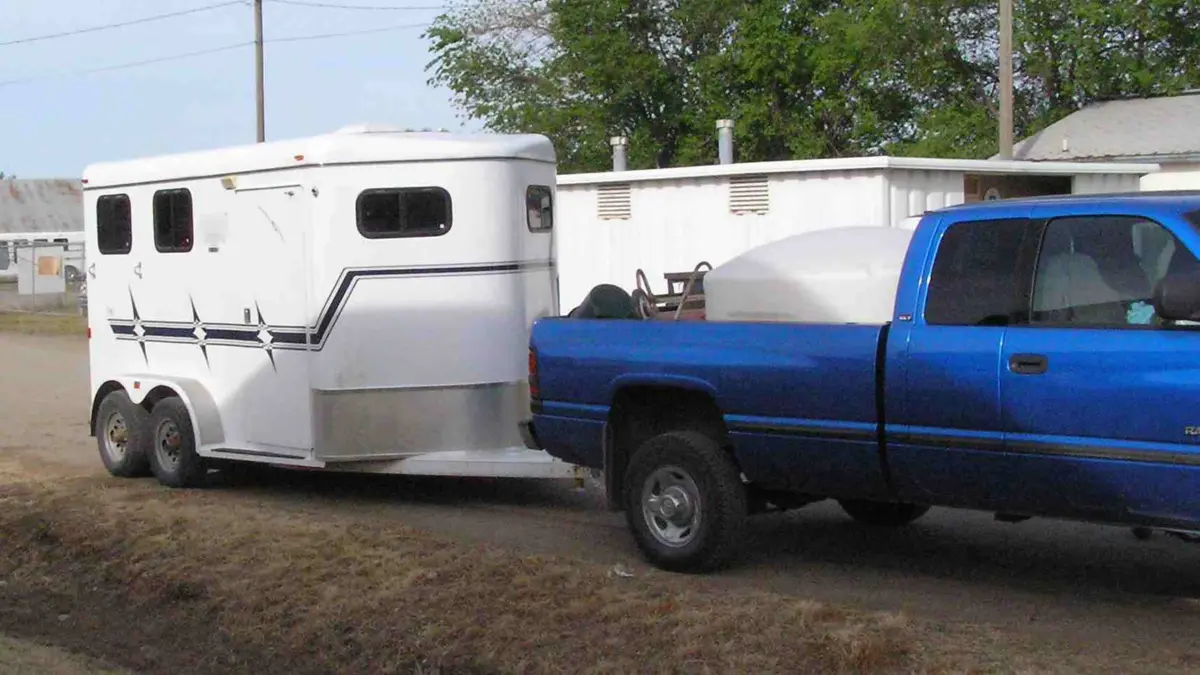
That trailer sits in Kurt’s driveway, white and shiny, with four stalls. Four.
We’d had a fight, Kurt and me, at Thanksgiving. Two days before.
He’d come up to my house for dinner, like he does every year, because his wife left him in 2015 and he doesn’t have anywhere else to go, and because Toby loves him. Toby calls him Uncle Kurtie. Kurt hates it and lets him.
After dinner, Kurt stood in my kitchen and looked out the window at my horses and said, “Diane, you’ve got to get rid of those animals.”
“Why would I do that?”
“Because you can’t take care of them. Look at you. Your knees are shot. Toby can’t do it. Glenn’s gone. That old mare is twenty-six years old. She ought to be dog food. And that pony of Toby’s is useless. You’re spending, what, six hundred a month on hay for three horses nobody rides?”
“Toby rides Biscuit every day.”
“Toby walks Biscuit around the round pen on a lead rope. That’s not riding.” He shook his head. “You’re living in a fire zone, Diane. On a dead-end canyon. With three horses and no trailer. Glenn’s old two-horse is rusted through. If a fire comes, what are you going to do? Lead them down the road on a rope?”
“Maybe I will.”
“You’ll get yourself killed,” he said. “And Toby too. Sell them. I know a man in Oxnard who’ll take the two old ones for meat and give you three hundred apiece.”
I asked him to leave. He did. He took a plate of pie.
That was Thursday.
On Saturday morning at four-fifteen, the sky over Sulphur Mountain was orange.
I’d heard about the fire the evening before. It had started in the afternoon, somewhere over toward Ojai, when the Santa Anas came up. A power line, they said later. By midnight it had jumped Highway 150. By four in the morning, the wind had swung around and was pushing it straight across the top of Sulphur Mountain, toward our canyon.
There’s one road out of Pinyon Canyon. One. Pinyon Canyon Road. Six miles of two-lane blacktop with switchbacks and no shoulder, winding down through the oaks and the avocado groves to Highway 126 in Santa Paula. Every house in the canyon, about forty of them, has to come down that road. Every car. Every truck. Every trailer.
My two-horse trailer, Glenn’s old one, had been sitting behind the barn with flat tires and a rusted-through floor since 2022. It couldn’t haul a sack of feed.
I called Kurt.
It was four-twenty in the morning. He answered on the second ring. He was already up. I could hear his diesel truck running in the background, and horses banging around in a trailer.
“Kurt,” I said. “It’s coming over the mountain. I’ve got an evacuation order. I need your trailer. Can you come up and get my three on your way down? You’ve got four stalls. You’ve only got two horses.”
“Diane, I’m loading right now. I’m pulling out in five minutes.”
“Then come up first. It’s two miles. Ten minutes. Please.”
There was a pause.
“I’m not driving up that canyon into a fire to get your animals, Diane.”
“It’s not in the canyon yet. It’s on the ridge. You’ve got time. Kurt, please. You’ve got two empty stalls.”
“I’ve got my own horses to worry about. Those are twenty-thousand-dollar horses. I’m not risking them on a second trip up a dead-end road for a twenty-six-year-old mare and a pony that ought to be in a can of dog food.” He was yelling now, over the truck. “I told you on Thursday. I told you to get rid of them. You wouldn’t listen. You never listen. Nobody in that family ever listened to me.”
“Kurt. Glenn paid for that trailer.”
That stopped him. For about two seconds.
“Don’t,” he said. “Don’t you dare bring Glenn into this right now.”
“Twenty-eight thousand dollars, Kurt. He gave it to you. He’d have come up here for your horses in a heartbeat. You know he would.”
“Glenn’s dead, Diane. And I’m not him. Turn them loose. Open the gates and let them run. The fire department’ll round up whatever’s left. That’s what everybody does.”
Behind me, in the barn, Toby had come back. He had his red jacket on, zipped all the way up, and his sneakers on the wrong feet. He was standing by Biscuit’s stall with his hand through the bars, petting Biscuit’s nose. Biscuit’s a little gray pony, about thirty years old, the size of a big dog, that we got for Toby when he was eight. Toby’s been taking care of him for thirty years. He brushes him every single morning. He tells him about his day.
Toby had heard me on the phone. He’d heard me say Kurt’s name.
“Is that Uncle Kurtie?” he said. “Is he coming with his big trailer?”
I didn’t answer.
“Mom. Ask him to bring the trailer for Biscuit. Biscuit is scared. Look at him. He’s shaking.”
Biscuit was shaking. All three of them were. Sugar had started to sweat, dark patches on her gold neck.
I held the phone out a little, so Kurt could hear.
“Uncle Kurtie,” Toby yelled at the phone. “Please come get Biscuit! He’s scared! He’s my best friend!”
Silence on the phone.
Then Toby looked at me with his big round eyes behind his glasses.
“Mom,” he said. “Why won’t Uncle Kurtie help Biscuit? He has a trailer. I helped him wash it. In the summer. Remember? I washed the whole thing. Why won’t he help?”
I didn’t know what to tell him. I’ve never once lied to Toby. Not in thirty-eight years.
I put the phone back to my ear.
“Kurt,” I said. “Did you hear him?”
“I heard him.” His voice had gone quieter. But it didn’t change. “Diane, I’m sorry. I’m leaving now. Turn them loose and get Toby in your car and get out of that canyon. That’s the only thing that matters. Do you understand me?”
“Understood,” I said.
And I hung up.
I stood there in my barn for maybe ten seconds. That’s all I gave myself. Ten seconds.
Then I looked at the three of them in their stalls. Sugar, and Rooster, Glenn’s old sorrel gelding, who’s twenty-two and blind in one eye, and Biscuit. And I looked at Toby, petting Biscuit’s nose through the bars, in his red jacket, with his shoes on the wrong feet.
And I thought about something Kurt had said on Thursday.
Lead them down the road on a rope?
Not the road. That road was going to be a parking lot in about twenty minutes, with forty families trying to get down it at once, in the dark, in the smoke. I’d seen it happen in the Thomas Fire in 2017. People were stuck on that road for two hours.
But I’d spent twenty-two years leading strings of animals through these mountains. And I knew something Kurt didn’t know, because Kurt has never once set foot on a trail in his life.
There’s an old fire road. It runs off the back of my property, past the spring, along the west side of the canyon, and down the ridge to the old county road above Steckel Park. The Forest Service cut it in the 1950s. Nobody uses it anymore. It’s gated at the bottom and grown over in places with chamise and sumac. But it’s there. Glenn and I used to ride it on Sunday mornings. Four miles, down the west ridge, away from the fire, which was coming from the north and east. It comes out at the bottom, at a locked Forest Service gate. And I have a key to that gate, on my key ring, from my packing days, that nobody ever asked me to give back.
Glenn found that fire road the first summer we lived here, in 1981, riding a young horse he was trying to get some miles on. He came home grinning like a kid and said, “Di, you’ve got to see this.” Every Sunday morning after that, for forty years, unless it was raining or one of us was sick, we saddled up before sunrise and rode it. Down the west ridge to the gate and back up. Two hours. We’d stop at the overlook at the halfway point, where you can see all the way to the ocean on a clear day, and he’d pour coffee out of a thermos into the lid and we’d share it. We talked about everything on that road. Money. Toby’s doctors. His father. Whether to sell. Whether to stay. Every big decision of our marriage, we made on that fire road, on a Sunday morning, passing a thermos lid back and forth.
After he died, I couldn’t make myself ride it. I tried once. I got as far as the spring and turned around.
“Toby,” I said. “Fix your shoes. Wrong feet. Then get your helmet. The riding one.”
“Are we going in the car?”
“No, honey. We’re going on the horses.”
He looked at me. His face lit up. Toby’s face lights up like nobody’s.
“Biscuit’s coming?”
“Biscuit’s coming.”
I’ll tell you how it went. It’s the most important morning of my life, and I want to tell it right.
I didn’t have time to do it properly. I’m seventy-one, and my knees are shot, just like Kurt said. I put a halter on Rooster and a halter on Biscuit, and I tied wet bandanas over both their eyes, loose, the way you do in smoke, so they wouldn’t spook at the glow. I put my old packsaddle bridle on Sugar, and Glenn’s saddle, the one he rode the backcountry in. It took me three tries to get it up on her back. I tied a wet bandana over my own nose and mouth, and one over Toby’s.
I put Toby on Biscuit. Biscuit’s small enough that Toby can almost touch the ground with his feet, which is why we got him. Toby’s been sitting on that pony for thirty years. He can’t really ride. But he can sit. He can hold on. And Biscuit will follow Sugar anywhere. He always has.
I tied Rooster’s lead rope to Sugar’s saddle horn, and Biscuit’s to Rooster’s, in a string, the way I used to string mules. Nose to tail. Sugar in front, then blind Rooster, then Biscuit with Toby on him.
Then I climbed up on a hay bale and got myself up on Sugar. I hadn’t been on a horse in three years. My left knee screamed. I didn’t care.
I put Glenn’s emergency bag on the saddle. His canteen. My key ring. My phone. My cash. My purse. Glenn’s rolltop desk was in the house, and the yellow legal pad in the top drawer, and every picture of our wedding, and Toby’s baby book. I didn’t go back for any of it. There wasn’t time.
At 4:41 in the morning, I opened the back gate of my property, behind the barn, past the spring, and the three of them and Toby and I went through it onto the old fire road in the dark, with the sky behind us glowing orange over the top of the ridge and the wind howling and ash coming down like snow.
Down on Pinyon Canyon Road, through the trees, I could already see the headlights. A long string of them. Not moving.
I’ll tell you about that ride another time. I can’t tell it all. I’ll tell you that Sugar never put a foot wrong in four miles in the dark. I’ll tell you that she knew every turn of that fire road better than I did, from all those Sunday mornings with Glenn, and that I mostly just let the reins go slack and held onto the horn and let her take us down. I’ll tell you that blind Rooster walked so close behind her that his nose was touching her tail the whole way, because that’s how he follows. I’ll tell you that Toby sang the whole time, at the top of his voice, behind his bandana. “Take Me Out to the Ball Game.” Over and over. Because that’s what he sings when he’s scared. And Biscuit’s ears were turned back the whole time, listening to him.
I’ll tell you that once, about halfway down, at the top of a switchback, Sugar stopped dead. She threw her head up and blew through her nose and wouldn’t take another step. I kicked her. She wouldn’t move. I almost got off to lead her. And about ten seconds later, a whole burning oak branch the size of a car came down across the trail thirty feet in front of us, out of the dark, blown down from the ridge, with sparks flying off it everywhere. If she’d kept walking, we’d have been under it.
She stood there and let it burn down a little. Then she picked her own way around it, through the brush on the downhill side, one careful foot at a time, with Rooster’s nose on her tail and Biscuit behind him and Toby still singing.
At 6:20 in the morning, it was getting light, a sick brown light through the smoke, and we came down the last switchback to the old Forest Service gate at the bottom.
There were two fire engines parked right below it, on the old county road, and a crew of firefighters in yellow, cutting a line. A young fire captain looked up and saw us coming out of the smoke down that fire road. An old woman on an old palomino with a blind gelding and a gray pony strung behind her, and a man in a red jacket and a riding helmet, singing “Take Me Out to the Ball Game.”
He stood there with his mouth open.
I got my key ring out of my pocket. My hands were shaking so bad I dropped it in the dirt. The fire captain came up and picked it up and handed it to me. I found the key. Forest Service gate key, number 4, from 1994. I put it in the lock.
It turned.
“Ma’am,” the fire captain said. “Where in the world did you come from?”
“Pinyon Canyon,” I said. “The top.”
“The top? The road’s jammed solid from the bottom to the top. We’ve got people stuck up there that we can’t get to. We’re about to start bringing them down on foot.”
“I didn’t take the road,” I said.
He looked up at the fire road, disappearing into the smoke behind me. He looked at Sugar, all white with lather and ash. He looked at Toby.
“Ma’am,” he said. “Nobody’s used that fire road in thirty years.”
“I know,” I said. “That’s why it was empty.”
They took us to the Ventura County Fairgrounds, where they were taking evacuated animals. A woman from a horse rescue in Moorpark met us there with a trailer for the last two miles. There were a hundred horses in the fairgrounds barns by noon. Goats. Chickens. A llama. Somebody’s pig. Volunteers with hoses and hay. Toby helped them all day. He brushed every horse they’d let him brush. He told every one of them about Biscuit.
That night, they let evacuees sleep in their cars in the fairgrounds parking lot, or on cots in the exhibition hall. I couldn’t leave the horses. A volunteer brought me a folding chair and a blanket, and I sat in the aisle outside their stalls all night with the barn lights on, listening to a hundred animals shift and stamp and breathe. Toby fell asleep on a pile of hay bales next to Biscuit’s stall, in his red jacket, with his helmet still on, and I didn’t have the heart to wake him and take it off.
About two in the morning, I started to cry. I hadn’t cried all day. I didn’t know yet if my house was gone. I didn’t know about the barn. I was thinking about Glenn, and the thermos lid, and how many Sunday mornings I’d turned around at the spring.
Toby woke up. I don’t know how. He came and sat down on the concrete next to my chair and put his head on my knee, the bad one, and patted my leg the way he pats Biscuit’s neck.
“Mom,” he said. “Dad would say good job.”
“You think so, honey?”
“Dad would say, ‘Di, that was a hell of a ride.'” He said it in Glenn’s voice, exactly. He’s always been able to do Glenn’s voice. “He’d say hell. I’m not allowed. But he’d say it.”
I laughed so hard I woke up the llama.
Here’s what happened to Kurt.
He told me himself, later, so I know it’s true.
He’d pulled out of his driveway at 4:25 with his two Quarter Horses in that four-horse trailer. Two empty stalls. By the time he got to the first switchback below his house, the road was stopped. Cars and trucks and trailers, bumper to bumper, as far as he could see, all the way down the canyon. Somebody’s car had stalled on the narrowest switchback, and a horse trailer had jackknifed trying to get around it.
Kurt sat in that line for two hours and forty minutes. In the dark. With the fire coming down the ridge on his right, close enough that he could see the flames through the trees and feel the heat through his windshield. His horses screamed and kicked the walls of that trailer the whole time. One of them, his sorrel gelding, the twenty-thousand-dollar one, kicked so hard he went down in the trailer and got a leg stuck under the divider and couldn’t get up.
The fire department finally cleared the switchback a little before seven. Kurt got to the fairgrounds at 8:10, an hour and fifty minutes after I did. His sorrel had a gash on his hind leg that took eighteen stitches. The vet said he’d be all right. Kurt sat on an overturned bucket outside the stall while the vet stitched it and didn’t say anything for a long time.
When he finally looked up, he saw Toby, across the barn aisle, brushing Biscuit.
Biscuit didn’t have a scratch on him. Neither did Sugar, or Rooster. Just ash.
Toby saw Kurt. He waved the brush at him.
“Uncle Kurtie!” he yelled. “Uncle Kurtie, we rode! Down the mountain! Mom knew a secret road! Biscuit wasn’t even scared!”
Kurt looked at Toby for a long time. Then he looked at me, sitting on a hay bale next to Sugar with a bottle of water a volunteer had given me.
He didn’t say anything. He just put his face in his hands.
Here’s the rest.
The fire burned eleven thousand acres. It burned fourteen houses in Pinyon Canyon. Mine wasn’t one of them. Three engine companies from Oxnard made a stand at the top of my road and saved four houses up there, and mine was one, though they couldn’t save my barn. The barn burned to the ground. Glenn’s old two-horse trailer, the one with the rusted floor, melted where it sat.
The house was fine. Smoke damage. A broken window. Glenn’s rolltop desk was fine. The yellow legal pad in the top drawer was fine. Every picture was fine. Toby’s baby book was fine.
Kurt’s house was fine too. Not a scorch on it. The fire went around it.
The insurance on my barn paid forty-one thousand dollars. A barn like mine, the contractor said, would cost about sixty-five to rebuild, these days.
They let us back up the canyon five days later, on a Thursday, with a sheriff’s escort. Toby and I rode up in the horse rescue lady’s truck. The canyon road was lined with burned-out cars that had been pushed off onto the shoulder. The oaks were black sticks. The avocado groves were gray. It smelled like a fireplace somebody had poured water in.
When we came around the last bend and I saw my house still standing, white, with the roof on, I made the woman stop the truck. I got out and stood in the road. I couldn’t make myself go any closer for a while.
Behind the house, where the barn had been, there was a pile of black twisted metal and ash, still smoking a little in places. Glenn’s old trailer was a lump. The water trough had melted into a puddle of plastic.
Toby walked right past me, up the driveway, around the house, to where the barn used to be. He stood there looking at the ashes of Biscuit’s stall for a long time. Then he came back down and took my hand.
“It’s okay, Mom,” he said. “Biscuit’s not in there. Biscuit’s at the fair.”
That’s Toby. He always knows what matters.
In January, I opened the top drawer of Glenn’s rolltop desk and took out the yellow legal pad.
I’d thought about it for two months. I’d thought about Kurt on the phone, yelling about dog food. I’d thought about Toby holding the phone up so Uncle Kurtie could hear him. I’d thought about two empty stalls going down the canyon road while my son sang “Take Me Out to the Ball Game” in the dark on a pony on a burning mountain.
I drove down the canyon to Kurt’s big stucco house with the pool, and I knocked on his door, and when he opened it, I handed him a photocopy of the note.
He read it standing in his doorway. Twenty-eight thousand dollars. His signature. Glenn’s. The date. Four hundred paid.
“I’m not going to sue you, Kurt,” I said. “I want you to know that. I’ve talked to a lawyer, and I could, and I’m not going to. Glenn wouldn’t want it.”
He didn’t say anything.
“But I’ve got a barn to build,” I said. “And you’ve got twenty-seven thousand, six hundred dollars of my husband’s money sitting in your driveway with four stalls in it. So I thought you should see that paper again. That’s all.”
I went home.
Three days later, Kurt drove up my road towing that big white four-horse trailer. He parked it in front of my burned-out barn. He got out and handed me the keys and a manila envelope.
In the envelope was the title to the trailer, signed over to Diane M. Whitlock. And a cashier’s check for nine thousand dollars. And a note, in Kurt’s handwriting, which is terrible, like Glenn’s was. It said: The trailer’s worth about nineteen. The check’s the rest. Paid in full. I’m sorry, Diane. For all of it.
I stood there in my driveway with the keys in my hand. Kurt stood there looking at the ground.
Toby came out of the house in his red jacket. He saw the trailer. He saw Kurt.
“Uncle Kurtie! Is that for Biscuit?”
Kurt looked at Toby for a long time.
“Yeah, buddy,” he said. His voice cracked. “It’s for Biscuit.”
The new barn went up in June. It’s metal, this time, with a fire sprinkler system, and a gravel firebreak cleared a hundred feet all the way around it, the way the fire department recommends now. The trailer sits next to it. White. Four stalls. Toby washes it every Saturday. He says it’s the cleanest trailer in Ventura County. He’s probably right.
Kurt comes up for Sunday dinner now. Every Sunday. Not just holidays. He doesn’t talk much. After dinner, he goes out to the barn with Toby and helps him brush Biscuit, which he never did once in thirty years. Toby tells him about his day. Kurt listens.
Sugar is twenty-seven now. She’s slowed down a lot this year. The vet says her heart’s getting tired. I don’t ride her anymore. Nobody does. She’s earned it.
But every Sunday morning, early, before Kurt comes, I halter her and lead her out the back gate, past the spring, and up the old fire road a little ways. Just to the first switchback. That’s as far as my knees will go. We stand there together and look down the canyon at the burned hillsides, which are coming back green now, with the new chamise and the wild mustard.
The Forest Service called me in the spring. They’re reopening that fire road. As an emergency evacuation route for Pinyon Canyon. They’re putting up signs at the top and the bottom and clearing the brush every year.
They asked me if I’d like to name it. I said I’d have to think about it.
I didn’t, really. The sign at the top went up in October. Toby picked it out. He wanted it in big letters, so people could read it in the smoke.
It says SUGAR’S ROAD.