The dining room table was bare when Noah and I came home from church. No white felt. No cotton snow. No extension cords taped down along the table legs the way June always taped them. Just the oak, wiped clean, with the light from the window lying across it.
I stood there in the doorway in my good coat with my Bible still under my arm.
“Grandpa,” Noah said behind me. “Where’s the village?”
My son-in-law Trent was sitting at the kitchen island with a cup of coffee and his phone, in his sweatpants. He didn’t get up.
“Garage,” he said. “Boxed it all up this morning. Took me three hours. You’re welcome.” He turned his phone around and held it up so I could see the screen. “Posted it on Marketplace at nine-thirty. Already got six messages. Guy from Peoria’s coming at four with cash.”
I put my glasses on and leaned in. There was a picture of our dining room table from last year, all lit up, with the little skaters on the mirror pond and the train going around the church. Under it, it said: “HUGE Christmas village, 200+ pieces, lights, accessories, all original boxes. $400 OBO. Must go this weekend. Pick up only. Galesburg.”
“Trent,” I said. “That’s June’s.”
He sighed, like I was a customer who’d called him back for the third time. “Hal, it’s a pile of dusty ceramic junk. June’s gone. She’s not coming back to plug it in. Four hundred bucks is four hundred more than it’s worth, and it’s four hundred more than we’ve got.”
My name is Harold Brennan. Everybody calls me Hal. I’m seventy-nine years old. I worked at the Maytag plant here in Galesburg, Illinois, for thirty-one years, on the line and then as a line supervisor, until they shut it down and moved it to Mexico in 2004. I’ve lived in the same brick house on North Kellogg Street since 1974. I was married to June Brennan for fifty-two years. She died in March of last year. Her heart. It was quick, the doctors said, which is supposed to be a mercy. It didn’t feel like one.
The village was June’s. It started with the little white church.
Our first Christmas in this house, in 1974, we didn’t have much. I’d been at Maytag four years. June was teaching second grade at Steele School. We’d spent everything we had on the down payment, which was three thousand dollars, and the mortgage was a hundred and sixty-one dollars a month, which scared us both half to death. We had a Charlie Brown tree in the corner of the living room and no money for presents. On the twentieth of December, I drove to Peoria on my lunch hour with twelve dollars and fifty cents I’d been saving out of my pocket change in a coffee can, and I went to Bergner’s downtown and bought her a little white ceramic church with a steeple and a light inside. It was the cheapest thing in the Christmas department that wasn’t an ornament. I wrapped it in the funny pages.
She cried when she opened it. She put it on the windowsill in the kitchen and plugged it in, and it lit up the snow outside, and she stood there and looked at it for a long time.
“Hal,” she said. “This is going to be a town someday.”
It was. Every Christmas after that, she added one piece. Sometimes two. A little house. A general store. A schoolhouse with a bell, after she got her twenty-year pin from the school district. A firehouse, from my mom and dad, the year Dad retired from the Galesburg fire department after thirty years. A red barn, from her sister in Iowa. A bakery. A skating pond made out of a mirror with cotton batting around the edges and six little skaters, two of them holding hands. A train set that went around the whole thing, from me, in 1988, when I got my supervisor’s raise. By the time she died, there were two hundred and twelve pieces. I know because she kept a list in a spiral notebook in the cedar chest in our bedroom, in her schoolteacher handwriting, with the year and the name of every piece and who gave it.
And every piece had the same thing written on the bottom, on a little piece of masking tape. The year, and who it was from, and a few words. On the bottom of the little white church, in faded blue ink, it says: “1974. From Hal. Our first Christmas in the house. We’ll be fine.”
We were.
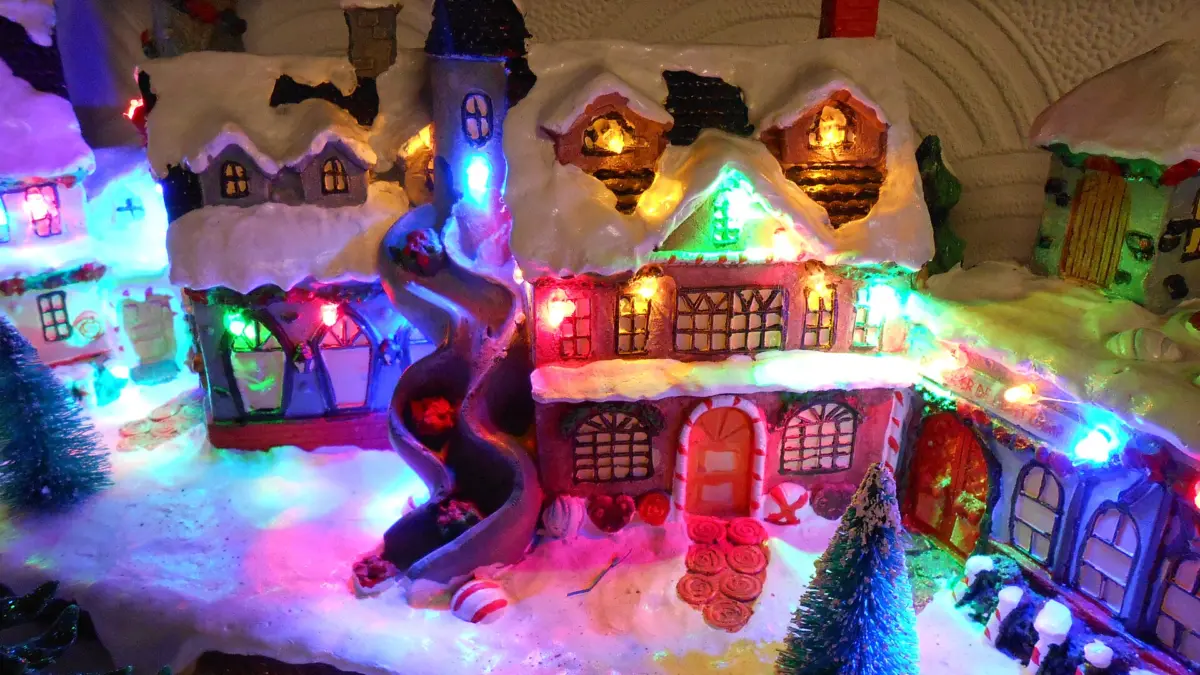
Every year, on the first Sunday of Advent, after church, we set it up. Fifty years we did that, June and me. The dining room table, both leaves in, and then the buffet, and then a card table at the end. She’d put down the white felt and the cotton snow and the mirror pond and plan out the streets, and I’d crawl around under the table taping down the extension cords, and we’d argue about where the firehouse went. It took us all afternoon. Then, when it got dark, she’d turn off every light in the house and I’d plug in the power strip, and the whole town would light up at once, two hundred little windows, and the train would start going around, and June would stand there with her hands together under her chin like she was seeing it for the first time.
When our daughter Lisa was little, she helped. When Lisa grew up and moved to Peoria and married Trent and had Noah, Noah helped. He was three the first time. June let him put the skaters on the pond. He put all six of them in a pile in the middle, and she left them like that the whole season.
Noah is ten now. He’s standing behind me in the dining room doorway in his church clothes, with his clip-on tie crooked.
He helped June set it up every year from the time he was three. The last Christmas, the December before she died, she was already tired. Her ankles were swelling. She sat in a chair at the end of the table and directed and Noah did all the placing. She let him decide where everything went. At the very end, she had him bring her the little white church, and she turned it over, and she took a ballpoint pen out of her cardigan pocket and wrote on the bottom, under the old masking tape, right on the ceramic, in her shaky handwriting: “For Noah. Keep the town going.”
Then she gave it back to him to put in the middle, where it always goes.
She also put it in her will. I didn’t know that till after. Dennis Kwiatkowski, who’s done our legal work since we bought the house, read it to Lisa and me in his office on Main Street in April of last year. It was paragraph four. “I give my Christmas village collection, including all buildings, figures, accessories, the train, and the notebook listing them, to my grandson, Noah James Hollis. I ask that my husband Harold keep it for him and set it up each year until Noah is grown and has a home of his own to put it in.”
Lisa cried in Dennis’s office. Trent wasn’t there. He was working.
Now here’s the part about Trent.
Trent Hollis is forty-four. He married Lisa in 2013. He’s always had some kind of a business going. Pressure washing. Gutters. Lawn care in the summer and snowplowing in the winter, mostly for commercial lots, gas stations and the bank parking lots on Henderson Street. He works hard, I’ll give him that. He’s just never been good with money. He thinks the next big thing is always right around the corner, and it never is, and the debts pile up behind him like plowed snow.
A few months after June died, in the summer of 2025, the house they were renting in Peoria got sold out from under them. The landlord’s kids wanted the money. They had sixty days to get out. Lisa called me crying. They were behind on everything. Their credit was shot. Nobody would rent to them.
“Come home,” I said. “Stay here. Just till you get on your feet.”
I had the room. Four bedrooms, and it was just me now, rattling around. And I’ll be honest, I wanted them. I wanted somebody in the house. I wanted to hear Noah running up the stairs. I wanted somebody to eat supper with.
So they came. In August of 2025. Trent and Lisa and Noah and a U-Haul and a fifty-inch TV and a lot of boxes they never unpacked. They took the two back bedrooms and Noah took Lisa’s old room, the one with the slanted ceiling.
That was supposed to be for a few months. It’s been fifteen.
They don’t pay rent. I never asked them to. I pay the property taxes, which are a little over five thousand dollars a year now, and the homeowner’s insurance, and the gas and the electric and the water, out of my Maytag pension and my Social Security. I buy most of the groceries. I don’t mind. That’s what family does. Lisa works at the pharmacy counter at the grocery store on Henderson, and she’s tired all the time, and she’s paying off old credit cards with every check.
Trent, though. Trent started acting like it was his house.
He moved my recliner out of the living room to the basement and put in a sectional he bought on credit at the furniture store on Main. He put a lock on the door to the garage, because his snowplow equipment was out there, and gave me a key to it like I was a guest. He started calling it “our house” when he talked to his friends on the phone, and then just “my house.” I heard him. I didn’t say anything.
In October, he asked me to co-sign a loan for him. A new plow truck. A Ram 3500 with a nine-foot blade. Forty-one thousand dollars, at the credit union, over six years. His old truck had a cracked frame, he said, and if he didn’t get a new one before the snow came, he’d lose his commercial contracts. He brought the paperwork home and laid it on the kitchen table in front of me with a pen on top of it.
I read it. I read every page, the way June always made me. And I said no.
“I’m seventy-nine years old, Trent,” I said. “If something happens to you and you can’t pay, the credit union comes to me. And if something happens to me, it comes out of what’s supposed to go to Lisa and Noah. I can’t do it. I’m sorry.”
He didn’t say anything. He picked up the papers and the pen and went out to the garage and didn’t come back in till after I’d gone to bed.
He didn’t get the truck. He’s still plowing with the old one, with the cracked frame, held together with a welded plate. He hasn’t really talked to me since. Not real talking. Just “pass the salt” and “the furnace filter needs changing.”
That’s how it was on the Sunday after Thanksgiving. The first Sunday of Advent. The day June and I set up the village for fifty years.
I’d told Noah all week we’d do it after church. Just him and me. Lisa had to work. He’d been so excited he couldn’t sit still in the pew. Pastor Lindqvist had to give him a look during the prayers.
And we came home, and the table was bare.
“Trent,” I said, in the dining room. “That’s June’s. She left it to Noah. It’s in her will.”
“Her will.” He laughed. Not a nice laugh. “Hal, I’m not trying to be a jerk here. But come on. Her will. You’re going to make a kid keep two hundred pieces of dusty ceramic junk for eight years in boxes in the basement because a dead lady wrote it on a piece of paper? Noah’s ten. He doesn’t want that stuff. He wants a PlayStation. He wants a dad who isn’t drowning.”
“He wants what his grandma left him.”
“His grandma’s not paying for anything around here.” He set his coffee down hard. “You know what I spent this week? Four hundred and eighty dollars on a new hydraulic pump for the plow. Because the truck you wouldn’t help me get is falling apart. Four hundred bucks from this junk pile pays for the pump. It’s the first useful thing that village has ever done.”
“Trent.”
“No, Hal, listen to me.” He stood up. He’s a big man, Trent. Six-two. He stood across the kitchen island from me with his hands flat on the granite June picked out in 2009. “I live here. This is my house too now. I’m not spending another December eating supper in the kitchen because the whole dining room’s full of toy houses and extension cords. I’m not tripping over that train every night. June’s gone. You need to let it go. Everybody in this family needs to let it go.”
Noah was standing next to me. He’d taken his clip-on tie off. He was holding it in his fist.
“Grandpa,” he said. His voice was very small. He wasn’t looking at his dad. He was looking at me. “Why does Dad get to sell Grandma’s village? She wrote my name on the church. She said it was mine when I grow up. Is it not mine anymore because she died?”
I couldn’t answer him.
I’m seventy-nine. I’ve buried my parents and two brothers and my wife. I stood on that line at Maytag the morning they told us the plant was closing and watched grown men cry into their gloves. I have heard a lot of things. I don’t think anything ever went into me as deep as that. Is it not mine anymore because she died.
Trent rubbed his face.
“Buddy,” he said to Noah. “It’s just stuff. Grandma would want you to have a nice Christmas. Not a dining room full of old junk.”
Then he looked at me. He picked up his phone again. He tapped something on the screen.
“Guy’s coming at four, Hal. I already told him it’s his. I’m not going back on it. You can be mad at me all you want. But this is happening. It’s my house too. I make decisions here too. You understand?”
I looked at my son-in-law across June’s granite.
“Understood,” I said.
Then I held out my hand to my grandson.
“Noah,” I said. “Grandpa needs you to show him something. That Marketplace thing on the Facebook. How do I send somebody a message on it?”
He looked at me. His eyes were wet. He took my phone out of my coat pocket, because he knows where I keep it, and he opened the Facebook and found it. Trent’s ad. Our dining room table, all lit up, in the picture.
“You press this,” Noah said, sniffling. “Where it says message. Then it already says, is this still available. You just press send.”
“Can I type more?”
“Yeah. Here.”
I typed it with one finger, the way I do. It took me a while. Trent was watching me from across the island with his arms folded.
“Is this still available? I would like to buy it. Full price. Four hundred dollars, cash. I can pick it up today. I’m already here. I’m in the kitchen.”
I pressed send.
Across the island, Trent’s phone buzzed in his hand.
He looked down at it. He read it. His face went red, starting at the neck.
“Very funny, Hal,” he said.
“I’m not being funny,” I said. “You said it’s for sale. You said four hundred, cash, pick up only. I’m a buyer. I’d like to pick it up.”
“You can’t buy your own stuff.”
“No,” I said. “I can’t. But you just told me it’s not mine. You said it’s yours to sell. So I’ll buy it from you. And then it’ll be mine to give to Noah, the way June wanted. And there won’t be any argument about it, ever again.”
I took my wallet out of my back pocket. I keep money in it from the bank, the way I always have, because I don’t trust the cards. I counted out four hundred dollars in twenties on June’s granite, slowly, twenty bills, one at a time, and lined them up in a row.
Trent stared at the money.
Noah was still holding my phone. He’d gone quiet. He was scrolling something.
“Grandpa,” he said. “Dad has other stuff for sale.”
“What?”
“It says, more from this seller.” He turned the phone around. “Look.”
I put my glasses back on.
There was a row of little pictures under Trent’s name. I didn’t know what I was looking at at first. Then I did.
June’s sewing machine. Her black Singer Featherweight, the little one, that she bought used in 1971 and sewed every one of Lisa’s Halloween costumes on. It said SOLD. Two hundred and seventy-five dollars.
June’s Hummel figurines. The little German children with their geese and their umbrellas, eleven of them, that stood in the corner cabinet for forty years. Her mother left them to her. SOLD. Three hundred and forty dollars.
Her mother’s wedding ring quilt. Pink and green. Hand-pieced, in 1952, in Iowa. SOLD. One hundred and fifty dollars.
The cedar chest that sat at the foot of our bed for fifty years. Her hope chest, from when she was seventeen, with her initials on the brass plate. SOLD. Two hundred dollars.
There were more. Her good china. The punch bowl. The mantel clock from her dad. Her fur coat that she never wore but couldn’t get rid of. The listings went back to August, all marked SOLD. I counted them later, on paper, at the kitchen table, the way June would have. Fourteen things. Two thousand, six hundred and fifteen dollars.
Those things had been in the basement since the spring after the funeral. Lisa and I packed them away ourselves, in boxes, and carried the cedar chest down the stairs between us, because I couldn’t stand to look at June’s things every day and know she wasn’t coming back to use them. Then Trent said, in the summer, that he was “organizing” the basement for us. Making room for his plow parts. He told me not to worry about it, he’d label everything. I hadn’t been down there since. My knees don’t like those stairs.
He’d labeled it, all right.
I looked up from the phone. Trent wasn’t looking at me anymore. He was looking at the twenties on the counter.
“Where’s the notebook?” I said.
“What notebook?”
“June’s spiral notebook. With the list. It was in the cedar chest.”
He didn’t answer for a second. Then he said, “It’s in the garage. With the village. I put it in the top box.”
“Go get it,” I said. “Please.”
He went. I think he was glad to have somewhere to go.
Noah and I stood in the kitchen and didn’t say anything. He put his hand in mine. His was sweaty from the tie.
Trent came back in with the notebook. The cover was blue, faded almost white. June’s handwriting on the front, in marker: “THE TOWN.” He set it on the counter next to the twenties, and I opened it, and the first line was “1974. Church (white). From Hal. $12.50. Bergner’s, Peoria.” And under that, two hundred and eleven more lines, in the same hand, getting shakier toward the end.
The last line, from the December before she died, said: “Nothing new this year. Noah did the whole town himself. Best year yet.”
I closed it.
“The man from Peoria,” I said. “Message him. Tell him it’s sold. Then take the boxes off the garage floor and bring them back in here. All of them. And then you’re going to sit down at this table and write down the name of every person who bought June’s things, and how to reach them. Every one.”
“Hal, I can’t. Those people paid. It’s done. They’re gone.”
“They’re on that Marketplace,” I said. “Noah can find them.”
Lisa came home at three-fifteen, from her shift. She walked in the back door in her blue pharmacy smock with her lanyard still around her neck and found her father and her son sitting at the dining room table, which was covered in cardboard boxes, with June’s notebook open between us, and her husband sitting at the end of the table with a pen and a yellow legal pad, writing.
“What is going on,” she said.
Noah told her. All of it. He didn’t leave anything out. Kids don’t.
Lisa stood there in her smock with her purse still on her shoulder. She walked over and picked up my phone, which was lying on the table with Trent’s seller page still open, and scrolled through it. I watched her face. When she got to the Singer, she made a sound I hadn’t heard her make since she was a little girl and fell off her bike on Kellogg Street and broke her wrist.
“That’s Mom’s sewing machine,” she said. “Trent. That’s my mom’s sewing machine. She made my wedding veil on that machine.”
“Lisa, it was just sitting in the basement—”
“You told me you were organizing the basement.”
“I was.”
“You told me you were making room for your plow parts.” She put the phone down. Her hands were shaking. “Two thousand six hundred dollars. Where is it? Where’s the money, Trent?”
He didn’t say anything for a long time.
“The truck,” he finally said. “Parts. The pump. Insurance. Gas. It’s gone, Lis. It’s just gone. I was trying to keep us above water. Your dad wouldn’t sign for the truck, and the plow contracts were going to—I was trying to—” He put the pen down. “It was just sitting down there. Nobody was using it. She was gone.”
Lisa looked at him for a long time. Then she sat down next to me, and she put her head on my shoulder, the way she did when she was Noah’s age, and she cried.
Trent got up and went out to the garage.
That night, Noah and I set up the town.
We didn’t do it all. We didn’t have time. But we put down the white felt and the cotton snow, and I crawled around under the table with the electrical tape, with my knees cracking, and Noah unwrapped every piece from its newspaper and read the masking tape on the bottom out loud before he put it down. “1977. Firehouse. From Mom and Dad Brennan.” “1981. Bakery. From Hal, after the layoff. We’ll be fine.” “1993. Schoolhouse. Twenty years at Steele!” “2016. Skaters. From Noah’s first Christmas.”
He saved the church for last. He turned it over and read both lines on the bottom, the old one in blue ink and the new one in June’s shaky ballpoint, and then he put it in the middle of the table, where it always goes.
At about eight o’clock, I turned off all the lights in the house, and Noah plugged in the power strip.
The whole town lit up at once. Two hundred and twelve little windows. The train started going around the church.
Noah stood there with his hands together under his chin.
I had to go in the kitchen for a minute.
When I came back, Lisa was standing in the doorway in her bathrobe. And behind her, in the dark hallway, Trent. He was looking at the village over her shoulder. I couldn’t see his face very well. He didn’t come in. After a while, he went upstairs.
The next week, Noah and I went to work.
He’d come home from school, and we’d sit at the kitchen table with my phone and Trent’s legal pad, and Noah would find the people on the Marketplace and help me write to them. I typed every message myself, with one finger. Something like: “Hello. My name is Hal Brennan. You bought a sewing machine from a man named Trent in September. It belonged to my late wife, June. He sold it without asking us. I’m not asking you to give it back. You paid for it fair. But if you’d be willing to sell it to me, I’ll pay you what you paid, plus a little for your trouble.”
Some people never wrote back. The man who bought the mantel clock had deleted his account. The quilt went to a woman in Moline, and she wrote one line, “Sorry, already resold it,” and blocked us. I don’t know where June’s mother’s quilt is now. I think about that more than I should.
But most people wrote back.
The cedar chest was in Monmouth, twenty minutes west of us, with a woman named Rosa Ochoa, who’s a widow herself. She’d bought it for her granddaughter. She read my message and called the phone number I put at the bottom, and she cried on the phone, and she said, “Mr. Brennan, I don’t want your money. Come get your wife’s chest.” I drove over on Wednesday with Noah. She’d polished the brass plate. June’s initials, J.A.M., June Ann Mueller, shining. Mrs. Ochoa made us stay for coffee and pumpkin bread. I sent her a Christmas card. I’m going to send her one every year.
The Hummels were in Peoria, with a man who collects them. He wanted six hundred dollars for all eleven. I paid him. I took it out of my savings account at the bank, which I keep for emergencies. This was one.
The Singer Featherweight was in Macomb, with a young mother named Kayla. She wrote back a long message. She said she’d always wanted one, and she’d been teaching herself to sew on it at her kitchen table at night after her kids went to bed. She was making her little girl a Christmas dress on it right then, red velvet, with a white collar. She sent me a picture of the dress, half done. She said she’d give it back if I wanted, because it was the right thing to do.
I thought about it for a whole day. Then I wrote back: “Keep it. Finish the dress. June would want somebody sewing on it.” And Kayla sent me a picture on Christmas Eve of her little girl in the red velvet dress, standing in front of their tree. I printed it out at the drugstore and put it in June’s notebook.
Lisa took the china back from the buyer in Galesburg herself, with her own money, from the pharmacy. She wouldn’t let me pay for it.
In the end, I got back nine of the fourteen things. It cost me eleven hundred and forty dollars, plus gas. The rest are gone.
On the Friday after, I went down to Dennis Kwiatkowski’s office on Main Street. Not to sue anybody. Just to talk. I wanted to know what I should do. He’s eighty-one and still goes in every day. He listened to the whole thing with his fingers steepled.
“Hal,” he said. “You know what you have to do. You’ve known it since Sunday.”
“I don’t want to put them out,” I said. “Lisa’s my daughter. Noah’s my grandson.”
“Nobody said put them out.”
So, with Dennis’s help, I did a few things. I updated my own will. The house still goes to Lisa when I’m gone, the way it always was. But Dennis wrote it so it goes to her, in her name only, not to her and her husband. Lisa knows. I told her myself. She said, “Good, Daddy.” She didn’t argue.
I opened a savings account for Noah at the bank, a custodial one, with Lisa’s signature on it and mine. And I sat Trent down at the kitchen table, the same table, with the twenties and the notebook gone and just two cups of coffee on it, and I told him how it was going to be from now on.
“You’re going to pay rent,” I said. “Six hundred a month. Starting January. It doesn’t go to me. It goes in Noah’s account. Every month, on the first. If you want to live in this house, you’re going to put something into it. And you’re going to pay back the two thousand six hundred and fifteen dollars. Not to me. To Lisa. It was her mother’s.”
“Hal, I can’t afford—”
“You found four hundred and eighty for a hydraulic pump,” I said. “You’ll find it.”
He sat there for a long time with his coffee. He didn’t apologize. I didn’t really expect him to.
“Fine,” he said.
He’s paid the rent every month since. Six hundred dollars on the first, into Noah’s account. Lisa checks. He’s paid Lisa back about half of the money, so far, mostly from the snowplow contracts in January and February, when we got that big storm. He doesn’t talk to me much more than he did before. He’s not a bad man, I don’t think. He’s just a man who sold his dead mother-in-law’s sewing machine to buy a hydraulic pump and doesn’t know how to look at me now. I don’t know how to look at him, either, some days. We’re working on it. Or we’re not. I’m not sure which.
But I’ll tell you one thing that happened.
On Christmas Eve, after church, Lisa and Noah and I came home and turned off all the lights, the way we always do, to look at the town. And when the windows lit up, I saw there was something new on the table. Down at the end, past the skating pond, by the train tracks, where there’d always been an empty spot that June never filled.
A little red pickup truck. Ceramic. With a snowplow blade on the front.
Noah picked it up and turned it over. There was a piece of masking tape on the bottom. In Trent’s blocky handwriting, in Sharpie, it said: “2026. From Dad.”
That’s all it said.
Noah didn’t say anything. He looked at it for a long time. Then he put it back down by the tracks, at the edge of town, where the snow would be, and he turned the blade so it was facing the road.
Trent wasn’t in the room. He was upstairs. I don’t know if he knows Noah kept it there. I didn’t tell him. Next year, when we set up the town on the first Sunday of Advent, I’ll put it on June’s list in the notebook. Line two hundred and thirteen. I’ll write it in my own handwriting, under hers.
I’ve been practicing. My handwriting’s terrible.