The Secret Ingredient
Part 1: The Platter
“Mommy, please don’t eat it!”
Monica’s voice was trembling. She had both of her small hands wrapped around my sleeve, pulling hard.
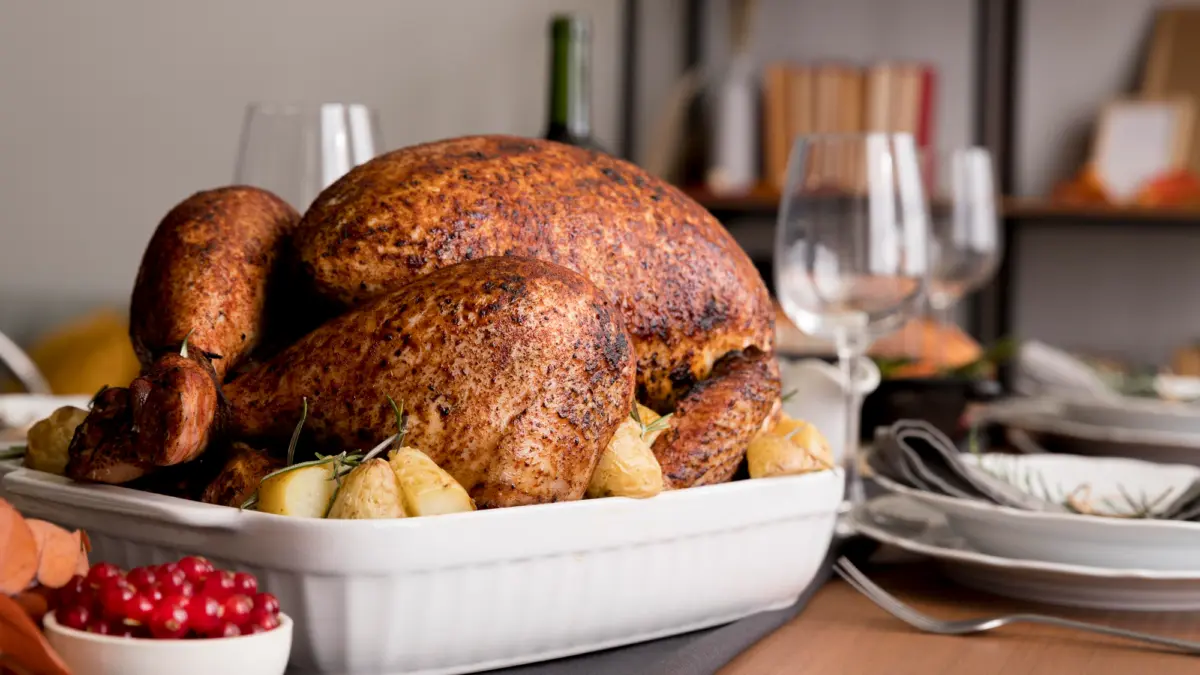
I was standing at the head of our dining room table holding a carving knife and a long fork. The turkey sat in front of me on my grandmother’s big white platter, golden brown and glistening, the skin crackling where it had pulled tight over the breast. It was the best turkey I had ever made. I’d been up since five in the morning.
Fourteen people were watching me.
“Not now, sweetie,” I said, smiling down at her. “We’ll play later. Okay?”
My name is Margaret Holt. I’m thirty-eight years old, and that Thanksgiving was supposed to be the warmest day of the year.
Our dining room was packed. My husband, Nathan. Our two daughters, Hazel, who was seven, and Monica, who was five. My parents, Bev and Phil, who’d driven down from Duluth. Nathan’s parents, Joyce and Douglas, who live twenty minutes away. My brother Tony and his wife, Mei, and their two boys. Nathan’s sister, Kristen, and her husband, Jared, and their baby, asleep in a car seat in the corner.
Fourteen people around a table built for eight. We’d added two card tables at the end and covered everything with three mismatched tablecloths. It was loud and crowded and chaotic.
In the best way.
Monica loved playing a game called Animal Rescue. She’d line up her stuffed animals on the living room couch and pretend they were trapped somewhere, a burning barn or a frozen pond or a cage at the zoo. Then she’d save them, one by one, and give them a little speech about how they were safe now.
So when she tugged on my sleeve and begged me not to eat the turkey, I assumed that’s what this was. A five-year-old who’d suddenly realized that dinner used to be a bird.
“We’ll play later,” I said again. I turned back to the turkey.
I pressed the long fork into the breast to hold it steady. I lifted the carving knife.
And before I could make the first cut, Monica let go of my sleeve, grabbed the edge of the platter with both hands, and tipped it.
The turkey slid.
It slid off my grandmother’s platter like a sled down a hill, bounced once off the edge of the table, and crashed onto the hardwood floor with a wet, heavy thud. Juice splashed across the floor and onto Nathan’s pant legs. A roasted carrot rolled under the china cabinet.
The entire table gasped.
For one long second, nobody moved. Fourteen people stared at a twenty-two-pound turkey lying on its side on my dining room floor.
Then my mother-in-law shrieked.
“Why would you DO that?”
Joyce was on her feet. Her chair had tipped over behind her. Her face was white, then red. She was staring at Monica like Monica had set the house on fire.
“Monica!” I said. My voice came out sharp. I couldn’t help it. “Oh no. What have you done?”
From the other end of the table, my father-in-law’s voice boomed. Douglas Holt spent thirty-five years as a high school football coach, and when he wants to be heard, he’s heard.
“Do you realize you just ruined Thanksgiving for everyone?”
Monica’s face crumpled. Tears filled her eyes. Her lower lip shook.
I waited for her to say she was sorry. That’s what Monica always did. She could be stubborn, the most stubborn kid I’d ever met, but when she knew she’d done something wrong, she apologized right away, usually before anyone even asked.
She didn’t apologize.
Instead, she balled her fists at her sides, lifted her chin, and shouted at the top of her lungs.
“I SAVED YOU ALL!”
The room went completely silent.
Even the baby in the car seat stopped fussing. Tony’s boys froze with their forks in the air. My mother put her hand over her mouth.
My heart dropped into my stomach.
Because Monica wasn’t playing. I could see it in her face. That wasn’t the face she made when she was saving stuffed animals on the couch. That was the face she made when she was scared. Truly, deeply scared.
I put the carving knife down on the table. I knelt down beside her on the wet floor, right next to the turkey.
“Sweetheart,” I said quietly. “What do you mean?”
She looked at me through her tears. Her whole body was shaking.
I gently took both of her hands in mine.
“Saved us from what?”
Part 2: What Monica Saw
Monica didn’t answer right away.
She looked past me. Past Nathan. Past my parents and my brother and all the cousins. Her eyes went to the far end of the table, where Joyce was standing next to her overturned chair.
Then Monica looked back at me. She leaned in close to my ear, and she whispered.
“Grandma put the bad stuff in it.”
I didn’t understand.
“What bad stuff, baby?”
Monica glanced at Joyce again. Then she whispered even quieter, so quiet I could barely hear her over my own heartbeat.
“The nut stuff. The stuff that makes Hazel’s throat close.”
I want to tell you that I understood right away. That I jumped up and knew exactly what to do.
But I didn’t. For a few seconds, I just knelt there on my dining room floor holding my five-year-old’s hands, and my brain refused to put the words together.
Grandma. Nut stuff. Hazel’s throat.
Hazel, my seven-year-old, has a severe allergy to peanuts and tree nuts. She was diagnosed when she was two, after she ate a single bite of a cookie at a birthday party and broke out in hives all over her face. Her allergist at the Mayo Clinic in Rochester told us it was one of the most severe reactions she’d seen in a child that age.
We carry two EpiPens everywhere. In my purse. In Nathan’s car. In Hazel’s school backpack. In a little red pouch clipped to her belt loop at all times.
We read every single label. We don’t eat at restaurants that use peanut oil. We don’t let her eat anything at birthday parties unless I’ve checked it myself.
Everybody in the family knows. Everybody.
“Monica,” I said slowly. “Are you sure?”
She nodded hard. Tears dripped off her chin.
“I saw her,” she whispered. “This morning. When you were in the shower. She came in the kitchen and she had a little jar. And she put the stuff from the jar under the turkey’s skin. With her fingers.”
My stomach turned to ice.
“And then she saw me,” Monica said. “And she put her finger on her lips like this.” She put one finger on her lips. “And she said, ‘Shh, it’s Grandma’s secret ingredient. Don’t tell Mommy. It’ll be good for Hazel.'”
I looked up.
Joyce was staring at us. She couldn’t hear what Monica was saying. But she could see Monica’s face, and mine. And something in her expression had changed.
She wasn’t angry anymore. She was afraid.
I stood up slowly.
“Nathan,” I said. My voice sounded strange to me. Very calm and very far away. “Take Hazel into the living room. Right now. Please.”
Nathan looked at me. He looked at Monica. He looked at his mother.
“Margaret, what’s—”
“Right now, Nathan.”
He didn’t ask again. He stood up and went around the table and picked Hazel up out of her chair, even though she’s seven and much too big to be carried. She was confused and starting to cry. He carried her into the living room.
Then I turned and looked at my mother-in-law.
“Joyce,” I said. “What did you put in the turkey?”
Part 3: Grandma’s Butter
Joyce Holt is sixty-seven years old. She has silver hair she gets set every Friday at a salon on Broadway, and she wears pearl earrings to the grocery store. She raised three kids. She taught Sunday school for twenty years. She makes the best pie crust I’ve ever tasted, and she’s very proud of it.
She’s always been a little difficult. I knew that when I married Nathan. She had opinions about everything. How I folded towels. How I loaded the dishwasher. How I dressed the girls.
But I never, ever thought she’d hurt them.
“I don’t know what you’re talking about,” Joyce said.
She bent down and picked up her chair. She set it upright very carefully, like the most important thing in the world was getting that chair back in its place.
“Monica says she saw you,” I said. “This morning. In my kitchen. Putting something under the turkey skin.”
“Monica is five years old,” Joyce said. “She has an imagination. You know that.”
“Joyce.”
“I made herb butter,” Joyce said. “That’s all. Rosemary and thyme and garlic. I always do herb butter. You know I do herb butter.”
That was true. Joyce always did herb butter under the turkey skin when she hosted Thanksgiving. She’d taught me how to do it the first year Nathan and I were married.
But this year, I’d hosted. And I’d done my own herb butter at five in the morning. Rosemary, thyme, garlic, and a little lemon zest. I’d made it myself. I’d rubbed it under the skin myself.
Joyce hadn’t asked if she could add anything. And I’d been in the shower for fifteen minutes at seven-thirty, while the turkey sat on the counter waiting to go into the oven.
“I already put herb butter on it,” I said. “At five o’clock this morning. You didn’t need to add any.”
Joyce’s mouth tightened.
“Well, I thought it could use a little more flavor,” she said.
My father, Phil, stood up from the table.
He’s a retired pharmacist from Duluth. He’s quiet, the kind of man who doesn’t say much at family gatherings. But he walked around the table to where the turkey was lying on the floor. He knelt down next to it with a groan, because his knees aren’t what they used to be.
He lifted the skin on the breast with a fork. He leaned in and smelled it.
Then he looked up at me. His face was gray.
“Margaret,” he said quietly. “That’s peanut.”
The room went silent again.
My father bent closer. With the tines of the fork, he scraped some of the butter out from under the skin and held it up to the light. It was brownish and gritty, not the pale green of my herb butter. You could see tiny pieces of something in it.
“Peanut butter,” my father said. “Mixed with butter. And these little pieces—” He sniffed again. “Those are pecans. Ground up fine.”
Across the table, Mei, my brother’s wife, put both hands over her mouth.
Joyce didn’t say anything. She was standing very still behind her chair, holding onto the back of it with both hands.
Part 4: “A Little Bit Won’t Hurt Her”
I’ll never forget the silence in that room.
Fourteen people. And not one of them said a word.
Then Douglas, Nathan’s father, the one who’d boomed at Monica that she’d ruined Thanksgiving, slowly turned his head and looked at his wife.
“Joyce,” he said. His voice wasn’t booming anymore. It was quiet. “What did you do?”
Joyce let go of the chair. She straightened her blouse. She lifted her chin.
“I didn’t do anything wrong,” she said. “It was a little bit. Just a teaspoon or two. Mixed in with the butter. You wouldn’t even be able to taste it.”
“A teaspoon,” I said. “Of peanut butter.”
“And some pecans. For texture.” She waved her hand. “It’s barely anything, Margaret. You make such a fuss about this allergy. You always have. Ever since she was a baby.”
I couldn’t speak. I just stared at her.
“These allergies,” Joyce went on, “are a modern thing. When I was a girl, nobody had allergies. Nobody. We all ate peanut butter sandwiches every day of our lives. And you know why? Because our mothers didn’t wrap us up in bubble wrap.”
“Joyce—” my mother said.
“I read about it,” Joyce said. “There was an article. They do it now in hospitals. A little bit of peanut, every day, and the children get used to it. They grow out of it. That’s how it works.”
“That’s a medical treatment,” my father said. He was still kneeling on the floor next to the turkey. His voice was shaking. “It’s called oral immunotherapy. It’s done in a clinic. With a doctor watching. With measured doses smaller than a crumb. With epinephrine in the room. Starting at a dose a thousand times smaller than what you put in that turkey.”
He stood up slowly. He looked at Joyce.
“What you did,” my father said, “isn’t treatment. It’s poison.”
Joyce’s face went red.
“How dare you,” she said. “I’m her grandmother. I love that child. I would never hurt her. I was trying to help her. Somebody has to, since her own mother won’t let her live a normal life.”
“She could have died,” I said. My voice cracked. “Joyce. She could have died. At this table. In front of all of us.”
“Oh, don’t be dramatic,” Joyce said. “It was a tiny amount.”
“When she was two,” I said, “she had one bite of a cookie with peanut butter in it. One bite. Her throat swelled shut in four minutes. She stopped breathing in the ambulance. Nathan was there. You know that. We told you. We told everyone.”
Joyce opened her mouth. Then she closed it.
From the doorway to the living room, a voice said, “Mom.”
Nathan was standing there. Hazel was behind him, peeking around his legs, her face blotchy from crying. Nathan had heard everything.
He walked into the dining room very slowly. He was looking at his mother like he’d never seen her before.
“Mom,” he said again. “Tell me you didn’t do this.”
Part 5: Nathan
Nathan is the youngest of Joyce’s three kids. The baby. The one she always says is “most like her.”
He’s forty, an engineer at a medical device company in Rochester, gentle and patient and slow to anger. In eleven years of marriage, I’ve seen him truly angry maybe three times.
This was the fourth.
“Mom,” he said. “Answer me.”
Joyce reached out to touch his arm. “Nathan, honey—”
He stepped back so she couldn’t touch him.
“Did you put peanut butter in the turkey?”
Joyce dropped her hand.
“A little,” she said. “Just a little, sweetheart. To help her. You were never allergic to anything. Your sister wasn’t. Your brother wasn’t. It’s not in our family. Margaret’s side has all these problems—”
“Stop,” Nathan said.
Joyce stopped.
“Hazel was going to get the first slice,” Nathan said. His voice was very quiet. “She always gets the first slice. Since she was three. Margaret always cuts the first slice and puts it on Hazel’s plate, because Hazel says it’s the luckiest piece. You know that, Mom. You’ve watched her do it for four years.”
Joyce didn’t say anything.
“You knew,” Nathan said. “You knew she’d eat it first. Before anyone else. Before anybody could notice anything.”
“I wanted to prove it,” Joyce said.
Her voice was different now. Not defensive anymore. Pleading.
“I wanted to prove that she’d be fine. That she’s not as sick as you think she is. That Margaret’s been scaring you for five years over nothing.” She looked at Nathan with wet eyes. “She’d eat it, and she’d be fine, and then you’d see. You’d all see. And she could finally be a normal little girl.”
“And if she wasn’t fine?” Nathan said.
Joyce didn’t answer.
“If her throat closed up,” Nathan said. “If she stopped breathing. At this table. What then, Mom?”
“Margaret has the pens,” Joyce said quietly. “The shots. She always has them.”
I heard my mother gasp.
Nathan stared at his mother for a long, long time.
“So you were going to wait,” he said slowly. “And see if my daughter stopped breathing. And then you’d let her mother stab her in the leg with a needle. In front of her cousins. On Thanksgiving.”
“It wasn’t going to happen,” Joyce said. “It was a tiny amount.”
“You don’t know that,” Nathan said. “Nobody knows that. That’s the whole point. That’s why we’ve spent five years reading every label in every grocery store in Minnesota. Because nobody knows how much is too much.”
He turned around. He knelt down in front of Monica, who was still standing next to the turkey on the floor, holding my hand.
“Monica,” he said gently. “Did Grandma tell you not to tell Mommy?”
Monica nodded.
“Why didn’t you tell Mommy this morning? When you saw?”
Monica’s lip trembled again.
“Because Grandma said it was a secret,” she whispered. “And Grandma said it was good for Hazel. And I thought maybe Grandma knew. Because she’s a grown-up.” She sniffed. “But then I kept thinking about it. All day. About Hazel’s red pouch. And her pen. And the time she couldn’t breathe in the car.”
“You remember that?” Nathan asked. Monica would have been just a baby. Three months old.
“No,” Monica said. “But Hazel told me. She tells me all the time. She says if she eats nuts, she could go to heaven like Grandpa Lou.” She wiped her nose on her sleeve. “And I didn’t want Hazel to go to heaven.”
Nathan put his arms around her. He held her for a long time.
“So when Mommy picked up the knife,” Monica said into his shoulder, “I knew I had to do something. Because Hazel always gets the first piece. And Mommy wasn’t listening. So I pushed it.”
She pulled back and looked at him. Her face was very serious.
“I’m sorry I ruined Thanksgiving, Daddy,” she said. “But I’d rather ruin Thanksgiving than Hazel go to heaven.”
Part 6: The Floor
I don’t know how long we all stood there in the dining room. It felt like hours. It was probably two minutes.
Then Douglas did something nobody expected.
He got up from his chair at the far end of the table. He walked around the card tables, past the cousins, past my brother, past his own wife. He walked all the way to the end of the room where Monica was standing with Nathan.
And Douglas Holt, sixty-nine years old, thirty-five years a football coach, with bad knees and a booming voice, got down on the floor next to the turkey on his knees.
He looked at his granddaughter.
“Monica,” he said. “I yelled at you. I said you ruined Thanksgiving.”
Monica nodded, her eyes huge.
“I was wrong,” Douglas said. “You didn’t ruin anything. You saved your sister’s life.”
Then he reached out and took both of Monica’s small hands in his big ones.
“That was the bravest thing I’ve ever seen anybody do,” he said. “And I’ve seen a lot of brave things. I coached a boy who played the whole fourth quarter of the state semifinals with a broken wrist. But that’s nothing next to you.” His voice cracked. “You stood up to a whole room full of grown-ups. You stood up to your own grandmother. Because you knew something was wrong. And nobody would listen to you.”
He looked up at me. His eyes were wet.
“I’m sorry, Margaret,” he said. “I’m so sorry.”
Then he stood up, slowly, with a hand on the back of Monica’s chair. He turned around and faced his wife.
Joyce was still standing behind her chair. Her face had gone very pale.
“Joyce,” Douglas said. “Get your coat.”
“Doug—”
“Get your coat,” he said again. “We’re leaving.”
“I’m not leaving. It’s Thanksgiving. I’m not going to be thrown out of my own son’s house because his wife—”
“Joyce,” Douglas said. His voice was quiet, but it filled the room the way it had filled football stadiums for thirty-five years. “You put peanut butter in a turkey you knew our granddaughter was going to eat. You told her little sister to keep it a secret. That’s not something a wife did. That’s not something a mother-in-law did. That’s something you did. And you’re going to go sit in the car and think about it until I come out.”
Joyce stared at her husband. In forty-four years of marriage, Nathan told me later, he had never once heard his father talk to his mother like that.
Then she picked up her purse. She took her coat off the hook by the front door. She walked out without saying a word to anyone.
The front door closed.
Douglas stood there in my dining room for a long moment. Then he turned around.
“Margaret,” he said. “Where’s your mop?”
Part 7: Checking Everything
We didn’t eat for a while after that.
My father and Douglas cleaned up the turkey together. They didn’t talk much. My father carried the whole thing out to the garbage can in the garage, platter and all, because I said I didn’t want any of it in my kitchen anymore. Douglas mopped the floor twice, then a third time with bleach, on his hands and knees, scrubbing at every spot where the juice had splashed.
“Just in case,” he said.
Then I had to check everything else.
Because if Joyce had put peanut butter in the turkey, what else had she touched? She’d been in my kitchen for an hour and a half that morning. She’d “helped” with the stuffing. She’d brought her famous pumpkin pie and her famous rolls. She’d stirred the gravy while I was setting the table.
I didn’t know what was safe anymore. I didn’t know what was poisoned.
My father stood next to me at the kitchen counter and went through every single dish on the table, one at a time.
He smelled the stuffing. He tasted a tiny bit of it on the tip of his tongue and spat it into a paper towel. He looked at it under the light.
“I think this one’s okay,” he said. “But I can’t be sure.”
He did the same thing with the gravy. The mashed potatoes. The green bean casserole. The sweet potatoes. My mother’s cranberry sauce. Kristen’s macaroni and cheese.
Then he got to Joyce’s pumpkin pie.
He cut a thin slice and held it up. He looked at the crust from the side. He smelled it. Then he broke off a little piece of crust and crumbled it between his fingers.
His face changed.
“Margaret,” he said quietly. “There’s ground pecan in this crust.”
I sat down hard on one of the kitchen stools.
The pie too. She’d put it in the pie too. Joyce’s famous pumpkin pie, the one she brought every single year, the one Hazel had always been told she couldn’t have because Grandma’s kitchen wasn’t “nut-safe.”
This year, Joyce had told me she’d made it special. “Nut-free, just for Hazel,” she’d said, handing it to me at the door that morning with a big smile. “I scrubbed my whole kitchen.”
She’d put pecans in the crust.
“Throw it out,” Nathan said. He was standing in the kitchen doorway. “Throw out everything she touched. All of it.”
“Nathan, the stuffing might be fine—”
“Margaret,” he said. “I don’t care if it’s fine. I don’t care if it’s ninety-nine percent fine. Throw it out. The stuffing, the gravy, the rolls, the pie. Anything she put her hands on.”
So we did.
We threw out half of Thanksgiving dinner. Fourteen people, standing in the kitchen, scraping food into garbage bags. Mei cried a little. My mother held the bags open. Tony carried them out to the garage.
When we were done, the table looked almost empty. Mashed potatoes, which I’d made myself and never left alone. Green beans. My mother’s cranberry sauce from a jar she’d brought from Duluth, sealed. Kristen’s mac and cheese, which she’d made at her own house.
That was it.
Part 8: Hazel
While everybody else was in the kitchen, I went to find Hazel.
She was sitting on the floor of the living room behind the couch, with her knees pulled up to her chest and her red EpiPen pouch held in both hands. She’d been crying. Her face was blotchy and her nose was running.
I sat down next to her on the carpet.
“Hey, baby.”
“Hey.”
“Are you okay?”
She shook her head.
“Was Grandma trying to make me die?” she asked.
I didn’t know what to say.
Hazel is seven. She’s smart and serious and she reads everything. She knows more about her allergy than most adults. She can tell you what anaphylaxis is and how epinephrine works and why you have to call 911 even after you use the pen.
She’s also seven. And Joyce is her grandmother.
“No,” I said finally. “No, baby. I don’t think Grandma wanted you to die.”
“Then why did she put peanuts in the turkey?”
I thought about it for a long time.
“I think Grandma doesn’t believe that your allergy is real,” I said slowly. “Or she doesn’t believe it’s as bad as it is. She thinks if you eat a little bit, you’ll get better. Like getting used to cold water at the lake.”
“But that’s not how it works,” Hazel said. “Dr. Abernathy said. She said nobody should ever try to make me eat nuts except her. In her office. With the special machine.”
“That’s right.”
“So Grandma was wrong.”
“Grandma was very wrong,” I said.
Hazel looked down at the red pouch in her hands.
“If Monica didn’t push the turkey,” she said, “I would have eaten the first piece. Like always. Because it’s lucky.”
“I know.”
“And then my throat would’ve closed,” she said. “And you’d have to give me the shot. And then the ambulance would come.”
“Maybe,” I said. “Or maybe the shot would have worked and you’d be okay. We don’t know.”
“But we don’t know,” Hazel said. “That’s the scary part. Right? We never know.”
“That’s the scary part,” I said.
She leaned against my shoulder. We sat there behind the couch for a while without saying anything.
“Mom,” she said finally. “Monica saved me.”
“She did.”
“She’s only five,” Hazel said. “She still sleeps with a nightlight. She cried last week because her popsicle melted.”
“I know.”
“But she saved me anyway,” Hazel said. And then she started crying again, but it was a different kind of crying. “She’s the best little sister in the whole world.”
Part 9: Pizza on the Floor
By five o’clock, everybody was starving.
We’d thrown out the turkey and the stuffing and the gravy and the rolls and the pie. The table had a bowl of mashed potatoes, a dish of green beans, a jar of cranberry sauce, and a pan of macaroni and cheese. For fourteen people.
“Well,” my brother Tony said, standing in the kitchen with his hands on his hips. “Who wants pizza?”
Everybody laughed. It was the first time anybody had laughed in two hours.
But it was Thanksgiving. Every pizza place in Rochester was closed.
Except one. A little hole-in-the-wall place called Luigi’s on Civic Center Drive, run by an old Italian man who’d been open on Thanksgiving for forty years because, he said, “somebody’s always gotta feed the people who burn the turkey.”
Nathan called them. He ordered six large pizzas. Cheese and pepperoni and plain. Then he asked the man on the phone a long list of questions about peanut oil and tree nuts and cross-contamination.
The old man on the phone, whose name turned out to be Sal, listened to all of it patiently.
“My granddaughter’s got the same thing,” Sal said. “Peanuts. I’ve had a nut-free kitchen for six years. No peanut oil. No pine nuts in the pesto. Nothing. You’re safe here, my friend.”
Nathan and Douglas went to pick it up.
When they got back, Monica was standing at the front door waiting for them. She’d been waiting there for twenty minutes.
“Is it here?” she asked. “Is the pizza here?”
“It’s here, pumpkin,” Douglas said. He held up the stack of boxes. “And I’ve got a surprise for you.”
He opened the top box. Somebody at Luigi’s had cut a pepperoni pizza into the shape of a turkey. A big round body, a little round head, and pepperoni slices arranged like feathers fanning out behind it.
“Sal made it special,” Douglas said. “When I told him what you did, he said a hero deserves her own turkey.”
Monica stared at the pizza turkey. Then she started to giggle. Then she was laughing so hard she had to sit down on the floor.
We didn’t eat at the dining room table. Somebody suggested it, I don’t remember who, maybe Kristen. We spread out a bunch of blankets on the living room floor and had a picnic.
Fourteen people, minus one, on the floor of my living room, eating pizza out of the box on paper plates. Mashed potatoes on the side. Green beans. Cranberry sauce. Macaroni and cheese.
Monica sat in the middle of everybody with the pizza turkey in front of her. Hazel sat right next to her, so close their shoulders were touching.
Before we ate, Douglas cleared his throat.
“I know it’s not my house,” he said. “But I want to say grace this year. If that’s okay with Margaret.”
I nodded.
Everyone bowed their heads. Even the cousins.
“Lord,” Douglas said, “thank you for this food. Even though it’s pizza. Thank you for Sal at Luigi’s, who stays open on Thanksgiving.” A few people laughed. “Thank you for this family. All of it. Even the parts that are broken right now.”
He paused.
“And thank you for Monica,” he said, and his voice cracked. “Who’s five years old, and who knew something was wrong when every grown-up in this room didn’t. Who wouldn’t stay quiet when she was told to keep a secret. Who saved her sister.” He wiped his eyes. “Help the rest of us be as brave as she was. Amen.”
“Amen,” everyone said.
Monica looked up at him with big eyes.
“Grandpa,” she said. “You said my name in a prayer.”
“I sure did, pumpkin.”
“Does that mean God knows who I am now?”
Douglas laughed, wiping his eyes again.
“Honey,” he said, “after today, I think God’s going to remember you for a long, long time.”
Part 10: The Car
Douglas didn’t go out to the car for a long time.
Joyce had been sitting in their Buick in my driveway for three hours. It was cold out, in the low thirties, and she had the engine running for heat. I could see the exhaust curling up from the tailpipe through the living room window.
Nobody went out to check on her. Nobody brought her a plate.
Around seven, after the pizza was gone and the cousins were watching a movie, Douglas stood up and got his coat.
“I better go,” he said.
He stopped at the door. He turned around and looked at Nathan and me.
“I’m going to talk to her,” he said. “Really talk. Not like we usually do, where she says something and I nod and we move on. I’m going to make her understand what she did.”
“Dad,” Nathan said. “You don’t have to—”
“Yes, I do,” Douglas said. “I’ve been nodding along with your mother for forty-four years, son. Every time she said something I didn’t agree with, I let it go. I let her tell Margaret how to raise those girls. I let her say the allergy was made up. I let her roll her eyes every time Margaret read a label.” He shook his head. “I thought I was keeping the peace.”
He looked down at his hands.
“Today, keeping the peace almost killed my granddaughter.”
He went out to the car. Through the window, I watched him get in on the passenger side. The dome light came on. Then went off.
They sat there for an hour.
I couldn’t see what was happening. But at one point, the dome light came on again, and I saw Joyce with her face in her hands.
Part 11: Dr. Abernathy
On Monday morning, I called Hazel’s allergist at the Mayo Clinic.
Dr. Catherine Abernathy has been Hazel’s doctor since she was two. She’s in her fifties, with short gray hair and a calm, steady voice that never seems to hurry. She’s seen thousands of kids with food allergies.
I told her everything.
She was quiet for a long time on the phone.
“Margaret,” she said finally. “I need to tell you something, and I need you to really hear it.”
“Okay.”
“Based on Hazel’s testing,” Dr. Abernathy said, “and her history of anaphylaxis at age two, a teaspoon of peanut butter, plus ground pecans, could have been fatal. Even with epinephrine. Especially if she’d eaten a full slice of turkey breast with that butter under the skin. That’s not a trace exposure. That’s a full dose.”
I had to sit down.
“The amount of peanut protein in a teaspoon of peanut butter,” she went on, “is roughly fifteen hundred milligrams. In oral immunotherapy, we start children like Hazel at a dose of a fraction of a single milligram. Sometimes less. Your mother-in-law was giving her more than a thousand times what we’d ever start with.”
“She said she read an article,” I whispered.
“I’m sure she did,” Dr. Abernathy said. “Those articles are everywhere. And they’re about real treatment that really works, in a controlled setting, over months, with a doctor watching every single dose.” She paused. “What she did wasn’t treatment. It was an uncontrolled exposure, hidden from the parents, in a child with a documented history of anaphylaxis.”
“Margaret,” she said. “Has Hazel been in her grandmother’s care unsupervised before?”
I thought about it. My stomach turned over.
“Yes,” I said. “Sometimes. She babysits once a month, on Saturday nights. So Nathan and I can go out.”
“Has Hazel ever had a reaction during those visits?”
“No,” I said. Then I stopped.
Because she had.
Last spring. In April. Nathan and I had gone to a movie and dinner. Joyce had watched the girls.
When we picked them up, Hazel had hives on her arms. Just a few. Red bumps on the inside of her elbows.
“She was playing outside in the grass,” Joyce had said. “It’s probably the pollen. It’s that time of year.”
I’d given Hazel a dose of Benadryl when we got home. The hives went away. We didn’t think about it again.
“She said it was grass,” I told Dr. Abernathy. “Pollen.”
Dr. Abernathy didn’t say anything for a long moment.
“Margaret,” she said gently. “I think your mother-in-law may have been testing this theory before Thanksgiving.”
Part 12: What Joyce Admitted
Nathan went to his parents’ house that Monday night. Alone.
He came home at eleven. He sat down at the kitchen table across from me and put his head in his hands.
“She admitted it,” he said.
“Admitted what?”
“April,” he said. “The hives. She’d put a little bit of peanut butter on a cracker. Hidden under cream cheese. She told Hazel it was a special grown-up snack.” He swallowed hard. “Hazel ate half of it. Then she said her mouth felt itchy, and she didn’t want any more. Mom gave her a juice box and sent her outside to play.”
I closed my eyes.
“She thought the hives proved it was working,” Nathan said. “That’s what she said. She said, ‘See? Just a few bumps. She didn’t stop breathing. Her body’s learning.’ So she decided to try more on Thanksgiving.”
Nathan put his hands flat on the table.
“Dad didn’t know,” he said. “About April. He didn’t know until tonight. When she told us both.” He shook his head. “I’ve never seen him look like that, Margaret. I’ve never seen him cry.”
“What did he say?”
“He said, ‘Joyce, if that little girl had died, I’d have spent the rest of my life married to the woman who killed her.'” Nathan’s voice cracked. “And then he went upstairs and packed a bag. He’s staying with Kristen.”
We didn’t call the police.
Nathan and I talked about it for a long time. Dr. Abernathy said we’d be within our rights. What Joyce did was, at minimum, child endangerment. Hiding a known allergen in a child’s food. Twice.
But Nathan couldn’t do it.
“She’s my mother,” he said, sitting at the kitchen table at two in the morning. “I know what she did. I know it was horrible. I know she could’ve killed Hazel. But I can’t put my mother in handcuffs, Margaret. I can’t.”
“I know,” I said.
“But she’s never alone with them again,” Nathan said. “Never. Not for five minutes. Not in our house, not in hers. Not until she understands. Really understands. And maybe not even then.”
“I agree,” I said.
Part 13: The Allergy Class
Joyce called our house eleven times in December. Nathan didn’t answer any of them.
She sent a card to Hazel for Christmas. A pretty card with a snowman on it and twenty dollars inside. Nathan read it first. Then he gave it to me.
It said: “Merry Christmas to my sweet Hazel. Grandma loves you very much. I’m sorry you’ve been told such terrible things about me.”
I tore it in half and threw it away. I put the twenty dollars in Hazel’s piggy bank.
In January, Douglas called.
He was still staying at Kristen’s. He’d been there seven weeks.
“I made her go,” he said. “To the Mayo Clinic. There’s a class. For grandparents and caregivers of kids with food allergies. Two hours, once a week, for six weeks.”
“You made her go?” I said.
“I told her I wasn’t coming home until she finished it,” Douglas said. “All six weeks. And passed the test at the end.”
I didn’t hear what happened at the class until March.
Douglas told me about it at a coffee shop on Broadway. He’d asked to meet me there. Just me. Not Nathan.
“The first week, she sat in the back with her arms crossed,” he said. “Didn’t take notes. Didn’t say anything. I think she thought it was all a big lie the doctors made up.”
“And then?”
“And then, the third week, they showed a video,” Douglas said. “A real one. Hospital security camera footage, with the parents’ permission. A little girl, about Hazel’s age, having anaphylaxis in an emergency room. You could see her throat closing. You could hear her trying to breathe.”
He stared down into his coffee.
“Joyce got up and walked out,” he said. “I found her in the bathroom. She was throwing up.”
“The fourth week,” Douglas said, “a mother came and spoke to the class. Her son had died. He was nine. He ate a cookie at a friend’s birthday party. Just one. The friend’s grandmother had made them and said they were nut-free. She’d used almond flour. She didn’t think almonds counted.”
My hands were shaking around my coffee cup.
“That mother looked right at the room,” Douglas said, “and said, ‘The grandmother who made that cookie loved my son. She thought she was being careful. And she killed him anyway.'”
He looked up at me.
“Joyce sobbed for the whole rest of the class,” he said. “Couldn’t stop. That was the night she finally understood, I think. What she’d almost done.”
Part 14: The Letter
In April, a letter came in the mail. Addressed to Monica.
Nathan opened it first, standing at the kitchen counter. He read it twice. Then he handed it to me.
It was from Joyce. Handwritten, on lined notebook paper. Her handwriting was shaky.
“Dear Monica,
I am writing this letter to tell you I’m sorry. I’m sorry I told you to keep a secret. A grown-up should never ask a child to keep a secret from her mommy. That was wrong.
I am sorry I put the peanut butter in the turkey. I thought I was helping Hazel. I was not helping her. I was hurting her. I could have hurt her very badly. I could have taken her away from all of us.
You knew that when I didn’t. You were five, and I was sixty-seven, and you were smarter than me.
Thank you for pushing the turkey on the floor. Thank you for not listening to me. Thank you for being brave enough to stand up to your grandma when she was wrong.
I hope someday you will let me see you again. If you don’t, I understand.
I love you very much.
Grandma Joyce”
At the bottom, there was a second note, smaller, addressed to Hazel.
“Hazel, I learned this month that your allergy is real. Not because someone told me, but because I finally listened. I’m sorry I didn’t listen before. I’m sorry for the cracker in April. I’m sorry for everything. I am taking a class now so I can learn how to keep you safe. Grandma.”
I read it three times. Then I sat down at the kitchen table.
“What do you think?” Nathan asked.
“I don’t know,” I said honestly. “I don’t know if it’s real. Or if she’s just saying what she thinks we want to hear.”
“Dad says it’s real,” Nathan said. “He says she’s been different. Quiet. She started seeing a counselor at their church.” He paused. “He moved back home last week.”
I looked at the letter in my hands.
“It’s not our decision,” I said finally. “Not really. It’s the girls’.”
Part 15: The Next Thanksgiving
We gave Monica and Hazel the letter that night. We read it to them at the kitchen table.
Hazel listened very seriously. When we finished, she was quiet for a long time.
“Is she still going to try to make me eat nuts?” she asked.
“No,” Nathan said. “She took a class. She knows now.”
“Does she have to stay far away from me?”
“For now,” I said. “She can’t babysit you anymore. Ever. And if she comes to our house, she can’t bring any food. And she can’t go in the kitchen. And Daddy or I will be with you the whole time.”
Hazel thought about that.
“Okay,” she said. “Then maybe.”
Monica didn’t say anything at all. She took the letter from me and read it herself, slowly, sounding out the big words. It took her a long time.
When she finished, she looked up.
“She said I was smarter than her,” Monica said.
“She did.”
“Is that true?”
I thought about it.
“About this,” I said, “yes. You were.”
Monica looked down at the letter for a long time. Then she folded it very carefully and put it in the pocket of her pajamas.
“I want to think about it,” she said.
The next Thanksgiving, we hosted again. Fourteen people around a table for eight, plus two card tables.
My parents drove down from Duluth. My brother Tony and Mei and the boys. Kristen and Jared and their baby, who was now a toddler running around the living room in a tiny turkey costume.
And Douglas, carrying a nut-free pie from a bakery in Rochester that’s certified allergen-safe. He handed it to me at the door with the receipt and the bakery’s allergy certification taped to the box.
“Just in case,” he said.
Joyce came too.
She came at noon, exactly when Nathan told her to. She didn’t bring any food. She didn’t go in the kitchen. She sat on the living room couch with her hands in her lap, and she didn’t say much.
When Hazel came into the room, Joyce looked up. Her eyes filled with tears. But she didn’t get up. She didn’t reach for Hazel. She stayed exactly where she was.
Hazel stood in the doorway and looked at her grandmother for a long time.
Then she walked over and sat down on the other end of the couch. Not close. But on the same couch.
“Hi, Grandma,” she said.
“Hi, sweetheart,” Joyce whispered.
Hazel reached down and unclipped the red EpiPen pouch from her belt loop. She held it out.
“Do you know how to use this?” she asked.
Joyce looked at it. She swallowed hard.
“Yes,” she said. “They taught me. In the class. Blue to the sky, orange to the thigh. Hold for three seconds. Then call 911. Even if she seems better.”
Hazel stared at her.
Then she nodded, slowly, and clipped the pouch back onto her belt.
“Okay,” she said.
That was all. Just okay. But Joyce put her hand over her mouth and cried quietly for a long time.
At three o’clock, I brought the turkey to the table.
Golden brown. Perfectly cooked. My own herb butter under the skin, rosemary and thyme and garlic and a little lemon zest. Made by me, at five in the morning, alone in my kitchen. Nobody else touched it. Not once.
I set it down on my grandmother’s white platter, the one my father had washed three times with bleach after last year.
I picked up the carving knife.
And then I stopped. I looked down the table at Monica, six years old now, sitting next to her sister in a sweater with a pumpkin on it.
“Monica,” I said. “Do you want to do the honors this year?”
She stared at me.
“Me?”
“You,” I said. “You’re the one who saved Thanksgiving last year. I think you should cut the first piece.”
Monica climbed down from her chair. She came around the table. I stood behind her and put my hands over hers on the knife, and together, very slowly, we cut the first slice off the breast.
It was golden and juicy and perfect.
Monica picked it up with the fork. She looked at it for a long moment.
Then she turned around and put it on Hazel’s plate.
“The lucky piece,” she said. “For Hazel. Because she always gets the first one.”
Hazel looked down at the slice of turkey on her plate. Then up at her little sister.
“Is it safe?” she asked. Not because she didn’t trust me. Just because that’s what Hazel always asks. That’s what we taught her to ask, every single time, about everything.
Monica looked at me.
“Mommy,” she said. “Is it safe?”
“It’s safe,” I said. “I made it myself. Nobody else touched it. I promise.”
Monica turned back to her sister.
“It’s safe,” she said. “I checked.”
Hazel picked up her fork. She took a bite.
And across the table, at the very end, sitting next to Douglas with her hands folded in her lap, Joyce watched her granddaughter eat the lucky piece. Safe and sound and alive.
Tears were running down her face. But she was smiling.
People ask me sometimes if I’m angry at Monica for throwing the turkey on the floor. For ruining Thanksgiving. For the mess and the shouting and the half a dinner we threw away.
I always tell them the same thing.
My five-year-old daughter saw something wrong. A grown-up told her to keep a secret. Every adult in the room told her to be quiet, to stop playing, to sit down. Her own grandfather yelled at her.
And she didn’t stop. She didn’t listen to any of us. She grabbed that platter with both hands and tipped it over.
She didn’t ruin Thanksgiving.
She saved it.
She saved all of us.
THE END