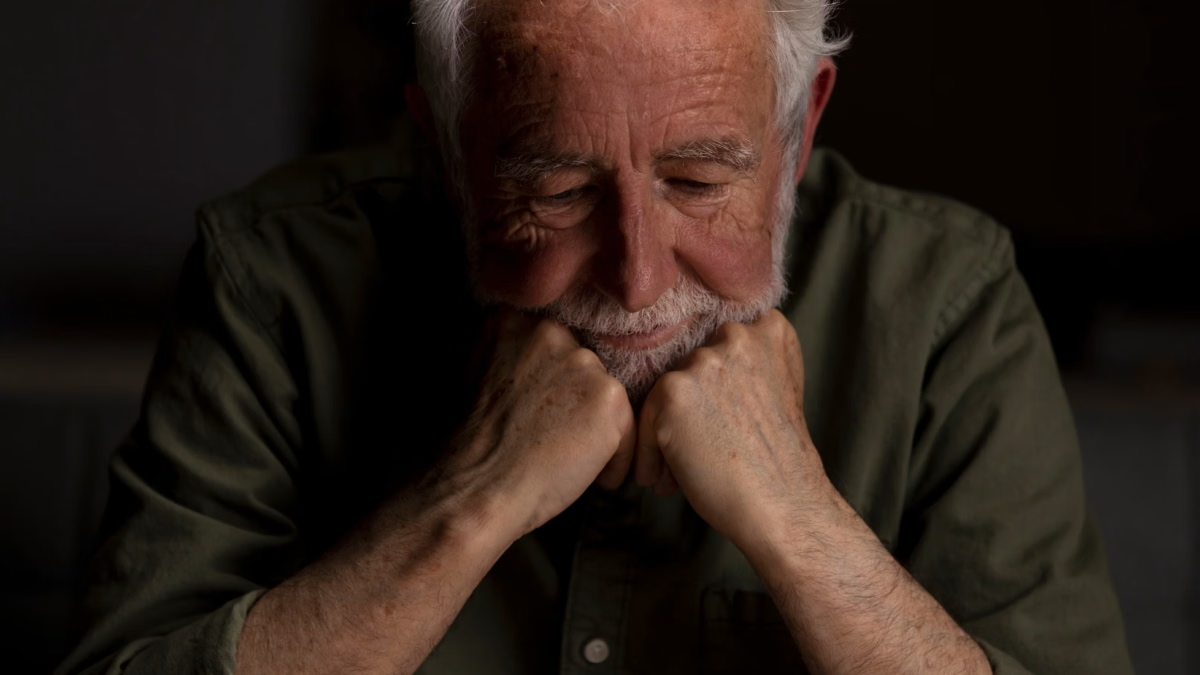
I had the sign leaning against the porch railing when Norris pulled into the driveway. It was the Thursday before Christmas, about two in the afternoon, and the sky over the Bitterroot was that flat white that means snow by suppertime. I’d brought the board up from the basement that morning and wiped the dust off with a dish towel, the way Ora always did. The paint had faded a little over the years. The red letters had gone a kind of brick color, and the green holly she’d painted in the corners had worn down to almost nothing where my hands had held it. But you could still read every word.
“Nobody eats alone tonight. Door’s open.”
My name is Sherman Pruitt. I’m eighty-one years old. I live in a small yellow house on a gravel road about eight miles outside Missoula, Montana, with a barn I don’t use anymore, a woodstove I do, and an old Ford pickup that starts when it feels like it. I worked thirty-four years for the railroad, mostly in the yard at Missoula, and I retired in 2009 with a pension and a bad knee. Ora and I bought this house in 1971 for $18,500. We paid it off in 1994. I remember the day because Ora baked a cake and wrote “PAID” on it in blue frosting, and we ate the whole thing in two days.
Norris got out of his car slowly. He drives a silver Lexus now. He’s fifty-two, and he sells commercial insurance in Billings, and he’s good at it. He’s got Ora’s dark eyes and my bad temper, which I’m sorry about. He came around the car with a grocery bag in each hand.
“Hi, Dad.”
“Hi, son. Roads okay?”
“Bozeman Pass was ugly. Livingston was fine.” He came up the porch steps and stopped. He was looking at the sign.
I knew that look. I’d seen it every December for twenty-some years.
“Dad,” he said.
“Come in. I’ve got coffee on.”
He set the grocery bags down on the porch. He didn’t come in.
I’d better tell you how the sign started.
It was Christmas Eve, 2001. That was a hard year for everybody. You remember. Ora and I were both sixty or near it, and Norris was twenty-seven and living in Seattle then, and he’d called that afternoon to say the passes were closed and he couldn’t make it home. So it was just the two of us. Ora made a ham anyway, a big one, because she never in her life learned how to cook for two people.
It was snowing hard by five o’clock. I mean really coming down, the big heavy flakes that pile up fast. Ora was at the kitchen window doing the potatoes when she stopped and put the peeler down.
“Sherman,” she said. “Come look at this.”
There was a boy walking down our road in the snow. He was a teenager, skinny, in sneakers and a thin gray hoodie with the hood pulled up. He had no coat and no gloves. He had his hands jammed in the front pocket of the hoodie and his shoulders up around his ears, and he was walking fast with his head down, the way you walk when you’re trying not to think about how cold you are.
“Where’s he going?” I said. “There’s nothing out that way for six miles.”
Ora watched him for maybe five more seconds. Then she untied her apron.
“Sherman,” she said. “Go get that boy.”
I put on my coat and boots and went out. By the time I got down the driveway he was almost past our mailbox. I called out, “Hey, son. You alright?”
He stopped. He turned around and looked at me like a deer looks at you from the edge of a road.
“I’m fine,” he said.
He wasn’t fine. He was shaking so hard I could hear his teeth clacking from ten feet away. His sneakers were soaked through. His jeans were wet up to the knee. His lips had a blue look to them that I’d seen once before, on a brakeman who fell in the Clark Fork in March.
“My wife’s got a ham in the oven,” I said. “It’s too big for two people. You’d be doing us a favor.”
He looked at our house. The kitchen window was all lit up gold, and you could see Ora standing in it with her arms crossed, watching us.
“I don’t want to be any trouble,” he said.
“You’re already standing in a snowstorm,” I said. “Can’t get much more trouble than that.”
He almost smiled. Then he followed me up the driveway.
Ora met us at the door with a towel already in her hands. She didn’t ask him a single question. She took his wet hoodie and hung it over the woodstove, and she went into our bedroom and came back with my old red flannel shirt, the one with the elbows worn through, and a pair of my wool socks. She sent him into the bathroom to change. When he came out, the shirt hung on him like a tent. Ora sat him down at the kitchen table and put a plate in front of him with ham and mashed potatoes and green beans and one of her rolls.
He ate three plates. He didn’t say a word the whole time he was eating. He ate like somebody was going to take it away from him.
After the third plate, he sat back in the chair and looked at his hands. Ora poured him a glass of milk.
“What’s your name, honey?” she said.
“L.J.”
“Just L.J.?”
“Just L.J.,” he said.
He told us a little after that, not much. He was sixteen. He’d had a fight with his stepfather in town. He didn’t say what kind of fight, and Ora didn’t ask, but I saw her look at a mark on his cheekbone that was starting to go purple, and I saw her look at me. He said he’d left with what he had in his pockets, which was about four dollars. He said he had an aunt in Idaho, in Coeur d’Alene, and he was going to walk there.
“Walk,” I said. “To Coeur d’Alene.”
“It’s only like a hundred and seventy miles.”
“In sneakers.”
“I didn’t really plan it out,” he said.
Ora laughed. She had a big laugh. It surprised him, and then he laughed too, a little.
We let him sleep on the couch that night. Ora made it up with sheets and two quilts, and she left the hall light on. I didn’t sleep much. I’m not proud of that, but I’d never had a stranger in the house before, and I kept listening. Around two in the morning, I got up for a glass of water, and he was sitting up on the couch in the dark, looking out the front window at the snow.
“Can’t sleep?” I said.
“I’m okay.”
“You want some cocoa?”
He thought about it. “Yes, sir.”
We sat at the kitchen table at two in the morning and drank Swiss Miss and didn’t say much of anything. He asked me what I did. I told him about the railroad. He asked how long Ora and I had been married. I said thirty-four years. He said, “Huh,” like that was a number he’d never heard of anybody reaching.
In the morning, Christmas Day, Ora made him pancakes and wrapped up half the leftover ham in tinfoil and put it in a grocery bag with two apples and a package of Oreos. She gave him my old Carhartt coat, the brown one, which I wasn’t using anymore, and a pair of leather work gloves. She tried to give him a hat too, and he drew the line at that.
The roads had been plowed overnight. I drove him into Missoula to the Greyhound station on Broadway and bought him a ticket to Coeur d’Alene. It was $41. I gave him a twenty for food, and he tried to give it back, and I wouldn’t take it. I made him write his aunt’s phone number on a scrap of paper so I could call and make sure he got there. He wrote it out very carefully.
When they called his bus, he stood up. He looked at me for a long moment. Then he shook my hand, very formal, like he’d seen men do on TV.
“Thank you, sir,” he said. “Nobody ever did anything like that for me.”
He got on the bus. I watched it pull out onto Broadway and turn toward the interstate. Then I went home.
That evening, I called the number. A woman answered, and when I said who I was, she started crying on the phone. She said L.J. had gotten there at three-thirty, and he was asleep, and she’d been trying to get him out of that house for two years. She said thank you about fifteen times. I gave the phone to Ora, and they talked for half an hour.
After she hung up, Ora went out to the barn. I heard her banging around out there for a while. When she came back in, she had an old pine board under her arm, about three feet long, left over from when I’d fixed the chicken coop. She got her paints out from the hall closet, the ones she used for her birdhouses, and she spread newspaper out on the kitchen table.
I watched her paint it. She did the letters in red and the holly in green, very carefully, with her tongue sticking out the side of her mouth the way it did when she concentrated.
“Nobody eats alone tonight. Door’s open.”
“What’s that for?” I said.
“Next year,” she said.
“Ora, we can’t just put a sign up inviting anybody off the road.”
She didn’t look up from the holly. “Why not?”
I didn’t have a good answer. I still don’t.
Then she went to the bookshelf in the living room and took down a blank book. It was a cloth-covered one with a green cover that her sister had given her years before, for a journal she’d never kept. She opened it to the first page and wrote at the top, in her beautiful round handwriting, “Christmas Eve Guests.” Under that she wrote “2001.”
She handed it to me. “Mail this to him,” she said. “Ask him to sign it and send it back. He was our first.”
I thought she was crazy. But I mailed it to the aunt’s address in Coeur d’Alene. And two weeks later, it came back in a padded envelope.
On the first line, in shaky teenage handwriting, it said “L.J.”
And under it, he’d written something. I’ve read it a hundred times since. I’ll get to it.
We hung the sign on the fence every Christmas Eve after that. I’d wire it to the post by the mailbox at about three in the afternoon so it would be up before dark, and Ora would start cooking at noon like she was feeding the whole county.
Some years, nobody came. We ate ham by ourselves and watched It’s a Wonderful Life and went to bed early, and Ora always said, “Well, maybe somebody saw it and felt better just knowing.” Some years, two or three people knocked. One year it was a long-haul trucker from Tennessee whose rig had a bad fuel line, stuck in Missoula waiting on a part. Another year it was a widow from down the road named Edna Voss, who’d lived a mile from us for twenty years and whom we’d never said more than hello to. She came every year after that until she died. There was a young couple from Spokane whose Subaru slid into the ditch in front of our house. They’d been married three weeks. There was a man named Curtis, who’d gotten out of the state prison at Deer Lodge two days before Christmas and had a bus ticket to nowhere and nobody to call. He sat at our table and didn’t take his coat off the whole time. When he left, he said it was the first meal he’d eaten in eleven years where nobody was watching him.
One year it was a nurse from St. Patrick Hospital who was coming off a double shift and saw the sign on her way home and just pulled over and cried in her car in our driveway. Ora went out and got her.
Every one of them signed the green book. Ora made sure of it. Some wrote their whole names and where they were from. Some just wrote first names. Curtis wrote “Thank you” and nothing else. The Spokane couple drew a little heart.
Ora cooked for all of them. She never once asked anybody why they were alone on Christmas Eve. “That’s not our business,” she’d say. “Our business is the potatoes.”
She passed away six years ago, in March, of a stroke. It was very fast. One morning she was making coffee and the next morning she was gone, at St. Pat’s, with me holding her hand and Norris driving across the state as fast as that Lexus would go. He didn’t make it in time. I don’t think he’s ever forgiven himself, and I don’t think he’s ever forgiven me for not calling sooner, though I called him the minute the ambulance left the driveway.
That first Christmas after she died, I didn’t think I’d hang the sign. I didn’t think I could stand to be in the kitchen. But about two in the afternoon on Christmas Eve, I went down to the basement and got it. I wired it to the fence post. Then I came inside and stood in the kitchen and realized I had no idea how to make her ham.
I called Edna Voss. She was ninety then. She talked me through it on the phone, step by step. The brown sugar and the mustard and the cloves stuck in a diamond pattern on top. I burned the first glaze. The second one was alright. Edna came over at six with a pie, and we ate together and both cried, and she signed the book.
I’ve made the ham every year since. I’m getting pretty good at it.
Norris has never liked the sign. He didn’t like it when he was twenty-seven and he doesn’t like it now.
“Dad, it’s dangerous,” he’s said, more years than I can count. “You don’t know these people.”
“Your mother knew them,” I’d say. “That’s enough for me.”
“Mom isn’t here anymore.”
“I know that, son. I’m aware.”
The last couple of years, it’s gotten worse. Norris worries about me. I know that’s what’s underneath it. I had a fall in the barn two winters ago and lay there for about forty minutes before I could get up, and I made the mistake of telling him about it. Since then, he calls every night at seven. He bought me one of those medical alert buttons you wear around your neck, and I wear it, mostly. Last spring, he started sending me brochures in the mail for places in Billings. They were assisted living places, with names like Heritage Pines and Sunrise Meadows, and smiling old people on the covers holding watering cans.
In October, he came out for a weekend and brought a real estate agent from Missoula with him, without telling me first. She was a nice woman named Darla. She walked through my house with a clipboard and said things like “great bones” and “the acreage alone.” She told Norris, standing in my kitchen, that the house and the five acres would probably list for around $485,000 in this market.
“Dad, think about it,” Norris said after she left. “That’s enough to cover Heritage Pines for years. Years. You’d be ten minutes from me and Kathy. You’d have people around you.”
“I have people around me.”
“Who? Name one.”
I named Edna, and then I remembered Edna had been dead two years. Norris just looked at me.
“I’m not selling your mother’s house,” I said.
“It’s not Mom’s house, Dad. It’s your house. And you’re eighty-one, and you live by yourself eight miles from town on a gravel road, and you fell in the barn and lay there for forty minutes.”
“I got up.”
“That time,” he said.
So that was where we were, the Thursday before Christmas, with Norris standing on my porch looking at the sign.
“Dad,” he said again. “Tell me you’re not putting that up.”
“I’m putting it up on Christmas Eve. Same as always.”
“Who came last year?”
“Nobody came last year.”
“And the year before?”
I had to think. “A fella from Wyoming. His truck broke down by the bridge.”
“A fella from Wyoming,” Norris said. “Who you’d never met. Who you let into your house. Alone. At night.” He ran his hand over his face. “Do you know what I see at work, Dad? I write policies for businesses all over this state. I see the claims. I see what people do to old folks who live alone. There was a man in Lewistown last year, eighty-four, let a guy in who said he was from the gas company. They found him three days later.”
“Nobody has ever hurt me in this house.”
“Yet,” Norris said.
He bent down and picked up the sign.
“Norris, put that down.”
He held it in both hands. He looked at it for a second. I really thought, for a second, that he was going to put it back.
Then he put it across his knee and snapped it in half.
The sound of it went right through me. It was dry old pine, twenty-five years in a cold basement, and it broke clean, right between “tonight” and “Door’s.”
“Norris!”
“I’m done with this, Dad.” His face was red. His voice was shaking. “I’m done. You’re eighty-one years old. You live alone. Some drug addict is going to walk in here off the highway and rob you blind, or worse, and I’m going to get a phone call in Billings, and I’m going to have to drive across this whole state again, and I’m going to be too late again.” He stopped. He took a breath. “Mom isn’t here to protect you anymore.”
“Your mother never protected me from anything,” I said. “She protected them.”
“If you put up another sign,” Norris said, very quietly, “if you let one stranger into this house, I’ll call the police myself. I’ll tell them you’re not safe living alone. I’ll call Adult Protective Services. I’ll talk to a lawyer about a guardianship. I’ll do it, Dad. I swear to God I will.”
He walked down the porch steps with the two pieces of the sign under his arm. He walked all the way down the driveway to the trash can I keep by the road for the Tuesday pickup, and he lifted the lid and threw them in, and he let the lid bang down. Then he walked back up, got in the Lexus, and backed out.
He’d left the groceries on the porch. I found out later he’d brought me a rotisserie chicken and two bags of salad and a box of the Fig Newtons I like, because he always remembers I like them.
I stood on my porch for a long time after his car was gone. It started to snow, little dry flakes at first, then heavier. I could see the trash can at the end of the driveway getting a cap of white on its lid.
“Okay,” I said, to nobody.
He called that night at seven, like always. Neither of us mentioned the sign. He asked if I’d eaten. I said I had the chicken. He said good. He said he was sorry he’d yelled. He didn’t say he was sorry about the sign, and I didn’t ask him to be.
“Kathy says you can come to us for Christmas,” he said. “I can drive back and get you Saturday.”
“I’ll be fine here.”
“Dad.”
“I’ll be fine, son.”
He was quiet for a long time. Then he said, “Okay. Call me if you need anything,” and hung up.
I didn’t put up a sign. I want to be clear about that. I thought about getting the pieces out of the trash and gluing them. I went down the driveway twice in the next three days and stood there with my hand on the lid of the can. Both times I came back up without opening it.
I thought about painting a new one. I had pine boards in the barn. I had Ora’s paints still in the hall closet, though they’d probably dried up. But I couldn’t do it. It wouldn’t have been hers. My hands shake too much now to do letters anyway, and the holly would’ve looked like broccoli.
And I’ll be honest. Some of what Norris said had gotten into me. I’d been lying awake at night thinking about the man in Lewistown. Thinking about being eighty-one, and about that forty minutes on the barn floor, and how cold it had been, and how I’d thought, for a while there, this is it, this is how it goes. I didn’t want Norris getting that phone call either. I didn’t want to be the reason he drove across the state again.
So I let it go. That’s what I told myself, anyway.
But there was one thing Norris didn’t know about, and it was sitting on the bookshelf in the living room.
Ora’s green book.
Twenty-five years. Every name. Every person who’d ever eaten at our table on Christmas Eve. There were forty-one of them, if you counted the Spokane couple as two and the Guatemalan family whose van broke down in 2015 as five, which I did. Ora had kept it all those years and I’d kept it the six since, and Norris had never once looked at it. I don’t think he even knew it existed. When he came for visits, it was just a green book on a shelf between the Reader’s Digest condensed books and Ora’s Bible.
On the night of the twenty-third, I took it down and sat in my chair by the woodstove and read through the whole thing. Curtis’s “Thank you.” The trucker from Tennessee, who wrote “Best ham in the lower 48.” Edna, every year, in her spidery little hand, “Edna Voss, neighbor,” as if we might forget her. The nurse from St. Pat’s, who wrote, “I was going to go home and sit in the dark. Thank you for the lights.”
And the very first line. The shaky teenage handwriting.
“L.J.”
And under that, what he’d written in 2001, at sixteen, at his aunt’s kitchen table in Coeur d’Alene:
“You didn’t ask me what I did wrong. You just asked if I was hungry. I don’t know how to pay you back. But if I ever have a house, I’m going to keep the door open like you. I promise. I’m going to be somebody who stops.”
I read it maybe five times. Then I closed the book and put it on the kitchen table, and went to bed.
On Christmas Eve, I made a small ham anyway. Out of habit, I guess. I went into town to the Albertsons on Reserve Street that morning and bought the smallest one they had, a five-pounder, and a bag of potatoes and a can of green beans. The checkout girl said, “Got the family coming?” and I said, “Something like that.”
I did the glaze the way Edna taught me. Brown sugar and mustard, the cloves in diamonds. It filled the whole house with that smell, and for a while I could almost hear Ora humming in the next room.
I set one plate on the kitchen table. Then I stood there and looked at it. Then I got out a second plate and set it across from the first one, the way Ora always did, just in case. I felt like a fool. I left it anyway.
Norris called at four, three hours early. “Merry Christmas Eve, Dad.”
“Merry Christmas Eve, son.”
“What are you doing?”
“Ham’s in the oven.”
There was a pause. “Did you put up a sign?”
“No,” I said. “I didn’t.”
Another pause. I could hear his kids in the background, my grandkids, who are teenagers now and don’t call me much. I could hear Kathy laughing at something.
“Okay,” Norris said. “Good. Thank you, Dad. I mean it. I’ll call you tomorrow.”
At about five-thirty I sat down by the front window with a cup of coffee and watched the snow. It had been coming down since noon, steady and quiet. The gravel road was white. The fence was white. The post by the mailbox, where the sign should have been, had a little tower of snow on top of it about six inches tall.
I thought about Ora. I thought about all forty-one of them. I thought about whoever might be out on Highway 93 that night in a car with a bad heater, or at the bus station, or sitting in the dark somewhere telling themselves they didn’t mind.
At 6:15 p.m., headlights came up the road.
Nobody comes up my road at night unless they’re lost or they’re coming to see me. I put my coffee down. The headlights came slowly through the snow, and then I saw the light bar on top, not flashing, just sitting there, and the shape of the car.
It was a Montana Highway Patrol cruiser. It turned into my driveway.
My stomach dropped all the way to my feet.
I thought, Norris called them. He said he would. He told me on the phone at four o’clock thank you, Dad, I mean it, and then he hung up and called the state police anyway. Or maybe he’d called them days ago. Maybe there’d been a lawyer, and papers, and this was what came next. I thought about Darla with her clipboard. I thought about Heritage Pines and the old people holding watering cans.
I sat there with my hands on my knees and watched the trooper get out.
He was tall, in a gray uniform with a heavy winter jacket over it and a campaign hat with a plastic cover for the snow. He was maybe in his early forties. He stood beside the cruiser for a moment, just looking at the house, at the lit-up kitchen window. Then he reached back into the car and took something out of the passenger seat and tucked it under his arm, and he walked up the driveway. He was walking slowly, and he stopped once at the bottom of the porch steps, like he was making up his mind about something.
I got up out of my chair. My knee popped. I went to the door and opened it before he could knock.
“Evening,” I said. “I’m Sherman Pruitt. I expect you know that.”
“Yes, sir,” he said. “Good evening, Mr. Pruitt.”
He took the thing out from under his arm and held it up so I could see it in the porch light.
It was my sign. Ora’s sign. Both broken pieces, laid end to end and taped together down the back with silver duct tape, a lot of it. You could see the crack running right between “tonight” and “Door’s.” There was a little snow melting on the red letters.
I couldn’t say anything. I just looked at it.
“Sir,” he said, “your son called our dispatch this afternoon. About two-thirty. He asked for a welfare check. He said you were eighty-one and living alone, and he was concerned you weren’t safe out here, and that you had a history of letting strangers into your home.”
He paused.
“I’m the one they sent,” he said.
I found my voice. “Well. I’m alive. As you can see.”
“Yes, sir. I can see that.” He shifted his feet on the porch. He looked down at the sign in his hands, and then back up at me. His eyes were wet, or maybe it was the snow. “Can I come in, Mr. Pruitt? It’s a little cold out here.”
I stepped back and let him in. He wiped his boots very carefully on the mat, both of them, twice. He took off the campaign hat and held it against his chest with the sign. His hair was cut short and had gray coming in at the sides. He looked around my living room, at the woodstove, at the couch, at the bookshelf. He looked at the couch a long time.
Then he looked into the kitchen, at the table, at the two plates.
“You set two places,” he said.
“Habit,” I said. “My wife always did.”
“I know,” he said.
I looked at him then. I mean, I really looked at him, the way you look at somebody when something’s starting to scratch at the back of your mind. A tall man in his forties. I did the arithmetic without meaning to. Sixteen in 2001.
“Where’d you get that sign?” I said.
“Out of your trash can, sir,” he said. “At the end of your driveway. I drove past it on the way in. The lid was up a little from the snow, and I could see the red paint.” He cleared his throat. “I’ve driven past this house on Christmas Eve for nine years, Mr. Pruitt. Every year since I transferred to the Missoula district. I always drive this road around five, on my way to start the night shift. Every year that sign was on the fence. Every year I slowed down and looked at it and I didn’t stop.”
“Why didn’t you stop?”
“I don’t know,” he said. “Every year I told myself next year.” He looked down at his boots. “Tonight I came up the road at five and there wasn’t any sign. And then I got to the station, and dispatch had a welfare check for this address. A son in Billings worried about his father letting strangers in on Christmas Eve. And I said, I’ll take it.”
“You’re him,” I said.
He didn’t answer right away. He set the sign down very gently, leaning it against the end of my couch. Then he unzipped his jacket and reached into the inside pocket of his uniform shirt and took out a piece of paper, folded small. He unfolded it, and handed it to me.
It was a Greyhound ticket. Missoula to Coeur d’Alene, December 25, 2001. $41.00. The paper was soft as cloth, and the ink was almost gone, but you could read it.
“I’ve kept it in every uniform shirt I’ve ever owned,” he said. “Army, then the patrol. My wife thinks I’m nuts.”
“L.J.,” I said.
“Lucas James Whitaker,” he said. “Trooper Whitaker, Montana Highway Patrol. But yes, sir. L.J.”
I had to sit down. I sat right down on the arm of the couch where he’d slept twenty-five years before, and I held that bus ticket, and I couldn’t say anything for a while.
He stood there in the middle of my living room in his uniform, turning his hat around in his hands.
“Is she…” he started. Then he stopped, because he already knew, from the one plate and the one coat on the hook and the way the house felt. “I’m sorry. I’m so sorry.”
“Six years ago,” I said. “March.”
“I should have come back,” he said. “I should have come back years ago. I meant to. I’d drive past and see the sign and think, she’s in there cooking, and I’d think, what am I going to say? Hi, I’m the kid you fed once? I’m sorry it took twenty-five years?” He laughed a little, but it wasn’t really a laugh. “And then you’d pass the house and the moment would be gone, and you’d tell yourself next year.”
“She’d have been glad to see you,” I said. “She’d have made you eat three plates.”
“I’d have eaten them,” he said.
We both laughed then. It came out of nowhere and it hurt my chest.
Then he straightened up, and I watched him turn back into a trooper. He took a little notebook out of his jacket pocket.
“Mr. Pruitt, I do have to do my job,” he said. “Your son called it in, and I have to write it up properly. Is that alright?”
“Do what you have to.”
So he did. He was very professional about it. He asked me my full name and my date of birth. He asked if I had my medications, and I showed him the pill organizer on the kitchen counter, the kind with the days of the week, and he looked at it and wrote something down. He asked if I had food in the house, and I opened the refrigerator, and he looked at the rotisserie chicken and the salad and the milk and the eggs, and then he looked at the ham in the oven and said, “Yes, sir, I’d say you have food.” He asked if I had heat, and I pointed at the woodstove, and he asked if I had a backup, and I showed him the furnace in the basement. He asked if I’d had any falls recently. I told him the truth about the barn two winters ago. He asked if I had a way to call for help, and I pulled the medical alert button out from under my shirt.
“My son bought it,” I said.
“Your son seems to care about you a great deal, sir.”
“He does,” I said. “He just doesn’t know how to say it without breaking something.”
He wrote for a while. Then he asked, carefully, “Has anyone ever come into this house and hurt you, or taken anything from you, or threatened you? Any of the people you’ve let in?”
“Not once,” I said. “Not in twenty-five years. A trucker from Tennessee left me a jar of moonshine once. I don’t know if you’d count that as a threat.”
He smiled and didn’t write that down.
“And you understand,” he said, “that you’re allowed to have whoever you want in your own home. That’s your right. Nobody can take that away from you just because of your age. Your son can be worried, and he can ask us to check on you, and that’s fine. But you’re a grown man in your own house.”
“I understand that.”
“Okay.” He closed the notebook. “Then my report’s going to say I did a welfare check at this address, I found the resident alert and oriented, with adequate food, heat, medication, and a means to call for help, in a clean and safe home, and that no further action is needed.” He tucked the notebook back in his pocket. “That’s what I saw, Mr. Pruitt. That’s all I can write.”
“Thank you.”
“Don’t thank me. It’s the truth.”
He looked over at the sign leaning against the couch.
“Can I ask you something?” he said. “Did your son break that?”
“He did.”
“Over his knee?”
“How’d you know?”
He shrugged. “It broke clean. Right down the grain. You’d have to put some weight on it.” He looked at the sign for a long time. “My stepfather broke things,” he said quietly. “That’s mostly what he did. He broke things and then said it was our fault for having them.”
I didn’t know what to say to that. So I said what Ora would have said.
“Are you hungry, L.J.?”
He looked at me. Then he looked at the two plates on the table. I could see him thinking about his shift, and his radio, and whoever was waiting on him back at the station.
“I’m on duty till six in the morning,” he said. Then he reached up and pressed something on the radio on his shoulder and said a few words into it that I didn’t catch, numbers mostly, and a voice crackled back, and he said, “Copy.” He took his hand off the radio.
“I’m on my meal break,” he said. “Thirty minutes. Then I’ve got to be back on 93.”
“Then sit down,” I said. “Before it gets cold.”
He took off his heavy jacket and hung it on the hook next to mine, and he sat down at the table in the chair across from my chair. It was the same chair. He’d sat in it in 2001 in my red flannel shirt. I don’t know if he remembered that. I did.
I carved the ham and gave him a big slice and potatoes and green beans and one of the rolls I’d bought at Albertsons, which weren’t anything like Ora’s, but they were alright. He ate it slowly this time. He said it was very good. He asked if it was her recipe, and I told him about Edna Voss walking me through it on the phone, and about burning the first glaze.
He told me about his life. He’d stayed with his aunt in Coeur d’Alene and finished high school there. He joined the Army at eighteen and did two tours in Iraq and one in Afghanistan. He came home to Idaho, then moved to Montana for the patrol. He’d been a trooper sixteen years. He’d married a schoolteacher named Rachel he met at a church supper in Polson. They had a daughter, Abby, who was eleven, and a son, Sam, who was eight. They lived in a little house in Lolo, about fifteen miles from me.
“Fifteen miles,” I said. “All these years.”
“I know,” he said. “I know.”
“Does your stepfather…”
“He died in 2010,” L.J. said. “In Butte. I didn’t go to the funeral.” He put his fork down. “My mother lives in Kalispell now. We talk at Easter.”
“And your aunt?”
“Aunt Ruthie.” His face changed when he said her name. “She’s seventy-six. She lives with us half the year now. She’s at my house right now, probably, making Rachel crazy about how to cook a turkey.” He smiled. “She talks about your wife. About that phone call. She says it was the night she knew I was going to be okay.”
I got up and went into the living room and brought back the green book. I set it on the table next to his plate and opened it to the first page.
He looked down at it. At his own name, in his own sixteen-year-old handwriting, and what he’d written under it.
He read it. I watched him read it. He read it twice. Then he put his hand flat on the page, like you’d put your hand on somebody’s shoulder.
“‘I’m going to be somebody who stops,'” he said. “I forgot I wrote that.”
“I didn’t,” I said. “I’ve read it every Christmas Eve for twenty-five years.”
He turned the pages slowly. He read the names. He stopped at Curtis’s “Thank you,” and at the Spokane couple’s heart, and at the trucker’s “Best ham in the lower 48,” and that one made him laugh. He stopped at Edna’s name, year after year after year. He read the nurse’s line about the lights.
When he got to the end, to last year’s page, there was the fella from Wyoming. And then nothing. A whole empty page for this year.
L.J. looked at the empty page for a while. Then he took a pen out of his shirt pocket.
“Can I?” he said.
“It’s what it’s for.”
He wrote slowly, in neat, square handwriting that didn’t look anything like the shaky line at the front of the book. When he was done, he turned it around so I could read it.
“Christmas Eve 2026. Lucas James Whitaker. L.J. Twenty-five years late. I stopped.”
I couldn’t see it very well, because my eyes had gone bad all of a sudden. I wiped them on my napkin.
His radio crackled. He listened. He said, “Copy, two minutes.” He stood up and carried his plate to the sink and rinsed it, without me asking him to, and set it in the dish rack.
“I’ve got a rollover near Florence,” he said. “Nobody hurt, sounds like. I have to go.”
“Go on,” I said.
He put on his jacket. He picked up his hat. Then he went over to the couch and picked up the sign, with all its duct tape, and held it out to me.
“This is yours,” he said.
I took it. I held it in both hands. It was lighter than I remembered.
“Mr. Pruitt,” he said. “My shift ends at six in the morning. Rachel’s making cinnamon rolls. Aunt Ruthie’s doing a turkey that she’s going to overcook. My kids would like to meet the man in the story. I’ve told them about you their whole lives. They think you’re about nine feet tall.” He hesitated. “Would you come to Christmas dinner tomorrow? In Lolo? I’ll come get you. You don’t have to drive on these roads.”
“I’d like that,” I said.
“Good.” He put on his hat. He went to the door. Then he turned around.
“About your son,” he said. “I’m going to call him tonight, when I clear this rollover. I’m going to tell him I came out and checked on you, and that you’re fine, and that my report says you’re fine. That’s procedure. I’d do it for anybody.” He paused. “Would you like me to tell him anything else?”
I thought about Norris. About his red face on my porch, and the sound that board made breaking, and the Fig Newtons in the grocery bag. I thought about him driving across the state in the dark to a hospital, too late.
“Tell him I said Merry Christmas,” I said. “And tell him I’ll call him in the morning. Myself.”
“Yes, sir.”
He went out into the snow. I stood on the porch in my slippers and watched him walk down the driveway. At the bottom, by the road, he stopped at my fence post. He stood there for a second looking at it with the little tower of snow on top. Then he knocked the snow off with his glove and kept walking to the cruiser. The lights came on, red and blue this time, and he backed out onto the road and drove off toward Highway 93 fast.
I went back inside with the sign. I closed the door. I stood in the living room holding it.
Then I got my coat and my boots and a flashlight and a roll of baling wire from the drawer by the back door. I walked down the driveway in the snow, slowly, because of my knee and because the gravel was slick under the white. It took me a while. When I got to the fence post, I held the sign up against it with one hand and wrapped the wire around it with the other, twice around the top and twice around the bottom, the way I’d done it twenty-four times before. It hung a little crooked because of the tape. The crack ran right down the middle. You could still read every word.
I stood back and shined the flashlight on it.
Then I walked back up to the house, and I put another log in the woodstove, and I wrapped up the rest of the ham in tinfoil in case anybody came. I left the porch light on.
Nobody else came that night. It was just the snow, and the stove ticking, and around nine o’clock the phone rang, and it was Norris.
He didn’t say hello. He just said, “Dad. A trooper called me.”
“I know,” I said. “He told me he would.”
“He said…” Norris stopped. I could hear him breathing. “He said you’re fine. He said he wrote it up. He said there’s nothing wrong with you.” Another pause. “He said he ate dinner with you.”
“He did.”
“Dad, you let the state trooper I sent to check on you into your house and fed him ham?”
“He was hungry,” I said.
There was a long silence on the line. I thought maybe he’d hung up. Then I heard something I hadn’t heard since he was a boy. I heard my son laugh, the helpless kind of laugh that’s about two inches from crying.
“Who was he?” Norris said. “He wouldn’t tell me. He just said to ask you.”
“That’s a long story,” I said. “Your mother’s in it. It’s in a green book on the shelf in the living room. Next time you’re out, I’ll show you.”
“Okay,” he said quietly.
“And Norris.”
“Yeah, Dad?”
“I put the sign back up.”
He didn’t say anything for a while. I waited. I could hear Kathy in the background asking if everything was alright.
“Okay,” he said finally. “Okay, Dad.” And then, “Is it crooked? The trooper said he taped it.”
“It’s crooked.”
“I’ll bring you a new board in the spring,” he said. “Maybe we can paint it together. Mom’s letters. I’ve got pictures of it on my phone. I could trace them.”
“Maybe,” I said.
“Maybe,” he said. “Merry Christmas, Dad.”
“Merry Christmas, son.”
After he hung up, I sat in my chair by the stove for a while with the green book in my lap. Then I went to bed.
At 6:40 in the morning, I was already up and dressed, sitting by the window in my good flannel shirt with my coat on my lap, when the headlights came up the road again. It wasn’t a cruiser this time. It was a blue Chevy Tahoe with a car seat in the back and a dog’s head sticking out of the passenger window. L.J. was driving, out of uniform, in a Carhartt coat. It was brown, and old, and worn through at the elbows.
He got out and stood in the driveway looking at the fence post, at the sign hanging crooked in the gray light with snow on its top edge. He looked at it for a long time. Then he came up and knocked on the door, even though I’d already opened it.
“That coat,” I said.
“It still fits,” he said. “Mostly. Rachel’s been trying to throw it out for twelve years.”
The dog barked from the truck.
“That’s Biscuit,” L.J. said. “He’s going to sit on your lap the whole way. I apologize in advance.”
I got my hat and locked the door behind me. Biscuit did sit on my lap the whole way to Lolo, all fifteen miles, and he smelled like wet dog and somebody’s bacon, and he licked my chin at every stop sign.