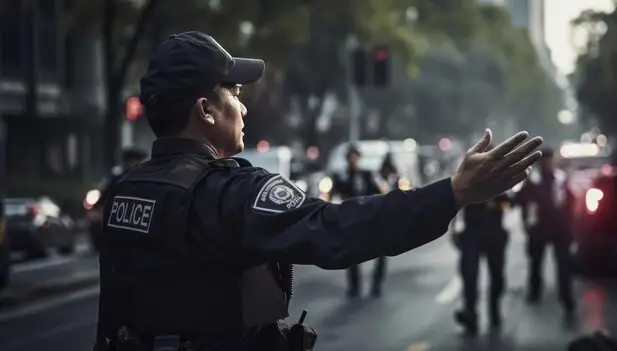
A Deputy Laughed at My 71-Year-Old Mother’s Paper License. Then She Asked Him to Say Her Name on His Radio.
My mother made me stop at the bank on the way. It was a Friday in August, a little after eleven, and we were supposed to be at the courthouse by one for a luncheon. She had me pull into the lot at Farmers and Merchants on Main and told me to keep the air conditioning running for the lemon bars.
“I’ll be ten minutes,” she said. “I need to get into my box.”
I assumed she meant cash, or maybe Dad’s old savings bonds. My mother has rented the same safe deposit box since before I could drive, and I had never once asked what was in it. She went in with her handbag on her arm and came out twelve minutes later, with the same handbag and the same expression. She buckled her seat belt and set the bag on the floor between her feet. Then she insisted on driving.
“It’s my car, Jeffrey, and you drive like you’re late for something.”
So she drove, and I rode in the passenger seat with a nine-by-thirteen pan of lemon bars on my lap. She had made them that morning and dusted the powdered sugar on through a tea strainer. The luncheon was for the opening of the county’s new records archive. It was also, in a roundabout way, for her. She had retired six years earlier after thirty-four years at the courthouse, and somebody had decided the two occasions ought to go together.
I had driven two hours from the city the night before to take her. I’m an insurance adjuster. I spend my days looking at hail damage and arguing about depreciation, and I had taken a vacation day for this with the feeling that I was doing her a favor.
We took County Road 6 because she always takes County Road 6. It was ninety-one degrees. There is no shade on that road for a mile in either direction, only corn on both sides, tall as a hallway. Mom drives forty-eight in a fifty-five. Always has. I watched the needle sit there and said nothing about it, because I’ve been losing that argument since 1994.
The lights came on behind us about four miles out of town. It was a sheriff’s department pickup, white with a green stripe. Mom signaled, slowed, and eased onto the gravel shoulder as carefully as she does everything. She put the car in park and placed both hands on the wheel.
“Was I speeding?” she asked me. She was not joking.
“No, Mom. You were not speeding.”
He walked up with his sunglasses on. He was young, twenty-five or twenty-six, with a fresh haircut and forearms like a ballplayer. His name tag said WESSEL.
“License and insurance.”
No hello. He didn’t say why he’d stopped her, either. My mother reached into her handbag and took out her insurance card and a folded sheet of yellow paper, the one the courthouse gives you when you renew. She had been in the week before for her eye test and her photograph. Her new card hadn’t come in the mail yet.
“My permanent one is on its way,” she said. “That’s the temporary. It’s good for thirty days.”
He held it up to the sun with two fingers, as if it were wet.
“Did you print this at the library, hon?”
Then he laughed. It was a small laugh, through his nose. I felt my face go hot, and it wasn’t from the weather.
“Deputy, that’s a state-issued—” I started.
“Step out of the vehicle, ma’am.”
She stepped out. She had on her flowered dress, the blue one she bought for my cousin’s wedding, and her good low heels. She hung her handbag on her arm and shut the door gently behind her.
“Stand at the back where I can see you.”
I leaned across the seat. “She’s seventy-one years old. It’s ninety degrees out there. Can you tell us what this is about?”
He bent down to my window. I could see myself in his sunglasses, a middle-aged man holding a pan of dessert.
“Sir, you stay in that seat.”
“Sit still, Jeffrey,” my mother said from the back of the car.
So I sat. I’m forty-six years old and my mother told me to sit still, and I did, like I was eight and we were in church.
He went back to his truck with her yellow paper and her insurance card. I watched him climb in. The engine was running and the windows were up, and I could see him behind the glass in the cool, looking down at something in his lap.
Ten minutes went by. I turned the vents so they all pointed at the lemon bars. In the side mirror I could see my mother standing behind the trunk with her feet together and her bag hanging from her elbow. A grain truck came past and blew her dress against her legs. She smoothed it down.
Twenty minutes. I rolled my window down and called back, “Mom, do you want my water?” She shook her head without turning around. She never leaned on the car. The trunk was too hot to touch, and I think that even if it hadn’t been, she wouldn’t have given him the satisfaction of seeing her need it. There was a line of sweat along her hairline, and she took a tissue from her bag and blotted it, the way she’d blot lipstick.
At thirty minutes, the deputy got out to check something on his front bumper, and she spoke to him.
“Deputy, may I wait inside my car? I’d be glad to leave the door open.”
“You can sit when I tell you,” he said, and got back in his truck.
The powdered sugar on the bars had melted clear. I looked down at them because I couldn’t keep looking at the mirror.
Here is what I’m ashamed of. My mother worked nights in the courthouse basement for thirty-four years. She left the house at a quarter to six in the evening with a thermos and a cardigan, even in July, because the basement was kept cold for the paper. She came home after two. She missed my eighth-grade band concert and the district track meet where I placed third in the mile. My father, who carried mail, came to those things alone and clapped loud enough for two.
When I got to college and people asked what my parents did, I said my dad was a letter carrier and my mom worked at the courthouse. If they asked what she did there, I said she just answered phones. I said it like an apology. I said it for years, at dinner parties and to my ex-wife’s family. I said it once to a district manager who had asked out of politeness.
So I sat there in the passenger seat thinking she was nobody to this kid. She was an old woman with a paper license who lived on a county pension of about seventeen hundred dollars a month. I thought about getting out of the car. I thought about it hard, and I thought about what a man like that does when a man like me gets out of a car after being told not to, and I stayed where I was. I haven’t made up my mind whether that was good sense or cowardice.
At forty minutes, he came back with his ticket book open. He walked past my window without looking in and stopped in front of my mother.
“Ma’am, I’m citing you for failure to maintain your lane and for operating a vehicle without a valid license. This paper isn’t going to cut it. I’ve got a tow truck coming for the car. You and your son can ride with the driver or call somebody.”
“A tow truck?” I said out the window. “For a temporary license?”
He ignored me. That’s when she spoke. Her voice was the same one she uses to ask a waitress for more coffee.
“Deputy, may I ask one thing first?”
He sighed. “You can ask.”
“Would you press the button on your radio and say my name? Only my name. Shirley Hagen.”
He turned his head and grinned at me through the back window, inviting me in on the joke.
“You think you’re somebody?”
“No,” she said. “I don’t think that at all.”
I wanted to crawl under the dashboard. I thought the heat had gotten to her. I thought she was about to embarrass herself in front of this boy, and that I’d have to watch it and then drive her home in a tow truck.
He did it for the joke. He put his thumb on the shoulder mic and tipped his chin toward it.
“Dispatch, Fourteen. Got a lady out here on a homemade license wants her name said on the air. Says it’s Shirley Hagen.”
He laughed again and let the button go.
Then the radio went quiet. I’ve been around enough police scanners in my line of work to know what a busy channel sounds like, with the clicks and half-words of people stepping on each other. This was nothing like that. The channel was open and empty, and it stayed that way for what felt like a long time. A blackbird sat on the fence wire across the ditch. The corn moved.
Then a woman’s voice came back, careful and slow.
“Fourteen, say that name again.”
He rolled his eyes and reached for the button. My mother leaned in toward his shoulder first.
“That’s enough, son,” she said quietly. “Just listen.”
He frowned and pulled back. “Ma’am, step back.”
But the voice on the radio came again, and it had an edge on it now.
“Fourteen, this is Dispatch. Confirm the full name.”
He lifted the microphone. Some of the fun had gone out of his face. “Shirley Hagen. That’s what she said.”
There was a pause.
“Deputy, take off your sunglasses and look at the document she gave you. Are you speaking to Shirley Ann Hagen?”
He glanced at my mother, then at the yellow paper clipped in his ticket book. He did not take off the sunglasses.
“That’s what the paper says.”
“Then you need to put your ticket book away. Right now.”
“Why?”
The dispatcher didn’t answer. Instead there was a click, and another voice came over the radio. It was an older man’s voice, unhurried and very clear.
“Fourteen, this is Sheriff Coleman. Do not move that woman another inch. Do you understand me?”
The deputy straightened as if somebody had run a wire up his back. “Yes, sir.”
“Do you know who you’re standing in front of?”
He looked at my mother again. She simply adjusted the strap of her handbag on her arm.
“No, sir.”
“Then you might ask anybody at that courthouse about the woman who spent thirty-four years looking after that building and everyone who worked in it.” The sheriff’s voice stayed level. “Shirley Hagen was the senior court records administrator for this county. She handled sealed judicial documents, evidence transfers and emergency court orders. She trained half the clerks we’ve got and a fair number of my dispatchers. Three sheriffs served during her career, and every one of us knew her.”
I stopped breathing somewhere in the middle of that. Senior court records administrator. I had seen those words exactly once, on the program at her retirement coffee, and I had thought it was a kindness they’d done her, a fancy title for the cake.
The deputy’s face had gone pale under his tan. My mother leaned slightly toward the microphone on his shoulder.
“I retired six years ago, Sheriff,” she said. “I believe the young man has simply forgotten his manners.”
There was a short silence on the air.
“Shirley, I’m sorry,” Sheriff Coleman said. “I’m about three miles from you. Stay where you are. Fourteen, cancel that tow.”
The deputy lowered his hand from the mic. He took his sunglasses off at last, and without them he looked about nineteen.
“Ma’am, I didn’t know—”
“That’s precisely the problem,” my mother said.
He stared at her.
“You didn’t know who I was,” she went on, “so you decided I wasn’t worth treating with respect. You’ve had me standing here forty minutes. I counted them on my watch.”
I looked down at the lemon bars. The powdered sugar had completely disappeared, and the tops had gone glossy and wet. I felt about the same myself. For thirty-four years my mother had gone down into that basement every night and done something that made the sheriff of the county apologize to her on an open radio channel. And I had spent most of my adult life telling people she answered phones.
A black SUV pulled onto the shoulder behind the pickup within four or five minutes. The man who got out had silver hair and a short-sleeved uniform shirt, and he walked straight past his deputy to my mother.
“Shirley.”
She smiled. “Hello, Robert.”
He shook her hand and held on to it a moment, looking her over the way you check on someone who’s had a fall. Then he opened the back door of her car himself and stood there until she sat down in the shade of it with her feet on the gravel. I finally got out. Nobody told me to stay put this time. I handed her my bottle of water and she drank half of it without stopping.
The sheriff turned to the deputy. “Give me your badge and your report.”
Wessel hesitated. “Sir, I was just checking a document. It looked off to me.”
“No. You were humiliating an elderly woman because you thought she couldn’t do anything about it.” He held out his hand. “Did you run her name?”
“I ran the plate.”
“On your laptop. Forty minutes ago. And then what did you do?”
The deputy didn’t answer. He unpinned his badge and laid it in the sheriff’s palm along with the ticket book. A second patrol truck was pulling up by then, and the sheriff told the deputy in it to stay with Fourteen until he sent word.
Then he turned toward me. “Are you Jeffrey?”
I nodded.
He glanced at the pan I was still holding. “Are those lemon bars?”
I almost laughed. “Yes, sir.”
My mother sighed from the back seat. “They were supposed to be for the luncheon.”
“I’d say they still are,” the sheriff said. “We’d better get you there.”
He offered her his arm to stand. Before she took it, she looked up at him, and her face was different. It was the look she used to give my report cards.
“Robert, did the county attorney ever settle what he means to do about the files from the old courthouse investigation?”
The sheriff’s expression changed. He looked at her for a long moment, then at her handbag.
“Why are you asking about those out here?”
She glanced at the deputy standing by his truck with an empty spot on his shirt. “Because that young man held up a piece of paper and decided what it was without reading it. A uniform doesn’t make a person important, and a piece of paper doesn’t make a thing true. The truth is in the records. I’ve been to the bank this morning.”
The sheriff slowly nodded. “Then we need to talk before lunch. Paul’s already waiting on you.”
I drove the rest of the way. Mom let me, which told me more about how she felt than anything she’d said. We followed the black SUV into town at fifty-five on the nose.
“Mom,” I said. “What’s in your purse?”
“Something that belongs to the court.”
“What old investigation?”
“I’ll tell you when we’re sitting down. I only want to say it once.” She had her handbag on her lap now with both hands folded over the clasp. She didn’t look angry and she didn’t look frightened. She looked like a woman who had been carrying something for a long time and could finally see the place to set it down.
The sheriff took us in through the side entrance and up to a conference room on the second floor. I carried the lemon bars, because there was nowhere to leave them. Three judges were waiting at the table, two men and a woman, in shirtsleeves, with their robes off for the heat. So was the county attorney, Paul Deering, a tall man with reading glasses pushed up on his forehead. One of the judges stood the moment he saw my mother.
“Shirley. We heard what happened out there.”
She waved her hand. “Let’s not make a ceremony out of it.”
The sheriff closed the door. He set a thick folder on the table, and Deering squared it in front of him.
“Before we get to this morning,” Deering said, “I have to ask. Did you bring the original?”
My mother opened her handbag. I was expecting her wallet or a tissue packet. She took out a small sealed envelope instead. It was yellowed at the edges and had a strip of brittle tape across the flap. Across the front, in her own neat handwriting, was a date: October 9, 1992.
She placed it on the table.
Deering looked at it without touching it. “Is that the original certification?”
My mother nodded.
I looked from one of them to the other. “Mom, what is going on?”
She turned her chair toward me. “Jeffrey, do you remember how you used to complain that I missed your school things?”
“I remember.”
“I wasn’t only filing papers. In the spring of 1992, the state opened an investigation into how this county was handling tax sales. Farms that fell behind on their property taxes were being sold off, and the same few names kept ending up on the deeds. Two county commissioners were involved, and a man in the treasurer’s office. Some of those deeds carried a notary stamp from a woman who had been dead three years.”
One of the judges shifted in his seat. Deering had opened his folder to a page of typed parcel numbers.
“The evidence came through my office,” she said. “It was deeds and ledgers and bank statements, boxes of it. And then copies started going missing. A file would be there on Tuesday and thin on Wednesday. Judge Whitfield called me upstairs one night and told me to log every piece that moved, who carried it and what time, and to keep the original of that log where nobody in the building could get at it. He signed an order saying so. I put the certification in my box at Farmers and Merchants the next morning.”
“For thirty-four years?” I said.
“The order never was lifted. Judge Whitfield died in 2009. The cases against the commissioners went through, but there were families who never got their ground back, and the paperwork on some of those parcels has been a mess ever since.” She touched the envelope with one finger. “This is the final chain-of-custody certification. Without it, nobody can say for certain which records in that archive are the true ones.”
The sheriff leaned forward. “Shirley refused to let those records disappear. She personally documented every transfer. She paid the rent on that box out of her own pocket the whole time. I only found that out last month.”
“Thirty-five dollars a year,” my mother said. “It went up to fifty.”
I stared at her. I was remembering a winter when I was eleven or twelve and my father suddenly started driving her to work in the evenings and picking her up at two in the morning, with me asleep under a blanket in the back seat. He told me her car was acting up. I remembered a gray sedan parked across from our house for most of a week, and my father walking out to it one evening in his postal jacket, and the sedan leaving.
“Was somebody after you?” I asked.
“Somebody let the air out of my tires in the courthouse lot. Twice. And there was a phone call.” She said it flatly, without any drama. “Your father handled it.”
“Why didn’t you ever tell me?”
She looked down at her hands. “Because I wanted you to have a normal childhood. I didn’t want you lying awake listening for cars.”
Deering asked the judges whether they were satisfied to have the envelope opened in their presence, and all three said they were. He slit the tape with a letter opener. Inside was a signed certification, three pages, with a list of evidence transfers typed single-spaced and initialed in the margin, line after line, with the same small S.A.H. He read the first page and then the second. His face went serious, and he pulled his glasses down onto his nose.
“There are eleven parcels on my list where the title has been in question since before I passed the bar,” he said. “The Lindqvist quarter is one. That estate has been sitting in probate for two years because nobody can prove which deed is good.” He looked up. “These pages could settle things that have been open for decades.”
“That’s why I kept them,” my mother said.
He told her his office would start with the Lindqvist heirs and work down the list. He didn’t make promises. He said some of those families might finally get clear title and some might have a claim for restitution, and there’d be a few it was simply too late to help. My mother nodded at each part of that, including the last.
The sheriff cleared his throat. “Shirley, the county board has approved a formal recognition. We were going to announce your part in all this at the luncheon.”
She shook her head. “I don’t need a plaque, Robert.”
“Then what do you want?”
She thought about it. “I want your department to look at how your people treat folks who don’t look important. Somebody old, or waiting on a replacement document, or too rattled to explain themselves. I had a son in the car and a sheriff who knows my name.” She folded her hands. “The next person that young man stands on the shoulder might not have either one.”
The room was quiet. The woman judge was looking at the table.
“We can make that part of the training review,” Deering said.
“We will,” the sheriff said. “And the ticket’s void. I’d tear it up in front of you, but I expect you’d tell me it’s a record.”
“It is a record,” my mother said. “File it.”
The luncheon was in the new archive itself, a long, bright room on the ground floor of the annex with rolling shelves and a smell of fresh paint. The basement had been retired. There were folding tables with white paper covers, a ham, three kinds of salad and a sheet cake. Someone had set a small photograph of my mother on a table beside a framed certificate. In the picture she was about forty, standing beside a wall of ledger books in a cardigan, not quite smiling.
I put the lemon bars down at the far end of the dessert table and hoped nobody would look closely. A woman with a headset mark still pressed into her hair came straight across the room and hugged my mother hard. That was Connie, the dispatcher, the voice on the radio. Mom had trained her in 1998.
“I about fell off my chair,” Connie told me. “He said ‘homemade license’ and then he said her name, and I thought, oh, you poor dumb kid.”
The sheriff stood up and tapped a glass. He talked about her thirty-four years of service and her attention to detail. He said there were people in the county who still owned their homes because a paper had been where Shirley Hagen said it would be. He kept to what the judges had agreed could be said about 1992, which wasn’t much. Everyone applauded. A lot of the people clapping were old enough to remember more than he said.
I sat in the back with a paper plate on my knee. I hadn’t planned to speak. When the clapping died down I found I was already standing, and then I was at the microphone with my hands in my pockets.
“My mother spent thirty-four years making sure people were treated fairly when they walked into this building,” I said. “A couple of hours ago, I watched someone treat her as if she didn’t deserve the same.”
I looked at her. She was sitting very straight with her handbag on her lap.
“Mom, when people asked me what you did, I used to tell them you answered phones. I’m sorry. I made your work sound smaller than it was, and I did it for years. I thought it was just a job. I never understood how many people were counting on you to do it right.”
Her eyes filled. Then she smiled at me.
“Jeffrey, I never needed you to be impressed by my job,” she said, loud enough for the room. “I just needed you to be proud of me.”
I couldn’t say anything after that. Connie handed me a napkin, and somebody cut the cake.
It turned out people ate the lemon bars anyway. One of the judges had two. We brought half a pan home at four o’clock, and it had by then spent most of the day in a hot car or a warm room. Mom took one at her kitchen table, bit into it, and laughed.
“Well, they’re not winning any baking awards.”
I laughed too, and ate one standing at the counter. It was mostly a lemon puddle on a crust, and it was still pretty good.
“Why didn’t you tell him who you were right away?” I asked. “You stood out there forty minutes. You could have ended it in one.”
She looked out the window over the sink, at the bird feeder Dad put up.
“If a person only treats you decently after he finds out your title or who you know, he hasn’t learned anything, sweetheart. I wanted to see what he’d do with an old woman and a piece of paper.” She brushed crumbs into her palm. “I saw.”
“And the radio?”
“He was going to tow my car. I’d seen all I needed by then.”
I stayed through the weekend. On Saturday I asked to see her retirement program, the one with her title on it, and she got it out of a folder in the hall closet without having to look for it.
The rest came in pieces over the next several weeks, mostly by phone. The department opened an administrative investigation into the stop. They reviewed the delay, the dash camera and the radio log, which showed he had run her license plate four minutes into the stop and then nothing at all for the next thirty-six. Deputy Wessel got his badge back after two weeks. He was required to go through additional training, and the incident went into his file. My mother never asked for his job. She told the sheriff she didn’t want a public apology either, and when he asked if she was sure, she said a man who apologizes in front of a crowd is mostly thinking about the crowd.
I’m not as generous as she is. I would have liked to see him gone. I told her so, and she said that was between me and my own conscience, and asked whether I’d had the oil changed in my car.
The county attorney’s review is still going. The Lindqvist heirs have a hearing date in the spring. Mom got a letter from one of them, a granddaughter in Oregon, and answered it the same day. Of the other ten parcels I know very little, and Deering has been careful about what he says. Mom doesn’t seem troubled by that. She kept that paper for thirty-four years, and she isn’t in a hurry now.
Her permanent license came in the mail the second week of September. I was there that Saturday, fixing a gutter. She opened the envelope at the kitchen table and held the card at arm’s length.
“I look like I’m being held for ransom,” she said.
There was a second envelope in that day’s mail, a plain white one with no return address and a local postmark. Inside was a single sheet of notebook paper, folded in thirds. She read it standing up. It was short, maybe five or six lines in blue ink, and I could see a signature at the bottom that started with a T.
She read it twice. Then she folded it along its creases, put it back in its envelope, and slid it into the drawer where she keeps her stamps and her address book. She didn’t tell me what it said, and I didn’t ask.
She took the yellow paper out of her handbag, where it had been riding for a month, and wrote the date across the top corner in pencil. That went into a folder in the hall closet.
“Are you staying for supper?” she asked. “I have pork chops, but I’d need to know now.”
I said I was staying.