My mother wanted to go to a restaurant because of its name.
That’s what I didn’t understand until much later. I thought she’d picked it because the women at church liked the food. That was part of it. But the real reason was the name painted in gold script across the front window on Westminster Street:
Concetta’s.
That was my grandmother’s name. My mother hadn’t said it out loud in fifty years.
It was Mom’s seventy-eighth birthday, a cold Thursday in early December. Providence, Rhode Island, already had Christmas lights strung across the downtown streets, and the wind coming off the river cut straight through your coat.
She didn’t want anything extravagant. She never does.
“No party, Carla,” she said on the phone the week before. “No cake with candles. No singing waiters. I’m seventy-eight. I don’t need people clapping at me.”
“Then what do you want, Ma?”
There was a pause.
“There’s a little Italian place downtown,” she said. “The ladies from St. Ann’s keep talking about it. Rosemary went for her anniversary. She said the gnocchi made her cry.”
“Rosemary cries at commercials.”
“Carla.”
“Okay. Okay. We’ll go.”
Then she said something I didn’t expect.
“I just want to feel close to home again,” she said.
Home meant Italy.
My mother was born in a small mountain town in Campania, in the south, called Sant’Angelo dei Lombardi. She moved to America in 1971, when she was nineteen.
She was pregnant with me when she got on the plane.
I’m fifty-four. My name is Carla Benedetto. I’m a nurse at Rhode Island Hospital, in the cardiac unit, twenty-six years now. I have two grown kids and a husband named Dom who snores like a leaf blower.
I’m the oldest of three. My brother Danny and my sister Lisa came later, after Mom married a man named Frank Benedetto in 1975. Frank drove a delivery truck for a bakery in Federal Hill. He was charming and loud and couldn’t keep a job or a promise. He left when I was eleven, came back twice, and left for good when Lisa was six.
After that, it was Mom.
She worked two jobs most of my childhood. Days at a jewelry factory in Pawtucket, soldering clasps onto cheap bracelets until her fingers were covered in tiny burns. Nights cleaning offices downtown. Sometimes, on weekends, she did alterations for women in the neighborhood at our kitchen table, a pincushion strapped to her wrist and her mouth full of pins.
She never complained.
Not once that I can remember.
When there wasn’t enough food, she’d say she wasn’t hungry. When we needed winter coats, she’d go without one. I remember her walking me to school one January in a sweater and a scarf, telling me she liked the cold, while her lips were turning blue.
When I graduated nursing school, she sat in the front row at the Providence Civic Center in her one good dress and cried so hard the woman next to her handed her a whole pack of tissues.
She never talked about Italy.
That’s the strange part. Other Italian mothers in our neighborhood talked about the old country constantly. The food. The weather. The cousins. The feuds.
My mother never did.
When I asked about my grandparents, she said they were gone. When I asked about my father, my real father, she said, “He wasn’t a good man, Carla. That’s all you need to know.”
When I asked if she had brothers or sisters, she’d look out the window and say, “There was a brother. A long time ago.”
“What happened to him?”
“There was an earthquake,” she said once. When I was about twelve. “In 1980. He died.”
And she never said another word about it.
So when she said, “I just want to feel close to home again,” I didn’t ask questions.
I just made the reservation.
That evening, I picked her up at her apartment in Cranston. A small one-bedroom on the second floor of a two-family house, with plastic flowers in the window boxes and a statue of the Virgin Mary in the tiny front yard.
She was waiting by the door in her coat.
She’d dressed up. For her, that meant her navy blue dress with the little white collar, the one she wears to funerals and christenings. Her good black orthopedic shoes, freshly polished. A string of fake pearls Danny bought her at Kohl’s in 2009. Lipstick. Just a little.
She was holding her cane. The wooden one with the brass handle. She’d needed it since her hip replacement three years earlier.
“You look beautiful, Ma,” I said.
She waved her hand at me.
“I look old,” she said. “But clean.”
We drove downtown. I parked in the garage on Washington Street. We walked the two blocks to Westminster slowly, because of her hip, with her arm through mine.
When we turned the corner and she saw the restaurant, she stopped.
She stood on the sidewalk under a streetlight and stared at the window.
Gold letters. Old-fashioned script.
Concetta’s. Cucina Irpina. Est. 2023.
“Ma?” I said. “You okay?”
She didn’t answer right away.
“Irpina,” she said softly. “Cucina Irpina.”
“What does that mean?”
“Food from Irpinia,” she said. “From the mountains. Where I’m from.”
She was still staring at the window.
“Nobody here knows Irpinia,” she said. “Everybody here is Neapolitan or Sicilian. Nobody ever says Irpinia.”
She squeezed my arm.
“Let’s go in,” she said.
We walked in holding hands.
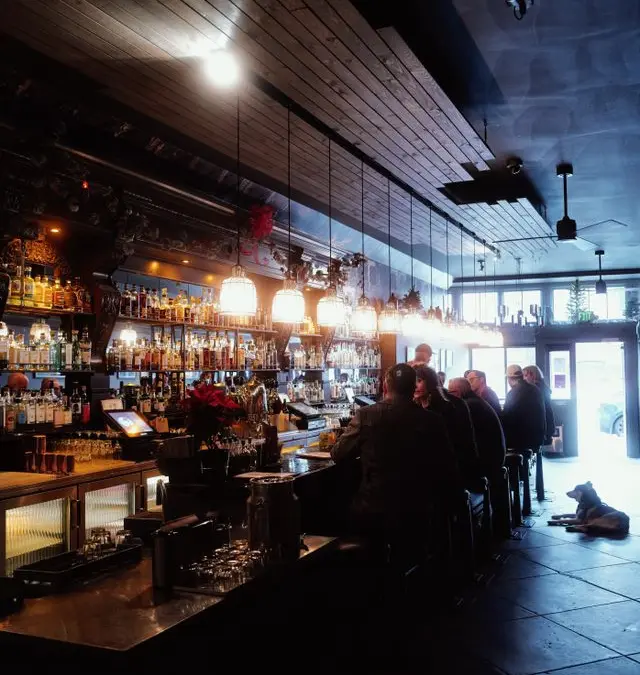
It was a small place. Maybe fifteen tables. Exposed brick walls. White tablecloths. Candles in little glass jars. Black and white photographs on the walls of a mountain village. Stone houses stacked on a hillside. An old church with a bell tower. Women carrying baskets on their heads.
It smelled like garlic and bread and something slow-cooked. Onions and beef and red wine.
My mother closed her eyes and breathed in.
The hostess stand was right inside the door.
The hostess was young. Twenty-two, maybe. Pretty. Long dark hair in a sleek ponytail. Perfect eyebrows. A black dress that probably cost more than my mother’s rent. She was looking at an iPad.
She looked up when we came in.
She looked us over.
Slowly.
Her eyes started at Mom’s orthopedic shoes.
Then moved to her simple navy dress with the little white collar.
Then to her cane.
Then to the fake pearls.
Then to me. My Old Navy puffer jacket. My jeans. My hospital lanyard, which I’d forgotten to take off.
Finally, she smiled.
“I’m sorry,” she said. “But we’re completely booked tonight.”
I glanced past her into the dining room.
Nearly half the tables were empty.
Seven of them, at least. Clean white tablecloths. Silverware laid out. Candles lit. Nobody sitting at them.
“I have a reservation,” I said. “Benedetto. Party of two. Seven o’clock.”
She looked at the iPad.
She scrolled.
She looked back up.
“I don’t see it,” she said.
“I made it on Tuesday. On the phone. I talked to a man. He said seven o’clock was fine.”
“I’m sorry,” she said. “It’s not in the system.”
I looked past her again.
“There are plenty of open tables,” I said.
Her smile tightened.
She leaned forward a little over the hostess stand. She lowered her voice. Like she was letting me in on a secret. Like she was doing us a favor.
“Ma’am,” she said. “This restaurant has a fairly high minimum spend.”
I stared at her.
“A what?”
“A minimum spend,” she said. “Per person. It’s kind of a fine-dining experience. It’s not really, like, a pizza place.”
I didn’t say anything.
I don’t think I could have.
She kept going.
“I just don’t think this place is really suited for you two,” she said.
She looked at my mother’s shoes again.
“You look a little…” She paused. Like she was searching for the polite word. “Inexpensive.”
My mother’s hand suddenly went weak in mine.
I felt it. Her fingers loosened. Her whole arm went soft.
I looked down at her.
She was looking at the floor.
“Sweetheart,” she whispered. “Please. Let’s just leave. I don’t want any trouble.”
She was trembling.
I could feel it through her arm. Through her coat. A fine, steady shaking, like a little bird in your hand.
This was my mother.
A woman who had crossed an ocean at nineteen, pregnant and alone, with one suitcase.
Who’d raised three children mostly on her own.
Who’d soldered bracelets until her fingers bled and scrubbed office toilets at two in the morning and sewed hems at the kitchen table until midnight.
Who’d gone without winter coats and dinner and new shoes and everything else so we wouldn’t have to.
And now she was standing in a restaurant named after her own mother, shaking, because a girl young enough to be her granddaughter had decided she didn’t look rich enough to eat dinner.
I looked right at the hostess.
My voice came out very calm. Calmer than I felt.
“How would you feel,” I said, “if somebody treated your grandmother this way?”
She laughed.
She actually laughed. A short, sharp little laugh through her nose.
“My grandmother,” she said, “would never show up somewhere looking like she couldn’t afford to be there.”
For a second, I couldn’t believe what I’d heard.
I’ve been a nurse for twenty-six years. I’ve been yelled at by drunk patients. Cursed at by family members. Spit on, once, by a man coming out of anesthesia.
I’ve never wanted to hit somebody as much as I wanted to hit that girl.
Mom tugged gently on my hand.
“Please,” she whispered. “Carla. Please. It’s okay. We’ll go somewhere else. We’ll go to the Olive Garden. I like the breadsticks.”
She didn’t like the breadsticks. She’d said so a hundred times. She said they tasted like cardboard with salt on it.
She just wanted to leave.
So I put my arm around her shoulders.
I turned her toward the door.
I got ready to walk out and take my mother to the Olive Garden for her seventy-eighth birthday.
That’s when we heard glass breaking in the kitchen.
It was loud. A crash and a shatter, like a whole tray of glasses hitting a tile floor.
Everyone near the entrance turned around. A couple at the bar. A server carrying two plates. The hostess.
Me.
There was a small service window behind the hostess stand. A rectangle cut into the brick wall, with a little stainless steel counter, where the cooks put plates out for the servers. It was open.
And on the other side of it, in the kitchen, stood an old man.
He was wearing a white chef’s coat. His sleeves were rolled up. He was in his seventies, maybe. Short. Thick-shouldered. A full head of white hair, combed back. Thick white eyebrows.
There was broken glass all around his feet. He must have dropped whatever he was holding.
He didn’t look down at it.
He was standing completely still.
Staring at my mother.
Not casually.
Not curiously.
He was staring at her like he’d seen a ghost.
His face had gone white. His mouth was open. One hand was pressed flat against the stainless steel counter of the service window, like he needed it to hold himself up.
Mom didn’t see him at first. She was turned toward the door. Looking at the floor.
Then the man disappeared from the window.
Seconds later, the kitchen doors burst open.
Two swinging doors at the back of the dining room. They slammed against the brick walls so hard that a picture frame rattled.
The old man came through them.
Fast. Faster than a man his age should be able to move.
He rushed through the dining room between the tables.
A server carrying a tray of wine glasses jumped out of his way.
A young cook in a white apron came through the doors behind him. “Nonno! Nonno, what’s wrong? Nonno, your hand—”
The old man ignored him.
He ignored everybody.
He stopped about three feet from my mother.
She’d turned around at the sound of the doors.
She was standing there with her cane in one hand and my arm in the other, looking at this old man in a chef’s coat, confused.
For several seconds, neither of them said anything.
The whole restaurant had gone quiet. The couple at the bar had stopped talking. The server with the tray of glasses was standing frozen in the middle of the room.
The hostess was staring at the old man with her mouth open.
Then his eyes filled with tears.
And to everyone’s shock, he dropped to his knees.
Right there on the tile floor of the entryway. In his white chef’s coat. In front of my mother.
He reached up.
And he gently took her hand.
The one that wasn’t holding the cane. The one that was shaking.
He held it in both of his. Big, rough, scarred hands. A cook’s hands. Covered in little burns, the same way my mother’s used to be.
The entire restaurant went silent.
Mom stared down at him.
Completely confused.
“Do I know you?” she whispered.
The man looked up at her.
His face was wet. His chin was shaking.
And then he said a name I had never heard before in my life.
“Nennella,” he said.
My mother’s face changed instantly.
I watched it happen.
The confusion vanished. Like a light switching on. Her eyes went wide. Her mouth fell open. All the color drained out of her face so fast I thought she was going to faint.
Her cane slipped from her fingers.
It struck the tile floor with a sharp crack. The brass handle bounced. It rolled under the hostess stand.
Nobody picked it up.
“No,” my mother whispered.
“Nennella,” the old man said again. “Nennè. Sono io. Sono Enzo.”
It’s me. It’s Enzo.
My mother’s knees buckled.
I caught her under the arms. I’m a cardiac nurse. I’ve caught a lot of people.
But I nearly didn’t catch her. She went down so fast.
The old man caught her too.
From below. He came up off his knees and put his arms around her waist, and between the two of us we held her up.
“Enzo,” my mother said.
Her voice was a thin, high sound I’d never heard come out of her.
“Enzo. No. No. Non è possibile. You’re dead. You died. In the earthquake. They told me. Zia Filomena told me. You were on the list. You were on the list of the dead.”
The old man was sobbing now.
“I was on the list,” he said in English. Heavy accent. “I was on the list. They made a mistake. They found me after four days. Under the church. Broken legs. Broken arm. Two weeks in a hospital in Avellino with no name on my bed.”
He was holding her face now. With both hands.
“I wrote to you,” he said. “Nennè. I wrote to you every month. Twelve years. Every letter came back. Every one.”
My mother couldn’t speak.
She just stood there, held up by me on one side and this stranger on the other. Shaking her head. Over and over.
“Ma,” I said. “Ma. Who is this?”
She turned and looked at me.
And she said the words that changed everything I thought I knew about my mother.
“Carla,” she said. “This is my little brother.”
Behind us, the hostess’s face had turned completely white.
She was standing behind the hostess stand with her iPad clutched against her chest. Staring at the old man. Staring at my mother.
The young cook in the apron had come up beside her. Twenty-five, maybe. Dark curly hair. Flour on his forearms.
“Bri,” he said quietly. “What did you say to them?”
The hostess didn’t answer.
The old man looked up.
He looked at the hostess. At the iPad. At my mother’s cane under the hostess stand.
Something changed in his face.
“Brianna,” he said.
His voice was very quiet.
“What did you say to your Zia?”
The hostess stared at him.
“My… what?”
“Your Zia,” the old man said. “Your great-aunt. My sister.”
He put his hand on my mother’s shoulder.
“This is Annunziata,” he said. “This is my big sister. Nennella. The one I’ve told you about your whole life. The one in the picture in my kitchen. The one this restaurant is for.”
Brianna’s iPad slipped out of her hands.
It hit the floor next to my mother’s cane.
Nobody picked that up either.
Somebody brought a chair. The young cook, I think. He set it down right there in the entryway, and Enzo and I lowered my mother into it.
She was breathing too fast. I put two fingers on her wrist without thinking. Fast pulse, but strong and regular. She was okay. She was in shock, but she was okay.
Enzo knelt down on the floor in front of her chair. He wouldn’t let go of her hand.
The young cook came back with a glass of water.
He also brought my mother’s cane. He’d crawled under the hostess stand to get it. He leaned it carefully against her chair.
“I’m Marco,” he said to me quietly. “I’m his grandson. Enzo’s. That’s my cousin Brianna.”
He nodded at the hostess stand.
Brianna hadn’t moved.
“Ma,” I said. I crouched down next to her chair. “Ma. Talk to me. Are you okay?”
She looked at me.
Then she looked at Enzo, kneeling on the floor in front of her.
She reached out with her free hand. Very slowly. And touched his face. His white eyebrows. His cheek. His chin.
“You have Papà’s chin,” she whispered.
“You have Mamma’s eyes,” he said.
She started to cry.
Enzo closed the restaurant.
Right then. At 7:20 on a Thursday night. He stood up and told Marco to put the CLOSED sign in the window and lock the front door.
There were six other tables with customers. A family. Two couples. A business dinner. A pair of old women from somewhere in the neighborhood.
Enzo went to each table himself.
“I’m sorry,” he said. “Your dinner is free tonight. Please, take your time. Finish your food. But I am closing. My sister has come home.”
Nobody complained.
Not one person.
One of the old women at the corner table, who looked about eighty, stood up as we passed and put her hand on my mother’s shoulder.
“Brava,” she said. “Brava, signora.”
I don’t think she even knew what she was saying it for.
Enzo sat us down at the big round table in the back corner. Under a black and white photograph of a mountain town.
He pulled his chair right next to my mother’s. Close. Their knees were touching.
He was still holding her hand.
“Ma,” I said. “I don’t understand. You told me your brother died. In the earthquake. In 1980.”
“I thought he did,” my mother said.
She was looking at Enzo. She couldn’t stop looking at him.
“Zia Filomena wrote to me,” she said. “My aunt. From Sant’Angelo. She wrote in December of 1980. She said the earthquake destroyed half the town. She said the church fell down. She said Enzo was inside it when it fell. She said they found his body.”
“They found a body,” Enzo said quietly. “A boy from the next street. Pasquale Ruggiero. He was wearing my jacket. I lent it to him that afternoon because he was cold.”
He wiped his eyes with the back of his hand.
“They put my name on the list,” he said. “On the board outside the town hall. Vincenzo Esposito. Deceased. For four days. Until they dug me out from under the bell tower.”
My mother put her hand over her mouth.
“By the time they fixed the list,” Enzo said, “Zia Filomena had already written to you. And then she died too. In the spring. Her heart. And I had no address. Nothing. Only the last letter you sent to Mamma, years before. From a place called Providence. In America.”
I didn’t know what to say.
I looked at my mother.
Seventy-eight years old. In her navy dress with the little white collar. Her fake pearls. Her cane leaning against her chair.
And sitting next to her, holding her hand, was a brother I’d never known existed.
Who she’d believed was dead for forty-six years.
“Ma,” I said slowly. “Why didn’t you ever tell me? About any of it? About him?”
My mother looked at me for a long time.
Then she looked down at the white tablecloth.
“Because I was ashamed,” she said.
She told me the story.
At that table. In the back corner of a restaurant named after her mother. With her little brother holding her hand.
It took almost two hours.
She was born in 1948 in Sant’Angelo dei Lombardi. A town of stone houses on a mountain in Irpinia. Her father, Gaetano, was a stonemason. Her mother, Concetta, made pasta by hand for the whole street every Sunday and sold it out of their kitchen window.
Annunziata was the oldest. Enzo came seven years later.
“She raised me,” Enzo said. Before my mother could. “Mamma worked so hard. Papà was always building something. Nennella took care of me. She walked me to school. She sang to me at night. She made me eat my vegetables. She hit me with a wooden spoon when I was rude.”
My mother laughed. A wet, broken laugh.
“You deserved it,” she said.
“I deserved it,” Enzo agreed.
“Nennella,” I said. “What does that mean?”
“Little Nunzia,” my mother said. “It’s Neapolitan. A baby name. Only my family called me that.”
She looked at Enzo.
“Only him, after a while,” she said. “He couldn’t say Annunziata when he was little. It was too long. So he called me Nennella. And it stuck.”
In 1970, when she was eighteen, my mother fell in love.
His name was Raffaele. He was twenty-three. He worked on a construction crew from Naples that came to build a new road through the mountains. He had a motorcycle and a gold chain and a smile, she said, that could make the Madonna blush.
He stayed in Sant’Angelo for four months.
When the road was finished, he went back to Naples.
In January 1971, my mother found out she was pregnant.
She wrote to Raffaele. Three times.
He never wrote back.
“When Papà found out,” my mother said, “he took off his belt.”
She said it very quietly.
“He didn’t hit me. Mamma stood in front of me. She stood between us. But he said things. Terrible things. In front of the whole street. He said I was dead to him. He said I had shamed the family. He said no daughter of his would have a bastard under his roof.”
My mother looked down at her hands.
“So Mamma sold her wedding ring,” she said. “To a man in Avellino. And she bought me a ticket. On a ship. To New York. And she gave me the address of her cousin in Providence. Cousin Lucia. And she put me on a bus to Naples in the middle of the night.”
“I was twelve,” Enzo said.
His voice was shaking.
“I woke up,” he said, “and I heard the door. And I ran outside in my bare feet. And she was getting on the bus. With one suitcase. And I ran after the bus. All the way down the hill. Screaming her name. Nennella. Nennella. Nennella.”
He put his hand over his eyes.
“She didn’t look back,” he said. “She couldn’t. I know that now. But I didn’t know it then. I thought she didn’t want to look at me.”
“I couldn’t look back,” my mother whispered. “If I looked back, I’d have gotten off the bus. And Papà would have killed me. Or I’d have stayed and ruined everybody’s life. So I didn’t look.”
She was crying.
“I heard you,” she said to Enzo. “I heard you the whole way down the hill. I’ve heard you every night for fifty-five years.”
She came to Providence in March 1971.
Cousin Lucia let her stay in her attic in Federal Hill for six months. My mother got a job at the jewelry factory in Pawtucket. She had me in September at Women & Infants Hospital. Alone.
She wrote to her mother every week.
“Papà burned them,” Enzo said. “The letters. He’d take them from the mailman before Mamma could see them. And he’d put them in the stove. Every single one.”
He swallowed.
“Mamma found one in the ashes once,” he said. “Half burned. She could read the last line. It said, ‘Kiss Enzo for me. Tell him I’m sorry I didn’t look back.’”
My mother made a sound. A small, broken sound.
“Mamma cried for three days,” Enzo said. “And then she started going to the post office herself. Every morning. Before Papà woke up. To get your letters first.”
He looked at my mother.
“She got four,” he said. “Four letters. Over two years. Before Papà found out and made the post office give him everything.”
“Mamma kept them,” Enzo said. “In her apron pocket. Every day. For nine years. Until the earthquake.”
The earthquake.
November 23rd, 1980. A Sunday evening. Magnitude 6.9.
It destroyed most of Sant’Angelo dei Lombardi. The hospital collapsed. The cathedral collapsed. Hundreds of people died in that one town. Almost three thousand across the region.
“Mamma was in the kitchen,” Enzo said quietly. “Making pasta for the next morning. The house came down on her.”
He looked at my mother.
“They found her letters in her apron,” he said. “In the pocket. When they found her. Four letters from Providence. With your address on the back.”
My mother couldn’t speak.
She just held onto her brother’s hand and cried.
“Papà died two years later,” Enzo said. “In a trailer. The government gave us trailers. For years. He never got over Mamma. He drank.”
He took a breath.
“And before he died,” Enzo said, “he gave me those four letters. And he said, ‘Find her, Vincenzo. Find your sister. Tell her I was wrong.’”
Enzo reached into the front pocket of his chef’s coat.
He took out his wallet. Old brown leather. Cracked and soft.
He opened it.
From behind his driver’s license, he pulled out a photograph. Black and white. Small. Creased in four places. The edges soft as cloth.
He laid it on the white tablecloth in front of my mother.
It was a young girl. Sixteen, maybe. Long dark hair. A simple cotton dress. Standing in front of a stone wall with a little boy on her hip. The boy was about five. He had a gap in his front teeth. He was laughing.
The girl was laughing too.
“Mamma took it,” Enzo said. “With a camera she borrowed from the priest. Summer of 1964. On the steps of the church.”
He touched the edge of the photograph.
“I’ve carried it every day for forty-four years,” he said.
My mother picked it up.
She looked at it for a long, long time.
“I remember that dress,” she whispered. “Mamma made it. Out of an old tablecloth.”
“I came to America in 1984,” Enzo said. “With the four letters. And this picture. And about two hundred dollars.”
He shook his head.
“I went to Providence first,” he said. “To the address on the letters. On Atwells Avenue. Cousin Lucia’s house.”
“Lucia sold that house,” my mother said. “In 1979. She moved to Florida.”
“I know,” Enzo said. “There was a family from Portugal living there. They’d never heard of you.”
“I went to the jewelry factory in Pawtucket,” Enzo said. “It was in one of your letters. They said they had a lot of Italian girls. They didn’t keep records.”
He looked at my mother.
“And I didn’t know,” he said, “that your name wasn’t Esposito anymore.”
Benedetto.
She’d married Frank Benedetto in 1975.
She’d been Annunziata Benedetto for nine years by the time her brother came looking for her.
“I looked for four months,” Enzo said. “I knocked on doors in Federal Hill. I asked at every church. Holy Ghost. St. Mary’s. St. Bartholomew. I asked every old woman on every porch.”
He wiped his eyes.
“Then my money ran out,” he said. “I had a cousin in New York. In Arthur Avenue, in the Bronx. He had a restaurant. He needed a cook. So I went.”
“I worked in his kitchen for twelve years,” Enzo said. “Then I opened my own. A little place. On Arthur Avenue. Thirty-one years.”
He smiled. A sad smile.
“I got married,” he said. “Teresa. Thirty-eight years. She died two years ago. Cancer. We had two daughters. Six grandchildren.”
He nodded toward the front of the restaurant.
“Brianna is my daughter Sofia’s girl,” he said. “Marco is Gina’s son.”
“After Teresa died,” Enzo said, “I didn’t know what to do with myself. I’m seventy-one. My daughters said retire. Move to Florida. Play bocce.”
He shook his head.
“Gina lives here,” he said. “In Providence. In Cranston. She said come live near us. And I thought about Providence. About those four letters. About the address on Atwells Avenue.”
He looked around the dining room. At the brick walls. At the photographs of the mountain town.
“So I opened one more restaurant,” he said. “A little one. And I named it Concetta’s. And I put Irpinia on the window. And I cooked Mamma’s food. Exactly the way she made it. Every dish.”
His voice broke.
“I thought,” he said, “maybe if you were still alive. Maybe if you were still here. Maybe someday you’d walk past. And you’d see Mamma’s name in the window. And you’d come in.”
My mother looked at him.
“I did,” she whispered.
“You did,” Enzo said.
“I saw the window,” my mother said to me. “Carla. Two months ago. Rosemary drove me past it after Bible study. She said, ‘Nancy, the food at that place is incredible. You’d love it. It’s real Italian, like your mother used to make.’”
My mother has gone by Nancy since 1971. Annunziata was too hard for Americans to say.
“And I looked out the car window,” Mom said. “And I saw it. Concetta’s. Cucina Irpina.”
She shook her head.
“I didn’t sleep that night,” she said. “I kept thinking it was a coincidence. A lot of women are named Concetta. A lot of people come from Irpinia.”
She looked at Enzo.
“But I had to come,” she said. “I had to see. I couldn’t tell anybody why.”
“Why didn’t you tell me?” I said.
My mother looked at me.
“Because I didn’t want to hope,” she said quietly. “I’d already lost him once. I couldn’t lose him twice.”
That’s when Brianna came over to the table.
She’d been standing at the hostess stand the whole time. For almost two hours. I’d forgotten she was there.
She walked slowly across the dining room. She stopped about five feet from our table.
Her face was pale and blotchy. Her mascara had run. She was holding her hands clasped in front of her, the way a kid does when she’s been called to the principal’s office.
Enzo looked up at her.
He didn’t say anything.
“Zia,” Brianna said.
Her voice was shaking.
“I’m sorry,” she said. “I’m so sorry. I didn’t know. I didn’t know who you were.”
My mother looked at her.
She didn’t say anything either.
“It doesn’t matter who she is,” Enzo said.
His voice was very quiet. But it filled the whole room.
“Brianna,” he said. “Look at me.”
She looked at him.
“It doesn’t matter,” Enzo said, “whether she’s your Zia or a stranger off the street. You don’t talk to anybody the way you talked to her. Not in my restaurant. Not anywhere.”
Brianna started crying.
“Nonno—”
“Do you know what this restaurant is?” Enzo said.
She didn’t answer.
“This restaurant,” Enzo said, “is named after a woman who sold pasta out of her kitchen window to feed her family. Who sold her wedding ring to put her daughter on a ship. Who wore cheap shoes her whole life. Who never once had a dress that cost more than a few thousand lire.”
He pointed at my mother.
“And her daughter,” he said, “crossed an ocean by herself at nineteen. With one suitcase. And raised three children by herself. In a country where she didn’t speak the language. Working in a factory.”
He looked at Brianna for a long time.
“Your great-grandmother,” he said, “would never have been allowed through that door. If you’d been standing at it.”
Brianna put her hands over her face and sobbed.
My mother reached for her cane.
She stood up. Slowly. Leaning on the table. I started to help her, and she waved me off.
She walked over to Brianna.
She stood in front of her.
Brianna was a head taller than her, even in flats.
“Look at me, cara,” my mother said.
Brianna lowered her hands.
My mother looked up at her for a long moment.
“You said,” my mother said slowly, “that your grandmother would never show up somewhere looking like she couldn’t afford to be there.”
Brianna flinched.
“Do you know what your grandmother looked like?” my mother said. “Your real grandmother. Your Nonna Teresa?”
Brianna shook her head. She couldn’t talk.
My mother turned to Enzo.
“Enzo,” she said. “What did Teresa wear?”
Enzo smiled. A small, sad smile.
“Housedresses,” he said. “From the Kmart on Fordham Road. She owned exactly one pair of good shoes. She wore them to our wedding, and to our daughters’ weddings, and I buried her in them.”
My mother looked back at Brianna.
“You see?” she said gently. “Neither of us could afford to be anywhere, cara. Not when we were young. We made places we could afford to be. For people like you.”
She reached up and touched Brianna’s cheek. Very lightly.
“Don’t ever forget who built the door you’re standing at,” she said.
Brianna couldn’t stop crying.
“I’m sorry,” she whispered. “Zia. I’m so sorry.”
My mother looked at her for a long time.
Then she did something I didn’t expect.
She opened her arms.
Brianna stared at her.
Then she stepped forward.
And my seventy-eight-year-old mother, in her navy dress with the little white collar and her orthopedic shoes, hugged the girl who’d called her inexpensive.
Over Brianna’s shoulder, I saw Enzo put his face in his hands.
Then Enzo stood up.
“Basta,” he said. “Enough crying. It’s her birthday.”
My mother turned around. “How do you know it’s my birthday?”
Enzo looked at her like she’d asked him what color the sky was.
“December 5th,” he said. “1948. I’m your brother. You think I’d forget?”
He clapped his hands.
“Marco,” he said. “The kitchen. Now. We’re making the genovese.”
Marco grinned. “Nonno, it takes six hours.”
“Then we’ll be here till two in the morning,” Enzo said. “I don’t care. Make the gnocchi first. And the soup with the escarole. And the peppers with breadcrumbs.”
He looked at my mother.
“And the torta,” he said. “Mamma’s torta. With the ricotta and the lemon. For your birthday.”
My mother’s face crumpled again.
“You remember the torta?” she whispered.
“I’ve made it every December 5th,” Enzo said, “for forty-six years. And eaten a piece for you. Every year.”
We stayed until almost two in the morning.
I called Dom. He brought our kids, Nicky and Gianna. I called my brother Danny in Warwick. He came in his pajama pants with a coat over them. I called my sister Lisa in Boston. She drove down. She got there at eleven-thirty, crying so hard she could barely walk.
Enzo called his daughters. Gina came from Cranston with her husband. Sofia, Brianna’s mother, came from New York. She drove three hours. She got there at midnight.
By the end of the night, there were nineteen of us at that round table in the back corner.
Under the photograph of the mountain town.
Enzo cooked everything.
The gnocchi, pillowy and soft in a sauce of tomato and basil. The escarole soup with little meatballs no bigger than marbles. The roasted peppers stuffed with breadcrumbs and capers. Homemade bread still warm from the oven.
And near midnight, the genovese. Beef and onions cooked down for hours until they were sweet and almost melting, over a twisted kind of pasta Enzo called ziti spezzati, broken by hand.
My mother took one bite.
She put down her fork.
She closed her eyes.
“Mamma,” she whispered.
At one in the morning, Marco brought out the torta.
A simple cake. Ricotta and lemon. Dusted with powdered sugar. No frosting. No decorations.
Seventy-eight candles.
Enzo insisted. Marco had to go to the CVS on Westminster Street and buy every box of candles they had.
My mother looked at it.
“I said no candles,” she said.
“You said no candles to her,” Enzo said, pointing at me. “You didn’t say no candles to me.”
She laughed.
She actually laughed. A real one. The kind of laugh I hadn’t heard from my mother in years. Maybe ever.
Enzo leaned over and whispered something to her in Italian.
She whispered something back.
Then, together, my mother and her little brother blew out seventy-eight candles.
It took them four tries.
Everybody at the table was laughing so hard that nobody could help.
That was a year ago.
My mother goes to Concetta’s every Sunday now. After Mass at St. Ann’s.
Enzo picks her up himself. In his old Buick. He opens the car door for her. He carries her cane.
She sits at the round table in the back corner. Under the photograph of the mountain town. And Enzo brings her a plate of whatever he’s making that day, and sits down across from her, and they talk.
In Italian. In the dialect from the mountains, which I can’t understand a word of. For hours.
Sometimes they laugh so hard the whole restaurant turns around.
Sometimes they cry.
Mostly they laugh.
In March, they went back to Italy together.
To Sant’Angelo dei Lombardi.
My mother hadn’t been back in fifty-five years. Enzo hadn’t been back in forty-two.
The town has been rebuilt. New houses. A new hospital. A new cathedral, built where the old one fell.
They went to the cemetery on the hill. To the graves of their parents. Gaetano and Concetta Esposito.
My mother knelt in front of her mother’s headstone.
She’d brought something from America.
The four letters. The ones Concetta had carried in her apron pocket for nine years. The ones Enzo had carried for forty-two.
My mother laid them on the grave.
And she said something in Italian that Enzo wouldn’t translate for me afterward.
“That one’s hers,” he said. “Not mine to tell.”
Then they went to the church steps.
The new church. But the same steps. Same stone. Same spot.
Enzo took a picture of my mother standing exactly where she’d stood in the summer of 1964, with a five-year-old on her hip.
Then my mother took a picture of Enzo.
Then a woman walking by offered to take one of them together.
That picture is framed on the wall of Concetta’s now.
Right next to the old one. The black and white one from 1964. The sixteen-year-old girl in a dress made from a tablecloth, with a gap-toothed boy on her hip.
And next to it, the new one. A seventy-eight-year-old woman with a cane and a seventy-one-year-old man in a white chef’s coat. On the same church steps. In the same spot.
Still laughing.
Brianna still works at the hostess stand.
Enzo didn’t fire her. A lot of people thought he would. Danny thought he should.
“No,” Enzo said. “If I fire her, she learns nothing. She goes to another restaurant and does the same thing to somebody else’s mother.”
So she stayed.
But there’s a new rule at Concetta’s now.
It’s printed on a little card at the hostess stand. In Enzo’s handwriting. In English and in Italian.
At this table, everyone is family.
Brianna spends every Tuesday morning now volunteering at the food pantry at St. Ann’s. With my mother.
My mother insisted.
They hand out cans of soup and boxes of pasta and bags of rice to families who look exactly like my mother looked in 1971.
The first week, Brianna was stiff and awkward. She didn’t know what to say to anybody.
By the third week, she was learning names.
By the second month, she was bringing day-old bread from the restaurant. Without being asked.
Last month, she came up to me at the restaurant on a Sunday.
“Carla,” she said. “Can I ask you something?”
“Sure.”
“Do you think she’s actually forgiven me? Zia? Or is she just being nice?”
I looked over at the round table in the back corner.
My mother was sitting there with Enzo. Eating a bowl of escarole soup. Laughing at something he said.
When she saw Brianna looking, she waved her over.
“Bri,” she called. “Come here. Sit. Your Nonno is telling the story about the goat again.”
I looked back at Brianna.
“She’s not just being nice,” I said.
This December 5th, my mother turned seventy-nine.
We had the party at Concetta’s.
All of us. Thirty-one people this time. Danny and Lisa and their families. Dom and our kids. Gina and Sofia and their husbands and all six of Enzo’s grandchildren. Rosemary and four other women from St. Ann’s. Cousin Lucia’s granddaughter, who flew up from Florida.
The whole restaurant. Every table. Closed to the public for the night.
Brianna stood at the hostess stand.
She’d made a sign herself. On a piece of poster board. Taped to the front of the stand.
BENVENUTA A CASA, ZIA NENNELLA.
Welcome home.
When my mother walked in the front door, holding my arm, in her navy dress with the little white collar and her orthopedic shoes, Brianna came around the stand.
She didn’t say anything.
She took my mother’s coat.
Then she took her cane and leaned it carefully against the wall.
And she held out her arm.
My mother looked at her.
She took Brianna’s arm.
And Brianna walked her slowly through the dining room, past every table, all the way to the round table in the back corner under the photographs.
To her brother.
Enzo stood up when he saw her coming.
He was wearing his white chef’s coat. His sleeves rolled up. Flour on his forearms.
He pulled out her chair.
“Nennè,” he said. “Happy birthday.”
My mother sat down.
She looked around the restaurant. At thirty-one faces. At the candles in the little glass jars. At the photographs on the brick walls. At the gold letters on the front window, backward from the inside.
Concetta’s.
“Ma,” I said. “Are you okay?”
She didn’t answer right away.
Then she reached over and took her brother’s hand on the white tablecloth.
“Carla,” she said. “Do you remember what I told you? Last year? When you asked what I wanted for my birthday?”
I remembered.
I just want to feel close to home again.
“I was wrong,” my mother said.
She squeezed Enzo’s hand.
“I didn’t want to feel close to home,” she said. “I wanted to find it.”
She looked around the table. At all of us.
“And I did,” she said.
Enzo leaned over and kissed her on the forehead.
Then he stood up and clapped his hands.
“Basta,” he said. “Enough. Marco! Bring out the genovese. And somebody go to the CVS. We need seventy-nine candles.”