The alarm went off at 3:15, but I was already awake. I’d been awake since about two, lying in the dark next to Dale and listening to the furnace kick on and off. It happens every year. My body knows when Black Friday is coming before my brain does.
I got up quietly and dressed in the bathroom so I wouldn’t wake him. Black slacks, the red Bramble Toys polo with my name stitched over the pocket, and two pairs of socks, because the front of that store gets cold every time the doors open. When I came out to the kitchen, Dale was standing at the counter in his flannel robe, pouring coffee into my thermos.
“You didn’t have to get up,” I said.
“I’ve gotten up for seventeen of these,” he said. “I’m not breaking the streak now.”
He handed me the thermos and a peanut butter sandwich wrapped in wax paper. He’s done that every year since my first one at Bramble, back when I was forty-seven and he’d just hurt his back at the hospital and we needed my paycheck more than either of us wanted to admit. His back got better. The paycheck never stopped mattering. Our Medicare supplement went up again in October, and the furnace guy had already told us we had maybe one more winter out of that old Carrier.
“You think he’ll come?” Dale asked.
He didn’t have to say who.
“He always comes,” I said.
“He’s what, almost eighty now?”
“Seventy-eight, I think. He told me once.”
Dale kissed me on the forehead. “Go on, then. Go see your doll man.”
My name is Norma. I’m sixty-four years old, and I’ve been a cashier at Bramble Toys in Rochester, Minnesota, for seventeen years. The store sits in a strip mall off Highway 52, between a mattress place and a Chinese buffet. It used to be a little family shop downtown, decades ago, before a company out of Minneapolis bought the name and turned it into four stores across southern Minnesota. Ours is the biggest. We have a whole wall of bikes, an aisle of video games behind locked glass, and a section of plastic dinosaurs that roar if you press their bellies.
Black Friday is the hardest day of my year. The doors open at five in the morning. By four-thirty, the line wraps around the building and halfway into the parking lot, past the mattress store’s windows. Parents stand out there in pajama pants and winter coats, holding phones with the ad pulled up. Kids sleep on their fathers’ shoulders. Grandmothers sit on folding camp chairs they brought from home. Somebody always has a thermos of hot chocolate going down the line, and somebody always gets in an argument about who was there first.
I pulled into the employee lot at 4:10. The line was already longer than last year. I could see breath steaming in the parking lot lights.
Inside, the store was bright and humming. The stock kids had been there since midnight. Devin, our sixteen-year-old stock boy, was pulling the last of the doorbuster boxes onto pallets near the front, a tower of discounted kids’ tablets wrapped in plastic. He waved at me with a box cutter.
“Morning, Miss Norma.”
“Morning, Devin. You eat anything?”
“A Monster.”
“That’s not food.”
“It’s got calories.”
I gave him half my peanut butter sandwich. Then I went to register three, where I’ve stood every Black Friday for seventeen years, and started counting my drawer.
That was when Tricia came over.
Tricia was new that year. The company had sent her down from the Burnsville store in August, after our old manager, Gary, retired to Arizona to play golf and complain about the heat. She was twenty-nine. She wore her hair in a tight ponytail and carried a clipboard with colored tabs on the side, a different color for every department. She’d already reorganized the stockroom twice, and she’d started timing our breaks with an app on her phone.
She wasn’t mean, exactly. She just treated everything like a spreadsheet with a few cells out of place.
“Norma,” she said. “You’re on three?”
“I’m always on three.”
“I’ve got you on three and then floating to returns at nine.” She made a little mark on her clipboard. “We’re targeting a ninety-second transaction time this morning. District’s watching the numbers.”
“I’ll do my best.”
“I know you will.” She smiled the way people smile at the dentist, and moved on to Kayla on register four.
At 4:58, the assistant manager went to the doors with the keys. The crowd outside pressed closer. Kids woke up. Somebody started counting down from ten, and the whole line picked it up, and at five o’clock exactly the doors slid open and the cold came rushing in.
And the first person through them, the same as every year for eight years, was Irving.
I’d better explain about Irving.
The first Black Friday he came was eight years ago. I remember it because it was the year the store had that hoverboard nobody could keep in stock, and the line was the longest we’d ever had. When the doors opened, a crowd of young parents sprinted for the electronics aisle. But the first man through the door didn’t run. He was tall and a little stooped, in a gray wool coat buttoned all the way up to his chin, with a gray felt hat. He walked right past the hoverboards. He walked past the bikes and the video games and the dinosaurs, all the way to aisle six, the doll aisle.
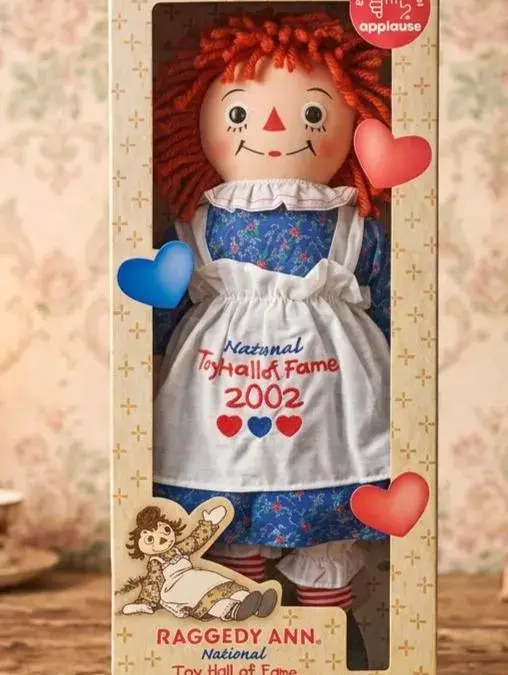
He came back with one rag doll. It had red yarn hair and a blue gingham dress with a white collar, and little black stitched eyes. It’s made by a family company over in Wisconsin. We get maybe two dozen in a season. It was $24.99.
He set it on my counter. He paid in cash, with exact change, counting it out slowly from an old leather coin purse. A twenty, four ones, three quarters, two dimes, and four pennies.
I handed him his receipt. Then I went to put the doll in a bag, and he put his hand flat on top of it.
“No,” he said. “That’s for you to keep.”
“Sir?”
He slid the doll back across the counter toward me.
“Give it to the first little girl who cries in line,” he said.
Then he tipped his hat and walked out into the dark parking lot, before I could ask him a single question.
I stood there holding that doll like it was a live bird. Kayla, who’d been on register four that year too, leaned over and said, “What was that about?”
“I have no idea.”
“Are you gonna do it?”
I thought about it. Then I put the doll on the shelf under my register, next to my thermos.
“I guess I am,” I said.
It took about forty minutes. A girl of maybe four, in a purple snowsuit, was standing in my line with her mother, and her mother was trying to explain that the thing she’d wanted from the ad, some talking pony, was already gone. The girl wasn’t throwing a tantrum. She just cried the way little kids cry when they’re too tired to do anything else, with her face pushed into her mom’s coat. The mother looked like she’d been awake since Wednesday.
I came around the counter, knelt down on the cold floor, and held out the doll.
“Somebody wanted you to have this,” I said.
I don’t know where the words came from. They just came out. The little girl stopped crying and stared at the doll. Then she took it, very carefully, with both hands. Her mother’s eyes filled up, and she kept saying, “Are you sure? Are you sure?” and I kept saying I was sure.
The first year, I thought he was a little strange. The second year, when he came through the doors at 5:01 in the same gray coat and went straight to aisle six, I laughed out loud right there at my register. By the third year, I was waiting for him. I’d watch the doors at 4:59 with my heart going a little faster than it should for a sixty-year-old cashier.
He always came, and every year he said the same thing. He never said more. Once, the fourth year, I tried.
“Can I ask you your name, at least?” I said.
He seemed to think about whether to tell me.
“Irving,” he said.
“I’m Norma.”
“I know,” he said, and nodded at the name stitched on my shirt. Then he tipped his hat and left.
Another year, I asked him why he did it. He just smiled a little and said, “Somebody did it once.” That was all I ever got.
And every single year, there was a little girl who cried. Some years she was cold, and some years she’d been in line for three hours and her feet hurt. One year it was a girl whose mother counted the money in her wallet twice at my register and then quietly put the doll she’d picked out back on the counter. I put that one in a bag with Irving’s doll and charged her mother for nothing, and nobody ever knew but me. One year it was a girl whose father was in a wheelchair and couldn’t reach the top shelf where the thing she wanted was, and by the time somebody got a stock boy over, it was gone.
Every year I knelt down and handed her the doll. “Somebody wanted you to have this,” I’d say.
I never once saw Irving’s face when it happened. He was always long gone by then, out into the dark, back to wherever he came from. I used to think about him on the drive home. I’d picture him at a kitchen table somewhere, drinking coffee alone, wondering if it had worked.
So that’s who walked through the doors at 5:02 that morning. The same coat, and the same hat. He walked to aisle six the same as always.
But I could tell something was different before he even got back to the counter. He was walking slower, and when he stopped at the end of the aisle, he put one hand on the shelf for a second like he needed it. His face looked thinner under the hat. The coat hung looser on his shoulders than I remembered.
He set the doll on my counter. Red yarn hair and blue gingham.
“Good morning, Irving,” I said.
“Good morning, Norma.”
He took out the old leather coin purse. His hands were shaking. I’d never seen them shake before. He dropped one of the quarters, and it rolled under the gum display, and he looked at the floor for a long moment like he didn’t know if he could bend down for it.
“I’ve got it,” I said. I came around and picked it up and put it in his palm.
“Thank you,” he said quietly.
He counted out the twenty, the four ones, the three quarters, the two dimes, and the four pennies. It took him a long time. The man behind him in line, holding a remote-control truck, sighed loudly, and I gave him a look that I hope he still remembers.
Irving slid the doll back across the counter.
“The first little girl who cries,” he said.
“I know,” I said. “I’ll find her.”
He looked at me for a second longer than usual. I thought he was going to say something else. Then he tipped his hat and turned and walked toward the doors, slowly, with one hand trailing along the edge of the checkout lanes.
I didn’t notice Tricia until I turned around. She was standing right behind my register with her clipboard against her chest.
As soon as the doors closed behind Irving, she reached past me and picked up the doll.
“What was that?”
“That’s Irving,” I said. “He comes every year.”
I explained. I tried to keep it short, because my line was backing up. Eight years, I told her, the same man, the same doll, and always the first girl who cries.
She frowned. She turned the doll over in her hands like she was checking it for a security tag.
“So you’re keeping paid merchandise behind the register.”
“I give it away. Within the hour. Every year.”
“To who? Random customers?” She shook her head. “Norma, that’s a liability. What if a parent complains? What if somebody says you’re playing favorites with their kids? What if someone sees you handing a toy to a child who isn’t yours and thinks something’s going on? We don’t know who that man is. We don’t know anything about him.”
“Nobody has ever complained,” I said. “Not once in eight years.”
“That’s not really the point.”
The man with the remote-control truck was watching us. So was the woman behind him. Tricia must have noticed, because she slid the doll back into its plastic bag, and then she did something I’ll never forget. She raised her voice. She didn’t yell, but she said it loud enough that the whole front of the store could hear her over the Christmas music.
“We are a business, Norma, not your personal charity. Merchandise doesn’t stay at the register. I’m writing this up.”
Two customers looked at me with pity. One of them was a grandmother about my own age, and she made a little face, like she wanted to say something and decided it wasn’t her place. Devin was standing by the doorbuster pallet with a box in his arms, and he stared down at his shoes.
I stood there for a moment. My face was hot. I could feel my pulse in my ears. I’ve been working jobs since I was fifteen years old. I worked the line at a canning plant in Owatonna, and I worked in a school cafeteria for eleven years, and I’ve had a lot of bosses. I’ve had good ones and bad ones, and I’ve had one who threw a stapler at a wall. I learned a long time ago that when somebody’s trying to make a show of you in front of people, the worst thing you can do is give them a better show.
So I said, “Alright.”
Tricia blinked. I think she expected more of a fight. Then she nodded once, tucked the doll under her arm, and walked it back to aisle six. I watched her put it on the shelf with the others.
I turned back to the man with the remote-control truck. “Sorry for the wait, sir,” I said. “Did you find everything okay?”
He paid without another sigh.
For the next hour and a half, I rang. That’s what Black Friday is, mostly. The ninety-second transactions. Scan, bag, total, card, receipt, next. I rang up Barbie Dreamhouses and Lego sets the size of suitcases and a two-hundred-dollar electric Jeep for a man who had to go out to his truck and come back with a dolly. I smiled. I said “Merry Christmas” and “Happy holidays” and “Did you find everything okay?” a few hundred times. And the whole time, part of me was watching the line.
At 6:40, I saw her.
She was maybe five years old. She had a pink parka with a fur-trimmed hood, and pink boots with little pom-poms on the laces, and she was crying into her father’s leg. Not loud. Just that worn-out, hopeless crying. Her father was a young guy, maybe thirty, in a Carhartt jacket with paint on the sleeve. He was holding a crumpled coupon from the newspaper insert, for a unicorn plush that sang a song when you squeezed its hoof. We’d sold out of those at 5:20.
“I’m sorry, baby,” he kept saying, rubbing her back. “I’m sorry. We’ll find something else. I promise.”
I watched him look at the price tags on the end cap next to him and put back the first two things he picked up.
My break was at 6:45. Tricia’s app had me down for fifteen minutes.
I put my “Next Register Please” sign up, and I walked straight to aisle six. Irving’s doll was on the shelf, third from the left. I knew it was his, because I’d watched her put it there. It didn’t really matter which one I took, but it mattered to me.
I carried it to Kayla’s register.
“Ring me,” I said.
Kayla looked at the doll. Then she looked at me. Then she looked over toward the service desk, where Tricia was standing with a district guy who’d driven down from the cities.
“Norma,” Kayla said quietly.
“Just ring me, honey.”
She rang me. $24.99, plus tax. It came to $26.86. I paid out of my own purse, with my own debit card from the credit union, and I kept the receipt, folded in half in my back pocket, because I had a feeling I might need it.
Then I walked over to the little girl in the pink parka, and I knelt down on the cold floor in front of her. My knees aren’t what they were. I felt it.
“Hi there,” I said. “Somebody wanted you to have this.”
She pulled her face out of her father’s jeans and looked at the doll. Her cheeks were wet and red. She looked at me, and she looked at her dad, like she was checking whether this was allowed.
“Go ahead,” I said.
She took it. She held it against her chest with both arms, and she stopped crying all at once, the way little kids do, like somebody turned off a faucet.
Her dad looked down at me. His eyes were wet. He didn’t say anything out loud, but he mouthed it: “Thank you.”
“Merry Christmas,” I said, and I got up off the floor, and one of my knees cracked loud enough that the little girl giggled.
When I turned around, Tricia was watching me from the service desk. She’d seen the whole thing. The district man had walked off toward electronics, so she was standing there by herself, with her clipboard.
She didn’t say a word. She just looked at me for a long time, and then she looked down at her clipboard and wrote something on it.
I went to the break room and ate the other half of my sandwich, and my hands were shaking a little, and I didn’t know if it was from anger or from my knees or from not eating since three in the morning.
The rest of the day went the way Black Fridays always go. By noon, the shelves looked like a tornado had come through. By two, the line was gone and it was just the steady trickle of people who’d slept in. At four, I clocked out. I didn’t see Tricia again before I left, and I was glad.
When I got home, Dale had a pot roast in the crockpot. He took one look at my face.
“What happened?”
I told him. All of it. Irving’s shaking hands. The quarter on the floor. Tricia holding the doll up and saying “personal charity” loud enough for the whole store. The pink parka. The $26.86.
Dale listened without interrupting. When I was done, he leaned back in his chair.
“She’s going to write you up?”
“She said so.”
“For what? Giving away a doll somebody already paid for?”
“For keeping merchandise at the register. I guess.”
He was quiet for a minute. “You’ve got seventeen years in that place, Norm.”
“I know.”
“You’ve never been written up.”
“I know.”
“Does it go in your file?”
“Probably.”
He made a face. Dale doesn’t get angry often. When he does, he gets very quiet and starts cleaning things. He got up and started wiping down the counter, which was already clean.
“Twenty-six dollars,” he said finally. “Out of your own pocket.”
“It’s twenty-six dollars, Dale.”
“I know what it is.” He kept wiping. “I just think that old man would want to know you did it.”
That night I couldn’t sleep. I kept thinking about Irving’s hands shaking over that coin purse. I thought about the way he’d held onto the shelf at the end of aisle six. And I thought about the way he’d looked at me at the end, like he had something else to say and couldn’t find the breath for it.
Eight years, and I didn’t know his last name. I didn’t know where he lived, or whether there was anybody at home to notice if he didn’t feel well. I lay there in the dark, listening to the furnace, and I thought, if he doesn’t come next year, I won’t even know why.
Saturday morning, I was back at the store at 5:30. We open at seven on the Saturday after Black Friday, and the restocking takes forever. The parking lot was still dark. I was standing at register three, counting my drawer, when the front door opened at 6:10.
The doors were supposed to be locked. Somebody had let him in from the side, I found out later. It was Devin, who’d been out back breaking down boxes and saw the cruiser pull up.
A sheriff’s deputy walked in. He was young, maybe twenty-four or twenty-five, and tall. He was in the brown and tan uniform of the Olmsted County Sheriff’s Office, with his hat in his hand. He had gray eyes. I don’t know why I noticed that first, but I did, under the bright store lights.
He was holding an envelope.
Tricia came out of the back office with her clipboard. “Can I help you, officer? We’re not open yet.”
He looked at her. “I’m sorry to come in early, ma’am. I’m looking for a cashier named Norma. My grandfather said she’d be at register three.”
Tricia went pale. I watched the color drain right out of her face. I think, in that moment, she thought something terrible had happened, and that it was somehow connected to the day before.
I set down my stack of ones and stepped out from behind the register.
“That’s me,” I said.
He looked at me for a long moment. It wasn’t a cop look. It was the way you look at somebody you’ve heard about for years and are finally seeing.
Then he said, “Ma’am, my grandfather is in the hospital. He made me promise to give you this before anything else.”
My heart dropped.
“Irving?” I said.
He nodded. “Irving Haldane. He’s at Saint Marys. He’s on the cardiac floor.”
“Is he…”
“He’s alive,” the deputy said quickly. “He’s awake. He’s not great. But he’s awake.” He held out the envelope. “My name’s Caleb.”
I took it from him. It was a plain white envelope, the kind you get in a box of a hundred at Walgreens, a little crumpled like it had been in a coat pocket. On the front, in shaky blue ballpoint handwriting that went uphill across the paper, it said:
“For the cashier. Please read this out loud to whoever runs the store.”
I looked up at Caleb.
“He wrote it last night,” he said. “In the hospital. It took him about two hours. He wouldn’t let me write it for him.” He glanced over at Tricia. “He said it had to be read out loud. He made me repeat that back to him twice.”
By then, everyone in the store had come to the front. Kayla was there, still in her coat. Devin was there with a flattened box under his arm. Marcy from the stockroom came out wiping her hands on her jeans. The assistant manager, Ron, came from the back. They all stood around the end of register three like a little congregation.
Tricia stood about six feet away with her clipboard.
“Who runs the store?” I asked her, even though I knew.
She swallowed. “I do.”
I opened the envelope. Inside were three sheets of yellow paper from a legal pad, folded in thirds. There was something else in there too, something heavier at the bottom of the envelope, but I didn’t look at it yet.
I unfolded the pages. My hands weren’t steady either.
I cleared my throat, and I read it out loud.
“To the cashier at register three, whose name is Norma, and to whoever runs Bramble Toys now.
“My name is Irving Haldane. I am seventy-eight years old. I live on 11th Avenue Northeast, in the same house I have lived in since 1971. I worked for IBM here in Rochester for thirty-one years, building computers you’ve never heard of. I am writing this from a hospital bed because my heart, the doctor tells me, is tired, and I would like to say a few things while I have the chance to say them in the right order.
“Yesterday morning, I heard somebody at your store say that Bramble Toys is a business and not a charity. I was still at the door. I want to say first that the young lady is right. It is a business. I have no quarrel with that. I paid for every one of those dolls, and I will explain what I paid for.
“In November of 1979, my wife Ruth and I had eleven dollars to last us until my next paycheck. I had been laid off from the plant in the spring and only just gotten back on, and we were behind on the mortgage at First Federal, and Ruth was cleaning houses on the side. We had one child, a daughter named Annie. She was five years old.
“The day after Thanksgiving that year, we took Annie downtown to see the lights. Bramble’s was a little shop then, on 1st Avenue, next to the shoe repair. There was a rag doll in the front window. Red yarn hair and a blue checked dress. It was six dollars and fifty cents. Annie stood in front of that window and asked if Santa might bring it, and Ruth and I looked at each other, because we both knew Santa had eleven dollars and a gas bill.
“We went inside to get warm. Annie walked to the shelf where the dolls were and held one for a while, and then Ruth told her to put it back. Annie put it back. She didn’t fuss. Then she stood in the line at the counter with us, holding my hand, and she cried. Very quietly. I have never forgotten how quietly. I think it hurt me worse than if she had screamed.
“There was a cashier there named Lorraine. She was older than us, maybe fifty, with glasses on a chain. She came around the counter without saying a word. She took that doll off the shelf, and she knelt down on the floor in front of my daughter, and she put it in Annie’s arms. Ruth tried to tell her we couldn’t. Lorraine just shook her head. She took six dollars and fifty cents out of her own apron pocket and put it in the register. Then she looked at Annie and said, ‘Somebody wanted you to have this.'”
I stopped reading.
I couldn’t help it. I stood there in the middle of the store with my mouth open, and the paper shook in my hands.
“Norma?” Kayla said.
Those were my words. I’d said them every year for eight years, without knowing where I’d gotten them. I’d said them yesterday to the little girl in the pink parka. Somebody wanted you to have this. I’d always thought I made them up.
“I’m okay,” I said. “I’m okay.” I found my place again.
“Annie named the doll Lorraine. She slept with it every night until she went to college at Winona State, and then she took it with her. She took it to her first apartment, and she took it to the hospital when her son was born. When Annie was older, people asked her why a grown woman kept a rag doll on her dresser, and she always said, ‘Because a stranger was kind to me once and I want to remember what that looks like.’
“Ruth passed in 2011. Annie passed eight years ago this November, the week before Thanksgiving. It was cancer, and it was fast. She was forty-six. She left a son, Caleb, who was sixteen, and who came to live with me, and who is the young man who gave you this letter. He has turned out better than I had any right to expect. Please be nice to him. He’s worried about me and he has not slept.
“After Annie’s funeral, I didn’t know what to do with myself on that long weekend. I drove around. I ended up in the parking lot of your new store on 52, because I’d heard Bramble’s had moved out there, and I went in, and I walked the aisles. And in aisle six there was a rag doll with red yarn hair and a blue checked dress. It is not the same doll. That one stopped being made a long time ago. But it was close enough that I had to sit down on the floor of aisle six, and a young man stocking shelves asked me if I needed a paramedic.
“I couldn’t do anything for Annie anymore. So I decided I would do for some other little girl what Lorraine did for mine. I would have done it myself, but I am not good at kneeling, and I am not good at talking to people. I am even worse at crying in public, which I knew I would do. So I gave it to the cashier. The first year, I picked you because you had a kind face and you said ‘Merry Christmas’ to the man in front of me like you meant it, even though he had been rude to you.
“I came back every year because you never once let me down. The second year, I sat in my car in the parking lot until the sun came up, and I watched through the window, and I saw you kneel down. I couldn’t drive for twenty minutes after. I never watched again. Once was enough. I knew it was in good hands.
“Now here is the business part, for whoever runs the store.
“I am not asking for charity. Enclosed is two hundred forty-nine dollars and ninety cents. That is ten dolls. I have also spoken by telephone this afternoon to my attorney, Mr. Dennis Kraft, of Kraft and Olson on Broadway, and he is adding a provision to my will so that my estate pays for one doll every Black Friday for as long as Bramble Toys sells one, or until the money set aside runs out, whichever comes first. Mr. Kraft will be in touch with the store’s office in Minneapolis to arrange it properly. Caleb has his card.
“I only ask one thing. Please let Norma keep the doll at register three until the first little girl cries. If Norma is not there someday, then whoever is standing at register three. It doesn’t have to be a big thing. It never was a big thing. That’s the point of it.
“I don’t know if I will be there next year. The doctor is not making promises and I’ve stopped asking him to. If I’m not, I wanted somebody to know why an old man kept buying the same doll.
“Thank you, Norma. Thank you for eight years. I should have said it standing up, to your face. I’m sorry I wasn’t brave enough.
“Respectfully,
“Irving Haldane”
When I finished, the store was so quiet I could hear the hum of the lights. Somebody had left the Christmas music off. Devin had his hand over his mouth. Kayla was crying openly, mascara and all. Marcy said “Oh, for heaven’s sake” and went to get a box of tissues from the break room.
I folded the yellow pages back up very carefully along the lines Irving had folded them.
Then I tipped the envelope, and the heavy thing at the bottom slid out into my palm. It was a small stack of bills, held together with a rubber band, and a plastic sandwich bag of coins. I counted it right there on the counter, because I’m a cashier and that’s what my hands do when they don’t know what else to do. There were twelve twenty-dollar bills, nine ones, three quarters, and a dime and a nickel. That makes two hundred forty-nine dollars and ninety cents. It was exact change, just like always.
Caleb was standing a little apart, with his hat still in his hand, looking at the floor. His jaw was tight.
Tricia hadn’t moved. She stood there holding her clipboard against her chest. She looked like a different person than the one who’d announced to the whole front of the store that I was running a personal charity. She looked about twelve years old.
“I didn’t know,” she said finally. Her voice was small. “I’m sorry. I didn’t know any of that.”
“No,” I said. “You didn’t.”
I wanted to say more. I’ll be honest about that. I had a whole speech in my head from lying awake the night before, about seventeen years and two hundred dolls and how a business is made of people whether the district office likes it or not. But Caleb was standing right there with his tired gray eyes, and his grandfather was in a hospital bed on the other side of town, and it didn’t seem like the time for my speech.
Tricia looked at the money on the counter.
“I’ll have to figure out how to put this through,” she said. “We can’t just put cash in a drawer. I think I can set it up as a prepaid hold in the system. Ten units. Then it’s all on the books, and nobody can say anything.” She looked at me. “Is that okay?”
It was such a Tricia thing to say that I almost laughed.
“That’s okay,” I said.
She picked up the money very carefully and took it back to the office. I heard the office door shut. She didn’t come out for a long time.
I turned to Caleb. “Can I see him?”
He looked up. “That’s the other thing he made me promise,” he said. “He wanted to know if you’d come. He said not to push you. He said you’d probably be too busy.”
“I get off at three.”
“Room 4-112,” he said. “Saint Marys. Generose Building’s the wrong one, people always go to Generose. It’s the main hospital, fourth floor.” He gave me a business card. On the front it said Olmsted County Sheriff’s Office, Deputy Caleb Haldane. On the back, in the same shaky blue ballpoint, someone had written: “Dennis Kraft, Kraft & Olson,” and a phone number.
“That’s for her,” Caleb said, nodding toward the office. “For the paperwork.”
“I’ll give it to her.”
He started toward the door. Then he stopped and turned around.
“He talks about you,” he said. “Every November. ‘I wonder if Norma’s still there.’ Every year. For eight years. I used to tease him about it. I said, Grandpa, you have a girlfriend at the toy store.”
I laughed, and that was what finally made me cry.
“Did you know?” I asked him. “Did you know about the doll? About your mom?”
“I knew he went,” Caleb said. “He never told me why. I didn’t really get it till last night.” He looked down at his hat. “My mom’s doll is in my closet. The real one. Lorraine. Her hair’s mostly gone now. I didn’t know where it came from. I didn’t know there was a whole story.”
“There’s always a whole story,” I said.
He nodded, put his hat back on, and went out to his cruiser.
At seven, we opened the doors, and the Saturday crowd came in, smaller than Friday but still plenty. I rang. I smiled. I said “Merry Christmas” two hundred times. Around nine, Tricia came out of the office and handed me a printout. It said HOLD — 10 UNITS — SKU 448716 — PREPAID — HALDANE. She’d written underneath it, in purple pen, “Register 3. Do not return to stock.”
“I put it in the system notes too,” she said. “So if I’m not here, whoever’s here will know.”
“Thank you,” I said.
She hesitated.
“The write-up,” she said. “I sent it to district last night. Before I left. It’s already in.”
I looked at her.
“I can’t pull it back,” she said. “It’s not how it works. Once it’s submitted, it’s in your file. But I can add a note. I’ll add a note explaining.”
“Okay,” I said.
“I’m sorry,” she said again.
“I heard you the first time,” I said, and I didn’t say it unkindly, but I didn’t say it warmly either. I’ve thought about that since. Maybe I should have. Maybe she was doing the best she knew how to do with a clipboard and a district man looking over her shoulder and four stores’ worth of numbers she was trying to hit. I don’t know. All I know is she went back to the office, and I went back to ringing up Nerf guns, and the write-up stayed in my file. As far as I know, it’s still there.
I clocked out at three on the dot. Tricia’s app probably liked that.
Saint Marys Hospital is the big one, the Mayo one, right down by the river. Everybody in Rochester has been there for something. Dale had his gallbladder out there in 2015. My mother died there in 1998. I parked in the ramp on 2nd Street and walked through the skyway, past the gift shop with its rows of balloons, and I almost went into the Generose Building, just like Caleb said people do. A volunteer in a red vest pointed me the right way.
Room 4-112 was at the end of a hallway that smelled like hand sanitizer and mashed potatoes. The door was half open. I knocked anyway.
“Come in,” said a voice. It was thinner than I remembered.
Irving was propped up in the bed with a clear oxygen tube under his nose. Without the hat and the gray wool coat, he looked smaller. He was in a blue hospital gown, and his arms on top of the blanket were thin and spotted, with an IV taped to the back of one hand. There was a heart monitor beeping softly on a pole beside him. On the bedside table, there was a cup of melting ice chips, a box of tissues, and his gray felt hat, set upside down so it wouldn’t crush.
Caleb was sitting in the corner chair in jeans and a Vikings sweatshirt. He stood up when I came in.
“I’ll get coffee,” he said, and he left before anybody could argue with him.
Irving looked at me. Then he looked away, out the window, at the parking ramp. Then back at me.
“You came,” he said.
“Of course I came.”
“I told him not to push.”
“He didn’t push.” I pulled the chair over next to the bed and sat down. “He said you’d been talking about me for eight years. He said you had a girlfriend at the toy store.”
Irving’s mouth twitched. “He’s a smart aleck. He gets that from his mother.”
We sat there for a minute. The monitor beeped. Somebody’s TV down the hall was playing a football game, and a crowd roared.
“I read it,” I said. “Out loud. Like you asked.”
“To the young lady?”
“To the young lady, and the assistant manager, and Kayla on register four, and the stock boy, and Marcy from the back. Everybody.”
He closed his eyes. “Good.”
“She’s setting it up in the computer. A prepaid hold. Ten dolls. It’s got your name on it.”
“That’s fine. That’s proper.” He opened his eyes again. “Did she give you trouble? Yesterday? After I left?”
I thought about lying. It would have been easy. He was a sick old man in a hospital bed, and he’d already had to write a three-page letter about the worst week of his life. But he’d also come to my register for eight years and trusted me with the only thing he still knew how to do for his daughter. I figured he’d earned the truth.
“A little,” I said. “She put your doll back on the shelf.”
His face fell. “Then the girl…”
“There was a girl,” I said. “At 6:40. Pink parka. Pink boots with little pom-poms on them. Maybe five years old. Her daddy had a coupon for a singing unicorn, and we’d sold out of them in twenty minutes.”
“And?”
“I went on my break and bought the doll off the shelf myself. Your doll. Third from the left. And I gave it to her.”
Irving stared at me. His eyes went wet, and he didn’t wipe them.
“You paid for it?”
“It was twenty-six dollars, Irving. With tax.”
“Twenty-six eighty-six,” he said immediately. Then he laughed, a short little wheeze of a laugh, and it made the monitor beep faster, and a nurse looked in through the door and then went away again. “I know the tax in Olmsted County. I’ve paid it eight times.”
“Well. Now I’ve paid it once.”
“I’ll pay you back.”
“You will not.”
“Norma.”
“Irving, you just left your estate to a toy store. You can let me have one.”
He looked at me for a long time. Then he turned his head on the pillow and looked out the window.
“What did she do?” he asked. “The little girl. When you gave it to her.”
“She stopped crying. All at once. Like turning off a faucet. And her daddy mouthed thank you at me, because I don’t think he could talk.”
Irving nodded slowly.
“That’s what Annie did,” he said. “Stopped all at once. Ruth used to say she could turn it off like a faucet.”
I didn’t say anything to that. There wasn’t anything to say.
“Can I ask you something?” I said after a while.
“You can ask.”
“The words. ‘Somebody wanted you to have this.’ I’ve been saying those since the very first year. I never heard them from anybody. I thought I made them up. And then I read your letter this morning, and there they were. Lorraine’s words.”
He looked back at me.
“I know,” he said. “I heard you say it. The second year. I had my window down in the parking lot, and somebody came out the front doors right when you knelt down, and the doors stayed open long enough.” He swallowed. “I thought I was hearing things. I thought maybe I’d finally gone senile. I sat in that car and shook.”
“How would I have known?”
“You wouldn’t have,” he said. “You couldn’t have.”
“Then how…”
“I don’t know, Norma,” he said. “I’m an engineer. I spent thirty-one years believing everything has an explanation if you look at it hard enough. I’ve had eight years to look at this one, and I’ve got nothing.” He shrugged against the pillow, which made the oxygen tube slip, and he fixed it with his shaking hand. “Maybe it’s just what people say. Maybe there’s only one right thing to say, and kind people find it.”
Caleb came back with three coffees in a cardboard tray. He handed me one. It was terrible hospital coffee. I drank all of it.
We talked for another hour. Irving told me about Ruth, who sang in the choir at Christ United Methodist and couldn’t carry a tune in a bucket. He told me about Annie, who’d been a nurse at a nursing home in Stewartville and used to sneak the residents butterscotch candies. He told me about the house on 11th Avenue, and the mortgage he’d finally paid off at First Federal in 1994, and how he’d mailed the last payment in a Christmas card to the loan officer as a joke. He told me about IBM, and a computer he’d worked on in 1968 that took up a whole room and had less brainpower, he said, than the cash register I use now.
I told him about Dale, and the canning plant in Owatonna, and our son, Mark, who lives in Tempe and calls on Sundays if we’re lucky. I told him about our furnace, which made him perk up, and he asked me what model it was, and when I told him he said, “Oh, those are good units. Replace the inducer motor and you’ll get five more years out of it.” Caleb rolled his eyes at me over the top of his coffee.
Around five, a doctor came in, a young woman with a stethoscope and a tablet, and she smiled at all of us and said she needed a few minutes with Mr. Haldane. I stood up to go.
“Norma,” Irving said.
I turned around.
“Will you be there next year?”
“I’ll be at register three,” I said. “I’ll be sixty-five. Dale wants me to retire.”
“Will you?”
“Not before Black Friday.”
He nodded. He didn’t say whether he would be there. I didn’t ask.
Caleb walked me down to the elevator. We stood waiting for it, watching the numbers light up.
“What are the doctors saying?” I asked him. “Really.”
He rubbed the back of his neck. “Congestive heart failure. They’ve known for a couple of years, but he didn’t tell me how bad it was getting. They’re talking about a valve thing. Maybe a procedure. Maybe he’s not strong enough for it.” He looked at the elevator doors. “They’re talking about whether he can go home or whether he needs a place. Like a care place. He says he’s not going to a nursing home. He says he’ll die in his own kitchen like a gentleman.”
“That sounds like him.”
“Everything sounds like him.” Caleb almost smiled. “I’m on day shift starting Monday. I don’t know how I’m going to do it if he goes home. I don’t know how I’m going to do it if he doesn’t.”
The elevator came. I stepped in. Before the doors closed, I put my hand on the edge to hold them.
“Caleb,” I said. “Would it be alright if I came back? Next week sometime?”
“He’d like that,” he said. “He’d never say so. But he’d like that.”
The doors closed.
I drove home in the dark. It had started snowing, a light, dry snow that blew across Highway 52 in long white snakes. The radio was playing Christmas songs. I turned it off.
When I got home, Dale was in the recliner with the Gophers game on. He muted it when I walked in.
“Well?”
I sat down on the arm of the couch, still in my coat, and told him everything. The deputy with the gray eyes, and the three yellow pages. Lorraine and her apron pocket, Annie, the $249.90 in exact change, and the hospital room with the hat upside down on the bedside table. I told him about the words, and how Irving had heard me say them through the open doors in the parking lot seven years ago.
Dale didn’t say anything for a long time. Then he said, “Huh.”
“That’s all you’ve got? ‘Huh’?”
“I’m thinking,” he said. “Give me a minute. I’m sixty-seven.”
I went to hang up my coat in the closet by the door. When I put my hand in the pocket to get my car keys out, there was something in there that hadn’t been there that morning.
It was a folded twenty-dollar bill, with four ones, three quarters, two dimes, and four pennies. Exactly $24.99.
Somebody had slipped it into my pocket while I wasn’t looking. I thought about Caleb taking my coat off the back of the chair to hand it to me when the doctor came in. I thought about him walking me to the elevator with his hands in his sweatshirt pocket. And I thought about Irving, flat on his back in that bed with an IV in his hand, probably giving his grandson very precise instructions about exactly which coins.
“Dale,” I said.
He came over. I held out my palm and showed him.
He looked at the money. Then he looked at me.
“He’s paying you back,” Dale said.
“He’s not paying me back. It was twenty-six eighty-six. He shorted me the tax.”
Dale laughed so hard he had to hold onto the closet door.
I stood there in the front hall in my stocking feet, holding an old man’s exact change. Then I went into the kitchen and got down the coffee can from on top of the refrigerator, the one where we keep the money for the furnace. I put it all in, every coin. It made a little clinking sound against the bottom.
“That’s for the inducer motor,” I said.
“The what?”
“Irving says if we replace the inducer motor, we’ll get five more years out of that Carrier.”
Dale stared at me. “You talked about our furnace with a dying man?”
“He brought it up,” I said. “He’s an engineer.”
Dale shook his head and went back to the Gophers game. He turned the sound back on. They were losing.
I put the coffee can back on top of the refrigerator, and I got a pot going, because I knew neither of us was going to sleep for a while. Out the kitchen window, the snow kept coming down on the backyard and the bird feeder and Dale’s tarp-covered grill. I stood there watching it and thinking about the hospital on the other side of town, the fourth floor, room 4-112, and whether the old man was asleep yet, and whether he’d remembered to ask the nurse to put his hat somewhere it wouldn’t get knocked off the table.
I’d go back on Wednesday, I decided. Dale could come if he wanted. I’d bring the furnace model number written on a piece of paper, so Irving could tell me which motor to buy.