It happened on a Tuesday evening in October.
The sun was going down behind the grain bins, turning the whole sky the color of a ripe peach. Elaine had cooked her usual harvest supper. Roast beef. Mashed potatoes. Green beans with bacon in them. A basket of dinner rolls under a dish towel.
Five of us from the crew sat around the long dining table. Ron, who’d hauled our grain for eleven years. Deb, who ran the grain cart. Lupe and her husband, Tomás, who’d helped every harvest since Dad’s knees went bad. And me.
Through the window over the sink, I could see the combine parked in the yard where I’d left it an hour earlier. Green and yellow, mud up to the axles, the header still dusty from the north field. We had one hundred and sixty acres of soybeans left to cut. Three days of good weather, maybe four, and we’d be done.
Elaine was passing the gravy when she said it.
“I went into Primghar today and signed a new will.”
She said it the same way she’d say it looked like rain.
“Brad and Kyle will get the farmland.”
The whole table went silent.
Nobody lifted a fork. Nobody reached for a roll. Lupe had the gravy boat in both hands, halfway between Elaine and Tomás, and she just held it there.
Brad and Kyle were Elaine’s sons from her first marriage. Brad was forty-four. Kyle was forty. They both lived in Phoenix. Brad sold commercial HVAC systems. Kyle did something with real estate that seemed to change every year.
Neither one of them had set foot on this farm since my father’s funeral.
I looked at Elaine.
She was sixty-six. Small and neat, with silver hair she got set every other Friday in Sheldon and reading glasses she kept on a chain around her neck. She’d married my dad twelve years ago, four years after my mother died. She kept the house spotless. She kept the books for the farm, because Dad couldn’t stand paperwork. She made a pot roast that people talked about at church.
She wasn’t looking at me.
She was looking at the gravy.
Dad had passed two years before. October, just like this. Twenty days into harvest. He’d gone out to check on a bin fan after supper and didn’t come back in. I found him by the auger. His heart.
He was seventy-one.
His will was one page. He’d written it himself on a form from the office supply store in Spencer, back when he married Elaine. Everything to my wife, Elaine Pruitt Lindgren. That was it. That was the whole thing.
He’d always told me not to worry about it.
“Elaine knows the score,” he’d said. More than once. Leaning on a fence post, or sitting on the tailgate with a thermos of coffee. “She knows what you’ve put into this place. She’ll do right by you, Mark. I’d stake my life on it.”
I’d trusted him.
So after he died, I kept working. Same six hundred acres. Same fields we’d farmed together for nineteen years. Same wages, too. Elaine paid me what Dad had paid me, which wasn’t much, because Dad had always said the real pay was the land. Someday.
We never wrote anything down. We didn’t need to. It was a handshake. With my father.
But legally, the land belonged to Elaine.
I knew that. I’d known it the day we buried him. She had every right to decide who got it when she was gone. I couldn’t fight her in court just because it broke my heart. You can’t sue somebody for keeping a promise your father made and never wrote down.
And arguing at the supper table wasn’t going to change her mind.
So I didn’t say anything.
I didn’t shout. I didn’t call her anything. I didn’t tell her what Dad would think.
I just stood up.
I had my work cap in one hand. My dad’s old seed cap, actually. Green, with a faded yellow DeKalb logo, sweat-stained around the band. I’d worn it every harvest since he died.
I put it on.
Then I reached into the pocket of my canvas jacket and took out the combine keys. The big key ring with the little brass tag Dad had stamped with our name. LINDGREN.
I set them down on the tablecloth beside her plate.
“These belong to you now, Elaine,” I said.
I waited a second.
“And so does the combine.”
She stared at the keys.
For a long moment, she didn’t say anything. She just looked at them lying there next to her mashed potatoes.
Then she looked up at me.
“Mark,” she said. “Sit back down and eat your dinner.”
That was all. Sit back down and eat your dinner. Like I was twelve. Like I’d thrown a fit about green beans.
I shook my head.
“There’s still a hundred and sixty acres of beans in the west field,” I said. “I’ll leave the custom operator’s number by the phone. Wendell Haas, out of Sanborn. He’s good.”
I turned to go.
Ron slowly put his fork down.
Ron is sixty-three. A big, quiet man with a gray beard and hands like ham hocks. He’d hauled our grain to the elevator in Paullina since before Dad got sick. He and Dad used to sit on the tailgate after the last load and split a can of Hamm’s and not say a word for an hour.
“Dale wouldn’t have wanted this,” Ron said.
He said it to the table. Not to anyone in particular.
I couldn’t tell if he meant Elaine’s will, or me walking out.
Maybe he meant both.
I went out the back door.
I didn’t slam it. I closed it quietly behind me.
The yard light had come on. The combine sat there under it, ticking as the engine cooled. I stood next to it for a minute with my hand on the big front tire.
I’d rebuilt that header myself the winter before Dad died. In the machine shed, with a space heater going and Dad in a lawn chair beside me, telling me I was doing it wrong.
“You’re doing it wrong,” he’d say.
“Then you do it.”
“I’m retired.”
“You’re not retired. You’re lazy.”
And he’d laugh so hard he’d have to cough.
I got in my pickup and drove to my house.
I live in the little farmhouse on the south quarter. A mile from the home place. Dad’s parents lived there when I was a boy. When I came back from Ames after two years of college to farm with Dad, he fixed it up for me. New roof. New furnace. A porch I built myself.
I’d lived there nineteen years.
I realized, sitting in the dark in my kitchen, that it wasn’t mine either.
It was Elaine’s.
And someday it’d be Brad’s, or Kyle’s. Two men who’d never once mowed the yard.
I didn’t sleep.
I sat at my kitchen table until three in the morning with a cup of coffee going cold. I thought about Dad’s hands. About my mother’s garden, which I still weeded every summer though nobody ate the tomatoes. About the drainage tile we’d laid in the north eighty, the summer I was twenty-four, with a rented trencher and a lot of swearing.
I thought about nineteen years of harvests.
At three-thirty, I got up and wrote a list on the back of an envelope. Everything Elaine would need to know. The custom operator’s number. The bean contract at the elevator. Which bin was nearly full. The guy in Hartley who could fix the grain dryer if it went down again.
At five, I drove up to the home place. The house was dark.
I set the envelope on the kitchen counter by the phone and drove away.
The next morning, I drove a mile east.
Arlen Stuckey was in his equipment shed when I pulled in. Bent over the open hood of his combine with a trouble light hooked on the frame and a pair of reading glasses on the end of his nose.
Arlen’s sixty-eight. He’s farmed the section east of ours his whole life, like his father before him. He’s got a bad left knee and a worse right one, and he walks like a man stepping over invisible logs.
Twice that summer, at the co-op and once at church, he’d asked me if I knew anybody looking for work. His hired man had moved to Sioux Falls. His son’s a dentist in Des Moines. He had nine hundred acres of corn and nobody to run his combine but himself.
He looked up when I walked in.
“Morning, Mark.”
“Morning, Arlen.”
He took off his glasses and looked at me for a while. He didn’t ask why I was there at seven o’clock on a Wednesday in the middle of harvest, when I should’ve been cutting beans a mile west.
I think he already knew. News travels fast in O’Brien County. Ron’s wife plays cards with Arlen’s wife on Thursdays.
“You still looking for somebody to run your combine?” I asked.
Now I was the one asking.
That’s a strange feeling. Nineteen years I’d been the one people called. Mark, my auger’s jammed. Mark, can you look at my planter. Mark, my dryer’s acting up, can you come by.
Now I was standing in another man’s shed with my cap in my hands.
Arlen wiped his hands on a red shop rag.
“I can pay you twenty-four dollars an hour,” he said. “Same rate I’d offer anybody.”
He said it plainly. He didn’t make it sound like charity. He didn’t make it sound like a favor. Same rate I’d offer anybody.
That mattered to me more than I can explain.
“I’ll take it,” I said.
He nodded.
“Corn’s in the south half. Combine’s got a hydraulic leak on the left side of the header. You know how to fix that?”
“I know how to fix that.”
“Thought you might,” Arlen said, and handed me the trouble light.
I fixed the leak by nine. I was in the field by ten.
It was strange, being in another man’s machine. The seat was set wrong. The mirrors were set wrong. The radio was tuned to a polka station out of Le Mars that I couldn’t figure out how to change.
But the corn was good. Big ears, dry kernels. The kind of corn that makes you forget, for a few hours, that anything else is wrong.
That evening, Arlen’s wife, Marcy, set a place for me at their harvest table.
Marcy is a small, round, cheerful woman who’s taught Sunday school at St. Paul’s in Primghar for forty years. She’s the kind of woman who keeps a pan of bars in the freezer at all times in case somebody dies.
She served pork chops. Sweet corn she’d put up in August. Applesauce. And a pan of homemade scotcheroos, the peanut butter and butterscotch kind, still soft in the middle.
She didn’t ask why I’d left my family’s farm.
She didn’t mention Elaine.
She didn’t even look at me like she felt sorry for me, which I was dreading more than anything.
She just pointed at an empty chair at the end of the table.
“You’ll probably like sitting by the window,” she said.
I sat down.
From there, I could see west across Arlen’s land, past the fence line, past the shelterbelt of old cottonwoods my grandfather planted in the Dust Bowl days.
To my father’s soybean fields.
A mile away. Gold and brown in the last light. Waiting.
Marcy didn’t say anything about that, either. She just passed me the applesauce.
Then the rain came.
It started Thursday afternoon, while I was on Arlen’s south quarter. A few drops at first, spattering the windshield of the cab. Then the sky to the west went the color of a bruise, and the radio crackled with a weather alert, and I had to pull out of the field before the ground turned to soup.
It rained for three straight days.
Not a hard rain. Not a storm. Just steady, gray, soaking rain. The kind that never quite stops and never quite gets serious. Nearly two inches fell by Saturday night.
Here’s the thing about soybeans.
When they’re ready to harvest, the pods are dry and brittle. If they get soaked, and dry out, and soaked again, and dry out again, the pods start to crack open. The beans fall out onto the ground.
We call it shattering.
A field that shatters can lose a quarter of its yield. Half, if it’s bad enough. All that grain, just lying on the ground in the mud, where the combine can’t pick it up. Where the deer and the geese get it instead.
A hundred and sixty acres of beans, at fifty-five bushels an acre, at ten dollars a bushel. That’s eighty-eight thousand dollars.
Lying in the mud.
Every morning, I drove past our old fields on my way to Arlen’s.
I’d slow down at the corner by the culvert. I’d look out the window at those beans.
I’d helped plant them. In May, in a cold spring, with the planter Dad and I bought used in 2014 and had been fixing ever since. I’d sprayed them in June. I’d walked them in July, looking for aphids, with my jeans soaked to the knee from the dew. I’d watched them turn from green to gold in September.
Dad and I had spent nineteen years working that ground. Building it up. Tiling it. Rotating it. Keeping the soil good.
Now I was driving past it on my way to someone else’s field. Watching it go to waste.
On Sunday, Deb called me.
Deb ran our grain cart for six years. She’s fifty, divorced, sharp as a tack, and she doesn’t like Elaine any more than she likes anybody else.
“Thought you’d want to know,” she said. “Elaine called her boys.”
“And?”
“Brad says he can’t get off work. Says he’s got a big installation in Scottsdale. Says maybe Thanksgiving.”
“Thanksgiving.”
“I know.”
“And Kyle?”
“Kyle didn’t even call her back.”
I didn’t say anything.
“Wendell Haas can’t get to her until November,” Deb said. “He’s booked solid. Said maybe the tenth. If the weather holds.”
“Those beans won’t last till the tenth.”
“I know that, Mark. You know that. Elaine doesn’t know that. She’s never run a combine in her life.”
“What about Ron?”
“Ron can drive a semi. He can’t run a combine. Neither can Lupe or Tomás. None of us can. You were the only one who ever ran it. You and your dad.”
There was a long silence on the line.
“You going to go back?” Deb said.
I looked out my kitchen window. West. Toward the home place.
“No,” I said.
“Mark.”
“No, Deb.”
“Those are your dad’s beans.”
“They’re Elaine’s beans,” I said. “She made that very clear.”
Every morning, I fought the urge to turn around.
I’d get to the corner by the culvert, where the road splits. Left to Arlen’s. Right to the home place. And every morning, my hands would want to turn the wheel right.
I wanted to climb back up into that combine. I wanted to feel the seat that fit me, and the mirrors that were set right, and the radio tuned to KICD out of Spencer. I wanted to finish the harvest Dad and I had worked so hard to get ready.
I wanted to do it for him.
But I knew what going back would mean.
It would tell Elaine that she could dismiss nineteen years of my work over a pot roast dinner and still count on me to come running the minute something went wrong.
It would tell her I was a hired man. That I’d always be a hired man. That she could cut me out of the will on Tuesday and have me fixing her grain dryer on Wednesday.
It would tell her it was okay.
So every morning, I turned the wheel left.
I stayed with Arlen.
The rain stopped on Monday. The ground dried out on Tuesday. On Wednesday, I was back in his south quarter, harvesting his corn.
I did the job he’d hired me to do. I did it well. I fixed a bearing on his grain cart that had been squealing for two years. I rebuilt the seal on his unloading auger. I harvested two hundred acres in three days.
“You’re making me look bad,” Arlen said on Thursday, standing at the edge of the field with his cane. “I’ve been doing it slower than that for forty years.”
“You’ve got bad knees.”
“I’ve got bad knees and a bad attitude,” Arlen said. “You’ve just got a bad attitude.”
He was right.
And every evening, Marcy put my dinner by the window.
Meatloaf. Chicken and noodles. Ham and scalloped potatoes. Every evening, the same chair. Every evening, the same view. West, across the cottonwoods, to Dad’s beans.
They were shattering. I could tell from a mile away. The color was going wrong. Too dark, too gray. Pods splitting open in the sun.
Marcy never said a word about it.
But one evening, she set down my plate and stood there for a second with her hand on the back of my chair.
“Your mother used to sit in that chair,” she said.
I looked up.
“When you were little,” Marcy said. “When your mother and I did the church bazaar together. Every year in October, she’d come over and we’d make apple butter in my kitchen. She always sat right there. By the window. So she could see her house.”
I didn’t know that.
“She’d watch for your dad’s truck,” Marcy said. “She always said she could tell what kind of day he’d had by how fast he drove up the lane.”
She patted my shoulder and went back to the stove.
I sat there with my meatloaf and couldn’t eat.
On the tenth day, Arlen’s voice came through the radio in the cab.
It was a little after two in the afternoon. I was halfway down a row of corn in his west forty. The one that borders our land.
“Mark.”
I picked up the handset.
“Go ahead, Arlen.”
There was a pause. A crackle.
“Your stepmother’s waiting at the end of the field.”
I stopped the machine.
I sat there for a minute with the engine running and the auger still turning. I looked out the side window.
Then I shut it down.
I climbed down the ladder to the ground. My boots sank into the soft dirt.
I looked toward the end of the field. Toward the edge of the harvested rows, where the stubble met the gravel road.
Elaine was standing there alone.
Out in the stubble, in a pair of rubber garden boots that were already caked with mud. In her good tan car coat, the one she wore to church. With her silver hair coming loose in the wind.
Her Buick was parked on the shoulder of the road behind her. The driver’s door was still open. She must have gotten out in a hurry.
There was no sign of Brad. No sign of Kyle.
Just Elaine.
She was holding something in her hands.
Even from a hundred yards away, I knew what it was.
A dented gray steel lunch pail.
The old-fashioned kind, with the round lid that holds a thermos and the wire handle. Scratched and scuffed. One corner pushed in where Dad dropped it off the tractor in 1987.
Dad carried that lunch pail to the field every day for forty-four years.
My mother packed it for him every morning of their marriage. After she died, he packed it himself. After he married Elaine, she packed it. Two sandwiches, an apple, a thermos of black coffee, and two of her oatmeal cookies.
I hadn’t seen it since the funeral.
I’d assumed she threw it out.
I walked toward her.
It’s a long way across a harvested cornfield. You have to step over the stalks. They crunch under your boots. I walked slowly. I didn’t know what I was going to say.
She didn’t move. She just stood there at the edge of the stubble, holding Dad’s lunch pail in both hands against her stomach, like a woman holding a baby she wasn’t sure she’d be allowed to keep.
I stopped about ten feet away.
“Elaine.”
“Mark.”
We stood there.
The wind was coming hard out of the northwest. It was cold for October. Her nose was red. Her eyes were red too, and I didn’t think it was from the wind.
“I didn’t know where else to find you,” she said. “Ron said you were here.”
“I work here now.”
“I know.”
“Arlen pays me twenty-four dollars an hour.”
She flinched. Just a little.
“I know,” she said again.
She held out the lunch pail.
I didn’t take it.
“What is that?”
“You know what it is.”
“I thought you got rid of it.”
“I couldn’t,” Elaine said. “I tried. I put it in a box for the Goodwill in Sheldon. Twice. Both times I took it back out.”
She held it out farther.
“Please,” she said. “Just look inside.”
I took it.
It was heavier than I expected. Heavier than an empty lunch pail should be.
I flipped open the latches. I lifted the lid.
There was a thermos inside. Dad’s old green Stanley, with the dent in the cup.
There were two sandwiches in wax paper. Roast beef, from the smell. On homemade bread.
There were two oatmeal cookies.
And under all of it, at the bottom of the pail, folded in half, there was a small, battered notebook with a black cover.
I knew that notebook too.
Dad’s pocket ledger. The kind they used to give away at the co-op every January, with the elevator’s name stamped in gold on the front. Dad bought the same kind every year. He kept it in the breast pocket of his overalls. He wrote everything in it. Rainfall. Seed varieties. Fuel prices. What the cows were doing. What he owed and who owed him.
I’d seen him write in it ten thousand times.
I’d never once looked inside.
“I found it in his good jacket,” Elaine said. “The brown one. In the back of the closet. I was cleaning out the closet last week.”
She swallowed.
“After you left.”
I opened it.
It wasn’t a ledger for the farm. Not exactly.
The first page said, in Dad’s blocky pencil handwriting:
MARK
And then underneath it:
What I Owe
The pages were full.
Dates. Hours. Dollar amounts. Year after year after year.
Starting in 2005. The year I came home from Ames.
- Mark. Planting + harvest. 2,100 hrs. Paid $11,000. Fair wage $26,000. Owe $15,000.
- Mark. 2,400 hrs. Tiled north 80. Paid $12,000. Owe $18,000.
- Mark. 2,350 hrs. Rebuilt planter. Paid $12,000. Owe $17,500.
On and on. Every year. Every page. In Dad’s handwriting.
Every hour I’d worked. Every dollar he hadn’t paid me. Every year he’d said the real pay was the land.
He’d kept track.
All of it.
On the last page, there was a total.
Nineteen years.
Owe Mark: $341,000.
And under that, in different ink, like he’d come back and written it later:
Land worth more than that. Mark gets the land. That’s the deal. Told Elaine. She knows.
Underneath that, one more line. Shakier. The ink was blue. It must have been one of the last things he ever wrote.
Need to write this down proper. Go see Jim Dahl in Primghar after harvest.
Jim Dahl was the lawyer in Primghar. He’s done everybody’s wills in this county for thirty years.
After harvest.
Dad died twenty days into harvest.
He never got there.
I stood in Arlen’s cornfield with my father’s notebook in my hands and the wind blowing and the stalks rattling all around me, and I couldn’t see anything for a minute.
“He told you,” I said finally.
My voice didn’t sound like mine.
“It says, ‘Told Elaine. She knows.’ He told you.”
Elaine didn’t look away. I’ll give her that.
“Yes,” she said. “He told me.”
“When?”
“The spring before he died. At the kitchen table. He showed me this book. He said, ‘I want Mark to have the land. I owe him. I’ve owed him for years. I’m going to fix the will after harvest.’”
“And then he died.”
“And then he died,” Elaine said. “And the will said everything went to me.”
“And you knew,” I said. “For two years. You knew what he wanted. You knew what he owed me. And you let me keep working for the same wages, and you said nothing. And then you went to Primghar and gave it all to Brad and Kyle.”
“Yes.”
“Why?”
She was quiet for a long time.
The wind blew. Somewhere behind me, a crow was hollering at something.
“Because it was never mine,” she said.
I didn’t understand.
“I married your father when I was fifty-four,” she said. “I came here from Phoenix. Did you know that? I lived there twenty-two years, after my first husband. I’d never been on a farm in my life. I didn’t know what a combine was. I didn’t know what a soybean looked like.”
I knew she was from Phoenix. I didn’t know much else.
“Your father brought me here,” she said, “and it was the most beautiful place I’d ever seen. And it was his. And yours. Not mine. Never mine. Everything here was the two of you. Your mother’s garden. Your grandfather’s trees. Your names on the mailbox and the bins and the brass tag on the keys.”
She looked down at the lunch pail in my hands.
“Even that,” she said. “Your mother bought that. Your father carried it for forty-four years. I packed it for ten. And I never once felt like it was mine to pack.”
“I tried,” she said. “I tried so hard, Mark. I learned to make your mother’s pot roast. I learned to keep the books. I went to the church. I sat in your mother’s pew. And every time I walked into a room, somebody said, ‘Oh, Carol used to do it this way.’”
Carol. My mother.
“You never called me anything but Elaine,” she said. “Not once in twelve years. Not Mom. I didn’t expect Mom. I’m not your mother. But you never even sat next to me. At supper, you sat next to your dad. At church, you sat next to your dad. At his funeral, you sat on the other side of the aisle with the crew.”
I opened my mouth.
Then I closed it.
Because she was right. I had. I’d sat with Ron and Deb and Lupe and Tomás. Because they felt like family. And Elaine didn’t.
I’d never thought about what that looked like from where she sat.
“And then he died,” Elaine said. “And it was just me. In that big house. And you, a mile away, still working the land like nothing had changed. Like he’d never died. Like I wasn’t even there. You’d come up to the shop every morning and leave every night and the only time you came in the house was for harvest supper.”
She wiped her eyes with the back of her glove.
“I was so lonely, Mark,” she said. “I’ve never been so lonely in my life. And my boys kept calling. Every Sunday. Mom, you don’t need to be stuck out there. Mom, sell it, come home. Mom, you know he’s just waiting for you to die so he can have it.”
That one hit me.
“He said that?”
“Brad did,” Elaine said. “Kyle too. Over and over. Two years. They said you didn’t care about me. That you’d never cared about me. That you were just waiting.”
She looked at me.
“And I started to believe it,” she said. “Because you never gave me any reason not to.”
I stood there.
I thought about two years of mornings. Driving up to the shop at six. Never once knocking on the kitchen door. Never once asking how she was. Never once bringing her a cup of coffee. Eating my lunch in the cab of the combine. Leaving at dark.
I’d told myself I was giving her space.
The truth was, I didn’t know what to say to her. So I said nothing.
For two years.
“So I went to Primghar,” Elaine said. “And I signed the will. And I came home and cooked supper and I told everybody at the table, because I wanted—”
She stopped.
“I wanted you to say something,” she said. “Anything. I wanted you to fight. I wanted you to tell me that you cared about this place. That you cared about me. That I was wrong about you.”
“And instead I put the keys on the table and walked out.”
“And instead you put the keys on the table and walked out,” she said. “And you didn’t say a single word. Just like always.”
We stood there in the stubble.
“That was a terrible thing to do,” I said. “Announcing it like that. In front of the crew. In front of Ron. At harvest supper.”
“I know.”
“You could’ve just told me. You could’ve talked to me.”
“I know,” Elaine said. “You could have talked to me too. For two years.”
I looked down at Dad’s notebook.
What I Owe.
Nineteen years of my father keeping track. Writing it all down in a little book in his pocket. Never once saying it out loud to me. Leaving it for somebody else to tell me after he was gone.
We were all the same, I thought. Dad, and me, and Elaine. Three people who never said anything. Who wrote it down instead, or kept it in, or put the keys on the table and walked away.
“Where are Brad and Kyle?” I said.
Elaine laughed. A short, bitter laugh.
“Brad says he’s busy until Thanksgiving. He told me to hire somebody. He said, ‘How hard can it be, Mom? Just call somebody.’ I called eleven people. Nobody can come. Everybody’s harvesting their own.”
“And Kyle?”
“Kyle sent me a text on Monday,” she said. “It said, ‘Can’t talk, will call later.’ He hasn’t called.”
She looked out across the field. West. Toward the home place. Toward the beans.
“They don’t care about the land,” she said quietly. “They never did. They want the money. Brad’s already talked to a developer in Sioux City about selling it off in parcels. For hog confinements.”
I closed my eyes.
Hog confinements. On my grandfather’s land. On the north eighty that Dad and I tiled by hand.
“The beans are shattering, Mark,” Elaine said. “Ron says we’ve already lost maybe a fifth. He says if they’re not out by Saturday, it’ll be half.”
“I know.”
“Will you come back?”
There it was.
The question I’d been waiting for since the night I put the keys on the table.
I’d imagined it a hundred times. Driving past the culvert every morning, I’d imagined her asking. I’d imagined what I’d say. I’d had big speeches. Angry ones. Proud ones.
Now she was standing in front of me in her church coat and her muddy garden boots, holding nothing. Because I was holding Dad’s lunch pail.
“No,” I said.
She closed her eyes.
“Not like this,” I said. “Not as your hired man. Not to save your beans so Brad can sell the ground for hog barns. Not on a handshake. I did nineteen years on a handshake, Elaine. Look where it got me.”
I held up the notebook.
“Three hundred and forty-one thousand dollars,” I said. “That’s what it got me. On paper. In a book nobody was ever supposed to see.”
Elaine opened her eyes.
“Then what do you want?” she said.
“I want it in writing,” I said. “All of it. Whatever we decide. I want it at Jim Dahl’s office in Primghar, on paper, with both our names on it. Like Dad meant to do. Like he wrote right there on the last page.”
She looked at me.
“And I’m not leaving Arlen in the middle of his harvest,” I said. “He gave me a job when I needed one. Same rate he’d give anybody. I owe him that.”
“The beans won’t last until Arlen’s done.”
“I know.”
“Then what—”
“She’s right.”
We both turned around.
Arlen was standing at the end of the corn row, maybe thirty feet behind me, leaning on his cane. I don’t know how long he’d been there. Long enough.
“Those beans won’t last,” Arlen said. “And my corn will. Corn can stand. Corn can wait a week. Beans can’t.”
“Arlen—”
“Mark, shut up for a minute,” Arlen said. “I’m talking to your stepmother.”
He limped across the stubble toward us, picking his way over the stalks.
He stopped in front of Elaine.
“Mrs. Lindgren,” he said. “I knew Dale Lindgren for sixty years. He was the best farmer in this county and the worst at talking. He’d rather fix a broken auger in a blizzard than tell somebody he loved them.”
Elaine didn’t say anything.
“His boy’s the same,” Arlen said. “I’m sorry to tell you. It’s genetic.”
“Here’s what’s going to happen,” Arlen said.
He took his phone out of his overalls. An old flip phone. He held it out at arm’s length so he could see the buttons.
“Tomorrow’s Friday,” he said. “Weather’s supposed to be dry through Sunday. I’m going to call Bud Rasmussen. He’s got a combine. He’s done with his beans. I’m going to call the Van Wyks. They’ve got two combines and three grain carts and four boys who’ll do anything for a free meal. I’m going to call Lowell Engelbrecht, who owes Dale for pulling his truck out of the ditch in the ‘93 flood. And I’m going to call the Pedersen brothers, who don’t owe anybody anything, but who’d never miss a chance to show off.”
He looked at me.
“And you’re going to run your dad’s combine,” Arlen said. “Out front. Where it belongs.”
“Arlen, your corn—”
“My corn,” Arlen said, “has been standing in that field since 1952. It’ll stand a few more days.”
He looked back at Elaine.
“And you, ma’am,” he said, “are going to do what my Marcy is going to do. Which is feed about twenty-five people.”
Elaine stared at him.
“You can make a pot roast,” Arlen said. “Everybody in this county knows you can make a pot roast. Make three.”
I’ll never forget her face.
She looked at Arlen for a long time. Then at me. Then back at Arlen.
“I’ll make four,” she said.
They came the next morning at seven.
I was already there. I’d gotten to the home place at five-thirty, in the dark, and walked into the machine shed and stood next to the combine for a long time. Then I’d climbed up into the cab.
The keys were in the ignition.
The brass tag. LINDGREN.
Elaine must have put them there the night before.
I sat in my seat, the one that fit me. I checked the mirrors. They were set right. I turned on the radio. KICD out of Spencer.
Then I started the engine.
By seven, the yard was full.
Bud Rasmussen came first, in his red combine, rumbling up the lane like a parade float. Then the Van Wyk boys, all four of them, crammed into two pickups, with their dad driving a second combine behind them and a grain cart behind that. Then Lowell Engelbrecht in a 1979 Chevy that I’m amazed still runs. Then the Pedersen brothers, Gary and Gordon, seventy-four-year-old twins in matching coveralls, each driving his own tractor and cart because they haven’t agreed on anything since 1968.
Ron was there with his semi. Deb was there in our grain cart. Lupe and Tomás came with a cooler of coffee and two dozen breakfast burritos.
And Arlen. In his pickup, with Marcy in the passenger seat and the back full of pans covered in tinfoil.
Elaine came out onto the back porch.
She stood there in her apron, looking at all of it. All the machines lined up in the yard. All the men and women in coveralls and seed caps, holding coffee cups, stamping their feet in the cold.
I watched her from the combine cab.
She didn’t know any of them. Not really. She’d met them at church. At the co-op. At Dad’s funeral. But she didn’t know them.
And they’d come anyway.
Arlen climbed out of his truck. He limped up to the porch steps.
“Mrs. Lindgren,” he said, loud enough for everybody to hear. “These are your neighbors.”
Elaine put her hand over her mouth.
We cut a hundred and sixty acres of soybeans in eleven hours.
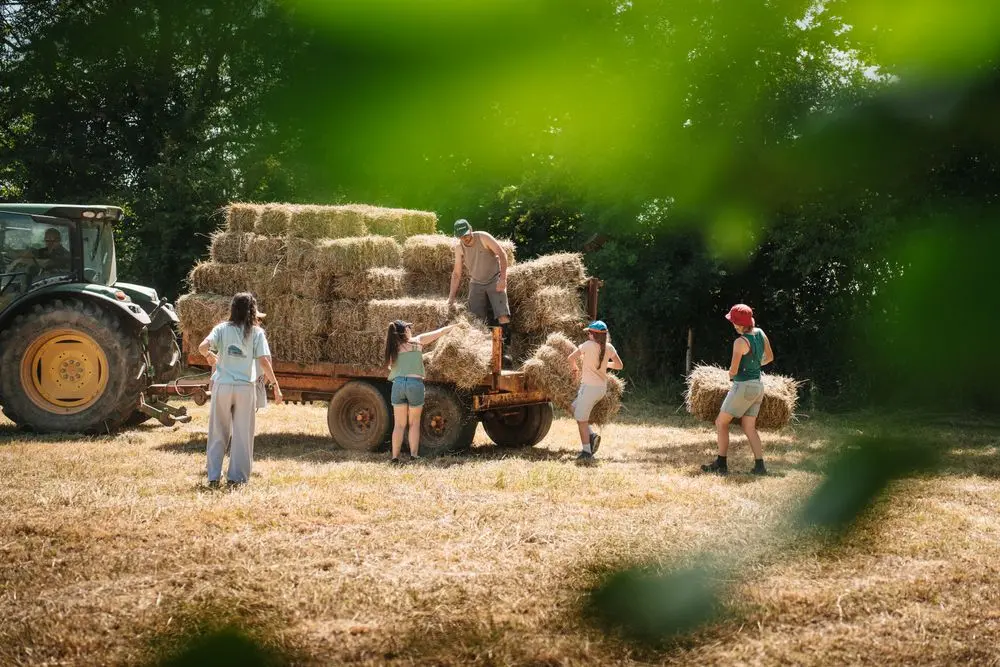
Three combines running side by side across the west field, like something out of an old photograph. Me in front, in Dad’s machine. Bud on my left. Big Hank Van Wyk on my right. Grain carts running back and forth like busy beetles. Ron’s semi hauling load after load to the elevator in Paullina. Ten loads. Eleven. Twelve.
The beans had shattered some. We lost maybe a quarter. But we saved the rest.
Forty-one bushels an acre. On a field that would have been nothing by Sunday.
At noon, Elaine and Marcy drove out to the field in Arlen’s pickup.
Four pot roasts. Mashed potatoes in a roaster. Gravy in a coffee urn. Green beans. Dinner rolls. Three pans of scotcheroos from Marcy. A pan of Elaine’s oatmeal cookies.
They set it all up on the tailgate, right there at the edge of the field.
Everybody ate standing up. In the wind. With their coats on. Gary and Gordon Pedersen argued about whose combine was faster. The Van Wyk boys ate six plates apiece. Lowell Engelbrecht told the story about Dad pulling his truck out of the ditch in 1993, and by the end of it, half the crew was laughing and the other half was wiping their eyes.
I climbed down from the cab and walked over to the tailgate.
Elaine was standing behind it with a serving spoon.
She looked at me. She held out a plate.
I took it.
And then I did something I’d never done in twelve years.
I stood next to her.
Right there at the tailgate, next to my stepmother, and ate my pot roast. Shoulder to shoulder. In front of everybody.
Neither of us said anything.
We didn’t have to.
We went to see Jim Dahl the following Wednesday.
His office is on the main street in Primghar, upstairs from the old Rexall. Wood paneling. A window unit air conditioner. A framed photograph of every high school football team he’s ever sponsored.
He’s seventy-two. He did my grandparents’ wills, and my parents’ wills, and Dad’s will with Elaine.
“Well,” he said, when we came in together. “This is a surprise.”
He’d heard. Everybody had heard.
Elaine sat down across from his desk. I sat next to her.
I’d brought Dad’s notebook. I set it on the desk.
Jim put on his glasses and read it. All of it. Every page. It took him twenty minutes. Nobody said a word the whole time.
When he got to the last page, he stopped.
Go see Jim Dahl in Primghar after harvest.
He sat back in his chair. He took his glasses off. He rubbed his eyes.
“He called me,” Jim said. “That October. The week before he died. He made an appointment. For the fifteenth of November.”
He looked at Elaine.
“He said he wanted to change his will,” Jim said. “He said, ‘It’s about my boy. I’ve been putting it off too long.’”
Nobody said anything for a while.
“I never knew that,” Elaine said finally.
“I didn’t tell anybody,” Jim said. “He died before the appointment. And he didn’t say what he wanted to change. I couldn’t do anything with that.” He tapped the notebook. “Not legally. Not then.”
He looked at both of us.
“But I can now,” he said. “If the property owner wants me to.”
Elaine had a piece of paper in her purse. She took it out. She’d written it herself, at her kitchen table, on a lined notepad. She’d crossed out a lot of it.
She read it out loud.
She’d revoke the will she signed in October. All of it.
She’d sell me the six hundred acres on a contract for deed. Twenty years. At a fair price. The price Jim and an appraiser would set.
And the three hundred and forty-one thousand dollars in Dad’s notebook would be credited toward the purchase. Right off the top. As back wages.
She’d keep the house and the farmyard, with the right to live there for the rest of her life. Life estate, Jim called it. When she was gone, the house would come to me too.
Her own savings, the money she’d brought from Phoenix and her first husband’s pension, would go to Brad and Kyle. That was hers to give, she said. That was fair. That was theirs.
But not the land.
“The land,” Elaine said, folding her paper, “was never mine to give away.”
I sat there.
“Elaine,” I said. “You don’t have to do this.”
She looked at me.
“Yes, I do,” she said. “Your father told me what he wanted. I knew. I always knew. I just let myself forget, because I was angry and I was lonely and my boys kept telling me things I wanted to hear.”
She looked down at Dad’s notebook on the desk.
“He trusted me,” she said. “He said, ‘She knows.’ He wrote it down. I’m not going to make him a liar.”
“There’s one more thing,” she said.
She looked at me. She took a breath.
“I want you to pay me a fair price,” she said. “Not a gift. Not a handout. A real contract. With payments. I don’t want you to ever feel like I gave you anything. I want you to feel like you earned it. Because you did.”
I didn’t trust my voice. So I just nodded.
Jim Dahl drew up the papers. It took him two weeks.
Elaine and I signed them on a Friday afternoon in November. In his upstairs office, with the window unit rattling and the Primghar water tower outside the window.
Jim notarized everything with a big brass seal that he said was older than both of us put together.
When it was done, he shook my hand. Then he shook Elaine’s.
“Dale would be pleased,” he said. “He’d never say so. But he’d be pleased.”
Brad called the next week.
He called me, actually. Not Elaine. He’d gotten my number from somebody.
“You manipulated her,” he said. “You got her to change it. She’s sixty-six years old and she’s grieving and you took advantage of her.”
“Brad,” I said. “Your mother called you nine days in a row to ask for help with the harvest. Where were you?”
He didn’t answer.
“Her neighbors came,” I said. “Fourteen of them. People she barely knew. They harvested a hundred and sixty acres in a day. And she fed them pot roast. And they thanked her.”
“That doesn’t—”
“She’s not alone out here, Brad,” I said. “You told her for two years that she was. You were wrong. She’s got a whole county now. You should come see it sometime.”
He hung up on me.
But he came at Thanksgiving.
He and Kyle both. For the first time in two years. They sat at the table and ate their mother’s pot roast and didn’t say much. Kyle asked me a lot of questions about soybeans. Brad mostly looked at his phone.
But they came.
Elaine cried in the kitchen after they left. Happy crying, she said.
I believed her.
It’s October again.
A year later.
We just finished the beans. A week ago, all six hundred acres. Corn’s coming out now. Good yield this year. The rain came at the right times for once.
Arlen’s corn too.
I ran both combines this year. His and mine. We split the work. Marcy and Elaine split the cooking. Thursdays at Arlen’s, Tuesdays at the home place. The crew eats at both tables. Nobody minds.
Arlen bought a new knee in March. Well. Insurance bought it. He’s walking better. He still uses the cane, mostly to point at things he thinks I’m doing wrong.
“You’re doing it wrong,” he says.
“Then you do it.”
“I’m retired.”
“You’re not retired. You’re lazy.”
And he laughs so hard he has to cough.
Elaine and I have coffee every morning now.
At six. In her kitchen. Before I go out to the shop.
I didn’t plan it. It just started. The Monday after we signed the papers, I drove up to the home place at six like always. And instead of going straight to the shop, I knocked on the kitchen door.
She opened it in her bathrobe.
“Mark? Is something wrong?”
“No,” I said. “I just wondered if you had any coffee.”
She looked at me for a long time.
Then she stepped back and let me in.
We didn’t say much that first morning. We just sat at the table and drank our coffee and watched the sun come up over the bins.
We’ve done it every morning since.
Some mornings we talk about the farm. Some mornings we talk about Dad. She tells me things I never knew. How he proposed to her at a Perkins in Spencer because he was too nervous to wait until they got home. How he cried at the end of every single John Wayne movie and denied it. How he used to stand at the kitchen window every night at dusk and watch for my pickup to go by on the road, on my way home to the south quarter. Every night. To make sure I got home.
I never knew that.
Some mornings we don’t talk at all.
That’s all right too.
She packs Dad’s lunch pail for me now.
Every morning. Two sandwiches. An apple. The thermos of black coffee in the old green Stanley with the dent in the cup. Two of her oatmeal cookies.
The first time she handed it to me, I just held it.
“You don’t have to do this,” I said.
“I know,” she said. “I want to.”
I carry it to the field every day. I eat my lunch in the cab with the door open and the radio on KICD. When I open the lid, I always look at the dent in the corner from 1987.
I keep Dad’s notebook in my breast pocket. In the same pocket he kept it in.
There’s a new page in it now. In my handwriting.
The first line says:
ELAINE
And underneath it:
What I Owe
I haven’t figured out how to add it up yet.
Last Tuesday was harvest supper.
The crew was all there. Ron, Deb, Lupe and Tomás. Arlen and Marcy. Bud Rasmussen and his wife. The Pedersen twins, who argued about the gravy.
Roast beef and mashed potatoes. Green beans with bacon. A basket of rolls under a dish towel.
Elaine was passing the gravy.
I stood up.
Everybody went quiet. I saw Ron put his fork down. I saw Deb look at Elaine.
I reached into the pocket of my canvas jacket.
I took out the combine keys. The big ring. The little brass tag. LINDGREN.
I set them down beside Elaine’s plate.
She looked at them. Then at me.
She went a little pale.
“Mark,” she said. “What are you doing?”
“Nothing,” I said. “I just wanted to give them to you for a minute.”
I sat down. In the chair next to hers. The one I’d started sitting in at Thanksgiving last year.
“So you’d know you could hand them back,” I said.
She looked at the keys for a long time.
Then she picked them up. She held them in her hand. She turned the little brass tag over with her thumb.
And then she reached over and dropped them into the pocket of my jacket.
“Eat your dinner, Mark,” she said.
And this time, I did.