“Is this real?” Brooke held the little blue box up to the light of the chandelier and squinted at it. “Because you can get these on eBay for, like, twenty bucks.”
Some of the people at the table laughed. Not all of them. Enough.
It was my son’s engagement party, in the main ballroom at Kingsbrook Country Club outside Columbus, on a Saturday night in October. There were a hundred and forty guests, most of them from the bride’s side, and white tablecloths and a string quartet in the corner playing something I didn’t recognize. The bride’s father had paid for all of it. He’d mentioned that more than once.
My father, Earl Dawes, was sitting across the table from Brooke in his only suit, a navy blue one he’d bought for my mother’s funeral in 2022. He’s seventy-nine years old. He’d taken his VFW cap off at the door and folded it into his jacket pocket because somebody told him hats weren’t allowed in the ballroom. He’d driven an hour and a half from Mansfield that afternoon in his Buick so he could give his grandson something.
He’d waited until dessert. He’d stood up, which isn’t easy for him anymore with his knees, and he’d walked around the table to where Tyler and Brooke were sitting, and he’d set that small blue box down between their coffee cups.
“This is for you, Tyler,” he’d said. “I want you to have it. I don’t need it anymore.”
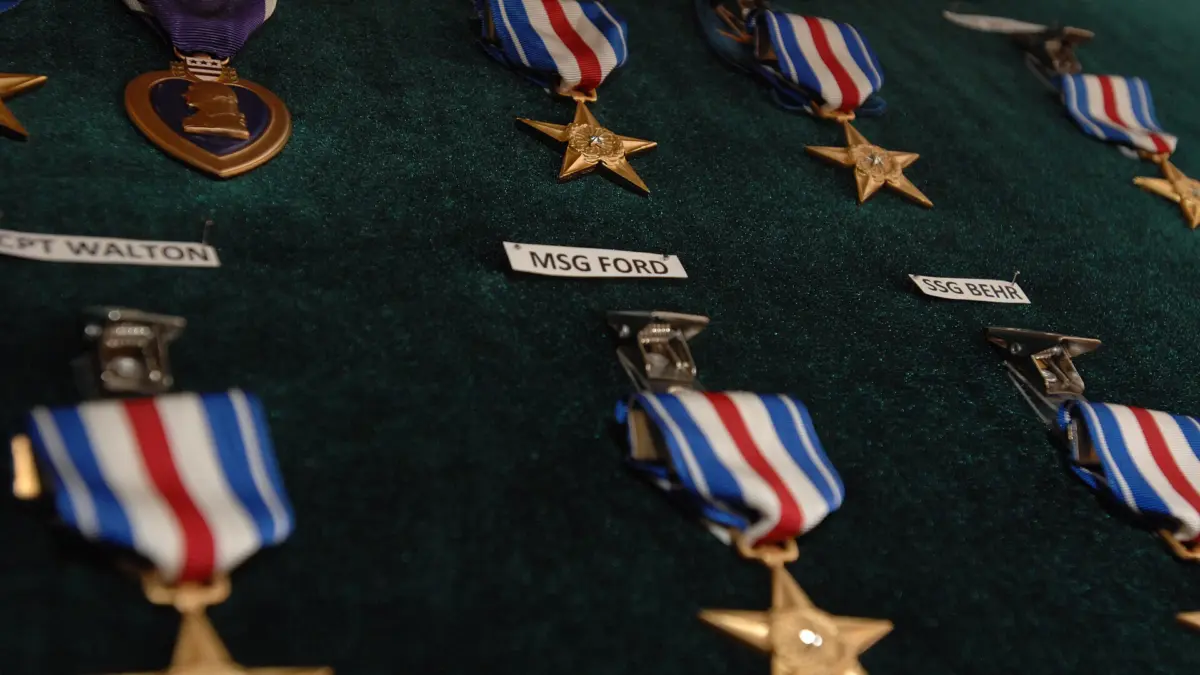
Tyler had looked at it like he didn’t know what it was. He didn’t. None of us had ever talked about it with him. Brooke had picked it up first and opened it. Inside, on faded blue satin, was a gold star with a smaller silver star in the center of it, hanging from a red, white and blue ribbon.
Now she was holding it up to the light like a pawn shop clerk.
“Brooke,” Tyler said, very quietly.
“What? I’m just asking.” She laughed and set it down. “It’s sweet, Earl. Really. It’s a sweet thought.”
Her father, Grant Whitfield, leaned back in his chair at the head of the table. He owns three car dealerships in central Ohio. You’ve seen his commercials if you live there. He wears a lot of cologne and laughs with his whole chest.
“My father served in Vietnam,” Grant said, loud enough for the next table to hear. “First Lieutenant, 173rd Airborne. Real heroes, Earl, they don’t carry their medals around in their pockets to show off at parties.” He winked at my father. “No offense.”
Everybody at that end of the table laughed. Grant’s wife, Celeste, laughed behind her napkin.
Tyler didn’t laugh. He also didn’t say anything. He looked down at the tablecloth, and his ears turned red, the way they did when he was a little boy and got caught at something.
My father didn’t say a word. He reached over and closed the blue box and picked it up off the table. He put it back in his jacket pocket next to his folded cap. Then he walked back around the table to his chair, slowly, with one hand on the backs of the other chairs as he went, and he sat down next to me.
He picked up his fork and took a bite of the cheesecake.
I was so angry my hands were shaking under the table. I’ve never in my life wanted to hit anybody the way I wanted to hit Grant Whitfield right then.
“Dad,” I said under my breath.
“Eat your cake, Karen,” he said.
I want to tell you about my father, so you understand what happened at that table.
Earl Wayne Dawes was born in 1947 in Mansfield, Ohio, the second of four boys. His father worked at the Westinghouse plant and his mother cleaned houses. He was drafted in 1966, when he was nineteen, and he went to Vietnam in the spring of 1967. He came home in 1968. He married my mother, Doris, in 1970, and he carried mail in Mansfield for thirty-four years, the same route on the north side of town, every day, rain or snow, until he retired in 2009. He knew every dog on that route by name. When he retired, the people on his route threw him a party in the parking lot of the Kroger, and two hundred people came.
He never talked about the war. Never once, not to me, not to my brother, not even to my mother as far as I know. If it came up on the television, he’d get up and go out to the garage. When people at church thanked him for his service, he’d nod and say “Thank you” and change the subject to the weather.
I found the blue box when I was twelve years old. I was digging in his sock drawer looking for a pair of his big wool socks to wear sledding, and there it was, under the socks, with a folded paper tucked underneath it. I opened it and looked at the gold star. I was trying to read the paper when he came into the bedroom.
He didn’t yell at me. He never yelled. He just held out his hand.
“Put that back, Karen,” he said. “Please.”
I put it back. I never touched it again. That night I heard him in the garage, very late, and when I looked out my bedroom window, the garage light was on and he was sitting on an upturned bucket with his face in his hands. That’s the only time I ever saw my father cry, until my mother died.
My son Tyler is twenty-seven. He’s an engineer for a company in Columbus that designs water treatment plants. He’s the first person in our family to graduate from college. Ohio State, 2021, mechanical engineering, with honors. It cost a lot of money. My husband and I paid what we could. My father paid forty thousand dollars of it out of his savings at the Mansfield Area Federal Credit Union, money he’d been putting away twenty dollars at a time out of his mail carrier paychecks since Tyler was born. He never told Tyler. I did, at graduation, and Tyler went over and hugged his grandpa so hard he knocked his VFW cap off.
Tyler met Brooke Whitfield at Ohio State, their junior year. She’s pretty and smart and very sure of herself, and she has never once in her life had to wonder where the money was coming from. I’m not saying that to be mean. It’s just true. Her family has a lake house at Indian Lake and a condo in Naples, Florida, and her father’s face is on billboards up and down I-71.
I tried to like her. I want to be honest about that. For four years I tried. She was always polite to me. She called me Mrs. Miller until I asked her to call me Karen, and then she called me Karen in a way that somehow felt less friendly than Mrs. Miller.
The Whitfields were polite too. Grant would shake my husband’s hand at Christmas and ask him about “the shop,” meaning the auto body shop my husband has run in Mansfield for twenty-two years, in a tone like it was a cute hobby. Celeste told me once, at Tyler’s birthday dinner, that she just loved how “authentic” our family was. I still don’t know what she meant by that. I have some ideas.
Two months before the engagement party, Tyler called me on a Sunday night. He sounded tired.
“Mom, Brooke’s dad wants me to sign a prenup.”
“Okay,” I said carefully. “That’s not so unusual, honey, with a family business.”
“It’s forty pages. Their family lawyer drew it up. It says if we ever split up, I give up any claim to anything Whitfield. The dealerships, the lake house, Brooke’s trust fund, any money she inherits.” He sighed. “Which, fine. I don’t want their money. But Grant made a big deal of it at dinner. He said, and I’m quoting, ‘We just need to protect what three generations of Whitfields built, Tyler. I’m sure you understand. Your people would do the same if they had anything.'”
“Your people,” I said.
“Yeah.”
“What did Brooke say?”
“She said her dad’s just old-fashioned.” He was quiet for a minute. “I signed it last week.”
I didn’t tell my father about the prenup. I figured it wasn’t my business, and it surely wasn’t his.
But a week before the party, my father called me.
“Karen,” he said, “I’m going to give Tyler the medal at that party.”
I was standing in my kitchen with a dish towel in my hand. I had to sit down.
“Dad. You don’t have to do that.”
“I know I don’t.” I could hear him breathing on the line. “I’m seventy-nine. Your brother’s boys are never going to have kids, you know that. Tyler’s the only one left with the Dawes name who’s going to carry it on. I want him to have it. I want him to have it while I’m still here to give it to him.”
“Are you going to tell him what it’s for?”
There was a long silence.
“No,” he said finally. “He can read the paper if he wants. It’s all on the paper. I said everything I was ever going to say about it in 1968.”
The afternoon of the party, I drove up to Mansfield to ride down to Columbus with him, because I didn’t like the idea of him driving the interstate alone. When I let myself in the back door, he was sitting at the kitchen table in his undershirt with his suit pants on and his reading glasses down on his nose. The blue box was open in front of him. He was polishing the medal with one of my mother’s old cloth napkins, very slowly, in little circles.
He didn’t hide it this time. He didn’t even look up.
“Your mother made me promise,” he said. “Before she went. She said, ‘Earl, you give that to one of the kids before you go, or I’m going to come back and haunt you.’ I kept putting it off.” He held the medal up to the light from the window. “Three years I’ve been putting it off. She’d be good and mad.”
“She’d be proud of you, Dad.”
“She’d be mad it took so long.” He set it back on the satin and closed the lid. “Help me with this tie. My fingers don’t work like they used to.”
So I tied his tie for him, standing in my mother’s kitchen, the way she used to every Sunday morning for fifty-two years.
At the club, they’d put us at the far end of the long table, down by the swinging doors to the kitchen, where every time a waiter went through you got a blast of hot air and the smell of the dish room. The Whitfields sat at the head. Celeste came down to say hello before dinner, in a silver dress that probably cost more than my car.
“Earl! So glad you could make it all the way down here.” She looked him up and down and smiled. “And look at that suit. How vintage.”
“It’s the one I buried my wife in,” my father said pleasantly. “Well. The one I wore when I buried her.”
Celeste’s smile didn’t move, but she found somebody else she needed to talk to very quickly.
So that’s what was in his pocket at that table. That’s what Brooke held up to the chandelier and asked if it came from eBay.
I want to tell you about one more person, because he was at the party too, and because he matters to what happened next.
Grant Whitfield’s father is James Robert Whitfield. Everybody calls him Big Jim. He’s eighty years old and he’s been in a wheelchair since a stroke three years ago, but you can still see that he was a big man once, with huge hands and a voice like a truck engine. He started the first Whitfield dealership in 1971 with a loan from his father-in-law and built it into what it is now. He sat at the head of the table that night, next to Grant, with a plaid blanket over his knees and a glass of bourbon he wasn’t supposed to have.
Big Jim was a lieutenant in Vietnam. That’s the family legend, and every Whitfield gathering I’d ever been to, somebody brought it up. He was a platoon leader with the 173rd Airborne. He got hit at a place called Dak To, on a hill with a number instead of a name, in November of 1967. Shrapnel in his legs and his back. He couldn’t walk. And a sergeant from his company, a kid he barely knew, picked him up and carried him down that hill under fire, almost two kilometers, to the landing zone where the helicopters were.
The sergeant put him on a helicopter and went back up the hill. Big Jim never saw him again. He never even got his name. He’d been out of his head with pain and morphine, and the sergeant was from a different platoon, and by the time Big Jim got out of the hospital in Japan, the whole battalion had been shuffled around and nobody could tell him who it was.
All he remembered was that the sergeant kept talking to him the whole way down. He talked about Ohio. About his girl back home, and the dogs on his paper route, and how cold Lake Erie was in June.
“Sarge from Ohio,” Big Jim called him. He’d been looking for him for fifty-eight years.
I knew that story. Everybody who’d ever eaten a meal with the Whitfields knew that story. Grant told it in his commercials sometimes, about how his father was a war hero who’d built a business from nothing, and how a stranger’s courage was the reason any of it existed.
I knew my father had been in Vietnam. I knew he’d been in the Army. I didn’t know which unit. I didn’t know where. I didn’t know anything, because he’d never told me, and I’d learned at twelve years old not to ask.
I didn’t put any of it together. Not until later.
After the cheesecake, I went to the ladies’ room because I was afraid I was going to start crying at the table. When I came out, Brooke was standing in the hallway by the coat check, scrolling on her phone. She looked up when she saw me.
I should have walked past her. I didn’t.
“Do you have any idea,” I said, “what that man had to do to get that medal?”
She lowered her phone. “Karen. Come on.”
“No. You come on. You held it up to the light like it was a fake Rolex. In front of everybody.”
“I asked a question! It was a joke.” She rolled her eyes. “Honestly. It’s an engagement party. It’s not a VFW meeting. He kind of put Tyler on the spot, you know? Handing him some old war thing in front of all my parents’ friends. It was awkward.”
“Awkward.”
“Yes, awkward.”
Grant came around the corner then, with a drink in his hand. He must have heard us. He put on his big commercial smile.
“Ladies. Ladies. Let’s not make a scene, okay? It’s a party.”
“Your daughter made the scene, Grant,” I said. “And you helped her.”
His smile didn’t move, but his eyes did. “Now, Karen. I think you’re being a little sensitive. Earl’s a nice old guy. Nobody meant any harm.”
“You called him a show-off. In front of a hundred and forty people.”
“I said real heroes don’t show off. That’s a general statement.” He took a sip of his drink. “My father never once in fifty years pulled out a medal at a party.”
“Neither did mine,” I said. “Tonight was the first time in fifty-eight years he’s ever taken it out of his sock drawer.”
Grant opened his mouth. Then Tyler came around the corner behind him.
“Mom.” He looked at me, and then at Brooke, and then at his future father-in-law. “Mom, please. Not tonight. Please don’t do this tonight.”
That one hurt. I’m not going to pretend it didn’t. My own son, standing next to Grant Whitfield, asking me not to make trouble.
“Okay, Tyler,” I said. “Okay.”
I went back into the ballroom. My father was standing by our table with his coat on.
“Dad. Where are you going?”
“Home,” he said. “It’s a long drive, and I don’t see so good after dark anymore.”
“I’ll drive you. We’ll leave the Buick and I’ll bring you back for it tomorrow.”
“I’m fine, Karen.” He buttoned his coat. “You stay. It’s your boy’s party.”
“I’m not staying.”
He looked at me for a second, and then he nodded. I got my purse. My husband went to get the car.
We were halfway across the ballroom, almost to the double doors, when the music stopped and somebody tapped a microphone.
It was Grant. He was standing at the head table with a glass of champagne in one hand and the microphone in the other. The servers were going around with trays of champagne flutes.
“If I could have everybody’s attention for a minute,” he said. “Everybody? Thank you. Thank you all so much for being here tonight to celebrate my beautiful daughter Brooke and her fiancé, Tyler.”
People clapped. My father kept walking toward the doors. I kept walking with him.
“Now, before we toast the happy couple,” Grant said, “I want to take a second to honor somebody very special. My father. Big Jim Whitfield. Dad, wave to everybody.”
Big Jim lifted one big hand off his blanket. People clapped again.
“Most of you know my dad’s story,” Grant went on. “But for Tyler’s family, who might not have heard it, I want to tell it. Because it’s the reason we’re all here tonight. If it weren’t for one brave man, there’d be no Big Jim, no Whitfield Auto, no Brooke, no wedding.”
My father stopped walking.
“In November of 1967,” Grant said, “my father was a twenty-one-year-old lieutenant with the 173rd Airborne Brigade at a place called Dak To, in the Central Highlands of Vietnam. On November twenty-second, on Hill 875, his platoon was pinned down, and he was hit. Badly. He couldn’t walk.”
My father was standing very still in the middle of the ballroom floor with his back to the head table. I was holding his arm. I felt it go stiff under my hand.
“A sergeant from another platoon came out of nowhere,” Grant said. “Picked my father up and threw him over his shoulders and carried him almost two kilometers down that hill, under fire, to the landing zone. Put him on a medevac helicopter. And then turned around and went back up the hill.” Grant’s voice got thick. He does this in his commercials too. “My father never learned his name. He’s looked for him for fifty-eight years. All he knows is that the man was from Ohio, and that he talked about his girl back home and the dogs on his paper route the whole way down.”
My father closed his eyes.
“So I’d like everybody to raise a glass,” Grant said, “to Sarge from Ohio. Wherever he is.”
Everybody raised their glasses. A hundred and forty people said “To Sarge from Ohio,” and drank.
I looked at my father’s face. I looked at it for a long time. Then I looked down at his hand, the right one, the one that wasn’t holding his cane.
He had put it in his jacket pocket. On the little blue box.
“Dad,” I whispered. “Dad. Your paper route.”
He had delivered the Mansfield News Journal every morning on his bicycle from the time he was ten years old until the day he got drafted. He’d told me that once, when I was little. He’d known every dog on that route too.
He opened his eyes. He didn’t look at me. He turned around, slowly, the way he does everything now, and he faced the head table.
Then he started walking back across the ballroom.
People noticed. You couldn’t not notice. An old man in a navy blue suit and a winter coat, walking alone across the empty dance floor toward the head table with a cane, while everybody was still holding their champagne glasses. The string quartet had stopped playing. Somebody’s chair scraped.
Grant saw him coming. He lowered the microphone. “Earl? Everything all right?”
My father didn’t answer him. He walked right past Grant. He walked past Celeste, and past Brooke, who was staring at him with her glass halfway to her mouth. He walked past Tyler.
He stopped next to Big Jim’s wheelchair.
Big Jim looked up at him. Two old men, one sitting and one standing, both seventy-nine and eighty years old, one in a plaid blanket and one in a winter coat.
My father took the blue box out of his pocket. He opened it and set it on the white tablecloth in front of Big Jim’s bourbon glass. Then he took out the folded paper from underneath the medal, the one I’d tried to read when I was twelve, and he unfolded it. It was yellow and soft and creased in a hundred places. He laid it flat on the table next to the box.
“Lieutenant,” my father said. His voice was steady. “You still got that scar under your left ear? The one that bled all down my collar?”
Big Jim stared at him.
Then he looked down at the paper on the table. He picked it up with both of his big shaking hands and held it close to his face. His lips started moving as he read.
The whole room had gone silent. A hundred and forty people, and nobody breathing.
Big Jim read it out loud. His voice was hoarse and it cracked in the middle of every line, but you could hear every word, all the way to the back of the ballroom.
“For gallantry in action… while serving with Company C, Second Battalion, 503rd Infantry, 173rd Airborne Brigade… in the Republic of Vietnam… on 22 November 1967…” He stopped. He swallowed. “Sergeant Dawes, upon observing that the wounded platoon leader of an adjacent element, First Lieutenant James R. Whitfield, was exposed to intense hostile fire… unhesitatingly left his position… and carried the lieutenant approximately two kilometers… to the landing zone… after which he returned to his unit’s position…”
He couldn’t finish it. He set the paper down on the table and put both hands over his face.
Grant was standing there with the microphone hanging down at his side. Brooke had set her champagne glass down, and her hand was over her mouth.
Big Jim took his hands away from his face. His eyes were wet. He reached out and grabbed the arm of his son’s suit jacket.
“Get me up,” he said.
“Dad, you can’t…”
“Grant. Get me up out of this goddamn chair.”
Grant looked around like somebody might tell him what to do. Nobody did. So he set the microphone down on the table, and he and one of the waiters got on either side of Big Jim’s wheelchair, and they lifted him. It took a long time. His legs shook. Grant was holding most of his weight. But Big Jim Whitfield got up on his feet for the first time in three years, in the middle of his granddaughter’s engagement party, in front of a hundred and forty people.
He looked at my father. Then he raised his right hand, shaking, to his eyebrow.
My father took his VFW cap out of his coat pocket. He unfolded it and put it on his head, there in the ballroom where hats weren’t allowed. And he saluted back.
Somebody in the back of the room started clapping. Then somebody else. Then the whole room was on its feet, a hundred and forty people in suits and cocktail dresses, clapping and crying. I couldn’t see anything. I was crying too hard.
When I could see again, Big Jim was back in his chair, and my father had pulled a chair up next to him, and they were holding onto each other’s forearms like two men in a shipwreck. Big Jim was saying something over and over. I went closer so I could hear it.
“I looked for you,” he was saying. “I looked for you. I wrote the Army three times. They sent me to a Dawes in Oklahoma. A Dawes in Kentucky. I called every Dawes in the Columbus phone book in 1979. Where the hell were you?”
“Mansfield,” my father said. “Carrying mail.”
Big Jim laughed so hard he started coughing, and he couldn’t stop, and somebody had to bring him a glass of water.
They talked until the club closed. They sat in the corner of the ballroom with the bourbon bottle between them, and my father, who had never said one word to me about Vietnam in fifty-two years, talked and talked. About the hill. About the rain. About the kid from Texas who didn’t come back down. About how heavy a lieutenant is when he’s six foot four and you’re five foot nine. Big Jim talked too. Grant brought them coffee at midnight and then stood there awkwardly behind his father’s wheelchair, like he wanted to say something and didn’t know how.
Finally, around one in the morning, he did.
“Mr. Dawes,” Grant said. “Earl. I owe you an apology. What I said at the table. I’m…” He stopped. “I’m very sorry.”
My father looked up at him for a while.
“Your daddy raised you,” he said finally. “He didn’t raise you to talk like that. Somebody else did. You go figure out who.”
Grant didn’t have an answer for that. He just nodded.
Brooke didn’t come over. I saw her sitting at a table by herself near the doors with her face in her hands, and Celeste sitting next to her, rubbing her back. Later I found out she’d gone into the ladies’ room and stayed there for half an hour, and her maid of honor had to go in and get her.
Tyler came over around twelve-thirty. He stood next to his grandpa’s chair and didn’t say anything for a long time. Then he knelt down so his face was level with my father’s.
“Grandpa,” he said. “I’m sorry I didn’t say anything. At the table. When she…”
“I know you are.”
“I should have said something. I just sat there.”
My father put his old hand on the back of Tyler’s neck, the way he used to when Tyler was a little boy and fell off his bike.
“You’ll say it next time,” he said. “That’s all. Next time, you say it.”
Tyler put his head down on his grandpa’s knee, right there in the ballroom, twenty-seven years old in a three-hundred-dollar suit. My father left his hand where it was.
I drove my father home that night. We left the Buick at the club. He fell asleep in the passenger seat somewhere around Bellville, with his VFW cap still on his head and the blue box in his lap.
That was six weeks ago.
Big Jim calls my father every Sunday night at seven o’clock now. Every single Sunday. Dad sits in his recliner with the phone and talks for an hour, and sometimes when I stop by I can hear him laughing from the driveway. Big Jim’s grandson drove him all the way up to Mansfield in November so the two of them could go to the Veterans Day ceremony at the courthouse together. They sat in the front row, one in a wheelchair and one with a cane, and the mayor asked them to stand up, and they both did.
Brooke came to my father’s house on a Saturday afternoon in November. By herself. She brought a pie from the bakery in Columbus. I wasn’t there, but my father told me about it. He said she sat on his couch for an hour and cried and said she was sorry about forty times.
“What did you say to her?” I asked him.
“Not much. I let her talk. She needed to talk.” He shrugged. “She’s young. She was raised in money. Money tells you a lot of things that aren’t true. She’ll figure it out or she won’t.”
“Do you think she will?”
“I think she’s trying,” he said. “That’s more than most.”
Grant called Tyler a week after the party and told him to tear up the prenup. Said it was insulting, and he never should have asked. Tyler told him no. He said he’d signed it and he’d keep his word, and he didn’t want a dime of Whitfield money anyway. He said his grandpa taught him that a man’s word is the only thing he really owns.
Grant didn’t argue. I hear he’s been quieter at family dinners.
The wedding is in June, at the lake house at Indian Lake. Big Jim told the planner that my father sits at the head table, next to him, or there’s no wedding. Nobody argued with that either.
Tyler has the blue box now. My father gave it to him again, the proper way, at his kitchen table in Mansfield on a Sunday afternoon, just the three of us. Tyler read the whole citation out loud this time, every word, sitting at the table where I ate my cereal as a little girl. When he was done, he folded it up and put it back in the box very carefully.
“Grandpa,” he said. “Why didn’t you ever tell anybody?”
My father looked out the kitchen window at the bird feeder for a long time.
“There was a kid from Texas,” he said finally. “Ramirez. Nineteen. I went back up that hill to get him too. I didn’t get there in time.” He was quiet for a moment. “They gave me a medal for the one I carried down. Nobody ever gave me anything for the one I didn’t. Didn’t seem right to go around showing it off.”
Tyler didn’t say anything. Neither did I.
Then my father got up and put the coffee on, and asked Tyler if the Buckeyes were going to beat Michigan this year, and we talked about football until it got dark.