Tomorrow
Part One: The Seventh Day
By the seventh day, I was curled in sheets soaked through with sweat, shaking so hard my jaw ached from clenching it.
The bedroom of our townhouse in the Lawrenceville neighborhood of Pittsburgh was dark except for a strip of light under the door. The thermostat said seventy-two degrees. I was wearing two sweatshirts and I couldn’t stop shivering. Then, twenty minutes later, I’d be throwing off the covers, burning up, my skin hot and dry as paper.
I’d stopped being able to tell what time it was. Or what day.
I knew one thing. I needed help.
I got up. It took me three tries. I held on to the dresser, then the doorframe, then the hallway wall, and I made my way to the second bedroom, which my husband used as his office.
The door was half open. He was sitting at his desk with his back to me, his face lit blue by two big monitors. One showed a spreadsheet. The other showed a video game paused on a loading screen. He had a gaming headset around his neck.
“Luca,” I said. My voice came out as a rasp. “I need to go to the emergency room.”
He turned in his chair and looked at me. He gave me the same heavy sigh he’d been giving me all week.
“Jessi,” he said. “You’re not in any danger. It’s a fever. You’ve got the flu or something. If we go now, we’ll sit in a waiting room for six hours with people coughing on us. Let’s wait until tomorrow.”
Part Two: Tomorrow
Tomorrow.
He’d said it on the third day, when my fever first hit a hundred and two. He’d said it on the fourth day, when I couldn’t keep down anything but sips of Gatorade. He’d said it on the fifth day, when I woke up confused and couldn’t remember the word for spoon. He’d said it that very morning, when I nearly fell walking to the bathroom and had to sit on the edge of the tub for ten minutes before I could stand.
Let’s wait until tomorrow.
And every single day, he changed the bandage on my ankle himself.
It had started as nothing. A scrape.
Eight days earlier, on a Saturday, I’d been carrying a laundry basket down the steep basement stairs of our townhouse. I missed a step and scraped the inside of my left ankle on the edge of the metal stair tread. It bled a little. It stung. I washed it off in the bathroom sink and put a regular Band-Aid on it and forgot about it.
The next morning, Luca noticed it.
“That looks like it could get infected,” he said. He’d never once in five years of marriage noticed a scrape on me. “Let me take care of it. I’ll clean it every day for you.”
I thought it was sweet. I remember thinking that. He’s being sweet.
He cleaned it every morning after that. And every night. He’d come into the bedroom with a little bottle and a roll of gauze and medical tape and a pair of gloves. He’d sit on the end of the bed and take my foot in his lap. He’d peel off the old dressing, wipe the scrape with whatever was in the bottle, and wrap it in fresh gauze and tape. Tight. Thick. All the way around my ankle.
It stung every time. Badly. Worse every day.
“That means it’s working,” he’d say. “That means it’s killing the bacteria.”
When I tried to look at it, to peel back the tape and see, he’d catch my hand.
“Leave the tape alone, Jessi,” he’d say. “You’re making it worse by messing with it. That’s why it looks bad. Let me handle it.”
Part Three: The Dressing
That night, the seventh night, after he told me to wait until tomorrow, I went back to the bedroom.
I sat on the edge of the bed. I listened. Through the wall, I heard his chair creak. Then the clicking of his keyboard. Then his voice, louder, cheerful. Talking to his viewers. He streams video games online three nights a week. He has about four hundred followers. He takes it very seriously.
He’d be at it for at least two hours.
I pulled my left foot up into my lap.
And I peeled back the tape.
I stopped breathing.
It wasn’t a scrape anymore.
The skin on the inside of my ankle had gone a deep, mottled color. Dark red and purple and an angry, shiny gray at the center, around where the scrape had been. The edges were swollen and raised and hard. And running up from my ankle toward my calf were dark red streaks. Like lines drawn with a marker. Four of them. Going up my leg.
It was hot. When I held my palm over it, without touching, I could feel the heat coming off it.
And it smelled. Not like an ordinary cut. Something sharp and chemical underneath the smell of infection.
For the first time in seven days, the fever lifted out of my head.
I understood one thing with perfect, terrible clarity.
I needed a doctor. Not tomorrow. Now.
Part Four: The Door
I didn’t tell him.
I don’t know why, exactly. I’ve thought about it a lot since. Some part of me, the part underneath the fever, already knew something was wrong. Not just with my leg.
I put the tape back down over the wound, loosely. I pulled a pair of sweatpants on over it. I found my phone on the nightstand. I found my purse on the dresser.
Through the wall, I heard Luca put his headset on. I heard him laugh. Okay, chat, let’s go. We’re dropping in.
I held on to the hallway wall. One step. Then another. My left leg felt like it was full of hot sand. Down the stairs, one at a time, sitting down and scooting on my bottom like a little kid because I couldn’t trust my balance.
At the front door, I opened the rideshare app on my phone. My hands were shaking so badly I had to type the address of the hospital three times.
St. Brendan’s Medical Center. Emergency Department.
The car was four minutes away.
I stood in the dark on our front stoop on 44th Street, holding on to the iron railing, in sweatpants and two sweatshirts and one sneaker, because I couldn’t get the other one on over my swollen ankle.
The car pulled up. A gray Toyota. The driver was a middle-aged man with a gray beard. He looked at me in the glow of the dome light.
“Ma’am,” he said. “You okay?”
“Emergency room,” I said. “Please. Fast.”
He didn’t ask anything else. He drove fast.
Part Five: Triage
The triage nurse at St. Brendan’s was a big, calm woman named Rhonda, with gray hair in a bun and reading glasses on a beaded chain.
She took my temperature. A hundred and three point eight.
She took my blood pressure. She frowned and took it again.
Then she asked me to roll up my sweatpants.
I did. She looked at my ankle for about two seconds.
She picked up the phone on her desk.
“I need a room,” she said into it. “Now. Not a hallway bed. A room.”
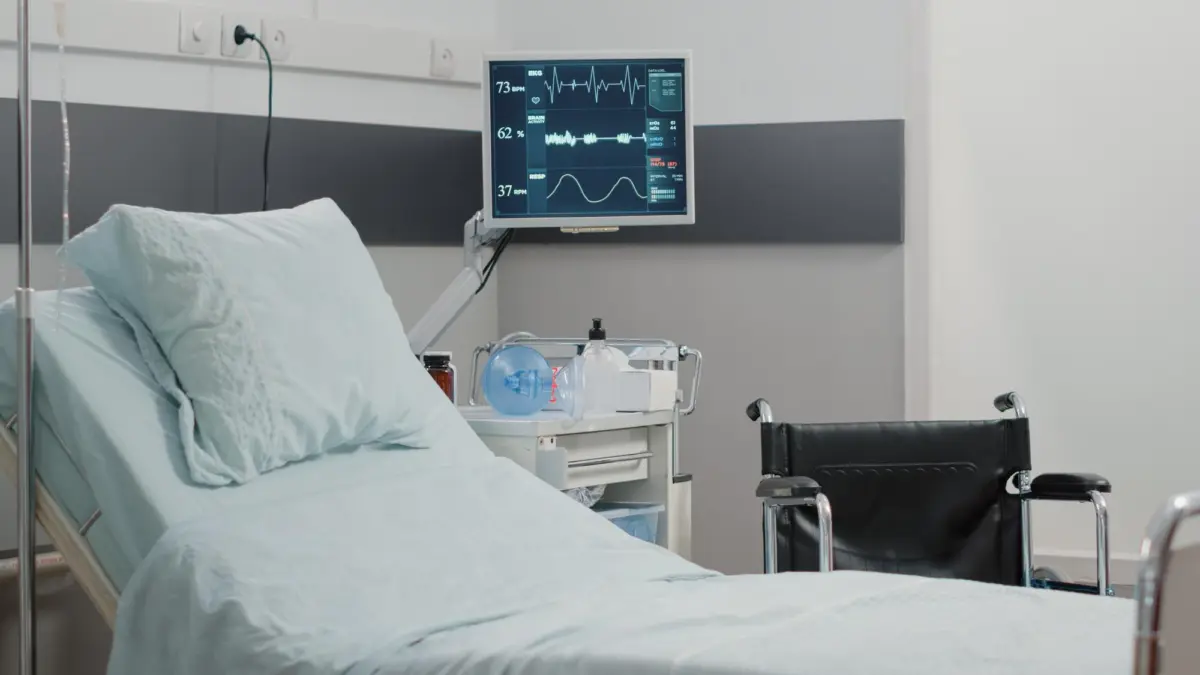
Within two minutes, I was in a private bay in the emergency department, in a hospital gown, on a bed with the rails up. A nurse put a blood pressure cuff on my arm that inflated by itself every five minutes. Another clipped a sensor on my finger.
My heart rate was a hundred and thirty-one. My blood pressure was low.
I heard somebody say the word sepsis in the hallway.
Part Six: Dr. Marcus
A few minutes later, a doctor came in.
He was in his forties, tall and lean, with dark skin and close-cropped graying hair and rimless glasses. His badge said Marcus Adeyemi, MD — Emergency Medicine.
He pulled a rolling stool over beside my bed and sat down so he was at my eye level.
“Jessi,” he said. “I’m Dr. Adeyemi. Everybody calls me Dr. Marcus. Tell me about your ankle.”
I told him. The basement stairs. The scrape. Eight days ago.
“And you’ve been taking care of it?”
“My husband has,” I said. “He’s been cleaning it and bandaging it. Twice a day.”
“What has he been putting on it?” Dr. Marcus asked.
“I don’t know,” I said. “Antiseptic. I thought.”
Dr. Marcus’s eyes came up to mine.
“You thought?”
“Luca handled it,” I said. “He wouldn’t let me look. He said I’d make it worse.”
Dr. Marcus didn’t say anything for a moment.
Then he pulled on a pair of blue nitrile gloves. He rolled my sweatpants up past my knee. He carefully lifted the loose dressing I’d taped back down at home.
He looked at the inside of my ankle for no more than three seconds.
Then his whole face changed.
He turned to the head nurse standing behind him. A woman named Gloria, short and sharp, with a stethoscope around her neck.
“Call security,” Dr. Marcus said. “And the police. Right now.”
Part Seven: “Police?”
A ringing started in my ears.
“Police?” I said.
Gloria was already out the door with her phone.
Dr. Marcus put both of his gloved hands on my shoulders. Firmly. Gently.
“Jessi,” he said. “Look at me. Stay calm. You’re safe here. Okay? You’re safe.”
Then three people seemed to move at once.
A nurse started an IV in my left arm. Another one drew blood. Four tubes. Six. Gloria came back in and talked fast on the phone in the corner. A second doctor came in, a surgeon, looked at my ankle, and went right back out again.
Dr. Marcus examined the edges of the wound with a little penlight. He didn’t touch the darkest part. He measured the red streaks going up my calf with a paper ruler. He drew a line on my skin with a purple marker at the top of the streaks.
“So we can see if it spreads,” he said.
Then he looked at the old dressing. The gauze and tape I’d peeled off at home. It was lying on the paper on the bed beside my leg.
“What kind of antiseptic did your husband use?” he asked again.
“I never saw the bottle,” I said. “Not clearly. It was brown. Plastic. No label, I think.”
“Did you ever put any of it on yourself?”
“No.”
“Not once?”
I shook my head.
Dr. Marcus picked up the old dressing with a pair of metal forceps. Carefully. Like it was something dangerous. He put it inside a clear plastic specimen container and screwed the lid shut. He wrote something on the label.
Part Eight: The Pattern
“What are you seeing?” I whispered.
Dr. Marcus pulled the stool closer to my bed.
“The original scrape may well be infected,” he said carefully. “That’s what the streaks are. The infection is spreading up the lymph channels in your leg. That’s serious. We’re going to treat it right now, with strong antibiotics through your IV.”
“But?” I said.
He looked at me for a long moment.
“But there’s another pattern here,” he said. “Around the scrape. On the skin. That doesn’t fit an ordinary scrape that just got infected on its own.”
My stomach went tight.
“What kind of pattern?” I asked.
“It looks like a chemical injury,” Dr. Marcus said. “Like something caustic was put on the skin. Repeatedly. Over days. The kind of damage you see when something that should never touch a wound keeps getting applied to it.” He paused. “It looks like a burn, Jessi. Underneath the infection.”
For a second, I thought I’d misheard him.
“A burn?” I said.
“We need to find out what was on that dressing,” Dr. Marcus said. “I’ve sent a sample to the lab. And we need to talk to the police.”
Part Nine: The Phone
My phone started vibrating on the bed beside me.
LUCA.
I watched it ring. And ring. Until it stopped.
It rang again.
It stopped. It rang again.
Then a text came in.
WHERE ARE YOU
And seconds later:
YOU SHOULD HAVE TOLD ME BEFORE YOU LEFT
I stared at the words on the screen.
Dr. Marcus was watching my face.
“Don’t answer yet,” he said quietly.
Part Ten: Detective Hall
Two uniformed Pittsburgh police officers came into the room about fifteen minutes later. And with them, a woman in plain clothes. A navy blazer and jeans. Forties, with short black hair and a calm, watchful face. She held up a badge.
“I’m Detective Simone Hall,” she said. “Pittsburgh Bureau of Police. Special Victims Unit.”
She pulled up a chair beside my bed.
She asked me questions. Simple ones. Slowly. Had Luca ever threatened me? Had he ever hit me? Did I feel safe going home? Had anybody else touched my ankle? Had I been to a doctor before tonight?
“No,” I kept saying. “No. No. Luca never hit me. Never. He’s never hurt me.”
My voice cracked.
“He said he was helping me,” I said.
That was the sentence that almost broke me.
He said he was helping me.
Detective Hall didn’t tell me what to think. She didn’t say your husband did this. She didn’t say anything at all for a moment.
She just picked up my phone from the bed and set it on the tray table, where I could reach it.
“If he contacts you again,” she said quietly, “don’t delete anything. Don’t respond yet. Just let me see.”
Part Eleven: The Message
As if he’d heard her, the phone buzzed again.
A new text. I picked up the phone. I read it.
And every person standing near my bed went completely still.
DON’T TELL THEM ABOUT WHAT I PUT ON YOUR LEG. IT WAS JUST ANTISEPTIC.
I looked up. Slowly. At Detective Hall. At Dr. Marcus. At Gloria the head nurse, standing at the foot of the bed with her clipboard.
“I never told him,” I said.
My voice was shaking.
“I never told him the doctor asked about what was on my leg. I never told him I was at a hospital. I never told him which hospital. I didn’t tell him anything. I just left.”
Detective Hall held out her hand. I gave her the phone. She read the message. Her face didn’t change, but something in her eyes did.
Dr. Marcus turned to her.
“I need that message preserved,” he said.
“It will be,” Detective Hall said.
Part Twelve: Downstairs
Before she could say anything else, somebody knocked sharply on the door.
A hospital security officer leaned in. A young man in a gray uniform with a radio on his shoulder. His name tag said DEVON.
“Detective?” he said. “Her husband’s downstairs. In the main lobby.”
My whole body went cold. Despite the fever. Despite the warm blanket the nurse had put over me.
“He found me?” I whispered.
“He’s asking to come upstairs,” Devon said. “He says his wife is confused from a fever and wandered off, and he wants to take her home. He says she’s not thinking straight.”
Detective Hall stood up immediately.
“He does not come into this room,” she said. “He does not come onto this floor. Officer Greer, go downstairs with Devon. Keep him in the lobby. Don’t let him leave.”
One of the uniformed officers, a big man with a shaved head, nodded and went out with Devon.
I lay in the hospital bed with the IV in my arm and the blood pressure cuff squeezing every five minutes, and I shook.
“How did he know?” I said. “How did he know where I was? How did he know the doctor asked about the bandage?”
Detective Hall sat back down beside me.
“Jessi,” she said gently. “Do you and your husband share locations on your phones?”
I thought about it.
“Yes,” I said. “He set it up. On both our phones. Two years ago. He said it was for safety. In case something happened.”
Detective Hall nodded slowly.
“That’s how he knew which hospital,” she said. “As for the rest of it…” She held up my phone. “I’d like to have our digital forensics people look at this. If that’s okay with you.”
Part Thirteen: The Lab
Dr. Marcus checked my IV. He looked at the purple line he’d drawn on my calf. The red streaks hadn’t crossed it yet.
“The antibiotics are going in,” he said. “That’s good. The surgeon is going to take you to the operating room in about an hour, Jessi. To clean out the damaged tissue around your ankle. That’s the most important thing right now.” He glanced toward the hallway that led to the lab. “And we’re testing what was on the dressing. Separately. As fast as they can.”
Twenty minutes later, he came back.
He was carrying a sealed plastic specimen bag. With a printed lab report clipped to the front.
His face was even more serious than before.
He stopped beside my bed. He looked directly at me.
“Jessi,” he said. “We know what was on that bandage.”
Part Fourteen: What Was on It
He sat down on the rolling stool. He didn’t look at the report. He looked at me.
“It wasn’t antiseptic,” he said. “There was no antiseptic in it at all.”
I couldn’t breathe.
“The lab found a strong industrial cleaning chemical,” Dr. Marcus said. “A caustic one. The kind of thing used to strip grease off engines and machinery. It’s sold in hardware stores. It says on the label never to let it touch your skin.” He paused. “It was soaked into every layer of the gauze. The old dressing. Fresh. From tonight.”
I stared at him.
“A cleaner?” I said. “He was putting… a cleaner… on my leg?”
“Twice a day, from what you’ve told me,” Dr. Marcus said quietly. “For about a week. On an open wound.”
He looked at my ankle.
“That’s why it burned every time he put it on,” he said. “That’s why it kept getting worse. That’s why it smelled the way it did. The chemical was destroying the tissue around the scrape. Over and over. And dead, burned tissue is exactly where bacteria grow best.” He took a breath. “The infection didn’t happen in spite of what he was doing, Jessi. It happened because of it.”
“Why?” I said. “Why would he do that? Why would anybody do that?”
Dr. Marcus didn’t answer.
Detective Hall did.
“That’s what I’m going to find out,” she said.
Part Fifteen: Surgery
They took me to the operating room at one-forty in the morning.
A surgeon named Dr. Rebecca Lindqvist cleaned out the wound on my ankle. She cut away all the dead and burned tissue around the scrape, down to healthy skin. She told me afterward that it was about the size of my palm. That another two or three days and the infection might have reached the bone. Or my bloodstream. Or both.
“Another two or three days,” she said, standing beside my bed in the recovery room in her scrub cap with little cartoon foxes on it. “That’s what wait until tomorrow would have cost you.”
I closed my eyes.
“You saved your own life, Jessi,” Dr. Lindqvist said. “When you got in that car. You know that, right?”
Part Sixteen: The Lobby
I didn’t see what happened in the lobby. Detective Hall told me later. When I was out of surgery and in a room on the fourth floor.
Luca had been waiting in the main lobby of St. Brendan’s for an hour and a half. Sitting in a plastic chair by the gift shop. Calm, at first. Polite. Explaining to anybody who’d listen that his wife had a fever and was confused and had wandered out of the house and he was so worried.
When Officer Greer told him he couldn’t go upstairs, his story got more detailed. She’s been delirious for days. She doesn’t know what she’s saying. She thinks people are trying to hurt her. She’s been paranoid since her mother died.
My mother died four years ago. Of cancer. I’m not paranoid. I’ve never been paranoid.
Detective Hall went down to the lobby at about midnight, while I was being prepped for surgery.
She sat down in the plastic chair across from Luca. She introduced herself.
“Mr. Castellano,” she said. “Can you tell me what you’ve been putting on your wife’s ankle?”
“Antiseptic,” Luca said. “From the drugstore.”
“What brand?”
He didn’t answer right away.
“I don’t remember,” he said. “Generic. Something brown.”
“Mr. Castellano,” Detective Hall said. “You sent your wife a text message at eleven-oh-four tonight. It said, Don’t tell them about what I put on your leg. It was just antiseptic.” She held up her notepad. “She hadn’t told you she was at a hospital. She hadn’t told you anybody was asking about her leg. How did you know to send that?”
Luca didn’t say anything.
“How did you know, Mr. Castellano?” Detective Hall asked again.
Luca stood up.
“I’d like to talk to a lawyer,” he said.
Part Seventeen: The Phone
The police department’s digital forensics unit looked at my phone the next morning. With my permission.
They found an app. Hidden. Disguised with a boring name and a generic gear icon, so it looked like a system settings file.
It was stalkerware. Commercial spyware. The kind sold online to concerned parents and suspicious spouses. It let whoever installed it read every text I sent and received. See every website I visited. Track my location in real time. And turn on my phone’s microphone remotely and listen.
It had been installed fourteen months earlier. On a Sunday night in September. From an account registered to Luca’s work email.
“He was listening,” Detective Hall told me, sitting beside my hospital bed. “Through your phone. Last night. In the emergency room. When Dr. Adeyemi asked you what your husband had been putting on your ankle.” She paused. “He heard the whole thing. That’s how he knew to send that message. He panicked.”
I lay in the hospital bed and stared at the ceiling.
“Fourteen months,” I said. “He’s been listening to me for fourteen months.”
“At least that long,” Detective Hall said.
Part Eighteen: The Search Warrant
Detective Hall got a search warrant for our townhouse on 44th Street that afternoon.
They found the bottle in the basement. On the shelf above the washing machine. In the place where we keep the laundry detergent and the stain remover. A brown plastic bottle with no label. The label had been peeled off and thrown away.
They found the original container in Luca’s car. In the trunk. Under the spare tire. A jug of industrial degreaser from a hardware store in Millvale. With the receipt still in the bag. Dated the Sunday after I scraped my ankle on the basement stairs.
The day he first offered to take care of it.
They found Luca’s laptop in his office. With a password I knew, because he used the same one for everything. The name of his childhood dog and the year he was born.
On it, they found his search history.
Can an infected cut kill you.
How long does it take for an untreated infection to become sepsis.
Can sepsis look like the flu.
Signs of sepsis that people miss.
Does life insurance pay for death from infection.
Life insurance contestability period two years.
Part Nineteen: The Policy
The life insurance policy was dated eleven months earlier.
A term life policy on me. Jessica Castellano. Seven hundred and fifty thousand dollars. With Luca as the sole beneficiary.
I’d never seen it. I’d never signed anything. Or I thought I hadn’t.
Detective Hall showed me the application. It had been submitted online. My name. My date of birth. My Social Security number. My height and weight and medical history. All filled in correctly.
And an electronic signature at the bottom. J. Castellano.
I’d never signed it. Luca had done it all from his computer. In my name.
“Most life insurance policies,” Detective Hall said quietly, “have a two-year contestability period. If the insured person dies within the first two years, the insurance company investigates closely before paying. Especially if the death is unusual.” She paused. “But a woman in her thirties who gets a scrape on the basement stairs, doesn’t go to the doctor, and dies of sepsis from an infected wound?” She shook her head. “That’s not unusual. That’s sad. People ignore infected cuts every day.”
I closed my eyes.
“He was waiting until tomorrow,” I said. “Every day. Wasn’t he? Waiting until it was too late.”
Detective Hall didn’t answer.
She didn’t have to.
Part Twenty: Why
They found the rest in his bank records.
Luca had been in debt for almost two years. Gaming. Not playing. Gambling. Online sports betting. Crypto. Some kind of foreign betting site where you could wager on esports matches. He’d lost his own savings first. Then he’d opened four credit cards I didn’t know about. Then he’d taken out a personal loan from an online lender. Then a second one.
He owed a hundred and ninety-four thousand dollars.
I’m a graphic designer. I work from home, for a marketing agency downtown. I’d always let Luca handle our finances. He was good with numbers, he said. He liked doing it. He showed me a spreadsheet every month with our budget, color-coded, everything balanced. It all looked fine.
It was fake. All of it. He’d been making it up. For two years.
“He needed money,” Detective Hall said. “A lot of it. Fast. Before the lenders came after him. Before you found out.” She closed her notebook. “And you had a scrape on your ankle.”
Part Twenty-One: My Sister
My sister, Maren, flew in from Denver the next morning.
She’s three years older than me. A pediatric nurse. She walked into my hospital room at St. Brendan’s with her rolling suitcase, still in her winter coat, and took one look at me in the bed with my leg wrapped in surgical dressings and an IV in each arm, and burst into tears.
“Jessi,” she said. “Oh my God. Oh my God.”
She sat down on the edge of the bed and held me.
“I called you,” Maren said, after a long time. “On Tuesday. Last week. You didn’t answer. I texted. Luca answered from your phone. He said you had the flu. He said you were sleeping and you’d call me back.” She wiped her eyes. “I called again on Thursday. He said the same thing. He said you were fine. He said not to worry.”
“I didn’t know you called,” I said.
“I almost flew out on Friday,” Maren said. “Something felt wrong. I almost bought a ticket.” Her voice broke. “Then I thought, he’s her husband. He’s taking care of her. He’d tell me if it was bad.“
Part Twenty-Two: Isolation
Over the next few days, lying in that hospital bed, I started to see it. All of it. The pattern I hadn’t been able to see when I was inside it.
Luca had been slowly closing the walls around me for two years.
He’d encouraged me to quit my office job and work from home. You’ll be so much less stressed. He’d taken over the finances. I’m good with numbers. He’d set up location sharing on our phones. For safety. He’d started answering my phone when I was busy. I just didn’t want it to wake you. He’d gently discouraged me from seeing my friends. They’re kind of negative, Jessi. You always come home upset.
Every single thing, he’d done for my own good.
He said he was helping me.
“That’s what it looks like,” Detective Hall said, when I told her. “Almost every time. It doesn’t start with a fist. It starts with let me take care of that for you.“
Part Twenty-Three: The Charges
Luca was arrested on the third day. At his lawyer’s office in downtown Pittsburgh, where he’d gone to talk about what to do.
The Allegheny County District Attorney charged him with attempted homicide. Aggravated assault. Insurance fraud. Identity theft, for applying for the policy in my name. And unlawful interception of communications under Pennsylvania’s wiretap law, for the spyware on my phone.
He pleaded not guilty.
He tried to contact me twice from the county jail. Through his lawyer. Letters.
The first one said he loved me. That it was all a misunderstanding. That he’d just grabbed the wrong bottle from the basement. That he’d never meant to hurt me.
The second one said I was confused. That the fever had made me paranoid. That the police were twisting everything. That if I loved him, I’d tell them the truth.
I gave both letters to Detective Hall.
“He grabbed the wrong bottle,” I said. “Twice a day. For a week. And peeled the label off it. And bought it on the same day he offered to clean my scrape. And searched can sepsis look like the flu.“
Detective Hall put the letters in an evidence envelope.
“We’ll add them to the file,” she said.
Part Twenty-Four: Recovery
I was in the hospital for eleven days.
I had three surgeries on my ankle. The first one to cut away the dead tissue. The second one, four days later, because some more had died. The third one, a skin graft. Dr. Lindqvist took a thin piece of skin from my thigh and placed it over the wound on my ankle.
I was on IV antibiotics the whole time. My fever broke on day four. My blood pressure came back up. The red streaks on my calf faded, below Dr. Marcus’s purple line, and then disappeared.
Maren stayed the whole eleven days. She slept in the recliner in my room. She took leave from her job in Denver without being asked. She brought me Pittsburgh pierogies from a place in the Strip District, and bad magazines, and fuzzy socks for my good foot.
Dr. Marcus came to see me every day after his shift in the emergency department. Even though I wasn’t his patient anymore. He’d stand at the foot of my bed and look at the chart and ask how I was doing.
On the last day, I asked him something.
“How did you know?” I said. “That night. You looked at my ankle for three seconds. And you called the police.”
Part Twenty-Five: What Dr. Marcus Saw
Dr. Marcus pulled up the rolling stool and sat down.
“Twenty-two years in emergency medicine,” he said. “I’ve seen a thousand infected scrapes. Maybe ten thousand. People let them go. People ignore them. People put the wrong thing on them.” He paused. “But I’d never seen a burn pattern like yours. A neat, round, caustic burn, exactly the shape of a folded square of gauze. Centered perfectly over the scrape. Layered. Like it had been put there over and over. With fresh gauze each time.”
He looked at me.
“And then you said he wouldn’t let me look,” he said. “He said I’d make it worse by messing with it.” He shook his head. “In twenty-two years, I’ve learned to listen very carefully when a patient tells me that someone else wouldn’t let them look at their own body.”
“I thought he was being sweet,” I said. “When he offered. I thought, he’s taking care of me.“
“I know,” Dr. Marcus said. “That’s what makes it work.”
Part Twenty-Six: The Trial
Luca’s trial was in September. Ten months later. In the Allegheny County Courthouse downtown, in a big old courtroom with marble columns and wood paneling.
He changed his plea on the second day. After the jury heard from Dr. Marcus. And Dr. Lindqvist. And the chemist from the county crime lab who’d tested the gauze. And the digital forensics examiner who’d found the spyware on my phone. And the insurance company’s fraud investigator, who’d matched the IP address on my life insurance application to Luca’s home office computer.
And after they played the stalkerware’s audio recording from my phone. From the emergency room. That night.
Dr. Marcus’s voice. What has he been putting on it?
My voice. I don’t know. Antiseptic. I thought.
Then, timestamped forty-one seconds later, on Luca’s phone: DON’T TELL THEM ABOUT WHAT I PUT ON YOUR LEG.
He pleaded guilty to attempted murder and insurance fraud. The other charges were dropped in exchange.
The judge sentenced him to twelve to twenty-five years in state prison.
I was in the courtroom for the sentencing. Maren sat beside me. Detective Hall sat behind us.
Before the judge announced the sentence, she asked if I wanted to make a statement.
I stood up.
Part Twenty-Seven: What I Said
I didn’t look at Luca. I looked at the judge.
“For eight days,” I said, “my husband told me to wait until tomorrow.”
The courtroom was quiet.
“Every day, I got sicker. Every day, I asked him to take me to the hospital. Every day, he said tomorrow. And every day, he came into our bedroom with a bottle and a roll of gauze and took my foot in his lap. And put something on my leg that he knew would burn me. And said, it means it’s working.“
I took a breath.
“He told me I was making it worse by looking,” I said. “He told me to leave the tape alone. He told me he was helping me.”
I finally looked at him. Sitting at the defense table in an orange jumpsuit. He didn’t look up.
“On the seventh night,” I said, “I looked anyway.”
I sat down.
Maren took my hand.
Part Twenty-Eight: The Scar
I still have the scar. On the inside of my left ankle. A smooth, pale oval about the size of my palm, where the skin graft took. Slightly shinier than the rest of my skin. A little numb, still, around the edges. Dr. Lindqvist says some of the feeling might come back. Some might not.
I don’t hide it.
In the summer, I wear sandals. People notice it sometimes. A woman at the farmer’s market asked me about it last July.
“I had an infection,” I said. “I waited too long to see a doctor.”
That’s true. Mostly.
The divorce was final in March. Before the trial. I sold the townhouse on 44th Street. I couldn’t walk down those basement stairs anymore.
I live in a small apartment in Squirrel Hill now. On the second floor. No basement.
I handle my own finances. I have my own bank account. I check it every week. I have my own password manager, with passwords Luca never knew. I have a new phone. Nobody shares my location. My sister checks the phone for spyware every time she visits. She says it makes her feel better. I let her.
Part Twenty-Nine: The Driver
In November, a year after that night, I did something I’d been thinking about for months.
I found the rideshare driver.
The man with the gray beard and the gray Toyota who drove me to St. Brendan’s at eleven o’clock at night. Who looked at me in the dome light and said, Ma’am, you okay? Who drove fast and didn’t ask anything else.
His name was in my trip history. Frank. I contacted the rideshare company. They put me in touch.
We met for coffee at a diner in Bloomfield. He was sixty-three. A retired steelworker from Homestead, driving for the extra money and something to do. His wife died two years ago.
I told him what happened. All of it. The scrape. The gauze. Wait until tomorrow. Dr. Marcus. The bottle in the basement. The trial.
He listened without saying a word. Holding his coffee cup in both hands.
When I finished, he was quiet for a long time.
“I almost didn’t take that ride,” Frank said finally. “I was about to log off. Go home. I’d been driving since four.” He looked at his coffee. “Then your request came in. Two minutes away. And I thought, one more.“
He looked up at me.
“You were standing on that stoop holding the railing,” he said. “In one shoe. And I thought, That girl’s gonna fall over if somebody doesn’t get her somewhere.“
“You did get me somewhere,” I said. “You saved my life, Frank.”
He shook his head.
“No, ma’am,” he said. “You did that. You got yourself down those stairs and out that door. I just drove the car.”
Part Thirty: Tomorrow
Dr. Marcus still works in the emergency department at St. Brendan’s.
I go to see him every November. On the anniversary. I bring a box of cookies from a bakery in Lawrenceville for the night shift. He always comes out to the waiting room to say hello.
This year, he asked me something.
“Jessi,” he said. “Do you still hear it? Wait until tomorrow?“
I thought about it.
“Sometimes,” I said. “When I’m sick. When I get a headache and I think, maybe I should call the doctor, and then I think, it’s probably nothing, I’ll wait.” I shook my head. “I hear his voice. For a second.”
“And then what?” Dr. Marcus asked.
“Then I call,” I said.
He smiled.
“Good,” he said.
I keep a sticky note on my bathroom mirror. Yellow. In my own handwriting. I wrote it the day I moved into my apartment in Squirrel Hill.
If something is wrong, it’s wrong today.
I see it every morning when I brush my teeth.
I’m thirty-six years old. I have a scar on my ankle the size of my palm. I have a sister who checks my phone for spyware and a retired steelworker named Frank who texts me every Thanksgiving and an emergency room doctor who gets a box of cookies from me every November.
And I never, ever leave the tape alone.