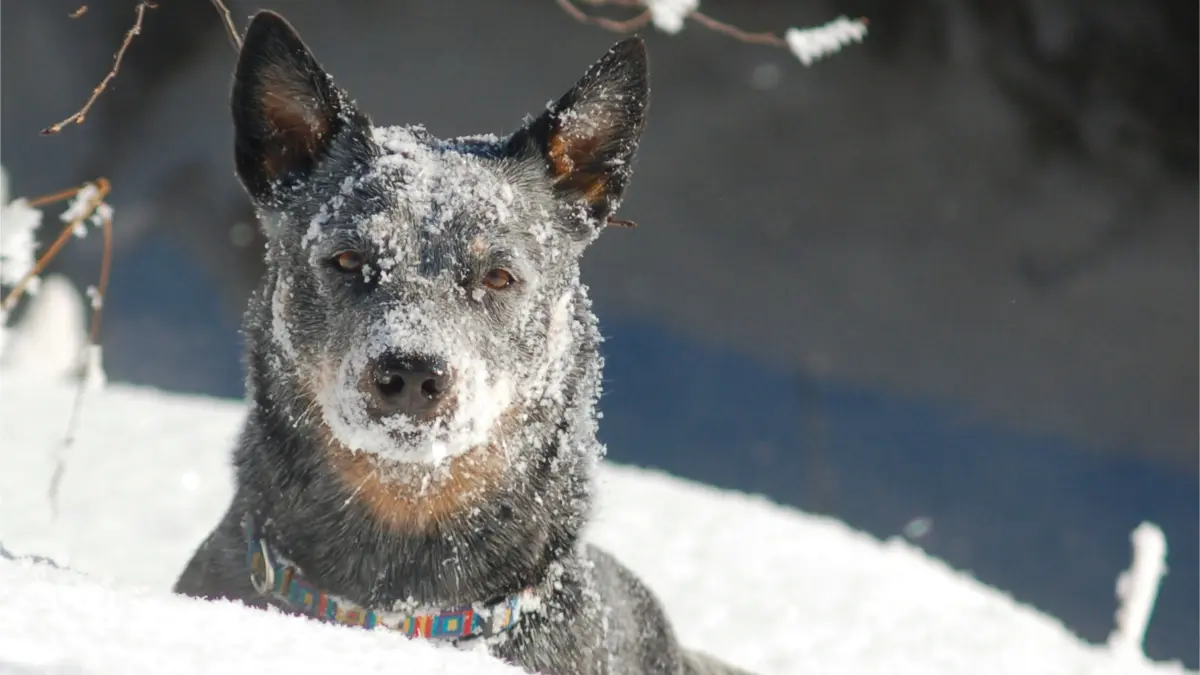
The door prizes at the Divide County Co-op annual dinner are always the same. A gift card to the hardware store, a case of motor oil, a pair of insulated coveralls, and a ham. Carl Lindahl had been on the co-op board for twenty-two years, and every year he got up to the microphone at the Legion hall in Crosby to draw the names out of a seed corn bucket, because he liked being up there and nobody else wanted to do it.
That year he drew the coveralls first. Then the oil. Then he reached in for the hardware store card and pulled out a ticket and squinted at it, and I saw his mouth twitch.
“Jen Halvorson,” he read.
People clapped a little. I stood up from my table near the back to go get it. Dot came out from under my chair, the way she always does when I stand up, and she followed me up the aisle between the tables on her three legs, hop and step, hop and step.
Carl watched us come. He held the gift card out at arm’s length so I’d have to reach for it. Then he leaned back into the microphone.
“Well, congratulations to my former daughter-in-law,” he said. “She got a gift card. And she got a three-legged dog out of the divorce.” He looked out at the room and smiled. “Sounds about what she was worth.”
Some people laughed. Not many, but some. A couple of the younger guys from the elevator crew, and Carl’s buddy Vern, who laughs at everything Carl says. Most of the room looked at their plates. There were two hundred people in that hall and you could have heard a fork drop for about three seconds.
I took the gift card out of his hand. I didn’t say anything to him. I turned around and walked back to my table with Dot hopping along behind me, and I sat down and put the card in my coat pocket. My face was so hot I thought my ears might catch fire.
Arlene Torgerson, who’s eighty and sat next to me because she always sits next to whoever looks loneliest, put her hand on my arm.
“Don’t you mind him, honey,” she said. “Carl’s been a horse’s behind since 1971.”
I laughed, because she wanted me to. Then I finished my ham and my scalloped potatoes and my piece of rhubarb pie, because I’d paid twelve dollars for that dinner and I wasn’t going to waste it. Then I took Dot and went home.
My sister called me that night. She’d heard about it from her mother-in-law before I’d even gotten my boots off.
“Why didn’t you just walk up there and take the microphone away from him?” she said. “I would have. I would have told the whole room what that family’s really like.”
“I know you would have, Becky.”
“So why didn’t you?”
I looked over at Dot, curled up on her blanket by the heat register with her chin on her one back paw.
“Because a man who needs two hundred people to laugh at a dog has already told everybody everything about himself,” I said. “He doesn’t need my help.”
I drive a milk truck. Two routes, about a hundred and forty miles a day, every dairy left between Crosby and the Canadian line, which isn’t as many as it used to be. I pick up from eleven farms, six days a week, and haul it to the plant in Minot on Tuesdays and Fridays. I like the work. You’re alone most of the day, and the farmers are good people, and you get to see the sun come up over the prairie every morning, which most people in the world never get to do.
I started driving after the divorce. Before that I’d worked part-time at the school cafeteria and helped Rick on his dad’s place, feeding calves and running the grain cart in harvest. Rick and I were married eleven years. Then the oil boom came to Williston and Rick went out there to work on a rig, and he came home less and less, and then one fall he didn’t come home at all. He’s in Texas now, last I heard. Midland. He sends child support most months.
When we split up, I didn’t want anything from the Lindahl place. It wasn’t mine. I took my clothes and my grandmother’s dishes and the pickup that was in my name, and I bought forty acres two miles south of Carl’s place with a little house trailer on it, a 1998 Skyline with a new metal roof. I got a loan through the USDA rural housing program. My payment is six hundred and twelve dollars a month. I’ve never missed one.
Our daughter Brynn was four when Rick left. She’s seven now. The divorce decree gives Rick every other weekend, but Rick’s in Texas, so in practice it’s Carl who has her on those weekends. I let him. I could have fought it, and my lawyer in Williston told me I’d probably win if I did. But Brynn loves her grandpa, and he loves her, and whatever else Carl Lindahl is, he’s good to that little girl.
He taught her how to feed bottle calves when she was five. He built her a wooden step stool so she could reach the nipple bucket. He lets her ride in the tractor cab on his lap and steer. She comes home from his place with mud up to her knees and stories about every calf, and she thinks he hung the moon. I’ve never once said a bad word about him in front of her, and I never will.
So that’s how things stood. I’d see Carl every other Friday at five o’clock, when I dropped Brynn off in his yard, and every other Sunday at five, when I picked her up. We’d nod at each other. Sometimes he’d tell me something about her weekend, like she’d lost a tooth or she’d eaten too many cookies. Sometimes he wouldn’t say anything at all.
And then sometimes he’d say something at the elevator or the café or the co-op dinner, where I’d hear about it later, and it would always be about the dog.
Dot came to me the way a lot of things did after the divorce, which is to say by accident and with a bill attached.
She was Rick’s dog first. He’d bought her as a pup from a ranch outside Wildrose for two hundred dollars, a little blue heeler with a black patch over one eye and ears too big for her head. She was supposed to be a cow dog. Rick never trained her. He mostly let her run loose around the yard and chase the barn cats.
When she was eleven months old, Rick was backing the feed truck out of the shop in a hurry, the way he did everything in those last months, and he didn’t look. I heard her scream from the house. By the time I got out there, Rick had her wrapped in a feed sack on the passenger seat. He drove her to the vet clinic in Crosby. He came home an hour later without her.
“They’re going to fix her leg,” he said. “Or something. I don’t know.”
Two weeks after that he was gone to Williston for good. Three days after he left, Dr. Haugen called me.
“Jen, I’ve got a dog here that nobody’s come to pick up,” she said. “Rick’s not answering his phone. The bill’s past due, and I can’t keep her forever. Somebody has to sign for this dog, or I have to put her down.”
I drove over that afternoon. Dot was in a kennel in the back with a big plastic cone around her head and her back left leg shaved and stitched from the hip to the hock. She looked at me through the wire and thumped her tail on the floor, once.
The bill was fourteen hundred and eight dollars. Dr. Haugen had tried to save the leg with pins, and it hadn’t worked, and she needed to take it off at the hip. That would be more. She said she’d knock some off if I took the dog. I didn’t have fourteen hundred dollars. I had about two hundred in checking and a stack of bills on the kitchen table.
“Can I make payments?” I asked.
“Four,” Dr. Haugen said. “I can do four.”
I signed a release-of-ownership form that afternoon. Dr. Haugen had Rick sign it too, over email, a week later. It was the only thing he ever signed for me without arguing. They took the leg off on a Thursday. I brought her home on a Saturday, cone and all, and she slept on my bed for three weeks while she healed.
Two months after that, she was herding my laying hens around the yard on three legs like nothing had ever happened to her. She runs with a funny little hop-step, hop-step, and she can turn on a dime. She’s not fast in a straight line. But she’s smart, and she doesn’t quit. She learned to open the screen door with her nose. She learned that the milk truck means I’m leaving and the sound of the engine at night means I’m home. When Brynn has a bad dream, Dot knows before I do, and she’s already at the bedroom door when I get there.
I made all four payments. The last one was the week before Christmas. I still have the receipts in an envelope in the drawer by the stove.
Carl told the whole county I took that dog to spite his son.
That was the story. That after the divorce, I’d gone and taken Rick’s dog out of pure meanness, because I knew Rick loved her, and that I’d paid some vet a fortune to keep her alive out of spite when any sensible person would have put a crippled dog down. He told it at the elevator. He told it at the café over coffee with Vern and the Nelson brothers. He told it so many times that people started repeating it back to me like it was true. A woman at church once asked me, very kindly, if I’d ever thought about giving the dog back to Rick’s family.
His son never asked about her. Not once. Not when she was in the clinic, not when I called him about the bill, not in the three years since. Rick has called Brynn on her birthdays and on Christmas, mostly. He’s never once asked how the dog was doing.
I know why Carl told it. I’ve had a lot of hours alone in a milk truck to think about it.
Carl’s wife Marlys died the spring before Rick left. Cancer, the fast kind. They’d been married forty-six years. Carl didn’t know how to cook or do laundry or write a check, and all of a sudden he was alone in that big farmhouse with nobody to talk to. Then his only son packed up and left for the oil fields, and then left the state, and the house went quiet.
It was easier to blame the woman two miles down the road than his own boy. I understood that. I didn’t like it, but I understood it.
What I didn’t understand was the dog. Dot never did anything to Carl. The first year, when I’d drop Brynn off, Dot would ride along in the truck and hang her head out the window, and she’d wag at Carl when we pulled into his yard. She liked him. Dogs usually like old farmers. He’d look at her like she was something that had been left in his ditch.
One Friday that April he said it right to my face, in his yard, with Brynn standing on the porch holding her backpack.
“Half a dog,” he said, looking at Dot in my cab. “Rick should’ve let them put it down.”
“Your son left her at that clinic to die with a fourteen-hundred-dollar bill, Carl.”
His face went red. “Don’t you talk about my son on my property.”
I got back in my truck. Brynn waved at me from the porch, and I waved back, and I drove home with my hands shaking on the wheel.
Brynn asked me about it. That spring after the co-op dinner, on the drive home one Sunday evening, she was quiet for a long time, looking out the window at the stubble fields.
“Mom,” she said. “Why does Grandpa say mean things about Dot?”
I kept my eyes on the road. “What did he say, honey?”
“He said she’s half a dog. He said Daddy should have let them put her to sleep.” She was twisting the string on her hood around her finger. “He said it to Vern on the phone. He didn’t know I was listening.”
I took a breath. “Grandpa’s sad, honey. He’s been sad since Grandma Marlys died, and since Daddy moved away. Sometimes sad people say mean things. It doesn’t mean they’re true.”
Brynn thought about that for a long time. We passed the Lutheran church and the old Thompson place with the fallen-down barn.
“Dot only has three legs,” she finally said. “And she’s not sad.”
I didn’t have an answer to that. I still don’t.
The storm came on a Sunday morning in the middle of March.
It wasn’t supposed to be much. On Friday the weather service out of Bismarck said a clipper would come through Saturday night with light snow and some wind. By Saturday afternoon they’d changed their minds. By Saturday night there was a blizzard warning for every county north of Highway 2, with sixty-mile-an-hour gusts and zero visibility, and the Highway Patrol had closed Highway 5 from Crosby to the Montana line.
It was Rick’s weekend, which meant Carl’s. I called Carl around eight Saturday night.
“I’m coming to get her before it hits,” I said.
“Roads are already drifting,” he said. “I just came back from the Nelsons’. You won’t make it, Jen, and you’ll end up in a ditch. She’s fine here. She’s got her calves to feed. I’ll bring her down when it clears.”
He was right about the roads. I could see out my window that the snow had already started blowing sideways in the yard light. I said okay. I talked to Brynn on the phone for a while. She was excited about the storm and about staying an extra day, and she told me one of her bottle calves had figured out how to lick her mittens off her hands.
“Make sure she stays inside if it gets bad,” I told Carl when Brynn handed the phone back.
“I raised a kid on this place, Jen,” he said. “I know what a blizzard is.”
I went to bed around eleven. The wind woke me up at two, howling around the corner of the trailer and making the metal roof pop and groan. Dot was standing at my bedroom door with her ears up, staring at the dark hallway. I got up and checked the furnace and the pipes and lay back down. She stayed at the door the rest of the night.
In the morning it was the worst I’d seen in years. I couldn’t see the barn from the kitchen window, and the barn is maybe sixty feet away. The radio said there was no travel advised anywhere in Divide County. The wind was steady at forty and gusting to sixty-five. Snow was coming sideways so hard and fine it hissed against the siding like sand.
I made coffee and sat at the table with my phone, waiting for it to be a decent hour to call Brynn.
At nine-forty, my phone rang. It was Carl.
I’d known Carl Lindahl for fifteen years. I’d heard him happy and drunk and mean and proud and grieving. I’d never heard his voice sound like it did that morning.
“Jen.” He was breathing hard. “Brynn went out to feed the bottle calves. I was in the bathroom. She put her coat on and went out by herself. The barn’s two hundred feet from the door, Jen. I just went out to check on her.” His voice broke. “She’s not in the barn. She’s not in the barn.”
I don’t remember hanging up. I remember standing up so fast the chair went over backward, and Dot was already at the door.
I called 911 while I was pulling on my coveralls. The dispatcher in Crosby was calm and kind and said she’d send the sheriff and the fire department, but the roads were closed, and the plows had been pulled in, and it would be forty minutes at least, maybe more. She told me not to go out in it. I said okay and hung up and went out in it anyway.
Dot jumped in the cab of my pickup before I even had the door all the way open. I didn’t stop her.
Those two miles north to Carl’s were the longest drive of my life. I couldn’t see the hood of my truck. I drove with my window down and my head out of it, in that wind, following the fence posts along the ditch. I’d find one post and creep forward until I saw the next one come out of the white, and then the next one. My face went numb in about two minutes. Twice I lost the fence and had to stop and wait for a gust to pass so I could see where I was. It took me almost half an hour.
When I finally pulled into Carl’s yard, I almost hit his porch. He was standing on it in his barn coat with no hat, with a lariat tied around his waist. The other end was tied to the porch post. His hair was white with snow and there was ice in his eyebrows.
“I’ve been out twice,” he shouted over the wind. “Out to the end of this rope, both times. I can’t see anything. I called her name till I lost my voice.” He grabbed my arm. “Jen, I can’t find the barn. I’ve lived on this place seventy-four years and I couldn’t find my own barn.”
Dot had come up the porch steps behind me. Carl looked down at her, and his face changed.
“What the hell are you doing bringing that thing up here?”
“She’s got a nose, Carl.”
“She’s got three legs! Call the fire department!”
“They’re forty minutes out! Brynn doesn’t have forty minutes!”
He stared at me. His hands were shaking.
There was something purple lying in the snow at the bottom of the steps. I bent down and pulled it out. It was one of Brynn’s mittens, the purple ones with the white snowflakes that her teacher had knitted her for Christmas. She must have dropped it on her way out. Or the calf had licked it off her hand, like she’d told me on the phone.
I knelt down in the snow on the step, and I held that mitten under Dot’s nose.
“Find Brynn,” I said. “Dot, go find Brynn.”
She stuck her nose into the mitten and breathed in. Then she looked up at me. The wind was shoving her sideways so hard she had to brace her one back leg to keep from sliding off the step.
“Find Brynn,” I said again.
“You’re sending a crippled dog into a whiteout after my granddaughter?” Carl said.
I didn’t answer him. He stared at me for one more second. Then he started untying the rope from his waist with his bare, shaking hands. He tied it around mine. I don’t know how he got the knot done with his fingers that cold. He pulled it tight and slapped my shoulder.
Dot stood there one more second with her nose up in the wind.
Then she put her nose down into the snow, hopped twice on her one back leg, and went out into the white.
I went after her on Carl’s rope. Within ten steps I couldn’t see the house. Within twenty I couldn’t see my own boots. All I had was the rope going back behind me and Dot’s barking up ahead, short and sharp every few seconds, the way she barks when she’s got a hen cornered by the shed.
I followed the barking. I don’t know how far.
Then the barking stopped.
I stood there in the white with the wind screaming in my ears, and I called her name. Nothing. I called Brynn’s name. Nothing. I took another step and the rope went tight around my waist and stopped me.
I’d come to the end of it.
There’s a moment in your life when you understand that the next thing you do might kill you, and you do it anyway, and it isn’t even a decision. I untied the rope. I dropped it in the snow. I walked forward toward the last place I’d heard Dot bark.
I counted my steps. That’s the only thing I remember thinking about clearly. Twenty steps. Thirty. Forty. My eyelashes were freezing together. I was holding my arms out in front of me like a blind person. At about fifty steps my hands hit something hard and round and covered in snow, and I almost screamed.
It was a round bale. Carl’s bale stack, the long row of big round hay bales he keeps on the north side of the yard for a windbreak, maybe three hundred yards past the barn. Brynn had gone past the barn in the white and followed the wrong fence and ended up out here.
I felt my way along the bales, around the end of the row, to the downwind side. And the wind stopped. Not all the way, but almost. The bales broke it like a wall. It was strange and quiet back there, and the snow was just falling, soft, the way snow falls in a Christmas card.
Dot was lying in the snow at the bottom of the third bale.
She was lying across Brynn’s legs. Brynn was curled up in a ball against the hay with her hood pulled down over her face, and her bare right hand, the one without a mitten, was buried up to the wrist in the thick fur on Dot’s neck. That’s why Dot had stopped barking. Brynn was holding onto her, and Dot wasn’t going to move.
I fell on my knees next to them.
Brynn pulled her hood back and looked at me. Her face was white and her eyelashes had ice on them, but her eyes were open and she was looking right at me.
“Mommy,” she said. “Dot found me.”
I don’t know what sound I made. I picked her up. She was so cold, but she was shivering, which is good, shivering means the body’s still fighting, I know that from the first aid classes they make us take at work. I unzipped my coveralls and put her inside them against my chest and zipped them back up as far as they’d go over both of us.
Dot stood up and shook herself.
Then I heard it. Faint, through the wind, from somewhere off to my left. Clang. Clang. Clang. And a man’s voice, hoarse, hollering something.
It was Carl. He was on his porch, banging a frying pan against the porch post with a big metal spoon and hollering my name every ten seconds.
Dot started toward the sound. Hop-step, hop-step. She’d go five or six steps and stop and look back to make sure I was coming. I followed her, with Brynn inside my coat, all the way back across that three hundred yards of white, until the porch light came out of the snow in front of us like the headlight of a train.
Carl’s kitchen was hot. He had the oven on and the door open, the way old farmers do in a storm. He took Brynn from me and sat down on a kitchen chair with her in his lap and wrapped her in the big quilt off the back of the couch, the blue and yellow one that Marlys had made in 1985. He was crying. He didn’t try to hide it.
“Her fingers,” I said. “Let me see her fingers.”
The bare hand was the bad one. The tips of three fingers were white and hard. I filled a mixing bowl with warm water from the tap, not hot, just warm, and we put her hand in it, and she screamed when the feeling started coming back, and Carl held her and rocked her and said “I know, I know, I know” over and over into her hair.
Dot had gone and lain down on the rug by the stove, where she could see Brynn. She was soaking wet and caked with ice balls in her fur, and she was panting. Her one back leg was shaking from the cold or from the work of it.
After a while Brynn stopped crying. Her fingers had gone from white to bright red, which is what you want. She was sitting in her grandpa’s lap with the quilt pulled up to her chin, sipping hot chocolate out of a coffee mug that said “World’s Okayest Grandpa.” She’d given him that mug for his birthday.
“I was going to the calves,” she said. “But I couldn’t find the barn. And then I couldn’t find the house. So I went to the bales because Grandpa says the bales are where the cows go when it’s windy.” She took a sip of hot chocolate. “And then Dot came.”
Carl didn’t say anything. He looked over at the rug by the stove.
Then he did something I never thought I’d see. He set Brynn down on the chair, quilt and all, and he got up and walked over to the stove. And he got down on the floor. Seventy-four years old, with his bad knees, he got down on the linoleum on his hands and knees and then sat down next to Dot, with his back against the cupboard.
He put his hand on her head. He just left it there.
“Good girl,” he said. His voice was all broken up. “That’s a good girl.”
Dot thumped her tail on the floor, once.
The sheriff’s deputy and the ambulance from Crosby got there about twenty minutes later, behind a county plow they’d talked into opening the road. The EMT, a young woman named Kayla who I used to babysit, looked at Brynn’s fingers and listened to her chest and took her temperature twice. Frostnip on three fingers, she said. Mild hypothermia, already getting better. If she’d been out there much longer, it would have been a different story. She said we didn’t need to take her in, but to watch the fingers and call if they blistered.
The deputy wrote some things down in a notebook. He asked how we’d found her.
Carl answered before I could.
“The dog found her,” he said, from the floor. He still had his hand on Dot’s head. “The dog found her and stayed with her and then brought them both home. Write that down.”
The storm blew itself out by Monday afternoon. Brynn’s fingers peeled a little, like a sunburn, and then they were fine. She went back to school on Wednesday with a bandage on one finger and a story that got bigger every time she told it. By Friday, according to her teacher, Dot had fought off a wolf.
Carl came to my place the next Saturday.
I was out in the yard feeding the hens when his pickup came down the drive. He parked by the trailer and got out and stood there with his hands in his coat pockets, looking at my little house and my little barn and my forty acres like he’d never really seen them before. Which I suppose he hadn’t. In three years he’d never once come down my driveway.
Dot came out from behind the hen house and hopped over to him. She sniffed his boots. He reached down and scratched her ears.
“Jen,” he said. He took an envelope out of his coat pocket and held it out.
I opened it. Inside was a check from his account at the First State Bank in Crosby, made out to me, for fourteen hundred and eight dollars. In the memo line, in his square farmer handwriting, it said “Vet bill.”
“Carl, I paid that off two years ago.”
“I know you did. I called Doc Haugen.” He looked at the ground. “It was Rick’s bill. It was never yours. Rick should have paid it, and he didn’t, and I should have made him. That’s on our family, not you.”
I didn’t know what to say. I stood there holding the check.
“I don’t want it for me,” I said finally.
“Then put it someplace for her.” He nodded toward the trailer, where Brynn was watching us through the kitchen window with her nose pressed to the glass. “Put it someplace for the girl.”
So on Monday, on my way back from Minot, I stopped at the bank and put it in the college savings account I’d opened for Brynn when she was born, the one I put twenty-five dollars into every month whether I can afford it or not. It was the biggest deposit that account has ever had.
Carl hadn’t left yet that Saturday. After he gave me the check, he went around to the back of his pickup and let down the tailgate. In the bed there was a long ramp made out of plywood and two-by-fours, with strips of rubber stair tread screwed onto it every few inches so it wouldn’t be slippery. He’d painted it barn red.
“What’s that for?”
“So she doesn’t have to jump into a truck on three legs,” he said. He set it on the ground and slid one end up onto his tailgate. “I made two. One’s on my porch steps.”
He looked at Dot. Dot looked at the ramp. Then she walked right up it, hop-step, hop-step, and sat down in the bed of his pickup like she’d been doing it her whole life.
Carl laughed. I hadn’t heard him laugh since before Marlys died.
That was almost a year ago now.
Carl and I aren’t friends, exactly. I don’t know what we are. He’s never apologized for what he said at the co-op dinner, and I’ve never asked him to. Some people can’t say the words. He says other things instead. He says them with lumber and checks and frying pans.
But things are different. When I drop Brynn off on the Friday weekends, Dot comes too now. She stays the whole weekend at Carl’s. She rides in his pickup to the elevator and the café and the post office, sitting up in the passenger seat with her head out the window like she owns the county. Arlene Torgerson told me that Carl told the whole coffee crowd at the café about the blizzard, start to finish, twice in one morning. Vern tried to make a joke about three legs and Carl told him to shut his mouth, in front of everybody. Arlene said she hadn’t enjoyed anything that much since the bicentennial.
Rick called once, in April, when he heard about it from somebody back home. He asked if Brynn was okay. Then he asked if it was the same dog.
“Yes,” I said. “It’s the same dog.”
He didn’t ask anything else. We talked for a minute about his child support, and then he had to go.
The co-op annual dinner was last month, at the Legion hall again. Same ham, same scalloped potatoes, same rhubarb pie. Carl got up to draw the door prizes out of the seed corn bucket like he does every year. He drew the coveralls and the motor oil and the ham. Nobody’s name was called that he made a joke about.
Then, before he sat down, he leaned into the microphone.
“One more thing,” he said. “There’s a dog in this county that ought to have her picture on the wall at the fire hall. I’m not going to say any more about it than that. Most of you know which one.”
People clapped. Arlene clapped the loudest. Dot was under my chair, chewing on a ham bone somebody had slipped her, and she didn’t even look up.