“Joyce, I’m sorry, but that dog cannot come in the house. Look at its eyes. It’s disgusting. There are going to be kids here. Leave it in the truck.”
My son’s fiancée said that to me on her parents’ front porch on Thanksgiving Day, at 12:40 in the afternoon, in front of about fifteen people, while I stood there holding a green bean casserole in one hand and my old dog’s leash in the other.
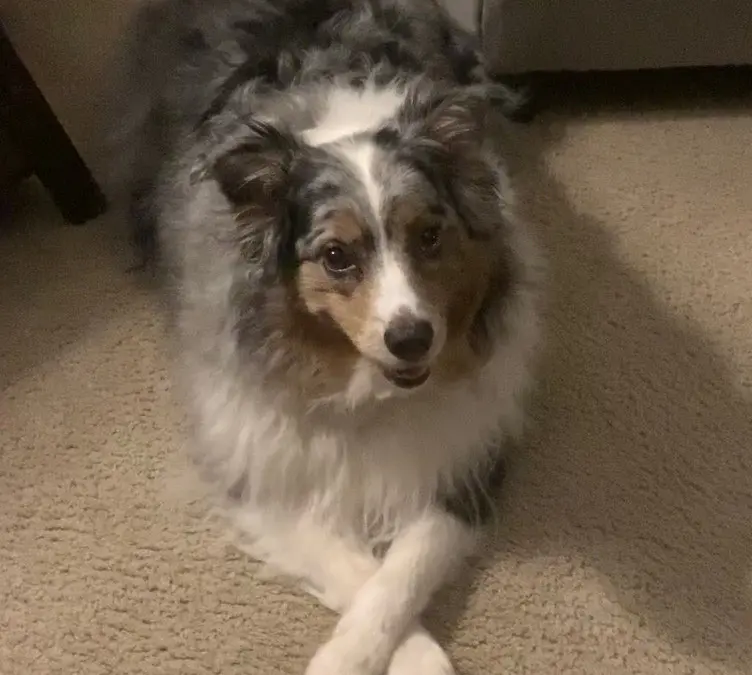
The dog’s name is Gus. He’s thirteen years old. He’s an Australian shepherd, mostly, with some other things mixed in that nobody’s ever been able to figure out. He’s black and white and copper, with one ear that stands up and one that folds over. And he’s blind. Both eyes. They went cloudy two years ago, a milky blue-white, like a glass of water with a drop of milk in it. Glaucoma, the vet in St. Paul said. It happens to old dogs.
He was standing next to my leg on the porch with his nose going, the way it always goes, taking in all those new people and the smell of turkey coming out of the house. His tail was wagging. He didn’t know anybody was talking about him.
“Brynn,” I said. “He’s very gentle. He’s never bitten anybody in his life. He’ll lie down by my chair and sleep.”
“I don’t care if he’s gentle. He’s going to bump into things. He’s going to knock over the kids. My sister’s baby is crawling.” Brynn crossed her arms. She had on a cream-colored sweater and tall brown boots and her hair was done in curls. “Kyle. Tell your mom.”
My son Kyle was standing behind her holding a bag of dinner rolls. He looked at me. Then he looked at the floor of the porch.
“Mom,” he said. “Just leave him in the truck. It’s one day.”
That one hurt worse than what Brynn said.
Because Kyle grew up with Gus. Kyle was the one who picked him out.
I’ll tell you about that. And then I’ll tell you what happened at that house at 5:12 that evening, when it was getting dark and the temperature was dropping into the twenties and a three-year-old boy wasn’t anywhere.
My name is Joyce Kessler. I’m sixty-six years old. I live on a farm in Howard County, Nebraska, about five miles north of St. Paul, on two hundred and forty acres that my husband Del and I bought from his uncle in 1986. We raised corn and beans and a cow-calf herd of about eighty black Angus. Del died two years ago this March. His heart. He was out checking heifers in a calving storm and he just sat down in the snow by the windbreak and didn’t get up. Gus was with him. Gus is the one who came back to the house and barked at the door until I came out.
I rent the cropland now to a neighbor. I sold most of the cows. I kept twelve, and three horses, and Gus.
Kyle is our only child. He’s thirty-four. He works for the co-op in St. Paul as an agronomist, which means he tells farmers what to put on their fields and when. He’s good at it. He lives in a little rental house in town. He’s always been a gentle boy, a quiet one, more like Del than like me. He never liked to argue with anybody.
He met Brynn Hartmann two years ago at a wedding in Grand Island. She’s thirty-one. She’s a dental hygienist in Grand Island. Her family farms about twenty-eight hundred acres west of St. Paul, which out here is a lot. Her father, Doug Hartmann, is on the bank board and the school board and the co-op board. He has a big house on a hill with a three-car garage and a pond out front with a fountain and two German shorthaired pointers that he bought from a breeder in Kansas for thirty-five hundred dollars apiece. He told me that the first time I met him. He tells everybody the price of everything he has.
Kyle proposed to Brynn in August. The ring was eleven thousand dollars. I know because Brynn told me. Kyle had to take out a loan at the credit union for it.
I’m trying to be fair. Brynn is a pretty girl, and she works hard, and I think she loves my son in her way. But she’s never liked me much, and she’s never liked my farm, and she’s never, ever liked Gus.
The first time Kyle brought her out to the place, two summers ago, Gus came trotting out to the car the way he does, nose down, tail going, following their voices. Brynn got out of the car and Gus came up and bumped his nose against her leg, gentle, to say hello. That’s how he says hello now that he can’t see. He bumps you.
Brynn shrieked and jumped back against the car.
“What’s wrong with its eyes?”
“He’s blind, honey,” I said. “He’s harmless.”
“It touched me.”
“He was saying hello.”
She wiped her jeans where his nose had been. She wouldn’t come in the house. She said she was allergic. She’s not allergic. She has a cat.
So that’s Brynn.
Now I’ll tell you about Gus.
In the spring of 2012, our old cattle dog, Sadie, died. Kyle was twenty-one, home from college at Kearney for the summer. He drove to the Hall County Humane Society in Grand Island by himself one Saturday and came home with a skinny black-and-white puppy about four months old with one ear up and one ear down. The adoption fee was forty dollars. Kyle paid it out of his own pocket. He set that puppy down in the kitchen and said, “Mom, Dad, this is Gus.”
Del looked at that puppy and said, “Well, he’s no Border collie.”
But Del started working with him that same week. Del could train a dog to do just about anything. He’d been doing it since he was a boy. By the end of that summer, Gus could bring the cows in off the pasture by himself. By the next spring, he could cut a calf out of the herd and hold it in a corner.
But the thing Gus was best at, the thing that made Del love him more than any dog he ever had, was finding things.
Out here, in a big corn year, when the corn is standing nine feet tall and the rows go on for half a mile, a calf can get through a bad spot in the fence and wander into the corn, and you’ll never find it. You can walk right past it. You can’t see three rows over. You can’t hear anything for the rustling. Every year, somebody out here loses a calf in the corn and doesn’t find it until harvest.
Del lost a calf in the corn in the fall of 2013. A little black heifer, about a month old. He searched for two days. Then he took one of her mother’s ear tags, or something that smelled like her, I don’t remember exactly, and he held it under Gus’s nose, and he said, “Go find ’em, Gus.”
Gus went into the corn. Twenty minutes later, he started barking. Del followed the barking a quarter mile into the field, and there was the calf, lying down in a row, alive.
After that, Del trained him on purpose. He’d hide things in the corn. Feed sacks. Old gloves. One time, his own hat. He’d let Gus smell something, and say “Go find ’em,” and Gus would go into the corn with his nose down, and find it, and bark. And sit right down next to it, and keep barking, until somebody came.
Gus found nineteen calves in the corn in his life. Del kept count on the wall in the barn, with a pencil, little marks. They’re still there.
And then he went blind.
The vet said it didn’t matter as much as I’d think. She said a dog’s nose is everything. She said Gus probably sees the world better with his nose than I see it with my eyes. She said, “He doesn’t know he’s missing anything, Joyce. He just knows the world got a little darker.”
He still goes everywhere with me. He sleeps by my bed. He follows me out to the barn in the morning, a few feet behind me, listening to my boots. He walks right up to the horses and bumps them with his nose. He’s never once fallen down a step on my place. He’s got the whole farm memorized.
When Del died, Gus slept on Del’s side of the bed for a month. I didn’t stop him.
So when Brynn said that dog was disgusting, on her mother’s front porch, in front of fifteen people, and my son told me to leave him in the truck, I stood there for a long moment, holding my casserole.
Then I said, “All right.”
I walked Gus back down the long driveway to my old Chevy pickup. I put him in the cab. I put his blanket on the seat, the red plaid one that was Del’s, and I cracked both windows about two inches, and I gave him a dog biscuit from the glove box.
He ate it. Then he lay down on the blanket and put his chin on his paws and turned his cloudy eyes toward the house, where all the voices were.
“I’ll come check on you, buddy,” I said. “I promise.”
I walked back up to that big house with my green bean casserole, and I went inside, and I put it on the counter next to about six other green bean casseroles, and I took my coat off.
It was a nice house. I’ll say that. Big open kitchen with a granite island. A big window in the back that looked out over the Hartmanns’ yard and the machine shed and, behind that, a hundred and sixty acres of corn that was still standing.
That corn should have been out of the field weeks ago. It was a wet fall in central Nebraska. It rained most of October, and the combines couldn’t get into the fields, and a lot of people still had corn standing at Thanksgiving. Doug Hartmann had about four hundred acres still out, and that quarter right behind the house was the last one. Nine feet tall, brown and dry, with the ears hanging down. It rattled in the wind like paper.
Doug came over and shook my hand.
“Joyce. Glad you could make it.” He had a beer in his other hand. He’s a big man, big belly, big laugh. “Sorry about the dog thing. Brynn’s just a little particular. You know how it is.”
“I know how it is.”
“Hey, while I’ve got you.” He leaned in. He always leans in when he’s going to talk money. “I’m still interested in that two-forty of yours. When you’re ready. I know it’s been a tough couple years. I’d go nine thousand an acre. That’s a good price. That’s two million, one-sixty. You’d never have to worry about a thing.”
“It’s not for sale, Doug.”
“Well, the offer stands.” He clapped me on the shoulder. “Kids are going to need a place to build, eventually. Be nice to keep it in the family.”
He walked off. I stood there. Brynn was across the kitchen, laughing with her mother, Sheryl. She looked over at me once, and then away.
I don’t want to make the whole day sound terrible. It wasn’t. The food was good. Sheryl made a beautiful turkey. Brynn’s older sister, Kelsey, was there with her husband, Travis, and their two kids. The baby, Ellie, was about nine months and crawling. And there was Bodie.
Bodie was three. Three and a half, Kelsey said. He had white-blond hair that stuck up in the back and a little Carhartt jacket and red rubber boots that he wouldn’t take off, and he talked a mile a minute. He came right up to me at the kitchen island in the middle of the afternoon and said, “Are you Uncle Kyle’s mom?”
“I am,” I said.
“Do you have a dog?”
“I do. His name is Gus.”
“Where is he?”
“He’s out in my truck.”
Bodie thought about that. He frowned.
“Why?”
I didn’t know what to tell him.
“He’s taking a nap,” I said.
“Can I see him?”
“Maybe later, honey.”
He ran off. He was running all afternoon. In and out of the kitchen. Under the table. Around the island. Out the back door to look at the shorthairs in their kennel and back in again. Kelsey was chasing the baby and Travis was watching the football game, and every so often somebody would yell, “Bodie, slow down!” and he wouldn’t.
I went out to check on Gus twice. Once at two-thirty and once at four. Both times he heard me coming down the driveway and sat up on the seat with his tail going. I let him out to do his business in the grass by the road, and I gave him water from a bowl, and I put him back in. The second time, I sat in the truck with him for about ten minutes with the heater running, and I put my hand on his head.
“I’m sorry, buddy,” I said. “Del would’ve had a fit.”
Del would have. Del would have walked right back up to that porch and told Doug Hartmann where to put his turkey. Del didn’t care who anybody was.
But I’m not Del. And I didn’t want to embarrass my son.
When I came back in, it was about 4:20, and the sun was going down. It goes down fast out there in November. By five it’s almost dark. The weatherman out of Grand Island had said the temperature would drop into the low twenties by evening, with a north wind. You could feel it coming.
We had pie at 4:45. Pumpkin and apple and a pecan that Sheryl got from a bakery in Grand Island. Everybody was in the big kitchen, standing around the island with their plates. Kids running around. Football on the TV in the living room.
At 5:05, Kelsey said, “Where’s Bodie?”
Nobody answered. Kelsey had the baby on her hip.
“Travis, is Bodie with you?”
Travis was on the couch. “I thought he was with you.”
“Bodie?” Kelsey called. “Bodie!”
Nothing.
She went down the hall to the bathroom. She came back. She went upstairs. I heard her calling his name up there, in every room. She came back down faster.
“He’s not upstairs.”
Sheryl checked the basement. Doug checked the garage. Travis checked the shorthairs’ kennel, because Bodie had been out there before.
At 5:12, Kyle was standing at the big back window, and he said, very quietly, “Kelsey. The back door’s open.”
It was. The back door off the mudroom, the one that went out to the yard. It was standing open about a foot. It had been open long enough that the mudroom was cold.
And Bodie’s little red rubber boots weren’t on the mat where Kelsey had made him take them off after the last time he went out.
Everybody went out the back door at once.
The backyard was empty. There was a swing set and a trampoline and the dog kennel, and past that, a gravel yard with the machine shed and the grain bins, and past that, the corn.
A hundred and sixty acres of standing corn. Nine feet tall. Rows a half mile long, running north. Brown and dry and rattling in the wind. With the sun almost gone behind it, the whole field was dark gold and black, like a wall.
“Bodie!” Kelsey screamed. “BODIE!”
Nothing. Just the corn, rattling.
I’ll tell you what the next half hour was like, because I don’t think you can understand what happened after unless you do.
Doug got on his phone and called the sheriff. Travis and Kyle and Doug and Brynn’s uncle ran into the corn, each down a different row, yelling Bodie’s name. Sheryl ran to the house for flashlights. Kelsey stood at the edge of the field holding the baby and screaming her son’s name until her voice went.
Doug let the shorthairs out of the kennel. He thought they’d help. He yelled, “Find him! Find him, boys!” The two dogs went tearing into the corn, and about thirty seconds later we heard them barking way off to the east, and then a rooster pheasant went flapping up out of the field, cackling, and the dogs went right after it. They were gone. We could hear them barking farther and farther away for a while. Then we couldn’t hear them at all.
“Damn it!” Doug yelled. “Duke! Rex! Get back here!”
They didn’t come back.
The men came out of the corn one at a time. They’d each gone a couple hundred yards in. They couldn’t see anything. They couldn’t hear anything. Travis was white as a sheet and shaking.
“You can’t see,” he said. “You can’t see three feet. You could walk right past him.”
The sheriff called back. They were sending two deputies, but it would be twenty minutes. And somebody from the Grand Island fire department had a drone with a thermal camera, but it was in Grand Island, forty minutes away, and it would take time to set up. They said keep looking. They said call everybody you know.
Doug started calling neighbors. People started coming. Pickups pulling into the yard with their headlights on. By 5:35 there were maybe fifteen people standing at the edge of that corn with flashlights. It was almost full dark. The temperature was twenty-six degrees, the thermometer on the machine shed said. The wind was picking up out of the north.
And Bodie had taken off his coat in the house. His little Carhartt jacket was still hanging on the hook in the mudroom. He was out there in that corn in a T-shirt and sweatpants and his red rubber boots.
Kelsey had sat down in the gravel at the edge of the field. She was holding the baby and rocking and making a sound I’ll never forget as long as I live.
That’s when I went to get Gus.
I didn’t ask anybody. I just turned around and walked back to my truck. Kyle saw me go.
“Mom?” he said. “Mom, where are you going?”
I didn’t answer him. I walked down that long driveway in the dark, past all the pickups, to my old Chevy at the end. When I opened the door, Gus sat up on Del’s blanket with his tail going and his nose working, and I could tell from the way he turned his head that he already knew something was wrong. He could smell it on me. He could hear it in the yelling.
I clipped on his leash. Then I took it off again. Del never used a leash in the corn.
“Come on, buddy,” I said. “We’ve got work to do.”
I walked him back up to the yard. He walked right at my knee the whole way, the way Del taught him, listening to my boots in the gravel. When we came around the side of the machine shed into the headlights, everybody turned around and looked at us.
Brynn was standing by the back door with her mother. She saw Gus and her face changed.
“Joyce,” she said. “What are you doing? Are you serious? That dog can’t even find his water bowl.”
I didn’t answer her. I walked past her, into the mudroom, and I took Bodie’s little Carhartt jacket off the hook. I came back out with it.
“Mom,” Kyle said. He’d come up next to me. His voice was shaking. “Mom, what are you doing?”
“Kyle,” I said. “How many calves did Gus find in the corn?”
He looked at me. Then he looked at Gus. And I saw him remember.
“Nineteen,” he said. “Dad kept count on the barn wall.”
I knelt down in the gravel next to Gus. I held Bodie’s jacket in front of his nose. He put his nose right into it. Into the collar, and the sleeves, and the little hood. I could hear him breathing it in, long and slow, snuffling, the way he used to when Del held the feed sack.
“That’s Bodie,” I said. “That’s the boy. Go find ’em, Gus.”
And Gus lifted his head.
I’ll tell you what everybody there saw, because I’ve heard them tell it since, at the café and the co-op and the church. He lifted his head and turned it, slow, to the left, and then to the right, with his nose working in the cold air, and his cloudy eyes looking at nothing. His ears came forward. Both of them, even the one that folds over.
And then he put his nose down to the gravel and walked straight to the corner of the trampoline. Then to the swing set. Then he stopped at the edge of the corn about thirty yards east of where all the men had gone in, and he stood there for a second, sniffing at a gap in the first row where a stalk had been knocked down.
Then he went into the corn.
He went in like he’d been shot out of a gun. Nose down, tail straight out behind him, and he disappeared between the stalks without a sound, and he was gone.
“He’s going the wrong way,” Doug said. “Joyce, everybody’s searched over west. He’s going east.”
“He’s not going the wrong way,” I said.
“He’s blind, for God’s sake. He’s going to get lost himself.”
“He’s not going to get lost,” I said. “Be quiet, Doug. And listen.”
Everybody went quiet. Fifteen people standing at the edge of that corn in their headlights, in the dark, with the wind coming down out of the north and rattling those stalks. Kelsey stopped rocking. Even the baby went quiet.
We listened.
For a long time, there was nothing. Just the corn. Kyle stood next to me. He took my hand, the way he used to when he was little, at the county fair, so he wouldn’t get lost. I didn’t let go.
One minute. Two. Three.
Brynn said, behind me, “This is crazy. We’re wasting time.”
“Brynn,” Kyle said, without turning around. “Shut up.”
I’d never heard him say that to anybody in his life.
Four minutes.
And then, from way out in that field, so far it was almost nothing, we heard it.
A dog barking.
Not the shorthairs. They were long gone, off east chasing pheasants into the next section. This was one dog. Deep and steady and stubborn. The same bark over and over, with the same space between, like a bell. The bark Del trained into him. Here. Here. Here. Here.
“That’s him,” Kyle said. “Mom. That’s Gus.”
Travis was already running. He went straight into the corn toward the sound. Kyle went after him. Then Doug, and the neighbors, all of them with flashlights, crashing through the stalks. I followed as fast as my sixty-six-year-old legs would let me. I’ve walked a lot of corn in my life. I’ve never walked it like that.
The barking never stopped. Not once. It got louder and louder. It was about a half mile in, way off to the east, almost to the fence line on the far side of the quarter. Here. Here. Here.
I heard Travis yell. Then I heard him start to sob.
When I got there, he was on his knees in the dirt between two rows of corn with his flashlight on the ground, and he had Bodie in his arms.
Bodie was curled up in a little ball. His lips were blue and his hands were like ice and he was shaking so hard his teeth were clacking. But his eyes were open. And he was talking, in a tiny little voice.
“I found the doggy,” he said. “Daddy, I found the doggy.”
And there was Gus, sitting right next to him in the row, the way Del taught him. Sitting straight up with his blind eyes pointed at nothing and his tail sweeping back and forth in the dirt. He’d stopped barking the second Travis got there. He’d done his job.
Travis wrapped Bodie up in his own coat and ran him out of that field. Somebody had called the ambulance from St. Paul and it was pulling into the yard with its lights going when they came out of the corn. The paramedics put Bodie in the back with Kelsey and the baby, and they turned the heat all the way up, and they wrapped him in one of those silver blankets.
His body temperature was ninety-three point eight when they took it. The paramedic told Kelsey later that another hour out there, the way the temperature was dropping, and in just a T-shirt, would have been very, very bad.
He was half a mile in. Way off to the east. Not one of those men had been within three hundred yards of him.
Before they shut the ambulance doors, Bodie pushed the silver blanket down off his face and started fussing. He wasn’t crying. He was reaching. He was reaching out the back of that ambulance with one little blue hand.
“The doggy,” he said. “I want the doggy.”
The paramedic looked at Kelsey. Kelsey looked at me.
I walked Gus up to the back bumper. He couldn’t see the ambulance, or the lights, or the boy. But he heard Bodie’s voice, and he put his front paws right up on that bumper like he’d done it a hundred times, and stretched his neck out, and bumped his nose against Bodie’s hand. Gentle. The way he says hello.
Bodie grabbed onto his ear, the floppy one, and held it.
“Good doggy,” he said.
Doug Hartmann was standing behind me in the headlights. He’d come out of the corn last, with burrs all over his good slacks. He looked at that old blind dog with his paws up on the bumper and his tail going, and he said, real quiet, “Well, I’ll be damned.”
Kyle was standing next to him. Kyle didn’t look at him. He just said, “Forty dollars, Doug. He cost forty dollars.”
He’d gone out the back door, he told us later, because he wanted to see the doggy in the truck. Uncle Kyle’s mom’s doggy, that was taking a nap. He went out the back door and he walked to the driveway and he got turned around in the dark, by the machine shed, and he thought the truck was over the other way. So he walked into the corn to find it. And once he was in the corn, he couldn’t find his way out.
He’d been looking for Gus. And Gus found him.
I’ll tell you the rest plain, because it’s not as tidy as you’d want.
Bodie was fine. They kept him at the hospital in Grand Island overnight to watch him and warm him up slow. He came home the next afternoon. He was running around like nothing ever happened by Saturday. Kelsey told me he asked about the doggy every day for a week.
Doug Hartmann’s shorthairs came home the next morning, about eight, covered in burrs and mud, with a pheasant feather stuck to Rex’s mouth. Doug didn’t say anything about them. I heard later he sold one of them that winter.
When we came out of the corn that night, Gus walking at my knee, Brynn was standing at the edge of the field by herself. Everybody else had gone to the ambulance. She looked at me, and she looked down at Gus, and she started to say something. I don’t know what. She didn’t finish it. She turned around and went in the house.
Kelsey came out to my truck the next week, with Bodie. She brought Gus a bag of the most expensive dog food they sell at the Tractor Supply in Grand Island, and a rawhide bone about the size of my arm. She hugged me for a long time in my driveway. Bodie fed Gus the rawhide. Gus let him.
“Joyce,” Kelsey said. “If you ever need anything. Anything. You call me.”
Brynn never did apologize. I want to be honest about that. She was polite to me at Christmas. She was polite to me at Easter. She didn’t say a word about Gus or the corn, and neither did I. I don’t know if she’s sorry. Maybe she is and just can’t say it. Some people are like that.
But Kyle changed. I don’t know how else to say it. Something got straightened out in him that night, standing at the edge of the corn holding my hand.
He drove out to the farm on Saturday, the day after Thanksgiving, and sat down at my kitchen table and said, “Mom, I’m sorry. About the truck. I shouldn’t have said that.”
“No,” I said. “You shouldn’t have.”
“Dad would’ve—”
“Your dad would’ve told Doug Hartmann where to put his turkey.”
Kyle laughed. Then he put his face in his hands.
“Brynn and I had a big fight about it,” he said. “After. About a lot of things. About her dad and the land. She’s been after me since August to talk you into selling to him. She said we could build out here. She said you’d come around.”
“I’m not going to come around, honey.”
“I know, Mom. I told her that.” He looked up at me. “I told her it’s your farm. And Dad’s. And that’s the end of it.”
They’re still engaged. The wedding’s set for June, at the Hartmanns’ place. I don’t know how it’ll all work out. That’s their business, and I try to stay out of it.
But I’ll tell you one thing. In March, Kyle called me and said, “Mom, the wedding invitation’s coming in the mail. Look at the second page.”
On the second page, under the names, in fancy gold letters, it said: Dogs welcome. Gus, especially.
I asked him later whose idea that was.
“Mine,” Kyle said. “Brynn said okay.”
That’s as close as I’ve gotten. I’ll take it.
The day after Thanksgiving, after Kyle left, I went out to the barn with Gus. I found the pencil Del kept on the ledge by the door, the one he used to mark the calves. I sharpened it with my pocketknife. And on the wall, next to Del’s nineteen little marks, I made a twentieth one.
Next to it, I wrote BODIE in small letters.
Gus sat by my boots the whole time with his nose going, listening to the pencil.
“That’s a good one, buddy,” I said. “That’s the best one.”