“Somebody needs to put Walt somewhere safe. He’s out there every evening walking my fence, talking about some spring from 1952. It’s sad, honestly.”
Kendra said it at the co-op counter in Miles City on a Tuesday in July, in line behind two ranchers buying a box of fence staples. She said it the way people say things they’ve already said a few times at home, smooth and practiced, like a line from a play. Duane at the register laughed before he could stop himself, and then he looked like he wished he hadn’t.
I was standing right behind her. I had a gallon of milk in one hand and a white pharmacy bag in the other with my grandpa’s blood pressure pills in it.
She didn’t see me until she turned around with her receipt. Her face did a funny thing, a little jump, and then it settled back into that pleasant look she wears to church.
“Oh. Leah. Hi.” She tucked the receipt into her purse. “I didn’t mean anything by that. I just worry about him, that’s all. Somebody has to say it.”
“He built that fence in 1964, Kendra.”
“And now it’s my fence. On my land.” She lowered her voice, but not by much. “If he falls over out there in the heat, who do you think gets sued?”
I didn’t answer her. I paid for the milk and walked out to my car and sat there in the parking lot with the engine running and the air conditioning blowing on my face until my hands stopped shaking. Then I drove the forty minutes home with the radio off.
Grandpa was on the porch when I pulled in, sitting in his metal chair with a coffee can of green beans between his feet, snapping them into a bowl. He’s eighty-six. He was born in that house in 1940, in the front bedroom with the slanted ceiling, and he’s never lived anyplace else except for two years in the Army and a winter in Billings he still won’t talk about.
I set the pharmacy bag on the porch rail. He looked at me over his glasses.
“Duane’s wife called,” he said.
“Already?”
“About twenty minutes ago.” He snapped another bean. “Said Kendra was holding court at the co-op again.”
“Grandpa, I’m sorry.”
“What for? You didn’t say it.” He dropped the bean in the bowl and picked up another one. “Sit down. These beans won’t snap themselves, and my thumbs aren’t what they were.”
So I sat down on the top step and snapped beans with him until the sun went behind the bluffs, and neither one of us said another word about Kendra.
I should explain how the land lays, because it matters to everything that happened.
My great-great-grandfather homesteaded on Cottonwood Creek in 1909. By the time Grandpa took it over from his father, it was twenty-eight hundred acres of grass and sagebrush and creek bottom, enough to run about three hundred cows if it rained and a lot fewer if it didn’t. Grandpa ran it for forty years. He calved those cows himself and he built half the fence on that place with his own hands and a post-hole digger, and his dad built the other half.
In 1999, when Grandma got sick and the doctor bills started coming in, he sold it. He sold it to the Kittredge family, who ranched the next place over, for a little under seven hundred thousand dollars. It seemed like a fortune back then. Most of it went to Grandma’s care at the end. The rest he put in a CD at the bank in Miles City and lived on carefully, the way people from his generation live on things.
He kept the house, the yard, the barn, and eighty acres of hay ground along the east side. That was the home place. He wasn’t ever going to sell the home place.
Four years later I married Travis Kittredge.
I know how that sounds. People made jokes about it at the wedding, about how I was marrying the ranch back into the family. It wasn’t like that. Travis and I had known each other since kindergarten. We were married for nineteen years, and some of those years were good. Then they weren’t, and in 2022 we got divorced. It wasn’t anybody’s fault in the way people like to say. It just wore out.
In the divorce, Travis kept the ranch. It was his family’s land, after all, and I didn’t want it. I moved back into the home place with Grandpa, into my old bedroom with the same wallpaper I had in high school. I teach fourth grade at the elementary school in town. Between my paycheck and Grandpa’s Social Security and the hay we sell off the eighty acres, we do fine.
The boundary between our eighty acres and the ranch is the old east fence. Grandpa built that fence in 1964. Four strands of barbed wire on cedar posts, with braced corners every quarter mile. Every evening after supper, if it isn’t raining or below zero, he walks it with his cane. A quarter mile out and a quarter mile back. He puts his hand on the top wire as he goes, and he counts the posts under his breath, and every so often he stops and pushes on one to see if it’s getting loose.
He’s done it every evening since I was a little girl. I used to walk it with him. He’d tell me which cow had calved behind which post in which year, and which post he’d set the day Kennedy was shot, and where the creek ran before the flood of ’78 moved it.
Kendra married Travis two years after our divorce. She came from Billings. She’s about thirty-five, pretty in a way that takes work, and she had big plans for the ranch from the first week she was there. I’ll say this for her, she isn’t lazy. But she had a way of looking at an old man walking a fence like he was a problem somebody ought to handle.
The first thing Kendra did was drill a new well.
The old stock wells on the ranch were shallow and slow, and the creek went dry most Augusts. So she hired a driller out of Billings and put in a new one in the middle of the north pasture, four hundred feet deep, with a solar pump and a big shiny steel stock tank, the kind with the blue powder coat. It cost thirty-eight thousand dollars. I know because she put the invoice in a Facebook post with a picture of herself standing next to the tank and the caption “Investing in the future of this ranch!!”
Grandpa doesn’t have Facebook. I showed it to him on my phone at supper. He looked at the picture for a long time, holding the phone way out at arm’s length the way he does.
“That well’s in the wrong place,” he finally said.
“How do you know?”
“Water on that ground moves along the draw. It always has. It comes down off the bluffs underground and follows the draw to the creek.” He handed the phone back. “Dad and I dug a spring out by the third corner post in ’52, the summer everything burned up. Boxed it with cedar. It ran the whole time I had cows on that place. Never once went dry.”
“What happened to it?”
“Silted in, probably. Nobody’s cleaned it out since I sold. Travis’s dad never used it. He had his own wells.” Grandpa picked up his fork again. “Somebody ought to tell them.”
“Did you tell Travis?”
“I told Travis in the spring, when they were talking about the well. Travis told her.” He took a bite of meatloaf and chewed it slowly. “She told me to stay off her fence.”
That was in May. In June, Kendra put up a yellow “No Trespassing” sign on the corner post nearest our yard, facing our house. In July came the thing at the co-op.
And then, two weeks after the co-op, a certified letter came.
I signed for it at the post office on my way home from summer school. It was from a law office in Billings, on heavy cream paper with the lawyer’s name embossed at the top. I opened it in the car.
The first paragraph said that Walter Sorensen had been observed on multiple occasions entering the property of Travis and Kendra Kittredge without permission, and that this constituted trespass under Montana law, and that any further entry would be reported to the Custer County Sheriff’s Office. The second paragraph said that “our clients have concerns regarding Mr. Sorensen’s safety and capacity, given his age and medical history,” and suggested that his family “consider appropriate arrangements.”
The third paragraph was an offer to buy our eighty acres for eleven hundred dollars an acre.
I read it three times. Then I put it on the seat next to me and drove home, and I didn’t turn the radio on that time either.
Grandpa read the letter at the kitchen table with his reading glasses on and a cup of coffee going cold next to his elbow. He read it slowly, all the way through, and then he read the third paragraph again.
“Eleven hundred an acre,” he said. “That’s about four hundred less than it’s worth.”
“Grandpa, they’re threatening to call the sheriff on you.”
“I heard.”
“And this part about your capacity. They’re talking about you like you’re…” I couldn’t finish it.
“Like I’m a confused old man.” He set the letter down and smoothed it flat with his palm. “I had a little stroke two winters ago, Leah. Everybody in the county knows it. The doctor called it a TIA and I was home in two days. That’s all she’s got.”
“What does she want with our hay ground anyway?”
He looked at me over his glasses like I was one of my own fourth graders who hadn’t done the reading.
“The hay ground’s got the oldest water right on the creek,” he said. “Eighteen ninety-nine. It’s senior to everything on that ranch. If the creek runs short, we get ours first and they get what’s left. And if I’m in a home somewhere in Miles City, you’d have to sell it to pay for me. Medicaid would make you.”
I sat there with that for a minute. I hadn’t put it together. I’m not proud of that.
Grandpa pushed his chair back and stood up, slow, with one hand on the table. He went down the hall to his bedroom. I heard the closet door and then the sound of something heavy being set on the bed. When he came back, he was carrying the gray fireproof box he’s kept on the closet shelf my whole life, the one with the key on a string around his neck.
He opened it on the kitchen table. Inside were his discharge papers, his marriage license, Grandma’s death certificate, the deed to the home place, and a long envelope from a title company in Miles City with “Kittredge Sale 1999” written on the front in Grandma’s handwriting.
He took out the warranty deed from the 1999 sale. It was six pages, stapled at the corner. He turned to page four and put his finger on a paragraph about halfway down, and he slid it across the table to me.
I read it.
“Excepting and reserving unto the Grantor, his heirs and assigns, forever, a right of ingress and egress on foot along the existing east boundary fence, for the purpose of inspection and repair of said fence; together with all rights to the use of water from the spring located at or near the third corner post of said fence, in the Northeast Quarter of Section 14, and a right of access to the same.”
I read it twice. Then I looked up at him.
“You kept it,” I said. “In 1999. You kept the right to walk the fence and you kept the spring.”
“Old Pete Kittredge didn’t care. He had his wells. He thought I was being sentimental.” Grandpa took the deed back and put it in the envelope. “I wasn’t being sentimental. I just know that ground. Sooner or later it always comes back to that spring.”
“Grandpa, we need to send this to her lawyer. Today.”
“No,” he said.
“No?”
“Not yet.” He closed the fireproof box and turned the key. “Let her finish showing you who she is. Then you’ll know.”
My friend Carla came over that Friday night with a bottle of wine and a bag of chips, and we sat out on the porch while Grandpa walked the fence. He went right past Kendra’s yellow sign without looking at it. I watched him go, a small figure in a straw hat getting smaller, one hand on the top wire.
“So why didn’t you really let her have it at the co-op?” Carla asked. “I would have. I would have said plenty.”
“I know you would have.”
“Leah. She basically said he belongs in a nursing home. In front of Duane. And now she’s got a lawyer sending you letters.”
“I know.” I watched Grandpa stop at a post and push on it with his hand. “He raised me to let people finish showing you who they are. He says that’s the only way you ever really know.”
“That’s very wise and very annoying,” Carla said, and poured me some more wine.
I’ll tell you something I didn’t tell Carla. Part of me was scared Kendra was right. Not about the trespassing. About the rest of it. He was eighty-six. He’d had a stroke. He forgot things sometimes, like where he’d put his good gloves or whether he’d taken his pills. One night that spring he’d called me by my grandma’s name. Every adult child of an old person knows that cold feeling in your stomach when it happens, and every one of us lies awake thinking about what comes next.
But then I’d watch him walk that fence, counting posts, and I’d think, that man knows exactly where he is.
I went back to teaching summer school the next Monday. I had eleven kids who needed help with reading, and one little boy named Dawson who couldn’t sit still for more than four minutes at a time but could tell you the name of every tractor ever built by John Deere. On Wednesday he asked me why my eyes were red. I told him I had allergies. He said his grandma had allergies too, and that she got them every time his grandpa went to the casino.
Kids are a good thing to have around when you’re scared about an old person. They don’t let you stay in one place for very long.
July turned into August, and the weather turned with it. It got hot in the second week, and then it got hotter, and then it stopped raining altogether.
It hit a hundred and four degrees on the ninth of August, and it stayed above a hundred for eleven days running. The radio out of Miles City put out heat warnings every morning. The grass in the hay ground turned the color of a paper bag. Cottonwood Creek dropped to a trickle, then to a string of green pools, then to cracked gray mud with dead minnows in it. The stock dams on the ranch went the same way, one after the other, until all that was left in the bottom of them was hoof prints baked hard as concrete.
On a Tuesday morning, Kendra’s new well started pulling air.
I heard it before I knew what it was. A strange sucking, gurgling sound carried across the hay ground on the hot wind, and then nothing. By noon there were cows standing around that big blue tank with their heads down, licking the bottom of it.
Travis hooked up the old water trailer to the flatbed. It holds about sixteen hundred gallons. He started hauling from the city fill station in Miles City, eleven dollars a load, forty minutes each way plus the time to fill. On a good day he could get five loads in if he didn’t stop to eat. That’s eight thousand gallons. Three hundred cows in that kind of heat will drink close to nine thousand a day, and that’s before you count the calves.
He couldn’t keep up. Nobody could have.
Wednesday evening, Kendra’s white Tahoe pulled into our yard. She got out and stood by the hood with her sunglasses pushed up on her head. She looked like she hadn’t slept.
“Leah,” she said. “I hate to ask.”
“Ask what?”
“Your well. The hydrant by the barn. Travis could fill the trailer here and save the drive to town. It’d save us an hour and a half a load.” She swallowed. “We’d pay you, obviously.”
I looked over at Grandpa. He was in his chair on the porch with a glass of iced tea sweating on the floor next to him. He gave me the smallest nod.
“Fill all you want,” I said. “Our well’s shallow, though. You’ll pull it down in a couple of loads and then you’ll have to wait for it to come back.”
“Thank you.” She said it stiffly, like the words were new shoes. “I mean it.”
Grandpa spoke up from his chair. “There’s a spring out by the third corner post, Kendra. Dad and I dug it in ’52.”
Her face went hard. “Don’t. Don’t you start with that spring again, Walt. I swear to God, I can’t do this today.” She turned around and walked back to her Tahoe.
Travis filled twice from our hydrant that evening before our well started spitting. It bought them a few hours.
By Thursday afternoon you could hear the cows from our kitchen with the windows shut. All of them at once, bawling at that dry tank, a low miserable sound that went on and on and came in through the walls. I tried to grade some summer school worksheets at the table and I couldn’t. I just sat there listening.
Kendra had been on the phone all day. Through the window I could see her pacing back and forth by the tank with her phone to her ear. Later I found out she’d called every well driller between Billings and Glendive. The soonest anybody could come was three weeks. A man in Miles City told her the whole aquifer in the north pasture was probably drawn down and drilling deeper might not help.
Grandpa set his coffee cup down on the counter and took his cane off the hook by the back door.
“Grandpa, it’s a hundred and three out there.”
He put on his straw hat. “Then you’d better bring water for both of us.”
We went out across the hay ground together, him with his cane, me with two quart jars of ice water. The stubble crunched under our boots like cornflakes. It took us almost fifteen minutes to cross the eighty acres to the fence. When we got there, I pushed the bottom wire down with my boot and held the top wire up, and Grandpa ducked through, slow, one leg and then the other.
Travis saw us coming from the tank. He set down the hose he was holding and stood there watching. Kendra came around the side of the flatbed with her phone still at her ear.
“Walt,” she said. She took the phone away from her face. “You can’t be out here. I’m serious. We’ve talked about this.”
Grandpa didn’t even look at her.
He walked down the fence line along the draw, on the ranch side of it, with his cane in his right hand and his left hand on the top wire. He was counting under his breath. I walked a few steps behind him. Kendra followed us for a little way, saying something about liability and heat stroke. Then she stopped and turned around and yelled at the tank. “Travis! Travis! Get him off my property before he drops dead out here!”
At the third corner post, Grandpa stopped.
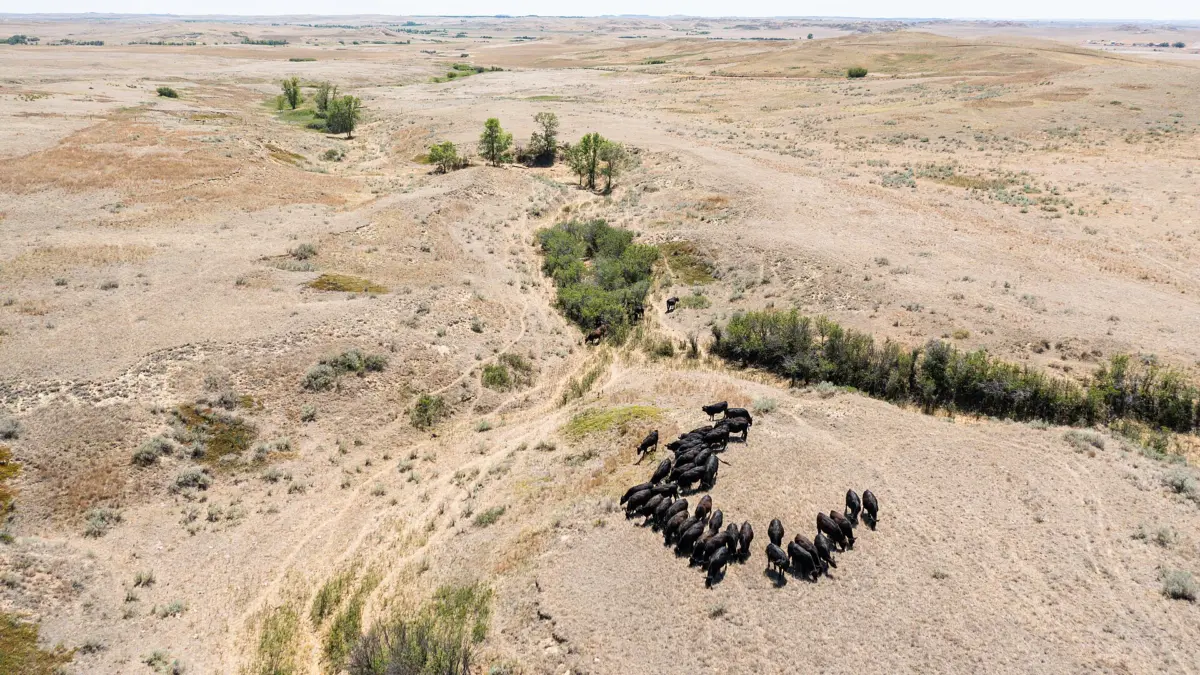
It’s a big corner, the brace posts as thick as a man’s waist, gray and cracked from sixty years of weather. Below it the ground slopes down into the draw a little, and there’s a stand of chokecherry and a couple of old box elder trees, half dead. The grass there was brown like everywhere else. But I saw what he was looking at. A patch about the size of a kitchen table, a little downhill from the corner, where the grass was one shade greener than everything around it. You’d never notice it unless you were looking.
Behind us, Kendra had her phone out. “Walt, I am calling the sheriff. I mean it.”
Grandpa stood there a long time anyway. A grasshopper landed on his sleeve and he didn’t brush it off.
Then he lifted his cane and pushed the rubber tip down into the middle of that green patch.
It went in easy. Four or five inches, like he was pushing it into cake.
He pulled it out and looked at the tip. There was dark mud on it.
He turned around and looked straight at Travis, who had walked up behind Kendra.
“Go get the backhoe,” he said.
Travis looked at Kendra.
Kendra looked at the cane. She had her arms folded across her chest. “Travis, come on. This is crazy. He had a stroke. He doesn’t even know what year it is half the time.”
“It’s 2026,” Grandpa said, without turning around. “And you’ve got three hundred cows that’ll start dying by Saturday.”
Travis wiped the sweat off his face with his forearm. He looked at the green patch, and then at the cane, and then at my grandpa. I watched something go across his face. I’d been married to that man for nineteen years and I knew most of his faces. This one I’d only seen a few times, mostly at funerals.
“Dad always said Walt knew this ground better than anybody alive,” he said quietly.
“Travis…”
“I’m getting the backhoe, Kendra.”
He walked back toward the shop at a jog.
It took him twenty minutes to bring it around on the road and through the gate. Kendra stood off to one side the whole time with her phone in her hand, not calling anyone, just holding it. Grandpa sat down on the brace pole of the corner in the shade of the box elder and drank one of my jars of ice water and didn’t say a thing.
When Travis got the backhoe in position, Grandpa stood up.
“Easy now,” he called out over the engine. “Not too deep on the first bite. There’s cedar down there, and I’d like to have it back in one piece.”
Travis set the bucket down where the cane had gone in and started to dig. The first bucket came up dark brown. The second came up darker, black almost, and wet, with a smell like a creek bed. By the fourth bucket the dirt was sticking to the teeth. At about five feet, the bucket scraped something hard.
“That’s it,” Grandpa said. “Hold up.”
Travis climbed down off the backhoe and got down on his knees at the edge of the hole. I came around beside him. At the bottom, through the mud, you could see the gray edge of a board. Then another one beside it. Cedar boards, laid edge to edge in a square, black with age but still solid.
As we watched, water started to come in between the boards. Just a little at first. A shine on the mud. Then a seep, then a trickle, running down the cedar and pooling in the bottom of the hole.
Nobody said anything.
Grandpa came over to the edge of the hole. He handed me his cane and got down on one knee, which took a while, and reached down with an old coffee can somebody had left by the corner post years ago. He scooped up some of that water. It was more mud than anything else.
He drank it anyway. Standing in the sun with his hat off, at eighty-six years old, he drank a coffee can of muddy spring water and then wiped his mouth with the back of his hand.
“Tastes the same,” he said.
By dark the hole was a third full of water, and it was clearing as it rose, the mud settling to the bottom. Travis called his hired man and a couple of neighbors. Duane from the co-op drove out with two hundred feet of black poly pipe and a box of fittings in the back of his pickup and wouldn’t take a dime for any of it. They dug a trench downhill from the spring to an old stock tank Travis dragged over from behind the shop, and they laid the pipe by the headlights of three pickups.
I sat with Grandpa on the tailgate of Travis’s flatbed and watched them work. Somebody had brought a cooler of beer and a bag of sandwiches. Grandpa ate half a ham sandwich, which was more than he usually ate for supper.
“Tell me about 1952,” I said.
He was quiet for a minute. Then he started.
“Worst summer anybody ever saw, up till then. The creek went dry the first week of July. Dad was hauling water with a team and a wagon and a stock tank on the back, if you can picture that. Four loads a day and the horses about dead from it. Then one evening Dad was walking this fence and he saw a patch of green right here, about where Travis set the bucket. Same as today.”
“So you dug it.”
“With shovels. Me and Dad and my uncle Arne. Took us three days. I was twelve years old. Mother brought us lemonade in a crock every afternoon and we drank it warm. We hit water at about five feet, and Dad went down to the river and cut cedar off the bottoms and boxed it so it wouldn’t cave.” He nodded at the hole. “That’s those boards. They’ve been down there seventy-four years.”
“And it never went dry?”
“Not while I had cows on this place. Not in ’61, not in ’88, not in 2002.” He took a sip of beer from a can Duane had handed him. “Things don’t change that much under the ground, Leah. People just stop paying attention.”
Around ten o’clock, Travis turned the valve. The water came down through the pipe and started splashing into the old tank. The cows heard it before we saw them. They came in out of the dark at a trot, dozens of them, bawling and shoving each other, crowding around that tank with their noses in the water. The sound of three hundred cows drinking is something I’ll never forget.
Kendra stood at the edge of the headlights, watching. She didn’t come over. After a while she got in her Tahoe and drove back to the house.
The spring ran about five gallons a minute. That’s about seven thousand gallons a day, which isn’t enough by itself for three hundred cows in a heat wave, but with Travis hauling two or three loads a day on top of it, it was enough. Nothing died. The heat broke on the twenty-second of August with a thunderstorm that dropped an inch and a half in forty minutes, and by September the creek was running again.
Kendra posted about it on Facebook the second week of September. Travis had built a new spring box out of treated lumber with a steel lid, and she took a picture of herself crouching next to it in a pair of clean boots. The caption said, “So grateful for OUR SPRING that saved our herd this summer!! Sometimes the old ways are the best ways!!” There were a hundred and some likes.
I showed it to Grandpa at supper.
He held the phone way out at arm’s length and looked at it for a long time. Then he started to laugh. It started as a chuckle and then it turned into a real laugh, the kind that shakes your shoulders, and then it turned into a coughing fit, and I had to get up and pound on his back and get him a glass of water. When he could breathe again he wiped his eyes with his napkin.
“Our spring,” he said, and started laughing all over again.
Two days later, Kendra drove into the yard in her Tahoe. She had a manila folder with her.
She came up on the porch where we were sitting. She didn’t sit down. She said she had good news, which was that she and Travis had decided to fence off the spring as part of their “infrastructure improvements,” with a locked gate, for safety reasons and to protect the water source. She said she understood Walt had a sentimental attachment to it, and he was welcome to come look at it anytime, as long as he called ahead and someone went with him.
Then she held out the folder. “And our attorney wanted me to give you this. It’s the same offer on the hay ground, but we went up to twelve hundred an acre. Because of everything this summer. We feel like that’s very generous.”
I looked at Grandpa.
He set his iced tea down on the porch floor. “Go ahead,” he said.
I went inside and got the envelope from the fireproof box, the one with “Kittredge Sale 1999” in my grandma’s handwriting, and I brought it back out to the porch. I took out the deed and turned to page four and handed it to Kendra with my thumb on the paragraph.
She read it standing up.
I watched her read it. I watched her get to “forever” and slow down. I watched her get to “together with all rights to the use of water from the spring located at or near the third corner post” and stop moving altogether. She read it again. Her lips moved a little on the second time through.
“This was recorded?” she said finally.
“With the Custer County Clerk and Recorder, on June the fourteenth, 1999,” I said. “Book 211, page 88. Your lawyer can pull it in about five minutes. Travis’s dad signed it. So did my grandpa.”
She looked up at Grandpa. For the first time since I’d known her, she didn’t have anything ready to say.
“So it’s his,” she said. “The spring.”
“The water in it is,” I said. “And the right to walk out to it. And the right to walk that fence, any day he wants to, which means your no-trespassing sign and your lawyer’s letter don’t mean much of anything.”
Grandpa picked his iced tea back up.
“Use all the water you want,” he said to her. “I didn’t keep it to sell it to anybody. I kept it so nobody could ever cap it off or forget where it was. That’s all. Somebody has to remember where the water is.” He took a sip. “And you can tell your lawyer the hay ground’s not for sale. Not at twelve hundred, and not at fifteen.”
Kendra closed the folder. She stood there for a second longer. Then she handed me back the deed, very carefully, like it might go off, and she walked back to her Tahoe and drove away. She didn’t put up a gate at the spring.
The yellow no-trespassing sign came down off the corner post sometime the next week. I never saw who took it down. Grandpa says it was the wind.
It’s November now. The hay is up and the cows are on the winter pasture, and the spring is still running, steady, five gallons a minute, into the tank Travis set below it.
Kendra and I wave at each other now when we pass on the county road. That’s about as far as it’s gone. She hasn’t apologized for the co-op or the letter, and I don’t expect she will. Carla says I should push it. I don’t see the point. Some people get to the end of showing you who they are, and then they just stand there, not sure what to do next. You don’t have to help them.
Travis comes over most Sunday evenings now. He knocks on the back door around six, and he and Grandpa walk the east fence together. Grandpa on the hay ground side with his cane and his hand on the top wire, Travis on the ranch side. I watch them from the kitchen window. Grandpa talks the whole way, pointing at things with his cane. Where the creek ran before ’78. Which cow calved behind which post. Where the water goes under the ground when it comes down off the bluffs.
Travis listens. Sometimes he writes things down in a little notebook he keeps in his shirt pocket.
Last Sunday, when they came back up to the porch, Grandpa sat down in his chair and Travis stood at the bottom of the steps for a while, turning his hat around in his hands.
“There’s another green spot,” Travis said. “Down by the seventh post. I noticed it in October.”
Grandpa nodded like he’d been waiting a long time for someone to say that.
“There’s a lot of them,” he said. “Sit down. I’ll tell you about the seventh post.”
Travis sat down on the top step. I brought out two cups of coffee and went back inside, and I left the kitchen window open a crack so I could hear.