The Hands
Part One: The Bread Hollow
My grandmother had her own way of kneading bread.
She’d stand at the south end of her kitchen table, plant the heels of both hands deep in the dough, and push. Forward and down, forward and down, until her elbows were almost straight. Then she’d fold the dough back over itself, give it a quarter turn, and push again. She did it every Saturday morning for as long as I knew her, in a flour-dusted apron with her sleeves pushed up past her elbows.
By the time I was old enough to help, she’d worn a shallow hollow into the wood at that end of the table. You could set a marble there and it would roll a few inches toward the middle and stop. Grandma called that spot her bread bowl, even though the real mixing bowl, a big yellow crockery one, lived in the cupboard beside the stove.
Her name was Elsa Ramberg. She lived in a little brick house on South Idaho Street in Dillon, Montana, a ranching town of about four thousand people in the far southwest corner of the state, where the Beaverhead River runs between two mountain ranges and the wind never quite stops.
The table had belonged to her mother, Bodil, who’d come from Norway as a girl. Bodil ordered it out of the Sears, Roebuck catalog in the spring of 1919. It came on the Union Pacific in two wooden crates, packed in straw. My great-grandfather drove a wagon to the depot to pick it up.
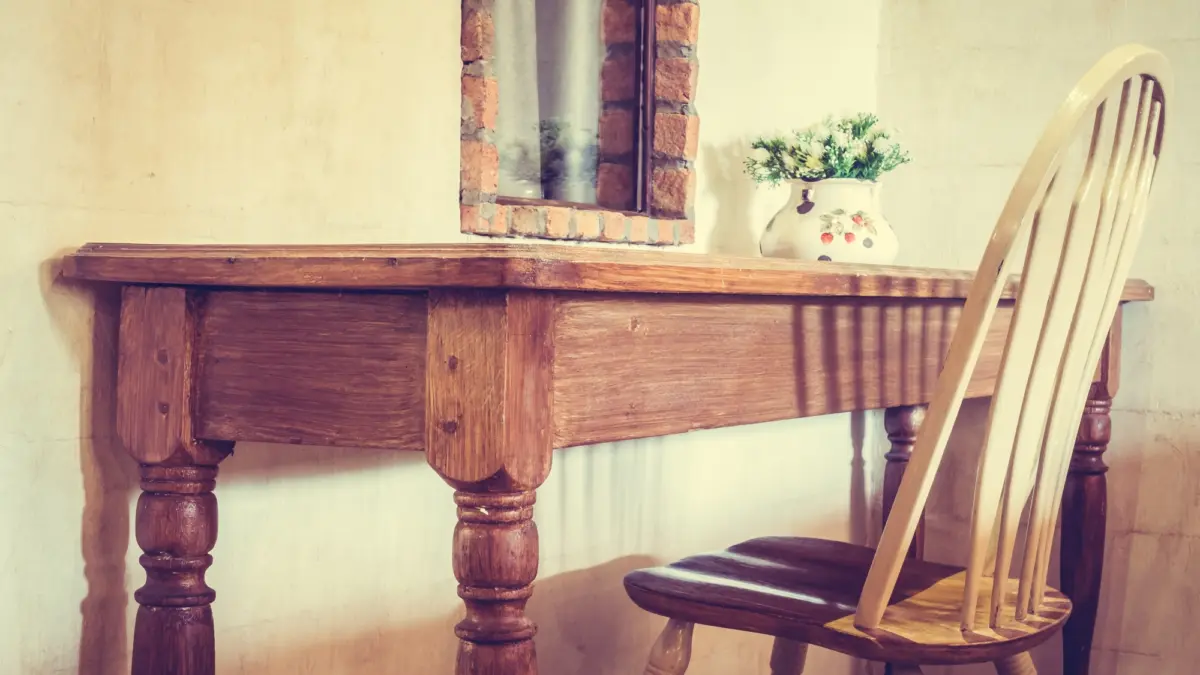
It was quarter-sawn white oak, the kind with the tiger-stripe flecks that catch the light. Two heavy carved pedestals. Three leaves you could put in or take out. It could seat four, or it could seat fourteen.
My grandfather, Vidar, drank his coffee at the north end of it every morning for thirty years. He never used a coaster in his life. He left a faint dark ring in the wood, just to the right of where his elbow rested, and it stayed long after he was gone.
Part Two: Grandpa’s Desk
My name is Court Bakke. I’ve spent most of my adult life restoring old furniture.
People sometimes ask me how I learned. I usually tell them about my grandfather’s desk. That’s where I learned the difference between making something look new and making it worth keeping.
Grandpa died when I was thirteen. Lung cancer. He’d smoked Lucky Strikes since he was a hand on a sheep ranch in the Big Hole at fifteen.
The next summer, Grandma let me fix his old drop-front desk. An oak secretary with a slanted lid that folded down to make a writing surface. The brass hinges had pulled loose from the wood, and the lid sagged when you opened it.
I plugged the stripped screw holes with dowels and glue. I put in new hinges. And then, because I was fourteen and wanted it to be perfect, I sanded the entire lid down to bare wood and put three coats of polyurethane on it until it shone like glass.
I was so proud of it. The top was so smooth it reflected the kitchen window.
Grandma stood and looked at it for a long time. She ran her fingers along the front edge of the lid.
Then she went into the pantry and closed the door.
I heard her crying in there. Quietly. For a long time.
I found out later what I’d done.
For fifty years, every time Grandpa sat at that desk to balance the checkbook, he rubbed his right thumb along the front edge of the lid while he added up the numbers in his head. Back and forth. Back and forth. Fifty years of a man’s thumb had worn a dark, satiny spot into the oak, about two inches long.
I’d sanded it away in four minutes.
She told me the desk looked beautiful. She hugged me and said she was proud of me. She meant it.
But I never forgot. That I’d taken something away that no amount of careful woodworking could ever put back.
Part Three: The Rubbings
After that, whenever somebody brought me an old piece of furniture to fix, I asked them a question before I touched it.
“Show me where your family’s hands rested.”
Then I’d lay a sheet of tracing paper over those places and make a pencil rubbing. The worn edge of a rocking chair arm. The dent in a dresser top where somebody’s keys landed every night for forty years. The scratched corner of a kitchen table where a kid did homework. The dark spot on a banister where three generations had put their hand on the way upstairs.
Then I’d do the repairs around them. Preserving the dents and the rings and the scratches and the worn-down edges wherever I could.
People in Dillon started calling the rubbings the hands.
Court, will you do the hands first?
By the time this story happened, I’d made more than five hundred of them. I keep them in flat file drawers in the back of my shop, labeled by name and date. Families come back sometimes, years later, after the furniture’s been sold or lost or burned, just to look at them.
Part Four: Mom
My mother, Maxine, never understood why I bothered.
She worked at a title company on Montana Street for twenty-six years. She could tell you what a house was worth before the owners had finished telling you why they loved it. She thought in square footage and comparable sales and recording fees.
Mom believed in clean finishes. Fashionable furniture. Getting rid of anything that looked old.
When she was sixteen, in 1979, she talked Grandma into painting that beautiful oak table almond white. Grandma told me years later she only agreed because she was tired of hearing Maxine complain about brown furniture every single day at breakfast.
“She said brown was for old ladies,” Grandma said. “I was forty-two.”
My little sister, Kendall, took after Mom.
She’s three years younger than me. Pretty and quick and full of plans. She always seemed to be starting a business.
First there was a cupcake trailer. Then a cleaning service for vacation rentals. Then a line of handmade leather hatbands, tooled with wildflowers, that sold for eighty-nine dollars apiece. Then a boutique on Montana Street that sold candles and throw pillows.
Every one of them looked wonderful on Instagram. Most of them lasted six months.
Part Five: Seven Hundred Fifteen Dollars
When I was fifteen, I started making money fixing furniture for neighbors.
Mrs. Haldane on Bannack Street paid me eighty-five dollars to fix a cedar chest her father built in 1938. Word got around. Before long, I was fixing chairs, dressers, church pews at First Lutheran, a whole set of school desks for the elementary school in Twin Bridges.
I saved almost every dollar. By the next spring, I had seven hundred and fifteen dollars in a savings account Mom had opened for me at First Montana Bank when I was twelve. I was saving for a planer. A real one, a used Delta I’d found in the classifieds in Butte for eight hundred.
Then Kendall needed braces.
I found out when I went into the bank to deposit a check from Mrs. Haldane’s sister, and the teller looked at the screen and then at me and said, very kindly, “Honey, there’s fourteen dollars in this account.”
Mom had withdrawn it. Seven hundred and one dollars. For Kendall’s orthodontist in Butte.
“Your sister’s going to have those teeth for the rest of her life, Court,” Mom said that night at the kitchen table. “That planer can wait.”
I didn’t argue. I was sixteen.
I didn’t know yet that you could love your family and still tell them they weren’t entitled to everything you had.
Part Six: The Receipt Book
When I was twenty-three, Mom asked me for three thousand dollars.
Kendall’s cupcake trailer had failed a county health inspection. It needed a new sink and a grease trap before the fair in August, and the bank wouldn’t lend her the money.
I gave Mom three thousand two hundred and fifty dollars. Everything I’d saved that year.
But this time, I got a cashier’s check from the bank. And I kept the receipt.
The next morning, I went to the bank and opened a new account. In my name only. Nobody else on it.
Then I went to the office supply store on Idaho Street and bought a carbon-copy receipt book. The kind with the white top sheet and the yellow copy underneath. And I wrote it down.
$3,250. To Maxine Bakke for Kendall’s cupcake trailer. Cashier’s check #4471.
Amund Gard saw the book a week later.
Amund was a saddle maker. He was seventy then. He’d been making saddles in Dillon since 1961, out of a narrow brick building on North Montana Street with a pressed-tin ceiling and a woodstove. He rented me the back half of it for my workshop for a hundred dollars a month.
He picked up the receipt book from my workbench and looked at the entry for a long time. Then he looked at me over his glasses.
“Put the date beside every one,” he said. “Every single one. From now on.”
“Why?” I asked.
Amund tapped the book with one thick, leather-stained finger.
“Because paper doesn’t forget,” he said. “People do. Especially family.”
I still have that receipt book. I’m on my fourth one now.
Part Seven: The Table Comes Home
When Grandma turned seventy-seven, she asked me if there was anything I could do about her kitchen table.
The almond-white paint from 1979 had chipped all along the edges. The oak was showing through in patches. Mom wanted her to buy a new table from the furniture store in Butte. A nice one, she said. Something modern. Glass top, maybe.
Grandma couldn’t bring herself to do it.
“I’ve eaten at that table every day for sixty years,” she told me. “My mother ate at it. Your grandfather ate at it. I’m not eating off glass.”
I asked if I could take it to my shop.
Before I loaded it into my truck, I sat with her in the kitchen and did the hands.
She put both palms flat in the bread hollow at the south end. I laid tracing paper over them and traced around her fingers. Then I lifted her hands away and rubbed the hollow itself.
She pointed to Grandpa’s coffee ring at the north end. I rubbed that too.
And near the middle of the table, she put her finger on two crooked letters scratched into the wood. A C and a B. Backwards.
I’d made them with a fork. At Easter dinner, when I was seven. While the grown-ups were talking. I got sent to my room for it.
Grandma never let anybody sand them out.
“That’s you,” she said. “That stays.”
I spent three weeks on that table at Amund’s shop. I took off the almond paint by hand. Slowly. With chemical stripper and a dental pick and fine bronze wool, so I wouldn’t touch the wood underneath any more than I had to. I reglued the pedestals. I made a new brass pin for one of the leaves, which had gone missing sometime in the 1980s. I worked the oil finish around every mark that mattered. The hollow. The ring. The C and the B.
When Amund and I carried it back into Grandma’s kitchen, she was standing by the stove in her apron with one hand over her mouth.
She walked to the south end of the table. She put both palms down in the old hollow.
“There you are,” she whispered.
She wasn’t talking to me.
Part Eight: Ten Years
Grandma hosted Thanksgiving at that table for another ten years.
The photograph I took of it the day we brought it back, on her seventy-seventh birthday, with her hands in the bread hollow and the November light coming through the window, became the most popular picture on my shop’s Facebook page. People still share it. Strangers from Ohio and Oregon and Norway message me about it.
My own life came together during those ten years.
I married Kateri, a second-grade teacher at Parkview Elementary. She’d brought an old pine table into the shop one afternoon. Her grandmother’s, from a farm near Wisdom. She asked me to fix a wobbly leg but please, please not to sand out the little dents on one corner where her mother had done her homework in the 1960s, pressing too hard with a pencil.
I did the hands on that table. Then I asked her to dinner.
Our daughter, Evie, was born a year after the wedding. She’s seven now. She grew up thinking every piece of furniture in my shop was a jungle gym.
When Amund retired from saddle making at eighty-two, he sold me the whole building on North Montana Street. On a payment plan. With no interest. “Pay me when you can,” he said. I fix furniture in the back now, sell restored pieces in the front, and keep Amund’s old saddle-maker’s chair by the front window. He still comes in most mornings to sit in it.
Part Nine: March
Grandma died in March.
She caught pneumonia in February. She was eighty-seven. She spent her last four days at Barrett Hospital, on the hill above town.
Kateri came to the shop to tell me. She didn’t want me to hear it on the phone. She came in the front door with her coat still on and stood by the old oak counter, and I knew from her face before she said anything.
Grandma had arranged things years earlier, with a lawyer in town. The house on South Idaho Street went to Mom, through a transfer-on-death deed. That made sense. Mom was her only child.
I didn’t expect to inherit a house.
But I wanted to keep the old kitchen in the family. The kitchen where Grandma kneaded bread every Saturday. Where I learned to make lefse at nine. Where I’d done the hands on her table.
So I went to the bank and got preapproved for a mortgage. Two hundred fourteen thousand dollars. What the houses on that street were selling for. I brought the letter to Mom.
“I’ll pay full price,” I said. “Every dollar. I just want to keep the house in the family.”
Mom read the letter. She folded it in half.
“The house is going to Kendall,” she said. “You already have your business, Court. Your building. Your wife. Kendall needs something of her own.”
She’d already signed the deed over to my sister. For nothing. Recorded at the Beaverhead County courthouse the week before.
I went home and sat on my front step for a long time.
It was Mom’s house. Mom’s choice. There was nothing I could do about it.
Part Ten: The Elsa
Kendall and her husband, Jordy, turned Grandma’s house into a vacation rental. For fly fishermen who come to Dillon every summer for the Beaverhead and the Big Hole. And for small weddings and events.
They named it The Elsa.
They gutted the kitchen. Ripped out Grandma’s knotty pine cabinets from 1958. Put in white shaker cabinets and quartz countertops and a big farmhouse sink and open shelving with plants.
I asked Kendall if I could have the old cabinet doors before the demolition crew hauled them to the dump. She said sure.
Then I asked about the table.
“We’re keeping it for now,” Kendall said.
That phrase bothered me. For now.
Part Eleven: Thanksgiving
Thanksgiving was our first holiday without Grandma.
Mom invited everybody to the remodeled house. Kendall and Jordy and their son, Jens, who’s eleven. Jordy’s parents, up from Bozeman. Me and Kateri and Evie.
Kateri made Grandma’s dinner rolls. From the recipe card Grandma had given her the Christmas after our wedding, in Grandma’s shaky handwriting. Elsa’s Sunday Rolls. Kateri had kept it in her kitchen drawer for nine years.
I loaded the rolls into the truck. Two pies. Pumpkin and apple. And Evie’s little purple winter coat.
We got to South Idaho Street at a quarter to two. It was nineteen degrees. A light snow was starting to fall, the dry powdery kind that blows sideways.
The house looked completely different. Black window trim. New gooseneck lights on the porch. A walnut front door with a brass number plate. A sign on a post in the front yard: THE ELSA — Est. 2024.
And beside the garbage cans, at the end of the driveway, upside down in a snowbank, was Grandma’s table.
Part Twelve: FREE
The two pedestals were sticking up into the air. The three leaves were stacked underneath, in the snow. A piece of cardboard was duct-taped to one of the pedestals.
In black marker: FREE.
Evie was holding my hand. She looked up at me.
“Daddy,” she said. “Why is Great-Grandma’s table outside?”
I asked Kateri to take her in the house. Kateri looked at the table in the snowbank. Then at me. She didn’t say anything. She just took Evie’s hand and the rolls and went up the walk to the walnut door.
I went to find my mother.
Part Thirteen: “That Old Table”
Mom came out onto the porch in her good gray wool coat. Jordy followed her out, holding a beer.
“What is Grandma’s table doing on the curb?” I asked.
Mom sighed. “That old table is trash, Court. Jordy’s taking it to the transfer station on Saturday.”
Jordy stepped forward. He’s a nice enough guy. He sells irrigation equipment to ranchers.
“We bought new tables for the rental,” he explained. “White farmhouse ones. From Pottery Barn. Guests want clean, modern stuff. That old thing’s got water stains and scratches all over it. It doesn’t fit the brand.”
I walked down the driveway to the snowbank.
I looked down at the south end of the table. At the hollow where Grandma kneaded bread every Saturday for sixty years.
There was snow melting in it.
“Then I’ll take it out of your way,” I said.
Part Fourteen: Jens
I backed my old F-150 up to the curb. I got my socket set out from behind the seat.
I’d rebuilt those pedestals myself, ten years earlier. I knew exactly where every bolt was.
I knelt in the snow and started taking the table apart.
My nephew, Jens, came out the front door while I was working.
He’s eleven. Skinny, with Kendall’s dark hair sticking up in the back and his coat unzipped. He stood at the end of the driveway in the falling snow, watching me with his hands in his pockets.
He didn’t say anything. He watched me take off the first pedestal.
Then he turned around and went back inside.
A minute later, he came back out. He was wearing a pair of leather work gloves. Jordy’s. Too big for him.
He didn’t ask what to do. He just walked over and took hold of one end of the oak tabletop.
Neither of us said much. He held one end while I lifted the other. We carried it together to the truck bed and slid it in on a moving blanket. Then the pedestals. Then the three leaves.
When we were done, Jens stood beside the truck with his too-big gloves and snow in his hair.
“Uncle Court,” he said quietly. “That’s the table where Great-Grandma taught me to make lefse.”
“I know, buddy,” I said.
“Mom said it was ugly,” Jens said. “I didn’t think it was ugly.”
“It’s not,” I said.
Part Fifteen: The Scene
Mom stood on the walkway the whole time. In her good gray coat. In the snow.
“You’re making a scene,” she said. “In front of Jordy’s parents. On Thanksgiving.”
I closed the tailgate.
“No, Mom,” I said. “I’m cleaning up your curb.”
Kateri brought Evie back outside. With the rolls. We left the pies.
We drove home to our little house on Railroad Street.
That night, the three of us had Thanksgiving dinner in our living room. Around a folding card table. With Amund, who’d been planning to eat alone. Kateri’s rolls. A rotisserie chicken from Safeway. Canned cranberry sauce.
Grandma’s oak tabletop leaned against the living room wall, drying beside the woodstove.
At nine-fourteen that night, Kendall texted me.
Mom’s been crying since you left. I hope your old table was worth it.
I looked at the tabletop leaning against my wall. At the bread hollow, catching the firelight.
I wrote back two words.
It was.
Part Sixteen: The Window
On Monday, I took the table to my shop.
I dried it slowly. Over two weeks, with the woodstove at a low steady heat. One of the leaves had gotten waterlogged in the snow, and the veneer on one edge had started to lift. I reglued it. Clamped it. Let it cure.
Then I oiled the whole thing. And I polished the places where our family’s hands had worn the wood. The bread hollow. Grandpa’s coffee ring. The C and the B.
I set it up in the front window of my shop. On North Montana Street. Where everybody walking by could see it.
Beside it, I put a little handwritten card in a brass stand.
Elsa Ramberg’s table. Sears, Roebuck & Co., 1919. Not for sale.
People stopped and looked through the window. All winter. Ranchers in town for feed. Women coming out of the Safeway. Kids from the high school.
Some of them came inside. They’d stand beside the table and touch it.
“I ate at this table,” an old man named Harlan Briggs told me. “In 1962. After my wife’s funeral. Elsa made me eat a whole plate of meatballs. She said I wasn’t leaving until I did.”
“My mother learned to make lefse at this table,” a woman named Ruth said.
They kept coming. All winter.
Part Seventeen: Thelma
About three months later, in February, Thelma Rostad came into my shop.
Thelma is eighty-three. She lived next door to my grandmother on South Idaho Street for forty-one years. They had coffee together every single morning. Thelma’s house is yellow, with a lilac hedge between it and Grandma’s.
She brought me her mother’s old rocking chair. A Boston rocker, painted black with gold stenciling, from 1890. One of the spindles was cracked. She wanted it fixed.
I asked her to show me the hands.
She showed me the worn spots on the arms where her mother’s palms had rested for sixty years. I laid tracing paper over them and started rubbing with my pencil.
While I worked, Thelma looked over at the front window.
At Grandma’s table.
“So you got it,” Thelma said. “Good. I was afraid you hadn’t.”
I stopped rubbing. “What do you mean?”
Thelma looked surprised.
“Didn’t your mother give you the list?” she asked.
Part Eighteen: The Blue Notebook
I put down my pencil.
“What list, Thelma?”
She looked at me for a long moment. Then she sat down in Amund’s chair by the window, slowly, with her cane.
“When your grandmother was in the hospital,” Thelma said. “At Barrett. The last week. I went up every day. On the second day, she asked me to bring her little blue notebook. The one she kept on the kitchen counter for grocery lists. By the bread box.”
I knew that notebook. A little spiral notebook with a blue cardboard cover. Grandma had kept one on that counter my whole life. When one filled up, she bought another one exactly like it at the Safeway.
“Her hands were too weak to write,” Thelma said. “The pneumonia. She was so tired. So she asked me to write for her.” She folded her hands on her cane. “She dictated a list. Of her things. Who she wanted to have them. And she made me read it back to her twice. And then she signed it. At the bottom. Her hand was shaking so bad, but she signed it. And I signed under her.”
I couldn’t breathe.
“Her good cameo brooch,” Thelma said. “The one Vidar gave her for their twenty-fifth anniversary. That went to Kateri. She said Kateri would wear it.”
Kateri had never gotten that brooch. I’d seen it, actually. At Thanksgiving. On Kendall’s sweater.
“Her recipe box went to Kendall,” Thelma said. “Her sewing machine went to First Lutheran. For the quilting ladies.”
She looked at me.
“And the very first line,” Thelma said. “The first thing she said. Before anything else.”
Part Nineteen: The First Line
“The oak table goes to Court,” Thelma said. “He gave it back to me.“
I sat there on my workbench stool, holding my pencil, with a half-finished rubbing of a dead woman’s hands on a rocking chair in front of me.
“She said it twice,” Thelma said quietly. “She made me write it big. At the top of the page. The oak table goes to Court. He gave it back to me.“
“Thelma,” I said. “What happened to the notebook?”
Thelma’s face changed.
“I gave it to your grandmother,” she said. “After we signed it. She held it in her lap. And that afternoon, your mother came. Maxine. She sat by the bed for about an hour.” She looked down at her hands. “Elsa handed her the notebook. I was standing right there by the window. Elsa said, Maxine, this is my list. Please do what it says.“
“And?”
“And your mother looked at it,” Thelma said. “She read the first page. Then she closed it. And she put it in her purse.”
Part Twenty: Before
I looked through the front window of my shop at the old oak table. At the bread hollow and the coffee ring, glowing in the February afternoon sun.
My mother had known.
She’d known what Grandma wanted. In the hospital. Before Grandma died. Before the funeral. Before she signed the house over to Kendall. Before she put the table in the snowbank with a cardboard sign that said FREE.
That old table is trash, Court.
For three months, I’d believed my mother just didn’t understand. That she thought the table was worthless. That she looked at it the way she looked at everything. In square footage and comparable sales.
She hadn’t thought it was worthless.
She’d been handed her own mother’s last wishes, written down and signed. And she’d put them in her purse.
And then put the table on the curb.
Part Twenty-One: Marlys
I didn’t go to my mother right away.
I called Marlys Kittredge instead. She’s the lawyer in Dillon who drew up Grandma’s will. She’s seventy, in a little office above the hardware store on Bannack Street. She’s handled half the estates in Beaverhead County since 1983.
She saw me the next morning.
I told her everything. The blue notebook. Thelma. The hospital. The first line.
Marlys listened without interrupting. Then she took off her reading glasses and went to a filing cabinet and pulled out a thick folder.
“Your grandmother’s will,” Marlys said, opening it on her desk. “I drafted it in 2016. She updated it in 2021.” She turned a page. “Paragraph Four. Read it.”
I read it.
I may leave a written list, signed by me, disposing of items of my tangible personal property. Any such list shall be given effect as provided by Montana law.
“Montana Code 72-2-533,” Marlys said. “If a will refers to a separate written list for personal property, and the list is signed by the person who made the will, it’s legally binding. As long as it describes the items and the people clearly enough.” She tapped the page. “Elsa put that paragraph in on purpose. She told me in 2016 she wanted to be able to give away her things without coming back to my office every time she changed her mind.”
I stared at her.
“Who’s the personal representative of the estate?” I asked. “The executor?”
Marlys looked at me over her reading glasses.
“Your mother,” she said.
Part Twenty-Two: The Duty
“A personal representative,” Marlys said, “has a legal duty to carry out the will. Including any valid list the will refers to. If your grandmother signed a list, and your mother received it, she was required to follow it.” She closed the folder. “The table, the brooch, the sewing machine. All of it.”
“The table’s already mine,” I said. “I took it off the curb.”
“Then legally,” Marlys said, “you were just collecting your property.” She almost smiled. “On Thanksgiving. In the snow.”
“Court,” Marlys said. “The table’s not really the question here. You know that.”
I didn’t say anything.
“The question,” Marlys said, “is what else was in that notebook. And why your mother didn’t want anyone to see it.”
Part Twenty-Three: The Receipt Books
That night, I went to my shop after Kateri and Evie were asleep. I turned on the light over my workbench.
I opened the bottom drawer. The one where I keep the receipt books. All four of them.
I took them out and laid them on the workbench in order.
The first book started when I was twenty-three. $3,250. Kendall’s cupcake trailer. June 14.
Then:
$1,800. Kendall’s cleaning business. Van repair. March 3.
$4,500. Kendall’s hatband business. Leather and tools. September 22.
$2,200. Mom. Kendall’s rent. Said it was a loan. February 1.
$6,000. Kendall’s boutique. Inventory. Mom said Kendall would pay it back by Christmas. October 17.
Page after page. Book after book. In my handwriting, with the date beside every one. Like Amund said.
I added them up. Twice.
Thirty-one thousand, four hundred dollars. Over fourteen years.
And on the inside cover of the first book, in pencil, written that first night when I was twenty-three, I’d made one more entry. From before I ever bought the book. From memory.
$701. Kendall’s braces. Withdrawn without asking. Age 16.
Part Twenty-Four: Mom’s Kitchen
I went to see my mother on Saturday morning.
She lives in a split-level on the north side of Dillon, near the college. She’s lived there since the divorce, when I was ten.
She opened the door in her bathrobe. She looked at me. Her face was tight.
“Court,” she said.
“Can I come in, Mom?”
We sat at her kitchen table. A white one. Laminate. From a furniture store in Butte.
I didn’t say anything for a long time.
Then I said, “Thelma Rostad came to my shop.”
My mother went very still.
“She told me about the blue notebook,” I said. “From the hospital. The list. She told me Grandma signed it. And she signed it. And Grandma handed it to you.” I looked at her. “And you put it in your purse.”
My mother didn’t answer.
“The first line said the table goes to me,” I said. “He gave it back to me. Grandma said it twice. She made Thelma write it big.”
My mother looked down at her laminate table.
“And three weeks after she died,” I said, “you put it on the curb in a snowbank with a sign that said FREE.“
Part Twenty-Five: Why
My mother sat at her white kitchen table for a long time with her hands folded.
Then she got up. She went to the hall closet. She came back with a purse. An old brown leather one. Not the one she carries now.
She opened it. She took out a little spiral notebook with a blue cardboard cover.
She set it on the table in front of me.
“I’ve been carrying it around for eleven months,” she said. “I took it out of that purse last week and put it back about fifty times.”
I opened it.
Most of the pages were grocery lists. In Grandma’s handwriting. Flour. Cardamom. Coffee. Lefse sticks. Butter. The last one, from February, before the pneumonia: Oranges for Thelma.
Then a page in different handwriting. Thelma’s. Big and loopy and careful.
Elsa Ramberg’s things. Dictated at Barrett Hospital, March 9.
1. THE OAK TABLE GOES TO COURT. HE GAVE IT BACK TO ME.
2. My cameo brooch goes to Kateri. She’ll wear it.
3. My recipe box goes to Kendall.
4. My sewing machine goes to First Lutheran. For the quilters.
5. Vidar’s desk goes to Jens. He likes to draw at it.
At the bottom, a signature. Shaky. Barely legible. Elsa Ramberg. And under it, Witness: Thelma Rostad.
I turned the page.
There was more.
Part Twenty-Six: The Last Page
It was still Thelma’s handwriting. But smaller. Like Grandma had been tired, and talking slowly.
For Maxine.
Maxine, I know you took Court’s money when he was sixteen. For Kendall’s braces. He came to me crying. He didn’t tell you he told me.
I know you’ve taken from him since. Over and over. For Kendall. He never says no.
I never said anything. I should have. I’m sorry.
I did the same thing to you. When you were small. I gave the good things to your brother Leif. Before he died. Because he was the boy. Because he was sickly. Because I was scared for him. You got the hand-me-downs. You got told you’d understand.
You painted my table white because you hated everything I loved. I knew why. I let you.
Don’t do to Court what I did to you. He’s the one who stays. He’s the one who fixes things. That doesn’t mean he doesn’t need anything.
Give him the table. And make it right.
You were always my girl, Maxine. Even when you painted my table.
— Mother
I read it three times.
Then I looked up at my mother across her white laminate table.
She was crying.
Part Twenty-Seven: Leif
“I had a brother,” my mother said. “Did you know that?”
I shook my head. I didn’t. Nobody had ever said.
“Leif,” she said. “Two years older than me. He had a hole in his heart. A congenital defect. In 1960, they couldn’t fix it in Montana. Mother took him to Salt Lake City four times. To Denver twice.” She wiped her eyes. “He got everything. The new clothes. The bicycle. The trip to Yellowstone. Because he might not live. Because he was the boy.”
She looked at her hands.
“He died when I was eleven,” she said. “And then it was just me. In a house where everything had been for him. Every picture on the wall was him. Mother kept his room exactly the same. For years.”
She looked at me.
“I painted that table white when I was sixteen,” she said, “because Mother loved it. Because she’d sit at it at night and cry about Leif. And I wanted to take something she loved away from her. The way everything I loved got taken away for him.”
“And then you had two children,” I said slowly. “And one of them was the one who stayed. Who fixed things. Who didn’t need anything.”
My mother closed her eyes.
“And the other one needed everything,” I said.
“Kendall was so scared all the time,” Mom said. “Of failing. Of not being good enough. She was always starting things and having them fall apart. And you were always fine. You were always fine, Court.” She shook her head. “I thought, he doesn’t need me. He never did. Kendall needs me.”
“I needed my seven hundred and fifteen dollars,” I said quietly. “For the planer. I was sixteen.”
My mother started to cry harder.
Part Twenty-Eight: The Curb
“Why did you put the table on the curb, Mom?” I asked. “After you read the list. After you read the last page.”
She didn’t answer for a long time.
“Because I couldn’t look at it,” she said finally. “When Kendall and Jordy were remodeling, they asked what to do with it. And I went over to the house, and I walked into the kitchen, and there it was. With the bread hollow. And Father’s coffee ring. And your initials.” She wiped her face with her bathrobe sleeve. “And all I could think was, She wrote it down. She knew. She knew about Leif, and she knew about Court, and she wrote it all down at the end, and gave it to me.“
She looked at me.
“I thought if the table was gone,” she said, “I wouldn’t have to look at the list. I wouldn’t have to look at what she said. I wouldn’t have to make it right.”
“So you put it in the snow,” I said.
“So I put it in the snow,” my mother said. “And then you showed up and took it home. Just like she said. He gave it back to me.” She laughed through her tears. “Even that, Court. Even that I couldn’t take from you.”
Part Twenty-Nine: The Receipts
I reached into my jacket. I took out the four receipt books. I set them on her white table beside the blue notebook.
My mother looked at them.
“What are those?” she asked.
“Amund told me to write down the date beside every one,” I said. “When I was twenty-three. He said paper doesn’t forget.”
I opened the first one to the inside cover.
$701. Kendall’s braces. Withdrawn without asking. Age 16.
My mother put her hand over her mouth.
“Thirty-one thousand four hundred dollars,” I said. “In fourteen years. Plus the seven hundred and one.”
My mother didn’t say anything.
“I’m not here for the money, Mom,” I said. “I want you to know that. I’m not going to sue you. I’m not going to make you pay it back.”
She looked up at me.
“I just wanted you to see it,” I said. “Written down. With the dates. The way Grandma wrote down the list.” I closed the book. “So you can’t pretend it didn’t happen. And neither can I.”
Part Thirty: The Brooch
“There’s one thing I need you to do,” I said.
My mother waited.
“The cameo brooch,” I said. “It’s supposed to go to Kateri. Kendall wore it at Thanksgiving. On her sweater.”
My mother closed her eyes.
“And Grandpa’s desk,” I said. “It’s supposed to go to Jens. Where is it?”
“In Kendall’s garage,” Mom said quietly. “She was going to sell it. On Facebook Marketplace. For the rental money.”
“And the sewing machine,” I said. “To First Lutheran.”
“Kendall has it,” Mom said. “In the basement of the Elsa.”
“You’re the personal representative, Mom,” I said. “Marlys Kittredge says you’re legally required to follow that list.” I pushed the blue notebook across the table toward her. “But I’m not asking you because of the law. I’m asking you because Grandma asked you. In the hospital. Please do what it says.“
My mother looked at the notebook for a long time.
“Okay,” she said.
Part Thirty-One: Kendall
My mother called Kendall that afternoon. I wasn’t there. Mom told me about it later.
She read her the list. All of it. Including the last page.
Kendall didn’t say anything for a long time. Then she started crying.
“Mom,” she said. “I didn’t know about any of it. I didn’t know about Court’s money. The braces. The cupcake trailer. I thought you were paying for all that. I thought it was your money.”
“I know, honey,” Mom said. “I never told you.”
Kendall drove the cameo brooch to my house that night. In a little box.
She stood on our front step in the cold, holding it out to Kateri.
“I wore it at Thanksgiving,” she said. “I’m sorry. I didn’t know it was supposed to be yours. Mom gave it to me. She said Grandma would’ve wanted me to have it.”
Kateri took the box. She opened it. She looked at the brooch. An ivory cameo of a woman’s profile, in a gold frame, from 1964.
Then she looked at my sister.
“Do you want to come in?” Kateri asked. “We’re having soup.”
Part Thirty-Two: Jens
The next Saturday, Kendall and Jordy brought Grandpa’s desk to my shop. The oak secretary. With the drop-front lid that I’d sanded smooth when I was fourteen.
Jens came with them.
He stood in my shop and looked at the desk. Then at me.
“Mom says Great-Grandma left it to me,” he said. “On her list.”
“She did,” I said.
“Can you fix it?” Jens asked. “The lid’s wobbly again.”
I looked at the desk. At the lid. At the front edge, smooth and shiny, where my grandfather’s thumb used to be.
“Jens,” I said. “Come here. I want to show you something.”
He came over. I took his hand. I put his thumb on the front edge of the lid.
“Your great-great-grandfather,” I said, “used to rub his thumb right here. When he balanced the checkbook. For fifty years. It wore a dark spot into the wood. Right here.”
Jens looked at the edge. “I don’t see a spot.”
“No,” I said. “Because I sanded it off. When I was fourteen. I didn’t know it was there. I didn’t ask anybody where his hands had been.” I took a breath. “And your great-grandma went in the pantry and cried.”
Jens looked at me.
“So I’m going to fix the hinges,” I said. “But I’m not going to sand anything. Ever again. And if you rub your thumb right there, every time you sit at it, someday there’ll be a spot again.”
Jens thought about that for a long time.
Then he rubbed his thumb along the front edge of the lid. Once. Carefully.
“Like that?” he asked.
“Exactly like that,” I said.
Part Thirty-Three: Easter
At Easter, my mother came to my shop.
She called first. She asked if she could come.
I’d moved Grandma’s table out of the front window and into the back of the shop. I’d put all three leaves in. It seats fourteen with all the leaves in.
It was the first family dinner at that table since Grandma died.
Everybody came. Mom. Kendall and Jordy and Jens. Kateri and Evie and me. Amund, eighty-six, in his good shirt. Thelma Rostad, with her cane, who brought rosettes. And Pastor Lindgren from First Lutheran, because Kendall had driven Grandma’s sewing machine to the church that week and the quilting ladies wanted to say thank you.
Kateri wore the cameo brooch.
Kateri made Grandma’s Sunday rolls. Mom brought a ham. Thelma brought her rosettes. Kendall brought lefse. She’d made it herself. With the lefse sticks from Grandma’s kitchen drawer, which she’d found when she was cleaning out the Elsa’s basement.
Before we ate, I took out a sheet of tracing paper and my pencil.
“I want to do the hands,” I said.
Everybody looked at me.
“The table’s got new ones now,” I said. “Since Thanksgiving. Since it went in the snow.” I laid the tracing paper at the south end of the table. Over the bread hollow. “Mom. Will you go first?”
Part Thirty-Four: Mom’s Hands
My mother stared at me.
“Me?” she said.
“You,” I said.
She came around the table slowly. She stood at the south end. Where her own mother had stood every Saturday for sixty years, kneading bread.
She looked down at the hollow in the oak. At the tracing paper laid over it.
She put both of her palms down. Flat. In the hollow. Where her mother’s hands had been.
Then she pushed. Forward and down. The way Grandma used to. Until her elbows were almost straight.
She stood there with her hands in her mother’s bread hollow, at a table she’d painted white at sixteen and put on the curb at sixty, and she cried. In front of everybody.
Nobody said anything. Thelma put her hand over her mouth. Kendall started crying too. Amund looked down at his plate.
I traced around my mother’s fingers. Slowly. Carefully.
Then I lifted her hands away and did the rubbing.
When I held it up to the light, you could see it. The old hollow, worn by sixty years of Elsa Ramberg’s bread. And inside it, the outline of her daughter’s hands. Pressed into the same place. Exactly where they belonged.
Part Thirty-Five: The Others
Then everybody did it.
Kendall put her hands on the north end, by Grandpa’s coffee ring. Jens put his thumb on the edge, the way he rubs Grandpa’s desk. Evie put both her little hands flat in the middle of the table, right on top of my C and B, and giggled.
Thelma put her hand where she used to rest her coffee cup every morning for forty-one years. Amund put his big, leather-stained hand on the corner, where he’d leaned the day we carried the table back into Grandma’s kitchen ten years ago.
Kateri put her hand over her heart, on the cameo brooch.
I did the rubbings. All of them. On one big sheet of tracing paper. The whole table. Every hand.
It’s framed now. In my shop. On the wall above the flat file drawers where I keep the other five hundred and twelve.
It’s labeled in my handwriting. With the date beside it, like Amund taught me.
Elsa Ramberg’s table. Sears, Roebuck & Co., 1919. Easter. Everyone.
Part Thirty-Six: Paper Doesn’t Forget
My mother gave me the blue notebook before she left that night.
“I think it should stay with the table,” she said. “With you.”
I keep it in the drawer of my workbench. Next to the four receipt books.
I don’t add to the receipt books anymore. Mom hasn’t asked me for money since February. Neither has Kendall.
In May, Mom came into the shop on a Tuesday afternoon. She sat in Amund’s chair by the window. She watched me work for a while.
Then she reached into her purse and took out an envelope. She set it on my workbench.
Inside was a check. Seven hundred and one dollars.
And a note, in her handwriting. With the date beside it.
For a planer. Forty years late. — Mom. May 14.
I don’t need a planer anymore. I’ve had a good one for twenty years.
But I didn’t cash the check.
I put it in the blue notebook. On the page after Grandma’s list. Right after You were always my girl, Maxine. Even when you painted my table.
Paper doesn’t forget, Amund says.
But I’ve learned that sometimes, if you’re very lucky, people remember too.