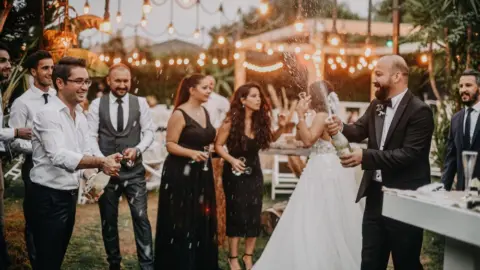
The microphone popped, and my father pointed straight at me across ninety guests gathered under the big Wyoming sky.
“Everything on this ranch is mine,” Wendell Brandt said, “and I’ll give it to who I please.”
Behind him a pig turned on its spit over a trench of coals, dripping fat that spat and hissed in the quiet. The band had stopped mid song, the fiddle player still holding his bow in the air as though he had forgotten what to do with it. Strings of yellow lights hung from the barn eaves, and the evening had gone the color of weak tea, the way it does in late summer when the sun drops behind the Haystack range and the whole prairie seems to hold its breath. My brother Brody stood at my father’s elbow with his arm around his fiancée, Kenzie, grinning like a man who had just won a buckle at the state finals.
My father had spent the last five minutes announcing that Spring Creek, the only year round running water on our eight thousand acres, would go to Brody and Kenzie as an engagement gift. Six hundred and forty acres, a full section, with the windmill and the cottonwoods and the long green bend where the creek slowed down and the elk came to drink at dusk.
I was nineteen years old, and I was standing at the grill with a pair of tongs in my hand.
I had spent the entire previous year working that ranch without a dollar of wages. I had pulled calves at three in the morning and spliced wire in the sleet and hauled hay until my palms split open and healed over into something like leather. I had done it because my father had stood with me at the north fence the week after my high school graduation, both of us sweating through our shirts as we reset a corner brace, and told me what he wanted. Stay one more year. Work the cattle. No pay. Spring Creek is yours.
He was not finished with the microphone. He never was.
“And Tate,” he said, and he turned toward the grill and smiled, the wide, generous smile he used on cattle buyers and county commissioners. “Don’t think I forgot you, son. You get the old stock trailer. Keep hauling that hay.”
A few people laughed. It started small and uncertain, the way laughter does when nobody is sure whether it is allowed. Then Lyle Carmichael, Kenzie’s father, a red faced man in a pressed white shirt who had financed half of the day’s festivities and wanted everyone to know it, let out a great booming guffaw.
“That’s perfect,” he said. “Every outfit needs a truck driver.”
Two old ranchers near the front found something to study on the toes of their boots. A woman I had known since I was in diapers took a sudden interest in her paper plate. Nobody stepped forward. In all my life I had never understood how a crowd of decent people could stand perfectly still while something unjust happened in front of them, and I understood it that night. It is not that they approve. It is that they are afraid of the sound their own voice would make.
My father leaned toward the microphone again and reminded everyone, in case there had been any misunderstanding, that a man could give his property to whomever he pleased.
I laid the tongs on the edge of the grill. I remember that I set them down carefully, parallel to the rail, because I did not want to make a noise. I walked across the gravel to the barn, past the long tables with their checkered cloths, and I stepped into the cool dark that smelled of hay and leather and old rope. The trailer keys hung on a nail beside the tack room door, where they had hung my whole life, on a loop of baling twine with a faded orange tag. I took them down.
When I came back around the corner, the crowd had begun to loosen, the band had started up again at a lower and more cautious volume, and my father was bent over a plate of ribs that someone had set in front of him. I walked straight up to the stage. I took his right hand off the plate, turned it over, and put the keys in his palm.
“Then keep it,” I said.
He stared at the keys and then at me. I think he truly believed I was going to take the trailer. I think he had planned for the part where I raged or wept, so that he could tell the story later about how the boy had never been grateful. He had not planned for the part where I handed him the trailer back.
I walked out to my old Ford F250, which had a cracked windshield and a bench seat held together with duct tape, and I tossed in the two duffel bags I had packed that afternoon. I had not told myself why I packed them. Some part of me had known.
My mother caught me at the back door of the house. Darlene Brandt was a small, tired woman with her hair pinned up in the way she had worn it since the Carter administration, and she wiped her hands on her apron as though she were about to hand me a plate of something.
“Tate,” she said, low. “Please don’t make a scene. Not tonight. Not in front of everyone.”
“I’m not making a scene, Mom,” I said. “I’m leaving one.”
She flinched as though I had slapped her. I felt sorry for it and I climbed in the truck anyway.
I should say that the promise was no misunderstanding. People told themselves that afterward, in the careful way people retell a story so that no one in it has to be a villain. Oh, you know Wendell, he probably meant something different, you know how those things get mixed up. But I knew what he had said. I had asked him that day at the north fence, with the wire stretcher still in my hands, to put it in writing.
“My word is good, Tate,” he had told me. “It’s been good in this county for forty years.”
I believed him. I want to be honest about that, because it would make me look wiser to say I had suspected something. The truth is that I believed my father the way a boy believes the ground. Though I should have known better, because I had already learned what happened when money moved through his hands.
When I was fourteen, I stacked hay for the neighbors every summer weekend until I had saved four hundred dollars, which I kept in a red Folgers coffee can on a shelf in the bunkhouse. I had a plan to buy a used saddle. One evening in June I reached for the can and it was empty, and my father explained at supper, without any embarrassment, that Brody’s rodeo entry fees had come due and that family helped family. Brody, sitting across the table, chewed his potatoes and said nothing.
When I was sixteen, I raised a steer named Domino for the county fair, a black baldy with a white blaze down his face and a disposition like a Labrador. I got up at five every morning for eleven months to feed and wash and walk him. He took grand champion, and the sale check was written out in my name, nearly four thousand dollars, and I stood in the exhibit hall holding it and feeling richer than I had ever been. My father drove me to the bank that Monday and made me sign it over to the ranch account. It was for the good of the operation, he explained. A few weeks later Brody pulled into the yard in a newer pickup.
Even the checks from my first hauling jobs, hauling neighbors’ calves to the sale barn in Lusk with that old trailer, sometimes ended up in my father’s shirt pocket and from there into places I could not follow.
So one winter I walked into the feed store in Lusk and bought a carbon receipt book, the kind with the white page on top and the yellow page beneath. It cost three dollars and eighty cents. I decided that every job, every payment, and every promise would be written down, with the date, and I would keep the yellow copy.
On the night my father promised me Spring Creek, I wrote down his exact words on the yellow carbon, and I had him watch me do it, and he laughed and called me a little bookkeeper. I kept that yellow page folded in a cigar box under my bunk.
After the engagement party, I drove twelve miles west with my headlights cutting a narrow tunnel through the dark. I did not cry. I remember how loud the engine sounded, and how the stars came out so thick over the sagebrush that it looked like someone had spilled salt across a black tablecloth. I did not have a plan. I only knew one porch where the light was always on.
Hap Lindqvist’s place sat at the end of a gravel road behind a stand of Russian olives. He was a lean, bowlegged widower in his seventies with a white mustache stained yellow at the edges, and he raised Hereford cattle and cussed the government with great creativity. When I pulled up, he was sitting on the porch steps in his undershirt, whittling a stick, as though he had been waiting there all evening.
“Took you long enough,” he said. “Bunkhouse is made up.”
I stared at him. “How did you know?”
“I was at the party, son. Left early.” He tossed the stick into the yard. “A man can only watch so much of that before it spoils his supper.”
Hap paid me twelve dollars an hour, in cash, every Friday, in a plain envelope with my name on it. It was the first honest wage I had ever received on a ranch. I remember standing in the bunkhouse that first Friday night, holding the envelope in both hands and looking at the bills, and feeling something loosen in my chest that I had not known was clenched.
He taught me more in three years than my father had in nineteen, and he did it without raising his voice. He taught me that cattle are not machines and cannot be driven like them. He showed me how to move a nervous herd with a sorting flag and a soft, two note whistle, one low and one high, like a mourning dove asking a question. No electric prod, no shouting, no dogs snapping at heels. Just a steady, patient presence at the edge of the herd, saying, I am here, and I mean you no harm, and we are going this way.
“You can push an animal,” Hap told me, “or you can show it where the gate is. One of those makes a calf that trusts you. The other makes a calf that remembers.”
I did not realize until years later that he was not only talking about cattle.
I saved every dollar I could spare. When I was twenty two, I bought a secondhand gooseneck trailer and a tired Dodge with two hundred thousand miles on it, and I started hauling livestock for ranchers who were tired of drivers who rattled their animals half to death. Word spread the way it does in a county where everybody knows everybody’s business. That boy of Hap’s is gentle with cattle. That boy shows up when he says he will. By the time I was twenty five, I had a second truck and a driver named Eusebio Ortega, a quiet, patient man who whistled the same two notes without being asked. By thirty, I had three trucks, six employees, a small dispatch office in Lusk with a coffee maker and a map of Wyoming pinned to the wall, and a wife.
Laney was a large animal veterinary technician with a laugh that filled a room and a habit of rescuing stray anything. I met her when she came out to a sale yard to vaccinate a load of calves, and I watched her hold a terrified heifer’s head against her shoulder and murmur to it for ten minutes until it stopped shaking. I asked her to dinner on the spot, with a sorting flag still in my hand, and she laughed so hard I thought I had ruined it. She said yes anyway.
We married under a cottonwood in the park in Lusk. My father did not attend. I had sent him an invitation, and I had followed it up with a phone call, and my mother had told me on the line, in a thin and apologetic voice, that Wendell had a meeting with a cattle buyer that day. Hap walked me down to the front and stood beside me as my best man, in a bolo tie that had belonged to his late wife’s father.
When our son, Wesley, was born two years later, I sent my father a photograph. A tiny, furious red face under a striped hospital cap, one fist raised as though he already had a complaint to file. I waited for a reply. I checked the phone for weeks. My mother sent a card with a ten dollar bill in it and a note that said Dad is very busy this season.
I named my hauling outfit Spring Creek Hauling. I painted it in white letters on the doors of every truck. I told myself it was only a name, a way of keeping something that had been taken from me. I told Laney it was a tribute to the place where I learned to work. She looked at me over the rim of her coffee cup and said nothing, which was what she did when she knew better.
What I did not tell her was that I needed to see those words every day. I needed them on the road in front of me, so that I would remember what I was building toward.
Over the years, my father’s world kept shrinking while mine grew. I heard about it in pieces, from Hap and from the men at the sale barn and from my mother’s careful phone calls. Brody and Kenzie had married the following summer and moved a double wide onto Spring Creek, right beside the cottonwoods where I had once, in my foolish nineteen year old heart, drawn a floor plan for a log house on the back of a feed store receipt. Brody built a roping arena with a covered grandstand. He bought four good quarter horses and a flashy dually pickup. Lyle Carmichael financed most of it, and in the way of such arrangements, the financing came with strings. Lyle’s name appeared on notes. Lyle’s opinion appeared at every barbecue. Debts followed, as debts do, quietly at first and then in a great rolling wave.
I kept driving. I kept my receipts. I was not waiting for anything, exactly, but I had learned that when a thing is going to fall, it is wise to be standing somewhere you can see it.
My father called me once a year or so, always when he needed something. He needed calves hauled to the sale in October, or bulls moved in spring, or a load of cull cows to a packing plant in Nebraska. He never said hello. He would say, “Tate, I need a truck,” in the same tone he used to ask for the salt. And then, always, “Family rate, I assume.”
“My regular rate,” I would say.
There would be a long silence on the line, in which I could hear him deciding whether his pride could stand the cost. It always could, in the end, because he needed the trucks more than he needed to win. I hauled his cattle with the same care I gave anyone’s. Eusebio whistled them up the ramp, and nobody ever got hurt, and I sent the invoice on the first of the month. He paid it, grumbling, usually late. I wrote every payment in my receipt book.
It was Hap who called, on a cold gray morning in the spring of my thirty first year. I was in the office, drinking bad coffee and trying to untangle a driver’s schedule, when the phone rang with his number.
“There’s a realtor sign on Spring Creek,” he said.
I put down the pen. “What?”
“A big one. Red and white, on a steel post, right at the cattle guard. I drove past it this morning on the way to town.” He cleared his throat. “I didn’t want you to hear it from somebody at the diner.”
By noon I had found the listing on a farm and ranch property website. There it was, under a photograph taken on a bright June day, the cottonwoods in full leaf, the windmill turning, the creek a bright ribbon winding through the green. Six hundred and forty acres. Live water. Excellent grass. Asking price, five hundred and forty thousand dollars.
I looked at the photograph for a long time. I looked at the bend in the creek, where I had once stood with my father and watched a pair of sandhill cranes lift off the water. The picture could not show the sound of it, that low, bright, endless sound of water moving over stones, which I could hear anyway, all the way from that office, as though it had been waiting for me.
That night, after Wesley was asleep, Laney and I sat at the kitchen table with a calculator and a legal pad and a pot of tea gone cold. We went through the numbers until one in the morning. A loan on that scale would mean years of payments, with the trucks as collateral, and the kind of narrow, careful budget that leaves no room for a bad winter or a blown engine. Laney had her own plans, a clinic she had always wanted to open. We would have to set them aside.
She tapped the pencil against the pad. “Is this about your dad?”
“It’s about the water,” I said.
She watched me a moment longer, in that patient way of hers, with one eyebrow slightly lifted.
“A little about your dad?”
I turned the legal pad around, and turned it back. “A little,” I said.
She nodded. She slid the pad toward her, wrote a figure at the bottom, and underlined it twice.
“Then let’s find out what we can afford.”
What happened next I kept out of family conversations, then and for a long time afterward. Brody found out I was interested, because in a county that small you cannot make an inquiry without a dozen people knowing before lunch. A week later, he sent me a text message, three lines long, sent at an hour when he must have been awake with the same worry I had.
Tate, I know I don’t have any right to ask you for anything. But if you do this, please don’t tell Dad yet. I can’t face him. I’ll tell him myself when I can.
I read it standing in a grain elevator parking lot, with the wind flattening my jacket against my back. I thought about all the ways I could answer. I thought of the red coffee can, and Domino, and the keys in my father’s palm. I typed, I won’t lie to him if he asks. And I sent it, and I stood there watching the little word Delivered appear and fade.
Then I called Brody, because a text was too small for what I wanted to say, and I heard him answer in a voice I hardly recognized. It was flat and exhausted, a voice that had been rubbed down to the grain.
He told me everything. Lyle Carmichael’s loans had been secured against the property, and the interest had been compounding for years, and when the cattle market turned and the horse business dried up, there was no way to pay. Kenzie had left in the winter, he said. Not for good, not yet, but she was staying with her parents in town, and she had said some things. The arena was empty. The horses were sold. The double wide was making noises in the wind like it was sick of him.
“I’m not asking you to forgive me,” Brody said. “I know what Dad did to you was wrong, and I know I stood there and let him. I knew about the creek. He told me you’d agreed to give it up. I swear that’s what he said. I should have asked you. I should have known.”
“You should have,” I said.
“Yes.”
I let the silence stretch. I was surprised to find that I was not angry. I had spent so many years rehearsing that conversation, the scene in which I finally told my brother exactly what he was, that when it arrived there was nothing left to say. He was a thirty four year old man with a sinking ranch and a failing marriage and our father’s chin. He sounded like me, at nineteen, in the dark.
“I’ll make you a fair offer,” I told him. “Appraised value, nothing more, nothing less. You’ll clear the debt to Lyle, and you’ll have a little left. And I’ll give you thirty days to find somewhere to live, and I’ll help you move.”
He was quiet so long I checked the screen to see if the call had dropped.
“Why would you help me?” he asked.
“Because the creek didn’t do anything wrong,” I said, which was the truest answer I had.
We closed in June, at the title company in Lusk, with no one else in the room but a notary and a stack of documents. I signed in the name of Spring Creek Hauling, LLC, because Laney’s brother, an accountant, had told us that would protect the house if the business ever went under. The county recorded the deed three days later. Brody signed with a hand that shook, and when it was done he stood up and extended it to me, and I took it, and neither of us could think of anything to say. Then he left.
Brody and Kenzie moved to a rental in Lusk. He took a job at the sale barn, running cattle through the alleys, and I would see him sometimes across the pens, in a dusty hat, working quietly and well. He nodded to me and I nodded back. We were not close, and we were not enemies, which in my family was a kind of progress.
My father never asked. That is the part I have turned over most often. He never drove to the creek again after the party. He had given it away, and in his mind a gift was a gate that closed behind him, and Wendell Brandt did not walk through gates he had closed. He did not notice the double wide was gone. He did not read the county records, or the legal notices, or the farm property listings, because he did not read anything he did not already believe. When Brody and Kenzie moved to town, Dad assumed it was to be near her family. When the sign went up and came down again, he was in Casper at a cattle auction. And so a man who had made his life out of owning things went three years without knowing he did not own the creek.
I did not hide it. I simply did not announce it. The deed sat in the courthouse in the public record, as plain as a barn on a hillside, for anyone who cared to look.
I did one other thing that I never mentioned to anybody except Laney. My father’s cattle had watered at Spring Creek for fifty years. It was the only reliable water on that side of the ranch, and the fence line ran along the northern edge of my section. When Brody lived there, he had left the north gate open on a handshake, and the cows had gone down to drink without anyone giving it a thought. After I bought the place, I walked the fence on the first morning and stood at that gate for a long time. Then I left it open. I told Eusebio to leave it alone. For three years, my father’s herd had watered on ground that belonged to the son he had sent away, and he had never known whom to thank.
I was not being generous. I told myself that. I simply could not make myself close it. Water is not the kind of thing you can use as a weapon, not if you have ever been dry.
We lived in town, in a modest ranch style house with a gravel driveway and a porch swing Laney had found at a yard sale. Wesley grew into a stubborn, freckled boy who loved fire trucks and had decided, at age four, that his father could fix anything. On weekends we drove out to Spring Creek and walked the section, the three of us, with Laney carrying a thermos and Wesley riding on my shoulders, and we sat on a blanket under the cottonwoods and watched the water. I had not built anything yet. The numbers would not let me. But I had marked out the corners of a house with four wooden stakes and a ball of orange string, in the place where I had once drawn it on the back of a receipt.
“Is that where the kitchen goes?” Wesley asked, pointing at one of the stakes.
“That’s where the kitchen goes,” I said.
“Can I help build it?”
“You’ll be in charge of the whole thing.”
He considered this with great seriousness. “I’ll need a hard hat,” he said.
Fourteen years after the engagement party, my phone rang one October night while I was sitting cross legged on the kitchen floor helping Wesley with a fire truck puzzle. The ladder piece kept going in upside down. Laney was washing dishes with the radio on low, and the whole house smelled of pot roast and woodsmoke.
My father did not say hello.
“I need you at the bank on Tuesday,” he said. His voice sounded older than I remembered, rougher at the edges, like a gate that needs oil. “My operating loan’s in trouble. The lender wants another signature and some additional collateral to carry me through the winter.”
I pressed the puzzle piece into Wesley’s hand and got to my feet. “How much trouble?”
“It’s nothing. A formality. Brody’s already agreed.” He paused. “The land’s solid, Tate. I just need your name on it. Family signs for family.”
He wanted my name on a loan backed by Spring Creek. I understood that before he said it, because there was nothing else on the ranch with real water, and the bank would be looking for exactly that. His voice went on explaining, in the slow, impatient tone of a man talking to a child. The cattle market was soft. The hay had been short. A man could not be expected to carry every note alone.
I looked across the kitchen. Laney had turned off the faucet. She stood with a dish towel in her hands, and she had heard every word. She did not say a thing. She raised her eyebrows, one small question, and I lowered my chin by half an inch.
“Tuesday at nine,” I told him.
“Good,” said my father, and hung up.
The bank in Lusk occupied a squat brick building on the corner of Main Street, with a faded awning and a clock above the door that had been four minutes slow since I was in high school. Inside it smelled of carpet cleaner and old paper. Dad was already there when I arrived, sitting in a leather chair in the corner office with his hat on his knee and his boots planted wide, like a man waiting to be given something he was owed. He had gotten smaller. That was the first thing I noticed. He was still broad through the shoulders, but his neck had thinned, and the skin on the backs of his hands looked like wrinkled paper. He wore his good shirt, the pearl snap one, and it did not quite lie flat.
He nodded at me. I nodded back. Fourteen years, and that was all.
Brody sat by the window, as far from the desk as the room allowed. He had come in his work clothes, with a smear of dust across his knee, and he held his hat in both hands and watched the parking lot as though someone might be coming to rescue him. When I walked in, he glanced up and looked away, and in that look I saw a plain and wretched fear.
Marcy Glenn sat behind the desk. She had handled agricultural loans at that bank for twenty two years, a trim, silver haired woman with half moon glasses on a beaded chain and an expression of mild, permanent attentiveness. She had the careful manner of someone who knew from long experience that one wrong signature could cost a family its ranch, and she had probably watched it happen more times than she cared to count. She shook my hand and offered me coffee, which I declined.
My father pushed a stack of papers across the desk toward my chair. Yellow sticky notes with little arrows marked each place I was expected to sign. There must have been a dozen of them, bright and cheerful, like flags on a trail.
“Just sign where the notes are,” he said, tapping a scarred finger against the top page. “It’s all standard. Marcy’s already been through it.”
I did not pick up the pen. I laid my hands flat on my knees. In the pocket of my jacket, pressed against my leg, I could feel the keys to my truck, and in the folder on my lap, behind a sheaf of loan statements I had brought for no particular reason, lay a thin folded sheet of yellow carbon paper that I had carried out of my father’s house fourteen years before.
“Tate,” my father said.
“I’d like to read it first.”
“There’s nothing to read.”
“Then it won’t take long.”
He gave a short breath through his nose, the sound he used to make when a heifer balked at the chute. But Marcy had already turned toward her computer, and she began to type. She worked with her eyes on the screen, her fingers moving in a steady rhythm, and for a while the only sounds in the room were the tick of the keys and the slow, patient tick of the clock above her head. Dad drummed his fingers on the arm of the chair. Brody kept staring out the window. Somewhere down the hall a telephone rang and was answered.
He had never been good at hearing the word no. Especially from me. I knew the tilt of his jaw, and the way his hand hovered over the first yellow arrow, ready to nudge the page across the desk a second time if I hesitated. I had grown up watching that hand. It had signed away my coffee can and my steer and my year of work, and it had done each of those things with such easy certainty that I had once believed it was simply the way the world worked.
I sat very still, and I thought of Hap, and the sorting flag. You can push an animal, or you can show it where the gate is.
Marcy stopped typing.
She looked at the screen again. She read for a moment longer, her lips pressed together, and then she removed her glasses and let them fall against her chest on their chain. She turned her chair slowly until she was facing my father, and she folded her hands on the desk.
“Wendell,” she said. “I can’t use Spring Creek as collateral.”
She did not raise her voice. She did not need to. My father’s hand stopped moving.
“What do you mean, you can’t use it?” he said. His voice had gone very quiet. “It’s the best asset on the place. The water’s what makes the whole operation worth lending against.”
“I mean exactly what I said. The property cannot be included in this loan package.”
He gave a short laugh, the kind he used when someone challenged him in front of other people. It was a hard, dry sound, with nothing amused in it. “It’s my land, Marcy. I’ve owned this ranch since my father passed it down to me, and he got it from his. I know what’s mine.”
Marcy did not smile. She had likely had this conversation in her head several times already, on the long drive in that morning, and she handled it with the gentleness of a woman who has delivered bad news at a great many kitchen tables.
“Then perhaps,” she said, “you should take a closer look at the ownership records.”
Brody finally turned away from the window. His face had gone gray. “What ownership records?” he said, though his voice told me he knew exactly.
Marcy clicked her mouse. Behind her, a printer on a credenza began its familiar grinding hum, the old kind that groans over every page as though each one costs it something. She waited, with perfect patience, while three sheets slid out one at a time. Then she squared the edges against the desk, and she placed them in front of my father.
He looked down. For several seconds nobody spoke.
I watched his eyes move across the page. He read slowly, the way he always did, following each line with his finger, a habit left over from a country school where they had taught him to read from a Bible and a seed catalog. His finger stopped at a name. It slid to the next line and stopped again. I saw his lips move.
Spring Creek Hauling, LLC.
“This is wrong,” he said.
“It’s a recorded warranty deed,” said Marcy. “Filed with the Niobrara County Clerk three years ago this June. The entire six hundred and forty acre section, including all water rights appurtenant to the property. The current owner of record is Spring Creek Hauling, a limited liability company. I pulled the title search yesterday afternoon, as I do before any collateral is pledged.” She paused. “I assumed you knew, Wendell. When I saw Mr. Brandt’s name on the signature page this morning, I thought perhaps you and he had arranged something.”
My father looked up. He looked at me. It was a long look, and in it I watched something move behind his eyes, a slow dawning, as if a man were walking up a familiar road and finding a wall where the house should be.
“You bought it,” he said.
“Yes, sir.”
“From who?”
“From Brody.”
He turned his head toward the window. My brother had risen halfway out of his chair, and he stood with his hat crushed in his fingers, and he looked, for one terrible moment, about fourteen years old.
“Dad,” Brody said. “I was going to tell you. I swear I was. Lyle’s notes came due, and Kenzie left, and I couldn’t make the payments. I couldn’t. I didn’t know where else to turn. Tate was the only one who made me a fair offer. I begged him not to say anything until I’d worked up the nerve.”
“You sold it,” said my father. “You sold Spring Creek. I gave you that creek.”
“I know.”
“You were supposed to hold it. That was the whole point. It was supposed to stay in the family.”
“It did,” I said.
My father turned back toward me. His face had gone the color of old tallow. “Don’t you smart mouth me.”
“I’m not, Dad.” I kept my voice level, the way I would with a skittish animal. “I’m only telling you the truth. It stayed in the family. It’s in my hands now, and Brody’s debts are paid, and no one lost it to a bank or to Lyle Carmichael. It’s the same creek. It’s the same cottonwoods. It’s only got a different name on the deed.”
“You waited,” he said. “You waited all those years, and you crept in behind my back, and you took what was mine.”
It was a strange thing to hear, after fourteen years. I felt no heat in it. I had always imagined that this moment would come with a storm in my chest, and instead there was only a great quiet, like the stillness at the center of a prairie after the wind has dropped. I opened the folder on my lap. I took out the folded yellow sheet and laid it on the desk, on top of the title search, and smoothed it flat with my palm.
The carbon had faded over the years, but the pencil was still dark. In my nineteen year old handwriting, the letters round and careful, it read:
Dad says: Stay one more year. Work the cattle. No pay. Spring Creek is yours. Wendell Brandt, north fence, June 14.
“You laughed when I wrote that,” I said. “You called me a little bookkeeper.”
He did not reach for it. He looked at the paper for a long while without touching it, as though it were something that might burn.
“I didn’t take what was yours,” I said. “I want you to hear me say that. I never took one thing from you. I paid for it, with money I earned hauling other people’s cattle, and I paid a fair price, to the man you gave it to. You told me you could give your property to anyone you pleased. I think you were right about that. And so could he.”
Nobody moved. The clock above Marcy’s head ticked on. A truck went by outside, rattling the window in its frame.
“I’m not here to shame you,” I said. “I’d like to be clear about that too. I only came because you asked me to, and because I wanted to see your face when you learned who owned the water.”
My father sat quite still. His hat had slid off his knee, and it lay on the carpet, and neither of us picked it up. When he finally spoke, his voice was hoarse and low and smaller than I had ever heard it.
“My cattle water there,” he said.
“I know.”
“Every summer. Fifty years. They’ve been going down to that creek every day since you were born. Brody left the gate open.” He stopped. “When he sold, I thought the new owner would have shut it. I thought I’d have seen it. I’ve been driving the herd down to the Bell tank. I never asked why they’d stopped coming back thin.”
“They didn’t stop,” I said. “The north gate’s been open the whole time.”
He stared at me.
“I told Eusebio to leave it alone,” I said. “Three summers. I never closed it.”
For a long moment my father said nothing. I watched him do the arithmetic. I watched him add up the thin years, the dry summers, the strange way his herd had come through the drought in better shape than his neighbors’, and I watched him arrive at a sum he could not look at. He lifted one hand to his mouth. It was the hand that had held the microphone, and the coffee can, and the pen, and it trembled against his lips like a leaf on a cold morning.
“Why?” he said.
I had thought about that question for years, in the cab of a truck at three in the morning, in a motel bed in Scottsbluff, standing at the stakes with Wesley on my shoulders. I had a dozen answers. Some were bitter. Some were noble. I discovered that none of them was true.
“Because the cattle never did anything to me,” I said. “And because I know what it is to be thirsty. And because Hap told me once that you can push an animal or you can show it where the gate is, and I wanted to be the kind of man who left the gate open.”
Marcy had quietly turned her chair back toward her monitor and busied herself with something on the screen. I was grateful. Brody had sat down again on the edge of the window sill with his hat held against his stomach, and he was crying without any noise, the tears running straight down his face and dripping off his chin onto the floor.
“I can’t sign this,” I said, nodding at the stack with its cheerful yellow arrows. “I won’t pledge that land against your loan. I’ve got a wife and a son and eleven employees, and every one of them depends on that section being clear. I hope you can understand it.”
“I understand it,” said my father, and the words seemed to cost him something I could not name.
“But I’ll tell you what I can do.” I pulled a clean sheet of paper from my folder, a blank page torn from the old receipt book, with its white top and its yellow carbon beneath. I had brought it that morning without knowing quite why. “I can put your water in writing.”
He frowned.
“A ten year agreement. Your herd waters at Spring Creek, same as always, through the north gate, and it doesn’t cost you a dime. I’ll draw it up with Marcy’s help, and we’ll sign it here in front of her, and she can keep a copy. If the loan officer wants to count it toward your operation, it’s a recorded easement, and it’s real. It doesn’t make the water yours. It makes it certain.”
My father looked at the paper. I could see him resisting, with every proud muscle in his face, the idea of taking something from the son he had thrown away. He had spent his whole life giving and withholding, and he had no idea what to do with a gift he had not arranged.
“Why would you do that?” he said again.
“Because you taught me that a man’s word is only as good as what he’s willing to put on paper,” I said. “I figured it was time somebody wrote one down.”
He did not answer. Marcy cleared her throat. “The bank can work with an easement of that kind,” she said, carefully, in the voice of a woman choosing her moment. “Wendell, it won’t solve the whole of it. You’ll need to restructure. Sell down some of the north pasture, perhaps, and reduce the note. But with a secure water source on record, I think I can take it to the committee and make a case.”
“I don’t want to sell the north pasture,” said my father.
“I know you don’t.”
“My father broke that sod with a team of mules.”
“I know,” said Marcy gently. “But he also would have wanted the ranch to see the spring.”
My father sat for a while with his hands between his knees. The clock ticked. Outside, the sun had broken through the clouds, and a long bar of light slid across the carpet and touched the toe of his boot. I saw how gray his hair had gone at the temples, and how his shoulders had rounded forward, and for the first time in my life I saw not the man who had held my future in his hand, but an old rancher, frightened, trying to hold on to something he had never really been able to keep.
“I was wrong,” he said.
He said it to the carpet. It came out low, and rough, and so quiet that for a moment I was not certain I had heard.
“I was wrong about the creek,” my father said. “I was wrong about the money and the steer and the coffee can. I told myself every one of those times that it was for the good of the ranch. It was never for the ranch. It was because I could.” He lifted his eyes, and they were wet and red rimmed and very pale. “You were the one who kept your word to me, Tate. All those years, you kept hauling my cattle. You never stopped. And I never once said thank you.”
I opened my mouth, and nothing came. I had imagined this scene a thousand times, and in none of them had it been so small. There was no thunder, no orchestra, no great reversal. There was only an old man in a bank, saying a sentence that had taken him fourteen years to find.
“It’s all right,” I said, and then, because that was not true, “It’s not all right. But I’m glad you said it.”
“I don’t expect you to forgive me.”
“I know.”
“I don’t expect much of anything.”
“Then we’ve got that in common,” I said, and the corner of his mouth moved, and for an instant, very briefly, I saw the ghost of the man who had stood with me at the north fence with a wire stretcher in his hands, a long time ago, before he had learned to hold onto things so tightly that they broke.
We signed the easement that afternoon. Marcy drew it up herself, in plain language, on bank letterhead, and she called a notary from the loan department to witness. My father signed his name in the slow, crabbed hand I knew from a hundred feed store tickets. I signed beneath it. When it was done, I tore the carbon copy free and held out the yellow sheet.
He took it. He looked at it, and then at me, and then he folded it in half and put it in the breast pocket of his pearl snap shirt, behind the little notebook where he kept his cattle tallies.
“You keep a good record,” he said.
“I had a good teacher,” I said. “Mostly in what not to do.”
He almost laughed.
The restructuring took the better part of that winter. My father sold the north pasture, eleven hundred acres of poor grass he had never liked anyway, to a young couple from Torrington who wanted to run sheep. It brought in enough to cut the note nearly in half. The bank carried the rest. He did not lose the ranch. I believe it was the first time in forty years that he had sat in a room and let someone tell him the truth about his own books, and he did it without once raising his voice, though he cussed a good deal in the truck on the way home.
Brody came to see me in December, on a cold morning with the snow blowing sideways across the lot. He stood in the door of my office with his hat in his hands and asked whether the dispatch desk had an opening. I told him the dispatch desk needed a driver, as a matter of fact, if he could pass a physical and keep a sorting flag steady. He stared at me.
“You’d hire me?”
“Eusebio would train you,” I said. “You’d start at the bottom. Same as everyone.”
“I don’t know how to do it quietly,” he said, almost to himself. “Haul cattle. Not with a prod.”
“Neither did I,” I said. “Somebody taught me. Hap’s still around. He’ll teach you.”
Brody learned. It took him two winters. He was not a natural, and he mourned his horses and his arena and the grandstand he had built for a life that never came, but one gray morning in March, I stood at the foot of a loading ramp and watched my brother, with a flag in one hand and his lips pursed, whistle two soft notes at a line of nervous heifers. They lifted their heads. They looked at him. And they walked up the ramp one by one, without a sound.
He turned and looked at me over the backs of the cattle. I did not say anything. I only nodded. His face opened like a window.
Kenzie came back in the spring, for a while, and then she left again, and I never learned the whole of it. Lyle Carmichael sold his house and moved to Arizona. My mother started coming to Sunday dinner at our place, in town, with a covered dish and an apologetic look, and she brought a quilt she had been making for Wesley for six years, one square at a time, in secret, in the back bedroom at the ranch. She said she had not known how to give it to him. She sat on our couch with it in her lap and cried until Laney brought her a cup of tea, and Wesley, age six, climbed up beside her and told her the fire truck on the quilt was missing a ladder.
In May, at the first warm weekend, I started the house.
We broke ground on a Saturday morning with the whole family in the sun beside the cottonwoods, in the exact place where the four stakes had stood for three years. Laney had brought a thermos and a bag of cinnamon rolls. Eusebio and his sons had come out with a skid steer and a trailer of lumber. Hap, ninety one years old and held together mostly by stubbornness, sat in a folding chair under a tree with a cane across his knees and supervised in a loud, cheerful voice. Brody was there, in a clean shirt, hammering stakes into the soft ground and saying very little. Wesley wore a hard hat two sizes too large and carried a clipboard, and he walked the perimeter with the weighty air of a foreman.
It was about ten in the morning when I heard the engine.
I looked up. A dusty gray pickup was bumping slowly down the lane from the north gate, the one I had left open for three years. It stopped at the edge of the trees. The door opened, and my father climbed out. He wore his old hat and a canvas coat, and he leaned for a moment on the fender as though to gather himself. In his hand he held a small square thing wrapped in brown paper.
Nobody spoke. The skid steer shut off. In the quiet I could hear the creek, that low, bright, endless sound, running over its stones.
My father walked up slowly. He stopped a few yards from me, with the stakes and the orange string between us, and he looked around at the cottonwoods and the staked out rooms and the long green bend where the elk came to drink.
“That where the kitchen goes?” he asked.
“That’s where the kitchen goes.”
He nodded. He turned the package over in his hands. “Your mother wanted to send something. I told her I’d bring it myself.”
He held it out. I peeled back the paper, and inside was a plain wooden frame, an old one, the kind you buy at a hardware store, and behind the glass lay a faded yellow sheet of carbon paper with a line of pencil on it in a boy’s careful hand. Beneath it, in a different hand, shaky and slanted, were a few new words in blue ink.
Paid in full. W.B.
I could not say anything. I held the frame against my chest, and the wind lifted the ends of the brown paper and carried it away across the grass.
“I figured it belonged here,” my father said, gruffly. “On the wall of whatever you’re building. Seems to me a man ought to see what it cost.”
“Dad.”
“I’m not asking for a room.” His voice caught. “I don’t deserve one. I only wanted to see it, once, before the walls went up. And I wanted to tell you something I never said when you were small.”
I waited.
“You were the best hand I ever had,” said my father. “I knew it the whole time. I’m sorry it took me this long to say.”
Wesley had come up beside me, hard hat askew, and he looked at his grandfather with grave, open eyes. My father looked down at him. It was the first time, I realized, that the two of them had ever stood face to face.
“You in charge here, son?” my father asked.
“Yes, sir.”
“Then I reckon I’ll need permission to come in.”
Wesley considered it. He turned to me, then back to the old man, and with the full dignity of his six years he tipped back his hard hat and said, “You can come in, Grandpa. But you have to wipe your boots.”
Something broke in my father’s face, and he laughed, a real laugh, rusty from disuse, and he bent and wiped his boots on the grass, carefully, one at a time. Laney, across the clearing, pressed a hand to her mouth. Hap, in his folding chair, said loudly to nobody in particular that it was about damn time.
Late that afternoon, after the crew had gone and the long gold light had begun to slant through the cottonwoods, I walked down to the creek alone. The water ran clear and cold over the stones, as it had every day of my life. A few of my father’s cattle stood downstream in the shallows, heads lowered, tails switching at the flies, drinking in the unhurried way of animals that have never once doubted the water would be there.
I stood on the bank and gave the two soft notes, one low, one high, a mourning dove asking a question.
The nearest cow lifted her head and looked at me. She did not startle. She regarded me for a long, calm moment, as though weighing a thing she already knew. Then she turned and walked on up the bank, unhurried, toward the open gate.
The creek ran on behind me. It ran as it had before any of us were born, through ground that now belonged to the one who had written down what it cost, and I stood and listened to it until the light was gone.