The South-Facing Room
Part One: The Gap in the Door
Last Friday, I pulled into my driveway after a twelve-hour shift at the hospital and saw a car parked beside my house that I didn’t recognize.
A beige Buick LeSabre. Old. With a dent in the rear bumper and a handicapped placard hanging from the mirror.
At first, I thought somebody had the wrong address. My street in Marietta, Ohio, is full of old houses that look alike from the road. People get confused.
Then I saw my front door.
It wasn’t closed. Not all the way. There was a gap. About two inches. Between the edge of the door and the frame.
I knew I’d locked it that morning.
I sat in my car with the engine off for a long time, staring at that two-inch gap.
My stomach went tight.
I’d only lived in the house since June. Four months. I was still learning all the sounds an old Victorian makes. The floors creak when the temperature drops. The radiator pipes knock like somebody’s trapped in the walls. The upstairs windows rattle when the wind comes up off the Ohio River.
But I knew one thing for sure.
I’d locked my front door. I always do. I’m an ICU nurse. I check things three times. It’s a habit.
Part Two: Bacon
I took my phone out of my bag. I got out of the car. I walked up the brick path to the porch, slowly.
Nothing looked wrong from outside. No broken windows. No splintered wood around the lock. The pots of mums I’d planted on the porch steps were untouched.
I pushed the door open with two fingers.
“Hello?”
Nobody answered.
Then I heard music. From the kitchen, at the back of the house. An old song. Something from the fifties. Que Sera, Sera. Doris Day. Loud enough to carry all the way down the long front hallway.
And under the music, I smelled something.
Bacon.
Bacon. Frying. In my kitchen.
I stood in my own front hallway in my blue scrubs and my compression socks and my clogs, holding my phone, and seriously wondered if I’d finally done it. Worked so many twelve-hour shifts I’d lost my grip on reality.
Then I heard a woman’s voice. Humming along with Doris Day.
Whatever will be, will be.
A very familiar voice.
Part Three: Linda
I walked down the hallway. Past the staircase with the carved oak banister. Past the dining room with the bay window. I stopped in the kitchen doorway.
My former mother-in-law was standing at my stove.
Linda Pruett. Seventy years old. In one of her floral polyester blouses, pink and yellow roses, and tan slacks. Her silver hair pinned up with a tortoiseshell clip. Frying bacon in my cast-iron skillet. Like she’d been cooking dinner in my kitchen for twenty years.
There were cardboard boxes stacked beside my breakfast nook. Five of them. With KITCHEN and BEDROOM and KNICK-KNACKS written on the sides in black marker.
And all across my granite countertops, there were cats.
Porcelain cats.
A big white Persian sat beside my coffee maker. Two little gray tabbies sat by the sink. A calico with a painted blue bow around its neck sat where I usually keep my cutting board. A black cat with green glass eyes was perched on top of my bread box.
I counted eleven.
Linda turned around from the stove.
“Oh!” she said. “You’re finally home!”
She smiled at me.
Not a nervous smile. Not the face of somebody caught where she shouldn’t be.
A big, warm, genuinely pleased smile. Like I was late for a visit we’d planned together weeks ago.
I stared at her.
“Linda,” I said. “What on earth are you doing in my house?”
Part Four: “The South-Facing Window”
She turned the bacon over with a fork.
“Well, I’ve been waiting for you,” she said. “You get home awfully late, Allison. That can’t be good for you.”
I couldn’t believe what I was hearing.
“How did you get in?” I said.
She waved her free hand. “We’ll get to that. First, I wanted to tell you. I’ve been through all the bedrooms.”
I blinked. “You did what?“
“And I’ve decided,” Linda said, “I’ll take the one at the top of the stairs. On the left. With the south-facing window.” She smiled. “The light in there is just wonderful. My African violets will love it.”
I opened my mouth. Nothing came out.
“I was going to ask you,” Linda said, flipping another strip of bacon, “which room you wanted me to use for storage. I’ve got my sewing machine and my Christmas village and the rest of my collections still in the car.”
The room with the south-facing window was my craft room. My quilting frame was set up in there. My fabric shelves. My sewing table. The room I’d been dreaming about for eleven years.
“Linda,” I said, very slowly. “You are not moving into my house.”
She looked almost offended.
“Oh, don’t start being difficult,” she said. “I’ve already thought it all through.”
Part Five: Turn Off the Stove
I set my bag down on the nearest kitchen chair.
“Turn off the stove,” I said.
“There’s no need to get upset.”
“Linda. Turn off the stove.”
She sighed. A big theatrical sigh. She slid the cast-iron skillet off the burner and turned the knob.
Doris Day kept singing. The future’s not ours to see.
I was thirty-eight years old. Divorced. Standing in the kitchen of a house I’d bought with my own money, after working so hard to build a life of my own.
And I was having the exact same argument I’d had a hundred times during my marriage.
Except this time, Linda wasn’t supposed to be in my life at all.
Part Six: Ralph
My divorce from her son, Ralph, was final in April. Six months earlier.
I hadn’t seen Linda since the separation, more than a year ago. On purpose.
Ralph and I didn’t divorce because of an affair. Or money. Or some terrible secret.
We divorced because there had never been room in our marriage for two women.
Linda made sure of that.
When Ralph and I first met, eleven years earlier, at a friend’s Fourth of July party on the riverfront in Marietta, I thought his closeness with his mother was sweet.
His father died when he was nineteen. Heart attack, at the glass factory in Williamstown where he’d worked for thirty years. Ralph was the only child. Linda was alone in her little house on Fourth Street. She called him every day.
I understood that. I’m close to my own parents. They live in Parkersburg, across the river. I call my mother every Sunday.
But slowly, over the years, Linda started treating our marriage like an arrangement. An arrangement in which I took care of her.
She wanted me to cook for her. Every Sunday, she came to dinner, and she’d tell me what she wanted me to make. Pot roast. Chicken and dumplings. Her mother’s ham loaf recipe, which takes four hours.
She expected me to clean her house. Every other Saturday. Because, she said, I was younger and had more energy. I worked three twelve-hour shifts a week in the ICU at Marietta Memorial. I didn’t have more energy. I just didn’t know how to say no.
She made plans for my days off without asking me. She’d call Ralph on Thursday and say, Tell Allison I need her to drive me to Columbus on Monday for my eye doctor. And Ralph would come into the kitchen and tell me. Not ask. Tell.
And Ralph always took her side.
If I complained, he’d say the same thing. Every single time.
“She’s my mother, Allison. What do you want me to do?”
I wanted him to tell her no. Just once. Occasionally. When it mattered.
That was apparently an unreasonable thing to want.
Part Seven: The Honeymoon
The most ridiculous thing happened before our honeymoon.
We were going to Asheville. Five days in a little cabin in the Blue Ridge Mountains. I’d been planning it for a year.
Two weeks before the wedding, Linda decided she should come too.
Not because she needed help. Not because there was an emergency. She just thought a trip to the mountains sounded nice. And she didn’t see why she should be left out.
“I’ve never been to Asheville,” she said, at the kitchen table. “And it’s not like you two need the whole cabin.”
I looked at Ralph. Waiting for him to laugh. To say Mom, that’s crazy.
He didn’t.
“She just wants to spend time with us,” he said later, when we were alone.
“Ralph,” I said. “It’s our honeymoon.”
“I know,” he said. “But she’s lonely. Since Dad.”
I stared at him across our little kitchen table.
“Do you understand what a honeymoon is?” I asked.
He didn’t like that question. We had our first real fight that night.
Linda didn’t end up coming. My mother called her and very kindly explained the concept of a honeymoon. But the fight ruined the last two weeks before the wedding.
And it wasn’t the last fight about Linda. Not even close.
Part Eight: Choosing
For eleven years, whenever Linda wanted something, Ralph expected me to make it happen.
If I came home from a twelve-hour shift in the ICU, after holding a dying man’s hand at four in the morning, it didn’t matter. His mother needed groceries.
If we had plans together, a concert in Columbus, dinner with friends, a weekend away, those plans could change. His mother wanted to visit.
If I said no, Ralph would say I was making him choose between the women he loved.
Finally, last year, I sat him down at our kitchen table. I told him I couldn’t keep living in a marriage where I came third. After his mother’s needs and his mother’s feelings.
He said I was asking him to abandon her.
I wasn’t. I was asking him to see me.
He said, “I can’t choose, Allison. Don’t make me choose.”
I looked at him for a long time.
“You’ve been choosing for eleven years, Ralph,” I said. “You just didn’t call it that.”
He moved into his mother’s spare bedroom on Fourth Street that week.
So I chose myself.
Part Nine: The House
The divorce was hard. But it was also a relief.
I didn’t have to wonder if Linda would show up unannounced on a Saturday morning. I didn’t have to plan my weekends around her eye doctor and her grocery list and her Sunday dinner menu. I could make plans without anybody telling me I was being selfish for wanting an afternoon to myself.
And I started looking for a house. A house that would be mine. Only mine.
I’ve always loved old Victorian houses. Marietta is full of them. It’s the oldest town in Ohio, founded in 1788, and the streets near the river are lined with big painted Victorians with turrets and gingerbread trim and wraparound porches.
There’s something about their tall windows and their carved woodwork and their slightly ridiculous floor plans that I’ve loved since I was a little girl. My grandmother lived in one, in Parkersburg, across the river.
When I found mine, on a quiet street called Fifth Street near the Ohio River, I fell in love the moment I walked through the front door.
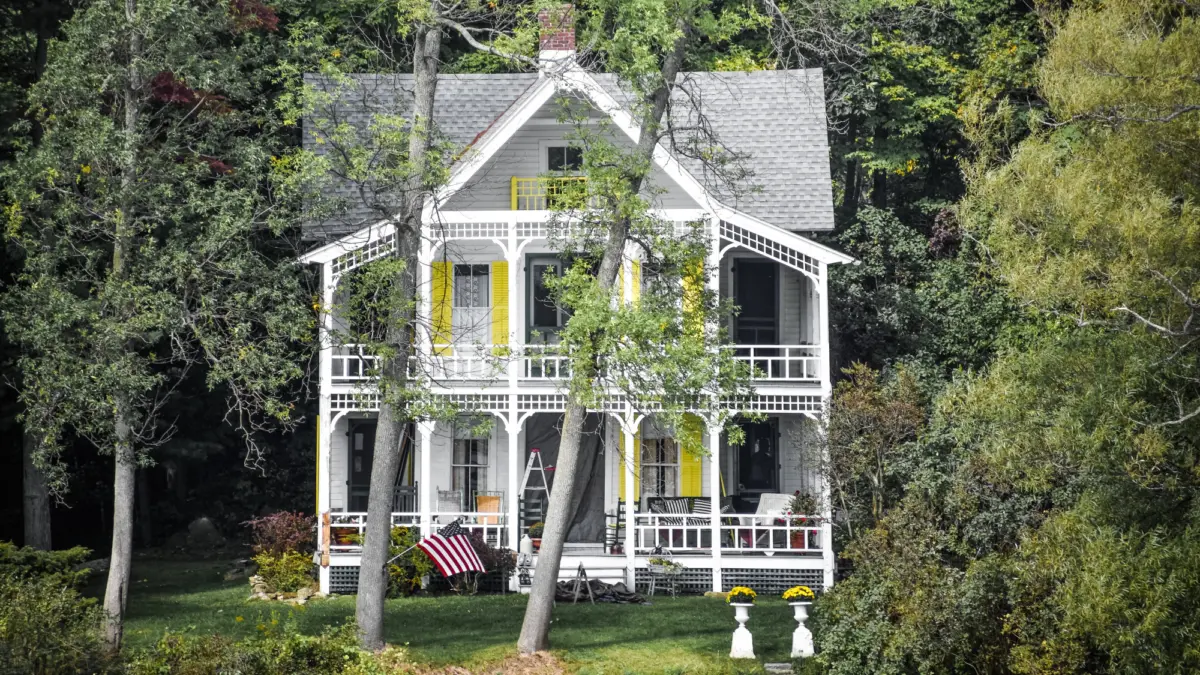
A two-and-a-half-story Queen Anne, built in 1889. Painted pale blue with cream trim and dark red shutters. Four bedrooms. A big kitchen at the back. A wraparound porch with a swing. A turret room on the second floor with a window seat. And a backyard so big it had a grape arbor and an old stone birdbath and a magnolia tree that a realtor told me was older than the house.
More room than one woman needed, honestly.
That was part of the charm.
I wanted a home office. For the charting I bring home and the nursing journals I read.
I wanted a craft room. Where I could leave a half-finished quilt on the frame for six months without having to clear it away for anybody’s Sunday dinner.
I wanted a guest room. A pretty one. For friends who actually liked spending time with me.
And I wanted one room that was just for me. The turret room, with the window seat, where I could sit and read and look at the river.
I bought it with my savings. Eleven years of putting away a little from every paycheck. Plus a small inheritance from my grandmother, who died two years ago and left me eighty thousand dollars and her quilting frame.
It was the life I was building after the divorce. No compromising with Ralph. No instructions from Linda. Nobody telling me where to put the couch.
Just my house.
I didn’t give either of them the address. I blocked Ralph’s number. I blocked Linda’s number. I blocked them both on Facebook. I was tired of being pulled into arguments that had nothing to do with me anymore.
But Marietta is a small town. Fourteen thousand people. People talk. At the Kroger on Pike Street. At church. At the hospital.
Somebody must have told Linda where I lived.
And now there she was. In my kitchen. With eleven porcelain cats on my countertops.
Part Ten: The Key
I looked at the stack of boxes by the breakfast nook again.
“Linda,” I said. “How did you get into my house?”
She made an impatient little sound with her tongue. “Honestly, Allison, why are you making such a fuss?”
“Because I didn’t give you a key.”
She smiled.
Then she reached into the pocket of her tan slacks. And held up a small silver key. On a little ring with a red plastic tag.
I knew it the second I saw it.
My spare key.
I’d hidden it inside a fake rock in the flower bed beside the back porch. A gray plastic rock from the hardware store with a little compartment in the bottom. Just in case I ever locked myself out after a night shift.
My heart started pounding.
“Where did you get that?” I asked.
“In your garden,” Linda said. She said it like I’d asked where she bought the bacon. “In that funny plastic rock by the back steps.”
“How did you know it was there?”
“I saw you put it there,” Linda said. “Yesterday. Thursday morning. At about seven-fifteen.”
I stared at her.
“You were here yesterday?” I said.
“I drove past,” Linda said. “To look at the property. I wanted to see what it was like before I brought my things over.” She smiled. “I parked across the street. By the Methodist church. You didn’t see me.”
Part Eleven: Watching
A chill went down my spine. All the way down.
She’d been watching my house.
She’d sat in her beige Buick across the street from my house at seven in the morning and watched me come out my back door in my scrubs and hide my spare key in a plastic rock.
And then she’d come back the next day. While I was at work. And let herself in. And walked through every room in my house. My bedroom. My bathroom. My craft room. My turret room.
And started unpacking.
Without asking. Without calling. Without a word.
I held out my hand.
“Give me the key,” I said.
Linda frowned. “Don’t be so dramatic.”
“Give me my key, Linda.”
She sighed. Loudly. She set it down on the granite countertop, between the white Persian cat and the coffee maker.
“There,” she said. “Happy?”
I picked it up. I put it in the pocket of my scrubs.
“No,” I said. “Now I want you to explain to me why you think you’re moving into my house.”
Part Twelve: Retirement
Linda folded her arms across her rose-print blouse.
“Because I’m retiring next month,” she said.
I waited.
Linda has worked part-time as a cashier at the Marietta Senior Center gift shop for the last fifteen years. Three days a week. Selling handmade potholders and greeting cards.
“My apartment’s too cramped,” she said. “I’ve been in that little place on Greene Street since I sold the house on Fourth. It’s barely five hundred square feet. I can’t even fit my curio cabinet.” She gestured around my kitchen. “You’ve got four bedrooms. And that enormous yard. It just makes sense.”
“It makes absolutely no sense,” I said.
Linda looked around my kitchen. At the tall windows. The old glass-front cabinets I’d painted cream. The farmhouse sink. The breakfast nook with the bay window looking out on the magnolia tree.
“You’re one woman living alone,” she said. “You don’t even have children. What on earth are you going to do with all this space?”
“Whatever I want,” I said.
“Don’t be selfish, Allison.”
There it was.
That word.
Selfish.
I’d heard it for eleven years. Every time I didn’t immediately say yes to something Linda wanted. Every time I asked for one Saturday to myself. Every time I said I was too tired to drive her to Columbus on my day off.
Don’t be selfish, Allison.
Part Thirteen: Her Collections
Linda pointed toward the hallway.
“That upstairs bedroom gets such beautiful light,” she said. “I can put my violets in the window. And there’s plenty of room for my collections.”
“Your collections?” I said.
She looked lovingly at the porcelain cats on my counter.
“They need proper shelves, of course,” she said. “I was thinking of the wall across from the window. And my Christmas village can go on the dresser. And I’ll need somewhere for my thimbles.”
I looked at the eleven little ceramic cats spread across my kitchen.
She hadn’t brought an overnight bag. She hadn’t brought a suitcase. She’d brought decorations.
She wasn’t asking if she could stay.
She’d already decided she lived here.
“Linda,” I said. “We are not family anymore.”
Her face tightened.
“Don’t talk nonsense,” she said.
“I’m divorced from Ralph. Since April.”
“That doesn’t mean you stop being part of the family,” Linda said.
“Actually,” I said, “that’s exactly what it means. In this situation.”
She shook her head at me, the way she used to when I made the pot roast wrong.
“You always were too sensitive, Allison,” she said.
Part Fourteen: Five Minutes
I took a slow breath.
I’d been on my feet for twelve and a half hours. I’d had two patients crash on me that day. A sixty-year-old man with a heart attack who coded twice, and a nineteen-year-old girl from a car accident on Route 7 whose parents I’d sat with in the family room at three in the afternoon.
My feet hurt. I was starving. I wanted to take off my scrubs and get in the shower and sit in my turret room with a glass of wine and look at the river.
Instead, I was standing in my own kitchen explaining property lines to a seventy-year-old woman who’d spent eleven years pretending they didn’t exist.
“Listen to me carefully, Linda,” I said. “You have five minutes to pack your things and leave.”
Linda laughed.
“You wouldn’t dare throw me out,” she said.
“This is my house.”
“Think of the scandal,” Linda said.
I stared at her. “The scandal?”
“Calling people,” Linda said. “Making a scene. Everybody at church would hear about it. How you treated a widow. An old woman. Your husband’s mother.”
“Ex-husband,” I said.
She picked up one of the porcelain cats. The calico with the blue bow. She turned it over in her hands.
“And honestly,” she said, “Ralph said you’d come around eventually.”
Part Fifteen: “Ralph Knows”
My stomach dropped.
“What did you just say?” I asked.
Linda looked pleased. Like she’d finally gotten to the part she’d been waiting to say.
“Ralph knows all about it,” she said. “It was his idea, actually.”
I stood very still.
“Ralph told you to move into my house?” I said.
“He said you’ve always had a good heart,” Linda said. “Even if you get worked up about things. He said you’d probably be upset at first.” She set the calico cat back down by my sink. “But he said you’d get used to having me here.”
You’d get used to it.
I thought about every fight we’d had in eleven years of marriage. Every time Ralph promised me his mother’s demands weren’t unreasonable. Every time he told me to keep the peace. Every time he said What do you want me to do?
And even now. Six months after the divorce. He was still volunteering me. My time. My patience. My Sunday afternoons.
And now my house.
“Ralph,” I said slowly, “has no authority to invite you here.”
“He knows you better than anybody,” Linda said.
“Then he should know,” I said, “that I mean what I’m saying.”
Linda waved her hand.
“Oh, settle down,” she said. “We can work out the details tomorrow. After you’ve had some sleep. You’re always cranky after work.”
She turned back to the stove. She slid the cast-iron skillet back onto the burner.
She turned the knob back on.
Part Sixteen: The Porch
That was the moment I understood.
She wasn’t going to leave because I asked her to. She was never going to leave because I asked her to. In eleven years, she’d never once done anything because I asked her to.
She’d come into my house without permission. She’d gone through every one of my bedrooms. She’d brought five boxes and eleven porcelain cats. And when I told her to go, she treated me like an inconvenience standing between her and her retirement.
I didn’t raise my voice.
I didn’t touch her cats. I didn’t argue about which bedroom got the best light.
I picked up my phone and walked toward the front door.
“Where are you going?” Linda called after me.
“Outside,” I said.
“Well, don’t be long,” Linda said. “The bacon’s getting cold.”
I stepped out onto my front porch.
The October air was cool on my face. The streetlights were coming on along Fifth Street. Across the road, the stained glass windows of the Methodist church were glowing gold. I could smell the river.
Behind me, through the front door, I could still hear Doris Day. Que sera, sera.
I looked down at the spare key in my hand. The little red plastic tag.
Then I called the Marietta Police Department’s non-emergency line.
“I need to report that someone has entered my home without permission,” I said. “And is refusing to leave.”
The dispatcher asked if the person was still inside.
I looked back through my front window. Down the long hallway, into the kitchen.
Linda was lifting another box onto my counter.
“Yes,” I said. “She’s still in my kitchen.”
Part Seventeen: Officer Tuttle
The police car pulled up in front of my house eleven minutes later.
It was Officer Ben Tuttle. Twenty-eight, with a buzz cut and a farm-boy face. I recognized him. He’d brought a man into the ICU at Marietta Memorial in August after a motorcycle wreck on Route 676. He’d stayed in the waiting room with the man’s wife for three hours.
He recognized me too.
“Ms. Hayes,” he said, coming up the porch steps. “From the ICU. You okay?”
“I’m okay,” I said. “I’m sorry to call. It’s my ex-mother-in-law.”
He listened. He didn’t interrupt. I told him about the gap in the door. The fake rock. The bacon. The south-facing bedroom. The porcelain cats.
Ralph said you’d get used to it.
When I finished, Officer Tuttle took off his hat and rubbed his head.
“Okay,” he said. “Let me go talk to her.”
He went inside. I stayed on the porch. Through the front window, I watched him walk down the hall to the kitchen.
I heard Linda’s voice. High and offended. This is a family matter, young man. I’m her mother-in-law.
I heard Officer Tuttle’s voice. Calm and low. I couldn’t make out the words.
Linda again. My son gave me permission.
Officer Tuttle again.
Then a long silence.
Then, very faintly, I heard Linda say, “Oh.”
Part Eighteen: What Officer Tuttle Said
Officer Tuttle came back out onto the porch ten minutes later. He closed the door partway behind him.
“She’s packing up,” he said. “She says she’ll be out in fifteen minutes.”
I let out a breath I didn’t know I’d been holding.
“Ma’am,” he said. “Can I tell you something? Off the record?”
“Sure.”
He looked back at the door.
“I explained to her that it’s your house,” he said. “That her son can’t give her permission to live in a house he doesn’t own. That if she didn’t leave, she’d be trespassing, and I’d have to cite her.” He paused. “She got real quiet.”
“Then she told me,” Officer Tuttle said, “that she gave notice on her apartment on Greene Street last month. Her lease is up October thirty-first. Two weeks.” He looked at me. “She said she doesn’t have anywhere else to go.”
I stared at him.
“She said her son told her to give notice,” Officer Tuttle said. “He told her she’d be moving in here. With you. He said it was all arranged.”
“Why wouldn’t she just move in with Ralph?” I asked. “He lived with her for a year. In her spare room.”
Officer Tuttle hesitated.
“She said,” he said slowly, “that her son is engaged. To a woman named Kristen. They bought a house together in Devola in August.” He paused. “And Kristen said no.”
Part Nineteen: Kristen
I sat down on my porch swing.
Ralph was engaged.
He’d been divorced for six months, and he was engaged. To a woman named Kristen. And they’d bought a house together in Devola, a little town five miles up the Muskingum River.
And Kristen had done the one thing I’d spent eleven years asking Ralph to do.
She’d told his mother no.
And Ralph, instead of telling his mother the truth, had done what he always does. He’d found a woman who’d never say no to him. A woman he thought would take care of it.
Me.
She’ll come around. She’s got a good heart. She’ll get used to it.
Officer Tuttle was watching my face.
“Ma’am,” he said. “You don’t have to do anything. Legally, you’re in the clear. She’s leaving.”
“I know,” I said.
I sat on my porch swing and looked through my front window. Down the hallway. Into my kitchen.
Linda was standing at my counter. Slowly wrapping each porcelain cat in newspaper. One at a time. Putting them back in the box marked KNICK-KNACKS.
Her shoulders were shaking.
Part Twenty: The Kitchen Again
When Officer Tuttle left, I went back inside.
Linda had packed up four of the five boxes. She was wrapping the last cat. The calico with the painted blue bow.
She didn’t look up when I came into the kitchen.
“I’ll be out in a minute,” she said. Her voice was very small. “I’m sorry for the bacon.”
I stood in the doorway for a long moment.
“Linda,” I said. “Your apartment lease. Officer Tuttle said it’s up on the thirty-first.”
She didn’t answer. She kept wrapping.
“Where are you going to go?” I asked.
She set the wrapped cat in the box. She closed the flaps.
“I don’t know,” she said. “I’ll figure something out. I always do.”
She picked up the box. It was heavy. She was seventy. Her arms shook.
“Ralph said,” she said quietly, “that you’d take me. He said you always took care of everything. He said, Allison’s a nurse, Mom. Taking care of people is what she does.” She laughed, a little broken sound. “He said Kristen didn’t understand family. Not like you did.”
She looked at me for the first time since Officer Tuttle came.
“I thought he was right,” she said. “I thought you’d be angry, and then you’d make up the bed. That’s what you always did.”
Part Twenty-One: What I Said
I took the box out of her arms. I set it down on the kitchen table.
“Sit down, Linda,” I said.
She stared at me.
“I’m not letting you move in,” I said. “That’s not going to change. But sit down.”
She sat down. At my kitchen table. In the breakfast nook, by the window, where the magnolia tree was a dark shape against the streetlight.
I sat down across from her.
“Did Ralph tell you to give notice on your apartment?” I asked.
She nodded.
“When?”
“September,” Linda said. “The week after they closed on the house in Devola. He came over and said, Mom, you need to give notice. Kristen and I talked about it, and it’s best if you live with Allison.” She looked at her hands. “He said you’d agreed.”
“I never agreed to anything,” I said. “I haven’t spoken to Ralph since April. I blocked his number.”
Linda closed her eyes.
“He lied to me,” she said.
“He lied to both of us,” I said.
Part Twenty-Two: Linda
Linda didn’t say anything for a long time. The kitchen was quiet. Doris Day had finished. The radio was playing some commercial for a car dealership in Parkersburg.
“When Harold died,” Linda said finally. “Ralph’s father. I was forty-nine. Ralph was nineteen. I’d never paid a bill in my life. I’d never had a checking account. Harold did everything.” She looked at the porcelain cats in the box. “He bought me a cat every anniversary. Twenty-eight years. Twenty-eight cats. I’ve got eleven left. The rest broke when I moved from Fourth Street.”
I didn’t say anything.
“After he died,” Linda said, “Ralph was all I had. And I was so scared, Allison. Every single day. Scared of being alone. Scared of the bills. Scared of getting old with nobody.” She wiped her eyes. “So I held on to him. As tight as I could.”
“And then he married you,” Linda said. “And I thought, I’m going to lose him. So I held on tighter.” She shook her head. “The honeymoon. The Sunday dinners. The cleaning. The eye doctor in Columbus. I thought if you were taking care of me, then I was still part of things. I wasn’t alone.”
She looked up at me.
“I didn’t see it,” she said. “Until tonight. When that young policeman told me Ralph couldn’t give me permission to live in a house he didn’t own.” Her voice broke. “I was going to do to you what I did to you for eleven years. Move right in. Take your best room. Put my cats on your counters. And Ralph was going to let me. Because it was easier than telling me no.”
Part Twenty-Three: Ralph’s Phone
“Linda,” I said. “Do you have Ralph’s number?”
She looked at me. “Of course.”
“Call him,” I said. “Right now. On speaker.”
She took out her phone. An old flip phone. She dialed with shaking fingers. She put it on speaker. She set it on the table between us.
It rang four times.
“Mom?” Ralph’s voice. Tired. Irritated. “What’s up? I’m in the middle of dinner.”
“Ralph,” Linda said. “I’m at Allison’s house.”
There was a pause on the line.
“Great!” Ralph said. Suddenly bright. “How’s it going? Did she show you your room?”
I leaned toward the phone.
“Hi, Ralph,” I said.
Silence. Total silence. For about five seconds.
“Allison,” he said finally.
“Your mother let herself into my house today,” I said. “With a spare key she watched me hide from across the street. She unpacked eleven porcelain cats on my kitchen counter. She picked out a bedroom.” I paused. “And then a police officer explained to her that you can’t invite people to live in a house you don’t own.”
“A police officer?” Ralph said. “You called the police on my mother?”
“She wouldn’t leave,” I said. “She said you’d told her I’d get used to it.”
Part Twenty-Four: Kristen’s Voice
There was a muffled sound on the line. Somebody else in the room with Ralph. A woman’s voice.
“Ralph? Who is that? Is that your mom?”
Then, clearer, closer to the phone: “Ralph, why is your mom at your ex-wife’s house?”
Kristen.
“It’s nothing, babe,” Ralph said, away from the phone. “Just a misunderstanding.”
“It’s not a misunderstanding, Kristen,” I said, loud enough for the speaker. “My name is Allison. I’m Ralph’s ex-wife. Ralph told his mother to give notice on her apartment. He told her I’d agreed to let her move into my house. I’ve never agreed to anything. I haven’t spoken to Ralph in six months.”
There was a very long silence on the line.
Then Kristen’s voice. Very quiet. Very clear.
“Ralph,” she said. “You told me your mom was moving into Riverview. The senior apartments on Front Street. You said she was on the waiting list. You said she was excited.”
Ralph didn’t say anything.
“You told me,” Kristen said, “that you’d handled it.”
Part Twenty-Five: Handled
“I did handle it,” Ralph said finally. His voice was small now. “Allison’s got four bedrooms, Kris. She’s alone. She’s a nurse. She takes care of people. I thought…”
“You thought,” Kristen said slowly, “that instead of telling your mother no yourself, you’d send her to your ex-wife’s house. Without asking. And let your ex-wife tell her no for you.”
Ralph didn’t answer.
“Like you did for eleven years,” I said quietly.
Linda was crying. At my kitchen table. Silently. With her hands folded in her lap.
“Ralph,” she said into the phone. “I gave notice on my apartment. Because you told me to. I have two weeks. Where am I supposed to go?”
Nobody said anything.
“Mrs. Pruett,” Kristen said finally. Her voice was gentle now. “Linda. I’m so sorry. I didn’t know any of this.” She took a breath. “You’ll stay with us. In Devola. In the guest room. Until we get you into Riverview. I’ll call them first thing Monday morning myself.”
“Kris,” Ralph started.
“No, Ralph,” Kristen said. “Not now. We’re going to have a long talk after this call. A very long talk.”
Part Twenty-Six: The Boxes
Kristen drove down from Devola that night. Ralph didn’t come. Kristen said he was “thinking about some things.”
She was thirty-five. A kindergarten teacher at Phillips Elementary. Short dark hair, a Marietta College sweatshirt, kind eyes. She stood in my front hallway and looked at me for a long moment.
“I’m so sorry,” she said. “I didn’t know. He told me you two had an amicable divorce. He said you were still friends.”
“We’re not,” I said.
“I’m getting that,” Kristen said.
I helped her carry Linda’s boxes out to the beige Buick. Five of them. KITCHEN. BEDROOM. KNICK-KNACKS. Linda walked behind us carrying the last cat in her hands. The calico with the blue bow. She hadn’t wrapped it.
At the car, she stopped. She looked back at my house. At the pale blue paint and the cream trim and the turret against the night sky.
“It’s a beautiful house, Allison,” she said quietly. “I’m sorry I walked in like it was mine.”
Then she held out the calico cat.
“Harold gave me this one,” she said. “Our first anniversary. 1975. It’s the oldest one I have.” She pressed it into my hands. “I want you to have it.”
“Linda,” I said. “I can’t take this.”
“Please,” she said. “So you have something of mine that I gave you. Instead of something I took.”
Part Twenty-Seven: The Keypad
On Saturday morning, I called a locksmith.
A man named Earl came at ten. Sixty-five, with a gray ponytail and a toolbox. He replaced the lock on my front door and my back door with keypad deadbolts. No more keys. No more fake rocks. No more spare.
“Somebody give you trouble?” Earl asked.
“My ex-mother-in-law,” I said.
Earl laughed. “That’s a new one,” he said. “Usually it’s the ex-husband.”
“He sent her,” I said.
Earl stopped laughing.
When he left, I went out to the flower bed beside the back porch. I found the gray plastic rock in the mums. I picked it up. I opened the little compartment in the bottom.
Empty.
I threw it in the trash can by the garage.
Part Twenty-Eight: Riverview
Linda moved into Riverview Senior Apartments on November 18th.
A one-bedroom on the third floor of a renovated brick building on Front Street, right on the Ohio River. With an elevator. A community room. A dining hall. Bingo on Tuesdays and a quilting circle on Thursdays.
And a south-facing window.
Kristen called the director at eight a.m. on that Monday, like she promised. She drove Linda over for an interview on Wednesday. Linda was on the waiting list for three weeks. She stayed in Kristen’s guest room in Devola the whole time.
Ralph, Kristen told me later, slept on the couch.
Part Twenty-Nine: Kristen’s Call
Kristen called me in December. I’d unblocked Ralph’s number by then. Not for him. For her.
“I wanted you to know,” she said. “Ralph and I are taking a break. From the engagement. Not ending it. Just… pausing.”
“I’m sorry,” I said. And I meant it.
“Don’t be,” Kristen said. “He’s in counseling. On Thursday nights. At a place in Parkersburg.” She paused. “The counselor asked him why he sent his mother to your house instead of telling her no himself. Do you know what he said?”
“What?”
“He said, Because Allison always said no for me. For eleven years. I didn’t know how to do it myself.” Kristen was quiet for a moment. “He said you were the only person who ever stood up to his mother. And instead of learning from it, he just kept sending her to you.”
I didn’t say anything.
“I don’t want to be the next person he sends her to,” Kristen said. “So he’s learning. Slowly.”
Part Thirty: The Doorbell
On a Saturday in February, my doorbell rang.
I was in my craft room. The one at the top of the stairs, on the left, with the south-facing window. I was working on a quilt on my grandmother’s frame. A log cabin pattern, in blues and creams, the colors of my house.
I went downstairs. I looked through the glass in the front door.
Linda was standing on my front porch.
In a navy wool coat. Holding a plate covered in foil. Her beige Buick was parked at the curb. Not by the side of the house. At the curb. In front.
She’d rung the doorbell.
I opened the door.
“Hello, Allison,” she said.
“Hello, Linda,” I said.
She held out the plate.
“It’s ham loaf,” she said. “My mother’s recipe. The one that takes four hours.” She smiled a little. “I made it myself this time. In my own kitchen. At Riverview. It’s the first one I’ve made in eleven years.”
I took the plate.
“I’m not here to come in,” Linda said. “I just wanted to bring you that. And to tell you something.”
I waited.
“I joined the quilting circle,” she said. “At Riverview. On Thursdays. There’s a woman there, Margaret, she’s ninety-one, she’s been quilting since 1942. She’s teaching me.” She looked at her hands. “I’ve never made anything myself. Not once. Harold did everything. Then Ralph. Then you.”
She looked up at me.
“I’m making a quilt,” she said. “My first one. A nine-patch. In pink and yellow. Like my blouses.” She laughed a little. “Margaret says it’s terrible. She says the corners don’t match. But she says I’m getting better.”
I stood in my doorway holding a plate of ham loaf, looking at my former mother-in-law on my front porch.
“Linda,” I said. “Would you like to come in? For a cup of coffee?”
She stared at me.
“Are you sure?” she asked.
“I’m asking you,” I said. “That’s the difference.”
Part Thirty-One: The Craft Room
She came in. She stopped in the front hallway and took off her shoes. She’d never once taken off her shoes in eleven years of coming to my old house.
I made coffee. A splash of milk, no sugar. I still remembered.
We sat in the breakfast nook. By the bay window. With the magnolia tree outside, bare in the February cold. On the windowsill, between my pothos and a little jar of buttons, sat the calico cat with the painted blue bow.
Linda saw it. She didn’t say anything. But her eyes filled up.
After coffee, I asked her something.
“Would you like to see my quilt?” I asked. “The one I’m working on?”
She looked at me.
“It’s upstairs,” I said. “In the craft room.”
I took her up the stairs. Slowly. She has a bad knee. To the room at the top of the stairs, on the left. With the south-facing window.
The February sun was pouring in. Gold and pale across my grandmother’s quilting frame. Across the blue and cream log cabin squares. Across my fabric shelves and my sewing table and the jar of pins on the windowsill.
Linda stood in the doorway and looked at it for a long time.
“This is the room,” she said quietly. “The one I picked.”
“I know,” I said.
“It’s perfect,” Linda said. “For quilting. The light. You were right to keep it.”
She walked over to the frame. She looked at my stitches. Close. With her reading glasses.
“Your corners match,” she said.
“Mostly,” I said. “That one’s off.” I pointed. “Bottom left.”
Linda looked at it. Then she laughed. A real laugh. The first one I’d ever heard from her that wasn’t at my expense.
“Margaret would make you rip that out,” she said.
“Margaret’s not the boss of me,” I said.
“No,” Linda said. She looked at me. “Nobody’s the boss of you. Not in this house.”
She left at four o’clock. At the front door, she put her shoes back on. She buttoned her navy coat.
“Thank you for asking me in,” she said.
“Thank you for ringing the doorbell,” I said.
She comes once a month now. The first Saturday. She calls on Thursday to ask if it’s still okay. I always say yes.
She rings the doorbell. She takes off her shoes. We have coffee in the breakfast nook and then go upstairs to the craft room and quilt for an hour in the south-facing light. Her corners are getting better. Margaret says so.
She never stays past four. She never brings boxes. She never brings cats.
And she never, ever asks which room she can have.