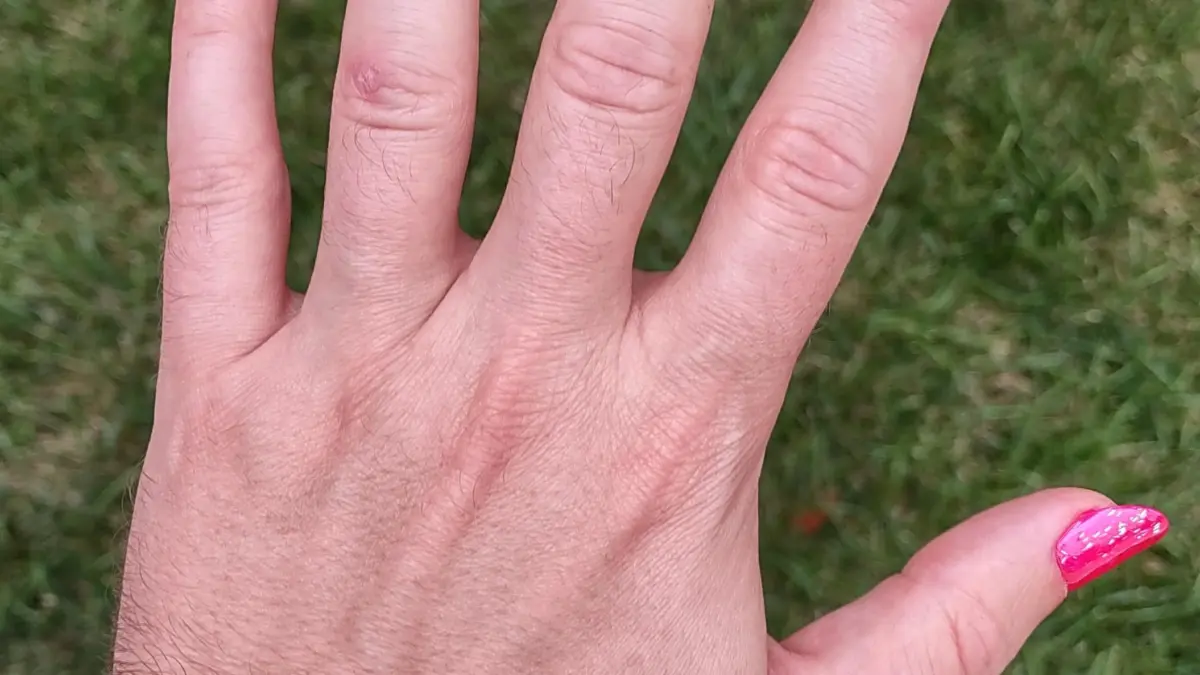
“Please tell me Kyle’s going to behave tonight.”
Adam said it with the engine still running, both hands on the steering wheel, staring through the windshield at the neon sign of the Penalty Box. It’s the sports bar on Route 9 where my brother has watched every big game for the last fifteen years. The “x” in “Box” had been burned out since about 2019, so the sign just said “The Penalty Bo,” and nobody had ever bothered to fix it.
“Define ‘behave,'” I said.
“Not challenge me to arm wrestling again.”
“No promises, my love.”
He turned the engine off and sat there a second longer. I watched him look down at his hands on the wheel. His nails were long and glossy and bright blue, the color of a swimming pool in a postcard, and they caught the red light from the neon sign and threw it back. He flexed his fingers once, like a man about to walk into a job interview.
“You can sit in the car if you want,” I said. “I’ll tell him you’ve got food poisoning.”
“Sarah.”
“I’m just saying. You don’t owe him anything.”
“I know I don’t.” He pulled the keys out of the ignition. “But if I start hiding them, then what was the point?”
I didn’t have an answer for that. I got out of the car.
I should explain my brother before I go any further. Kyle is three years older than me, six foot four, two hundred and forty pounds, and he has never in his life walked into a room quietly. He played defensive tackle in high school and has been talking about it ever since. He sells commercial roofing for a company out of Dayton, and he’s good at it, because he can talk to anybody about anything for as long as it takes them to sign.
Two years ago, Kyle won a charity arm-wrestling tournament at the Elks Lodge. It raised money for the volunteer fire department. First prize was a fifty-dollar gift card to the Outback Steakhouse. Kyle went online that same night and bought himself a replica heavyweight championship belt for $189, gold plates and fake jewels and everything. He wore it to his own birthday dinner. He made the waiter call him “Champ.” For about six months afterward, he signed his text messages “The Champion.” Our mother finally told him to knock it off, and he did, mostly.
He’s not a bad man. I want to be clear about that. When our dad had his heart attack in 2021, Kyle drove four hours in a snowstorm to get to the hospital and slept in a plastic chair in the waiting room for three nights. He helps his neighbors shovel their driveways. He remembers my birthday every year.
But Kyle has some very firm ideas about what a man is supposed to look like. And none of those ideas involve blue acrylic nails.
The Penalty Box was loud and crowded, the way it always is on a Friday when the Bengals are playing. It smelled like fryer grease and spilled beer. Kyle had a booth near the big screen, the same booth he always has, and two of his buddies from work were at the high-top table next to it. Trevor and a guy named Dusty, whose real name I’ve never learned.
“There she is!” Kyle stood up and hugged me, lifting me a couple of inches off the floor the way he’s done since we were kids. Then he stuck his hand out to Adam. “Adam, my man.”
Adam shook it.
Kyle looked down.
I watched it happen. I watched his eyes land on those ten bright blue nails wrapped around his own big fist, and I watched his whole face change, like a kid on Christmas morning who just saw the bike under the tree.
“What,” Kyle said slowly, “is with your nails?”
Then he burst out laughing.
It wasn’t a little laugh either. It was a big, booming, head-back laugh, the kind that makes people at other tables turn around. He let go of Adam’s hand and pointed at it.
“Got them done,” Adam said, and slid into the booth.
“On purpose?!”
“Well,” Adam said, picking up a menu, “I didn’t wake up like this.”
Kyle dropped back into his seat, still laughing, and leaned over toward the high-top. “Trev. Trev, look at this. Look at my brother-in-law’s hands.”
Trevor looked. Dusty looked. Trevor’s mouth fell open.
“My sister married a guy with longer nails than hers!” Kyle said, and slapped the table so hard the ketchup bottle jumped.
I put down my menu.
“Kyle,” I said. “Leave him alone.”
“Come on, Sarah! It’s a joke!”
“Then try making it funny.”
That got a little “ohhh” from Dusty, and Kyle waved him off. The server came over, a young girl with a ponytail and a Bengals jersey, and Adam ordered a cheeseburger, medium, no onions, and a Coke. He handed her the menu. She looked at his nails, then at his face, and smiled a little.
“Those are really pretty,” she said.
“Thank you,” Adam said. “I didn’t pick the color.”
She went off to put in the order. Kyle was still staring at Adam’s hands.
Adam had been wearing acrylic nails for three weeks. I knew why. I’d known from the first day, when he came home with ten nails the color of a tree frog and I laughed so hard I had to sit down on the kitchen floor. He wasn’t ashamed of them. He’d worn them to his office at the insurance company, where he’s a claims supervisor, and to the grocery store, and to church. A few people had looked. One old man at the Kroger had said, “Well, that’s a new one,” and Adam had said, “It sure is,” and that was the end of it.
But Kyle was different. Kyle wasn’t going to let it go.
“Seriously, though,” my brother said, leaning his big forearms on the table. “How do you even work with those things? How do you type?”
“Carefully.”
“How do you button your pants?”
“Also carefully.”
Trevor snorted into his beer. Kyle grinned, encouraged.
“I’m just saying, man. You look pathetic.”
Adam took a slow sip of his water.
“I’m serious,” Kyle said. “Real men don’t wear that stuff.”
“Real men also know when to stop talking,” I said.
Kyle rolled his eyes so hard I thought they might get stuck. “Why won’t your husband defend himself? Why’s he letting his wife do all the talking? Come on, Adam. Say something. Tell me why a grown man with a mortgage is walking around with Smurf claws.”
The game was on the big screen behind us. The Bengals had just fumbled, and half the bar groaned at once. Adam set down his glass.
“You really want to know why I wear them?”
Kyle shrugged and leaned back with his arms spread across the top of the booth. “Go ahead. I’m all ears.”
Adam looked at me for just a second. I gave him the smallest nod. Then he leaned across the table toward my brother, close, so close I could see Kyle lean away a little in surprise, and he started to talk.
I couldn’t hear what he said. The bar was too loud. Somebody at the next table was shouting at the referee, and the jukebox was playing Bob Seger, and the fryer bell kept dinging in the kitchen. I watched Adam’s mouth move, low and steady. I watched him hold up one blue hand, just briefly, and then lay it flat on the table.
And I watched my brother’s face.
It went still first. The grin stayed there a moment too long, the way a grin does when the rest of the face hasn’t caught up yet. Then it slid off. Kyle’s arms came down off the top of the booth. He leaned in.
Adam kept talking. Kyle didn’t interrupt him once, which I’m not sure has ever happened before in my brother’s life.
When Adam finally sat back, Kyle stayed where he was, leaning forward over the table with his big hands folded in front of him.
“Every week?” he said. His voice was different. Quieter.
Adam nodded.
“And you never told us? You never said anything?”
“It wasn’t my story to tell,” Adam said.
Kyle looked down at Adam’s hands. He looked at those ten blue nails for a long time. Trevor said something to him from the high-top, some joke, and Kyle didn’t even turn his head.
Then my brother picked up his beer, looked at it, and set it back down without drinking.
“Can I come with you next time?” he said.
I stared at him.
Adam studied his face for a long moment. “Are you serious?”
Kyle nodded. “Yeah. I want to.”
“You understand this isn’t something to joke about? Not one thing about it?”
“I understand.” Kyle swallowed. “I get it, man. I swear.”
I had known my brother for thirty-nine years. I had never once seen him change his mind about anything that fast. He’d once argued with a Home Depot manager for forty-five minutes about a return policy, and he’d been wrong, and he’d known he was wrong, and he still wouldn’t let it go.
And I had no idea what my husband had said to him.
We didn’t stay for the second half. Kyle got quiet after that, quiet enough that Trevor asked him twice if he was feeling okay. When Adam’s cheeseburger came, Kyle pushed his own plate of wings toward him and said, “Here, have some of these too.” Kyle has never shared a chicken wing with anybody, including me, including on my birthday.
In the car on the way home, I waited until we were past the Speedway station before I asked.
“What did you say to him?”
Adam had both hands on the wheel again. The streetlights slid across his blue nails, one after another, as we drove.
“I told him about Rosie,” he said.
And then I understood why Kyle had stopped laughing.
Three months earlier, in the spring, Adam had started volunteering on Saturday mornings at Dayton Children’s Hospital.
It was because of a man at his office named Phil, whose little boy had spent six weeks on the oncology floor the year before. The boy was fine now, back in second grade and playing T-ball, but Phil had told Adam over lunch one day that the worst part of the whole thing wasn’t the needles or the medicine. The worst part was the waiting. The long, gray hours in a hospital room when there was nothing to do and nobody to talk to except the people who loved you so much they couldn’t stop crying.
“The volunteers saved us,” Phil said. “Honest to God. There was this one old guy who came in every Tuesday and did magic tricks. Terrible magic tricks. Coins falling out of his sleeve. My son thought he was the funniest man alive.”
Adam went through the training in March. There was a background check and a TB test and a whole afternoon about hand-washing and infection control and what you can and can’t say to a sick child’s parents. Then they gave him a badge on a blue lanyard and sent him up to the fourth floor.
He helped with the activity room. He set up board games and read picture books and kept kids company when their moms and dads needed to step out and make phone calls or just stand in the hallway for ten minutes and breathe.
That’s where he met Rosie.
She was eight years old and had been fighting leukemia since the previous fall. She was small for her age and very pale, with big dark eyes and a voice that was much bossier than you’d expect from someone that size. Her mother, Hannah, almost never left her side. Hannah slept on the fold-out chair in Rosie’s room four or five nights a week.
Rosie’s father, Michael, had died two years earlier. A heart thing, sudden, at thirty-six. He’d been a high school wrestling coach. I’d learn that part later.
Adam came home after his second visit and stood in our kitchen eating crackers out of the box.
“She called me boring,” he said.
I laughed. “Who did?”
“This little girl on the fourth floor. Rosie. I tried to play Candy Land with her and she said, ‘This is boring and you’re boring.'”
“What did you do?”
“I built her a cardboard castle.” He crunched a cracker. “Out of a box from the supply closet. I cut out windows with these little safety scissors they give you. Took me forty-five minutes.”
“Did she like it?”
“She said the windows were crooked.” He paused. “Then she made me put a dragon on the roof.”
From then on, every Saturday when he came home, he had a Rosie story. She’d told him his jokes were bad. She’d beaten him at Uno four times in a row and accused him of letting her win, and he had to swear on his life he hadn’t. She’d made him do all the voices in a library book about a pig who wanted to be a ballerina, and when he got the pig’s voice wrong, she’d made him start over.
My husband adored her. I could hear it in the way he said her name.
Then, one Saturday in early May, Adam came home and didn’t say anything at all.
He sat on the back step for a long time with his elbows on his knees. I finally went out and sat beside him.
“Rosie’s hair is falling out,” he said.
The new round of treatment had been hard on her. Her hair, which had grown back a little after the first round, was coming out in clumps on her pillow. She’d stopped wanting to play games. She’d stopped wanting to see the other kids in the activity room. She’d stopped asking for the pig book.
“Hannah told me something today,” Adam said. “Before Rosie got sick, the two of them used to get their nails done together. Every other Saturday, at this little salon in Kettering. It was their thing. Their girls’ day. Michael used to drop them off and go get donuts.”
Hannah had wanted to bring a little of that back for her daughter. She’d talked to the nurses and the child life specialists, and they’d worked out a way. A licensed nail technician named Aria, who owned the salon in Kettering, would come to the hospital once a week with a big binder of color samples and design pictures. She would follow all the hospital’s rules. She wouldn’t do anything on Rosie that might risk an infection, because Rosie’s counts were so low. But she would bring the binder, and Rosie could look through it, and pick colors, and Aria could paint Hannah’s nails right there in the room with regular polish.
Rosie loved picking designs for her mother. She spent an hour that first afternoon going through Aria’s binder page by page, pointing at hearts and stars and tiny cupcakes.
But when Aria asked whether Rosie wanted something on her own nails, even just a little clear polish, Rosie hid her hands under the blanket.
“She said people already stare at her,” Adam told me. “Because of her hair. She said if she had pretty nails and no hair, people would stare even more.”
I didn’t say anything. There wasn’t anything to say.
“So I made her an offer,” Adam said.
He’d been sitting on the windowsill in Rosie’s room, watching her flip through the binder. He’d held up his hands.
“What if you designed mine instead?”
Rosie had looked at him like he’d lost his mind.
“But you’re a man,” she said. “Men don’t wear pretty nails.”
“Well,” Adam said, “maybe they should.”
She’d studied his hands for a long time, very seriously, the way a jeweler studies a diamond. She turned one of them over and looked at the palm.
“Can I make them green?”
“How green?”
“Like a frog.”
My husband agreed on the spot. Hannah laughed so hard she had to sit down, which, Adam said, was the first time he’d ever heard her laugh.
Aria couldn’t do acrylics in the hospital, so after the visit, she drove back to her salon and Adam followed her there in his car. He sat in the chair for an hour and a half while she glued and filed and painted.
When he came home with ten long, bright green nails, I laughed until my stomach hurt. I laughed until I had to hold on to the kitchen counter.
“How are you going to type?!”
“Carefully.”
“How are you going to open a soda can?”
He held one out to me, unopened, with a perfectly straight face. “That’s what wives are for.”
The next Saturday, Rosie chose purple, with little silver moons on the thumbs. The week after that, blue. The week after that, orange with black polka dots, which Rosie said looked like a ladybug, and which Adam said looked like a Halloween accident.
Every single week, she picked another design from Aria’s binder, and every single week, Adam wore it to work, to the grocery store, to church, wherever he went. He sent Rosie pictures. Adam’s green hands holding a stapler. Adam’s purple hands holding a gas pump. Adam’s ladybug hands holding a coffee cup at a staff meeting.
Hannah told him that Rosie had started counting down the days to Saturday. That she’d sit up in bed with Aria’s binder on her lap on Thursday nights, planning. That some days, when the medicine made her too sick to eat, she’d still ask what color Adam was wearing.
But that wasn’t all of it. There was a piece of the story I hadn’t heard yet. The piece that explained why my brother had put down his beer.
Adam told me the rest of it that night, after the Penalty Box, when we were getting ready for bed.
“Remember Kyle’s birthday picture?” he asked. He was sitting on the edge of the bed in his T-shirt, carefully working his socks off without breaking a nail.
“The one with that ridiculous wrestling belt?”
“That’s the one.”
I remembered it. Everybody remembered it. Kyle sitting at the end of a long table at the Olive Garden, the gold belt strapped around his waist over his polo shirt, flexing both arms for the camera with his mouth wide open like a lion. Our mother had it printed and framed. It was on her refrigerator.
“I was showing Hannah some pictures on my phone a few weeks ago,” Adam said. “Just family stuff. She’d asked about you. And Rosie was looking over my shoulder, and that picture came up.”
Rosie had pointed straight at the screen.
“Is he a wrestler?”
Adam laughed. “No. That’s my brother-in-law. Kyle.”
“He looks strong.”
“He certainly thinks so.”
Rosie had taken the phone right out of his hand and studied the picture very closely. She zoomed in on Kyle’s face, then on the belt, then on his arms.
“Can he lift a refrigerator?”
“Probably not,” Adam said.
“Can he come visit?”
Adam thought she was joking. He told her Kyle was a very busy man who sold roofs, and she said that was boring, and they went back to Uno.
But the next Saturday, Rosie asked about Kyle again. She wanted to know if he was coming. She wanted to know if he’d bring the belt.
And then, while Hannah was down the hall talking to the nurse, Rosie told Adam why.
Her daddy had been a big man. Big and bearded, with a laugh that shook the windows. He’d coached wrestling at Beavercreek High School for eleven years and he loved it more than almost anything, except Rosie and her mom. On Saturday nights, he used to put Rosie on his shoulders and pretend to be a ring announcer.
“In this corner,” he’d shout, in a deep booming voice, standing in their living room with a hairbrush for a microphone, “weighing in at forty-four pounds, the undefeated, the unstoppable, the champion of the whole entire world, ROSIE THE RHINO!”
Then he’d lie down on the carpet and let her pin him, and he’d slap the floor three times and yell “She got me! She got me!” and Rosie would scream and laugh until she got the hiccups.
Kyle reminded her of him. The size of him. The belt. The way he was flexing in that picture like he thought he was the toughest man alive.
“She said she missed having somebody to play wrestling with,” Adam told me.
My throat got tight. I had to stop folding the laundry.
“And that’s what you told Kyle? At the bar?”
Adam nodded. “I told him she’d asked about him twice. I told him she wasn’t looking for another father. That’s not what this was. She just wanted to meet somebody who reminded her of the fun she used to have with hers.”
I wiped my eyes with one of Adam’s socks. “Is that why he asked to come?”
“Partly.” Adam lay back on the bed and looked up at the ceiling. “But I also told him she’d been having a hard week. The new treatment’s been rough on her. And Kyle asked if it’d help if he visited. If it might cheer her up.”
He was quiet a second.
“Then he said something I didn’t expect,” Adam said. “He said he’d spent his whole life trying to look tough. And maybe it was time he did something useful with it.”
Kyle was at our front door at nine o’clock the next morning, an hour before anybody had told him to come.
He was holding a big plastic shopping bag from Dick’s Sporting Goods. He had shaved, which he doesn’t usually do on weekends, and he was wearing a clean button-down shirt tucked into his jeans.
Adam opened the door in his bathrobe. “You’re early.”
“I didn’t want to be late.” Kyle came in and set the bag on our kitchen table. He reached into it with both hands and pulled out the championship belt.
I just stared at it.
“Thought she might like this,” Kyle said.
“Kyle,” I said. “You love that thing.”
He shrugged. “It’s just a belt.”
“You made everybody call you ‘Champ’ for six months! You made Mom call you ‘Champ’! You wore it to Uncle Ray’s funeral luncheon!”
“I took it off before the casseroles.”
Adam laughed out loud. Kyle grinned at him, but it didn’t last long. He sat down at our kitchen table with the belt across his lap, and he ran his thumb over one of the fake rubies, and he looked up at Adam with an expression I’d never seen on my brother’s face before.
“What if she doesn’t like me?”
My brother has never, as far as I know, worried about making a good impression on anyone. Not on teachers, not on girlfriends, not on our parents, not on the man who interviewed him for his roofing job. He walks into rooms like he already owns them.
Adam came over and put a hand on his shoulder.
“Just be yourself,” he said. “And listen to her. That’s the whole trick. Listen.”
Before they left, Adam called the hospital volunteer office to make sure it was all right. Kyle wasn’t a trained volunteer, so he couldn’t just walk onto the floor. But the child life specialist, a woman named Denise, talked with Hannah, and Hannah said yes, and Denise said Kyle could come up as Adam’s guest for the supervised activity hour, as long as he washed his hands and wore a mask and wasn’t sick.
“I’m never sick,” Kyle said.
“You had the flu in February,” I said.
“That was allergies.”
I stayed home. Hannah didn’t know me yet, and Rosie had enough strangers in her life.
At noon, my phone rang. It was Adam.
He was laughing so hard I could barely understand him. He was laughing the way you laugh when something is so funny it hurts.
“Your brother,” he wheezed, “lost his championship!”
“What?”
“Rosie beat him at arm wrestling!”
In the background, I could hear my brother’s voice booming. “She cheated! She CHEATED!”
And then a little voice, thin and sharp and absolutely delighted, yelled right over him: “YOU’RE JUST WEAK!”
I sat down on the couch and laughed until I cried.
When they came home that afternoon, Kyle wasn’t carrying the belt.
He came in the front door and dropped down onto my couch like a sack of potatoes, with his big arms spread across the back cushions and his head tipped back.
“You really gave it to her?” I asked.
“No,” Kyle said, staring at the ceiling. “She won it.”
“Fair and square,” Adam said, hanging up his keys.
“That child,” Kyle said, “is terrifying.”
Then his face changed. It went soft. I don’t think he knew it was happening.
“She’s something else, Sarah,” he said quietly. “She’s really something else.”
Over dinner, the two of them told me everything. They kept interrupting each other.
When Kyle walked into her room, Rosie had been sitting up in her bed with a pink knit cap on her head and Aria’s binder on her lap. She looked him up and down, slowly, from his sneakers to the top of his head.
“You’re smaller than I expected,” she said.
Kyle is six foot four.
“Excuse me?”
“Adam said you were huge.”
“I AM huge!”
Rosie shrugged one tiny shoulder. “My dad was bigger.”
Kyle didn’t argue with that. He pulled the visitor’s chair up next to her bed and sat down in it, which made the chair look like it belonged in a dollhouse.
“Your dad sounds impressive,” he said.
“He was. He could lift me with one arm. Like this.” She held one skinny arm straight out to the side. “Like I was a suitcase.”
“I bet he could,” Kyle said.
Then Rosie looked him right in the eye, pulled her rolling bed table between them, plunked her elbow on it, and held up her hand.
“Arm wrestle me.”
Adam said Kyle hesitated for just a second, and looked over at Hannah, and Hannah nodded. So Kyle put his big elbow on the table and wrapped his huge hand around her tiny one, very carefully, the way you’d hold a baby bird.
What followed, Adam said, was the greatest performance in the history of professional wrestling. Kyle groaned. Kyle grunted. Kyle’s face turned red. He gritted his teeth and shook his whole arm like he was holding up a car. He started shouting things like “No! It can’t be! Where is this power coming from?!” A nurse stuck her head in the door to see what was going on.
And then, very slowly, inch by inch, Rosie pushed his hand down flat against the table.
Kyle threw himself back in the chair and slid halfway onto the floor like he’d been shot.
Rosie raised both arms over her head and screamed. Hannah laughed until she had to wipe her eyes.
When everybody calmed down, Rosie pointed at the Dick’s Sporting Goods bag.
“What’s in there?”
Kyle pulled out the belt. Rosie’s eyes went huge.
“That’s mine now,” she said. “I won it.”
He handed it over without a word. She put it across her lap on top of the blanket, and it was so big it covered her from her hips to her knees. She ran her little fingers over the fake jewels, one at a time.
Then she noticed his hands.
“Why don’t you have nails like Adam?”
Kyle froze.
“You need some color,” Rosie said.
Kyle turned very slowly and looked at Adam. “What does that mean?”
Adam smiled at him. “You’re about to find out.”
The following Saturday, I went with them.
Hannah had asked to meet me. She called me on Wednesday night, which surprised me, and we talked for almost an hour. She was a dental hygienist, or she had been, before Rosie got sick. She told me she’d cut down to two days a week back in the fall and then stopped altogether in January, because she couldn’t leave the hospital and she couldn’t stand being anywhere else.
“Your husband and your brother are the best thing that’s happened to her in months,” she told me. “I want to meet the woman who puts up with both of them.”
The hospital approved my visit, and I went through the hand-washing and the mask and the little paper bracelet. Rosie’s room was on the fourth floor at the end of the hall, with a big window that looked out at the parking garage. Somebody had taped drawings all over the walls. Dragons, mostly. A castle with crooked windows.
The championship belt was draped across the foot of her bed like a quilt.
Rosie was sitting up when we came in. She looked smaller than I’d pictured. She had on a pink knit cap with a pom-pom and a hospital gown with little cartoon giraffes on it, and there were dark circles under her big eyes. But she looked at me the same way she’d looked at Kyle, slowly, up and down.
“You’re Sarah,” she said.
“I am.”
“Adam says you laugh like a goose.”
I turned and looked at my husband. He held up his hands.
Kyle had brought her a stuffed dinosaur. A green one, a stegosaurus, with felt plates down its back. He’d bought it at the hospital gift shop on the way up. He held it out to her proudly.
Rosie examined it, turning it over in her hands.
“That’s a baby toy,” she said.
Kyle looked wounded. Genuinely wounded. “I thought you liked dinosaurs.”
“I do. But I’m eight.”
He opened his mouth and then closed it again. Rosie kept looking at the dinosaur. She squeezed it. She looked at its face.
“His name is Sir Pickles,” she announced, and tucked him under her arm, and didn’t let go of him for the rest of the visit.
At eleven, Aria arrived with her big binder.
Aria was about forty, with short purple hair and tattoos of flowers up both arms. She’d been doing nails for twenty years and had owned her own salon for nine. She hugged Hannah, high-fived Rosie, and shook Kyle’s hand. When she shook it, she turned it over and looked at his nails, the way a mechanic looks at an engine.
“Oh, honey,” she said. “We have work to do.”
Rosie flipped through the binder for Adam first. She took her time. She chose blue acrylics with tiny silver stars scattered across them, which she said looked like nighttime. Then she turned to Kyle.
“What color do you want?”
My brother swallowed. “Something tough.”
Rosie smiled. I’ve thought about that smile a lot since. It was a very small smile, and very sly, and for just a second she looked exactly like what she was, a little girl about to get away with something.
She flipped to a page near the back of the binder and pointed.
Hot pink, with tiny strawberries.
“Those aren’t tough!” Kyle said.
“They are if you’re scared of strawberries,” Rosie said.
Adam laughed so hard he almost fell off the windowsill. Hannah laughed. Aria laughed. Even the nurse who was changing Rosie’s IV bag laughed. And Kyle sat there in the little plastic chair, looking at that picture of hot pink strawberry nails like it was a death sentence.
“Fine,” he sighed.
Aria booked him for three o’clock that afternoon at her salon.
Before we left, while Adam was helping Hannah carry some things out to her car, Rosie called Kyle back into the room. I was standing in the doorway, and I heard all of it.
“Kyle? Can I tell you something?”
He went back and sat down beside her bed. “Anything.”
“My dad would have laughed at those nails,” she said. “He would have laughed so hard.”
Kyle smiled at her.
“He laughed a lot,” Rosie said. She was smiling too, but her eyes were wet.
My brother nodded. “I wish I’d met him.”
Then Rosie reached over and took his big hand in her small one.
“Can you come again and show me what they look like? When they’re done?”
Kyle cleared his throat. It took him two tries.
“I’d love to,” he said.
I went with Kyle to the salon that afternoon. I wouldn’t have missed it for anything.
Aria’s salon was in a little strip mall in Kettering, between a vacuum repair shop and a Chinese takeout place. It was called Polished. Inside, there were six pedicure chairs along one wall and four nail stations along the other, and every single seat was full of women. When Kyle walked in, all six foot four of him, ducking a little under the bell over the door, every one of those women stopped talking and looked up.
Aria waved him over to her station from the back. “There’s my strawberry boy!”
Kyle turned the color of a fire truck. He walked down the aisle between the chairs like a man walking the plank.
He sat in Aria’s chair for an hour and forty-five minutes. He didn’t say much. A woman in the pedicure chair closest to him, maybe seventy years old with tight white curls, kept leaning over to look at what Aria was doing.
“Are those strawberries?” she finally asked.
“Yes ma’am,” Kyle said.
“Pink strawberries?”
“Yes ma’am.”
She looked at him for a long time. “Did you lose a bet?”
Kyle looked down at his hands in Aria’s. He was quiet for a second.
“Kind of,” he said. “I lost an arm-wrestling match.”
The woman burst out laughing, and so did Aria, and so did the lady in the next chair. When Kyle walked out of that salon, he had ten long hot pink nails with tiny red and green strawberries painted on every single one, and the old woman in the pedicure chair called out “Good luck, Champ!” as the door closed.
He sat in my car in the parking lot and held his hands up in front of the windshield and stared at them.
“Sarah,” he said, “I have to go to work Monday.”
“I know.”
“I have a meeting with a property manager from a strip mall in Huber Heights. About a forty-thousand-dollar roof.”
“I know.”
He looked at his strawberry nails a while longer. Then he started to laugh, a real laugh, and shook his head.
“She’s going to lose her mind,” he said. “She’s going to absolutely lose her mind when she sees these.”
He took a picture of his hands and sent it to Hannah’s phone before we even got out of the parking lot.
Over the following weeks, Saturday became everybody’s favorite day.
Adam and Kyle went to the hospital every Saturday that Rosie felt well enough for visitors. I went with them sometimes. Some Saturdays, Hannah called in the morning and said Rosie was having a bad day, or that the doctors had moved things around, or that she just needed some quiet time alone with her daughter. We understood. On those days, Kyle would come over to our house anyway, and sit on our couch, and not say much.
The nail designs got ridiculous.
Rosie went through every page of Aria’s binder and then demanded that Aria bring more. Kyle wore strawberries, then rainbows, then tiny cheeseburgers with sesame seeds on the buns, then a set Rosie called “space unicorn” that I still can’t describe. Once, he wore ten little rubber ducks, one on each nail, each duck wearing a different hat.
He wore them to work. He wore them to his meeting in Huber Heights. He told me later that the property manager, a big man named Lou who’d been a Marine, had stared at the strawberries for about thirty seconds, then asked him why. Kyle told him. Lou didn’t say anything for a while. Then he signed the contract for the forty-thousand-dollar roof and asked if Kyle knew whether the hospital took donations of old sports equipment, because he had a garage full of it.
At the Penalty Box, Kyle’s buddies didn’t know what to make of him.
One Friday night, about a month in, Trevor pointed across the booth at Kyle’s hands. That week it was glittery orange and black, with tiny footballs.
“Okay,” Trevor said. “What happened to you? Seriously. Did you join a cult?”
Kyle held his hands up and wiggled his fingers. “Professional styling.”
“Since when do you wear that stuff? A month ago you were giving Adam crap for it.”
My brother smiled.
“Since I met someone with better taste than you, Trev.”
Adam choked on his Coke and had to be pounded on the back.
The funniest part was Kyle’s competitive streak. It never went away. It just found a new target. Every single Saturday, he’d walk into Rosie’s room and hold up his hands next to Adam’s and say, “Okay. Judge. Whose are better?”
Every single Saturday, Rosie said Adam’s.
“Adam’s are prettier,” she’d say, without even looking up from her coloring book.
“You haven’t even looked!”
She’d look. Very slowly and seriously. “Adam’s are prettier.”
The week Kyle wore the glittery football nails, he argued for ten full minutes. He made a case. He said they were thematic. He said they were seasonal. He said they showed team spirit.
“Adam’s are prettier,” Rosie said.
Kyle pointed at my husband. “You’re bribing her. You’re bribing the judge.”
Adam held up both hands, which that week were pale yellow with little white daisies. “Some people are just born winners.”
But underneath all the jokes, something was happening to my brother. I watched it happen.
He started listening. Really listening. He asked Rosie about her favorite books, and she told him about a series about a girl detective who solved mysteries with her pet raccoon. The next week, he showed up having read the first one. He asked her about her friends from school, and she told him about a girl named Maddie who could burp the alphabet, and a boy named Jaxon who ate glue. He asked her what she wanted to be when she grew up.
“A veterinarian,” she said. “For giraffes.”
“Just giraffes?”
“Giraffes have the most problems. Their necks.”
He remembered all of it. Every name, every book, every giraffe fact. He’d bring it up a week later, and Rosie’s eyes would light up because somebody had remembered.
He stopped trying to cheer her up every second, too. Some Saturdays, Rosie didn’t want to arm wrestle or pick nail designs or do anything at all. On those days, Kyle would just sit in the little chair next to her bed and watch cartoons with her. They’d watch the same episode of a show about talking trucks two or three times in a row. Neither of them would say anything. Sometimes Rosie would fall asleep, and Kyle would just sit there and watch the trucks by himself until Hannah came back.
And Rosie loved having him there. You could tell. When she was awake and he walked in, she’d say “Ugh, it’s YOU” in a voice that meant exactly the opposite.
One Saturday in July, Kyle went out to the hallway to fill up Rosie’s water cup, and he found Hannah standing by the window at the end of the corridor with her phone to her ear. She was holding a stack of papers against her chest. Her face was gray.
He didn’t mean to listen. He told me that later, over and over, like he needed me to believe it. But the hallway was quiet, and he heard her say, “I understand that it’s out of network. I understand that. But he’s the only specialist in the state who does this procedure, and you’re telling me that means you’re not going to pay any of it?”
He filled up the water cup at the fountain and went back into Rosie’s room and didn’t say anything. But when they left that afternoon, he asked Adam about it in the parking garage.
Adam knew some of it. Hannah had told him a little, here and there, on the long afternoons. Michael had had a life insurance policy through the school district, a hundred thousand dollars, and Hannah had thought that would be enough to keep them safe. Then Rosie got sick. The deductible came first, then the out-of-pocket maximum, then a second-opinion specialist at a hospital in Cincinnati that the insurance company decided wasn’t covered, then a bill for an ambulance transfer that nobody had warned her about. She’d stopped working in January. She was still paying the mortgage on the little house in Beavercreek that she and Michael had bought in 2016. The life insurance money had been gone since April.
There was a woman in the hospital’s billing office, a financial counselor, who was trying to help her. They’d applied for some kind of assistance program. Hannah was waiting to hear. In the meantime, she’d started selling things. Michael’s bass boat had gone in May. His collection of wrestling memorabilia, signed photographs and old programs from the state tournament going back to the 1970s, was listed on eBay.
Kyle sat in the passenger seat of Adam’s car in the parking garage for a long time without saying anything.
“Eighteen thousand dollars,” Adam said. “That’s what she still owes from the Cincinnati thing alone. I saw the statement. It was sitting on her chair.”
Kyle looked down at his hands. That week, Rosie had picked bright green with tiny frogs on lily pads.
“How much did the Elks raise?” he said. “At the tournament where I won the belt?”
Adam looked at him. “I have no idea. A few thousand?”
“Six thousand, two hundred dollars,” Kyle said. “For the fire department. I remember because I made them read the number out loud when they gave me the gift card.”
He pulled out his phone and started typing.
That’s how the Rosie the Rhino Invitational happened.
Kyle called Stan, the owner of the Penalty Box, that same night. Stan has known Kyle for fifteen years and has thrown him out of the bar twice, once for arguing with a referee on TV and once for something involving a mechanical bull at a bachelor party that nobody will discuss. But when Kyle explained what he wanted to do, Stan said yes before Kyle even finished talking.
It would be an arm-wrestling tournament on a Saturday night in August. Twenty-five dollars to enter, ten dollars to watch. Stan would donate twenty percent of the bar’s sales that night. There was one rule, and Kyle printed it on every flyer in big letters at the top: EVERY COMPETITOR MUST HAVE PAINTED NAILS.
Aria offered to do anybody’s nails for free the week before. She said the line outside Polished on Thursday afternoon went all the way past the vacuum repair shop. Trevor came in. Dusty came in. Lou the property manager came in and asked for camouflage, and Aria found a way to do it. Half the Beavercreek volunteer fire department came in on their day off. The Elks Lodge sent their whole arm-wrestling committee.
Kyle went down to the Kroger and asked if he could put a flyer on the bulletin board, and the manager put one up at every register instead. Adam told the people at his office, and his boss bought twenty spectator tickets and didn’t even plan to come.
Rosie wasn’t well enough to be there, of course. But Kyle set up a laptop on a barstool next to the arm-wrestling table and video-called her hospital room. Hannah held the iPad so Rosie could see. Every time a match started, Kyle leaned into the camera and did his best Michael impression, the deep, booming ring announcer’s voice.
“In THIS corner, weighing in at two hundred and twenty pounds, a captain of the Beavercreek Fire Department, with fingernails the color of a HOT FIRE ENGINE…”
Rosie judged every match from her hospital bed. She was the final word. When a man named Big Earl from the Elks Lodge beat a firefighter in eleven seconds, Rosie said through the laptop speakers that it didn’t count because Big Earl’s nails were chipped. The whole bar went silent. Then everybody cheered, and Big Earl was disqualified, and he took it like a gentleman and bought the firefighter a beer.
Kyle didn’t compete. He said he’d retired.
At the end of the night, Stan counted the money on the bar with Kyle and Adam standing over him. Entry fees, spectator tickets, Stan’s twenty percent, and a big glass pickle jar Kyle had set out by the door that people had been stuffing with bills all night. The pickle jar alone had almost three thousand dollars in it, including a folded check from Lou for $1,000 with “for the giraffe doctor” written in the memo line.
The total came to $11,460.
Kyle took it to the bank on Monday morning and had them make out a cashier’s check to Hannah. Then he and Adam drove to the hospital and gave it to her in the hallway outside Rosie’s room, in a plain white envelope.
Hannah opened it and looked at the number and tried to hand it right back.
“I can’t,” she said. “Kyle, I can’t take this.”
“It’s not from me,” Kyle said. “It’s from about two hundred people with painted fingernails. You’d have to give it back to all of them, and I don’t have their addresses.”
Hannah stood there in the hallway holding the envelope against her chest, the same way she’d been holding that stack of bills the day Kyle overheard her. Then she put her face against my brother’s chest and cried. He stood there with his frog nails on her back, patting her very gently, and looked over her head at Adam with an expression of complete panic.
One Saturday at the end of August, Hannah called Adam early in the morning. Rosie wasn’t feeling well enough for visitors. A fever overnight. The doctors were keeping a close eye on her.
Kyle was disappointed. I could see it when Adam told him. But he didn’t complain. He sat at our kitchen table with his chin in his hand for a while.
“Can we send her something?” he finally asked. “Anything?”
Adam thought about it. Then he got up, went to our junk drawer, and came back with a box of birthday party supplies left over from his nephew’s fifth birthday. There was a paper crown in it, gold with red cardboard jewels.
“I have an idea,” Adam said.
That evening, the two of them sat side by side at our dining room table while I held my phone up and recorded. Kyle wore the paper crown, which was too small and sat on top of his head like a cupcake liner. Adam held one of my wooden mixing spoons like a microphone.
“Good evening, ladies and gentlemen,” my husband announced in his most serious news anchor voice. “We regret to inform you that the International Nail Championship has been postponed.”
Kyle leaned into the camera, his face full of outrage.
“This is OUTRAGEOUS! I have been training for WEEKS!”
Adam nodded gravely. “Unfortunately, our chief judge is currently unavailable.”
My brother held his hands up right in front of the lens. That week they were bright purple with tiny gold crowns on them, Rosie’s last pick before the fever.
“Look at these! Look at them! They’re MAGNIFICENT! They deserve to be judged!”
Adam turned and looked straight into the camera.
“Rosie,” he said, “please let us come back when you’re ready. He’s becoming impossible.”
I sent the video to Hannah. About an hour later, she sent one back.
Rosie was lying in her hospital bed with Sir Pickles tucked under her chin and the championship belt draped over her feet. She looked very tired, and there were wires taped to her chest. But she was laughing. She was laughing so hard while she watched our video on her mother’s phone that she had to hold onto her stomach.
When the video ended, she looked right into the camera.
“Kyle still loses,” she said.
My brother watched that clip at least twenty times. I know because I was sitting next to him on the couch while he did it. Every single time, at the end, when she said “Kyle still loses,” he laughed out loud like it was the first time he’d heard it.
Rosie’s health didn’t get better after that.
In September, her doctors sat down with Hannah in a little conference room down the hall from Rosie’s room. They explained that the treatment wasn’t working the way they’d hoped. They talked about options and trials, and then, after a while, they stopped talking about those things. The focus, they said, would shift now to keeping Rosie comfortable.
Hannah called Adam from the parking garage afterward. He went out on our back step to take the call and was gone for almost an hour.
That night, Adam went over to Kyle’s house to tell him in person. I went too.
Kyle was sitting in his recliner watching a baseball game when we came in. He muted it when he saw our faces. Adam sat down on the coffee table in front of him, close, the same way he’d leaned across the table at the Penalty Box, and told him.
My brother didn’t say anything. He sat there for a long, long time. On the TV behind us, somebody hit a home run, and the crowd went wild without making a sound.
Then Kyle started to cry.
I’d seen my brother cry exactly once before in my life, when he was eleven and fell off his bike and broke his wrist in two places. Even then, he’d tried to hide it. But that night, he didn’t try to hide anything. He put his face in his big hands with their purple crown nails and cried like a little boy.
“I thought we’d have more time,” he said.
Adam moved over and sat down on the arm of the recliner beside him. “So did I.”
Kyle wiped his face on his sleeve, hard, like he was angry at it. “What do we do? Tell me what to do, man. What do we do?”
“We keep showing up,” Adam said. “When she wants us there. That’s all. We keep showing up.”
Their visits got shorter after that.
Some Saturdays, Rosie wanted stories. Adam read her the pig ballerina book until he’d memorized it. Kyle read her the raccoon detective books, all six of them, doing every voice. He made the raccoon sound like a 1940s gangster, and she said it was the dumbest thing she’d ever heard, and made him do it again.
Some Saturdays, she didn’t want anything at all. She just wanted them there. So they sat.
Aria still came every Saturday. Rosie still picked their nails.
One afternoon in October, Rosie was propped up on her pillows with Sir Pickles under one arm. She had Kyle and Adam hold their hands out side by side over her blanket so she could inspect them.
Kyle’s that week were black and gold, with tiny wrestling belts painted on each nail. Aria had stayed up late the night before figuring out how to do them.
Rosie studied them for a long time.
“You’re still not a real champion,” she told my brother.
Kyle smiled. “I know.”
“But you’re getting better.”
“Thanks, Coach.”
Then she looked at Adam’s hands. His were soft pink with little white clouds.
“Your nails are better,” she said.
My husband grinned. “Obviously.”
Kyle threw his head back and groaned like he’d been stabbed. “Even now? Even with the BELTS? You’re killing me, Coach!”
And Rosie laughed. It was a small laugh, not much more than a breath. But for a little while, in that room on the fourth floor with the window looking out at the parking garage, everything felt the way it always had.
Rosie died on a Tuesday morning in early November, with Hannah beside her and Sir Pickles tucked under her arm.
Adam heard from Hannah at eight-fifteen. He came home from work at nine. I heard his car in the driveway and went to the door, and he was standing on the front step, and he didn’t have to say anything at all.
He cried. I held him in the front hallway, with the door still open and the cold air coming in, until he was ready to talk.
Later that morning, we drove over to Kyle’s house together.
He opened the front door in sweatpants and a T-shirt. He was still wearing his nails from that Saturday. Rosie had picked them the last time she’d been awake enough to look at the binder. Hot pink, with tiny strawberries, the very first design she’d ever chosen for him. “For old times’ sake,” she’d said.
He looked at our faces.
He knew.
He put one hand over his mouth. I saw the strawberries against his face.
And then my brother, who had once told a whole table full of people at the Penalty Box that real men don’t wear that stuff, who had believed his whole life that a man should never let anybody see him hurting, stepped forward into the doorway and wrapped his huge arms around both of us and wept.
Hannah held a memorial service the following Saturday at the Methodist church in Beavercreek where she and Michael had been married.
At the front of the church, next to the flowers, she’d set up a big display board covered in photographs. There were pictures of Rosie as a baby, and Rosie on her father’s shoulders, and Rosie in a Halloween costume dressed as a giraffe. But most of the board was something else.
It was nails. Photograph after photograph of hands. Adam’s frog nails holding a stapler. Kyle’s rubber ducks. The cheeseburgers. The space unicorns. There was a picture of Adam in the paper crown with the wooden spoon. There was one of Kyle in the hospital room doing his ridiculous wrestling pose, both arms flexed, with pink strawberry nails.
And in the very center of the board, there was a picture of Rosie, sitting up in her hospital bed in her pink knit cap, grinning from ear to ear, with Kyle’s championship belt across her lap.
The church was full. Aria was there, and the nurses from the fourth floor, and Denise from child life. Stan from the Penalty Box came. Trevor and Dusty came, in suits that didn’t fit. Lou the property manager came. Big Earl from the Elks Lodge came. And almost every one of them, I noticed, had painted fingernails.
Afterward, in the fellowship hall, when people were standing around with paper cups of coffee and plates of ham sandwiches, Hannah came over to where we were standing by the window. She was holding two pieces of paper, folded in half.
She handed one of them to Kyle.
“Rosie made this for you,” she said. “A few weeks ago. She made me promise to give it to you. After.”
Kyle unfolded it. It was a piece of plain white printer paper. At the top, in big uneven letters in green marker, Rosie had written:
WORLD’S SECOND-BRAVEST MAN
Underneath, she’d drawn a strawberry. A big, lopsided red one with little green leaves on top and a smiley face in the middle.
Kyle looked at it for a long time. Then he laughed through his tears, one short, surprised laugh.
“Second?”
Hannah smiled. “Adam got first.”
She handed Adam the other paper. He unfolded it slowly.
WORLD’S BRAVEST MAN
Underneath it, Rosie had drawn a frog. A green one, sitting on a lily pad, wearing a crown.
My brother shook his head and wiped his eyes with the back of his strawberry hand.
“I can’t even win,” he said, “when she’s not here!”
Adam pulled him into a hug right there in the middle of the fellowship hall, the two of them holding onto each other with their painted fingernails. Hannah laughed, and I laughed, and somehow, standing there by the window with the ham sandwiches and the bad church coffee, we all managed to laugh together.
Before we left, Hannah pulled Kyle aside by the coat rack. I was close enough to hear.
“The money from your tournament,” she said quietly. “I wanted you to know where it went. I paid off the Cincinnati bill. All of it. They called me to say the account was closed.” She swallowed. “And what was left covered most of today. The service. The flowers. The plot next to Michael’s.”
Kyle didn’t say anything. He just nodded.
“She knew,” Hannah said. “I told her about the tournament. I showed her the video of everybody’s nails. She made me play it four times.”
Three months later, in February, I stopped by Kyle’s house on a Sunday afternoon to drop off a casserole dish he’d left at our place after the Super Bowl.
He let me in and went back to the kitchen to make coffee. I wandered into his living room while I waited.
He’d made some changes. Over the TV, where for years he’d had his high school football trophies lined up on a shelf, he’d moved the trophies over to one side. In the middle of the shelf, in a cheap black frame from Walmart, was Rosie’s certificate. WORLD’S SECOND-BRAVEST MAN, with the lopsided smiling strawberry.
Beside it was the picture of her in her hospital bed with the championship belt across her lap. Hannah had given him a copy.
The belt itself wasn’t there. Hannah had asked if she could keep it, and Kyle had said of course.
Then I noticed something on his coffee table, sitting on top of a stack of roofing catalogs. It was a plastic badge on a blue lanyard. It had his picture on it, a terrible picture with his eyes half-closed, and underneath it said: DAYTON CHILDREN’S HOSPITAL – VOLUNTEER.
I picked it up.
“What’s this?”
Kyle came in from the kitchen with two mugs of coffee. He looked at the badge in my hand, and for a second he looked almost embarrassed.
“I signed up for Saturdays,” he said.
“At the hospital?”
He nodded. He set my coffee on the table. “Did the training last month. TB test and everything. Background check. Adam’s been helping me get started. He’s showing me the ropes.”
I looked from the badge to the certificate on the shelf and back again.
“Why?” I asked.
My brother sat down in his recliner and looked at Rosie’s strawberry for a while before he answered.
“Because Rosie wasn’t the only kid up there,” he said, “who needed somebody to show up.”
The following Saturday, Adam and Kyle drove to the hospital together in Kyle’s truck.
I went with them as far as the lobby. They took the elevator up to the fourth floor. The activity room was full of new kids. A boy of about ten in a wheelchair, playing a racing video game by himself. Two little sisters, maybe five and seven, coloring at the table. A teenage girl in the corner with headphones on, who wouldn’t look up.
Kyle stood in the doorway and looked around the room for a minute. Then he walked over to the boy in the wheelchair and pulled up a chair.
“Mind if I play?” he said.
The boy looked at him. He looked at his hands, which that week were plain. No polish, no acrylics, nothing at all. Aria had taken the last set off on Wednesday, and Kyle hadn’t gone back.
“You any good?” the boy asked.
“Terrible,” Kyle said.
The boy handed him a controller.
That afternoon, after the hospital, Kyle drove to Polished in Kettering. He walked in under the little bell and sat down in Aria’s chair.
“What are we doing today, Champ?” Aria said.
Kyle looked at the binder on the counter for a long time. He flipped it open and turned the pages slowly. Hearts, stars, cupcakes, rainbows. He stopped on the page with the hot pink strawberries and sat there looking at it.
“I don’t know,” he said finally. “I’ve never had to pick before.”
Aria put her hand on top of his for just a moment. Then she reached over and closed the binder.
“Take your time,” she said. “I’m not going anywhere.”