My wife came home from her weekend retreat on a Sunday evening in April, and within about four hours I was quietly afraid of her.
I couldn’t have told you why. She looked exactly the same. Same dark hair falling past her shoulders, same gray-green eyes, same little curve at the corner of her mouth when she smiled.
But something was wrong, and I felt it before I could name it.
My wife’s name is Alma. We’d been married fifteen years. We live in a brick bungalow on the east side of Milwaukee, about six blocks from Lake Michigan. There’s a crooked maple in the front yard, a vegetable garden she’s very serious about, and a forty-pound mutt named Milo who thinks he’s a lapdog.
Alma is a pediatric occupational therapist. She helps kids with cerebral palsy learn to hold a spoon. She helps toddlers born too early learn to crawl. She’s patient in a way I’ll never be. I sell commercial HVAC systems, which is about as exciting as it sounds.
She’d been going on weekend retreats for years.
Yoga weekends. Silent meditation. Digital detoxes in the woods. Once she spent three days at a place in northern Wisconsin where nobody was allowed to speak, use a phone, or wear shoes indoors. She came home and wouldn’t stop talking for six hours straight. I think she was making up for lost time.
I never really understood the appeal. But I didn’t need to. She always came home lighter somehow. More rested. More herself.
This time was different.
She’d gone to the same place she went every spring. A retreat center on the shore in Door County, up on the peninsula, three hours north. Cedar cabins on a bluff over the water. Morning yoga on the beach. Silent dinners. She’d been going every April for six years.
She left on Friday afternoon with her canvas tote bag over her shoulder and a thermos of coffee. With cinnamon, the way she always made it.
“Don’t let Milo eat any more socks,” she said, kissing me in the driveway.
“No promises.”
“Victor.”
“He’s his own dog, Alma. I can’t control his choices.”
She laughed and got in the car and drove away.
She came back Sunday evening around seven.
I heard her car in the driveway. Her Subaru, the green one with the dent in the back bumper from the time she backed into a mailbox in 2019 and swore it jumped out at her.
The front door opened.
She came through it carrying the same canvas bag she’d left with.
“Hey,” she said.
I stood up from the couch.
“Hey. How was it?”
“Good.”
She hugged me.
That was the first thing that felt wrong.
Alma has hugged me the same way for fifteen years. Both arms all the way around my waist. Her cheek pressed flat against my chest, right over my heart. She holds on for a long time, longer than you’d expect, and she always lets out a little breath right at the end. Like she’s setting something down.
When we were first dating, I asked her why she hugged like that.
“So I can hear your heart,” she said. “So I know you’re really here.”
This hug was brief and stiff.
One arm around my shoulders. A pat on the back. Her face didn’t touch my chest at all. It lasted about two seconds.
It felt like something you’d give a distant relative at a funeral.
I told myself she was tired.
Three hours of driving. Two days of yoga on a cold beach in April. Maybe she was coming down with something.
Then Milo came running down the hallway.
Usually, when Alma came home from a trip, Milo lost his mind. You’d have thought she’d been gone for three years. His tail would slam into the furniture so hard it knocked things off the coffee table. He’d put his front paws up on her legs and make little whining sounds, like he’d suffered a personal tragedy in her absence and needed her to know about it.
She’d get down on the floor with him and let him lick her face, and say “I know, I know, I know, you poor neglected baby,” while he wiggled all over her.
This time he came skidding around the corner on the hardwood.
And he stopped.
About six feet away from her.
He stared at her.
His tail stopped wagging. His ears went flat.
He didn’t growl. Milo doesn’t growl at anybody. Not the mailman, not the UPS guy, not the raccoon that lives under our deck.
He just stood there and stared.
“Milo,” Alma said. She laughed. It sounded forced. “What’s wrong with you, buddy?”
She held out her hand.
Milo backed up.
One step. Then another.
“Maybe you still smell like the retreat,” I said. “All that incense or whatever.”
“Maybe,” she said.
She put her bag down by the stairs.
She didn’t go to Milo. She didn’t get down on the floor. She just stepped around him and walked into the kitchen.
I heard a cabinet open.
Then silence.
I followed her in.
She was standing in front of the cabinet next to the stove. The one with the plates. She was staring at the plates like she was trying to read them.
“Where do we keep the coffee mugs?” she said.
I laughed.
I thought she was joking.
She turned around and looked at me.
She wasn’t joking.
“The mugs?” I said.
“Yes, Victor. The mugs.”
“You picked that cabinet,” I said. I pointed at the one next to the refrigerator. “When we moved in. You said mugs should be near the coffee maker and the plates should be near the stove. You made a whole chart.”
She looked at the cabinet next to the refrigerator.
“Right,” she said. “Long weekend.”
She opened it. She took out a mug. My mug, actually. The gray one with the Brewers logo. Not hers. Hers is the yellow one with a little painted sunflower that a patient’s mom made for her.
She made herself tea.
Alma doesn’t drink tea at night. She says it makes her pee at three in the morning.
It was a small thing.
People forget where things are when they come home tired.
People can act strangely after spending forty-eight hours meditating near strangers.
So I let it go.
That night, I brushed my teeth and filled a glass of water and walked into the bedroom.
She was already in bed.
On my side.
I stood in the doorway holding the glass.
“You’re in my spot,” I said.
She looked down at the mattress.
“Am I?”
“You’ve slept on the left for fifteen years,” I said. “Since our first apartment. You said the right side was too close to the door. You said if somebody broke in, they’d get me first, and you’d have time to call 911.”
She moved quickly. Too quickly.
She slid over to the left side and pulled the blanket up to her chin.
“Sorry,” she said. “I feel a little tired. It’s causing all this confusion.”
I smiled.
I got into bed.
I turned off the lamp.
But something cold had started to settle in my stomach. And it stayed there all night.
She didn’t reach for my hand in the dark.
For fifteen years, Alma has fallen asleep holding my hand. Just her fingers wrapped around mine on top of the blanket. Even when we’ve been fighting. Even when she’s furious with me. She says she can’t fall asleep otherwise.
That night, she rolled over and faced the wall.
I lay on my back and stared at the ceiling.
Milo didn’t come to bed. He always sleeps on the rug at the foot of the bed, on Alma’s side. That night, I heard his nails clicking on the floor in the hallway. Back and forth. Back and forth.
Until almost three in the morning.
The next morning, I woke up to the sound of the shower running.
I lay in bed for a few minutes. The sun was coming in through the blinds. A normal Monday morning.
I told myself I’d been ridiculous. She was tired. She was out of sorts. That was all. People get weird after retreats. She’d be fine by tonight.
A few minutes later, the shower turned off.
Alma walked into the bedroom with a towel wrapped around her body and her wet hair hanging down her back.
She turned toward the dresser.
That was when I saw it.
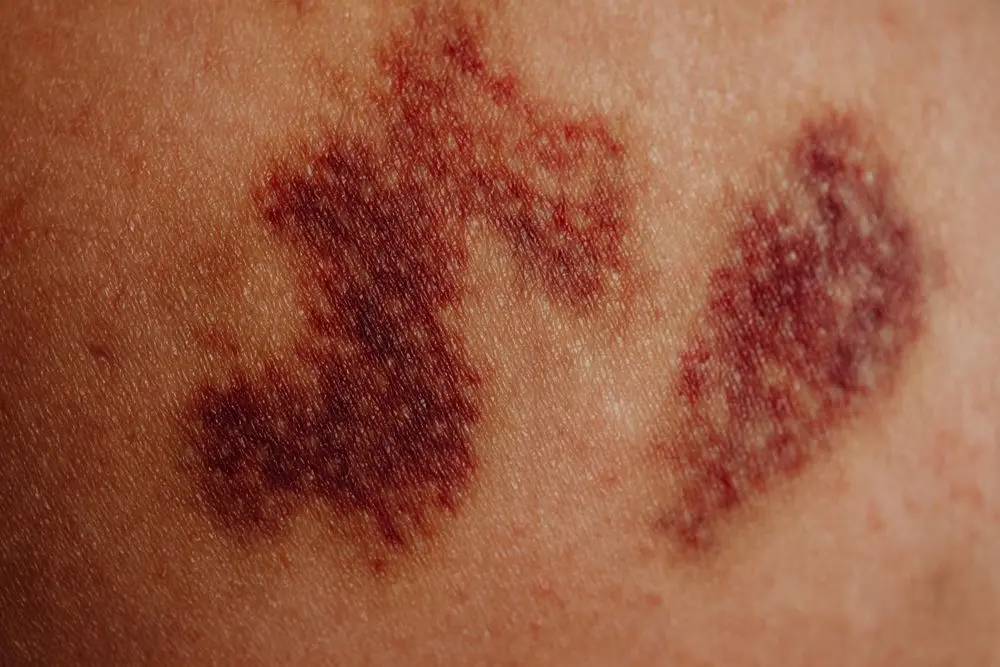
Just below her left shoulder blade, there was a birthmark.
Brown. About the size of a quarter. Shaped almost exactly like a lily. A dark center, with lighter edges curving out from it like petals.
I sat up in bed.
I’d spent fifteen years beside that woman.
I’d seen her back on beach vacations. In swimming pools. On lazy Sunday mornings. I’d rubbed aloe into it after she fell asleep on a raft at Devil’s Lake and got burned so badly she couldn’t wear a bra for a week. I’d given her a thousand back rubs. I’d kissed that exact spot under her shoulder blade a thousand times.
That mark had never been there.
I stared long enough for her to notice.
She turned around. Holding the towel against her chest.
“What?” she said.
I pointed.
“The birthmark,” I said.
She frowned.
“What birthmark?”
“On your back. Below your shoulder blade.”
I got out of bed. I picked up the little hand mirror on the dresser, the one she uses to check the back of her hair, and I held it out to her.
She took it.
She turned her back to the big mirror over the dresser. She angled the little mirror behind her so she could see.
The second she saw it, the color left her face.
She touched it.
Carefully. With two fingers.
Almost fearfully. Like she was as surprised as I was. Or like she’d forgotten it was there.
“I’ve never had that,” she said. Abruptly.
My skin prickled.
“That’s what I was thinking,” I said.
She kept staring at it in the mirror.
Then she laughed.
A nervous little laugh. It sounded forced.
“Maybe it was always there,” she said.
“No.”
“You could have missed it.”
“I didn’t.”
Her eyes met mine in the mirror.
For half a second, I saw panic.
Real panic. Her pupils went wide. Her mouth tightened.
Then it was gone. Like a curtain coming down.
“Maybe the sun brought it out,” she said. “At the retreat. We were on the beach every morning.”
“A birthmark?” I said. “The sun brought out a birthmark?”
“Or a skin spot. A mole. I don’t know, Victor.”
Her voice sharpened.
“I just got home,” she said. “Can we please not turn this into something weird?”
I backed off.
I held up my hands.
“Okay,” I said. “Okay. Sorry.”
She went into the closet to get dressed. She closed the closet door behind her.
Alma never closes the closet door. She says it makes the room feel small.
That evening, while she was in the kitchen making dinner, I sat on the couch with my laptop and pulled up old photographs.
I didn’t plan to. I just sat down to check my email and found myself opening the photos folder instead.
Our honeymoon in Costa Rica. 2011. Alma in a red bikini on a beach in Manuel Antonio, laughing at a monkey that had stolen a guy’s sandwich. Her whole back was in the picture. Bare and tan and smooth.
No mark.
A trip up the Lake Michigan shore in 2017. Alma on a paddleboard at Sleeping Bear Dunes. Her back to the camera. In a sports bra.
No mark.
My cousin Danny’s wedding in Florida in 2022. Alma in a backless blue dress. Dancing with my uncle. The camera caught her from behind.
Smooth skin. All the way from her neck to the small of her back.
No mark.
Not even a shadow.
I sat there with the laptop on my knees and felt sick.
I carried the laptop into the kitchen.
She was standing at the stove stirring something in a pot.
“Alma,” I said. “Look.”
I showed her the photographs. One at a time. Costa Rica. Sleeping Bear. Florida.
She became very quiet.
She looked at each one for a long time.
She didn’t say anything.
“I’ll see a dermatologist,” she said finally. “Maybe it’s a mole that’s developing. That happens. At our age. Things change.”
“In three days?”
“I’ll make an appointment,” she said. “Okay? Tomorrow. I’ll call Dr. Kessler.”
That should have reassured me.
It didn’t.
Because Alma’s dermatologist isn’t Dr. Kessler.
It’s Dr. Novak. On Oakland Avenue. She’s been seeing her for ten years.
There is no Dr. Kessler.
I didn’t say anything.
I went back to the living room.
My hands were shaking.
Over the next few days, the small inconsistencies kept coming.
On Tuesday morning, she made coffee.
She didn’t put cinnamon in it.
She’s put cinnamon in her coffee every single morning since the day I met her. A quarter teaspoon. She keeps a little glass jar of it right next to the coffee maker. When we went to Costa Rica, she packed a Ziploc bag of cinnamon in her suitcase because she didn’t trust the hotel to have any.
On Tuesday, she drank her coffee black.
The cinnamon jar sat on the counter. Untouched.
On Tuesday night, I made dinner.
Mushroom pasta. Cremini and shiitake in a cream sauce with parmesan. It’s one of her favorites. I’d been planning it all day. I thought maybe if I made her something she loved, something familiar, she’d come back to herself a little.
I set the plate down in front of her.
She looked at it.
She pushed it away.
“You know I hate mushrooms,” she said.
I stared at her.
Alma loves mushrooms.
She loves them more than any normal person should love a fungus. On our fifth anniversary, she made me drive forty minutes to a restaurant in Cedarburg because she’d read that it had truffle risotto. She ate the whole thing and then asked the waiter if she could have the recipe. He said no. She tried to bribe him with a twenty.
“Since when do you hate mushrooms?” I said.
She looked at me.
For a moment, I saw something in her face. Like she’d realized she’d made a mistake.
Then it was gone.
“Since always,” she said. “I just never wanted to hurt your feelings.”
She got up and made herself a peanut butter sandwich.
That night, after she went to bed, I sat at the kitchen table alone.
I thought about calling someone. But who? What would I say?
My wife came back from a retreat and now she doesn’t like mushrooms.
My wife has a birthmark she didn’t have last week.
My wife forgot where the mugs go.
They’d think I was losing my mind.
I called my friend Teddy anyway.
We’ve been friends since college at UW-Madison. He’s a pharmacist at a Walgreens in Wauwatosa. Calm. Practical. The kind of guy who reads the instructions before he assembles furniture.
“Something’s wrong with Alma,” I said.
I told him everything.
He listened without interrupting.
When I was done, he was quiet for a while.
“Vic,” he said carefully. “Have you thought about a medical thing? Like a stroke? Small ones can do weird stuff. Memory gaps. Personality changes. Taste changes too, actually. Some people lose their taste for foods they used to love.”
“And the birthmark?”
“I don’t know about the birthmark,” Teddy said. “But you should get her to a doctor. Like, this week.”
He was right. I knew he was right.
I hung up and sat there for a long time.
A stroke. Memory problems. Some kind of brain thing.
That would explain the mugs. The side of the bed. The mushrooms. The cinnamon.
It would explain everything.
Except the birthmark.
And except the way Milo looked at her.
On Wednesday, I tested her.
I’m not proud of it. But I couldn’t stop myself.
We were sitting on the couch after dinner. She was scrolling on her phone. Milo was lying in the doorway to the hallway, as far away from her as he could get while still being in the room. Watching her.
“Hey,” I said. “Remember Paris?”
She looked up.
“Of course,” she said.
“That little café by the river? Where the waiter yelled at us for ordering a cappuccino after lunch?”
She smiled.
“How could I forget,” she said.
Alma and I have never been to Paris.
We’ve been to Costa Rica. Florida. Mexico once. Toronto for a weekend. Never Europe. We’ve been talking about it for fifteen years. We have a jar on the kitchen windowsill labeled PARIS FUND that has about four hundred dollars in it, mostly in quarters.
She walks past that jar every single day.
I didn’t say anything.
I got up and went to the bathroom and turned on the faucet and threw up in the sink.
On Thursday afternoon, I came home from work two hours early.
I’d told my boss I had a migraine. I didn’t. I just couldn’t sit at my desk anymore. I couldn’t stop thinking about her.
Her car was in the driveway. She’d taken the week off work. She said she needed time to readjust after the retreat.
I let myself in through the side door. Quietly. I don’t know why I did that either.
The house was quiet.
I walked down the hallway.
The bathroom door was open.
She was standing in front of the mirror.
Her shirt was pulled down off one shoulder.
She was tracing the outline of the lily-shaped mark with one finger.
Slowly. Around the petals. Around the dark center. Over and over.
She didn’t see me.
I watched her face in the mirror.
And the look on her face wasn’t confusion.
It wasn’t worry. It wasn’t fear.
It was recognition.
Like she’d known that mark her whole life. Like she was looking at an old friend.
Like she was thinking, Oh. There you are.
I stepped back before she saw me.
I went back out the side door. I sat in my car in the driveway for twenty minutes.
Then I came back in through the front door, loudly, calling, “Hey, I’m home early. Migraine.”
She came out of the bathroom with her shirt on straight.
“Oh no,” she said. “Do you want some Advil?”
She didn’t know where we keep the Advil.
I watched her open three different drawers before she found it.
That night, Milo refused to sleep in our room.
I called him. I patted the rug at the foot of the bed. I got down on the floor and held out a piece of cheese.
He wouldn’t come in.
He lay down outside the guest room across the hall. With his chin on his paws. Facing our door. Watching the hallway.
Like he was on guard.
I barely slept.
I lay in bed with her next to me. Facing the wall. Breathing slow and even.
My mind kept trying to find normal explanations.
Maybe she’s stressed. Maybe she’s exhausted.
Maybe she has an undiagnosed medical issue. A brain tumor. Early-onset dementia. A series of tiny strokes, like Teddy said.
Maybe she’s having some kind of breakdown.
But every explanation failed.
None of them made a birthmark appear on someone’s back in three days.
None of them explained Paris.
None of them explained the way she’d looked at herself in that mirror.
The birthmark was what kept me up.
On Friday morning, she said she was going grocery shopping.
“We’re out of everything,” she said. “I’ll be gone a couple hours. I want to go to the Pick ‘n Save and then that farmers market on Downer.”
The farmers market on Downer doesn’t open until May.
I didn’t say anything.
“Okay,” I said. “Drive safe.”
I watched from the front window as she backed the green Subaru out of the driveway.
The moment the car turned the corner at the end of the block, I went upstairs.
Her laptop was on the desk in the little office at the top of the stairs. A silver MacBook with a sticker on the lid that said OT: Helping Kids Do Kid Stuff.
I opened it.
The password screen came up.
I knew her password. Or I thought I did. We share everything. Netflix. Banking. Email. We’ve never kept secrets from each other. Her password had been the same for five years. MILO2019. The year we adopted him.
I typed it in.
Wrong.
The password had been changed.
I tried our anniversary. 061111. Wrong.
I tried her mother’s birthday. Wrong.
I tried Milo’s name with different numbers. MiloBoy. MiloMilwaukee. Wrong. Wrong.
Then I thought about her birthday.
I almost didn’t try it.
Because I remembered something. A few years ago, we were setting up a joint Amazon account, and I suggested using her birthday as the password.
She’d laughed at me.
“Victor,” she said. “That’s a ridiculously obvious password. Anybody who’s ever met me could guess it. I’d never use my own birthday.”
I tried it anyway.
October 9th, 1984. 10091984.
The screen unlocked.
I sat there and stared at it.
The desktop background was gray. Plain gray.
Alma’s desktop background has been the same picture of Milo for seven years. Milo as a puppy, asleep in a laundry basket full of towels. She changes it every few months to a different picture of Milo, but it’s always Milo.
This was gray.
There was almost nothing on the desktop.
No work folders. No patient files. No vacation photos. No grocery lists. No PDFs of recipes she’d been meaning to try.
Alma’s desktop is usually a disaster. Hundreds of files. Screenshots she forgot to delete. Downloads from 2018.
This one was empty.
Except for one folder.
It was in the middle of the screen.
The icon was a little picture of a lily.
The folder didn’t have a name.
I clicked it.
A video window opened.
At first, I thought it was recorded footage. Some old video.
The picture was dim and grainy. A small room with concrete walls. A bare light bulb hanging from the ceiling. An old green couch. A folding table with some plastic water bottles on it. A bucket in the corner.
Then the picture moved. Just a little.
Something in the corner of the room shifted.
And I saw the little red dot in the corner of the screen. And the word LIVE. And a timestamp.
Friday. 10:47 a.m.
The current time.
It was a live feed.
A woman was sitting on the couch.
She was hunched over. Facing down. Her hair hanging in her face. Her knees pulled up to her chest. She was twisting her fingers together in her lap. Over and over. The way you do when you’re trying to keep your hands busy so you don’t lose your mind.
She was wearing a gray sweatshirt.
My gray sweatshirt. The UW-Madison one. The one Alma always steals and wears to her retreats because she says it smells like me.
Then she lifted her head.
And I stopped breathing.
It was Alma.
Or someone who looked exactly like Alma.
Dark hair. Gray-green eyes. The little curve at the corner of her mouth.
Her face was pale and dirty. Her eyes were red and swollen. There was a bruise on her cheekbone.
She stared toward the camera. Not seeing me. Just staring. At the lens, or the wall, or nothing.
But I could see her face.
It was my wife’s face.
And then she did something.
She reached up and pushed her hair out of her eyes. With her left hand. And she tucked it behind her ear.
And she bit her lower lip. Just on the left side.
Alma does that when she’s trying not to cry. She’s done it my whole life with her. At her father’s funeral. When we lost our first pregnancy. When Milo got hit by a car in 2021 and the vet said he might not make it.
She bites the left side of her lower lip.
If that was my wife…
Then who was the woman who’d been sleeping next to me all week?
I shoved back from the desk so hard that the chair hit the wall.
The laptop slid across the desk. I caught it before it fell.
For several seconds, I couldn’t move.
I just sat there. Staring at the screen. At my wife. In a basement. Somewhere.
And then a memory came up.
From a long way back.
It was 2010. We’d been dating about eight months. We were lying on a blanket in Lake Park, on the bluff over the lake, on a hot night in July. We’d been talking about our families.
I told her about my parents. My brother. My cousins. All the big loud Polish chaos of the Kowalczyk family.
She was quiet for a long time.
Then she said, “I have a sister.”
“You do? You’ve never mentioned her.”
“I don’t like to,” Alma said. “She’s my twin. Identical. Her name is Ava.”
I sat up.
“You’re a twin? An identical twin?”
“Yes.”
“Where is she?”
“I don’t know,” Alma said. “We haven’t talked since college. Almost ten years.”
She didn’t like talking about it. I could tell. She was picking at the grass with her fingers.
But she told me some of it.
“Ava didn’t want to live her own life,” Alma said. “She was obsessed with mine.”
At first, I thought she meant normal sibling stuff. Twins fight. Sisters fight. Everybody’s jealous of somebody.
But it wasn’t normal sibling stuff.
In high school, Ava started dating two of Alma’s ex-boyfriends. Right after Alma broke up with them. Within a week.
She copied Alma’s clothes. Her haircut. Her makeup. If Alma bought a new jacket, Ava had the same one by the weekend. If Alma got bangs, Ava got bangs. Alma said it was like living with a mirror that wouldn’t leave you alone.
She spread lies about Alma. To Alma’s friends. Little things at first. That Alma had said something mean about them. That Alma was talking behind their backs. Until Alma’s friends stopped talking to her. And started hanging out with Ava instead.
“Our parents always made excuses for her,” Alma said. “Always.”
She did their voices. Flat. Tired.
“‘Ava is sensitive, Alma.’”
“‘Ava only wants to be close to you.’”
“‘Ava is just doing what normal twins do. Twins are like that. They want to be the same.’”
In college, Ava showed up at Alma’s dorm at the University of Minnesota. Pretending to be Alma. She told Alma’s roommate she’d lost her key. The roommate let her in.
Ava sat at Alma’s desk for two hours and read all of her private messages on her computer. Her emails. Her journal. Her chat logs with her boyfriend.
Alma came home and found her there.
“She didn’t even look embarrassed,” Alma said. “She just turned around in my chair and smiled at me. And said, ‘You’re so much more interesting on paper.’”
The final break came junior year.
At a party, Ava kissed Alma’s boyfriend. A guy named Nate. They’d been together two years. Ava walked up behind him at a party, put her arms around him, and kissed him. In front of everyone.
When people saw, Ava laughed and said Nate had confused them. That he thought she was Alma. That it was an honest mistake.
“Nate swore he knew it was her,” Alma said. “He swore. He said she was wearing my perfume. My earrings. She’d done her hair exactly like mine. He said he only figured it out when he looked at her eyes.”
She was quiet for a long time.
“I broke up with him anyway,” she said. “I didn’t know what was true anymore. And I stopped talking to Ava. Completely. I changed my number. I moved out of Minnesota. I came here.”
She looked up at the stars.
“I haven’t heard from her since,” she said. “And I hope I never do.”
That was sixteen years ago.
In all the years since we’d been married, Alma had never said a single word about her sister. Not one. Her parents never mentioned her at Thanksgiving. There were no pictures of her in their house in Minneapolis. It was like she’d never existed.
I’d forgotten.
I’d honestly forgotten my wife had a twin.
I sat there in front of the laptop with my heart pounding.
And I knew.
Whoever had been sleeping next to me since Sunday night was not my wife.
My wife was in a basement.
My wife had been in a basement for five days.
And the woman wearing her face was at the grocery store.
I grabbed my phone and called 911.
This wasn’t something I could deal with alone.
My hands were shaking so badly I had to try three times to hit the numbers.
“911, what’s your emergency?”
“My wife is on a live camera,” I said. “She’s being held in a basement. Somebody took her. And somebody’s pretending to be her. The woman in my house is her twin sister. She’s been pretending to be my wife for five days.”
There was a pause.
“Sir,” the dispatcher said. “I need you to slow down.”
“I can’t slow down! She’s in a basement! She’s on the screen right now! I’m looking at her!”
“Sir. What’s your address?”
Two Milwaukee Police officers arrived in fifteen minutes. A young man and an older woman. They came up the stairs to the office. I turned the laptop around so they could see.
They looked at the screen.
They looked at each other.
The older one picked up her radio and asked for a detective.
Detective Shannon Brooks arrived twenty minutes later.
She was in her forties. Short black hair. Reading glasses on top of her head. A navy blazer and a Milwaukee Bucks lanyard. She walked into my little upstairs office and looked at the screen for a long time without saying anything.
I showed her everything.
The live feed. The photographs from Costa Rica and Florida and Sleeping Bear. I told her about the birthmark. The mugs. The side of the bed. The mushrooms. The cinnamon. Paris. Milo.
I told her about Ava.
Detective Brooks listened to all of it. She wrote things down in a little notebook.
When I was done, she leaned closer to the laptop screen.
“Do you recognize the room?” she said.
“No.”
“Do you know where Ava lives?”
“No,” I said. “I didn’t even know she was alive. Alma hasn’t talked to her in almost twenty years.”
“Okay,” Brooks said.
She turned to the younger officer.
“Get IT on the phone,” she said. “I want to know where this feed is coming from. Now.”
A detective from the cyber unit came twenty minutes later. A skinny young guy named Patel with a backpack full of cables.
He sat down at the laptop and started typing.
Meanwhile, another officer searched public records on his phone.
It didn’t take long.
Ava Rose Lindqvist. Thirty-nine years old. Born October 9th, 1984.
The same birthday.
Of course. Twins. The password wasn’t Alma’s birthday.
It was Ava’s.
Ava owned a small house in Waukesha County. A one-story ranch on a dead-end road outside a town called Mukwonago. About forty minutes southwest of Milwaukee.
She’d bought it three years ago.
“The camera feed is connected to an internet account registered at that address,” Patel said. “Spectrum. In Ava Lindqvist’s name. The camera’s a Wyze. Cheap. She set it up to stream to this laptop.”
He looked at me.
“She’s been watching your wife from your house,” he said.
Detective Brooks turned to me.
“We’re sending a team there now,” she said. “Waukesha County Sheriff’s Office is closer. They’ll be there in under thirty minutes.”
“What about Ava?”
“We wait for her,” Brooks said. “Here.”
That hour was the longest of my life.
The officers moved their cars down the street, around the corner, out of sight. The young officer stood in the front hallway behind the coat closet. The older one stood at the back door.
Detective Brooks sat with me at the kitchen table.
I had the laptop open in front of me. On the screen, Alma was curled up on the green couch in the basement. Her knees against her chest. Her face in her hands.
I couldn’t stop watching her.
“How long has she been down there?” I said.
“We don’t know yet.”
“She left Friday. For the retreat. The woman came home Sunday night. So at least since Sunday. Maybe since Saturday.”
Brooks nodded.
“There’s water on that table,” she said gently. “See it? Bottles. And food. Crackers. Somebody’s been feeding her.”
“Somebody locked her in a basement.”
“I know,” Brooks said. “I’m just telling you. She’s been fed. She’s got water. That matters.”
Milo came into the kitchen.
He walked straight to the laptop. He put his front paws up on the table, which he’s never allowed to do.
He stared at the screen.
He started whining.
Very softly. That little sad whine he makes when Alma’s been gone too long.
He put his nose right up against the screen. Against Alma’s face.
I put my face in my hands.
Brooks’s radio crackled every few minutes.
“Team’s on the road.”
“Team’s ten minutes out.”
“Team’s on the property.”
“What if she’s hurt?” I said.
“They’ll take care of her,” Brooks said.
“What if Ava did something to the house? What if there’s a… I don’t know. A trap. Something.”
“Mr. Kowalczyk,” Brooks said. “They know what they’re doing.”
At 3:17 p.m., the green Subaru pulled into the driveway.
I watched from the kitchen window.
She got out of the driver’s seat. She opened the back door and pulled out two paper grocery bags from Pick ‘n Save. She shut the door with her hip.
She walked up the front steps.
The front door opened.
“Victor?” she called. “I’m home. I got those cookies you like.”
The officers stepped out.
The young one from behind the coat closet. The older one from the back hallway.
“Ava Lindqvist,” the older one said. “Put the bags down. Put your hands where I can see them.”
She froze.
For one second, her face went completely blank.
Not scared. Not confused.
Blank.
Like a TV screen when someone turns it off.
Then she dropped the grocery bags.
A carton of eggs hit the floor and broke. A jar of peanut butter rolled across the hardwood.
She ran.
She made it three steps toward the side door before the young officer caught her by the arm.
She screamed.
Not in fear.
In rage.
“Let go of me! Leave me alone! Leave me ALONE!”
She kicked. She clawed at the officer’s arm. She twisted and fought so hard it took both officers to get her against the wall.
I stood in the kitchen doorway.
I watched her.
My wife’s face. Twisted into something I’d never seen it do. Red and furious and screaming.
“Why would you do that to your sister, Ava?” I said.
She stopped screaming.
She turned her head toward me.
“I’m not Ava!” she yelled. “I’m Alma! Victor! Tell them! Tell them who I am! I’m your wife!”
“No,” I said. “You’re not.”
I said it very calmly. I don’t know how.
She stopped fighting.
Her eyes found mine.
She looked at me for a long moment.
And then she laughed.
It was Alma’s face.
But it wasn’t Alma’s laugh.
Alma laughs with her whole body. She snorts sometimes. She covers her mouth because she’s self-conscious about her teeth.
This laugh was high and thin and cold. Like something cracking.
“You finally figured it out,” she said.
Detective Brooks stepped forward. She read Ava her rights. You have the right to remain silent. Anything you say can and will be used against you.
Ava laughed again.
She looked right at me.
“He didn’t even notice at first,” she said. To Brooks. Like they were sharing a joke.
I wanted to hit her.
I’m not a violent man. I’ve never hit anyone in my life. Not even my brother, when we were kids and he deserved it.
But I wanted to cross that kitchen and hit her.
Instead, I gripped the doorframe so hard my knuckles turned white.
“The police are already at your house,” I said.
Her smile disappeared.
For the first time, she looked afraid.
“You found her?” she said.
“You really thought I wouldn’t?”
She stared at me.
“You were supposed to believe I was her,” she said. “You were supposed to live with me. To love me.”
She said it so calmly.
Not angry. Not crazy. Just calm. Matter-of-fact. Like she was explaining a math problem.
It frightened me more than her screaming had.
“You’re insane,” I said.
“No,” Ava said. “She doesn’t deserve the life she has. I do.”
She said it like it was obvious. Like any reasonable person would agree.
“Everybody always said she got the better life,” she said. “Even when we were little. Better grades. Better friends. Better boyfriends. Then a better career. A better house. And a better husband.”
She looked at me when she said that.
“You took her because you were jealous?” I said.
Ava’s face twisted.
“She stole everything first,” she said. “She was born first. Did you know that? Seven minutes. Seven minutes and she got everything. The first name. The first steps. The first word. The first everything. And I got the leftovers.”
Her voice rose.
“I deserve what she has,” she said. “I’ve always deserved it. She just got there first.”
Detective Brooks stepped between us.
“Ms. Lindqvist,” she said. “Tell us what happened at the retreat.”
Ava didn’t look at her.
She looked at me.
“I followed her,” she said.
The words came out almost proudly.
“She always goes to the same place in spring,” Ava said. “Door County. The Bluffside Retreat. Every April. She posts about it on Instagram every year. Pictures of the sunrise. Pictures of the yoga deck. Pictures of her little cabin.”
She smiled.
“I booked a cabin under a different name,” she said. “Jennifer Reed. I cut my hair different and wore a hat and sunglasses the whole time. I watched her for two days. She never even noticed me.”
My stomach turned.
“On Sunday morning,” Ava said, “she went for a walk on the beach. Alone. At sunrise. She always does that. The last morning. She posts about it. ‘Last sunrise. Feeling grateful.’”
She shook her head.
“So I was waiting for her,” she said. “On the beach. With two coffees. I walked up and said, ‘Alma. It’s me. Ava. I came to apologize. I’ve been in therapy. I’m so sorry for everything I did. Can we talk?’”
Ava laughed.
“And she believed me,” she said. “Can you believe that? Twenty years. And she just believed me. She started crying. She hugged me. She said, ‘Oh, Ava. I’ve missed you.’”
I closed my eyes.
“I gave her the coffee,” Ava said. “I’d put something in it. Something I got online. It works fast.”
“You drugged her,” I said.
“She was foolish enough to trust me,” Ava said. “That’s not my fault.”
“I put her in my car,” Ava said. “Right there in the beach parking lot. Nobody saw. It was six in the morning. I drove her home. To my house. I put her in the basement. I’d already set it up. The couch. The camera. The lock on the door.”
She looked at me.
“Then I drove back to the retreat,” she said. “In her car. With her bag. Her phone. Her clothes. I packed up her cabin. I checked out at the front desk. As her. Nobody noticed.”
“And then you came here,” I said.
“And then I came here,” she said. “Home.”
The word made me sick.
“How long were you planning this?” Detective Brooks asked.
Ava looked at her for the first time.
“Years,” she said.
The room went still.
“I found her on Facebook in 2019,” Ava said. “And Instagram. And LinkedIn. And your Facebook, Victor. And your mother’s. I studied everything. Every photo. Every post. Every comment. I knew where you worked. I knew your schedules. I knew what restaurants you liked. I knew the name of your dog. I knew your anniversary. I knew the names of your nieces and nephews.”
She smiled.
“I bought the house in Mukwonago so I could be close,” she said. “I drove past here a hundred times. I saw you mow the lawn. I saw her in the garden. I knew enough.”
“You didn’t know where we keep the coffee mugs,” I said.
Her eyes flashed.
“I would have learned,” she said.
“You didn’t know our life,” I said.
“I knew the important parts.”
“No,” I said. “You knew what we put on the internet. You knew what we showed the world.”
I took a step toward her.
“You didn’t know she puts cinnamon in her coffee,” I said. “You didn’t know she loves mushrooms. You didn’t know she sleeps on the left side of the bed because she thinks if somebody breaks in, they’ll get me first.”
My voice cracked.
“You didn’t know she holds my hand every night,” I said. “You didn’t know how she hugs.”
She lunged at me.
The officers pulled her back against the wall.
“I could have made you happier than she did!” Ava screamed. “I could have been better! I could have been better than her!”
That was the moment I stopped seeing her as a confused woman.
I’d been thinking, somewhere in the back of my mind, that maybe she was sick. Maybe she didn’t understand what she’d done. Maybe she’d somehow convinced herself she really was Alma.
She hadn’t.
She knew exactly what she’d done.
She hadn’t mistaken herself for Alma.
She wanted to erase her.
Detective Brooks’s radio crackled.
She turned away. She put her hand over her ear and listened.
Then she turned back.
She looked at me.
“They found your wife,” she said.
My knees nearly gave out.
I grabbed the counter.
“Is she okay?”
“She’s conscious. She’s talking. She’s dehydrated and she’s scared, and she’s got some bruises,” Brooks said. “But she’s alive. She’s okay.”
She put her hand on my shoulder.
“As good as she can be,” she said.
I covered my face with my hands.
And I cried. Right there in my kitchen. In front of two police officers and a detective and the woman who’d stolen my wife’s face.
I didn’t care.
Behind me, I heard Ava say something.
Very quietly.
“She wasn’t supposed to be found.”
The next several hours came to me in pieces.
Ava in handcuffs. Being walked out the front door. Past the broken eggs and the jar of peanut butter on the floor. She didn’t look back.
A detective putting Alma’s laptop in a plastic evidence bag.
Milo standing in the front window, watching the police cars pull away.
The young officer driving me to Froedtert Hospital in Wauwatosa, where the ambulance had taken Alma. He ran every red light. I didn’t ask him to.
On the way, Detective Brooks called me with more details.
Alma had been in the basement for five days. Since early Sunday morning.
The door was locked from the outside with a padlock. There were no windows. Ava had left water bottles, crackers, canned soup, a can opener, granola bars, a bucket, and a blanket. She’d installed the camera in the corner of the ceiling, behind a wire cage, so Alma couldn’t reach it.
So she could check, from my house, from my kitchen, from our bed, that Alma was still there.
“She told us she was planning to go back every weekend,” Brooks said. “To check on her. Bring more food. She was going to tell you she was going to yoga on Saturday mornings. Or the farmers market. She thought she could disappear for a few hours, check the basement, and come home before you noticed.”
“For how long?” I said.
Brooks was quiet on the line.
“She didn’t say,” she said.
At the hospital, a nurse met me at the front desk and walked me down a long hallway on the third floor.
She stopped outside a door.
“She’s been asking for you,” the nurse said. “Since they brought her in. Every five minutes.”
I opened the door.
Alma was sitting up in a hospital bed under a white blanket.
She had an IV in one arm. A bandage on her wrist where she’d scraped it on something. A bruise on her cheekbone, purple and yellow.
She was still wearing my UW-Madison sweatshirt.
For one terrible second, I hesitated.
In the doorway. With my hand on the frame.
I hate that I did. I’ve hated it every day since.
But for five days, I’d been looking at that face across the dinner table. In the bathroom mirror. On the pillow next to mine. And it hadn’t been her.
For one second, my body didn’t trust my eyes.
Then Alma looked at me.
“Victor,” she whispered.
And her face crumpled.
And she bit the left side of her lower lip.
I crossed the room in three steps.
She sat up and wrapped both arms all the way around my waist.
She pressed her cheek flat against my chest. Right over my heart.
And she held on.
For a long time. Longer than you’d expect.
And right at the end, she let out a little breath.
Like she was setting something down.
The way she always had.
I held her so tightly that the nurse cleared her throat and asked me to be careful of the IV.
I didn’t let go.
“I’m sorry,” I said into her hair. “I’m so sorry, Alma.”
She pulled back. She looked up at me. Her eyes were swollen and red.
“For what?” she said.
“I didn’t know,” I said. “Five days. She was in our house for five days. Sleeping in our bed. And I didn’t know.”
“You did know,” Alma said.
“Not fast enough.”
“You found me,” she said.
Her voice broke.
“She kept saying you wouldn’t notice,” Alma said. “Every time she came down. She’d talk to me through the door. She’d say, ‘He hasn’t noticed. He hasn’t noticed anything. He thinks I’m you.’ She said she’d studied me so well that you’d never know the difference.”
She was crying now.
“She said you’d forget me,” Alma said. “She said in a few months you wouldn’t even remember there’d ever been a difference.”
I took her face in my hands. Gently. Around the bruise.
“I knew something was wrong the second she hugged me,” I said. “At the front door. On Sunday night.”
“Really?”
“And then Milo wouldn’t go near her.”
Alma laughed. And cried. At the same time.
“Of course,” she said. “Of course the dog knew first.”
I sat with her for six hours that night.
She didn’t want to talk about the basement. Not yet.
But around midnight, when the lights were down and the hallway was quiet, she told me a little.
“I counted,” she said. “Every day. I counted the bricks in the wall. There are four hundred and twelve. I counted them so many times.”
She was holding my hand. Tight.
“And I said our grocery list,” she said. “Out loud. Over and over. The one on the refrigerator. Eggs. Milk. Cinnamon. Mushrooms. Dog food. That stupid organic peanut butter you like.”
She laughed. Wet.
“I said it a thousand times,” she said. “I thought, if I keep saying it, I won’t forget. I’ll remember who I am. I’ll remember our kitchen. I’ll remember where everything goes.”
“And I sang,” she said. “To myself. That song you hum when you’re washing dishes. The one you don’t know the name of.”
“It’s a real song.”
“I know it’s a real song, Victor. You’ve been humming it for fifteen years. It’s ‘Harvest Moon.’ Neil Young.”
I stared at her.
“It is?”
“You didn’t know?”
“I had no idea.”
She laughed so hard she started coughing and the nurse came in to check on her.
Ava was charged with kidnapping, false imprisonment, battery, identity theft, and several other offenses.
The police searched her house in Mukwonago.
In a back bedroom, they found eleven spiral notebooks. Filled with handwriting. Years of it.
Details about our lives.
My work schedule. Our anniversary. The names of my parents, my brother, my cousins. The restaurants we went to on our date nights. The name of Alma’s dentist. The color of the bathmat in our bathroom, which she must have seen in one of Alma’s Instagram posts.
Phrases Alma used in text messages. Long lists of them. “Lol, okay.” “Love you, goofball.” “Don’t let Milo eat any more socks.”
She’d been watching us for years.
And on the last page of the last notebook, written in big block letters, underlined three times:
BIRTHMARK — COVER WITH MAKEUP?
The lily-shaped birthmark was the one thing she couldn’t remove.
Alma never had one. Ava always had.
Identical twins can have different birthmarks. A dermatologist told us that later. Birthmarks aren’t completely set by genes. They form in the womb, and two babies from the same egg can end up with different ones.
Ava claimed she’d forgotten about it. She said she’d planned to cover it with concealer every morning, and she’d forgotten on Monday because she was rushing out of the shower.
I don’t know if that’s true.
I think maybe some part of her wanted to be caught.
Or maybe some part of her just couldn’t stand to completely disappear.
Alma’s parents flew in from Minneapolis on Saturday.
Gunnar and Ingrid Lindqvist. In their seventies. They came straight from the airport to the hospital in a cab.
Ingrid came into Alma’s room first. She stopped at the foot of the bed.
She looked at her daughter. At the bruise on her cheek. The IV. The bandaged wrist.
And she put her hand over her mouth.
“I’m sorry, Alma,” she said. “I’m so sorry.”
Alma looked at her for a long time.
“You always made excuses for her, Mom,” Alma said quietly. “Always. ‘She’s sensitive. She just wants to be close to you. Twins are like that.’”
Ingrid started crying.
“I know,” she said.
“You didn’t listen to me,” Alma said. “Not once. Not in high school. Not in college. Not when she read my journal. Not when she kissed Nate. You told me I was overreacting.”
“I know,” Ingrid said. “I know, sweetheart. I was wrong.”
Gunnar stood in the doorway behind her. A big, quiet man with white hair. He’d been a shop teacher in St. Paul for thirty-five years.
He didn’t say anything for a long time.
Then he walked over to the bed and sat down on the edge of it. He took Alma’s hand. The one without the IV.
“We were scared,” he said. “Of Ava. Of what she might do. We thought if we kept her calm, if we gave her what she wanted, if we told you to just be patient with her, she’d grow out of it.”
He shook his head slowly.
“We put her feelings ahead of your safety,” he said. “For your whole life. And look what it cost.”
Alma squeezed his hand.
She didn’t say she forgave them.
Not that day.
But she let them stay.
Alma came home twelve days later.
I picked her up from the hospital on a Wednesday afternoon in late April. It was raining a little. She sat in the passenger seat with her hands in her lap and looked out the window at the city going by.
When we pulled into the driveway, she didn’t get out right away.
She looked at the house for a long time. The crooked maple. The vegetable garden, which nobody had touched in two weeks. The front porch.
“Okay,” she said finally. “Okay.”
Milo was waiting inside the front door.
He hadn’t been himself the whole time she was in the hospital. He wouldn’t eat much. He slept outside the guest room every night, facing the hallway, like he was still on guard.
When the front door opened and Alma walked in, he froze.
He stared at her.
For one second, I was afraid he wouldn’t go to her. That he’d be confused. That he’d smell Ava on the furniture, in the bed, on the clothes in the closet, and not know who to trust.
Then his tail started going.
Slowly at first. Then faster. Then so fast that his whole back end was wiggling.
He ran at her so hard he nearly knocked her over. He slammed into her legs. He put his paws up on her stomach. He made those little whining sounds like he’d suffered a personal tragedy and needed her to know about it.
Alma got down on the floor.
Right there in the front hallway. In her jeans and her raincoat. And she let him lick her face.
“I know,” she said. “I know, I know, I know. You poor baby. You knew. You knew the whole time, didn’t you?”
That first night, she walked into the kitchen.
She stood in front of the cabinets for a moment.
Then, without looking, she reached out and opened the cabinet next to the refrigerator.
She took out her yellow mug. The one with the little painted sunflower.
She made herself a cup of coffee. At eight o’clock at night.
She put a quarter teaspoon of cinnamon in it from the little glass jar.
And then she started crying.
She stood at the kitchen counter holding her yellow mug and sobbed.
I held her while Milo pressed against her legs so hard he nearly knocked us both over.
Recovery was slow.
I won’t pretend it wasn’t.
She hated closed doors. All of them. Bedroom doors, closet doors, bathroom doors. She couldn’t stand being in a room with the door shut. For months, we lived with every door in the house wide open.
She woke up from nightmares. Two, three times a week. Gasping. Clawing at the sheets. Saying, “Four hundred and twelve, four hundred and twelve, four hundred and twelve.” I’d hold her and say our grocery list until she calmed down.
Eggs. Milk. Cinnamon. Mushrooms. Dog food. That stupid organic peanut butter.
She stopped going to retreats.
She said she couldn’t. Not yet. Maybe not ever. She said every time she thought about the beach at sunrise, she saw her sister walking toward her with two cups of coffee.
For months, she couldn’t look at her own reflection without seeing Ava’s face.
She’d stand in front of the bathroom mirror in the morning and freeze. And I’d find her there, sometimes twenty minutes later, still standing there, staring at herself.
“It’s my face,” she said once. “It’s my face, Victor. And I can’t stop seeing her in it.”
We took down the big mirror over the dresser.
We put up a painting instead. A watercolor of Lake Michigan at sunset that we bought at a street fair in 2016.
She left the little hand mirror in the drawer. She didn’t use it for a long time.
We went to therapy together.
A woman named Dr. Halloran in an office on Brady Street. Every Tuesday night. Alma went by herself on Thursdays too.
Some weeks, Alma talked the whole hour. Some weeks, she didn’t say a word.
Once, about two months in, Dr. Halloran asked her what she was most afraid of.
Alma was quiet for a long time.
“That he’ll look at me,” she said. “Victor. And for one second, he won’t be sure.”
I didn’t say anything.
I just reached over on Dr. Halloran’s couch and took her hand.
And I held it the way she holds mine every night before she falls asleep.
A year later, Ava was sentenced in Waukesha County Circuit Court.
She pleaded guilty to everything. Her lawyer tried to argue mental illness. The court-ordered psychiatrist said she had a personality disorder, but that she was competent and fully understood what she’d done.
She was sentenced to twenty-two years in the Taycheedah Correctional Institution.
Alma didn’t attend.
Neither did I.
Alma wrote a victim impact statement. The district attorney read it out loud in court. Alma never told me what it said, and I never asked.
But Detective Brooks called me afterward.
“I’ve been doing this for nineteen years,” she said. “I’ve never seen a courtroom that quiet.”
We didn’t need to watch Ava being removed from our lives.
She’d already been removed.
The moment Alma walked back through our front door, she was gone.
Alma’s parents come down from Minneapolis once a month now. They stay at a hotel near the lake, because Alma isn’t ready for overnight guests yet.
Ingrid brings homemade bread. Gunnar fixes things in the house that don’t need fixing. Last time, he rebuilt the kitchen drawers so they close softly and don’t slam.
They visit Ava too. Once a year. At Taycheedah.
Alma knows. She’s okay with it.
“She’s still their daughter,” Alma said. “I’m not going to tell them what to do with that.”
Alma’s back at work. Part-time now. Three days a week. She’s helping a little boy named Marcus learn to tie his shoes. He has a condition that makes his hands shake.
“He’s so patient with himself,” she told me. “He tries and tries. And when he gets it wrong, he just laughs and starts over.”
She smiled.
“I’m learning a lot from him,” she said.
This past April, a year after everything, Alma came downstairs on a Saturday morning in her running clothes.
“I’m going to go see the sunrise,” she said. “At the lake. At the bottom of the bluff in Lake Park.”
I stared at her.
“By yourself?”
“No,” she said. “With you. And Milo.”
So we went.
The three of us. At six in the morning. Down the long wooden steps from the bluff to the beach. The lake was calm and gray. The sky over the water was just starting to turn pink.
Alma stood at the edge of the water for a long time.
She didn’t say anything.
Milo sat at her feet.
I stood next to her.
When the sun came up over the lake, she reached over and took my hand.
She didn’t look at me.
She just held on.
After a while, she let go of my hand.
And she turned to me.
And she wrapped both arms all the way around my waist. And pressed her cheek against my chest, right over my heart.
And she held on.
Longer than you’d expect.
And at the end, she let out that little breath.
“So I can hear your heart,” she said quietly. Against my chest. “So I know you’re really here.”
People sometimes ask how I knew.
How I figured it out. When the police and the doctors and even her own parents might not have.
The birthmark started it.
The forgotten habits made me suspicious.
The camera proved it.
But the truth is, I knew before I understood.
A face can look the same. A voice can be practiced. A life can be studied from the outside, through photographs and posts and notebooks full of other people’s words.
But love lives in smaller places.
The side of the bed someone reaches for without thinking.
The cabinet they open in the dark.
The way a dog recognizes the person beneath the skin.
And in the way your wife hugs you.