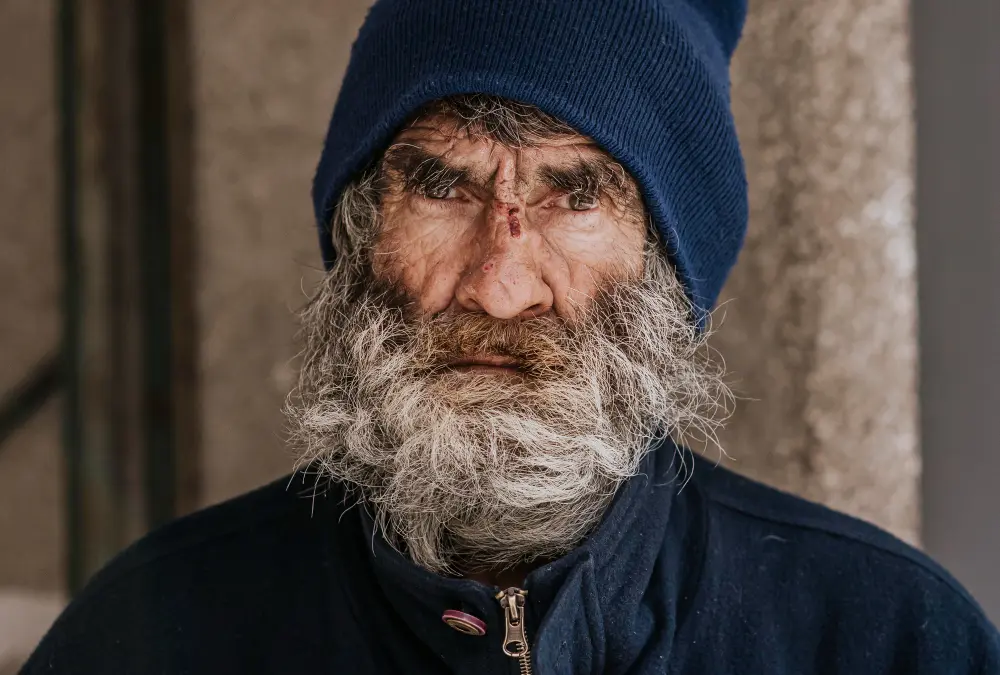
I passed Larry every morning on my way to work.
He sat in the same spot every day, at the top of the stairs at the Walnut-Locust subway station in Center City, Philadelphia, with his back against the brick wall next to the newsstand that had been closed since the pandemic. He had a gray wool blanket and a green Army surplus backpack. Usually there was a paper cup in front of him with a few coins in it.
He was quiet and polite. He never yelled at anybody. He never grabbed at people’s sleeves. When people walked past without looking at him, which was most people, he just nodded at them anyway.
“Morning,” he’d say. “Watch your step. That third stair’s loose.”
He was right. It was.
Over two years, we’d fallen into a simple routine.
I’d stop at the Wawa on the corner of Broad and Walnut and buy two coffees. One for me, with too much cream. One for him, black.
I’d crouch down next to him and hand it over.
“Thank you, Sarah,” he’d say. He always said my name. I’d told it to him once, the first week, and he never forgot it.
We’d talk for a few minutes. About the weather, the Eagles, the construction on Chestnut Street, or the pigeon with one foot that hung around the newsstand and that Larry had named Admiral.
Then I’d look at my watch and say, “I’ve got to run.”
“Go on,” he’d say. “Go do your important things.”
And I’d hurry off to the office.
I’m an actuary at an insurance company in a glass tower on Market Street. I calculate risk all day. The odds of a house fire. The odds of a car accident. The odds of a fifty-five-year-old man dying before sixty.
I’m good with numbers. People, I’m less sure about.
Larry was one of the only people I talked to every day who wasn’t on a spreadsheet.
I didn’t know much about him.
I knew his name was Larry. I knew he was in his fifties, probably. I knew he had a gray beard and very kind, very tired blue eyes, and that he walked with a limp on cold days. I knew he’d been on the street a long time. I knew he didn’t drink, or at least I never saw him drink, which surprised me.
I knew he liked the Phillies more than the Eagles, which in Philadelphia is a kind of treason.
That was about all.
Once, early on, I asked him how he ended up out here.
He looked at me for a long moment.
“Long story,” he said. “Not a good one.”
He didn’t tell it. I didn’t ask again.
Then, one freezing Tuesday morning in January, Larry wasn’t holding out a cup.
He wasn’t asking anyone for change.
He was holding a piece of cardboard.
It was the side of a box, torn off unevenly. He’d written on it in thick black marker. The letters were shaky, like his hand hadn’t been steady.
MARRY ME. I HAVE ONLY ONE MONTH LEFT TO LIVE.
I stopped right at the top of the stairs.
People bumped into me from behind. Somebody swore at me. I didn’t move.
A woman in a camel coat walked past, read the sign, and laughed. A man in a suit took a picture of it with his phone.
I walked over. I crouched down beside him and held out his coffee, the way I always did.
“Larry,” I said quietly. “What is this?”
He looked worse than I’d ever seen him.
His face was pale, almost gray. Under the gray there was a yellow tint to his skin that I’d never noticed before, and the whites of his eyes were yellow too.
His hands shook so hard when he took the cup that some of the coffee spilled on his blanket.
“Sorry,” he mumbled.
“Don’t be sorry. Larry. What’s going on?”
“The clinic gave me about a month,” he said quietly.
I stared at him.
“What happened?”
“Liver failure.”
He said it simply. Like he was telling me it was going to snow.
My heart sank.
“I’m so sorry,” I said.
He nodded. He took a sip of the coffee. His hands were still shaking.
“The free clinic on Race Street,” he said. “Dr. Abernathy. Nice lady. She said it’s end stage. She said there’s nothing more they can do. She’s getting me a bed at a hospice place in Kensington. State-funded. Sometime next week.”
He looked down at the coffee cup.
“She said maybe a month,” he said. “If I’m lucky.”
I didn’t know what to say.
So I looked at the sign again.
MARRY ME.
“But Larry,” I said. “Marriage?”
Larry looked down at the pavement.
He was quiet for a long time.
The trains rumbled under us. Somebody’s phone was playing music. The pigeon with one foot was hopping around the newsstand.
“I just don’t want to die as a John Doe, Sarah,” he said.
His eyes filled with tears.
“I’ve seen it,” he said. “Guys out here. They die in a doorway, or at a shelter, or in a hospital with no ID, and nobody claims them. The city keeps them for a while, and then they cremate them and put the ashes in a mass grave with a number on it. No name. Nothing.”
He swallowed.
“I want to belong to somebody,” he said. “On paper. Just on paper. That’s all.”
I didn’t know what to say.
He swallowed hard.
“I want someone to claim my ashes when I’m gone,” he said. “I don’t want the city putting me somewhere nobody will ever visit.”
He looked up at me.
“I’m not asking for anything else,” he said. “I swear. I don’t want anything from anybody. I just want somebody to come get me. After. So I’m not a number.”
I’ve always been too empathetic for my own good.
My grandmother used to say I’d give away my own coat in a blizzard and then apologize for not having a second one.
I was single. I’d been single for three years, since my last boyfriend, Greg, decided he wanted to “find himself” in Portland.
I’m practical. I’m the kind of person who reads the fine print on everything. I calculate risk for a living.
And I was completely heartbroken for him.
I went to work that day and couldn’t concentrate.
I sat at my desk on the thirty-first floor and looked at the same spreadsheet for three hours without seeing it. Actuarial tables. Mortality rates. Life expectancy.
I kept thinking about that sign. About the woman in the camel coat laughing. About the man taking a picture.
I kept thinking about a mass grave with a number on it.
I called my best friend, Dana, on my lunch break.
“You’re thinking about doing it,” she said, before I’d even finished telling her. “Aren’t you?”
“I don’t know.”
“Sarah.”
“He’s dying, Dana. He’s got nobody. He just wants somebody to pick up his ashes.”
“So pick up his ashes. You don’t have to marry him to do that.”
But I’d already looked it up.
On my phone, in a Google search, on the train that morning.
In Pennsylvania, if a person dies without a will or a legal next of kin, the city decides what happens to the body. A friend can’t just walk in and claim it. A coworker can’t. A woman who brought him coffee every morning for two years definitely can’t.
But a spouse can.
“It’s just paper,” I said to Dana. “That’s all. I’ll sign some papers. He’ll go to hospice. In a month, I’ll pick up his ashes and bury them somewhere with his name on it. And then I’ll get a death certificate and it’ll be over.”
“What if he’s a con man?”
“He’s dying, Dana. You should see him. He’s yellow.”
“What if he has debts? What if you end up owing money?”
I’d already looked that up too. In Pennsylvania, a spouse isn’t personally responsible for the other spouse’s debts. Not unless they cosigned something.
“He doesn’t have anything,” I said. “He lives on the street. There’s nothing to inherit and nothing to owe.”
Dana was quiet for a long time.
“You’ve already decided,” she said finally.
“Yes.”
“Okay,” she said. “Then I’m coming with you.”
Two days later, Larry and I went to City Hall.
The marriage license office is on the first floor, Room 413, of that enormous stone building with William Penn standing on top of it. There’s a waiting room with plastic chairs and a ticket machine like at a deli counter.
I picked Larry up at the subway stop in an Uber. He’d tried to wash up at the shelter. He was wearing a clean flannel shirt from the donation box and a pair of corduroy pants that were too big for him, held up with a piece of rope.
He’d combed his beard.
When he got into the Uber, the driver looked at him in the rearview mirror. Then at me.
He didn’t say anything.
We pulled a ticket. Number 47.
We waited forty minutes.
When they called our number, a woman behind a plexiglass window with reading glasses on a beaded chain asked for our IDs.
Larry had one.
That surprised me. A Pennsylvania state ID card. Old. Laminated. A little bent at one corner. Expired, actually, but the clerk let it go.
Lawrence Michael Ostrowski. Date of birth: March 4th, 1970.
He was fifty-six.
The clerk looked at the ID. She looked at Larry. She looked at me. She looked at Dana, who was sitting in a plastic chair behind us with her arms crossed.
“Are you both entering into this marriage voluntarily?” she said.
“Yes,” I said.
“Yes, ma’am,” Larry said.
She looked at me for a long moment over her reading glasses.
Then she stamped the form.
In Pennsylvania there’s a three-day waiting period after you get the license. Larry didn’t have three days to waste. Dana’s cousin was a judge’s clerk in Common Pleas Court. She made a phone call, and a judge waived the wait.
We were married that afternoon. In a small office on the fourth floor of City Hall, by a deputy officiant who’d clearly done six of these already that day.
There was no romance.
No wedding dress. No rings. No kiss.
Just me in my work clothes, Larry in his donated flannel shirt and rope belt, and Dana as our witness.
The officiant read the words off a laminated card. We said “I do.” We signed the papers.
When it was over, Larry looked at the marriage certificate for a long time.
He ran his finger along his name. Then mine.
Lawrence Michael Ostrowski and Sarah Elizabeth Callahan.
“There,” he said quietly. “I belong to somebody.”
To me, it was just a legal technicality. A way to let a dying man leave this world with a little dignity.
That’s what I told Dana in the elevator.
That’s what I told myself.
Larry moved into the hospice facility in Kensington the following Monday.
It was called Saint Agnes House. An old convent on a narrow street off Kensington Avenue, run by the state and a group of nuns. Twelve beds. Each room had a crucifix on the wall and a window that looked out at a brick wall.
I visited him three times a week. After work. I brought him black coffee from Wawa, even though the nurses said he shouldn’t have it.
“What’s it going to do?” Larry said. “Kill me?”
We talked.
More than we’d ever talked at the subway stop.
He told me he grew up in Port Richmond, in a row house on Almond Street. His father worked at the Navy Yard. His mother cleaned offices downtown at night. He had a younger brother, Pete, who he hadn’t talked to in twenty years.
He told me he’d played baseball at North Catholic High School. Second base. He said he’d been pretty good.
He told me he’d been in the Army for four years. In the early nineties. Stationed in Germany.
But when I asked what he did after the Army, he got quiet.
“Lot of things,” he said.
“Like what?”
He looked out the window at the brick wall.
“Lot of things,” he said again.
I let it go.
One evening in the second week, I came in and found him sitting up in bed, looking at something in his hands.
When he saw me, he quickly tucked it under the blanket.
“What’s that?” I said.
“Nothing.”
“Larry.”
He looked at me for a long moment.
Then he pulled it out.
It was a photograph. Small, old, a color print with the colors gone soft and orange.
He didn’t show me what was in it. He just held it against his chest.
“Not yet,” he said.
On the third Sunday, he asked me something strange.
“Sarah,” he said. “Do you still have that scar? On your arm?”
I froze.
I had a scar. On the inside of my left forearm, from my wrist to my elbow. Raised and shiny, a burn scar. I’d had it since I was six. I always wore long sleeves, even in summer. I’d never once shown it to Larry.
“How do you know about that?” I said.
Larry didn’t answer.
He just looked at me.
Then he closed his eyes.
“I’m tired,” he said. “Can you come back Tuesday?”
I sat in my car in the parking lot of Saint Agnes House for twenty minutes.
I told myself he must have seen it. Some morning at the subway stop when my sleeve rode up while I was handing him the coffee. That must be it.
That must be it.
Exactly three weeks after we were married, Larry died at Saint Agnes House.
It was a Thursday. Very early in the morning. Sister Margaret, the night nurse, called me at 4:40 a.m.
“He went peacefully, honey,” she said. “In his sleep. He wasn’t in any pain.”
She paused.
“He asked me to tell you something,” she said. “Last night. Before he went to sleep. He made me write it down so I’d get it right.”
“What was it?”
“He said,” Sister Margaret said, “‘Tell her she was right to come back for the coffee.’”
I didn’t understand it.
I thanked her and hung up and sat on the edge of my bed in the dark for a long time.
I arranged everything exactly the way he’d asked.
I claimed his body as his wife. I signed the forms at the hospice and the medical examiner’s office. I picked out a plain wooden urn at a funeral home on Girard Avenue. I paid for it myself. I didn’t mind.
He’d asked for cremation. He’d asked to have his ashes buried somewhere with his name on a stone. Somewhere people could visit.
“Anywhere,” he’d said. “I don’t care where. As long as it’s got my name.”
I bought a small plot at Holy Redeemer Cemetery in Port Richmond. Near where he grew up. I ordered a flat bronze marker.
LAWRENCE MICHAEL OSTROWSKI. 1970 – 2026.
I didn’t know what else to put.
The burial was on a cold, gray Saturday morning in February.
It was me and Dana. Sister Margaret from Saint Agnes. And one of the other residents of the hospice, an old man named Eddie in a wheelchair, who’d played cards with Larry every afternoon.
And a man I didn’t know.
He was standing a little way off, by a big oak tree. Sixty, maybe. Big. Barrel-chested. Gray buzz cut. A navy wool coat. He was holding his hat in his hands.
He didn’t come closer during the service. He just stood by the tree.
When the priest finished and the cemetery workers started lowering the little wooden urn into the ground, the man put his hand over his heart.
When I looked back after the service, he was gone.
Then, yesterday, I checked my mailbox.
It had been a week since the burial. I’d gone back to work. I was trying to get back to normal.
My building is an old brownstone in Fitler Square, split into four apartments. My mailbox is in the front hallway, a little brass one with a key.
I opened it after work, expecting the usual. Bills. Credit card offers. A catalog from a store I’d bought one sweater from in 2019.
There was a thick envelope inside.
Manila. Legal size. Thick, like there were a lot of pages inside.
My name was written on the front in shaky, careful handwriting I recognized.
Sarah Callahan.
And my address.
No return address.
The postmark was dated the day before Larry died.
Wednesday, February 18th. From the Kensington post office.
I carried it upstairs.
I sat down at my kitchen table.
I stared at it for a long time.
I expected a thank-you note.
Maybe a goodbye. Something sad but simple. Thank you for the coffee. Thank you for claiming me. Thank you for making sure I’m not a number.
Instead, I unfolded several handwritten pages.
Eight of them. Lined yellow legal paper. Written in blue ballpoint pen, in shaky handwriting that got worse as it went on.
And something else slid out of the envelope onto the table.
The photograph. The one he wouldn’t show me.
It was face down.
I left it there.
I picked up the letter.
I read the first sentence.
Sarah, I wasn’t completely honest with you.
Then the second.
I didn’t ask you to marry me only because I was afraid of dying alone.
By the time I got to the third, my hands were shaking.
And those mornings outside the subway station weren’t an accident. I sat in that spot for two years because I knew you’d walk past it.
The blood drained from my face.
I put the letter down.
I picked it back up.
I read those three sentences again. And again.
Then I turned over the photograph.
It was a little girl.
Six years old, maybe. Sitting on the back bumper of a fire truck. Wrapped in a gray wool blanket. Her face was covered in soot. Her hair was singed on one side. Her left arm was wrapped in white gauze from her wrist to her elbow.
She was holding a stuffed bear with a melted ear.
And she was holding the hand of a firefighter.
He was kneeling next to the bumper in full turnout gear. His yellow helmet was pushed back on his head. His face was black with smoke. He was young. Thirty, maybe.
He had a dark beard. And very kind, very tired blue eyes.
On the back of the photograph, in faded pencil:
Ladder 9. 2200 block Tasker St. Jan 14, 2000. The one I got out.
I knew that little girl.
I knew that bear. His name was Mr. Pickles.
I knew that blanket.
I knew that night.
I don’t talk about January 14th, 2000.
I don’t talk about it with Dana. I didn’t talk about it with Greg in four years of dating. I don’t talk about it with anybody.
But I’ll tell you now.
I was six years old. I lived with my mom and dad and my baby brother, Michael, in a row house on Tasker Street in South Philadelphia. Second floor. Michael’s crib was in my parents’ room. My room was at the end of the hall.
At about two in the morning, a space heater in the living room downstairs caught a curtain on fire.
I don’t remember much.
I remember waking up because I couldn’t breathe. I remember my room full of black smoke. I remember crawling under my bed with Mr. Pickles because I was so scared. I remember hearing my mother screaming my name from somewhere far away.
Then I remember a man.
A man in a yellow helmet, crawling toward me on his stomach through the smoke. With a flashlight. Saying my name.
“Sarah. Sarah. I’m here. I’ve got you.”
He pulled me out from under the bed. He wrapped me in his coat. The doorway was on fire, and he carried me through it. That’s when my arm got burned. On the doorframe. I remember the pain. I remember screaming.
He carried me down a ladder outside my bedroom window. He was singing to me the whole way down. I don’t remember what song.
He sat me on the back of the fire truck. He wrapped me in a gray blanket.
He held my hand.
And then he went back in.
For my parents. For Michael.
He came back out twenty minutes later.
Alone.
My mother, my father, and my eighteen-month-old brother died in that fire.
Smoke inhalation. The medical examiner said they never woke up. My mother had been screaming my name, the fire department report said, because she’d gotten Michael out of his crib and was trying to get to my room. The smoke got them in the hallway.
I went to live with my grandmother in Delaware County. Nana Callahan. She raised me.
I got a scholarship to Penn. A full one. Four years. Tuition, room, board. From an anonymous donor, through a small private foundation I’d never heard of.
It was called the Tasker Street Fund.
I always wondered who it was.
I wrote a thank-you letter to the foundation every year. Four letters. I never got a reply.
I picked up the letter again.
My hands were shaking so badly I had to put it flat on the table.
Sarah,
I wasn’t completely honest with you.
I didn’t ask you to marry me only because I was afraid of dying alone. And those mornings outside the subway station weren’t an accident. I sat in that spot for two years because I knew you’d walk past it.
My name is Lawrence Ostrowski. In January 2000, I was a firefighter with Ladder Company 9 out of the firehouse on Wolf Street in South Philly. I’d been on the job six years.
I’m the one who pulled you out from under your bed on Tasker Street.
I put my hand over my mouth.
I want to tell you some things. I don’t have much time left to tell them, and I couldn’t say them out loud. I tried. A hundred times. At the subway stop. At the hospice. Every time, I’d open my mouth and nothing would come out. So I’m writing it down instead. Sister Margaret is going to mail it for me tomorrow.
I want you to know first that I went back in. For your mom and dad and your little brother. I went back in three times. The third time, the floor was going, and Captain Fiore physically dragged me out by my coat. I fought him. I broke his nose. I’m not proud of that. I just couldn’t stand that I’d left them in there.
I found your mom in the hallway. She was holding your brother. She was trying to get to you. She almost made it. She was about six feet from your bedroom door.
I’m so sorry, Sarah. I’m so sorry I couldn’t get them out. I’ve been sorry every single day for twenty-six years.
I couldn’t see the words anymore.
I put my head down on the kitchen table and cried for a long time.
When I could see again, I kept reading.
After that night, I couldn’t do the job anymore. I tried for two years. But every time we rolled up on a house fire, I’d see that hallway. Your mom. The baby.
I started drinking. At first just to sleep. Then to get through the shift. Then all the time.
In 2002 I showed up to a fire drunk. They put me on leave. In 2003 they gave me a disability retirement. PTSD, they called it. They didn’t have a lot of words for it back then.
My wife left in 2004. We didn’t have kids. I don’t blame her. I wasn’t anybody worth staying with.
By 2008, I was on the street.
But there’s something I need you to know, Sarah. Something important. And I need you to understand that I’m not telling you this so you’ll feel like you owe me. You don’t owe me anything. Not one thing. Ever.
The disability pension started in 2003. Every month. About $3,400.
I didn’t spend it.
I looked up from the letter.
I mean, I spent some, the first few years. On drinking. I’m not going to lie to you.
But in 2006, I got sober for the first time. Eleven months. And in those eleven months, I found out where you were. You were twelve. Living with your grandmother in Upper Darby. I drove past your school once. I saw you on the playground. You were swinging on the monkey bars with a long-sleeve shirt on, even though it was June.
I went home and I called a lawyer. Mr. Feldman. On Walnut Street. And I set up a fund. A foundation. I called it the Tasker Street Fund.
And I had my pension check deposited straight into it. Every single month. So I couldn’t touch it. So I couldn’t drink it.
I stared at the page.
I went back to drinking in 2007. And off and on for the next eleven years. I’ve been on the street most of that time. Shelters. Doorways. The subway.
But I never once touched that fund, Sarah.
Not one dollar.
When you graduated from Upper Darby High School in 2012, Mr. Feldman sent your scholarship. To Penn. Four years. That was me.
I’m sorry it had to be anonymous. I didn’t think you’d want anything from the man who couldn’t get your family out.
I put my face in my hands.
The Tasker Street Fund.
Four letters. Every year. To a foundation I’d never heard of.
He’d gotten every one of them. I’d find that out later, from Mr. Feldman. Larry had kept them all in a plastic bag in his green Army backpack. For fourteen years.
I got sober for good in 2018. I’ve been sober eight years now. I still live on the street because I don’t know how to live anywhere else anymore. I tried. Mr. Feldman got me an apartment twice. I couldn’t sleep in it. Four walls and a door felt like that hallway on Tasker Street.
In 2024, I saw you on the news.
I remembered.
A segment on 6abc. About fire safety. During Fire Prevention Week in October. They’d interviewed me because my company did a big study on space heater fires, and I’d worked on it. I’d talked, on camera, about why I became an actuary.
“I lost my family in a house fire when I was six,” I’d said. “I wanted to understand risk. I wanted to understand why things happen the way they do.”
The reporter had asked me what I’d say to the firefighter who saved me, if I could.
I’d said, “I’d say thank you. And I’d say I’m sorry. I think he probably carried that night a lot longer than I did.”
I watched that segment twelve times on a TV in the window of a bar on Chestnut Street.
You said thank you. To me. On television. And you said you were sorry I’d carried it.
Nobody had ever said that to me. Not once. In twenty-four years.
The next day, I went to your office building on Market Street. I’d seen it in the background on the news. I sat across the street in a doorway and waited. I watched you come out at six-fifteen. I watched you walk down to Walnut-Locust and get on the subway.
The next morning I was at the top of those stairs.
I just wanted to see you, Sarah. That’s all. I swear it. I didn’t want to tell you who I was. I didn’t want anything from you. I just wanted to see the little girl I got out. All grown up. Okay. Alive.
And then, the second week, you stopped.
You crouched down and handed me a black coffee. And you said, “I’m Sarah. What’s your name?”
I almost told you right then. I almost said, I know who you are. I’m the one from the fire. But I couldn’t. I was afraid you’d look at me and see the man who left your mother and your baby brother in that hallway.
So I said, “Larry.”
I put the letter down.
I sat back in my chair.
The kitchen was very quiet. The radiator clanked. Somewhere outside, a siren went by on 24th Street.
I thought about two years of black coffees.
Admiral, the one-footed pigeon. The loose third stair. The Phillies.
Go on. Go do your important things.
He knew my name before I told it to him.
He’d known it for twenty-six years.
There were three more pages.
When the clinic told me about my liver, I didn’t know what to do.
The fund still had money in it. A lot of money. I hadn’t touched it, and Mr. Feldman invested it well. Your scholarship came out of it, and some other kids’ scholarships after you. Kids who lost parents in fires in Philadelphia. Eleven of them.
There’s still about $612,000 left.
I stopped reading.
I read that line again.
$612,000.
Mr. Feldman told me that when I died, the money in the fund would go to my next of kin. That’s how I set it up in 2006, when I was drunk and stupid and didn’t know any better. He tried to change it, but the paperwork was complicated. A foundation has rules.
My next of kin is my brother, Pete. In Florida. I haven’t talked to him since 2006. The last thing he said to me was, “You’re dead to me, Larry.” He wasn’t wrong to say it. I stole money from our mother for liquor.
If Pete gets that money, it’ll be gone in a year. He’s not a bad guy. He’s just like me. He’d drink it.
Mr. Feldman said the only way to make sure the fund kept going, to make sure it kept helping kids like you, was for me to have a spouse. A legal spouse. Who could take over as trustee of the foundation after I died.
He said I could leave it to you in a will, but Pete would contest it. He said a homeless alcoholic’s will doesn’t hold up very well in court. He said a spouse is different. A spouse is the next of kin. Nobody can argue with that.
So I asked you to marry me, Sarah.
I’m sorry. I wasn’t honest about why. Some of what I told you was true. I didn’t want to die a John Doe. I wanted somebody to claim my ashes. That was all true.
But that’s not the whole reason.
The whole reason is that I wanted the Tasker Street Fund to go to the one person in the world I knew would use it right.
The little girl I got out.
I couldn’t breathe.
You don’t have to keep it going. You don’t have to do anything with it. It’s yours. Spend it. Buy a house. Go to Paris. I mean that. You’ve earned it more than anyone.
But if you want to, Mr. Feldman will show you how. There are kids out there tonight, Sarah. In row houses with space heaters and old wiring. Some of them are going to lose everything this winter. And they’re going to need somebody to tell them it wasn’t their fault, and that they can still go to college.
There was one more page.
The handwriting was much worse now. Shaky and slanting, the letters falling down the page.
I’m getting tired, Sarah. Sister Margaret says I should rest. So I’ll finish.
You asked me once how I ended up on the street. I said it was a long story and not a good one.
Here’s the short version.
I saved one little girl, and I couldn’t save her family. And I spent twenty-six years thinking that was the worst thing I ever did.
Then you crouched down at the top of those subway stairs and handed me a black coffee. And every morning for two years, you made me feel like a person.
And I finally understood something.
Getting you out wasn’t the worst thing I ever did.
It was the best thing.
It was the only thing that ever really mattered.
Thank you for coming back for the coffee, Sarah.
Thank you for claiming me.
I’m not a number anymore. I’m your husband. On paper. For three weeks.
That’s the proudest thing I’ve ever been.
Larry
P.S. The song. The one I sang to you on the ladder. You told the reporter you didn’t remember it.
It was “Take Me Out to the Ball Game.”
It was the only song I could think of. I was so scared.
I sat at my kitchen table until three in the morning.
I read the letter four times. I looked at the photograph until the colors blurred.
The little girl on the bumper with the soot on her face. The bandaged arm. The bear with the melted ear. The young firefighter kneeling next to her with his yellow helmet pushed back, holding her hand.
At some point, I rolled up my left sleeve.
I looked at the scar. Shiny and pink, running from my wrist to my elbow.
The doorframe. The man carrying me through the fire. The singing.
Take me out to the ball game.
I’d forgotten the song. For twenty-six years.
I remembered it now.
I sang it.
Out loud. At three in the morning. Alone in my kitchen. Crying so hard I could barely get the words out.
The next morning, I called Mr. Feldman.
Jacob Feldman. Attorney at law. An office on the twelfth floor of an old building on Walnut Street. He’s seventy-eight. He was waiting for my call.
“Mrs. Ostrowski,” he said when I told him my name.
Nobody had ever called me that.
“Larry told me you’d call,” he said. “Can you come in today?”
His office smelled like old paper and pipe tobacco. The walls were covered in framed photos. One was a group of firefighters standing in front of a fire engine, in front of the firehouse on Wolf Street.
A young man with a dark beard was standing in the back row. Second from the left.
Mr. Feldman showed me everything.
The paperwork from 2006, when a sober, shaking, thirty-six-year-old Larry came into this office and said he wanted to set up a fund for a little girl he’d pulled out of a fire.
Twenty years of statements, with a pension deposit every month.
The scholarship records. Mine, from 2012. And eleven more. Eleven kids from Philadelphia who’d lost parents in house fires. All of them went to college on the Tasker Street Fund.
And a plastic sandwich bag.
Wrinkled. Soft. Worn at the corners.
Inside were four letters.
My letters. My thank-you notes. One from each year at Penn. In my handwriting.
Dear Tasker Street Fund. Thank you for my scholarship. I just finished my first year. I’m studying math.
“He kept these in his backpack,” Mr. Feldman said quietly. “For fourteen years. He’d come in here every few months. Sit right there in that chair. And read them.”
He took off his glasses and wiped them.
“He asked me every single time,” Mr. Feldman said. “‘Is she okay, Jake? Is she happy?’”
That afternoon, I drove to the firehouse on Wolf Street.
Engine 10. Ladder 9. An old brick building with two big red doors and a Philadelphia Fire Department shield over the top.
I parked across the street. I sat in my car for twenty minutes.
Then I got out and knocked on the side door.
A young firefighter answered. Twenty-five, maybe.
“Can I help you, ma’am?”
“I’m looking for a Captain Fiore,” I said. “He would have been here in 2000. I don’t know if he’s still around.”
The young firefighter looked at me strangely.
“Tommy Fiore? He retired in 2015,” he said. “But he still comes by every Thursday for dinner. He’s actually here now. Hold on.”
A minute later, a big man came out of the firehouse.
Sixty-something. Barrel-chested. Gray buzz cut. A navy wool coat.
The man from the cemetery. Standing by the oak tree with his hat in his hands.
His nose was a little crooked. Like it had been broken once.
He stopped when he saw me.
He looked at me for a long time.
“You’re her,” he said. “Aren’t you? You’re Sarah. From Tasker Street.”
I nodded.
Tommy Fiore put his hand over his mouth.
“I knew it,” he said. “At the cemetery. I knew it. Larry called me. Three weeks before he died. First time in fifteen years. He told me he married you. He told me why. I said, ‘Larry, you crazy son of a gun.’”
His eyes filled with tears.
“He told me you’d come,” Tommy said. “He said, ‘She’ll come, Cap. She’ll read the letter and she’ll come down to the house. She’s like that.’”
Tommy took me inside.
Into the firehouse kitchen. Big long table. A pot of coffee. Six firefighters eating dinner. They all stood up when we came in.
Tommy introduced me.
“This is Sarah,” he said. “Larry Ostrowski’s wife.”
Every one of them knew the name.
Tommy took me to the wall by the apparatus floor.
There was a long row of framed photographs. Every firefighter who’d ever served at Ladder 9. Black and white, then color. Going back to the 1950s.
He stopped at one.
A young man with a dark beard and kind, tired blue eyes. In his dress uniform. Smiling.
FF LAWRENCE M. OSTROWSKI. LADDER 9. 1994 – 2003.
“He was the best firefighter I ever worked with,” Tommy said quietly. “Fearless. Kind. Always singing. Always making the guys laugh.”
He looked at the photograph.
“That night on Tasker Street,” he said, “we got there in four minutes. The whole first floor was already gone. Larry went up the ladder to your window before I could even tell him to. He went in without a partner. Against every rule we have.”
He shook his head.
“He came down that ladder with you wrapped in his coat,” Tommy said. “And he was singing. Take Me Out to the Ball Game. At the top of his lungs. I’ll never forget it.”
“And then he went back in,” I said.
“Three times,” Tommy said. “I had to drag him out. He broke my nose.”
He touched his crooked nose.
“I never fixed it,” he said. “I wanted to remember.”
In March, Tommy and the guys from Ladder 9 asked me if they could do something.
A firefighter’s memorial for Larry. A real one. With full honors.
“He was one of ours,” Tommy said. “He never stopped being one of ours. He just got lost. We should have found him. We didn’t. That’s on us.”
So on a Saturday morning in late March, we went back to Holy Redeemer Cemetery.
Ladder 9’s truck led the procession. Polished and gleaming. Its ladder was raised at the cemetery gate with an enormous American flag hanging from the top.
Behind it came Engine 10, and then trucks from six other firehouses across South Philly.
There were bagpipes. The Philadelphia Fire Department Emerald Society, in kilts, playing “Amazing Grace.”
Two hundred firefighters came.
Some of them had worked with Larry. Most of them hadn’t. They came anyway.
Sister Margaret came from Saint Agnes, and Eddie in his wheelchair. Mr. Feldman. Dana.
And eleven young people I’d never met. Twenty-somethings, thirty-somethings. A nurse. A teacher. A software engineer. A guy who’d just graduated from law school.
All eleven Tasker Street Fund scholars.
Mr. Feldman had called every one of them.
They stood together in a row behind me. Eleven strangers. Every one of them had lost a mother or a father or a sister or a brother in a fire. Every one of them had gone to college on a homeless man’s pension.
None of them had known his name until that morning.
We put a new marker on his grave.
Granite this time. Upright. With the Philadelphia Fire Department shield carved into the top.
FF LAWRENCE MICHAEL OSTROWSKI
LADDER 9
1970 – 2026
BELOVED HUSBAND.
HE GOT HER OUT.
At the end of the service, the dispatcher’s voice came over the radio on every truck at once. Loud and clear across the whole cemetery.
The Last Alarm.
“Firefighter Lawrence Ostrowski. Ladder 9. Has answered his final call. Rest easy, brother. We’ll take it from here.”
Then Tommy Fiore walked over to me.
He handed me a folded American flag.
And something else.
An old yellow firefighter’s helmet.
Scratched and dented. The leather front shield was faded, with the number 9 painted on it in gold. On the inside band, written in black marker, very faded:
L. OSTROWSKI.
“We found it in the basement,” Tommy said. “In a box. When he retired, he left everything behind. His coat. His boots. His helmet.”
He put it in my hands.
“This is the one he was wearing,” Tommy said. “That night. On Tasker Street.”
I held that helmet against my chest.
The yellow helmet.
The man in the yellow helmet, crawling toward me through the smoke. Saying my name.
Sarah. Sarah. I’m here. I’ve got you.
That was eight months ago.
I’m the trustee of the Tasker Street Fund now.
Mr. Feldman taught me how to run it. I spend most of my weekends on it. Paperwork, applications, interviews.
Larry’s brother, Pete, called me once, in April. From Florida. He’d heard about the money. He was angry. He said he was going to get a lawyer.
I let him talk.
When he was done, I told him about the black coffee. About Admiral the pigeon. About the bagpipes and the two hundred firefighters and the eleven scholars standing in a row in the cemetery.
Pete was quiet for a long time.
Then he said, “He did all that? Larry?”
“He did all that.”
Pete started crying on the phone.
He didn’t get a lawyer.
He called me back in June and asked where Larry was buried. He flew up in July. I took him to the grave. He stood there for an hour.
He’s been sober for four months now. He calls me every Sunday.
This year, the Tasker Street Fund gave six new scholarships. To six kids in Philadelphia who lost parents in fires.
I interviewed every one of them myself.
And at the end of every interview, I tell them the same thing.
“It wasn’t your fault,” I say. “And there’s a man who would want you to know that somebody’s got you.”
The yellow helmet sits on a shelf in my living room.
Next to the photograph of the little girl on the back bumper of the fire truck, holding the hand of a young firefighter with a dark beard.
Next to the marriage certificate from City Hall. Lawrence Michael Ostrowski and Sarah Elizabeth Callahan.
Next to a plastic sandwich bag with four thank-you letters inside.
People ask me sometimes if I regret it.
Marrying a dying homeless man I’d only known from the top of the subway stairs. Out of pity. On a cold Tuesday in January.
I tell them no.
Because it wasn’t pity.
I didn’t know it then. But it wasn’t.
I still go to the Walnut-Locust station every morning.
I still stop at the Wawa on the corner of Broad and Walnut. I still buy two coffees. One for me, with too much cream. One black.
There’s a new man sitting at the top of the stairs now, in Larry’s old spot by the closed newsstand. His name is Darnell. He’s an Army veteran. Iraq, 2005. He’s been on the street for three years. He’s quiet. He’s polite. He tells people to watch out for the loose third stair.
Admiral the pigeon still hops around the newsstand on one foot.
Every morning, I crouch down next to Darnell. I hand him his black coffee.
We talk for a few minutes. About the weather. About the Phillies. About the construction on Chestnut Street.
Last week, I gave him Mr. Feldman’s card. And the number of a counselor at the VA who specializes in PTSD. And a list of three apartments that take vouchers.
He looked at the card for a long time.
“Why are you doing this?” he asked.
I thought about the man in the yellow helmet. Crawling through the smoke. Singing at the top of his lungs. Going back in three times.
Spending twenty-six years thinking he’d failed, when he’d been saving people the whole time.
“Because somebody once came back for me,” I said.
Darnell looked at me.
He didn’t understand.
That’s okay.
I looked at my watch.
“I’ve got to run,” I said.
Darnell smiled.
“Go on,” he said. “Go do your important things.”
I stood up.
I walked down the stairs and stepped over the loose third one.
And somewhere underneath the city, as the train came rumbling into the station, I caught myself humming.
Take me out to the ball game.