Boone Tillery had sold everything else by two that afternoon.
The tractors. The welder. The baler that only worked if you kicked it in one particular spot. Mom’s canning jars, by the box. Thirty-one boxes. A woman from Hays bought every one of them for forty dollars and loaded them into the back of a minivan while I watched.
Then Boone climbed onto the back of his pickup with the microphone.
He pointed at the Ford.
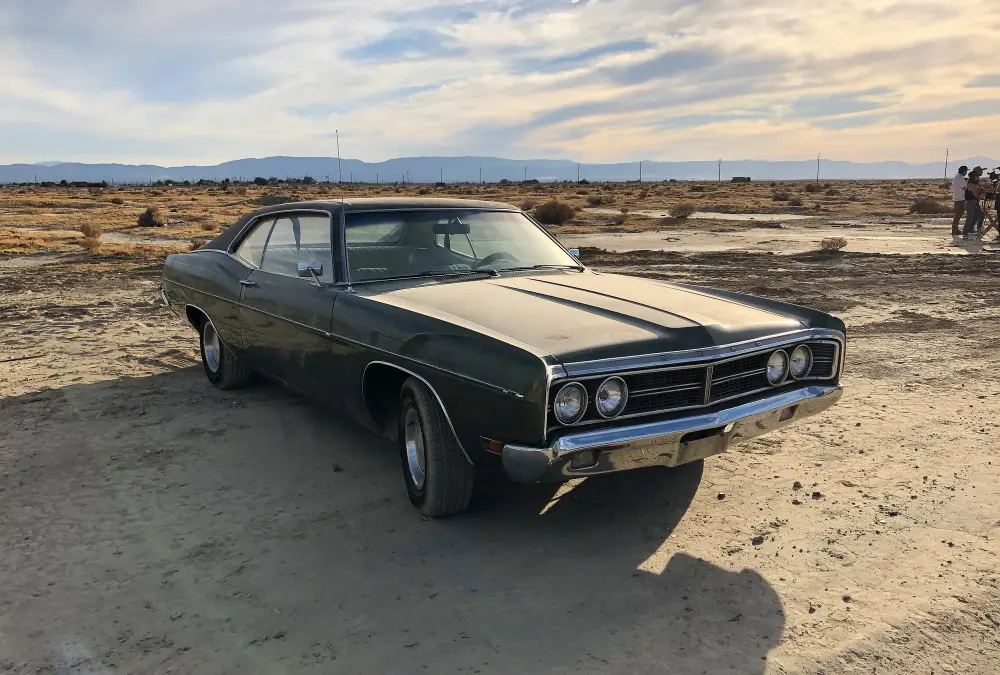
A two-tone 1978 F-150, tan and brown, sitting on the gravel by the machine shed. It had a dent in the tailgate shaped like a cow’s head and a crack across the bottom of the windshield that Dad had been meaning to fix since the first Bush administration.
“All right, folks,” Boone said. “Here’s the one a lot of you came for.”
I was standing at the edge of the crowd in my green barn coat with a white bidder card in my hand.
Number 112.
I had six thousand two hundred dollars in my checking account. It had taken me two years to save it.
And I already knew it wasn’t going to be enough.
I rode in the cab of that truck every Saturday from the time I was nine years old.
Dad would honk twice in the driveway at six forty-five in the morning. Not once. Not three times. Twice. Mom used to say you could set a clock by it. I’d come running out with my shoes untied and climb up onto that bench seat, and he’d hand me a thermos lid full of hot chocolate, and we’d drive the eleven miles into Merrill with the heater blowing on our feet.
He parked it outside the Corner Café on Main Street. Always the same spot, right in front of the window, so he could see it from his chair.
The same men were always inside. Emmett Riggle. Dale Prentice. Hollis Bauer. Old Lyle Swank, back when he was alive. A rotating cast of others. Farmers and ranchers in seed caps, drinking black coffee out of thick white mugs, arguing about rain.
Dad would sit down. I’d sit next to him and eat a cinnamon roll the size of my head.
And at some point, every single Saturday, somebody would look out the window at the Ford and say something about it. That it was getting rusty. That he ought to trade it in. That a man with four hundred acres could afford something built after disco.
And Dad would say the same thing.
“That one’s Cassidy’s when I’m gone.”
The first time he said it, I was nine.
Hollis Bauer had just told him the truck sounded like a cement mixer with bronchitis. Everybody laughed.
Dad set down his coffee.
“Can’t sell it,” he said. “That one’s Cassidy’s when I’m gone.”
He reached over and messed up my hair.
I remember Emmett Riggle, who sat on Dad’s left every Saturday, looked over at me and lifted his mug a little. Like a toast.
“Well, then,” Emmett said. “Guess we’ll all have to keep an eye on it for her.”
I didn’t understand what it meant. Not really. I was nine. I thought “when I’m gone” meant when he went to the feed store.
But I remembered it.
He said it when I was twelve and learning to drive it in the pasture. He said it when I was sixteen and crying in the cab after a boy named Travis broke up with me at the county fair. He said it when I was twenty-two and home from college for Mom’s funeral, sitting at that same table with my eyes swollen shut.
He said it at my vet tech graduation. He said it at the café the Saturday after he married Charmaine. He said it the week he got his diagnosis.
Twenty-five years. Every Saturday I was there, and probably plenty of Saturdays I wasn’t.
That one’s Cassidy’s when I’m gone.
He died in June.
Pancreatic cancer. Fourteen months from the day the doctor in Salina said the word to the day the hospice nurse called me at four in the morning.
His will left everything to Charmaine.
The house. The land. The equipment. The money, what there was of it. Everything.
It was legal. I knew that. Our family lawyer, an old man named Ferris Waddell who’d done Mom’s will too, sat me down in his office after the funeral and explained it very gently, like he was explaining it to a child.
“A spouse gets what the will says, Cassidy. And the will says Charmaine.”
“But the truck. He always said—”
“I know what he said,” Mr. Waddell said. “Half of Merrill knows what he said.”
“So doesn’t that count?”
He took off his glasses and rubbed his eyes.
“A promise made over coffee,” he said, “holds up nowhere but in the people who heard it. I’m sorry, honey. I really am. It’s not in the will. It’s not in writing. There’s nothing I can do.”
So I didn’t call anybody.
There was nobody to call.
When Charmaine put the farm up for auction in September, I found out the same way everybody else did. From a flyer on the bulletin board at the co-op, between a lost dog poster and an ad for piano lessons.
HARLAN FARM DISPERSAL AUCTION. SATURDAY, OCT. 4. 10 A.M. TRACTORS, IMPLEMENTS, LIVESTOCK EQUIPMENT, HOUSEHOLD. 1978 FORD F-150, RUNS.
Runs.
That was the whole description. One word.
I stood there in front of that bulletin board for a long time.
Then I went home and looked at my bank account.
I’m a vet tech at a large-animal clinic in Russell, about forty minutes from Merrill. I spend most of my days with my arm inside a cow or holding down a horse that doesn’t want a shot. I’m good at it. I don’t make much doing it.
Two years before Dad died, I’d started putting back money. A little every paycheck. Fifty dollars. A hundred, when I could. I told myself it was for a down payment on a house someday. Or an emergency.
But I knew what it was really for.
I knew Dad was getting older. I knew Charmaine was his wife. I knew what a will was. Some part of me knew, even then.
By October, I had six thousand two hundred dollars.
I thought it might be enough. A 1978 F-150 with a cracked windshield and a dented tailgate. Runs. In Kansas, at a farm sale, it might go for four thousand. Maybe less, if the day was slow.
I thought I had a chance.
Charmaine had been married to Dad twelve years.
She came into our lives two years after Mom died. A widow from Great Bend. Fifty-one. A bookkeeper at a farm supply company. Dad met her when he went in to argue about an invoice.
I was twenty-two and grieving and furious at everything. I did not make it easy for her.
I’ll be honest about that, because it matters. I’m not the hero of every part of this story.
The first time Dad brought her to the house, I went out to the barn and stayed there until she left. The first Thanksgiving, she made a sweet potato casserole with little marshmallows on top, and I made sure everybody knew Mom never put marshmallows on hers. The first Christmas, she gave me a sweater she’d knitted herself, and I said thank you and put it in a drawer and never wore it.
I never called her Mom. She never asked me to. I barely called her Charmaine. I called her “she.” As in, “Is she coming?” As in, “Did she move Mom’s dishes?”
She had. She’d moved Mom’s dishes to the top shelf of the hutch in the dining room and put her own in the kitchen cabinets. I remember standing there looking at it and feeling like someone had put their hand through my chest.
Dad caught me looking.
“Cass,” he said. “It’s her kitchen now too.”
“I know.”
“Do you?”
I didn’t answer.
One Christmas, maybe five or six years in, we were all at the farmhouse. Dad, Charmaine, me, Dad’s brother Earl and his wife.
After dinner, Charmaine and I ended up alone in the kitchen. Me washing, her drying. It was the only time we were ever alone together for more than a minute.
She was quiet for a long time. Drying a gravy boat. Then she said, without looking at me:
“Do you know I’ve felt like the outsider in this house the whole time?”
I stopped washing.
“Every picture on the wall is your mother,” she said. “Every recipe card in that drawer is in her handwriting. The men at the café call your dad by your mother’s last name sometimes, did you know that? ‘How’s the Kessler place?’ Like I’m not even here.”
She put the gravy boat down.
“I’m not trying to replace her, Cassidy,” she said. “I just wanted to belong somewhere.”
I didn’t know what to say.
So I said nothing. I washed the next plate. And after a minute, she picked up another towel and kept drying.
I’ve thought about that conversation a lot since June.
I should have said something. Anything. I should have said, I’m sorry. Or, I didn’t know. Or even just, That must be hard.
I never did warm to her.
That part is on me.
But what she did at the auction wasn’t about warming.
It was cold that morning. Early October, and the wind was coming hard across the stubble fields from the northwest. I wore my green barn coat over a sweatshirt and still couldn’t stop shivering.
There were more people than I expected. Maybe a hundred and fifty. Trucks and trailers parked all down the county road. A food truck from the Lutheran church selling sloppy joes and coffee. Kids running between the hay wagons.
I signed in at the folding table by the machine shed. A woman from Boone’s auction company took my name and my driver’s license and handed me a white card.
I folded it once and put it in my coat pocket.
I didn’t bid on anything else all morning. I just walked. Around the shed. Through the barn. Past the equipment lined up in the yard with little numbers on them.
I stood in front of Dad’s welder for a long time. He taught me to weld on that machine when I was fourteen. I burned a hole in my jeans and he laughed so hard he had to sit down on a bucket.
It sold for six hundred dollars to a man I didn’t know.
The men from the café were there.
All of them. Emmett. Dale. Hollis. A few others. They stood together in a loose bunch near the hay barn, in their caps and seed jackets, drinking church coffee out of styrofoam cups.
Men who’d bought Dad’s calves every fall for thirty years.
Men who’d carried his casket.
Emmett saw me and nodded. Dale lifted his coffee cup a little, like he used to at the café.
I nodded back. I didn’t go over.
I didn’t know what I’d say. Hey, remember how Dad promised me that truck? Could you all please not bid on it?
You can’t ask that. Not out here. A farm sale is a farm sale. Everything’s for sale. Anybody can bid. That’s how it works.
So I just stood by myself, near the shed, holding my card in my pocket, and waited.
At one o’clock, I saw Charmaine.
She was standing by the house with her sister, a woman named Ruth from Tulsa who’d come up for the week to help. Charmaine was wearing a brown wool coat and sunglasses even though it was cloudy. Her hair was grayer than I remembered. She’d gotten thin. Thinner than thin.
She saw me.
For a second, I thought she was going to come over. She took half a step.
Then her sister said something, and she turned away.
By two, Boone had sold everything else.
The tractors. The baler. The cattle chute. A hundred and sixty-two lots. Every single thing my father had ever owned that wasn’t nailed to the ground.
And then he climbed onto the back of his pickup with the microphone, and the crowd moved over toward the machine shed, and he pointed at the Ford.
“All right, folks,” he said. “Here’s the one a lot of you came for.”
Boone Tillery is about sixty-five. Big, red-faced, with a voice like a cattle prod. He’s been running farm auctions in this part of Kansas since before I was born. He did Grandpa Harlan’s sale in 1991. He’d known Dad forty years. They went to high school together. They played on the same terrible football team.
He came to Dad’s funeral. He was one of the men who stood at the back of the church because there weren’t enough seats.
He looked out over the crowd for a second before he started. He found me. He looked at me just a beat too long.
Then he looked at the truck.
That’s when Charmaine walked up to his pickup.
She went right up to the tailgate. She took off her sunglasses. She spoke low, but I was close enough to hear. I don’t think she knew I was that close. Or maybe she did.
“Open it at nine thousand,” she said. “She wants it. She can pay like anybody else.”
I felt the blood go out of my face.
Nine thousand.
I had six thousand two hundred. Nine thousand for a 1978 F-150 with a cracked windshield. Nobody would pay that. It wasn’t worth half that. Not to anybody.
Not to anybody but me.
And she knew it.
Boone looked down at her for a long second.
He didn’t say anything. He just looked at her. His face didn’t change, but something happened in his jaw.
Charmaine held his eyes. She didn’t blink.
Then Boone lifted the microphone.
“Folks,” he said. “Seller’s asking nine thousand on the Ford.”
Nobody moved.
There’s a rhythm to a farm sale. A sound it makes. Boone starts high, somebody laughs, somebody yells out a low number, Boone grabs it and runs. Bidder cards go up and down. Ring men holler “Yep!” and point. It’s fast and loud and it goes on all day.
This wasn’t that.
It was quiet. The wind was blowing. Somebody’s kid was crying over by the food truck. That was the only sound.
A dozen men stood along the side of the truck. Emmett, Dale, Hollis. Wendell Kraus, who ran the elevator. Pete Ochoa, who’d sold Dad his first bull. A few others I knew from the café, from church, from my whole life.
Hands in their pockets. Every single one.
“Eight thousand,” Boone said. “Who’ll give me eight?”
Nothing.
Usually, out here, somebody always throws out a low number to get it going. Fifteen hundred! Two thousand! Somebody always does. It’s practically a rule. It breaks the ice. It gets the ring men shouting.
Nobody threw out anything.
“Seven,” Boone said. “Six. Somebody give me six on a good running Ford.”
Not one card.
And they were all looking at me.
That’s what I couldn’t stand.
Every one of them. Emmett. Dale. Hollis. Wendell. Pete. Their eyes on me. Not on the truck. Not on Boone. On me.
I thought she’d told them something.
I thought she’d gone around that morning, quiet, while I was walking around the shed, and talked to each of them. I thought they knew what she was doing. I thought they were in on it.
I thought they were standing there waiting to watch me go to nine and break.
I thought, This is what she wanted. Not the money. This. Me standing here in front of everybody I’ve ever known, being made to pay for something Dad promised me for free.
My chin started to tremble.
I hate that. I’m thirty-four years old. I’ve put my arm in a breech calf up to the shoulder at three in the morning in a snowstorm. I’ve held down a stallion for a vet with a broken wrist. I don’t cry in front of people.
My chin trembled anyway.
I held the card down by my green coat and stared at the gravel.
I couldn’t look up. If I looked up, I’d see their faces. And if I saw their faces, I’d cry.
There was a little piece of red glass in the gravel by my boot. From a taillight, probably. Some tractor, some year. I stared at it like it was the most interesting thing in the world.
Then I heard footsteps on the gravel.
Charmaine. Coming up closer to Boone’s truck.
I looked up just enough to see her. She’d put her sunglasses back on. She was standing right at the tailgate.
“Lower,” she said.
Boone looked down at her.
“You want to pass it, Charmaine?”
He said it into the microphone. I don’t know if he meant to. His voice went out over the whole yard. Over the hay barn and the food truck and the hundred and fifty people standing in the cold.
Forty people were looking at her now. Maybe more.
She looked out at them. All those faces. The men along the truck. The women by the food truck. People from church. People who’d come to her wedding.
She didn’t say anything for a long moment.
“Lower,” she said again. And nodded.
Boone didn’t waste a second.
“Five,” he said. “Forty-five. Forty-one hundred, folks.”
He dropped it like a stone.
Forty-one hundred.
He didn’t go forty-eight, or forty-five, or forty-three. He went straight to forty-one. Like he’d already decided.
That’s when I raised my card.
I don’t remember deciding to. My arm just went up.
I held it as high as I could reach. All the way up. Arm straight. The way Dad taught me at my first cattle sale, when I was ten years old and terrified of the auctioneer.
“Get it up there, Cass,” he’d said, standing behind me with his hand on my shoulder. “Don’t be shy about it. Man can’t sell you anything he can’t see.”
My hand shook so hard the number wobbled.
Boone pointed right at me.
“I’ve got forty-one hundred from number 112,” he said. “Do I hear forty-two?”
He looked down the line of men.
Slowly. One at a time. Emmett. Dale. Hollis. Wendell. Pete.
Not a hand.
Not a twitch. Not a nod. Not one of them even took his hands out of his pockets.
Boone looked out over the rest of the crowd. A hundred and fifty people.
Nothing.
Then he looked at Charmaine.
She opened her mouth.
Then she shut it.
That’s when I noticed Emmett Riggle.
He was standing at the very end of the line of men. Seventy-four years old. Skinny as a fence post, in the same faded Pioneer seed cap he’d worn for as long as I could remember. He sat on Dad’s left at the café every Saturday morning for twenty-five years. He was the one who lifted his mug to me when I was nine.
He was the only man there not looking at me.
He was looking at Charmaine.
Not angry. Not mean. Just steady. Like he was waiting for something.
And Charmaine was looking back at him.
I didn’t understand it. Not then.
Boone took a breath.
“Going once,” he said.
Nobody moved.
The wind blew. A flag on somebody’s trailer snapped. The kid by the food truck had stopped crying.
“Going twice.”
Charmaine was still looking at Emmett. Her hands were in fists at her sides.
Emmett didn’t move. His hands stayed in his jacket pockets. He just looked at her.
Then, very slowly, he shook his head.
Just once. Just a little.
Charmaine looked away.
“Sold,” Boone said. “Forty-one hundred dollars. Number 112.”
He banged the side of the truck with his flat hand. Once. Hard.
“Congratulations, Cassidy.”
He said my name. Not my number.
I didn’t move.
I stood there with my card still up in the air. I couldn’t figure out how to put my arm down. My whole body felt frozen.
Then somebody started clapping.
I don’t know who. Somewhere in the back. One person. Then another. Then the men along the truck took their hands out of their pockets and started clapping too. Dale. Hollis. Wendell. Pete Ochoa was clapping with his coffee cup still in one hand, slopping coffee onto his boots.
And then the whole yard was clapping. A hundred and fifty people. For a forty-one-hundred-dollar truck.
I put my card down.
And I cried. Right there on the gravel. In front of everybody.
Hollis Bauer got to me first.
He’s a big man. Bigger than Dad was. He put his arm around my shoulders and squeezed so hard my feet nearly came off the ground.
“There you go, girl,” he said. “There you go.”
“I thought—” I couldn’t talk. “I thought you were all—”
“We know what you thought,” Dale Prentice said. He was standing in front of me now, with his cap in his hands. “Saw it on your face. Liked to break my heart.”
“Why didn’t anybody bid?”
Dale looked at Hollis. Hollis looked at Dale.
“Walt told us twenty-five years running,” Dale said. “We figured we’d heard it enough times to believe it.”
Behind them, Boone climbed down off his truck.
He walked straight to Charmaine. He stood very close to her and said something I couldn’t hear. She didn’t answer. She just stood there with her sunglasses on, staring at the Ford.
Then she turned around and walked back to the house.
Her sister Ruth followed her.
The screen door banged shut behind them.
I paid at the folding table by the machine shed.
The woman from the auction company ran my debit card. Forty-one hundred dollars. Plus the buyer’s fee. I watched the little machine think about it for a long time, and I held my breath, and it went through.
She handed me a receipt. And a set of keys.
The keys were on Dad’s old ring. A brass ring with a little plastic tag from the Merrill Co-op, so worn you couldn’t read it anymore. And a bottle opener shaped like a bass. Mom had bought him that at a gas station in Missouri on their honeymoon.
I stood there holding it.
“You okay, hon?” the woman asked.
“Yeah,” I said. “Yeah. Sorry. I’m fine.”
I wasn’t fine. I walked out to the truck and opened the driver’s door and climbed up onto that bench seat, and I sat there with both hands on the wheel, and I cried so hard I couldn’t see.
It still smelled like him. Coffee and diesel and that wintergreen chewing gum he switched to when he quit tobacco. His sunglasses were still on the dash. An old Royals cap was on the seat beside me.
My seat. The passenger side. Where I’d sat every Saturday morning for twenty-five years.
I don’t know how long I sat there.
At some point, somebody knocked on the window.
It was Emmett.
I rolled down the window. It was the old crank kind. It squeaked.
Emmett leaned his forearm on the door. He looked at me for a while. He didn’t say anything about me crying. He just waited until I was done.
“She asked me to bid it up,” he said.
I stared at him.
“This morning,” Emmett said. “Charmaine came and found me by the hay barn. Asked me if I’d throw in a few bids on the Ford. Run it up. She said she’d cover me if I got stuck with it. Said it was her truck now and she wanted what it was worth.”
I couldn’t say anything.
“I told her I’d think about it,” Emmett said.
He looked out across the yard toward the house.
“I guess I thought about it,” he said.
“She asked anybody else?”
“Nope. Just me.” Emmett rubbed his chin. “Figured I was the easiest mark, I suppose. Old man. Sat next to Walt longest. Figured I’d do it for her out of respect for his wife.”
“Why didn’t you?”
Emmett looked at me then. Really looked at me. His eyes were watery blue. Old-man eyes.
“Because I sat next to Walt longest,” he said.
He told me the rest standing there with his arm on the door.
How he’d told Dale and Hollis about it that morning. How the word had gone down the line. Quiet. Not a meeting. Not a plan, exactly. Just one man telling another man, and that man telling another.
“Nobody said, ‘Let’s do this,’” Emmett said. “Nobody said much of anything. Just, ‘You hear what she asked Emmett?’ And then a fella would nod. And that was that.”
“So you all just decided not to bid.”
“We all just decided to keep our hands in our pockets,” Emmett said. “That’s all. Free country. Man doesn’t have to bid on anything he doesn’t want.”
He almost smiled.
“Boone knew,” he said. “Don’t ask me how. Boone always knows. You see how fast he dropped it?”
“Straight to forty-one.”
“I’ve seen Boone Tillery sell a three-legged goat for two hundred dollars,” Emmett said. “That man can wring a nickel out of a fence post. He’s never dropped a price that fast in his life.”
I wiped my face with the sleeve of my coat.
“I thought she’d told you something,” I said. “I thought you all were in on it. I thought you were waiting to watch me go to nine.”
Emmett’s face changed.
“Cassidy,” he said. “Look at me.”
I looked at him.
“Your daddy sat next to me every Saturday morning since 1983,” he said. “He talked about two things. Rain and you. Mostly you. You know how many times I heard about your first calf? Your first cattle sale? Your vet tech certificate? You know he carried that certificate around in his wallet for a month to show people?”
I didn’t know that.
“When he got sick,” Emmett said, “the last time he came in to the café, he couldn’t hardly sit up. He’d lost so much weight his coat hung on him like a sail. And he looked out the window at that truck. And he said it one more time.”
He stopped.
“He said, ‘That one’s Cassidy’s when I’m gone, Emmett. You make sure.’”
I put my forehead down on the steering wheel.
Emmett patted the door twice. Gently. Like you’d pat a horse.
“So I made sure,” he said.
I drove the Ford home that night.
Forty minutes, with the crack in the windshield catching the headlights of every car coming the other way. It pulled to the left when I braked. The heater only worked on high. The radio only got two stations, and one of them was all sermons.
It was the best drive of my life.
I parked it in front of my little rental house in Russell and sat in it for another hour in the dark.
Then I went inside and called my best friend, Tasha, and told her everything, and she said, “Oh, honey. Oh, honey,” about forty times. Then she said, “That woman.”
“I know.”
“That woman, Cass.”
“I know.”
“Nine thousand dollars. For a truck she knew you’d sell a kidney for.”
“I know.”
Tasha was quiet for a second.
“You okay?”
I looked out the window at the Ford, sitting under the streetlight.
“I don’t know,” I said. “I think so. I don’t know.”
For about two weeks, I was angry.
Not sad. Angry. The kind of angry that wakes you up at three in the morning with your heart pounding.
I’d be cleaning out a stall at work and suddenly I’d hear it. Open it at nine thousand. She wants it. She can pay like anybody else.
Like anybody else.
Like I was anybody else. Like I was just some stranger who’d driven in from Hays to bid on a pickup.
I replayed it over and over. I thought about all the things I should have said. I should have walked up to that tailgate. I should have said, in front of everybody, You know what he promised. You know. You were there. You sat in that café with him a hundred times.
I didn’t. I’d just stood there looking at a piece of red glass.
I was angry at Charmaine for asking Emmett to bid it up.
I was angry that she’d sold Mom’s canning jars to a stranger from Hays for forty dollars. Thirty-one boxes. Some of those jars were my grandmother’s.
I was angry that she’d sold the house. The house I grew up in. The land Grandpa Harlan bought in 1947. A couple from Wichita bought it for a weekend place, I heard. Weekend place.
I was angry that she’d done all of it so fast. Four months after the funeral. Like she couldn’t wait to be rid of us.
Mostly, I was angry that Dad left her everything.
That’s the part I didn’t say out loud to anybody. Not even Tasha.
He left her everything. Every single thing. And all he left me was a promise he said over coffee. And he didn’t even put that in writing.
I loved him so much.
And I was so angry at him I couldn’t breathe.
Three weeks after the auction, Charmaine came to the clinic.
I was in the back, wrapping a horse’s leg. One of the receptionists, a young girl named Kenzie, came through the swinging door and said, “Cass? There’s a lady here for you. Says she’s your stepmom?”
I stopped wrapping.
“Tell her I’m busy.”
Kenzie looked uncomfortable. “She said she’d wait. She’s sitting in the lobby. She brought something.”
I finished wrapping the horse’s leg. Slowly. Way more slowly than I needed to. I washed my hands for a long time. I took off my coveralls.
Then I went out to the lobby.
She was sitting in one of the plastic chairs by the window, next to a man holding a beagle in a cone.
She looked terrible. That’s the first thing I noticed. She was even thinner than at the auction. Her skin was gray. Her brown wool coat hung off her shoulders.
She had a cardboard box on her lap.
She stood up when she saw me.
“Cassidy,” she said.
“What do you want?”
The man with the beagle looked up. Then very quickly looked back down at his dog.
Charmaine swallowed.
“Can we talk somewhere?” she said. “Please. Five minutes.”
We went out to the parking lot.
It was cold and bright. She stood by her car, an old silver Buick, still holding the box.
I stood with my arms crossed.
“I’m leaving,” she said. “Tomorrow. I’m moving to Tulsa. To live with Ruth.”
I didn’t say anything.
“I wanted to give you some things before I went,” she said. “Things that didn’t go in the sale. Things that should be yours.”
She held out the box.
I didn’t take it.
“You asked Emmett to bid up the truck,” I said.
She closed her eyes.
“Yes,” she said.
“You told Boone to open it at nine thousand dollars. Nine thousand. You knew what I had. You knew I couldn’t go that high.”
“I didn’t know what you had.”
“You knew I couldn’t go that high.”
She didn’t answer.
“He promised it to me,” I said. My voice was getting louder. A man walking into the clinic with a cat carrier looked over at us. I didn’t care. “Twenty-five years, Charmaine. Every Saturday. You heard him. You sat in that café with him. You heard him say it.”
“I heard him,” she said quietly.
“Then why?”
She set the box down on the hood of her car.
She took off her sunglasses. Her eyes were red.
“Do you want to know how much your father’s hospice cost?” she said.
I stopped.
“Fourteen months,” she said. “The chemo. The surgery in Wichita that didn’t work. The second surgery. The clinical trial in Kansas City that insurance wouldn’t cover. Four hundred dollars a week in gas just driving back and forth. The hospice nurse at the end. The hospital bed. The medicine that cost eleven hundred dollars a month.”
She was crying now. Not loud. Just tears running down her face.
“Do you know he took out a second mortgage on the farm?” she said. “Last fall. Without telling you. Because he didn’t want you to worry. Because he thought he’d beat it. He told me, ‘Don’t you dare tell Cass. She’ll start sending money. She doesn’t have money to send.’”
I didn’t know. I didn’t know any of it.
“The farm sold for less than what we owed on it,” she said. “Do you understand? I sold every single thing your father owned, Cassidy. Every tractor. Every jar. The house. The land. And when it was all done, after the bank and the hospital and the lawyers, I had nineteen thousand dollars left. That’s it. That’s what twelve years of marriage got me. That’s what I have to start over with at sixty-three years old.”
She wiped her face with the back of her hand.
“That’s why the truck,” she said. “Not because of you. Because I needed every dollar. Because I was scared.”
I didn’t say anything for a long time.
The wind blew a plastic bag across the parking lot. A dog was barking inside the clinic.
“You could have told me,” I said finally. “About the money. You could have just told me.”
“Would you have listened?”
I opened my mouth.
I closed it.
She laughed. It wasn’t a happy laugh.
“Twelve years,” she said. “You never once called me on the phone, Cassidy. Not once. Not on my birthday. Not when I had my hip done. You called your father. If I answered, you’d say, ‘Is Dad there?’ Like I was a receptionist.”
I looked at the ground.
“I’m not saying that to make you feel bad,” she said. “I’m saying it because it’s true. You didn’t want to know me. That’s your right. I’m not your mother. I never pretended to be. But don’t stand here and tell me I could have just told you. You’d never have heard it.”
She was right.
I hated that she was right. I stood there in that parking lot with my arms crossed, and I knew she was right.
I’d made her a stranger. For twelve years. On purpose. Because she wasn’t Mom. Because she put marshmallows on the sweet potatoes. Because she moved the dishes.
And then at the auction, she’d treated me like a stranger.
Like anybody else.
“That’s not all of it,” I said. “Is it?”
She looked at me.
“The money,” I said. “That’s part of it. But that’s not all of it. You didn’t need nine thousand for that truck. You didn’t need Emmett to bid it up. Nobody else wanted it. You’d have gotten four thousand from me either way.”
She was quiet for a long time.
“No,” she said finally. “That’s not all of it.”
She leaned back against her car. She looked so tired.
“Do you know what it’s like,” she said, “to sit next to your husband in a café every Saturday for twelve years and hear him say, over and over, ‘That one’s Cassidy’s when I’m gone’?”
I didn’t answer.
“Every Saturday,” she said. “Twelve years. And never once, not one time, did he say anything about what was mine. When he was gone. Not one word. The men would look at me. Sometimes they’d look at me when he said it. And I’d smile and drink my coffee.”
She shook her head.
“I knew it was silly,” she said. “It was a truck. It was a forty-year-old truck that I hated riding in because the heater smelled like burning dust. But it was the one thing he ever promised anybody out loud. And it was never me.”
I didn’t know what to say.
I’d never thought about it that way. Not once.
I’d always thought of that promise as mine. Something between me and Dad and the men at the café. I’d never thought about who else was sitting at that table. Who else was hearing it.
“So I wanted you to pay for it,” Charmaine said. “Just a little. That’s the ugly truth. I wanted one thing that was supposed to come easy to you to come hard. Just once. In front of all of them.”
She looked down at the box on her hood.
“And then I stood there,” she said, “and Boone said nine thousand, and nobody moved. And I looked at you. And you were standing there staring at the ground like you were nine years old. And your chin was shaking.”
She stopped.
“And I looked at Emmett,” she said. “And he was looking at me. And I knew he wasn’t going to do it. And I knew why. And I felt like the smallest person who ever lived.”
“You said lower,” I said. “Twice.”
“Boone asked if I wanted to pass it. Into the microphone. In front of everybody.” She almost laughed. “That man. I think he did it on purpose.”
“I think so too.”
“If I’d passed it,” she said, “everyone would’ve known exactly what I was doing. That I’d rather take nothing than let you have it. I couldn’t do that. I couldn’t stand there in front of everybody your father ever loved and be that person.”
She wiped her eyes again.
“So I said lower,” she said. “It was all I had.”
We stood there for a long time.
A truck went by on the highway. Somebody came out of the clinic with a puppy in a crate and drove away.
“I’m sorry,” Charmaine said. “For the truck. For asking Emmett. For all of it. I’m sorry.”
I looked at her.
At her gray face. At her coat hanging off her shoulders. She’d lost so much weight. I’d been too angry to notice how much.
She’d taken care of him. That’s what I suddenly saw, standing there in that parking lot. Fourteen months. Driving him to Wichita and Kansas City. Sitting in waiting rooms. Learning how to give shots. Changing the sheets on a hospital bed in the living room at three in the morning. Holding his hand when he couldn’t swallow.
I’d come on weekends. I’d sat with him for a few hours and then driven back to Russell. I’d cried in the truck on the way home and told myself I was doing everything I could.
She’d been there every single night.
“I’m sorry too,” I said.
She looked up at me, surprised.
“For twelve years,” I said. “For the sweater I never wore. For the marshmallows. For never calling. For ‘Is Dad there?’” My voice broke. “For Christmas. In the kitchen. When you told me you felt like an outsider. And I didn’t say anything.”
Charmaine’s face crumpled.
“You remember that?” she said.
“I remember everything,” I said. “I just never did anything about it.”
She picked up the box off the hood of her car.
She held it out to me again.
This time, I took it.
“These were in the house,” she said. “In his dresser. In the closet. I didn’t put them in the sale. They’re yours. They were always yours.”
I opened it.
On top was his old Carhartt jacket. The brown one, with the corduroy collar, worn white at the elbows. Under it, his pocketknife. His good belt buckle from the county fair in 1979. A shoebox of photographs.
And underneath all of it was a manila envelope.
“What’s this?”
“I found it in the glove box,” Charmaine said. “Of the Ford. In June. After the funeral. I was cleaning it out.”
I looked at her.
“I didn’t open it,” she said. “It has your name on it. I thought about it. Every day. But I didn’t.”
She looked away.
“I should have given it to you before the auction,” she said quietly. “I know. I almost did. A dozen times.”
“Why didn’t you?”
“Because I was afraid,” she said, “of what was in it.”
I opened it right there in the parking lot.
Inside was a single sheet of yellow legal paper, folded in thirds. And a key on a plastic tag.
The paper was in Dad’s handwriting. Shaky. Shakier than I’d ever seen it. He must have written it near the end.
Cass,
If you’re reading this, you’ve got the truck. I knew you would. Those boys at the café won’t let anything else happen. I made sure.
The key is for a safe deposit box at First National in Merrill. Box 41. There’s not much in it. Your mother’s wedding ring. Grandpa’s watch. A few savings bonds I bought when you were born that I never cashed. They’re yours.
I want you to do something for me. And you’re not going to like it.
Take care of Charmaine.
I know you two never got along. I know that’s partly my fault. I was so glad to have somebody again that I never stopped to see how hard it was for you. Or for her. I should have made you two sit down at a table together years ago. I was a coward about it. I didn’t want to pick.
She’s been good to me, Cass. Better than I deserved. These last months, she hasn’t slept. She’s the one who holds my hand at night when the pain gets bad. She sings to me. Did you know she sings? She’s terrible at it. It’s the best thing I’ve ever heard.
I left her everything because she’s going to need it. The bills are worse than you know. I’m sorry I didn’t tell you. I didn’t want you carrying it. I made a lot of mistakes with money these last years. I’m leaving her with a mess.
So when it’s done, check on her. Call her once in a while. Not “Is Dad there.” Call her.
She’s not your mother. She never tried to be. But she was my wife, and she loved me, and she’s going to be alone.
The truck’s yours, kiddo. It always was. Keep the heater on high. It only works on high.
Love,
Dad
P.S. Tell Emmett thanks. He’ll know for what.
I read it twice.
Then I handed it to Charmaine.
She looked at me. Then she took it.
I watched her read it. I watched her get to the part about the singing. She put her hand over her mouth.
When she got to the end, she sat down on the curb of the parking lot. Right there, in her brown wool coat. She sat down like her legs had just quit.
She held the yellow paper against her chest. And she cried.
I sat down next to her.
I didn’t know what to do. So I put my arm around her shoulders. She was so thin. I could feel her bones through the coat.
She leaned against me.
We sat there on that curb, outside the Russell Large Animal Clinic, while a man with a goat on a rope walked past us and pretended not to see.
“He never told me,” she said finally. “Not once. In twelve years. That I had a terrible voice.”
I laughed. I couldn’t help it. It came out wet and strange.
“He told everybody I had a terrible arm,” I said. “Softball. Fifth grade. He told it at the café for twenty years.”
“I know,” Charmaine said. “I heard it. You threw the ball into the dugout and hit the coach.”
“In the knee.”
“In the knee,” she said, and she was laughing too, and crying, and so was I.
Charmaine didn’t move to Tulsa the next day.
She moved four days later.
Because I asked her to wait. Because I took off work and drove to the farmhouse with the Ford, and we loaded her things into the bed of it. Her sewing machine. Her boxes of books. A rocking chair that had been her mother’s. A box of Christmas ornaments, half of them Mom’s, half of them hers, all mixed together in tissue paper. She hadn’t sold those. I didn’t know that until I opened the box.
“I couldn’t figure out which were which,” Charmaine said. “After twelve years. They just all became ours.”
I looked at them for a long time.
Then I closed the box and put it in the truck.
We drove to Tulsa together.
Four and a half hours. In the Ford. The heater on high because it only worked on high. The radio getting one station, which played country music until we crossed into Oklahoma, and then switched to a Spanish-language talk show neither of us understood a word of.
We left it on anyway.
She sat in the passenger seat. My seat. The one I’d sat in every Saturday for twenty-five years. I didn’t say anything about it. It felt right.
Somewhere past Wichita, she said, “Can I ask you something?”
“Sure.”
“Why did you never wear that sweater? The one I knitted?”
I kept my eyes on the road.
“Because I liked it,” I said. “And I didn’t want to like anything you gave me.”
She was quiet for a long time.
“That’s the most honest thing anybody’s ever said to me,” she said.
“I still have it,” I said. “It’s in a drawer. In my dresser.”
“Is it moth-eaten?”
“Probably.”
She laughed.
“I’ll make you another one,” she said. “If you want.”
I thought about it.
“Make it brown,” I said. “Like the truck.”
Somewhere around Ponca City, she fell asleep.
She’d been so tired. I don’t think she’d slept a full night since June. She fell asleep with her head against the window and Dad’s letter folded in her lap. She’d been carrying it in her coat pocket all week.
I drove the rest of the way listening to the Spanish talk show and her breathing.
And at one point, near the Arkansas River, I heard it.
Very quietly. In her sleep. She was humming.
She was terrible at it.
It was the best thing I’d ever heard.
I went to the bank in Merrill the next week. Box 41.
It was just what Dad said. Mom’s wedding ring, a thin gold band, worn smooth. Grandpa Harlan’s pocket watch, which still ran if you wound it. And a little bundle of savings bonds with a rubber band around them, bought one a year from 1991 to 2009. Fifty dollars each. My name on every one.
The teller added them up for me. With interest, after all those years, they came out to a little over two thousand dollars.
Two thousand.
I stood at the counter and did the math in my head. Six thousand two hundred, minus forty-one hundred, minus the buyer’s fee. I’d had about eighteen hundred dollars left after the auction.
And now I had a little over two thousand more.
I stood there a long time.
Then I asked the teller for a cashier’s check.
I mailed it to Tulsa.
I put a note in with it.
Charmaine,
Dad bought these bonds for me a long time ago. He’d want some of them to go to you. Use it for whatever you need. Don’t argue with me. I’m as stubborn as he was.
I’ll call you Sunday.
Not “Is Dad there.” I’ll call you.
Cass
She called me first. Saturday night. She was crying again. She said I was ridiculous. She said she couldn’t take it. She said she was going to mail it right back.
She didn’t.
She used it to buy a new hearing aid, which she’d needed for two years and hadn’t been able to afford. She told me about it on Sunday.
“I can hear the birds again,” she said. “Ruth’s got a feeder outside the kitchen window. I didn’t even know there were birds.”
I call her every Sunday now.
Not every single one. Most of them. We talk about Ruth’s garden. About her new church. About the women in her knitting group, who she says are all lovely and all completely nuts. About the sweater, which is brown, and taking forever, and she keeps having to take out the sleeves because they come out different lengths.
Sometimes we talk about Dad.
She told me things I never knew. That he cried at every single Hallmark movie. That he slept with one sock on and one sock off, for reasons he could never explain. That on their first date, he took her to the Dairy Queen in Great Bend and ate two Blizzards in a row and then got sick in the parking lot, and she married him anyway.
“Why?” I asked her.
“Because he was so embarrassed,” she said. “He kept apologizing. All the way home. Like a little boy. And I thought, here is a man who’s never once tried to be anybody but who he is.”
The first Saturday in November, I drove the Ford into Merrill.
I got up at six. I made a thermos of hot chocolate. I pulled out of my driveway in Russell at six-fifteen, and I drove the forty minutes with the heater on high and the windows fogged.
I parked in front of the Corner Café. In the same spot. Right in front of the window.
I sat in the cab for a minute.
Then I went inside.
They were all there. Emmett, Dale, Hollis. Wendell from the elevator. Pete Ochoa. A couple of the younger ones.
The table in the back. The thick white mugs. The smell of coffee and bacon grease and cinnamon rolls.
They all looked up when I came in.
Nobody said anything for a second.
Then Emmett pushed out the chair next to him with his boot.
The chair on his right. Dad’s chair.
I sat down.
The waitress, a woman named Darlene who’d worked there since I was a kid, came over without me asking. She set down a mug of black coffee in front of me. And a cinnamon roll. The size of my head.
“On the house, sweetheart,” she said, and squeezed my shoulder, and walked away before I could say anything.
The men started talking. About rain. About the price of corn. About whether Wendell’s new knee was worth what he paid for it. About Dale’s grandson, who’d gotten a tattoo of a fish on his calf.
Normal Saturday talk. Like I’d been sitting there all along.
I didn’t say much. I ate my cinnamon roll. I drank my coffee. I listened.
At some point, Hollis looked out the window at the Ford.
“That truck’s got rust on the rocker panels,” he said. “You ought to get that looked at.”
“I know,” I said.
“And that windshield. That’s a ticket in some counties.”
“I know.”
“And that tailgate,” Dale said. “Looks like a cow ran into it.”
“A cow did run into it,” I said. “1997. Dad was trying to load a heifer. She didn’t want to go.”
Everybody laughed.
Then Pete Ochoa said, “You thinking about trading it in, Cassidy? Get something with a heater that works on low?”
The table got quiet.
Everybody looked at me.
I set down my coffee.
I looked out the window at the Ford. At the dent in the tailgate. At the crack in the windshield. At the rust on the rocker panels, and the Royals cap still sitting on the dash where Dad left it.
“Can’t sell it,” I said.
Emmett turned his head and looked at me.
I thought about it for a long time before I said the next part. I’d been thinking about it the whole drive in. Maybe longer. Maybe since that parking lot in Russell.
I don’t have kids. I don’t know if I ever will. I’m thirty-four and single and I work too much and smell like cows.
But Dale’s granddaughter, Josie, is nine. She comes into the clinic every spring with her 4-H calf. She asks a million questions. She wants to be a vet. She makes me show her everything.
And Charmaine’s sister Ruth has a grandson named Eli who’s six and has never seen a cow up close, and Charmaine told me on the phone last week that he asked her if she’d take him to see “the farm where Uncle Walt lived.” And Charmaine had to tell him there wasn’t a farm anymore.
I don’t know who it’ll be. I don’t know yet.
But I knew, sitting there, that the promise didn’t end with me. That’s not how promises work out here. Not the real ones. They don’t live in wills. They live in the people who hear them.
And they keep going as long as somebody’s willing to keep saying them.
“It’s going to somebody when I’m gone,” I said. “I haven’t figured out who yet.”
Emmett looked at me for a long moment.
Then he picked up his mug.
He lifted it. Just a little. Toward me.
Like a toast.
Like he did when I was nine.
“Well, then,” Emmett said. “Guess we’ll all have to keep an eye on it.”
I lifted my mug back.
Down the table, one at a time, they all lifted theirs. Dale. Hollis. Wendell. Pete. Even the young guys, who didn’t totally know what was going on, but figured they’d better.
Then they put them down and went back to arguing about rain.
I sat there in my father’s chair, with my hands around a thick white mug, and looked out the window at the truck.
On the drive home, I stopped at the cemetery outside Merrill.
Dad’s stone is next to Mom’s. Gray granite. Walter James Harlan, 1952–2025. There’s room on the other side for Charmaine, if she wants it. She hasn’t decided yet. I told her she has time.
I stood there in the cold for a while.
“I got it,” I said. “The truck. Emmett made sure. They all did.”
The wind blew. A crow was sitting on the fence at the edge of the cemetery, watching me.
“I’m calling her,” I said. “Charmaine. Every Sunday. Like you asked. She’s knitting me a sweater. It’s brown. The sleeves keep coming out wrong.”
I laughed a little.
“And I told Emmett thanks,” I said. “Like you said. He just nodded. I think he knew.”
I stood there for another minute.
“You should have put it in the will, Dad,” I said. “You know that? You should have just written it down. Would’ve saved everybody a lot of trouble.”
The crow flew off.
I knew why he hadn’t, though. I’d known since the auction. Since all those hands stayed in all those pockets.
He didn’t need to write it down. He’d said it out loud every Saturday for twenty-five years in front of the men who’d hold him to it.
He’d made sure it was in the right place. In the people who heard it.
I got back in the truck.
I turned the key. It took two tries. It always takes two tries.
I turned the heater on high. It only works on high.
Then I put my hand on the horn, and I honked.
Twice.
Not once. Not three times.
Twice.
And I drove home.