Sunday Dinner
“Do you think someone like you should be having children?”
My mother-in-law asked me that on a Sunday afternoon in March, while I was helping her set the table for dinner. I was standing on the little wooden step stool she kept by the china cabinet, the one Michael had bought for her kitchen the first year we were married so I could reach the plates. I had four of her good dinner plates in my arms, the ones with the blue rim, and I was three months pregnant.
I set the plates down very carefully on the counter beside me. “What do you mean?” I asked.
Patricia didn’t answer right away. She folded a cloth napkin into a neat triangle and laid it beside a fork. Then she glanced at my stomach, which was only just beginning to show under my sweater, and looked away again.
“With your condition, Sarah,” she said.
I’d heard that word all my life. Condition. Doctors said it, teachers said it, strangers in grocery stores said it while they stared. I’d learned a long time ago to let it slide off me the way rain slides off a window. But hearing it in my mother-in-law’s kitchen, about my baby, it didn’t slide. It stuck.
“Michael and I have discussed everything with our doctors,” I said. “We’ve had genetic counseling. I’ve seen a maternal-fetal medicine specialist at Ohio State since before we started trying. We know the risks.”
Patricia frowned. She set down the napkin. “Doctors don’t know everything,” she said.
Before I could answer, Michael came into the kitchen from the back porch, where he’d been fixing the latch on his mother’s storm door. He’s six foot one, and he had to duck a little under the kitchen doorway the way he always does in that old house. He looked at his mother, then at me, standing on the step stool with my hands flat on the counter.
“Everything okay?” he asked.
Patricia smiled immediately. A bright, warm, completely different smile, like somebody had flipped a switch. “Of course, sweetheart,” she said. “Just asking Sarah how she’s feeling.”
I wondered why she’d changed her tone so quickly. I wondered why she couldn’t say the same thing in front of her son that she’d just said to me.
I didn’t know then how far she would go to keep me from raising my child.
Chapter Two: Thirty Years
I was born with achondroplasia, the most common form of dwarfism. I’m three feet eight inches tall. My arms and legs are short, my head is a little larger than average, and my back has a curve in it that aches when it rains. My parents were both average height. Most people with achondroplasia are born to average-height parents. It happens by chance, a single change in a single gene, about once in every twenty-five thousand births.
I spent most of my life being treated like a joke.
In elementary school in Westerville, Ohio, the other children called me “doll” and “little freak” and asked if I lived in a dollhouse. They’d pat me on the head on the playground like I was a puppy. One boy in third grade picked me up and carried me around the cafeteria while everybody laughed, and the lunch monitor laughed too before she told him to put me down.
By high school, it was worse, because by then the cruelty had learned to be clever. In my junior year, the boys at Westerville North had a game. They’d dare each other to ask me to prom.
One of them actually did. His name was Kyle Prentice. He was tall and handsome and played lacrosse, and he stopped me at my locker in April and asked if I’d go with him. He said it so sweetly. I said yes. I went home and cried with happiness, and my mother took me to the mall that Saturday, and I spent the whole afternoon choosing a dress. Blue, with little silver beads on the bodice. We had it taken up at a tailor in Worthington.
On Monday, I found him at his locker to tell him the color so he could get a matching corsage. His friends were standing around him. When I said the word blue, they burst out laughing. Kyle laughed too. Then he told me, still laughing, that it was a bet. Fifty dollars. He said he couldn’t believe I actually thought he’d take me.
I never went to prom. The blue dress hung in my closet until I left for college, and then my mother gave it to Goodwill.
Adulthood wasn’t much kinder. It was just quieter. I got my degree in accounting from Ohio State and went to work at a credit union in Columbus, where I’m a senior financial analyst now. I bought a condo and had the kitchen counters lowered and lived a good, careful life. But some men rejected me the moment they saw me in person, after weeks of messaging online. Others treated my height as a curiosity, a novelty, something to tell their friends about. One man on a first date asked me, over appetizers, whether everything was “proportional.”
By thirty-five, I’d stopped believing anyone could genuinely love me. Not because I didn’t think I was worth loving. I’d made my peace with my body by then. I just didn’t think the world would ever let anybody look past it.
Then I met Michael.
Chapter Three: Michael
I met him at a friend’s fortieth birthday party at a brewery in the Short North, in October. He was standing by himself near the dartboard, holding a beer and looking like he’d rather be anywhere else. He was forty-two then, tall and handsome in a quiet way, with gray coming in at his temples and kind brown eyes behind wire-rimmed glasses. A civil engineer for the Ohio Department of Transportation, I found out. Bridges, mostly.
He came over and asked if I played darts. I said I’d never been able to reach the board. He laughed, not at me, but with me, and then he took the board down off its hook and leaned it against the wall at my height, and we played six games. I won four of them.
He asked me out the next week. On our first date, at a little Italian place in German Village, he pulled out my chair, and then he asked about my work. And he listened. He asked about how credit unions differ from banks. He asked follow-up questions. He told me about a bridge over the Scioto River he’d spent three years redesigning, and how it was the thing he was proudest of in his life.
He never mentioned my height. Not once. Not that night or any night after.
When he called the next morning, I almost couldn’t believe it. I sat on the edge of my bed with the phone pressed to my ear and listened to him ask if I was free on Saturday, and I had to put my hand over my mouth so he wouldn’t hear me crying.
We married two years later, at a little stone chapel in Granville, with forty people. Michael had the pastor stand on the floor instead of the raised platform so I wouldn’t have to look up at him while we said our vows. He never treated my body as something embarrassing or something to manage. When strangers stared at us in restaurants, he simply reached across the table and held my hand.
His mother was harder to understand.
Patricia Halloran was sixty-eight when I met her. A retired school secretary, widowed since Michael’s father, Gerald, died of a heart attack in 2019. She lived alone in the brick house in Upper Arlington where Michael grew up, with a garden full of roses and a living room full of photographs of her only son. She was polite to me. Always polite. But distant, the way you’re polite to a stranger in a waiting room.
At our wedding, she congratulated us without hugging me. She shook my hand. She hugged Michael for a long time, and then she shook my hand.
Whenever Michael mentioned wanting children, she changed the subject. She’d ask about his job, or the weather, or the Buckeyes. I assumed she worried about medical complications. I understood that. I had concerns myself.
Chapter Four: The Plan
Because of my body, pregnancy required careful planning. Women with achondroplasia can have healthy pregnancies, but our small torsos leave less room for the baby to grow, and our pelvises are too narrow for a vaginal delivery. Everything has to be watched. Breathing, as the baby gets bigger and presses up against the lungs. Blood pressure. Spine. Weight.
Michael and I met with a maternal-fetal medicine specialist at the Ohio State Wexner Medical Center before we ever tried. Dr. Adaeze Nwosu, who’d cared for more than a dozen women with skeletal dysplasias. We sat in her office for two hours. She talked us through every risk. The monitoring I’d need. Why a planned C-section around thirty-eight weeks would be safest. The anesthesia team who’d need to plan ahead, because spinal anesthesia can be harder with my spine.
Then we met with a genetic counselor named Ruth Abernathy. She explained that because I have achondroplasia and Michael doesn’t, any child of ours would have a fifty percent chance of inheriting it. One in two. A coin flip.
Michael held my hand under the table. “Does it change anything for you?” he asked me, in the car afterward. “Knowing that?”
I thought about it for a long time. About the third-grade cafeteria. About Kyle Prentice and the blue dress. About the man who asked if everything was proportional.
“If she’s like me,” I said finally, “she’ll have one thing I never had.”
“What’s that?”
“A mother who knows exactly what it’s like,” I said. “And a father who took the dartboard off the wall.”
Nothing was guaranteed. But we made the decision together, with our eyes open.
When I found out I was pregnant, at thirty-eight, I cried so hard on the bathroom floor that Michael came running and thought something was wrong. “Sarah? What happened? Are you hurt?”
I handed him the test.
He stared at it. He read the little window three times. Then he sat down on the bathroom floor beside me and started crying too.
Michael attended every appointment he could. He took Thursday afternoons off from ODOT for six months. He assembled the crib himself and painted the nursery a soft pale yellow. He built a little set of wooden steps so I’d be able to reach the changing table. We chose the name Charlotte, after my grandmother, who taught me to read and never once in her life looked at me like I was anything but ordinary.
Dr. Nwosu monitored me every two weeks, then every week. The pregnancy progressed beautifully. My breathing got harder as Charlotte grew, and I couldn’t sleep lying down after thirty weeks, but my numbers were good.
But Patricia became more and more uncomfortable.
When Michael showed her the twenty-week ultrasound photograph at Sunday dinner, she barely glanced at it. She handed it back to him without a word. Then she said, “Are you sure this is a good idea?”
Michael frowned. “Mom,” he said. “We’ve been over this.”
“I’m only concerned.”
“Then ask how Sarah’s doing,” Michael said, “instead of questioning whether we should have a child.”
Patricia didn’t say a word for the rest of dinner.
At six months, she visited our house in Clintonville for the first time in a year. She walked down the hall to the nursery and stood in the doorway looking at it for a long time. The pale yellow walls. The white crib. The little wooden steps beside the changing table. The rocking chair in the corner with a quilt my mother made folded over the arm.
“You’ve certainly bought a lot,” she said.
“Babies need things,” I said.
She walked over to the crib and touched the rail with one finger. “People get attached to plans that don’t always work out,” she said quietly.
I asked her what she meant. She said she was only being realistic. Then she went back to the kitchen and asked Michael about the Buckeyes.
Chapter Five: The Lunch
At seven months pregnant, Patricia invited me to lunch.
She called me at work on a Tuesday, which she’d never done. She asked if I could come to her house on Thursday. Michael would be at a bridge inspection in Zanesville, she said, so she’d specifically like me to come alone. Just the two of us.
I hoped she wanted to repair our relationship. I hoped, I’ll admit it, that she’d finally decided to love her granddaughter. I put on a nice blue maternity dress, and I picked up a little bouquet of tulips at the Kroger on the way.
When I arrived, she had tea waiting on the dining room table, in her good china cups. Chicken salad sandwiches with the crusts cut off. She thanked me for the tulips and put them in a vase. Then we sat across from each other at that long dining table, my feet dangling from her tall chair, and made small talk for several awkward minutes. My job. Her roses. The weather.
Then Patricia got up and disappeared into the den.
She came back carrying a white envelope. She sat down again across from me and laid it on the table between us.
“I’ve been thinking about your situation,” she said.
“My situation?”
She slid the envelope across the table. I opened it. Inside was a check. Drawn on her account at Huntington National Bank. Pay to the order of Sarah Halloran. One hundred thousand dollars. In the memo line, in her neat school-secretary handwriting, she’d written: For Charlotte’s future.
I stared at it. “What’s this for?”
Patricia folded her hands on the tablecloth. “When the baby is born,” she said, “leave it at the hospital. I’ll arrange everything.”
I stared at her across her dining table. For a moment, I honestly didn’t understand the words. They just sat there in the air between us like they were in a foreign language.
“You want me to abandon my child,” I said slowly.
“Think of it as giving the baby a better life,” she said.
“Are you offering me money to give up Charlotte?”
“I’m offering you a chance to do what’s best for her,” Patricia said. Her voice was calm. Reasonable. Like she was explaining a school schedule to a confused parent.
“She’s my daughter,” I said.
“That doesn’t necessarily mean you’re the best person to raise her,” Patricia said.
I pushed the check back across the table to her. My hands were shaking.
“Get out of my life,” I said.
Patricia picked up the check. She folded it once, carefully, and put it back in the envelope. “Then don’t say I didn’t warn you,” she said.
I struggled to get down from her tall dining chair. At seven months pregnant, with my center of gravity gone and my back aching, it took me a long time. She didn’t help me. She sat there and watched.
“Don’t contact me again,” I said, when I finally got my feet on the floor.
“You’re being emotional, Sarah,” she said.
“No,” I said. “I’m being clear.”
I left before she could say anything else. I walked out her front door and down her brick front steps one at a time, holding the railing, and got into my car. The seat was pushed all the way forward and the pedals had extensions on them, the way they’ve been on every car I’ve ever driven.
Then I sat there in her driveway gripping the steering wheel with both hands.
I’d heard cruel things about my body for thirty years. In cafeterias and hallways and grocery stores and restaurants. But nobody, not once in my whole life, had ever suggested I should surrender my child because of it.
Chapter Six: Silence
When Michael came home from Zanesville that night, I told him everything. I was sitting in the rocking chair in Charlotte’s nursery when he found me. I’d been sitting there for four hours.
He stood in the doorway in his ODOT polo shirt with his hard hat still in his hand, and he listened to the whole thing. When I finished, he looked stunned. Like somebody had hit him.
“She offered you how much?” he said.
“A hundred thousand dollars.”
“And she said to leave Charlotte at the hospital?”
I nodded.
Michael reached for his phone in his back pocket. His hands were shaking. I’d never seen my husband’s hands shake.
I stopped him. I reached up and put my hand on his wrist. “Please don’t call her while you’re this angry,” I said. “Please. Not tonight.”
He looked at me for a long moment. Then he put the phone down on the dresser and sat down on the floor beside the rocking chair, so we were eye to eye. He took both my hands.
“She’s never coming near our baby,” he said. “Never.”
For once in my life, I didn’t try to soften his words. I didn’t say she’s your mother. I didn’t say she’s just worried. I just held his hands and let him say it.
Michael called Patricia the next morning, from the kitchen, before he went to work. I listened from the hallway. He told her that what she’d done was unacceptable. He said he didn’t care what her reasons were. He told her she wasn’t welcome in our home, and she wasn’t welcome at the hospital when the baby came, and if she showed up, he’d ask security to remove her.
Patricia said something I couldn’t hear. A long something.
“Help whom?” Michael said. His voice was very cold. “Help whom, Mom?”
He hung up.
For the rest of my pregnancy, we didn’t speak to her.
She sent a birthday card to Michael in May. He threw it away without opening it. She called him four times in June. He didn’t answer. His aunt Margaret, Patricia’s sister in Dayton, called him in July and said his mother was beside herself and wouldn’t explain why. Michael told his aunt it wasn’t his story to tell.
At thirty-six weeks, I folded Charlotte’s clothes into the drawers of the white dresser. Tiny onesies. Tiny socks. A little hat my mother knitted. At thirty-seven weeks, Michael installed her car seat in the back of his Subaru and had it checked by a firefighter at the station on North High Street. Dr. Nwosu scheduled my C-section for a Thursday morning in August, at thirty-eight weeks and four days. We kept my hospital bag packed by the front door.
Three days before the scheduled delivery, I woke at two in the morning with contractions.
Chapter Seven: Charlotte
“Michael,” I whispered.
He was awake instantly. He’s always been a light sleeper. He sat up in the dark and turned on the lamp and looked at my face, and he knew.
We called the labor and delivery line at Wexner. The nurse on the phone told us to come right in. Michael carried my hospital bag and helped me down the front steps and into the Subaru, and he drove the eleven minutes to the hospital in seven.
My doctors assessed me in triage. Dr. Nwosu wasn’t on call that night, but the doctor who was, a calm woman named Dr. Feldman, had read my entire chart. She said the contractions were real and regular, and with my small pelvis there was no question of waiting. They prepared for surgery right away. The anesthesia team had already planned for me months before, so they knew exactly what to do with my spine.
Michael held my hand the whole time. He sat by my head on the other side of the blue drape in his paper gown and paper cap and held my hand so tight it hurt.
“You’re going to meet our daughter today,” he said.
At thirty-eight weeks and one day, at 5:12 in the morning, Charlotte arrived.
I heard her cry before I saw her. A thin, furious, beautiful cry, from the other side of the drape. Michael stood up and looked over it. And then he sat back down, hard, like his legs had given out.
“She’s perfect,” he whispered. “Sarah. She’s perfect.”
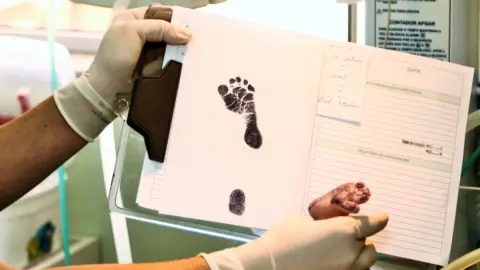
Our daughter weighed six pounds, two ounces. She had a tiny button nose and a full head of dark hair and impossibly small fingers that curled around nothing. After the nurses did the necessary checks, a nurse named Denise brought her around the drape and helped place her against my chest, skin to skin, under my gown.
For the first time in my life, I wasn’t thinking about everything people had ever said was wrong with my body. Not the cafeteria. Not the blue dress. Not the word condition.
I was thinking about what my body had done. It had carried my daughter. All the way. Thirty-eight weeks, in a torso that doctors once told my mother would never hold a baby.
“Hello, Charlotte,” I whispered.
Michael kissed my forehead. We were both crying.
I thought nothing could interrupt that moment.
I was wrong.
Less than an hour after we got to the recovery room, a nurse came in. Not Denise. A younger nurse with a clipboard and a worried face.
“Mrs. Halloran,” she said. “There’s a woman downstairs at the front desk claiming to be the baby’s grandmother.”
My heart sank. “Patricia?”
The nurse checked her clipboard. “That’s the name she gave. Patricia Halloran.”
“She’s not welcome,” Michael said, before I could speak. “We told the charge nurse when we were admitted. She’s not on the list.”
The nurse hesitated. “She says there’s been a mistake,” she said. “She’s very upset.”
Before I could ask what she meant, another nurse hurried into the room. An older woman, gray-haired, with reading glasses on a chain. She went straight to Charlotte’s bassinet beside my bed and bent over it and looked at the little plastic band on Charlotte’s ankle.
“Who brought this baby into the room?” she asked.
Michael stood up. “What do you mean?”
“Please,” the nurse said. “Nobody touch the bassinet for a moment.”
I tried to sit up. Pain shot through my abdomen, across the incision, and I gasped. “What’s happening?” I said. “That’s my daughter!”
The gray-haired nurse turned to me. Her face was calm, but her voice was careful. She said she was the charge nurse, and she needed to verify a discrepancy in Charlotte’s identification record. Somebody had flagged something in the system. She said it was probably nothing. She said they had to check.
Then shouting erupted in the hallway.
“I am her grandmother! You can’t keep me out! I have a right to see her!”
Patricia.
Michael moved toward the door. The charge nurse put her hand on his arm and asked him, very gently, to stay where he was, by the bassinet, until they’d checked.
Another staff member arrived with a laptop and a folder of delivery records. Two of them stood over Charlotte’s bassinet and checked her ankle band against my wristband and against Michael’s, number by number, and against the record from the operating room. It took four minutes. The longest four minutes of my life.
One number had been typed in wrong, in a transfer record when Charlotte went from the OR to the nursery for her first checkup and back again. A single digit. The bands themselves had never been off her. Charlotte had been with her care team the whole time.
The identification bands matched. She was our daughter.
I started crying from relief. Michael leaned over the bed and held me, carefully, around the incision.
“I’m so sorry we frightened you,” the charge nurse said. “It was a typing error. But we have to make sure. Every time.”
Out in the hallway, Patricia’s voice rose again. “Michael! Michael, tell them I have a right to see my granddaughter!”
Michael looked at me.
I didn’t want Patricia anywhere near Charlotte. But I wanted to know why she’d come. Why she’d shown up an hour after the birth, when we hadn’t spoken in two months.
“Talk to her outside,” I said. “Don’t let her in here.”
Chapter Eight: Anna
Through the door, I heard my husband confront his mother.
“How did you know we were here?”
“Margaret mentioned Sarah was due this week,” Patricia said. Her voice was shaking. “I’ve been calling the hospital every morning. Asking if a baby girl named Halloran had been born. They wouldn’t tell me anything. But this morning the woman at the desk said congratulations.”
“Why did you come?”
“I thought,” Patricia said, and then stopped. “I thought you might need help making arrangements.”
“What arrangements?”
A long pause.
“For Charlotte,” Patricia said.
Michael’s voice sharpened. I’d never heard him sound like that. “Mom,” he said. “What have you done?”
Patricia began speaking very quickly, like she’d been holding it in for months. She’d prepared a nursery at her house in Upper Arlington. In Michael’s old bedroom. She’d painted it pink. She’d bought a crib, a dresser, clothes, bottles, formula, a car seat, everything a newborn needed. She’d told her sister Margaret, and her friends from church, and her bridge club, that she expected to be Charlotte’s primary caregiver. That her daughter-in-law wasn’t physically able, and that she’d be taking the baby home.
I stared at the door from my hospital bed.
The check. The warning. Then don’t say I didn’t warn you. The way she’d stood in Charlotte’s nursery with her finger on the crib rail and said people get attached to plans that don’t always work out. Suddenly all of those moments meant something completely different.
Michael came back into the room. His face was pale. He sat down on the edge of the bed and took my hand.
“Sarah,” he said quietly. “Mom wasn’t planning to give Charlotte to another family.”
“What?”
“She wanted to take her home herself,” he said. “She thought if she offered you enough money, you’d leave the baby here and walk away. And she’d come pick her up.”
My mouth went dry. I looked over at Charlotte’s bassinet, at my daughter asleep in her little striped hospital blanket.
“She wanted my daughter,” I said.
Michael nodded. “She told everybody. Her sister. Her friends. She said she’d be raising her.”
“Did you know?” I asked. I had to ask.
“No,” he said. “I swear to God, Sarah, I didn’t.”
I believed him. But I couldn’t understand how Patricia had convinced herself that we’d agree. That I’d take a check and walk out of a hospital without my child.
“Why would she think this was right?” I said.
Michael shook his head. “She keeps saying she knows what’s best. That’s all she’ll say.”
I wanted her gone. But another question kept pulling at me, even through the pain and the exhaustion. Why was she so certain? Why was a sixty-eight-year-old retired school secretary, who’d never once shown me any warmth, so absolutely sure that separating a mother from her baby was the right thing to do?
Patricia was still waiting outside. I could hear her crying.
“Bring her to the doorway,” I told Michael. “With a nurse right there. She doesn’t come in. But I want to hear it from her.”
Michael went out. When he came back, Patricia was with him. She stopped in the doorway, with the gray-haired charge nurse standing right beside her, and she didn’t come a single step farther. She looked smaller than I’d ever seen her. Her eyes went straight past me to the bassinet.
“Is Charlotte all right?” she asked.
“She’s fine,” I said. “And she’s staying with us.”
Patricia looked away. “I never meant to upset you,” she said.
“You offered me a hundred thousand dollars to abandon my daughter,” I said.
“I wanted her to have stability.”
“With you?”
She didn’t answer.
“Why, Patricia?” I asked.
Her eyes filled with tears. “You don’t understand what can happen,” she said, “to a child who’s different.”
I stared at her from my hospital bed. Three feet eight inches tall, with a six-inch incision across my belly and a daughter who might, or might not, grow up to be three feet eight inches tall too.
“I understand better than you think,” I said.
She shook her head slowly. “No,” she said. “You don’t understand what it does to a mother.”
Michael stepped closer to her. “Mom,” he said. “What are you talking about?”
Patricia looked at her son for a long, long moment. Then she whispered something that made the whole room go still.
“You weren’t my first child, Michael.”
He went completely still. “What?”
“Before you were born,” Patricia said, “I had a little girl.”
Her name was Anna. Patricia told us standing in that hospital doorway, with the nurse beside her, in a voice so quiet I had to strain to hear it. She was born in February 1978, at Riverside Methodist Hospital in Columbus. Patricia was twenty-two. Anna was born with achondroplasia.
“Your father’s family reacted very badly,” Patricia said to Michael. “His mother came to the hospital and looked at her and said she’d never have a normal life. She said she’d be a burden. She said people would laugh at her.” Patricia’s voice broke. “And Gerald listened to his mother. He always did. They convinced me she’d suffer. That I wasn’t equipped to raise a child like that. That she’d be better off with a family who knew how.”
“So you gave her up,” Michael said. His voice sounded far away.
“There was a Catholic agency in Columbus,” Patricia said. “They found a family. In Dayton, I think. I signed the papers when she was nine days old.” She put her hand over her mouth. “I held her for nine days, Michael. And then I signed the papers.”
Michael stared at her. “You had a daughter,” he said. “I have a sister. And you never told me.”
“I couldn’t,” Patricia whispered.
She wiped her cheeks with her fingers.
“I spent forty-seven years telling myself I’d given her a better life,” she said.
I looked over at Charlotte, asleep in her bassinet. Then back at Patricia in the doorway.
“Do you know what happened to Anna?” I asked.
Patricia shook her head. “I received one letter from the agency,” she said. “When she was a year old. It said she was healthy and happy and her family loved her. After that, nothing.” Her voice broke completely. “I don’t even know if she’s alive.”
For a long moment, nobody in that room spoke.
I felt sorrow for the frightened young woman Patricia had once been. Twenty-two years old in a hospital bed, with her mother-in-law standing over her newborn saying the word burden. But I also felt anger. Hot and clear.
“You tried to make me do what you did,” I said.
Patricia looked down at the floor.
“I thought you’d understand eventually,” she said.
“Understand what?”
“That love doesn’t always mean keeping a child.”
I took a breath. “Sometimes that’s true,” I said. “Sometimes letting a child go is the most loving thing a mother can do. But that has to be her choice. You never asked what I wanted. You never asked what Charlotte needed. You just decided.”
Patricia started crying harder.
“When I saw you pregnant,” she said, “all I could think about was Anna. Everyone told me she’d be miserable because she was different. Everyone. The doctors. Gerald’s mother. The priest.”
“And seeing me happy,” I said slowly, “made you question them.”
She didn’t answer.
I understood then. Patricia had spent forty-seven years defending a decision she’d made at twenty-two, when she was frightened and alone. And then her son married a woman with dwarfism. A woman with a career and a home and a husband who loved her. A woman who was happy. If I could raise Charlotte with love, then maybe Anna could have been raised with love too. Maybe Patricia had given her baby away for nothing.
That possibility was more painful than Patricia could bear to face. So she’d tried to make me repeat her choice. Because if I gave Charlotte up too, then it would mean she’d been right.
Michael was staring at his mother.
“Did Dad know?” he asked. “About Anna?”
“Of course,” Patricia said.
“And he never told me either?”
“We agreed not to discuss it,” she said. “Ever. Not with anybody.”
Michael shook his head slowly. “I grew up thinking I was your only child,” he said. “Forty-five years.”
Patricia reached toward him from the doorway. “Michael, please.”
He stepped back.
“You should have told me,” he said.
“I was ashamed,” Patricia whispered.
“I understand that you’re hurting, Mom,” Michael said. His voice was steady now. “I do. But you tried to take my daughter away from her mother.”
Patricia began sobbing. “I only wanted to protect her,” she said.
“No,” Michael said. “You wanted to feel certain that what happened to Anna had to happen.” He looked at her. “Charlotte isn’t Anna. Sarah isn’t you. And you don’t get to decide our daughter’s future.”
Patricia looked past him at me. “Can I at least see her?” she asked. “Just for a moment?”
I shook my head. “Not today,” I said.
For once, Patricia didn’t argue. She turned around and walked down the hallway, slowly, with the charge nurse walking beside her. We heard the elevator ding. Then she was gone.
Chapter Nine: Fifty Percent
The days that followed were exhausting.
I was recovering from major surgery in a body that wasn’t designed for it. Learning to nurse Charlotte, which took three days and two lactation consultants and a special pillow. Sleeping in ninety-minute stretches. Michael helped with everything. He changed every diaper for the first week. He walked the halls with Charlotte at three in the morning so I could sleep. He learned to swaddle her from a YouTube video and practiced on a stuffed bear until he could do it in the dark.
On the third day, the pediatrician came in to talk to us. Dr. Hassan, a young man with gentle hands. He sat down in the chair by my bed with Charlotte’s chart in his lap.
“I’d like to talk to you about the genetic screening,” he said. “You know there was a fifty percent chance.”
“We know,” Michael said.
Dr. Hassan nodded. “Her X-rays and her features are consistent,” he said. “We’d like to do the genetic test to confirm. But I’m fairly certain. Charlotte has achondroplasia.”
Michael reached over and took my hand. I felt it, the thing I’d been afraid of feeling. Not grief. Something else. Something like a door swinging open onto a long hallway I’d already walked down myself.
Dr. Hassan explained what it meant. Regular checkups to watch her spine and her breathing. A specialist at Nationwide Children’s Hospital. A CT scan of the base of her skull in her first year, because some babies with achondroplasia have narrowing there that needs watching. He said that most children with achondroplasia grow up to live full, healthy, ordinary lives. He looked at me when he said it.
“I suspect you already know that better than I do,” he said.
After he left, Michael and I sat there in the quiet hospital room. Charlotte was asleep on my chest, a tiny warm weight. Her hands were curled up against her cheek. I looked down at her fingers. Short, like mine. Her little legs, folded up under her. Like mine.
“Are you okay?” Michael asked quietly.
I thought about it for a long time.
“I’m thinking about my mother,” I said. “The day I was born. A nurse told her I’d never ride a bike, never drive a car, never have a family. She went home and cried for a week.” I looked down at Charlotte. “Then she went to the library and checked out every book about dwarfism they had. And she found Little People of America. And she took me to my first convention when I was four.”
Michael didn’t say anything. He just listened.
“I’m not crying for a week,” I said. “I already know everything those books said. I’m the book.”
I looked up at my husband.
“She’s going to have people stare at her,” I said. “Kids will be cruel. Some boy will probably ask her to prom on a dare. I can’t stop all of that.” I swallowed. “But she’s never going to wonder if her own family wants her. Not for one day of her life.”
Michael leaned down and kissed the top of Charlotte’s dark head. Then he kissed mine.
“Not for one day,” he said.
When we brought Charlotte home, Michael carried her through the front door in her car seat. I followed slowly, holding the railing, one step at a time. He carried her down the hall to the pale yellow nursery and lifted her out and placed her in the crib he’d built.
She opened her eyes, stretched her short arms over her head, yawned enormously, and fell asleep again.
I laughed out loud. After everything, that ordinary moment felt extraordinary.
Patricia sent a letter two weeks later.
It came in the mail in a plain envelope with her return address. Michael brought it in from the mailbox and stood in the kitchen holding it for a long time before he opened it. Three pages, in her neat handwriting.
She apologized for the check. She apologized for the nursery in her house, and for telling her friends and her sister that she’d be raising Charlotte. She said she’d been wrong. Completely wrong. She said she’d taken the crib apart and given everything to a women’s shelter in Columbus.
Then she wrote about Anna.
She wrote about the nine days she held her. About the way Anna had grabbed her finger and wouldn’t let go. About the morning she signed the papers, with Gerald’s mother waiting in the hallway. About walking out of Riverside Methodist Hospital with empty arms and getting into the car and Gerald saying, We’ll have another one, Pat. A normal one.
And then, for the first time, she wrote: I don’t know anymore whether giving my daughter away was the right decision. I think I’ve known for a very long time that it wasn’t. I just couldn’t say it. When I saw Sarah pregnant and happy, I couldn’t stand it. I’m so sorry.
Michael read the letter twice. Then he handed it to me and asked what I thought.
“I think she’s finally beginning to face what happened,” I said.
“Does that mean we should let her visit?”
I thought about it. “Not yet,” I said.
He nodded. Patricia’s pain deserved compassion. I believed that. But compassion didn’t require us to pretend she hadn’t slid a hundred-thousand-dollar check across her dining table and told me to leave my baby at the hospital. If she ever became part of Charlotte’s life, it would be because she’d learned to respect us as Charlotte’s parents. Not because she was lonely, or guilty. And certainly not because she’d offered money.
Chapter Ten: The Search
Michael started looking for Anna in October, when Charlotte was two months old.
He didn’t tell me at first. I found out because a little box arrived in the mail from Ancestry, a DNA kit, and he spit in the tube at the kitchen table one Saturday morning while I was nursing Charlotte and sent it off.
“I have a sister,” he said, sealing the envelope. “Somewhere. I want to know if she’s alive.”
I thought about telling him to wait. That it might not work. That she might not want to be found. But I looked at his face, and I didn’t say any of that.
“Then find her,” I said.
He did his research the way he designs bridges. Carefully. He learned that Ohio had passed a law in 2015 opening adoption records for people adopted between 1964 and 1996. Adoptees from those years could request their original birth certificates from the Ohio Department of Health, the one with their birth mother’s name on it. Birth parents could also file a form saying whether they wanted to be contacted. Michael called the Department of Health and asked if Patricia had ever filed one. They said they couldn’t tell him that.
He asked his mother. She said no. She’d never filed anything. She said she’d been too afraid.
The DNA results came back in December, a week before Christmas. Michael was at work when the email came. He called me from his truck, in the parking lot of a bridge site on Route 33, and his voice was shaking.
“There’s a match,” he said. “A close one. Half-sibling. Her name is Anna Reyes. She’s in Dayton.”
I sat down on the kitchen floor with Charlotte in my lap.
“She’s alive,” Michael said. “Sarah. She’s alive.”
Anna Reyes had taken a DNA test four years earlier, he found out. She’d uploaded her results looking for biological relatives. She’d written a short note in her profile, visible to matches. Michael read it to me over the phone that night, standing in the nursery with Charlotte asleep in his arms.
I was adopted at nine days old from Catholic Social Services in Columbus. I have achondroplasia. I’ve known my birth mother’s name since 2016 but have never contacted her. If you’re family and you’d like to talk, I’d be glad to hear from you. If you’d rather not, I understand that too.
Michael wrote to her that night. It took him three hours and he deleted it six times. In the end, it was only a few lines. He said his name. He said he was her brother. He said he hadn’t known she existed until four months ago. He said he had a newborn daughter with achondroplasia, and a wife with achondroplasia, and he’d very much like to meet her, if she was willing.
She wrote back in forty minutes.
Chapter Eleven: Dayton
We met Anna Reyes on a Saturday in January, at a coffee shop in Kettering, outside Dayton. Michael and Charlotte and me. Patricia didn’t know yet. We’d decided, Michael and I, that this first meeting would be just us. Anna had asked for that too.
She was already there when we came in, sitting at a low table by the window. I saw her before Michael did. Because she was my height. Exactly my height. Three foot nine, she told me later. One inch taller than me. She stood up when she saw us come in, and she looked at Michael for a long time, and he looked at her, and I watched two people who’d never met see their own faces across a room.
She had his eyes. Brown and kind, behind glasses. She had his jaw. She was forty-seven years old, with short gray-brown hair and a navy fleece and a lanyard around her neck from a pediatric therapy clinic.
“Michael,” she said.
“Anna,” he said.
He didn’t know what to do. I watched him not know. He’s six foot one, and she’s three foot nine, and he stood there in the doorway of that coffee shop with his hands at his sides. Then he got down on one knee, right there on the floor in front of everybody, so they were eye to eye. The way he’d knelt by the rocking chair for me. And he held out his arms.
Anna walked into them. My husband held his sister for the first time in his life in the middle of a coffee shop in Kettering, Ohio, and they both cried, and the barista came out from behind the counter with a box of napkins and set it on the table without a word.
We talked for four hours.
Anna was raised in Dayton by a couple named Luis and Margaret Reyes. Luis was a machinist at the General Motors plant in Moraine, and Margaret was a nurse. They’d been trying to have a baby for eleven years when Catholic Social Services called them in February 1978 and said there was a little girl with dwarfism, and some families had said no.
“My mother told me they said yes before the woman finished the sentence,” Anna said. “She said they drove to Columbus that same afternoon.”
Luis and Margaret found Little People of America when she was two. They took her to conventions every summer. They had the kitchen counters lowered and the light switches moved. Her father built her step stools for every room in the house. When kids at school were cruel, her mother went to the principal’s office and didn’t leave until something changed.
Anna became an occupational therapist. She works at Dayton Children’s Hospital, with kids who have skeletal dysplasias. Kids like Charlotte. She married a man named Tom, a high school history teacher, average height, and they have a son, Gabriel, who’s nineteen and studying engineering at the University of Cincinnati. He’s average height too.
“I’ve known Patricia’s name for nine years,” Anna said quietly, holding her coffee cup in both hands. “Since I got my original birth certificate. Patricia Ann Halloran, age twenty-two. I looked her up. I found her address in Upper Arlington. I drove past her house twice.” She looked out the window. “I never stopped. I always thought, she gave me away because I was little. Why would she want to see me now?”
Michael didn’t say anything.
“My mother died three years ago,” Anna said. “Margaret Reyes. Before she died, she told me something. She said, Annie, whoever your birth mother is, she didn’t give you away because of you. Nobody looks at a nine-day-old baby and decides it isn’t worth loving. Something happened to her. Something somebody told her.” Anna’s eyes filled. “I never believed it. Until your message.”
I’d been holding Charlotte the whole time. She woke up then, the way babies do, all at once, and looked around the coffee shop with her big dark eyes. Anna looked at her.
“Can I hold her?” she asked.
I handed Charlotte across the little table. Anna took her in her short arms, exactly the way I do, settling her into the crook of her elbow, supporting her head the way you have to with our babies. She looked down at her for a long time.
“Hello, Charlotte,” she said softly. “I’m your aunt. And I’m going to teach you how to reach everything.”
Chapter Twelve: Nine Days
Patricia met Anna in March.
Michael told her about the DNA match in February, sitting at her kitchen table in Upper Arlington. He went alone. When he came home, he said his mother had sat there for twenty minutes without saying anything, and then she’d gone into her bedroom and come back with a little box. Inside it was a hospital bracelet, the old plastic kind, yellowed with age. A tiny one. Baby Girl Halloran. February 11, 1978.
“She kept it,” Michael said. “Forty-seven years. In her jewelry box.”
Anna agreed to meet her. On one condition. That it happen at our house. With Michael and me there. With Charlotte there.
“I want her to see it,” Anna told me on the phone. “I want her to see you holding your daughter. And I want her to see me holding mine.” She paused. “Not to punish her. I think she needs to see it. I think it’s the only thing that will help her.”
Patricia came on a Sunday afternoon. She stood on our front porch in her good wool coat for a long time before she knocked. Michael opened the door.
Anna was standing in our living room. She’d driven up from Dayton with her husband, Tom. She was wearing a blue dress. She stood in the middle of the room, three foot nine, with her hands folded in front of her.
Patricia came through the door and saw her and stopped. She put her hand on the doorframe to hold herself up.
Neither of them said anything for a very long time.
Then Patricia said, in a voice I’d never heard her use, “You held my finger. For nine days. You wouldn’t let go.”
Anna looked at her.
“I didn’t let go,” Anna said. “You did.”
Patricia’s face crumpled. She stood in our doorway and covered her face with both hands and cried, standing up, the way people cry when they’ve been holding it for a lifetime.
Anna let her cry. She didn’t move toward her. She didn’t move away. She just stood there in the middle of our living room and let her birth mother cry for forty-seven years.
Then, when Patricia finally lowered her hands, Anna said, “They told you I’d be a burden.”
Patricia nodded. She couldn’t speak.
“I’m an occupational therapist at Dayton Children’s,” Anna said. “I’ve worked with three hundred kids like Charlotte. I’ve been married twenty-four years. I have a son in engineering school. My parents loved me every day of their lives.” She took a breath. “I wasn’t a burden, Patricia. I was a little girl. That’s all I ever was.”
Patricia looked past her then. At me, sitting in the rocking chair by the window with Charlotte in my lap. Seven months old now. Awake and alert and gnawing on a teething ring shaped like a giraffe.
“May I?” Patricia whispered. To me. Not to Michael. To me.
I looked at her for a long moment. At this woman who’d slid a check across her dining table and told me to leave my daughter at the hospital. Who’d painted a nursery pink in her own house. Who’d held another baby’s finger for nine days and then signed the papers.
Then I looked at Anna, standing in the middle of my living room. Anna nodded at me. Just slightly.
“You can sit beside me,” I said to Patricia. “And you can hold her hand. That’s all, for today.”
Patricia crossed our living room slowly and knelt down on the floor beside my rocking chair. Her knees cracked. She was sixty-nine years old. She knelt there on my rug beside me, so she was looking up at Charlotte and me instead of down.
She held out one finger.
Charlotte looked at it. Then she dropped her giraffe and reached out with her short, chubby hand and wrapped her fingers around Patricia’s finger. And held on.
Patricia didn’t make a sound. She just knelt there on my floor with my daughter holding her finger, and tears ran down her face and dripped off her chin onto her good wool coat.
Anna came and stood beside her. After a while, she put her hand on Patricia’s shoulder.
That was a year and a half ago.
Patricia comes to dinner on the first Sunday of every month now. Not every Sunday. The first one. That was my condition, and she accepted it without arguing. She calls me before she buys Charlotte anything, and asks first. Last Christmas she asked if she could buy Charlotte a little wooden step stool. She’d found a woodworker in Hilliard who made them. It has Charlotte’s name painted on it in yellow.
She tore up the check. She told me so at dinner one Sunday. She’d kept it in her desk drawer for months after the hospital, she said, folded in its envelope. One night in the winter she took it out and tore it into tiny pieces and burned them in her fireplace. Then she called the Little People of America office in California and donated a hundred thousand dollars to their scholarship fund, in Anna’s name. Anna Halloran Reyes Scholarship, for college students with dwarfism.
She told Anna about it after it was done. Anna cried for a long time. Then she said, “My mother would’ve liked that.” She meant Margaret Reyes.
Patricia said, “I know. I hope she would.”
Anna drives up from Dayton every few weeks. She’s teaching Charlotte, who’s two now and walking and getting into everything, how to climb onto chairs and reach the bathroom sink and get her own cup out of the low cabinet Michael built. She brings her son Gabriel sometimes. He’s six foot two and carries Charlotte on his shoulders around our backyard, and she screams with happiness at being taller than everybody.
People still stare at us in restaurants. They always will. A table of three generations, three of us under four feet tall and two of us over six. Last month at a Bob Evans in Hilliard, a little boy at the next table pointed at Charlotte and asked his mother, loudly, “Why is that baby so small?”
Before his mother could hush him, Patricia turned around in her chair. Sixty-nine years old, in her good cardigan, with her reading glasses on their chain.
“Because she’s exactly the size she’s supposed to be,” Patricia said. “Just like you.”
The boy thought about that. Then he waved at Charlotte. Charlotte waved back.
I sat there across the table and looked at my mother-in-law for a long moment. She didn’t look at me. She turned back around and picked up her fork, and her hand was shaking a little.
So people sometimes ask me, when they hear the story, whether I’d have let Patricia back into Charlotte’s life after what she did. Whether I’d have cut her off forever.
I tell them the truth. I didn’t let her back in because she was sorry. Lots of people are sorry. I let her back in, one Sunday a month and one finger at a time, because she finally told the truth about what she’d done to her own daughter. And because that daughter stood in my living room and decided, on her own, to let her mother kneel on the floor.
Anna gave Patricia a second chance. That wasn’t mine to take from either of them.
But Charlotte’s first chance belongs to me and Michael. And she’s never once had to wonder whether her own family wants her. Not for a single day.
Last night, I sat in her room with her asleep in my lap. She’s getting too big to rock, and I’ll miss it. I looked at her face, her dark hair, her short strong fingers curled around the ear of a stuffed giraffe. And I thought about what I want her to know, when she’s old enough. When some boy asks her to prom on a dare. When some stranger in a restaurant says the word condition.
That she was loved, from the very first minute. That her body belongs to her. That being different will never make her less deserving of anything.
And that once, when she was seven months old, she reached out and held on to the finger of a woman who’d been afraid of little girls like her for forty-seven years. And she didn’t let go.
I kissed her forehead.
“You don’t have to prove anything to anyone, sweetheart,” I whispered.
She stirred and murmured something and settled back against me. And I sat there in the pale yellow nursery Michael painted, holding the daughter someone once tried to buy from me, and knew there was no amount of money in the world that could have made me walk away.