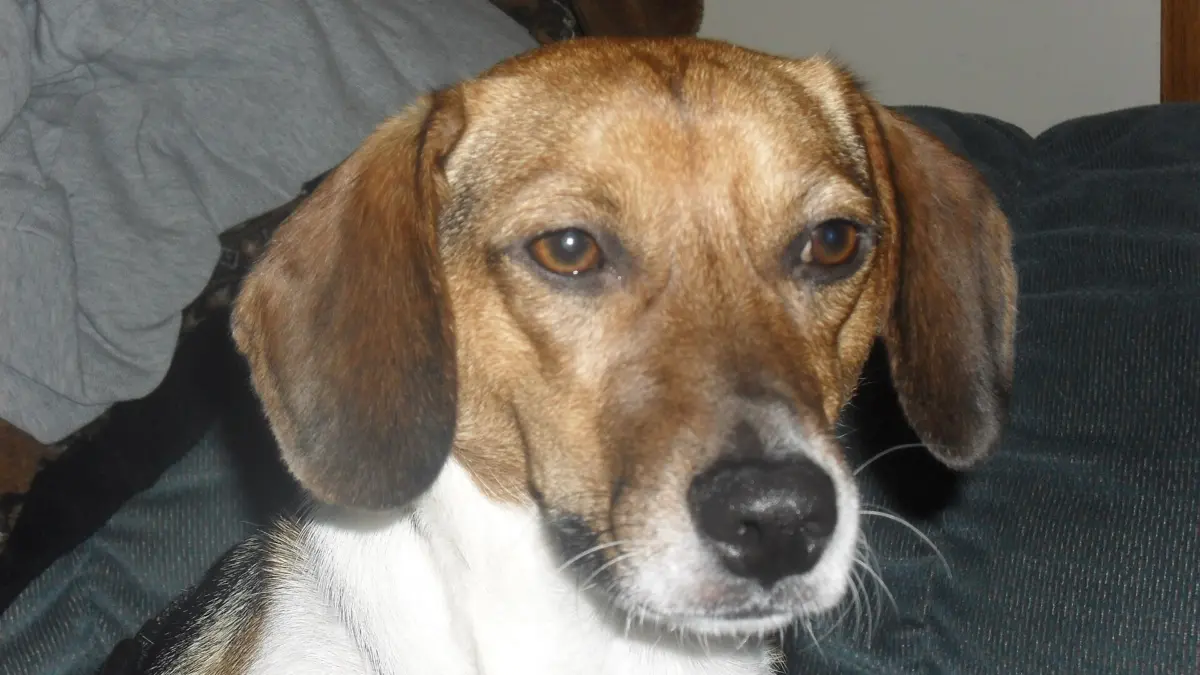
Ruby has one brown eye and one blue eye, and an underbite so bad her bottom teeth stick out over her top lip like a bulldog’s. She’s about the size of a beagle, with a beagle’s ears, and a basset hound’s long back and short crooked legs, and gray wiry whiskers on her chin like an old man who forgot to shave. Her tail curls up over her back like a pig’s. Her coat is about four different colors, none of which match. When she runs, her ears flap and her back end goes a little sideways, like a shopping cart with a bad wheel.
I got her from the Cass County animal shelter in Harrisonville, Missouri, four years ago, for a forty-dollar adoption fee. She’d been there for seven months. The girl at the front desk told me they’d had her on the website the whole time and nobody had ever even asked about her. Not once. People would walk right past her kennel to look at the puppies.
I walked past her too, the first time. I’m not going to lie. I’d gone in to look at a little white poodle mix, because my husband Dale had just passed and the house was too quiet and I thought a little white dog would be nice to have on my lap. But the poodle mix had already been adopted that morning. On my way out, I passed the last kennel at the end of the row, and this strange-looking dog was sitting there, very straight, with her funny crooked legs tucked under her, looking at me with her two different eyes.
She didn’t bark. She didn’t jump. She just looked at me. Like she’d been waiting.
I went home without her. I came back the next day and got her. I couldn’t stop thinking about the way she looked at me.
I named her Ruby, after my grandmother, who was also not much to look at and was also the best person I ever knew.
I’ve been a hairdresser in Harrisonville for thirty-eight years. I have my own shop on Pearl Street, just off the square, called Patti’s Hair Affair. That’s me, Patti. Two chairs, two dryers, a shampoo sink, and a coffee pot that’s been running since 1988. I do mostly older ladies. Wash and sets, perms, color, the occasional haircut for a husband who gets dragged in. My regulars have been coming to me for decades. Some of them, I’ve done their hair for their weddings and their daughters’ weddings and their husbands’ funerals. You get close to people when you have your hands in their hair every week.
Ruby comes to work with me every day. She has a bed under the second dryer, by the window, where the sun comes in. My ladies love her. Most of them, anyway. They bring her treats in their purses. Mrs. Gutierrez knits her sweaters. Old Mrs. Ballard, who’s ninety-three, saves the bacon from her breakfast every Tuesday and brings it in a sandwich bag.
The one lady who doesn’t love Ruby is my ex-mother-in-law.
Her name is Loretta Mayfield. She’s eighty-four years old. She’s been the organist at First Baptist for fifty-two years, and she’s been getting her hair done at my shop every Friday at nine a.m. for longer than that, since back when it was Doris’s shop and I was the girl who swept up. When I married her son Ronnie in 1987, Loretta told Doris she’d only let me do her hair if I could get it to hold through Sunday service. I did. I’ve been doing it ever since.
Ronnie and I divorced in 2011. He had a girlfriend in Belton, the second one I knew about. I put up with the first one. I didn’t put up with the second. Loretta never forgave me. Not him, me. As far as Loretta was concerned, a wife who couldn’t keep her husband home had nobody to blame but herself, and a wife who divorced a Mayfield was the lowest thing on God’s earth.
But she kept coming to my shop. Every Friday, nine a.m. sharp. For fifteen years after the divorce. Because nobody else in Cass County could do her hair the way she liked it.
Loretta’s hair is the same hair she’s had since 1968. A silver bouffant, teased high on top, smooth on the sides, with a little flip at the bottom, and so much hairspray you could bounce a quarter off it. She uses one kind of hairspray. The gold can, extra hold, unscented, the one they don’t even sell at Walmart anymore. I order it special from a beauty supply in Kansas City by the case, just for her. She won’t let me use anything else. And she wears one perfume, a lily-of-the-valley cologne that comes in a green bottle, which she splashes on her neck right before she leaves the shop every Friday. Between the hairspray and the cologne, you can smell Loretta Mayfield coming from across the square.
She pays eighteen dollars for a wash and set. The price was eighteen dollars in 1999, and she has never once agreed that it went up. My price now is thirty-two. She pays eighteen, exact change, and she has never tipped me one penny in thirty-eight years. When I raised my prices in 2015, she said, “I’m family, Patti.” I said, “Loretta, you told the whole church I’m not family anymore.” She said, “Well, I’m practically family,” and put eighteen dollars on the counter.
I let it go. Every week, I let it go. You do a lot of letting go in my line of work.
Then I got Ruby. And Loretta found something new to complain about.
“What is that?” she said, the first Friday Ruby came to work with me. She stood in my doorway in her church coat and stared at Ruby under the dryer.
“That’s Ruby. My new dog.”
“That’s a dog?”
“She’s a mix.”
“She’s a mess, is what she is.” Loretta sniffed. “Patti, that is the ugliest dog I have ever seen in my life. That is the ugliest dog in Cass County. Where did you get it?”
“The shelter.”
“Well, I can see why they gave it away.”
And every Friday after that, for four years, it was something. That dog smells. That dog has fleas, I know it does. That dog is staring at me. Get that dog away from my purse. She told her whole Sunday school class I’d adopted a dog that looked like a possum that got hit by a truck. She told the pastor’s wife. She told my other ladies, right there in my shop, while she was under the dryer. “Patti’s got herself a new man,” she’d say, and point at Ruby. “It’s about her speed.”
And Ruby? Ruby loved her. That’s the thing I could never understand. Of all my ladies, Loretta was the one Ruby wanted most. As soon as Loretta sat down in my chair, Ruby would get up from her bed and go lie down right next to her feet, with her chin on the toe of Loretta’s church shoe. Loretta would kick at her. Ruby would move back about six inches, and then a few minutes later, she’d creep back and put her chin on that shoe again.
“Why does it keep doing that?” Loretta would say.
“She likes you.”
“Well, I don’t like her.”
“She doesn’t seem to care.”
Then last March, Loretta made me put Ruby out.
It was a Friday, of course. Loretta was in my chair, I was halfway through her set, and Ruby got up from under the dryer and came and lay down on Loretta’s foot like always. And Loretta stood up out of my chair with half her rollers in and said, “That’s it. That’s it, Patti. Either that dog goes outside or I do.”
“Loretta, sit down. She’s not hurting anything.”
“She smells like a feedlot. I’m not paying good money to sit here with that animal slobbering on my shoes.”
“You’re paying eighteen dollars,” I said.
The whole shop went quiet. Mrs. Gutierrez was under the other dryer and she lifted the hood up so she could hear better.
Loretta looked at me. Her face went red under all that face powder.
“Put that ugly dog out in the parking lot,” she said, “or I’ll take my business to Belton. And don’t think I won’t tell everybody at church why.”
I should have let her go. I know that now. But I’d been doing that woman’s hair since I was twenty-three years old. I think a part of me still wanted her to like me. So I took Ruby’s leash off the hook, and I took her out to my car in the parking lot, and I cracked the windows, and I left her there for the hour Loretta was in my shop. Ruby sat in the driver’s seat the whole time, looking at me through the window with her two different eyes.
When Loretta left, she put eighteen dollars on the counter, exact change. She splashed on her lily-of-the-valley at the door like always. She said, “Same time next week,” and went out.
I went out to the car and sat with Ruby for a while. I told her I was sorry.
That was the last Friday in March.
The tornado came on April ninth.
It was a Wednesday. The sirens went off at about seven-forty in the evening. It had been warm and sticky all day, that kind of spring weather in Missouri where you can feel something coming. The TV weatherman out of Kansas City had been talking about it since noon. When the sirens went, I took Ruby down to my basement and we sat on the old couch down there with a flashlight and the weather radio. I could hear it go over, off to the south. It sounded like a freight train, the way everybody always says. The house shook. The lights went out. Then it was gone.
It didn’t hit town. It came down out of the sky about four miles southeast, out in the country, and it went right across Peculiar Road and up through the bottoms along the creek. It was on the ground for eleven miles. They called it an EF3 the next day.
My phone rang at eight-fifteen. It was my daughter Amber, who lives in Raymore.
“Mom,” she said. “Mom, it hit Grandma Loretta’s.”
Ronnie and I have one daughter. Amber. She’s thirty-six. She never stopped loving her grandmother, which I always thought was to her credit. Loretta was a different woman with Amber. Softer. Amber called her every Sunday night.
“Hit it how?”
“It’s gone, Mom. Dad just called me. The house is gone. Dad’s out there and he can’t find her. He says it’s just—it’s just gone.”
Loretta lived alone on her family’s place on Old Peculiar Road, in the farmhouse her granddaddy built in 1912. Eighty acres of pasture and timber along a creek. She refused to move to town after her husband died. Ronnie had begged her. I’d heard him beg her, years ago, before the divorce. She said she’d been born in that house and she’d die in it.
“I’m coming,” I said.
I don’t know why I said it. I just said it. I grabbed my keys. And Ruby was already standing at the door.
I almost didn’t take her. Then I did. I don’t know why I did that either. I keep telling people that. I don’t know why. Something just told me to.
The roads were a mess. There were limbs down everywhere, and power lines, and I had to go around twice. It was full dark by the time I got out to Old Peculiar Road. There were emergency lights everywhere. Fire trucks, sheriff’s cars, an ambulance, a bunch of pickups with their headlights on. The rain had started again, a cold steady rain.
And where Loretta’s house had been, there was nothing.
I mean nothing. I’d been in that house a hundred times. Christmases, Thanksgivings, Amber’s birthday parties when she was little. It was a big white two-story farmhouse with a wraparound porch and green shutters. Now there was just a pile. A huge pile of boards and shingles and broken glass and pink insulation and furniture, all mashed together and spread across the yard like somebody had dropped it from the sky. A bathtub was sitting upside down in the middle of the driveway. Loretta’s car was on its side against a tree.
There were men climbing on the pile with flashlights, calling her name. Loretta! Loretta! Mrs. Mayfield! And then stopping and listening. Then calling again.
Ronnie was out there on the pile. I saw him in the headlights. He was in his good work boots and no raincoat, and he was soaked, and he was pulling boards off the pile with his bare hands and throwing them behind him, one after another, and shouting, “Mama! Mama!”
Amber got there right after I did. She ran up to me and threw her arms around me and we stood there in the rain.
A sheriff’s deputy came over. I knew him. I cut his hair. Jason Kemper.
“Patti,” he said. “Amber. I’m so sorry.”
“Is she in there?”
“We think so. Her car’s here. Her phone was going to voicemail when Ronnie called at seven-thirty, before it hit. We think she was home.” He looked at the pile. “We’ve got the fire department and every volunteer in the county coming. But it’s a big pile, Patti. And it’s dark. And we don’t know where to start. If she was in the cellar, she could be anywhere under there. If she wasn’t in the cellar—” He stopped.
“Can’t you get dogs?” Amber said. “The search dogs?”
“We called. There’s a search and rescue team out of Kansas City with cadaver dogs and live-find dogs. They’re coming. But they’re working the damage over in Belton, too. It hit there first. They said two hours. Maybe more.”
Two hours. In the rain. In the cold. Under a house.
I looked at Ruby. She was sitting next to me in the wet grass, perfectly still. She had her nose up in the air, and her nostrils were moving.
I should tell you something else about Ruby. About a year after I got her, I signed us up for a class at the community college on Saturdays. Canine scent work, it was called. A nice young woman taught it who did search and rescue with her own dogs. I only signed up because the vet said Ruby was getting fat and needed something to do. You take a little tin with a cotton swab in it that’s been scented with something, birch oil or clove, and you hide it somewhere, and the dog has to find it. In a box, in a room, in a car. It’s a sport. People do it in competitions.
Ruby was the best dog in the class. The teacher said she’d never seen anything like her. She said it was the beagle in her, and the basset. She said those were two of the best noses God ever put on a dog, and Ruby had both of them on the same face. Ruby could find a scented swab inside a closed toolbox inside a car trunk in under a minute. She got a ribbon. It’s hanging on the wall in my shop, next to my license.
So I stood there in Loretta’s yard in the rain, and I looked at that pile, and I looked at Ruby with her nose in the air.
And I thought about the shop. About the gold can of hairspray. About the lily-of-the-valley. About fifteen years of Fridays, and Ruby with her chin on Loretta’s shoe every single week. Breathing her in. Every week. For four years.
“Jason,” I said. “Let me try my dog.”
He looked down at Ruby. Ruby looked up at him. In the flashing red and blue lights, with her underbite and her crooked legs and her wet mismatched fur, she looked about as much like a search dog as I look like Miss America.
“Patti,” he said gently. “That’s not a search dog.”
“She knows Loretta. She knows her smell better than anybody in this county.”
Before he could answer, Ronnie came down off the pile.
He saw me first. Then he saw Ruby. I’ll never forget his face. He was covered in mud and blood, from his hands, from pulling at the boards. He’d been crying. And when he saw me standing there with that dog, his face twisted up into something I’d never seen on him before, even at the worst of our marriage.
“What are you doing here?” he said. “What are you doing here, Patti?”
“I came to help.”
“Help? You came to help?” He laughed, a terrible laugh. “You brought that thing? That ugly mutt? Mama hated that dog! She told everybody! Get it out of here!”
“Ronnie, listen to me—”
“Get that mutt off my mother’s property!” He was screaming now. Everybody was looking. “This is not a joke! My mother is under there! Get out of here! Go home!”
Amber stepped between us. “Daddy. Stop it.”
“Stay out of this, Amber!”
“No! Mom’s trying to help! Let her try!”
“With that?” He pointed at Ruby. His hand was shaking. “With that?”
Out on the pile, somebody shouted. Everybody turned. One of the firemen had pulled a big piece of roof off, and underneath it was Loretta’s organ. The old upright she practiced on every day. It was smashed to pieces, the keys scattered everywhere like teeth.
Ronnie made a sound like he’d been punched. He sat down on the wet ground right there, with his hands over his face.
I didn’t wait anymore.
I went to my car and opened the trunk. My work bag was in there, like always. I keep a bag of supplies in the trunk for when I do house calls, for my ladies who can’t get out anymore. Combs and curlers and a blow dryer. And a can of hairspray. The gold can. Extra hold, unscented. The one I order by the case from Kansas City for one person in the whole county.
I sprayed some on my hand. Just a little. I knelt down in the wet grass and held my hand under Ruby’s nose.
“Ruby,” I said. “Find Loretta.”
That’s not a real command. They don’t teach you that in the class. In the class you say “find it,” and the dog finds the tin. But I didn’t know what else to say.
Ruby put her nose in my hand. She breathed in, a long deep snuffle, the way she does. Then she lifted her head up into the rain. And she looked at that pile with her two different eyes.
And she went.
She didn’t go fast. She went low and slow, with her nose right on the ground, zigzagging back and forth across the yard the way they do in the class. Her ears dragged in the mud. I had her on her long leash, thirty feet, and I followed behind her and let her go wherever she wanted. Jason followed behind me with his flashlight. So did Amber. Behind us I could hear Ronnie, still yelling, and then I couldn’t hear him anymore.
Ruby went past the front of the pile, where the porch used to be. She didn’t stop. She went around the east side, past the upside-down bathtub, through broken glass that I was terrified would cut her feet. She didn’t stop. She went to the back of the pile, the north side, where the kitchen had been. And there she slowed down.
She lifted her head and sniffed the air. Put her nose back down. Took three steps up onto the pile itself, picking her way across the boards on her crooked little legs. Then three more.
The firemen had stopped working. They were watching. Everybody was watching. I could feel it.
Ruby stopped on a flat piece of what used to be the kitchen floor. Linoleum, the yellow kind with the little brick pattern, that I remembered from forty Thanksgivings. She stood very still. She put her nose down into a crack between two broken boards.
And she started to dig.
She dug like I’ve never seen her dig. Like there was nothing else in the world. Her front feet going so fast they were a blur, mud and splinters flying back between her legs, and the whole time she was making a sound I’d never heard her make. A high, desperate whining. And then she stopped digging and she barked. Once. Twice. Three times. Loud and sharp, the alert bark, the one she does in class when she finds the tin.
Then she put her nose back in that crack and went still.
“There,” I said. “Jason. She’s there. She’s right there.”
Jason was already on the radio. Firemen were already running across the pile.
And then, under all of it, under the boards and the linoleum and the mud and the rain, we heard it.
A voice. Thin and far away. Like somebody talking from the bottom of a well.
“Hello? Is somebody there? I’m down here. I’m in the cellar. Hello?”
It was Loretta.
The cellar door had been in the kitchen floor, a trapdoor by the back porch, with steps going down to the old root cellar where her granddaddy kept potatoes. When the sirens went off, Loretta had gone down there with a flashlight and her Bible and a folding chair, just like she’d done every tornado warning for eighty-four years. The house came down on top of the trapdoor. The firemen said later the cellar was the only reason she was alive. All that weight came down and the old stone walls held it.
But nobody knew the cellar door was there. It was under four feet of house. They’d been digging on the other side of the pile, where the bedrooms were, because that’s where they thought she’d be at that time of night. They’d have gotten to the kitchen eventually. The fire chief told me that later. Eventually. Maybe in the morning.
It took them two hours to get her out. They had to bring in a little tractor with a grapple and lift the pieces off one at a time, carefully, so nothing would shift and fall in on her. Ruby wouldn’t leave the spot. She lay down right on that piece of yellow linoleum with her chin on her paws, the way she lies on Loretta’s shoe, and she stayed there. A fireman tried to move her and she growled at him. She’s never growled at anybody in her life.
Ronnie came up on the pile and knelt down by the crack and talked to his mother through it the whole two hours. I heard him. “Mama, we’re coming. Mama, hold on. Mama, I’m right here.” He didn’t look at me. He didn’t look at Ruby. I didn’t blame him for that.
At about ten-thirty, they lifted the last big piece of floor and pulled the trapdoor open, and two firemen went down the cellar steps with a backboard. When they brought her up, she was gray with dust and her lips were blue from the cold. She had a broken wrist and a cut on her head and she was so stiff she couldn’t stand. But she was alive, and she was holding her Bible, and she was complaining.
“Mind my hair,” she said, as they carried her up the steps. “Mind my hair, I just had it done Friday.”
The firemen laughed out loud. Everybody did. Even Ronnie.
And her hair was perfect. I want you to know that. A house fell on that woman and her hair was still standing up exactly the way I set it on Friday. I’ve never been prouder of anything in my professional life.
They put her on a stretcher and carried her down off the pile to the ambulance. Amber ran alongside, holding her good hand. And as they went past me, standing there in the rain with Ruby on her leash, Loretta turned her head and saw us.
She looked at me. And then she looked down at Ruby, all covered in mud, with her wet ears and her underbite and her crooked legs. Ruby looked back up at her with her two different eyes and wagged her pig tail.
Loretta didn’t say anything. She just looked at Ruby for a long time while they loaded her into the ambulance. Then the doors closed and they drove away.
I took Ruby home and gave her a bath in the kitchen sink and fed her a whole can of the good wet food, the kind with gravy, and she slept on my bed that night, which she’s not allowed to do. I didn’t sleep at all.
Loretta was in the hospital in Harrisonville for six days. Amber went every day. I didn’t go. I didn’t think I’d be welcome.
On the seventh day, Amber called me.
“Mom,” she said. “Grandma wants to see you.”
“Me?”
“You. And she says to bring the dog.”
“Amber, they don’t let dogs in the hospital.”
“She already talked to the nurses. She said, and I quote, ‘That dog has been in worse places than this hospital.’ They’re letting her in.”
So I took Ruby to the hospital. The nurses had put a sign on Loretta’s door that said THERAPY DOG VISIT, which made me laugh. Loretta was sitting up in her bed with her wrist in a cast and a bandage on her forehead. Her hair was flat for the first time in fifty-eight years. She looked very small and very old.
Ruby went straight to the bed and put her front paws up on the edge of the mattress and looked at her.
Loretta looked back. For a long time. Then she reached out with her good hand and put it on Ruby’s head, between those big beagle ears.
“Well,” she said. “You’re still the ugliest dog in Cass County.”
Ruby wagged her tail.
“I heard what you did,” Loretta said to her. “Jason Kemper told me. And the fire chief. And about eleven people from church.” She scratched behind one of Ruby’s ears, very gently. “They said you knew my hairspray.”
“She knew you, Loretta,” I said. “She’s been lying on your foot every Friday for four years. She knew your hairspray and your cologne and probably what you had for breakfast.”
Loretta didn’t say anything for a while. She just kept scratching Ruby’s ear.
“I made you put her in the car,” she said finally.
“You did.”
“In March. In front of everybody.”
“You did.”
“And she found me anyway.”
“She did.”
Loretta’s chin started to shake. I’d never seen that before. Not at her husband’s funeral. Not ever.
“Patti,” she said. “Ronnie’s wife says I can’t come stay with them. When I get out of here. She says they don’t have room.”
I knew Ronnie’s wife. Her name is Crystal, and they have a four-bedroom house in Belton with a pool.
“I see,” I said.
“Amber’s got the baby and that little apartment. And my house is gone. And the insurance man says it’ll be a year, maybe more, before they can build anything.”
I waited.
“I don’t know where to go,” Loretta said.
I looked at her in that bed with her flat hair. I thought about thirty-eight years of Fridays. I thought about eighteen dollars, exact change.
“I’ve got a spare room,” I said.
Loretta looked up at me.
“It’s not much. It’s got a double bed and a dresser and a window that looks out at the garden. And you’d have to put up with the dog.”
She looked at Ruby. Ruby was still standing with her paws on the bed, looking at her with that underbite.
“She sleeps on your bed?” Loretta said.
“She’s not supposed to.”
“Hm,” said Loretta.
She came home with me on April seventeenth. She’s still there. It’s been seven months now. The insurance company has paid out, mostly, after a lot of back and forth that Ronnie handles, and they’re supposed to start building her new house on the old place in the spring. A smaller one, one story, with a storm shelter. She’s picked out the floor plan. She’s picked out the shutters. Green, like the old ones.
Living with your ex-mother-in-law is about what you’d expect. She tells me how to cook. She tells me how to run my shop. She tells me my curtains are tacky and my coffee is weak and I should have married that nice boy from the bank instead of her son. She plays hymns on my old piano at six in the morning. She still calls Ruby the ugliest dog in Cass County, about once a day.
But she feeds Ruby bacon off her plate at breakfast when she thinks I’m not looking. And Ruby sleeps on the foot of her bed now, not mine. Every night. Loretta pretends she doesn’t like it. I’ve heard her talking to Ruby through the door. I won’t say what she says. That’s between them.
I still do her hair every Friday at nine. At the shop, like always. She rides in with me now.
The first Friday after she moved in, when I was done with her set, she went to the counter like always and put eighteen dollars down. Exact change.
Then she reached into her purse and took out an envelope and put it down on top of the eighteen dollars.
“What’s that?” I said.
“Your tips,” she said.
I opened it. There was a cashier’s check inside, from her bank. For two thousand, eight hundred and eighty dollars.
“Loretta, what is this?”
“Five dollars for every Friday since 2015,” she said. “When you raised your prices. I figured you were right about the eighteen dollars. I just didn’t want to say so.” She sniffed. “I’ve been keeping track. I’m not a cheapskate, Patti. I just don’t like to be told.”
I stood there holding that check. My other ladies were all looking at us. Mrs. Gutierrez lifted the hood of her dryer again.
“I don’t know what to say,” I said.
“Don’t say anything,” Loretta said. “Just don’t put it in the bank. Buy that dog a decent bed. The one under that dryer is a disgrace.”
Then she splashed on her lily-of-the-valley at the door like always, and she said, “Same time next week,” and went out to sit in the car and wait for me.
Ruby followed her out.
I bought the bed. It’s a big orthopedic one, with a memory foam cushion and a washable cover in a pattern of little pink roses. It sits under the second dryer by the window. Ruby won’t use it on Fridays, though. On Fridays she lies right where she always has. With her chin on the toe of Loretta’s church shoe.
Loretta doesn’t kick at her anymore.