My brother Doug called me on a Thursday night in October to tell me the estate sale was Saturday.
“This Saturday?” I said. “Doug, Mom’s only been gone five weeks.”
“I know how long she’s been gone, Jeanie. I was there.” He sounded tired and short, the way he always sounds when he’s already decided something and doesn’t want to hear about it. “Sheryl found a company out of Des Moines that does the whole thing. They come in, they price everything, they run the sale, they haul off what’s left. They take thirty percent. It’s the only way to get the house cleaned out before winter. The realtor wants it listed by the first of November.”
“I wanted to go through her things.”
“So come Saturday.”
“I work Saturday. You know I work Saturday.”
“Then come Sunday and see what’s left.” He sighed. “Look, there’s nothing in there anybody wants. It’s an old lady’s house. Doilies and Tupperware and forty years of National Geographic. If there’s something special you want, tell me now and I’ll pull it.”
I thought about it. I thought about Mom’s kitchen, and her button box, and her Bible with all our birthdays written in the front. I told him those things. He said fine. I said, “And her quilts, Doug. Don’t let them sell her quilts.”
There was a little pause.
“What, all of them?”
“All of them.”
“Jeanie, there’s like thirty quilts in that house. Where are you going to put thirty quilts? You live in a two-bedroom condo.”
“I’ll figure it out. Just don’t sell them.”
“Okay,” he said. “Okay. I’ll tell Sheryl.”
That was the whole conversation. I wrote it down afterward, word for word, on the back of an envelope, because I had a feeling. I have that envelope still.
Our mother was Evelyn Albright. She was ninety-one years old when she died in September, in her own bed, in the same house on Fourth Avenue in Marshalltown, Iowa, where she’d lived since 1959. She was a farm girl from outside Gilman who married a man who worked at the Lennox furnace plant, and she raised two kids and buried one husband and taught Sunday school for fifty years. And she quilted. Lord, she quilted.
She learned from her own mother, at a quilting frame set up in a farmhouse front room, during the Depression, when you made quilts because you needed them and you made them out of whatever you had. Feed sacks. Worn-out shirts. The good parts of old dresses. Mom kept quilting her whole life, long after anybody needed to. She said it kept her hands busy and her mind quiet. There was always a quilt in the frame in her back bedroom. In the evenings she’d sit there with her thimble and her reading glasses and the radio tuned to the Cubs, and she’d stitch, ten little stitches to the inch, until bedtime.
She made a quilt for everybody. When you were born, you got a quilt. When you graduated from high school, you got a quilt. When you got married, you got a wedding quilt. She made quilts for the church auction and for the Lutheran World Relief and for every new baby in the congregation for sixty years. I couldn’t tell you how many she made in her life. Hundreds.
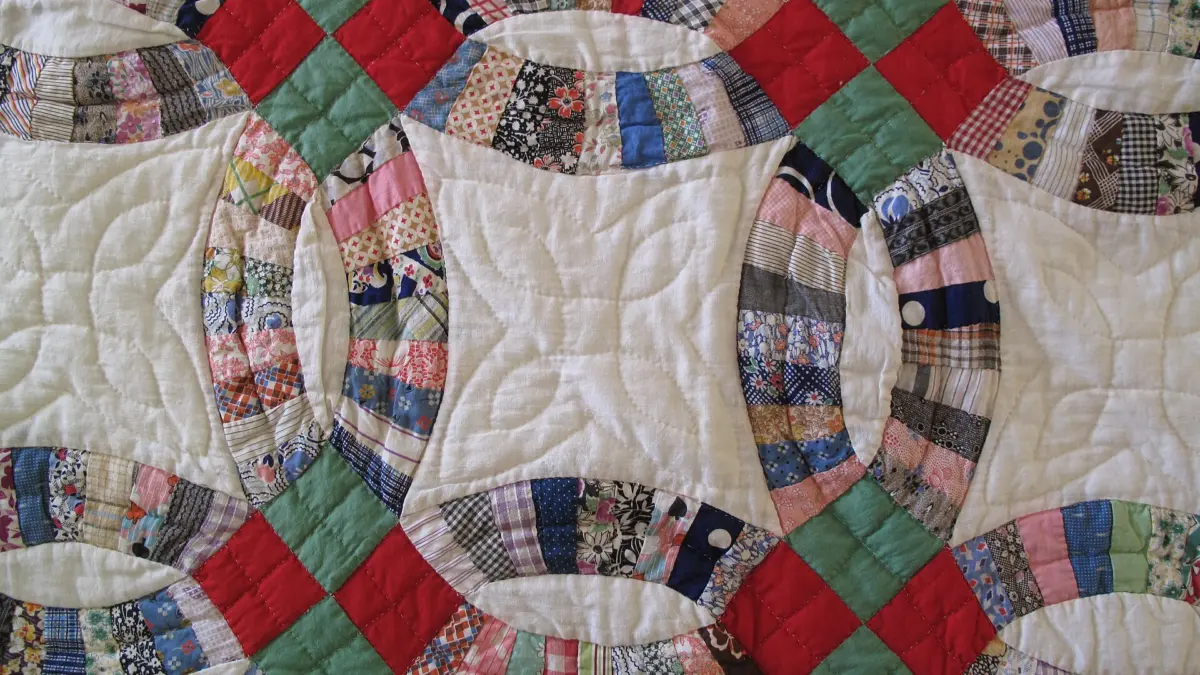
The ones she kept, she kept for a reason. There were about thirty of them in her house when she died. Some were her mother’s, from the farm. Some were ones she’d made for Dad. One was the Double Wedding Ring quilt she made for her own wedding in 1955, out of scraps from her mother’s dresses and her sisters’ dresses and her own going-away suit, pale yellow and blue and lilac. It was on her bed when she died. She’d slept under it for seventy years.
The last two years, after her stroke, I drove down from Omaha every weekend. Four hours down on Sunday morning, four hours back on Monday night. Doug lived eleven minutes away, over on the west side of town, and he’d stop by on holidays and sometimes on a Wednesday to drop off groceries Sheryl had picked up. I’m not saying that to be mean. People do what they can. That’s what I tell myself.
On those weekends, Mom and I would sit in her back bedroom, with the quilting frame empty because her hands couldn’t do it anymore, and she’d tell me about the quilts. Which aunt made which block. Which dress the blue calico came from. She’d make me take them out of the cedar chest one at a time and unfold them on the bed so she could look at them, and then she’d make me fold them back up a different way than before, so the creases wouldn’t wear through.
One Sunday in August, three weeks before she died, Doug was there too. He’d come to fix the garbage disposal. He stood in the doorway of the sewing room with a wrench in his hand and watched me fold the Lone Star.
“Mom,” he said. “What are you going to do with all these?”
“They’ll go to you kids,” she said.
Doug laughed. “Mom, nobody wants quilts anymore. Everybody’s got comforters from Target.”
Mom didn’t laugh. She looked at him over her reading glasses for a long time, the way she used to look at us when we tracked mud in.
“Then they’ll go to whoever wants them,” she said.
Doug went back to the disposal. Mom looked at me. She didn’t say anything else. She just patted the wedding quilt on the bed beside her, twice, the way you’d pat a dog that was being good.
I thought she was tired. I thought she wanted to lie down. So I helped her lie down, and I pulled the wedding quilt up over her, and she went to sleep.
I’m a nurse. I work twelve-hour shifts at a hospital in Omaha, three days a week, Thursday, Friday, Saturday. I’d tried to get the Saturday off when Doug called, but we were short, and they said no. So I worked my shift Friday night into Saturday morning, seven to seven, and when I got off at seven a.m., I didn’t go home. I got in my car in my scrubs and drove the four hours to Marshalltown. I couldn’t stand it. I couldn’t stand the idea of strangers in Mom’s house without me.
I pulled onto Fourth Avenue a little after eleven.
There were cars parked all the way down both sides of the street. There was a big orange sign on Mom’s lawn that said ESTATE SALE TODAY with an arrow. There were people on the porch and people on the steps and people walking down the driveway carrying lamps and boxes and Mom’s kitchen chairs. A man was loading her sewing machine into the back of an SUV.
And there was a woman in a red jacket walking down the front walk with a quilt over her arm.
It was the Grandmother’s Flower Garden. I knew it from fifty feet away. Little hexagons of flowered feed-sack fabric, hundreds and hundreds of them, all hand-pieced. My grandmother made that quilt in 1936. Mom said it took her two winters.
I parked in the middle of the street. I didn’t even pull over. I got out and ran up the walk.
“Excuse me,” I said to the woman in the red jacket. “Excuse me, ma’am, where did you get that?”
She looked at me like I’d lost my mind, which I suppose I looked like I had. I was in green scrubs with my hair falling down and I hadn’t slept in twenty-eight hours.
“I bought it,” she said. “Inside. They’re five dollars.”
“Five dollars?”
“Five dollars each. They’ve got a whole stack of them in the back bedroom.” She hugged the quilt a little tighter. “I’m going to use it for my dog’s bed.”
I went up those porch steps like I was going to a code blue.
Inside, Mom’s house didn’t look like Mom’s house. There were little white price stickers on everything. Her china was stacked on the dining room table in piles, a dollar a plate. Her good winter coat was hanging on a rolling rack with a sticker that said $8. Her Hummel figurines were lined up on a card table. People were everywhere, picking things up and turning them over and putting them down, talking and laughing like they were at a flea market. Which I suppose they were.
Doug was in the kitchen. He was standing by the table with a cash box, making change for a man buying Mom’s mixer. His wife Sheryl was next to him, wrapping a cut-glass bowl in newspaper. Doug saw me and his face did a whole complicated thing.
“Jeanie,” he said. “You came.”
“Where are her quilts, Doug?”
“Jeanie—”
“Where are her quilts?”
“They’re in the back bedroom.” He handed the man his change. “Look, before you go back there—”
I didn’t wait for the rest.
Mom’s back bedroom was the sewing room. Her quilting frame was still set up in the middle of it, empty. There was a folding table against the wall, and on the folding table there was a stack of quilts, folded in squares. There was a handwritten sign taped to the edge of the table, in Sheryl’s loopy handwriting. HANDMADE QUILTS, $5 EACH, GREAT FOR MOVING BLANKETS.
Moving blankets.
I counted the stack. There were twelve.
There’d been thirty.
A young couple was standing at the table, going through the stack, pulling quilts out and unfolding them and holding them up to look at, then tossing them back on the pile. The girl had Mom’s Double Wedding Ring quilt in her hands. The one from her bed. The one she’d slept under for seventy years. She held it up and looked at it and said to her boyfriend, “This one’s kind of ugly but it’s big.”
“I’m sorry,” I said. My voice didn’t sound like my voice. “I’m sorry, that one’s not for sale.”
“It says five dollars.”
“It’s not for sale.”
“Ma’am,” the boyfriend said, “it’s got a sticker on it.”
Doug came in behind me. Sheryl was behind him.
“Jeanie,” Doug said. “Come on. Don’t make a scene.”
“You said you’d pull them.” I turned around. “You said. On the phone. I told you not to sell her quilts, and you said okay, I’ll tell Sheryl.”
Sheryl lifted her chin. “He did tell me. And I told the sale company. But they said you can’t run an estate sale and hold back half the inventory, Jean. That’s not how it works. People come for the quilts. They put them in the ad.”
“Half the inventory? They’re Mom’s quilts!”
“They’re old blankets,” Doug said. He said it low, like he didn’t want the customers to hear. “Jeanie, honey. Nobody wants that stuff anymore. You can’t get anything for quilts. The sale lady said so. Five dollars is what they’re worth. We already sold eighteen of them before nine o’clock.”
“To who?”
“I don’t know! To people! A lady from Des Moines bought six.”
“Grandma’s Flower Garden is walking down the sidewalk right now to be a dog bed.”
“So go buy it back if you want it so bad.”
The young couple had backed away from the table and were watching us like we were a television show. The girl was still holding Mom’s wedding quilt.
I don’t know what I would have said next. I think it would have been something I’d have regretted for the rest of my life. But I looked at that girl holding that quilt, and I looked at the stack on the table, and I thought: twelve. There are still twelve.
I opened my purse. I had sixty-three dollars in my wallet. It was my grocery money for the week. I took out three twenties and put them on the folding table.
“I’ll take them,” I said. “All twelve. Sixty dollars.”
Doug stared at me. “Jeanie, I’m not going to charge my own sister—”
“Take the money, Doug. Put it in the cash box. The sale lady gets her thirty percent.”
The girl handed me Mom’s Double Wedding Ring quilt. She actually looked a little embarrassed. “I’m sorry,” she said. “I didn’t know it was your mom’s.”
“That’s okay, honey,” I said. “You couldn’t have.”
I picked up all twelve quilts in my arms, in a stack so tall I couldn’t see over it, and I walked out of my mother’s house through all those strangers, and I put them in the back seat of my car. Then I went back down the street to find the woman in the red jacket. She was loading her trunk. I asked her if she’d sell me back the Flower Garden quilt. She said she’d paid five dollars for it. I said I’d give her twenty. She looked at me in my scrubs, and she looked at the quilt, and she said, “Oh, honey, just take it. I’ll find something else for the dog.” She wouldn’t take my money.
I sat in my car in the middle of Fourth Avenue and cried until a man knocked on my window and asked me to move so he could get his truck out.
I’d planned to drive straight back to Omaha. Instead I got a room at the AmericInn out by the highway, because I was too tired to drive and I couldn’t stand to stay in that house. I carried all thirteen quilts up to my room. I laid them out across both beds and over the chairs and on the floor. I just wanted to look at them.
I knew most of them. I’d grown up with them. There was the Log Cabin she made for Dad in 1962, in browns and greens, which was always on the couch for naps. There was a little Nine Patch made from my old play dresses, the ones from when I was four and five, and I could still see the cherry print from my favorite one. There was a crazy quilt from the farm, older than Mom, all velvet and silk with fancy stitching. There was a Lone Star in red and white she made for the Bicentennial.
And there was the Double Wedding Ring. I saved that one for last. I took it out of the stack and unfolded it on the bed, all the way, and smoothed it out with my hands. It still smelled like her. Like Jergens lotion and the cedar chest and that soap she used.
And when I smoothed my hand over the middle of the quilt, across the back, I felt something crinkle.
I stopped. I put my hand back on it. I pressed down. There was something in there. Something stiff and flat under the top layer, between the quilt top and the backing, right in the middle of the bed. It made a little crackling sound, like paper.
I turned the quilt over. The backing was plain muslin, the way she always did it. And there, in the middle of the back, there was a patch.
I’d never noticed it before. Nobody would have. It was a square of the same plain muslin, maybe twelve inches by twelve, hand-stitched onto the backing with the tiniest stitches you ever saw. Ten to the inch. Mom’s stitches. If you didn’t know it was there, you’d think it was a repair. A patch over a worn spot.
I got my little sewing scissors out of my purse. Every nurse carries scissors. My hands were shaking. I clipped one corner of the stitching, very carefully, then another, and folded back the flap.
There was a pocket underneath. And in the pocket was a big flat envelope, a heavy manila one, folded around something thick.
On the front of the envelope, in Mom’s handwriting, in blue ink, it said: For whoever loves these quilts enough to keep them.
I sat down on the edge of the motel bed.
Inside the envelope were United States savings bonds. Series EE. The old paper kind, green and white, with Benjamin Franklin on some of them and other faces on the others. There was a whole stack of them, held together with one of Mom’s hair clips. I counted them on the bedspread. There were thirty-one.
They were thousand-dollar bonds. Every one. Bought between 1987 and 2001, a couple every year. And on every single one of them, right under Mom’s name, typed in where it says co-owner, there was another name.
Mine.
Evelyn R. Albright or Jean M. Albright.
There was a letter, too. One sheet of her blue stationery, with the little violets in the corner. It was dated March 3, 2002.
Jeanie, it said.
If you’re reading this, then you kept my quilts, and I knew you would. Your brother never cared for them and that’s all right, he’s a different kind of person, he loves me in his own ways.
These are for you. I bought them a little at a time from my egg money and my quilt money and whatever I could save from the household. Your father knew about them. He said I should put your name on them so they’d go to you without any trouble when I’m gone, and the man at the bank said the same. So they’re yours and nobody else’s.
I want you to have something of your own. You work so hard and you never take anything for yourself. Spend some of it on something nice. And please keep the wedding quilt on your bed. It’s tired of being folded.
All my love,
Mom.
I read it maybe twenty times. Then I lay down on the motel bed under Mom’s wedding quilt in my scrubs and slept for eleven hours.
When I woke up it was almost ten o’clock Sunday morning. My phone had six missed calls from Doug.
I called him back from the motel parking lot.
“Where are you?” he said. “We thought you’d gone home. Sheryl’s mad. She says you embarrassed her in front of the whole sale.”
“I’m at the AmericInn.”
“Well, come by the house. The sale company’s hauling the leftovers this afternoon. If there’s anything else you want, now’s your chance.”
“Doug,” I said. “I need to tell you something.”
And I told him. About the patch. About the envelope. About the thirty-one bonds with my name on them, and about Mom’s letter. I read him the letter, all of it, standing in the parking lot of the AmericInn with semis going by on the highway.
He didn’t say anything for a long time.
“How much are they worth?” he said finally.
That was the first thing he said. How much are they worth.
“I don’t know yet.”
“Well, find out. Jeanie, that’s estate property. That’s Mom’s estate. I’m the executor. Anything that was in that house belongs to the estate until it’s settled. Half of that is mine.”
“Doug, they have my name on them.”
“I don’t care whose name is on them. They were in Mom’s house. In Mom’s quilt.”
“In a quilt you sold to me for five dollars.”
There was a long silence.
“That’s not funny,” he said.
“I’m not trying to be funny.”
“I’m calling the estate lawyer,” he said, and he hung up.
I want to tell you that I was calm about all this. I wasn’t. I sat in my car in the AmericInn parking lot and shook. Doug is my big brother. He taught me to ride a bike. When a boy named Rodney Pfeiffer pulled my braids in fourth grade, Doug, who was in seventh, waited for him after school and sat on him until he apologized. I always thought Doug and I would be all right. Even after Sheryl. Even after he stopped calling on my birthday. Even after Mom got sick, and I drove four hours every weekend for two years to sit with her, and he lived eleven minutes away and came by on holidays. I always thought, when it really mattered, he’d be my brother.
And the first thing he said was how much are they worth.
I went to the bank Monday morning. The same bank on Main Street where Mom had banked for sixty years, where she bought every one of those bonds. A woman named Marcia at the customer service desk took them into a back room and came out about forty-five minutes later with a printout.
“Mrs. Albright,” she said, “your mother was a very smart woman.”
The thirty-one bonds were worth fifty-seven thousand, eight hundred and some dollars. Some of them had stopped earning interest, because they were more than thirty years old, so Marcia said I shouldn’t leave them sitting. She explained everything to me. She said that because I was named on every bond as the co-owner, and Mom had passed, the bonds were mine. She said that’s what the co-owner line was for. She said she’d seen families fight over bonds like these for years, when there was no second name, or the wrong one, and her eyes got a little wet. “Your mother made sure that wouldn’t happen,” she said.
Before I left, Marcia pulled up something else on her computer. She turned the screen so I could see it. It was an old record, from the bank’s microfilm, of every one of those bonds being bought. A date and a teller number and an amount. Mom came in twice a year, every year, in April and in October, for fifteen years. Always cash. Always five hundred dollars, which was what a thousand-dollar bond cost back then.
“April and October,” I said. “That’s when she sold her eggs. Spring and fall. She kept laying hens in the backyard until the city made her stop.”
Marcia smiled. “Well,” she said. “Those were some expensive eggs.”
Doug’s lawyer called me Wednesday. Actually, it was the estate lawyer, a nice older man named Mr. Hruska who had done Mom’s will back in 2002. He said Doug had asked him to look into the bonds. He asked me to read him the names on them. I read them. He asked me to read him Mom’s letter. I read that too.
“Well,” he said. “Those were never part of the estate, Mrs. Albright. Not with your name on them. I’ll tell your brother.”
“What did he say when you told him?”
Mr. Hruska was quiet for a second. “He wasn’t pleased,” he said. “But it is what it is. Your mother came and asked me about this in 2002, did you know that? About the bonds. I told her to make sure your name was on every one. I’m glad to see she listened.”
So Mom had talked to the lawyer too. Mom, who I always thought didn’t know the first thing about money. Who let Dad handle the checkbook. Who paid for everything at the IGA with exact change counted out of a coin purse. She’d been planning this for twenty-four years.
Doug didn’t call me for a month after that. Then he called on a Sunday afternoon in November, two weeks before Thanksgiving. He sounded different.
“Jeanie,” he said. “The house sold.”
“That’s good, Doug.”
“Hundred and sixty-two thousand. After the realtor and the sale company and everything, there’s about a hundred and forty for the estate. Half’s yours.”
“Okay.”
He was quiet. I waited.
“I was wrong,” he said. “About the bonds. Mr. Hruska explained it to me. I shouldn’t have said what I said.”
“Okay.”
“I was wrong about the quilts too.” His voice cracked a little. “Sheryl says I wasn’t, but I was. I told you I’d pull them and I didn’t. I just—it was so much stuff, Jeanie. It was a whole house full of stuff and I just wanted it gone. I couldn’t stand being in there. Every time I walked in that house, I kept thinking she was going to come out of the kitchen.”
I hadn’t known that. Doug had never said a thing like that to me in his whole life.
“I know,” I said. “Me too.”
“Did you ever find the others? The other eighteen?”
And that’s the other part of this story. Because after I went to the bank, I didn’t spend the money right away. The first thing I did was try to find the rest of Mom’s quilts.
The estate sale company had a Facebook page. I wrote them a message. I told them who I was, and what had happened, and I asked if they had any receipts or names from the buyers who’d bought the quilts. They wrote back that they didn’t keep names for cash sales. But the owner of the company, a woman named Linda, said she’d put a post on their page. So she did. She posted a picture of one of the quilts I’d bought back, the Lone Star, and wrote that the family was looking for the other quilts from the Albright sale in Marshalltown and would pay to buy them back.
That post got shared about four thousand times. I still don’t understand how those things work.
The lady from Des Moines who bought six called me two days later. She was a quilter herself, and she said she’d known the second she saw them that they were something special, and she’d felt bad paying five dollars. She’d been planning to hang them in her quilt shop. She drove all six to Omaha herself and refused to take a penny. We had lunch. Her name is Patty, and she’s my friend now.
Three more came back from people in Marshalltown who saw the post. One came back from a girl at Iowa State, who’d bought it for her dorm room and cried on the phone when she found out. One came back from the young couple, the girl who said the wedding quilt was kind of ugly but big. They’d bought a Sunbonnet Sue at the last minute, on their way out, after I left. She mailed it to me with a card that said, “We’re so sorry. It’s not ugly at all.”
Two quilts I found but couldn’t get back. A man in Waterloo had cut one up to make Christmas stockings. He sent me a picture of the stockings. I’ll admit they were pretty. And a woman in Ames said she’d paid for hers fair and square and she was keeping it, and I could take her to court if I wanted. I didn’t want to take her to court. I told her I hoped she’d keep it on a bed. She hung up on me.
The other six, I never found. They’re out there somewhere. On somebody’s couch, or in somebody’s garage wrapped around a lawn mower, or under somebody’s dog. I think about them sometimes.
But one of the ones I did find, from a woman in Marshalltown who’d bought it for her granddaughter, was a little blue baby quilt with yellow ducks appliquéd on it. Hand-stitched. With a name embroidered in the corner in blue thread. Douglas Allen Albright, June 4, 1960.
Doug’s baby quilt. The one Mom made when he was born.
He’d sold it for five dollars and never even noticed.
So when Doug asked me on the phone if I’d found the others, I said, “Some of them. Doug, come for Thanksgiving. I’ve got something for you.”
He came. Without Sheryl. That was his idea. He drove four hours to my little two-bedroom condo in Omaha, and I made Mom’s stuffing recipe and Mom’s cranberry relish, and we ate at my kitchen table, just the two of us. It was the first time we’d had a meal alone together since he left for college in 1978.
After the pie, I went into my bedroom and came back with the little blue quilt with the ducks on it. I’d washed it by hand in the bathtub and dried it flat on towels, the way Mom taught me. I put it in his lap.
He looked at it for a long time. He ran his thumb over his own name in the corner.
My big brother, who sat on Rodney Pfeiffer, who taught me to ride a bike, who sold Mom’s quilts for five dollars apiece, put his face down in that little baby quilt and cried like he was six years old.
I sat next to him and held his hand until he was done.
He took it home. He told me later he keeps it on the back of his recliner. Sheryl doesn’t like it there. He keeps it there anyway.
I won’t pretend Doug and I are close now. We’re not. We talk every few weeks. He calls on my birthday again. Sheryl still doesn’t speak to me, and I’ve stopped expecting her to. I think Doug’s a little embarrassed every time we talk, and I think he always will be. That’s all right. Embarrassed is better than gone.
As for the money, I did what Mom said. I spent some of it on something nice. I took my first real vacation in nineteen years, a week in Door County, Wisconsin, in a little cabin on the water, and I took Mom’s crazy quilt from the farm and put it on the bed there. The rest of it went toward paying off my condo. I own it free and clear now. It’s the first thing I’ve ever owned outright in my life.
And I did one more thing. I bought a quilt frame. A used one, from Patty’s shop in Des Moines, for a hundred and fifty dollars. It’s set up in my second bedroom now. I’m not very good yet. My stitches are about five to the inch. Mom would have made me take them out and start over. But I’m learning.
I’m making a quilt out of some of the scraps I found in Mom’s sewing room, before the sale company hauled the rest away. Bits of her house dresses and Dad’s old work shirts, and a piece of that cherry print from my play dress when I was four.
I don’t know who it’s for yet. Mom always said you’d know when it was done.
Mom’s Double Wedding Ring quilt is on my bed. I took the patch off the back and sewed it into the corner of my new quilt instead, so it’ll be in there. With her stitches still in it.
She said it was tired of being folded. So I don’t fold it.