“Here, Linnie. For your sewing.”
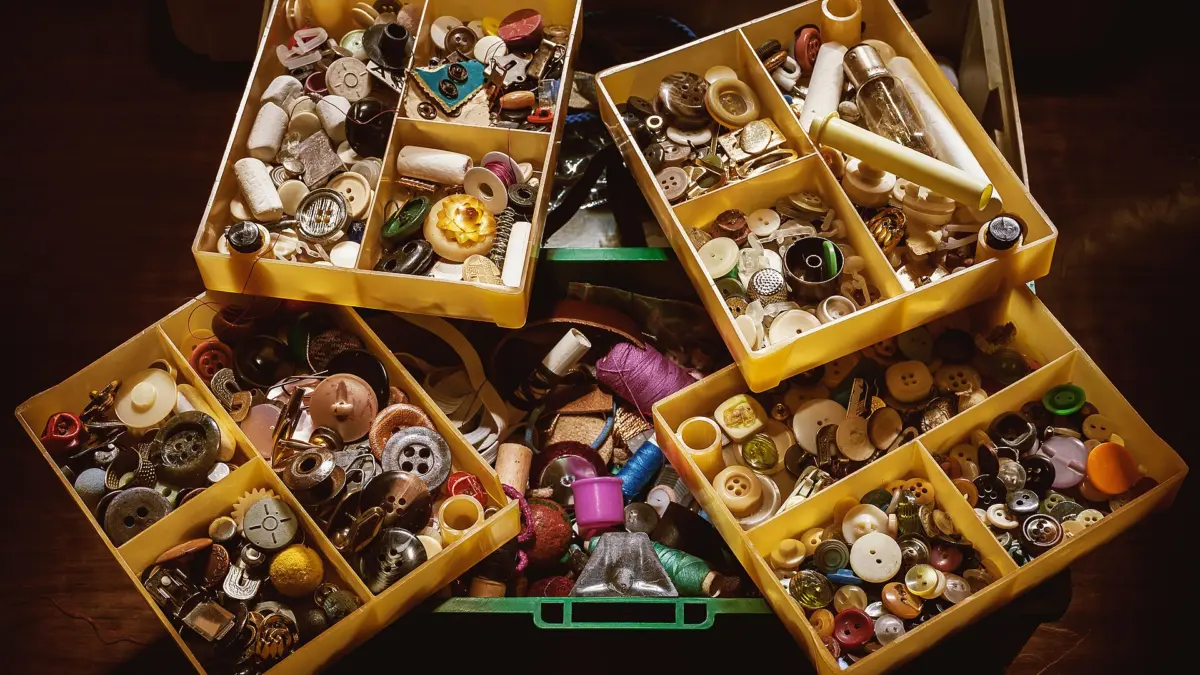
My brother Gary held out a rusty red Folgers coffee can with both hands, like he was handing me a casserole. It was full to the top with buttons. Hundreds of them. Thousands, maybe. White shirt buttons and brown coat buttons and little pearl ones and big wooden toggles, all jumbled together, with the plastic lid long gone.
Behind him, in the middle of Dad’s garage, sat the car. A 1967 Ford Mustang fastback, candy apple red, with chrome that Dad had polished every Sunday afternoon for forty years. A man had driven down from Sioux Falls the week before to look at it. He’d said forty-eight thousand dollars, maybe more at auction.
Gary was already holding the keys. He’d hooked the ring on his finger and was swinging it a little while he talked.
“Gary,” I said. “Dad said the car was supposed to be sold and the money split between us.”
“Dad told me it was mine.” He shrugged. “Plenty of times. You weren’t here.”
I stood there in my father’s garage two weeks after his funeral, with a coffee can of buttons in my arms, and I felt my face go hot.
“I wasn’t here? Gary, I was here three days a week for six years. I drove him to dialysis. Three hundred and twelve times. I counted on the calendar.”
“And you got paid for it.” His wife Sherry was standing over by the workbench, wrapping Dad’s good socket wrenches in newspaper and putting them in a box with her name on it. “You got the house money, didn’t you? Half of a hundred and eighty thousand. That’s a lot of gas money, Linda.”
“We both got half of the house. That was in the will.”
“And now you got Evelyn’s buttons.” Sherry laughed. “You can make a quilt out of Frank’s old shirts.”
Gary laughed too. That was the part that got me. Not Sherry, I expected it from Sherry. Gary. My big brother, who taught me to ride a bike and beat up Jimmy Kessler in the fourth grade for pulling my braids. He stood there swinging the keys to Dad’s Mustang and laughed at me holding Mom’s buttons.
“Linnie, come on,” he said. “It’s a car. You don’t even like cars. What would you do with it?”
“Sell it. Like Dad said.”
“Well, I’m not going to sell it.” He wasn’t laughing now. “I’m the executor. Dad named me. Personal property gets divided the way the kids agree, and I’ve decided. I get the car, the tools, the gun safe. You get the sewing room and Mom’s recipe box and whatever else you want out of the house. That’s fair.”
“That’s not fair, Gary. That’s you deciding.”
“Somebody has to.”
I looked at the car. I looked at my brother. I looked at the coffee can in my arms.
I could have fought him on it. Doug, my husband, would tell me later that I should have, that I should have called Mr. Bauer, the lawyer who did Dad’s will, right there from the garage. Maybe he was right. But I was so tired. I’d been tired for six years. I’d buried my father fourteen days earlier and I hadn’t slept a whole night since.
So I didn’t fight him. I said, “Fine, Gary,” and I walked out of the garage with Mom’s buttons, and I put the coffee can on the passenger seat of my Buick, and I drove home with one hand on the wheel and the other hand holding that can so it wouldn’t tip over on the turns.
My name is Linda Hale. I’m sixty-three years old. I was a school nurse in Spencer, Iowa, for twenty-nine years, at the middle school and then at the high school. I’ve cleaned up more nosebleeds and bandaged more skinned knees and called more mothers than I could ever count. I retired two years ago so I could take care of Dad full-time, because by then he couldn’t really be alone anymore.
My father was Frank Dobson. He farmed four hundred acres west of town until the farm crisis in the eighties, when he lost all of it but the house and the land it sat on. After that he worked the parts counter at the John Deere dealership for twenty-five years. He knew every part number for every tractor ever made by heart. Farmers used to call the dealership just to ask him things. He was quiet, and stubborn, and funny when you didn’t expect it, and he loved my mother more than I’ve ever seen a man love anything.
Mom was Evelyn. She got breast cancer in 2003. It took her six years. I was there for most of it. I cut my hours at the school to part-time and drove her to Sioux City for chemo and slept in the recliner by her hospital bed. Gary was in Phoenix then, selling RVs. He came home twice. Once for Christmas, and once for the funeral.
Gary moved back to Spencer in 2018, after his RV dealership went under. He and Sherry lived in Dad’s basement for a year and a half. Dad paid for their groceries and their cell phones and, I found out later, a good chunk of a debt Gary owed to a bank in Arizona. Gary never mentioned it. Dad never mentioned it either. That was Dad.
When Dad’s kidneys started failing in 2019, he needed dialysis three times a week, at the clinic in Spencer, four hours a session. Gary had a new job by then, selling insurance, and he said he couldn’t get off work. So I drove him. Monday, Wednesday, Friday, six-thirty in the morning, for six years. I’d sit in the waiting room and knit, and then I’d drive him home and make him lunch and make sure he took his pills.
Somewhere in there, I started keeping track on the calendar on Dad’s refrigerator. A little red check mark on every dialysis day. I don’t know why. I think I just needed to see that it added up to something. At the end, there were three hundred and twelve red check marks.
After the funeral, I took that calendar down and put it in my purse. Gary watched me do it and didn’t say anything.
At the funeral lunch in the basement of First Lutheran, Gary went table to table with a plate of ham sandwiches in one hand and a cup of coffee in the other, telling everybody about the car. “Dad always said that Mustang was mine,” he told the Petersons. “Promised it to me when I was sixteen,” he told Pastor Lund. “That car’s going to stay in the family,” he told Dad’s old boss from the John Deere dealership, who’d driven all the way from Spirit Lake.
I sat at the end of a long folding table with my plate of potato salad and listened to my brother talk about the car at our father’s funeral. Not once did I hear him talk about Dad.
Aunt Marlene, Mom’s sister, who’s eighty-four and doesn’t miss a thing, leaned over and patted my hand.
“Your brother,” she said, “has always known the price of everything.”
The button can was Mom’s.
It was an old three-pound Folgers can, the kind they don’t make anymore, red with the white lettering mostly worn off. She’d kept it on the shelf in her sewing room for as long as I could remember. Every time a shirt wore out or a coat got thrown away, Mom cut the buttons off and dropped them in the can. When we lost a button, she’d dump the whole thing out on the kitchen table and we’d sit there and hunt for a match. It’s one of my oldest memories, sitting on a phone book at the kitchen table, sorting buttons into piles by color while Mom hummed and the radio played the farm report.
After Mom died, Dad kept the can on the kitchen counter, next to the toaster. Some nights when he couldn’t sleep, I’d come over in the morning and find all the buttons sorted out on the kitchen table in little piles. Whites and blacks and browns and the fancy ones. He said it settled his mind.
About a month before he died, on one of the last good days, he was sitting at the kitchen table with the can in front of him, running his hand through the buttons the way you’d run your hand through sand.
“Linnie,” he said. “When I’m gone, you take your mother’s button can. You hear me? Don’t let Gary throw it out.”
“Dad, nobody’s going to throw it out.”
“Gary will.” He looked at me over his glasses. “Gary doesn’t know what’s important. Never has. You take it. Promise me.”
I promised. I figured he was being sentimental. He’d been getting sentimental at the end, about things like Mom’s apron and the old radio and the porch light.
So when Gary held out that coffee can in the garage and laughed, part of me was hurt. And part of me thought, well, at least I kept my promise.
Doug was in the kitchen when I got home. He’s a diesel mechanic, sixty-five, and he doesn’t say much, but he can read me like an engine manual.
He looked at the coffee can in my arms.
“He gave you buttons?” he said. “For a forty-eight-thousand-dollar car?”
That’s when I started crying. I put the can on the kitchen table and sat down and cried harder than I had at the funeral. Doug stood behind me with his big hands on my shoulders and let me.
When I was done, he made me a cup of tea and went out to the garage to do whatever he does out there. And I sat at the kitchen table with the coffee can, and after a while I did what Dad used to do when he couldn’t settle his mind.
I dumped the buttons out on the table.
It made a sound like rain on a tin roof. Buttons everywhere, rolling and bouncing, a few hitting the floor. I started sorting them. Whites in one pile. Blacks in another. Browns. Navy blues. The fancy ones by themselves.
I found Mom’s Sunday coat buttons, big tortoiseshell ones. I found a tiny pink one that I knew, I just knew, came off my Easter dress in 1969. I found a brass button with an eagle on it from Dad’s Army coat from when he was stationed in Germany, and I held that one for a long time. I found a red plastic button shaped like a ladybug off Gary’s little corduroy jacket when he was three, and I set that one aside, and I don’t know why I did that either.
It took me almost two hours. When I got near the bottom of the can, my fingers hit something that wasn’t a button.
It was flat and stiff, pressed against the bottom of the can. Something wrapped in wax paper, the kind Mom used to wrap sandwiches in, and taped down with a strip of yellowed masking tape.
I pried it up with a butter knife.
Inside the wax paper there was a key. A small brass key, flat, with a round head and the number 114 stamped on it. Taped to the key was a piece of paper, folded into a little square.
I unfolded it. It was Dad’s handwriting, his careful parts-counter printing, all capitals.
“LINNIE. FIRST FARMERS AND MERCHANTS BANK, BOX 114. DON’T TELL GARY TILL YOU’VE SEEN IT. LOVE, DAD.”
And underneath, smaller:
“P.S. COUNT THE BUTTONS LATER. THERE’S OVER 4,000. YOUR MOTHER NEVER THREW ANYTHING AWAY.”
I sat there at my kitchen table, surrounded by little piles of buttons, holding that key, and I couldn’t breathe.
Gary called that night at eight-thirty. I was still sitting at the kitchen table. The key was in my sweater pocket.
“Linnie. Sherry wants Mom’s recipe box.”
“Dad said I could have the recipe box. You said so yourself, in the garage. You said I could have anything out of the house.”
“Yeah, well, Sherry wants it. She’s going to make the cookbook thing, for the grandkids. Bring it by tomorrow.”
“No, Gary.”
There was a silence on the line. Gary’s not used to hearing no from me. I don’t think he’d heard it in sixty years.
“What did you say?”
“I said no. Mom’s recipe box is mine. You got the car.”
“Jesus, Linda. It’s a box of index cards.” I heard Sherry say something in the background. “Fine. Whatever. Keep your recipes. Oh, and I put the Mustang on Facebook Marketplace tonight. Fifty-two thousand. Already got six messages.”
“You said you weren’t going to sell it.”
“I changed my mind.” I could hear him smiling. “It’s my car, Linnie. I can do what I want.”
I didn’t tell him about the key. I didn’t tell him about anything. I said goodnight and hung up, and I put my hand in my pocket and held onto that little brass key so hard it left a mark in my palm.
First Farmers and Merchants Bank opens at nine o’clock. I was in the parking lot at eight-forty, sitting in the Buick with the engine running and the heat on, and the coffee can on the seat next to me. I don’t know why I brought it. It just felt like the can should be there.
Doug offered to come with me. I told him no. I think I needed to do it by myself.
When the doors opened, I walked in and stood in line behind a farmer depositing a check. The bank in Spencer hasn’t changed much since I was a girl. Same marble floor, same brass teller cages they made into a decoration, same calendar from the seed company on the wall. When it was my turn, I asked for whoever handled the safe deposit boxes.
The woman who came out of the back office was Carol Jensen. She’s about my age. She’s been at that bank for forty years. Her mother and my mother were in the same church circle at First Lutheran. She was at Dad’s funeral. She’d hugged me in the receiving line.
“Linda,” she said. “I’ve been wondering when you’d come in.”
I took the key out of my pocket and put it on the counter. “I found this. Box 114. Dad left a note saying to come here.”
Carol looked at the key. She didn’t pick it up. She went over to her computer and typed something, and I watched her read the screen. Then she looked up at me. Then she looked down at the Folgers can I was holding against my chest like a baby, because I’d brought it in from the car without even realizing.
Her eyes filled up.
“Mrs. Hale,” she said. “Your father told us you’d come with a coffee can.”
I couldn’t say anything.
“He came in and set it up in 2009,” Carol said softly. “Right after your mother passed. He added you to the box as a co-lessee, so you’d have access when he was gone. He came in every year in March to check on it, right up until last year.” She swallowed. “And he told me, Carol, my daughter’s going to come in here someday holding her mother’s button can, and when she does, you take care of her. Those were his exact words.”
She came out from behind the counter and took my arm.
“Come on back,” she said. “It’s all waiting for you.”
The safe deposit room is in the basement, behind a big round steel door that’s been open every business day since 1924. Carol used her key and I used mine, and she slid the long metal box out of the wall and set it on a little table in a private room with a curtain. Then she said she’d be right outside, and pulled the curtain shut, and left me alone with it.
I sat there for a long time before I opened it.
The first thing on top was a deed. An old one, on that heavy cream-colored paper they used to use, with a raised county seal on the bottom. Osceola County, Iowa. A quarter section, a hundred and sixty acres, northwest of Ashton. Purchased by Frank L. and Evelyn M. Dobson, March 14th, 1974. Six thousand dollars.
I knew about that land. Or I thought I did. Dad had bought it when I was a little girl, as an investment, pasture ground that he rented out to a neighbor for cattle. I remembered driving up to look at it once, all of us in the old station wagon, and Dad standing in the grass with his hands on his hips. I’d always assumed he lost it in the farm crisis, with everything else. Nobody ever mentioned it again.
He hadn’t lost it.
Under the deed was a thick folder of papers. The first one was a trust document, from the office of Robert Bauer, Attorney at Law, Spencer, Iowa. Dated June 2nd, 2009. “The Frank L. Dobson Revocable Trust.” The quarter section in Osceola County had been deeded into the trust that same day. The successor trustee, and the sole beneficiary, upon Frank’s death, was “my daughter, Linda Dobson Hale.”
Under that was a wind energy lease. A company out of Des Moines had leased the quarter in 2012 and put up three wind turbines on it. The lease was for thirty years. The payments came twice a year.
And under that was a statement from First Farmers and Merchants Bank, for a savings account in Dad’s name, with a payable-on-death beneficiary. Me. Every lease payment from the wind company for thirteen years had gone straight into that account. Dad had never taken out a dime. He’d paid the taxes on it every year out of his Social Security.
The balance at the bottom of the last statement, dated the month before he died, was three hundred and sixty-one thousand, four hundred and eight dollars.
I read it four times. Then I put my head down on the little table and cried.
At the very bottom of the box, there were two envelopes. Plain white, sealed. One said “LINNIE” on the front in Dad’s printing. The other said “GARY.”
I opened mine.
“Linnie,
If you’re reading this, I’m gone and your brother has done exactly what I figured he’d do. He’s taken the car and the tools and he’s laughed at you, and you’ve let him, because you always do. That’s all right. That’s who you are. It’s who your mother was too.
I want you to know why I did it this way.
Your brother asked me about that car every single time he came home for forty years. When are you going to give me the Mustang, Dad. How much is the Mustang worth now, Dad. You never asked me for one thing. Not once. Not when you were taking care of your mother, not when you were driving me to that clinic three times a week while your brother sold insurance. You never asked for gas money. You never asked for a thank you. You just did it.
Your mother made me promise before she died that I’d look after you. She said, Frank, Linnie gave up everything to take care of me, and nobody’s ever going to take care of Linnie. So I bought that land back in ’74 thinking someday it’d be worth something. Turns out it was the wind. I never needed that money. You did. You just never said so.
Gary gets the car because the car is the only thing he ever wanted from me. Give him his letter. Don’t read it. It’s his.
And Linnie, count the buttons. Your mother would want somebody to know how many there were.
Love, Dad”
Before I left the little room, I called Mr. Bauer from my cell phone. I don’t know why. I think I needed to hear a grown-up tell me it was real.
His secretary put me right through. Robert Bauer has been a lawyer in Spencer for forty-five years. He did Mom and Dad’s first wills in 1971 and their last ones in 2009, and he came to Dad’s funeral in a brown suit and stood at the back.
“Linda,” he said. “You found the box.”
“Mr. Bauer, is this… is it real? Is it legal? Can Gary…”
“It’s real, Linda. Every bit of it. Your father sat in my office for three hours in June of 2009 and asked more questions than any client I’ve ever had. He made me explain the trust to him twice. Then he made me explain it a third time so he could write it down.” He paused. “He also asked me what would happen if Gary contested it. I told him a revocable trust funded during his lifetime, with proper witnesses, isn’t part of the probate estate. Gary has no claim to it. Your father said, good, and signed it.”
“He never told me. Not once in sixteen years.”
“No,” Mr. Bauer said. “He told me he was afraid you’d try to give it to your brother. He said, Bob, Linnie would give the shirt off her back to that boy, and that boy would sell the shirt.”
Carol drove me home. I wasn’t in any shape to drive. She followed me in my own Buick with her husband driving behind us in her car. When I got in the house, Doug took one look at my face and sat me down and didn’t ask anything until I was ready to tell him. Then I told him everything, and he sat there across the kitchen table from me with the deed and the trust papers and the bank statement spread out in front of him, among all the little piles of buttons, and for a long time he didn’t say a word.
“Your dad,” he said finally. “That sneaky old son of a gun.”
I drove over to Gary’s house the next afternoon with his envelope in my purse.
He and Sherry were in the driveway, washing the Mustang. Sherry was taking pictures of it with her phone for Facebook Marketplace, from different angles, crouched down by the front bumper. Gary had his shirt sleeves rolled up and a bucket of soapy water and Dad’s old chamois.
He looked up when I pulled in.
“If you’re here about the recipe box, Linnie, I already told Sherry to forget it.”
“I’m not here about the recipe box.” I got out of the car. I held out the envelope. “Dad left this for you.”
He stared at it. “Where’d you get that?”
“In a safe deposit box at First Farmers. Dad set it up in 2009. The key was in the bottom of Mom’s button can.”
Sherry stood up very slowly from behind the bumper.
“What else was in the box?” she said.
I thought about lying. I’d thought about it the whole drive over. But Dad had raised me better than that, and anyway, it would all come out sooner or later. Things always do in a town of eleven thousand people.
So I told them. The quarter section in Osceola County. The trust. The wind turbines. The account.
When I said the number, Sherry made a sound like she’d been punched.
“Three hundred and sixty thousand dollars?”
“Three hundred and sixty-one.”
“That’s fraud.” Her face went red. “That’s elder fraud, Gary. She got him to sign something when he was sick. He was on dialysis, he didn’t know what he was doing…”
“He signed it in 2009, Sherry,” I said. “Ten years before dialysis. In Mr. Bauer’s office, with two witnesses and a notary. He was sharper that day than any of us. You can call Mr. Bauer if you want. He’s expecting you to.”
Gary hadn’t said anything. He was standing next to the Mustang with the chamois dripping in one hand and the envelope in the other. He was looking at his name on the front of it, in Dad’s printing.
He opened it.
I don’t know what it said. I’ve never asked, and he’s never told me all of it. I know it was short, one page, because I could see through the back of it in the sun. I watched my brother read it standing in his driveway next to the car he’d wanted his whole life. I watched his face change.
Then he sat down on the front bumper of the Mustang, right in the soapy water, and put his hand over his eyes.
“Gary?” Sherry said. “Gary, what does it say?”
He didn’t answer her. He sat there with his shoulders shaking, and I stood there in his driveway, and after a while I went over and sat down on the bumper next to him. The soap soaked through my slacks. I didn’t care.
“He knew,” Gary said, through his hand. “About the IRS. About all of it. He knew the whole time.”
I didn’t know what he meant then. I found out later. Gary owed the IRS thirty-one thousand dollars in back taxes from the RV dealership, and they’d put a lien on his house in October. He hadn’t told anybody. Not me. Not even Sherry, until it got bad.
The one line of his letter he ever told me about, months later, was this one: “Sell the car, son. Pay what you owe. Then call your sister. She’s the one who’ll pick up the phone.”
Sherry went to see Mr. Bauer on Tuesday. I know because he called me afterward, as a courtesy, he said. She’d brought a cousin of hers who’d been to a year of paralegal school. They’d sat in his office for forty-five minutes.
“I explained the law to her,” Mr. Bauer said, in his dry way. “Twice. Then I explained it a third time, slower. Then I showed her the video.”
“What video?”
“Your father insisted we record the signing, in 2009. On one of those little camcorders. He said he’d seen something on 20/20 about family members fighting over wills. He looked right into the camera and said, my name is Frank Dobson, I am of sound mind, and I am doing this because my daughter has never once asked me for anything.” Mr. Bauer cleared his throat. “Sherry didn’t say much after that. The cousin asked if she could have a copy. I said no.”
Gary sold the Mustang in January to a man from Omaha for forty-nine thousand, five hundred dollars. He paid off the IRS with thirty-one thousand of it. He told Sherry about the rest of the debt, finally, all of it, and I understand they had a long winter.
He called me in March. It was a Sunday afternoon. I was at the kitchen table, sewing a button on Doug’s work shirt.
“Linnie,” he said. “It’s Gary.”
“I know who it is, Gary.”
“I was wondering.” He cleared his throat. “Would you want to drive up to Ashton sometime? To see the turbines? I’ve never seen them. I didn’t even know Dad still had that land.”
“Neither did I,” I said.
We drove up the next Saturday, in my Buick. I drove. Gary sat in the passenger seat with Mom’s button can in his lap, because I’d brought it, and he didn’t ask why. The turbines were bigger than I’d imagined, white and enormous against the blue sky, turning slow over the pasture. We parked by the fence and got out and stood there in the wind with our hands in our coat pockets, the way Dad used to stand.
“Dad stood right here,” Gary said. “When we were kids. Remember? You were in your Easter dress.”
“I remember.”
We stood there a long time. Gary didn’t apologize, not in words. Our family’s never been much good at words. But on the drive home, he asked if he could have the ladybug button off his old corduroy jacket, and I gave it to him, and he put it in his wallet.
Sherry still doesn’t speak to me. She tells people at church that I “worked on” Dad for years. I hear about it from Carol Jensen at the bank, who hears about it from her sister-in-law. I let it go. Dad would have.
I kept the land. I’m the trustee now. Mr. Bauer helped me with the paperwork. The wind company sends the checks twice a year, and I’ve put most of it back into the same account, the way Dad did. Doug and I paid off our house. We bought a new furnace. We’re taking a trip to see the Grand Canyon in May, which I’ve wanted to see since I was nine years old.
I did one other thing with the first check. I wrote one to the dialysis clinic in Spencer for three thousand, one hundred and twenty dollars. Ten dollars for every red check mark on Dad’s old calendar. The nurses bought two new recliners for the treatment room, the good kind that lean all the way back, and a little TV for each one. They put a brass plate on the back of one of the chairs. It says “Frank’s Chair.” The nurse who used to sneak him extra graham crackers told me he’d have hated it. Then she said he’d have sat in it every time.
And I counted the buttons.
It took me three evenings, at the kitchen table, with the radio on. I counted them out in piles of ten, then piles of a hundred. Four thousand, two hundred and twelve buttons. I wrote the number on a piece of masking tape and stuck it on the side of the can, in capitals, the way Dad would have.
I sewed one of them onto my own winter coat, where I’d lost a button last year. The brass one, with the eagle on it, from Dad’s Army coat. It doesn’t match the others at all.
I don’t care. I wear it every day.