“That’s a three-hundred-dollar lawn ornament, June. She eats better than you do.”
My brother-in-law Darrell said it at the Valley County co-op on the second Saturday in December, loud enough for the whole counter to hear. There were maybe eight men standing around the coffee pot, waiting on feed tickets, and every one of them laughed. Darrell has always had a voice that carries. He used it to call bingo at the Legion hall for twenty years, and he never learned how to turn it down.
I was buying a fifty-pound sack of donkey pellets and a mineral block. That’s all I’d come in for. I set the sack on the counter and paid the girl, and I didn’t say a word back to him. I’ve been in that family for forty-four years. I’ve learned when it’s worth it and when it isn’t.
“I’m serious,” he said, following me to the door. “Ray wasted money on that animal and you’re still wasting it. You know what you could’ve had for that pasture if you’d just sold it to me?”
“I know exactly what you offered, Darrell,” I said. “Two thousand one hundred an acre. I can do the math.”
“It’s a fair price.”
“It was a fair price in 2009.”
He laughed again, like I was being cute. Then he held the door for me, because Darrell is the kind of man who’ll insult you and hold the door in the same breath, and he went back to his coffee.
I drove home with the sack in the bed of the pickup and my hands tight on the wheel. It was eleven miles of gravel back to the place. The North Loup was running low and gray beside the road, and the cottonwoods were bare. I kept thinking about that word. Ornament. Like Clementine was a plastic deer you stick in the yard.
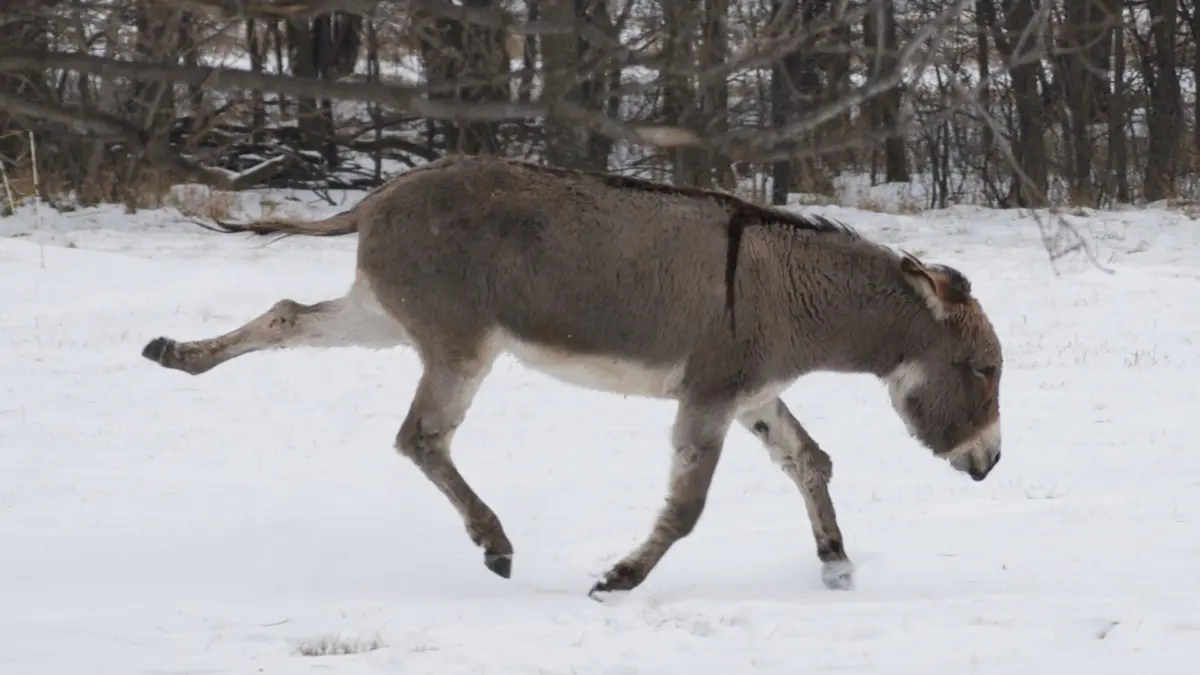
My husband Ray bought Clementine at the Burwell sale barn three years before he died. She came through the ring at the very end of a Tuesday, after the cattle, when half the buyers had gone home. She was a little gray jenny with a dark cross down her back and over her shoulders, and she was so thin you could count her ribs from the bleachers. The auctioneer started her at fifty dollars. The man who bought horses for the plants in Mexico bid her up to two-eighty. Ray put his hand up at three hundred and kept it there until the hammer came down.
I asked him what on earth we needed a donkey for. We’d sold our cows the year before. Ray’s heart wasn’t good, and we’d leased the pasture out, and all we had on the place was two old barn cats and a flock of guineas that ran the yard like they owned it.
“She looked at me,” Ray said. “Right in the eye, June. She’s got more sense than half the people in this county.”
That was all the reason he ever gave me.
Clementine was fourteen when we got her, according to the vet. She put on weight that first spring, and her coat came in thick and soft, and she followed Ray around the yard like a dog. When he sat on the porch in the evening, she’d stand at the fence and rest her chin on the top wire and watch him. When he went to the hospital in Grand Island the last time, she stood at that fence for two days and wouldn’t eat. I went out and sat on an overturned bucket in the cold and talked to her. I don’t know what I said. I think I told her he wasn’t coming back. I think I needed to say it to somebody.
After the funeral, Darrell came over with a casserole his wife Carol had made and a folder full of papers. He sat at my kitchen table, in Ray’s chair, and slid the folder across to me before I’d even taken the foil off the casserole.
“I’ll take that pasture off your hands,” he said. “One sixty, all of it. You won’t have to worry about the lease or the fence or any of it.”
“Ray’s been in the ground three days, Darrell.”
“I know. That’s why I’m trying to help.”
I gave him the folder back. I let him keep renting the pasture, because he’d been renting it already and I didn’t have the heart to change anything that winter. Nine thousand six hundred dollars a year, paid in two checks, one in May and one in November. He ran his bred heifers on it every winter because it had the river on the north side and good shelter in the cottonwoods.
And that was how Clementine got to know his cattle.
The pasture fence runs right along the edge of my yard. Clementine has her own little lot by the barn, maybe two acres, and from the first winter the heifers came, she’d stand at that fence and watch them. Donkeys are curious. They want to know everybody’s business. She’d bray at them in the mornings, that awful rusty sound like a pump handle that needs oil, and the heifers would come up to the wire and stare at her.
The second winter, the float in Darrell’s water tank froze up during a cold snap, and his hired man was down with the flu. I looked out the kitchen window at six in the morning and saw thirty-some heifers bawling at a dry tank. I put on Ray’s old coveralls and took Clementine on a lead rope through the gate, and I walked her down the cattle trail to the river crossing where the water stays open under the bank. I didn’t have a plan. I just figured somebody ought to take them to water.
They followed her. Every one of them. They came down that trail in a line behind a little gray donkey like she was the Pied Piper, and they drank, and they followed her back up. I called Darrell’s house and told Carol, and Carol laughed so hard she had to put the phone down.
After that, whenever that tank froze, I’d do it again. It got to be a little routine. The heifers changed every year, because Darrell sold them as bred cows in the spring and brought in a new bunch in the fall, but it never mattered. By the second week, the new ones would be lined up at the fence every morning waiting for Clementine to bray. There was always one who’d figure it out first and lead the rest. This year it was a big black baldy with a notched left ear and a yellow tag that said 41.
I told Darrell once that the heifers liked her. He said cattle like anything that might feed them.
That December, the trouble started with the church.
Our little Lutheran church in town has done a living nativity every Christmas Eve for as long as I’ve been alive. They build a stable out of old pallets and straw bales on the lawn by the parking lot, and the kids dress up in bathrobes and dish towels, and somebody always brings a couple of sheep or a calf. When I was a girl, the Albrechts brought a real donkey, an old jack named Pete, and I thought he was the most wonderful thing I’d ever seen. The Albrechts sold out in the eighties. There hadn’t been a donkey since.
So in November, I stood up at the church council meeting and offered Clementine. She’s gentle. She’s good with kids. My granddaughter Kaylee, who’s nine, had already asked if she could be the one to lead her.
Darrell is the council president. He’s been the council president since 2011, mostly because nobody else wants to do it.
“No,” he said. “Absolutely not.”
“Why not?”
“Because she’ll bray right through Silent Night, June. She’ll bray during the Christmas story. We’ll have the whole town standing out there in the cold and that animal hollering like a broken gate.”
Pastor Erickson tried to smooth it over. He said maybe we could vote on it. Darrell said there was nothing to vote on, the nativity was a council decision and he was the council, and he moved on to the boiler repair before anybody could say another word. Kaylee cried in the car on the way home. I told her maybe next year.
Two weeks after that was the morning at the co-op, and the lawn ornament.
I didn’t tell anybody this, but there was something sitting on my kitchen table that whole month. It was a lease. A different lease. The Nielsen brothers, who farm north of the river, had come by in October and asked about my pasture. They’d heard Darrell was only paying sixty dollars an acre. They offered eighty. That’s twelve thousand eight hundred a year instead of nine-six. They’d signed it already and left it with me, and all I had to do was sign it too and mail Darrell a letter saying his lease wouldn’t be renewed in March.
I’d been looking at that paper for six weeks. I had it propped against the sugar bowl. Some mornings I’d pick up a pen. Some mornings I’d think about Ray, and how Darrell was his little brother, and how Ray never once said a hard word about him even when he deserved it. I’d put the pen back down.
After the co-op, I picked up the pen again. I got as far as writing the date.
Then the ice storm came.
It came in on the seventeenth, a Thursday. The radio said freezing rain overnight, and they weren’t lying. It started around nine o’clock, just a tapping on the windows, and by midnight it sounded like somebody was throwing handfuls of gravel at the house. I lay in bed and listened to the cottonwoods along the river. You could hear them cracking. Every few minutes there’d be a sound like a rifle shot, and then a long tearing crash as a limb came down.
The power went out at two in the morning. I got up and lit the kerosene lamp Ray kept in the pantry and sat in the kitchen in my robe. I couldn’t sleep with all that noise. At some point I put the Nielsens’ lease in the drawer so I wouldn’t have to look at it.
By morning, the rain had stopped, and the temperature had dropped to six degrees. Everything was glass. The power lines along the road were sagging to the ground. My yard light pole was bent like a fishhook. The whole world looked like it had been dipped in sugar water and left to harden, and when the sun came up at a quarter to eight, it was so bright I had to squint.
I went out to check on Clementine first thing. I had to walk sideways down the porch steps, holding onto the rail. Her lot was fine. She’d been in the shed all night and she was standing in the doorway with her ears forward, looking past me toward the river.
She was looking at the pasture. And the pasture was empty.
I didn’t understand it at first. There should have been thirty-eight heifers in that pasture. Darrell had moved them in on the first of November, and I’d counted them myself out of habit. Now there was nothing. Just the ice-covered grass and the bent cottonwoods and the snapped limbs lying everywhere.
Then I saw the fence. A whole cottonwood limb, thick as my body, had come down across the river side of the fence and laid it flat for thirty feet. The heifers had walked right out over it.
I got the binoculars from the house. I walked as far as I dared toward the bank, which wasn’t far, because the ground was slicker than a skating rink. I put the binoculars up and looked down at the river.
There they were.
The North Loup makes a bend below our place, and there’s a wide flat backwater there we always called the slough. In summer it’s mostly sandbars and cattails. In a cold December it freezes over, and that year it had frozen early, back in the first week of the month. The heifers had gone out on the slough ice. I suppose they were looking for shelter from the storm, or they’d gotten turned around in the dark. Thirty-eight bred heifers were standing in a tight bunch on the ice about sixty yards from the bank, right where the slough meets the main channel.
And the main channel wasn’t frozen. The river was running dark and fast between the ice shelves, steaming in the cold. The heifers were maybe twenty feet from open water.
I could see them shaking. Even from that far, I could see it. Cattle on ice are terrified. Their feet go out from under them and they know it, so they lock up and won’t move. A couple of them had already gone down and were lying on their sides, trying to get their legs under them and failing.
I went in and called Darrell on the landline. The cell tower was out, but the old phone line still worked. Carol answered.
“They’re on the slough,” I said. “All of them. Out on the ice by the main channel.”
“Oh, dear God,” Carol said. “He’s already down there, June. He’s been down there since six.”
I couldn’t see Darrell from my place because of the trees. So I bundled up, Ray’s coveralls and my good boots and the cleats Ray used to strap on for chores in the winter, and I walked down the field road along the bank. It took me twenty minutes to go half a mile. I fell twice.
When I came around the last bend, I saw the whole show.
Darrell’s tractor was sitting at the top of the riverbank with the bucket down, chained to a cottonwood. He’d tried to come down the bank with it and slid sideways, and his hired man Luis had chained it off before it went in. Luis’s horse, a big sorrel gelding, was tied to the trailer, sweating and blowing. You could see the gouges in the ice on the bank where it had tried to go down and lost its footing. Two volunteer firemen from town were standing there in their turnout coats with a coil of rope and nothing to do with it. The sheriff’s deputy, a young man named Tyler Voss, was talking on his radio.
Darrell was standing on the edge of the bank in his insulated bibs, with his hands on his hips, staring at those heifers.
“Thirty-eight head,” he said when he saw me. He didn’t even say hello. “Three thousand two hundred dollars apiece. That’s a hundred and twenty-one thousand dollars standing out there on that ice.”
“What are you going to do?”
“What can I do? You can’t get a horse out there. You can’t get a tractor down. If we go out there on foot and try to push them, they’ll spook, and if they spook, they’ll go the wrong way, and if they go the wrong way—” He pointed at the open channel. “That ice by the channel is two inches thick if it’s anything. The whole edge of it is rotten.”
“Can you call somebody?”
“I called everybody. The vet’s on his way from Ord, but what’s the vet going to do? Tyler called the state. There’s a water rescue team out of Kearney, but they’re three hours away with the roads like this, and they don’t do cattle anyway.” He rubbed his face with his glove. “They’ll be in the water by noon. The sun’s on that ice already. You hear it?”
I listened. And I heard it. A low groaning, booming sound from out on the slough, like somebody moving furniture in an empty house. The ice was shifting.
One of the firemen, the Baker boy, said maybe they could lay plywood out and walk on it. Darrell told him that was the dumbest thing he’d ever heard. Luis said something in Spanish under his breath and went back to rubbing down his horse.
I stood there for a minute and looked at those heifers. And I picked out the big black baldy with the notched ear. Number 41. She was on the outside of the bunch, on the bank side, standing with her head low.
“Darrell,” I said. “Let me get Clementine.”
He turned around and looked at me like I’d suggested we pray for a miracle and wait.
“Your donkey.”
“They know her. They follow her to water every time the tank freezes. You know that. Carol told you.”
“That’s walking down a cow path in a pasture, June. This is a river.”
“It’s the same cattle.”
“It’s a three-hundred-dollar lawn ornament.” He said it louder this time, because there were people listening and Darrell always gets louder when there are people listening. “You want to walk that thing out on the ice, she’ll go through, and then we’ll have a dead donkey and a dead widow to go with the dead heifers. Is that what you want? Go home, June.”
The deputy had stopped talking on his radio. The firemen were looking at their boots. Nobody wanted any part of this.
I didn’t go home. I didn’t argue with him either. I turned around and started back up the field road the way I came.
Behind me I heard Darrell say, “Thank you,” like I’d done what I was told.
It took me twenty minutes to get back to the house. My knees were shaking by the time I got there, and not from the cold. I went into the barn and took down Clementine’s halter, the blue nylon one Ray bought her the first week, and her lead rope. Then I stood there with the halter in my hand and thought about what I was doing.
Darrell was right about one thing. It was dangerous. If that ice went, it went, and a donkey and an old woman go into a river just as easy as a heifer does. I’ve lived on that river my whole married life. I’ve pulled a calf out of it. I know what it does.
But I also knew something about donkeys that Darrell didn’t, because Darrell never bothered to learn it.
A donkey is not a horse. People think they’re stubborn, and they are, but it’s not stubbornness, it’s caution. A horse panics and runs. A donkey stops and thinks. If a donkey doesn’t like the footing, she won’t go. You can pull and pull and she’ll plant her feet and look at you like you’re a fool. Ray used to say that was the most valuable thing about Clementine. “She won’t step anywhere she doesn’t trust,” he said. “If she walks on it, you can walk on it.”
And there was one more thing. In the barn on the wall, in a coffee can, there was a set of shoes. Ray had our farrier put borium studs on Clementine’s front feet the last winter he was alive, after she slipped on the ice by the water tank and scared him half to death. Little hard points welded onto the shoes, the way they do for draft horses that work on pavement. I’d kept having the farrier reset them every November since, even though I’d never really known why. Habit, I guess. Ray asked for it once, and I kept doing it.
She had those studs on that morning.
I haltered her. She put her head down into it like she always does, easy as anything. And then I did one more thing. I went to the feed room and filled the old red Hills Bros. coffee can with her pellets. Every morning when I took her down to the tank, I rattled that can. The heifers knew that sound as well as they knew her bray.
The Nielsens’ lease was in my coat pocket. I’d taken it out of the drawer on my way through the kitchen. To this day I couldn’t tell you why. I think I wanted Darrell to see it.
I led Clementine out of the lot and down the field road. She walked better on that ice than I did. Her little hooves bit down with every step, and she kept her head low and her ears forward, studying the ground. Twice when I started to slide, she stopped and stood still and let me grab her neck. Twice. I’ll never forget that. She waited for me.
When we came around the last bend, Carol was there. She’d driven over in the pickup and was standing beside Darrell with a thermos. She saw me first.
“June,” she said. “Oh, honey.”
Darrell turned around. His face went red, then white.
“I told you to go home.”
“I heard you.”
“You are not taking that donkey out there.”
“Darrell,” Carol said.
“No. No, Carol. I am not going to stand here and watch my brother’s widow drown herself over a bunch of cattle.”
“They’re your cattle,” I said. “A hundred and twenty-one thousand dollars, you said.”
“I’d rather lose every one of them.”
“Then why are you still standing here?”
He didn’t have an answer for that. He opened his mouth, and shut it, and opened it again.
Out on the slough, the ice boomed. It was louder this time, a deep crack that rolled across the water and echoed off the far bank. The heifers flinched all together. One of them bawled, that long terrible sound a cow makes when she’s scared to death. A slab of ice the size of a pickup bed broke off the edge by the channel and turned over in the current, and the black water came lapping up where it had been.
Everybody on that bank went quiet. Even Darrell.
Carol put her hand on his arm.
“Let her try,” she said. “Darrell. For heaven’s sake. Let her try.”
Darrell looked at me. Then he looked at the donkey. Then he looked out at his heifers, and I watched him do the arithmetic, and it wasn’t money he was counting anymore.
“If she breaks through,” he said, “you let go of that rope. You hear me? You let go and you come back.”
“I hear you.”
The deputy said, “Ma’am, I can’t let you—” and Darrell turned around and said, “Tyler, it’s her land on this side of the river. It’s her bank. She can walk on it.” Tyler shut his mouth. I’ll give Darrell that.
The Baker boy tied the end of his rope around my waist, and the other fireman held the coil. Luis came over and checked Clementine’s halter without being asked, and he put his hand on her neck and said something to her, very soft. Then he looked at me and nodded.
I didn’t go out on the ice right away. That was the thing Darrell never understood until he saw it. You don’t walk out to cattle on ice. You can’t. They’ll scatter. You have to let them come to you.
I walked Clementine down to the very edge of the bank, where the slough ice met the frozen sand. There was a cattle trail there in the summer, a little worn path the heifers used to come down to drink, and under the ice and snow you could still see the shape of it. That’s where I stopped. Sixty yards out, the heifers were watching us. Every head in that bunch was turned our way.
I took the coffee can out of my coat and rattled it. Slow. The way I did every morning at the tank.
And Clementine lifted her head and brayed.
If you’ve never heard a donkey bray, I can’t describe it to you properly. It’s the ugliest sound in the world. It starts with a sort of wheezing gasp and goes up into a honk like a train whistle full of gravel, and it goes on and on, and when you think it’s over it starts again. Up on the bank I heard one of the firemen laugh out loud, and somebody shushed him.
She brayed three times. The sound rolled out over the ice and bounced off the far bank and came back.
Out in the middle of the bunch, there was a shifting. A couple of the heifers turned their heads. One of the ones lying down tried to get up.
And then Number 41, the big black baldy with the notched left ear, lifted her head. She looked at Clementine across sixty yards of ice. She looked at that red coffee can.
And she took one step toward us.
I didn’t breathe. I didn’t move. I just stood there with my hand on Clementine’s neck and rattled that can, slow, slow, and Clementine brayed again.
Number 41 took another step. Her feet slid and she caught herself, and she stopped, and she stood there shaking. I thought that was it. I thought she’d lock up again.
Then Clementine did something I didn’t expect. She took a step forward onto the ice. Just one. I felt the rope tighten around my waist as the firemen braced. Her studded front shoes went down on that ice with a sound like a pick hitting stone, and she stood there, square and solid, and brayed again. Like she was saying, see? It’s fine. It holds. Come on.
Number 41 came.
She came slow, one step at a time, with her head low and her legs splayed out. Behind her, another heifer started moving, and then another. They came in a line, the way they always did at the water tank, nose to tail, following the one in front. Each one stepping where the one in front had stepped. That’s the other thing about cattle. They’ll follow a leader anywhere. They just need someone to go first.
It took twenty-five minutes. I know because Carol was timing it on her wristwatch. The two that were down got up eventually, when they saw the others leaving, and they came at the very end, scrambling and sliding. The last heifer in line was a little red one, the smallest of the bunch. She was maybe forty feet from shore when the ice behind her cracked wide open. The whole shelf where the bunch had been standing just tipped and slid into the channel like a door closing.
The little red heifer went down on her back end. Her hind legs broke through the edge and went into the water up to her hocks. She bawled and scrambled, and her front feet clattered on the ice, and for one second I thought we’d lose her.
Luis was already on the ice. I don’t know when he got there. He was lying flat on his belly with the firemen’s second rope around his waist, and he had his arms out, and he grabbed that heifer by one ear and the loose hide of her neck and just hauled. Darrell was behind him, also on his belly, holding Luis’s boots. The two of them dragged that heifer forward a foot, and another foot, and her back legs came up out of the water, and she got her feet under her and lunged for the bank.
She made it. All thirty-eight made it.
They stood on the frozen sand by the cattle trail in a big steaming bunch and bawled their heads off. And Clementine walked up the trail, right through the middle of them, and they parted for her like she was the Queen of England, and she went and stood at the top of the bank and started eating the hay Luis had tossed down for his horse.
I sat down. Right there on the ice at the edge of the bank. My legs just quit. Carol came and sat down beside me and put her arms around me, and we both cried like a couple of fools.
The vet got there about half an hour later. He went through every heifer. Two of them had cuts on their legs from the ice, and the little red one was chilled, but he said they’d all be fine. He said he’d never seen anything like it. He said that to Darrell three times. “Never in thirty years, Darrell. I’ve never seen anything like it.”
Darrell didn’t say much. He was soaked down the whole front of his bibs from lying on the ice, and his face was gray. He stood off by himself for a while, smoking a cigarette, which he’d quit doing in 2015. Then he came over to where I was sitting on the tailgate of Carol’s pickup with a cup of coffee.
He stood there in front of me for a long time.
“June,” he said.
“Darrell.”
He looked over at Clementine, who was still eating Luis’s hay. Then he looked back at me.
“Ray always said she had more sense than half the county.”
“He did.”
“I guess he meant me.”
“He never said that.”
“He didn’t have to.” Darrell laughed, just a little, and wiped his nose with the back of his glove. “Thank you,” he said. “I mean it. I don’t know what else to say.”
I reached into my coat pocket and took out the Nielsens’ lease. It was folded in thirds and a little damp. I held it out to him.
He unfolded it and read it standing right there. I watched his face. He read the first paragraph and then he read the number, eighty dollars an acre, twelve thousand eight hundred a year, and the Nielsen brothers’ two signatures at the bottom, and the blank line where mine should go.
He read the date at the top. The date I’d written in, the day of the co-op.
“You were going to sign this,” he said.
“I was thinking about it.”
“For eighty an acre.”
“That’s what it’s worth, Darrell. You know it is.”
He folded it back up. He didn’t hand it back to me right away. He stood there holding it, and the ice boomed again out on the slough, quieter now, and the heifers bawled.
“I’ll match it,” he said. “Eighty.”
“I didn’t ask you to.”
“I know you didn’t.” He handed the paper back to me. “And the offer to buy it. That’s done. I won’t bring it up again.”
I put the lease back in my pocket. I didn’t tell him yes and I didn’t tell him no. I told him I’d think about it, and he nodded like that was fair, and he went to help Luis load his horse.
The power came back on the twenty-first. That was a Monday. Darrell’s crew fixed the fence that same afternoon. They put in four new posts and three new wires, and they hung a gate in it right where the limb had come down. A good steel gate, sixteen foot. I asked Luis why they’d put a gate there. He said Darrell told them to, so the donkey could get to the cattle when the tank froze.
Then on Tuesday night, Pastor Erickson called me.
“June,” he said. “The council met tonight. An emergency meeting.”
“About what?”
“Well.” He cleared his throat. “Darrell made a motion. To add a donkey to the living nativity. It passed six to nothing.”
“Six to nothing? There’s seven of you.”
“Darrell abstained. He said since it was his motion it wouldn’t look right. But he said to tell you he’d haul her into town in his trailer, so you won’t have to.”
So on Christmas Eve, Clementine stood in a pallet stable on the lawn of St. John’s Lutheran Church with straw in her mane and a red ribbon around her neck. My granddaughter Kaylee stood next to her in a blue bathrobe, holding the lead rope like it was made of gold. There were maybe two hundred people there, the most I’d ever seen. Word had gotten around. People drove in from Burwell and Ord and even a couple of families from Broken Bow, because somebody had put a picture on the internet of a little gray donkey standing on a river bank with thirty-eight heifers behind her. The Baker boy took it on his phone. I didn’t even know until my daughter called me from Lincoln and said, “Mom, you’re famous.”
Pastor Erickson read the Christmas story from Luke, and the kids did their parts, and the shepherds forgot half their lines, and the little Albrecht boy who played Joseph dropped his staff twice.
And then we all started singing Silent Night.
We got through the first line. “Silent night, holy night.” And right on cue, Clementine lifted her head and let out the longest, loudest, ugliest bray of her life. It went on for the whole second line. People started laughing. The kids laughed. The shepherds fell down laughing. Pastor Erickson tried to keep singing and couldn’t.
I looked over at Darrell. He was standing at the back of the crowd with Carol, in his good wool coat. And Darrell was laughing so hard he had to hold onto Carol’s shoulder to stay up.
“I told you,” he called out over the noise. “I told you she’d bray right through Silent Night!”
“You did,” I called back.
“Best one we ever had!”
People still talk about it. They called it the year the donkey sang.
I wish I could tell you everything changed after that. Some of it did. Darrell is different with me now. He calls on Sunday afternoons to see if I need anything. He came over in February and fixed my yard light pole himself, without being asked. He brought Clementine a whole bag of carrots for her birthday, which is a day Ray made up, because nobody knew when she was born. Ray picked March second, because that was the day he bought her.
But Darrell is still Darrell. He still calls bingo too loud. He still tells people at the co-op how to run their places. Last month I heard him tell Ed Lindgren his hay was so bad he wouldn’t feed it to a goat. People don’t change all the way. I’ve stopped expecting them to.
I still haven’t signed anything. The Nielsens’ lease is in the drawer in the kitchen, and Darrell’s new lease, the one at eighty an acre, is in there with it. He brought it over in January, typed up proper by his lawyer in Ord, with his signature already on it. The old lease runs out in March. I suppose I’ll have to decide before then.
Some days I think I’ll sign with Darrell. He’s family, and he’s got his heifers on that ground, and the gate’s there now. Some days I think about the co-op, and all those men laughing, and the lawn ornament, and I pick up the other one.
Kaylee says I should let Clementine decide. She says I should put both leases on the ground in front of her and whichever one she steps on, that’s the one. I told her that’s no way to run a farm. She said it worked for the heifers.
Clementine is twenty now, or close to it. She’s still gray with a dark cross down her back. She still stands at the fence every morning and brays at the heifers, and the heifers still line up and stare at her. Number 41 calved in March, a big bull calf, and Darrell kept her. He doesn’t usually keep the heifers. He sells them as bred cows every spring. But he kept that one. He told the sale barn she wasn’t for sale, at any price.
He named the calf Ray.
I go out in the evenings now and sit on the porch where Ray used to sit. Clementine comes up to the fence and rests her chin on the top wire, just like she did with him, and she watches me. Some nights I tell her about my day. Some nights I don’t say anything at all.
She looked at Ray, the day he bought her. Right in the eye, he said. I didn’t know what he meant then.
I think I do now.