The Woman Behind Me Took the Last Turkey Out of My Cart. Then the Cashier Said My Late Wife’s Name.
Every Thanksgiving for forty-nine years, my wife, Margaret, made me promise not to touch the turkey before the family arrived. And every Thanksgiving, I broke that promise.
She’d take the bird out of the oven and set it on the cutting board under a tent of foil to rest. Then she’d go into the dining room to fuss with the napkins. I’d wait about ninety seconds, sneak into the kitchen, lift the corner of the foil, and cut myself a sliver off the end of the breast with whatever knife was handy. Usually it was a butter knife, because she hid the good one.
She always caught me. She had ears like a bat.
“Arthur, you’re seventy-two years old,” she said the last time, standing in the kitchen doorway with a stack of plates against her hip. “When are you going to learn to wait?”
“When you stop making such good turkey.”
She laughed and shook her head. Then she put the plates down, got a saucer out of the cupboard, and spooned some stuffing onto it next to my sliver of turkey.
“Here. If you’re going to ruin your dinner, you might as well do it properly.”
That was Margaret. She couldn’t stand the thought of anybody going hungry, even when dinner was thirty minutes off and the anybody was a grown man who’d been told to wait.
She died last December, on the eleventh, three weeks after that Thanksgiving. It was her heart. She’d been tired for a while and kept saying it was nothing. She was folding laundry in the bedroom one afternoon and sat down on the edge of the bed. When I came in to ask her where the stamps were, she was gone. The doctor at the hospital said it would have been very fast. I’ve decided to believe him.
We’d been married forty-nine years. We’d have made fifty that June.
Our daughter, Ellen, stayed with me for the first three weeks. She slept in her old room, which had become Margaret’s sewing room, on the daybed among the fabric bins. Our son, Paul, stopped by every evening after work at the water treatment plant and sat with me while I pretended to watch the news. Eventually, of course, they had to go back to their own lives. Ellen’s an hour away in Lancaster with a husband and two teenagers. Paul has three little ones and a wife who works nights at the hospital. I understood. I told them to go.
What I hadn’t understood was how much of my day had been built around another person. I’d spent forty-nine years waking up and waiting for Margaret to tell me what we were doing. Now nobody told me anything. Some mornings I still made two cups of coffee. I’d carry them both into the living room before I remembered nobody was waiting for the second one. Then I’d drink them both, because Margaret hated waste, and be jittery till lunch.
The house was very quiet. I’d never noticed the clock in the hall ticking before.
In early November, Ellen called.
“Dad, I’ve been thinking about Thanksgiving. Why don’t you come to us this year? I’ll do all the cooking. You won’t have to do a thing but show up.”
I almost said yes. It would have been easy. Every year since the kids were small, everybody came to our house. There were Ellen and Paul and their spouses and the five grandchildren, and Margaret’s sister, Ruth, until she passed. Margaret cooked the turkey and the gravy and her sausage stuffing, and the kids brought the sides. It was my favorite day of the year, every year, because everybody I loved was in one room.
But I couldn’t picture sitting at our table without her. I couldn’t picture sitting at Ellen’s table either, eating somebody else’s turkey and pretending it was fine.
“Can I think about it, honey?”
“Of course, Dad. Whatever you want. We’ll do whatever you want.”
A few days later, I was looking in the kitchen drawer for a rubber band. It’s the drawer next to the stove that everybody has, full of twist ties and dead batteries and coupons for things nobody buys. Underneath everything, there was a thick envelope with Margaret’s recipes in it. I’d never once looked in it. I took it out and sat down at the kitchen table.
Her Thanksgiving turkey was on a sheet she’d torn out of a spiral notebook years ago. The ragged edge was still on it. It was in blue pen, in her slanty handwriting, with grease spots from every November since the Carter administration. It had the brine and the butter under the skin. It told you to put a halved lemon and an onion in the cavity and to baste every forty minutes. Under the instructions, at the very bottom, she’d written in capital letters and underlined twice: MAKE EXTRA GRAVY FOR ARTHUR.
I sat at that table and cried for a good long while. I hadn’t cried like that since the funeral.
Then I wiped my face with a dish towel and called Ellen back.
“Tell everybody to come here on Thursday,” I said. “I’m going to make your mother’s turkey.”
There was a pause on the line. “Are you sure, Dad?”
“No,” I said. “But I think she’d want me to try. And I think if I don’t, I’ll never sit at that table again.”
Ellen was quiet for a second. I could hear her breathing. “Okay,” she said. “We’ll bring all the sides. You just do the turkey.”
“And the gravy.”
She laughed, and it sounded a lot like her mother. “Of course. And the gravy.”
I spent the next two weeks studying that recipe like it was the driver’s test. Ellen talked me through brining over the phone. Paul came over on a Saturday and helped me find the big roasting pan in the basement. It was behind the Christmas decorations and had a family of spiders in it. I bought a meat thermometer at the hardware store, a digital one, because I didn’t trust myself with the old kind.
The Wednesday before Thanksgiving, I drove to the Giant Eagle on Route 30 with Margaret’s recipe folded in the inside pocket of my coat.
I should have gone earlier in the week. Everybody knows that, and I knew it too. But I’d been putting it off, because going to the grocery store alone was one of the things I still hadn’t gotten used to. Margaret did the shopping for forty-nine years. She had a system. She went up one side and down the other and never forgot anything. I wander. I forget what I came in for. I end up in the cereal aisle reading boxes.
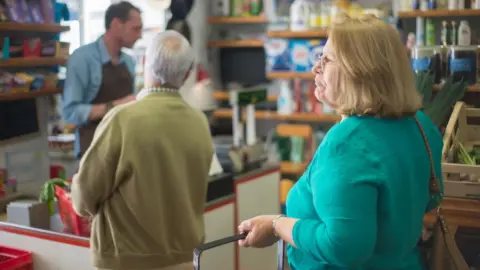
The store was packed that morning. Every cart was taken except one with a wobbly wheel, which I got. There were people rushing up and down the aisles and kids crying. Employees in red aprons were throwing cans onto shelves as fast as people pulled them off. Somebody had knocked over a display of canned pumpkin, and a teenage boy was on his knees picking it up.
I hadn’t really worried about finding a turkey. It was a big store. Then, in the produce section, I heard a man in a Steelers jacket tell his wife there wasn’t a single bird left at the ShopRite.
I left my cart by the potatoes and went straight to the back of the store.
The big refrigerated case where they keep the turkeys was nearly bare. There were a few turkey breasts, a couple of bags of giblets, and a sign that said CUSTOMER LIMIT 2 TURKEYS PER TRANSACTION, handwritten in marker and taped to the glass. And there, pushed all the way back in the corner, was one turkey. It was a fresh one, sixteen pounds.
It was the last one in the case. I knew that bird was meant for me.
I reached in and hauled it out. My shoulder isn’t what it was, and I nearly dropped it. I carried it back to my cart like a baby and laid it in the basket. Then I went back through the store with Margaret’s list. I got butter, two lemons, onions, celery, and a pound of Jimmy Dean sausage for the stuffing. I picked up a bag of the dried bread cubes too, though she always made her own. I didn’t trust myself to do that.
I called Ellen from the baking aisle.
“I got it,” I said. “Sixteen pounds. Last one in the store.”
“Dad! That’s great. See, it’s a sign.”
“I’m getting everything else now.”
“Remember we’re bringing the sides. You only have to worry about the turkey.”
“And the gravy,” I said.
“And the gravy,” she said.
The checkout lines went halfway back into the store. Every register was open and it didn’t matter. I picked the line at register six, because the cashier looked quick, and settled in to wait.
I waited almost thirty minutes. I read the tabloids at the end of the aisle. I tried to read the cooking instructions printed on the turkey wrapper without my glasses. It said something about an internal temperature, and that the thigh and the breast weren’t the same, and I couldn’t make out the numbers. I didn’t want to get my glasses out in front of everybody, which was foolish.
About twenty minutes in, a woman got in line behind me. She was in her forties, I’d guess, in a puffy white coat, with very long fake eyelashes. She had her phone in one hand and was pushing her cart with the other. She was muttering the whole time, half to the phone and half to herself, about the line and the store and somebody named Tricia who’d better not be late tomorrow. I didn’t pay much attention. I was trying to work out how many hours sixteen pounds would take.
Then it was finally my turn.
I pushed my cart up beside the conveyor belt and started unloading it. The cashier was a young woman in her early thirties, I’d say, with brown hair pulled back. She had a red apron like the others, but she also had a lanyard with a different-colored badge than the rest of them. She smiled at me.
“Getting ready for a big family dinner?”
“Something like that,” I said. “First time I’m doing the cooking myself.”
She looked at me for a second, a little longer than seemed normal. “Well, good luck,” she said. “You’ll do great.”
“Thank you, young lady.”
I unloaded the celery and the onions and the butter. My cart had drifted back a little behind me while I was unloading. The wheel was bad. I turned around to get the last of it, the lemons and the sausage and the turkey.
The turkey was gone.
I stood there looking at the empty basket like a fool. For a second I thought I’d already put it on the belt. I looked at the belt. It wasn’t there. I looked around, confused, and then I saw it. It was sitting in the cart of the woman behind me, right on top of two other turkeys.
“Excuse me, ma’am,” I said. “Did you take that turkey out of my cart?”
She looked straight at me without lowering her phone. “Yeah. So what?”
I honestly didn’t know what to say. I’ve been a mail carrier, a husband, a father, and a deacon at St. Matthew’s. In seventy-three years I’ve never had someone take something out of my cart and say “so what.”
“But that’s my turkey,” I said.
She laughed in my face. “Well, old man, if you haven’t paid for it yet, then it isn’t yours. What difference does it make whether it was sitting on the shelf or in your cart? It’s the store’s.”
I looked at the cashier, hoping she’d say something. She was busy scanning my celery and didn’t look up. She did reach under her counter for something for a second, and then went back to scanning.
Behind the woman in the white coat, people were getting restless. A man farther back called out, “Come on, let’s go! Some of us have places to be!”
I took a breath. I tried to be polite. Margaret always said you catch more flies with honey.
“Please, ma’am. Give me my turkey back. My family’s coming tomorrow, and I need to cook for them. It’s important to me.”
She rolled her eyes. “Look, I’m having a party tomorrow. Thirty people are coming. Thirty. I need more turkeys, and there aren’t any left on the shelves. So I honestly don’t care what you need.”
The line behind us got louder. A woman muttered, “Oh my God, just pick one.” The man farther back, the one in the Steelers jacket from produce, called out again. “Hey, buddy! Either buy what you’ve got or get out of the way!”
My eyes started to sting. I’m ashamed of that, but there it is. For weeks I’d been telling myself I could manage Thanksgiving without Margaret, that I could get through one day by myself. Now I couldn’t even get through the checkout line at the Giant Eagle. I could feel everybody in that line staring at the back of my neck.
I looked at the woman. She wasn’t the least bit embarrassed. She’d gone back to her phone and was chewing gum with her mouth open. She hadn’t made any effort to hide that she already had two turkeys before she grabbed mine.
“Please,” I said one more time. “You’ve already got two turkeys in your cart.”
She shoved her cart forward. It banged into mine hard enough to knock it into my hip.
“And what are you going to do about it? Fight me over a turkey? I need more than two!”
I couldn’t say another word. I was afraid that if I opened my mouth, I’d cry in front of all those people. So I turned back around, put the lemons and the sausage on the belt, and let the cashier finish ringing me up. She told me the total. It was $43.12. I paid with my card. My hands were shaking and I got the PIN wrong the first time.
I picked up my two bags and started for the doors. I was already thinking about what I’d tell Ellen. I’d call Paul and ask if anybody had a turkey left anywhere in the county. If not, I’d go to Ellen’s after all and sit at her table, and that would be fine. It would have to be.
I’d gotten maybe ten steps when I heard a scream behind me. It was loud enough that the whole front of the store went quiet.
“What the hell did you just do? How dare you!”
I turned around.
The cashier had taken all three turkeys off the woman’s side of the belt. They were sitting on the floor behind her register, at her feet, out of reach. The woman in the white coat was standing at the end of the counter with her mouth open. All the color had gone out of her face. She’d been yelling so hard her gum had come out of her mouth. It was lying on the belt between a bag of rolls and a can of cranberry sauce.
Everybody in line was staring.
The cashier turned her head and looked straight at me over the woman’s shoulder. And she winked.
I set my bags down by the gumball machines and walked back.
A man in a white shirt and tie was hurrying down from the customer service desk. He was maybe fifty, with a name badge that said DOUG, STORE MANAGER. The woman spun around to face him.
“Look what your cashier did! What am I supposed to do now? I’ve got thirty people coming tomorrow!”
The cashier was perfectly calm. She pointed at the little screen on her register, which said TRANSACTION VOID in red letters.
“I started ringing her up,” she told Doug. “She had three turkeys. I told her there’s a limit of two per customer today. She told me if she couldn’t have all three, I should cancel the whole order. So I canceled it.” She paused. “Also, she took one of those turkeys out of this gentleman’s cart while he was unloading. I saw her do it.”
Doug leaned over and looked at the register screen. Then he looked at the three turkeys on the floor. Then he looked at me. He put his hand over his mouth.
“Oh my God,” he said. He turned to the woman. “You took a turkey out of another customer’s cart?”
“That’s not the point!” she shouted. “She took all three of mine!”
“I told you there’s a limit of two,” the cashier said again. Her name tag said RACHEL. “There’s a sign.” She pointed. There was a sign, the same handwritten one from the turkey case, taped to the side of her register. “You told me to cancel everything. So I did.”
“I didn’t mean actually do it!”
“I’m happy to ring up your groceries again, ma’am. I just can’t sell you three turkeys.”
The woman reached across the end of the counter for my turkey. It was the one on top. She knew which one was mine, all right. Rachel slid it back with her foot without even looking down.
“Well, ma’am,” Rachel said pleasantly, “if you haven’t paid for it yet, then it isn’t yours.”
I knew those words. So did everybody else in that line. Somebody behind me snorted. Then a woman with a baby on her hip started laughing, and then a few more people did.
The woman in the white coat turned to Doug. “Are you seriously going to let her talk to me like that?”
“Ma’am,” Doug said, “she’s enforcing store policy. And I’m certainly not going to reward you for taking something out of another customer’s cart.” He folded his arms. “I’ll let you buy the two turkeys you picked out yourself. If you stop shouting at my employee.”
She opened her mouth to argue. Before she could, the man in the Steelers jacket spoke up from four people back. It was the same man who’d told me to buy what I had or get out of the way.
“You’ve got two turkeys, lady. The rest of us would like to get home before Thanksgiving too.”
She looked around. I think she was waiting for somebody, anybody, to take her side. Nobody did. A teenage bagger at the next register was filming the whole thing on his phone, and Doug gave him a look until he put it away.
Finally she threw up her hands and said fine. Doug flagged down a girl from the bakery counter and had her open register seven. The woman pushed her cart over there with her two turkeys and her chin in the air, without her gum.
When she was gone, Rachel bent down and lifted my turkey off the floor with both arms. She set it on the counter in front of me.
“Sir,” she said. “I believe this belongs in your kitchen.”
I couldn’t say anything. I just looked at her.
She lowered her voice. “I’m sorry I didn’t step in sooner. When she banged your cart, I pushed the manager call button under the counter. I didn’t want to get into it with her while you were standing right there. I was afraid she’d do something worse. Shove you, or something.”
“I thought everybody wanted me gone,” I said. My voice wobbled.
“Not everybody,” Rachel said. “I wasn’t about to let her walk out of here with your turkey.”
Doug nodded at the sign. “We put those limits up this morning so more families could get a bird. I wish we didn’t have to remind people why that matters.” He shook my hand. “I’m sorry, sir. That shouldn’t have happened in my store.”
I reached into my back pocket for my wallet. “Thank you, young lady. You don’t know what this means to me.”
“Actually,” Rachel said, “I think I do.”
She turned to Doug. “Can you cover my register for a minute?”
He looked surprised, but he stepped behind the counter. Rachel took a debit card out of her apron pocket.
“I’d like to buy this for you,” she said.
“Oh, no. No, no. You’ve done more than enough already. I can afford a turkey.”
“Please, Arthur,” she said. “Let me. Margaret would have done the same for me.”
My hand stopped on my wallet.
“How do you know my wife’s name?”
Rachel smiled, but her eyes had gone wet. “I was wondering when you’d ask me that.”
Doug rang up the turkey, and Rachel paid for it. It came to $27.84. Then she took my arm and walked me to the bench by the front windows, where people wait for their rides. She carried the turkey for me and set it on the bench between us. My grocery bags were where I’d left them by the gumball machines, and the teenage bagger brought them over without being asked.
She told me she’d known Margaret for seven years.
Back then, Rachel was twenty-five. She’d just separated from her husband, who had left her with a car payment and not much else. She was working part-time at this same store, stocking shelves on the overnight shift. She had a four-year-old son named Oliver. Her mother watched him at night while she worked.
The day before Thanksgiving that year, she finished her shift at seven in the morning and went through the store with a basket. She had whatever was left in her checking account after paying her rent on the first.
“I added it all up in my head,” she said. “Twice. I thought I had enough. When the cashier told me the total, I was almost forty dollars short.”
She’d started taking things out of her bags and handing them back. First the rolls went, and the cranberry sauce, and then the pie. Then she picked up a little turkey she’d promised Oliver. It was a nine-pounder, because he’d seen one in a cartoon and wanted one with “legs to hold.”
There was an older woman in line behind her, in a navy blue raincoat, with her hair in a bun.
“She tapped me on the shoulder,” Rachel said. “She asked me if I was cooking Thanksgiving for somebody special. I told her about Oliver. I don’t know why. I was so embarrassed I’d have told her anything.” She wiped her eyes with the back of her hand. “And she said to the cashier, ‘Put it all back in her bags, please, and ring it up with mine.’ Just like that. She paid for the whole thing.”
Rachel had been so mortified she’d insisted on writing her phone number down on the back of the receipt. She told Margaret she’d pay her back when her next paycheck came.
“She folded the receipt up and put it in her pocket. And she said, ‘You keep your money for your little boy.'”
I looked down at the turkey on the bench between us. I could see Margaret doing it. I could see the navy raincoat. She’d had it for twenty years and wouldn’t let me buy her a new one.
“She never told me about that,” I said.
“Well,” said Rachel, “there’s more.”
After that, she said, Margaret always stopped to talk to her whenever she saw her in the store. Margaret would ask about Oliver and how his preschool was going, and whether his cough had cleared up.
About six months later, Rachel mentioned that a full-time customer service position had opened up at the store. It paid better, with benefits and health insurance, and she’d be on days instead of nights. She wanted to apply, but she was scared to death of the interview. She’d never had a real job interview in her life, and she didn’t own anything decent to wear.
“The next Tuesday was my day off,” Rachel said. “And Margaret picked me up at my apartment in this big tan Buick.”
“The LeSabre,” I said. “She loved that car.”
“She took me to the Goodwill on Lincoln Highway. She bought me a blouse, a gray one with little buttons, and a pair of black pants and some flats. Then she took me to the Eat’n Park and bought me coffee and pie. And she made me practice. She asked me every question she could think of. She was tough.”
“She ran the church rummage sale for twenty years,” I said. “She was tougher than she looked.”
Rachel laughed. “She kept stopping me. I’d say I needed the job because I had a little boy and rent was going up. And she’d say, ‘No. Tell me why you deserve it. Not why you need it.’ She made me say it about ten times, until I believed it.”
Rachel got the job. Two years after that, she was promoted to customer service supervisor, which was why her badge looked different. She still jumped on a register when the store got slammed, like the day before a holiday. That was why she was standing at register six that morning.
She’d since moved into a better apartment, a two-bedroom near Oliver’s school. Oliver was eleven now. He played trombone in the middle school band, badly, she said.
“I told her everything about him,” Rachel said. “And she’d show me pictures on her phone of her grandkids. That’s how I knew you the minute you got in my line. You were in every single picture.”
She laughed a little.
“She talked about you all the time, Arthur. Especially around Thanksgiving. She said you couldn’t be trusted alone in a room with a cooked turkey.”
I laughed. It came up out of me before I could stop it. It was the first time I’d laughed in a long while, and it hurt a little.
“How did you find out she’d passed?”
Rachel’s face changed. “Your daughter came in last spring. Ellen. I recognized her from the pictures too. She has Margaret’s eyes. I asked her how her mother was doing.” She wiped her cheeks again. “I’d always thought there’d be another chance to thank her properly. Really thank her. I was going to bring Oliver by your house sometime, so she could see him. I kept putting it off. I thought there’d be time.”
For eleven months people had been telling me how lucky I was. Forty-nine years, they’d say, what a blessing to have had so many good years. I knew they meant well. They were kind people, from church and the neighborhood. But every time I heard it, I felt worse. I didn’t want to be told to be grateful for the years I’d had. I wanted one more.
Sitting on that bench with Rachel was different. She had known a side of my wife I’d never even seen. Margaret had driven a stranger to the Goodwill on a Tuesday and bought her a blouse. She’d never mentioned a word of it to me.
I took Rachel’s hand. It was cold from handling the turkeys.
“I think you just did thank her,” I said.
She squeezed my hand and couldn’t say anything for a minute.
Before I left, the man in the Steelers jacket came up to us with his cart. He stood there awkwardly with his cap in his hand.
“Sir,” he said, “I’m sorry about what I said back there. I was tired and I’d been in line forever, and I took it out on the wrong person. I should’ve been telling her to give your turkey back, not telling you to get out of the way.”
“That’s all right,” I said. “It was a long line.”
He nodded and put his cap back on and left.
I asked Rachel if she’d take a picture with me, so I could show my family. She said she’d love to. The teenage bagger took it on my phone. In it, Rachel and I are standing by the gumball machines and I’m holding the turkey in both arms like a prize fish. I’m smiling, which I don’t usually do in pictures. Rachel’s mascara has run.
When I got home, I put the turkey in the refrigerator and the groceries away. Then I went into the bedroom and opened Margaret’s side of the closet. I hadn’t had the heart to clear it out yet. Her navy raincoat was hanging on the end. I put my hand in the right pocket, the way she always did. There was a folded grocery receipt in it, soft and faded, from the Giant Eagle. I unfolded it under the lamp.
It wasn’t from seven years ago. It was from last November, the week before Thanksgiving. It was a regular receipt for our groceries, with the butter and the celery and the little things she always got. And on the back, in her slanty blue handwriting, there was a note to herself.
“Rachel—ask about Oliver’s band concert. Bring the pie plate back.”
I sat down on the edge of the bed where she’d sat down that afternoon. I held that receipt for a long time. Then I put it in my wallet, behind my driver’s license.
The next morning I was up at five. I brined the turkey the way Ellen had told me. I put the butter under the skin, and the lemon and onion in the cavity. I put it in the oven at a quarter to eight, and I set a timer on the stove for every forty minutes, to baste. I made the stuffing from the bag, with the sausage. It wasn’t Margaret’s, but it was close enough. I made the gravy last, from the drippings, in her cast-iron skillet. I made extra. I made about twice as much as anybody needed.
Ellen and Paul came at one, with everybody. For the first time in almost a year, my house was loud. Paul’s little ones ran up and down the hall. Ellen’s teenagers sat on the couch with their phones and still ate everything in sight. My son-in-law brought a sweet potato casserole that was mostly marshmallows.
Before we sat down, I got everybody in the living room. I took out my phone and showed them the picture of Rachel, and I told them what had happened at the store. I told them all of it. I had to stop a couple of times.
When I got to the part about Margaret taking Rachel to the Goodwill for interview clothes, Ellen started crying. She came and sat on the arm of my chair and put her head on my shoulder.
“That sounds exactly like Mom,” she said. “Exactly like her.”
“Did you know?” Paul asked her.
“No. She never said a word. I asked a cashier how Mom was doing last spring, and she got so quiet. I thought it was strange.” Ellen wiped her face. “Oh, Dad.”
The turkey wasn’t as good as Margaret’s. I won’t pretend it was. The breast was a little dry, and I forgot to take the bag of giblets out of the neck until halfway through, which Paul thought was the funniest thing that had ever happened. But my grandson Tyler had seconds, and so did Paul’s middle girl, and everybody drowned it in gravy anyway.
Before we carved it, Ellen caught me in the kitchen. I had the foil lifted off one corner and a butter knife in my hand.
“Dad,” she said.
“I know,” I said.
“Mom would have caught you.”
“She always did.” I cut a sliver and held it out to her. She hesitated, and then she took it and ate it. Then she got a saucer out of the cupboard and spooned some stuffing onto it for me.
After dinner, while the kids were watching the game and the grandkids were fighting over the pie, I packed up a container of leftovers. It had turkey and stuffing and a jar of the gravy. I asked Ellen to help me send Rachel a text message, because I’m still slow on that phone. I invited her and Oliver to come over for dinner sometime. I said I’d make a turkey, if she didn’t mind one that was a little dry. I said there would be plenty of gravy.
Rachel wrote back in about ten minutes. She said they’d love to come. She said Oliver wanted to know if he could bring his trombone, and that I should say no.
I told Ellen to write back that he could bring it.
I drove the leftovers over to the Giant Eagle on Friday morning. Rachel was at the customer service desk. She took the container and lifted the lid and smelled it, and she laughed.
“This is a lot of gravy, Arthur.”
“It was in the recipe,” I said.
She put it under the counter and asked me how long I’d cooked it. I told her five and a half hours. She said that was too long for sixteen pounds. She said next time I should check the thigh with the thermometer starting at four, and take it out at a hundred and sixty-five.
“Margaret tell you that too?” I said.
“No,” Rachel said. “That one’s on the package. You just need your glasses.”