“Mom, I know what really happened that weekend.”
Sophie stood in the kitchen doorway holding a phone. Her face had gone white, and her hands were shaking so hard the phone rattled against her ring.
It was a black iPhone with a cracked corner and a blue rubber case. A little sticker of a largemouth bass on the back, half peeled off.
I knew that phone.
“Where did you get that?” I said.
“It was in the garage,” Sophie said. “In Dad’s tackle cabinet. In the bottom drawer. Inside an old reel case. Wrapped in a sock.”
“That’s not possible.”
“Mom.”
“Your father lost that phone,” I said. “Two months before the trip. We bought him a new one. At the Verizon store in Baraboo. I remember. He was so annoyed about it.”
Sophie didn’t say anything.
She just held it out.
“There’s a video in the gallery,” she said. Her voice was very quiet. “You’re not going to believe what’s on it. It’s the last video Dad ever recorded. The night before they left.”
She looked right at me.
“I know what happened, Mom,” she said. “I know it wasn’t an accident.”
Before I tell you what was on that phone, I have to tell you about that summer.
Six years earlier.
The last summer I had a whole family.
My name is Anna Mercer. I was forty-four when this happened. I’m fifty now.
My husband, Daniel, and I had six children. Three boys and three girls. People used to joke that we were the Brady Bunch, only nobody had been married before and we didn’t have Alice.
We lived in an old farmhouse outside Portage, Wisconsin, on four acres with a red barn and an apple tree and a tire swing that Daniel hung the summer Ethan turned three.
Ethan was our oldest. Fifteen that summer. Tall and quiet, with Daniel’s dark hair and my freckles. He’d just gotten his learner’s permit. He talked about trucks constantly.
Caleb was twelve. Loud. Funny. A terrible speller. He could make anybody laugh, including his teachers when they were trying to give him detention.
Owen was nine. The baby boy. He still slept with a stuffed otter named Gus and still held my hand in parking lots without being asked.
Then the girls.
Sophie was thirteen. Serious and stubborn and smart. She read everything. She argued with everybody.
Grace was ten. Gentle. Shy. She drew horses on every piece of paper in the house.
And Lucy was four. Pigtails and scabbed knees and opinions about everything.
Daniel was forty-six.
He ran Mercer Marine & Bait on Pine Ridge Lake with his younger brother, Dean. Their father started it in 1979. A little bait shop, a boat rental dock, a repair garage, and twelve slips for summer people from Madison and Chicago.
Daniel did the repairs and the boats. Dean did the books and the front counter.
Daniel was careful.
That’s the thing people need to understand. He was the most careful man I ever met.
He never let the car drop below half a tank. Never. He checked the weather three times before he left the house. He replaced the smoke detector batteries on the first of every month whether they needed it or not. He made all six kids wear life jackets on the dock, even the ones who could swim.
He’d been on Pine Ridge Lake his whole life. He knew every rock, every current, every sandbar.
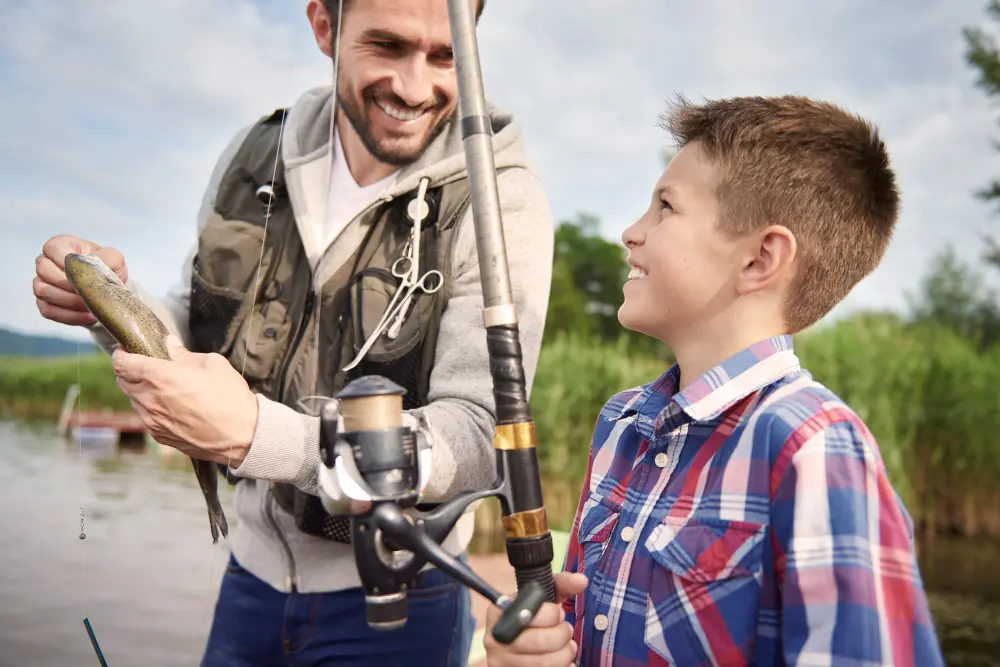
And every summer, the second weekend in June, he took the boys fishing.
Just the boys. It was their tradition. It started when Ethan was six. They’d take Daniel’s old sixteen-foot aluminum boat out to the north end of the lake, where it narrows into the Wapaka River. They’d camp on a sandbar there. Two nights. Catch walleye. Eat too many hot dogs. Come home Sunday sunburned and filthy and happy.
The girls and I had our own tradition. Movies and popcorn and painting our toenails on the living room floor.
That Friday morning, I stood in the driveway in my bathrobe with a cup of coffee and watched the boys load the truck.
Coolers. Fishing rods. Sleeping bags. Owen’s otter, Gus, sticking out of his backpack.
Ethan rolled his eyes when I told him to wear sunscreen. Caleb tried to sneak a second bag of Doritos into the cooler. Owen came back up the driveway twice to hug me.
“Bye, Mom. Bye, Mom. Bye.”
I took a picture.
I don’t know why. I didn’t usually. I just held up my phone and said, “Boys. Look at me.”
Daniel put his arm around Ethan. Caleb made a face. Owen held up Gus.
Click.
I didn’t know it would be the last photograph I ever took of my husband and my sons.
Daniel kissed me through the truck window.
He looked tired. I remember that. More tired than usual. He’d been working late at the shop all spring. Quiet at dinner. Distracted.
“You okay?” I said.
“I’m fine,” he said. “Just a lot going on at the shop. I’ll tell you about it when we get back. Monday.”
“Tell me now.”
He smiled. That crooked smile.
“Monday,” he said. “I promise. It’s nothing for you to worry about.”
He backed out of the driveway.
The boys waved out the windows.
And they were gone.
They were supposed to come home Sunday evening. By six.
By seven, I’d called Daniel four times. It went straight to voicemail.
By eight, I’d called Ethan six times. Voicemail.
The younger boys didn’t have phones yet.
At nine, I called Dean.
“They’re probably just running late,” Dean said. “The fish were biting. Daniel loses track of time. You know how he is.”
“Daniel doesn’t lose track of time, Dean. Ever.”
He was quiet for a moment.
“I’ll drive out to the dock,” he said.
At ten-thirty, Dean called back.
“Anna,” he said. “The truck’s here. At the north landing. The trailer’s here. The boat’s not.”
I called the Columbia County Sheriff’s Office at 10:41 p.m.
They found the boat the next morning.
On the far shore of the lake. Near the mouth of the Wapaka River. Washed up in the reeds. Upside down. Half full of water.
The motor was still attached. The cooler was gone. The fishing rods were gone. One life jacket was tangled in the reeds nearby.
It was Owen’s. Orange. With his name on it in black marker.
They searched for three weeks.
The sheriff’s office. The DNR. The Coast Guard Auxiliary from Lake Michigan. Volunteer divers. Fishermen from all over the county. A helicopter. Cadaver dogs on the riverbanks.
They found a sleeping bag two miles down the Wapaka. They found Caleb’s baseball cap stuck in a fallen tree.
They never found Daniel or my boys.
The sheriff came to my house on a Thursday at the end of June. Sheriff Ron Hollister. Big man. Gray mustache. He’d known Daniel since high school.
He sat at my kitchen table with his hat in his hands.
“Anna,” he said. “We’re going to call off the search.”
He said there’d been a storm Saturday night. A fast one. Came through around eleven. High winds. Heavy rain. The lake got rough.
He said the boat probably took on water. Maybe they tried to make it back across in the dark. Maybe they capsized near the river mouth, where the current is strongest.
He said the Wapaka runs fast in June. Deep. Cold. With logjams and undercut banks.
“They may never be found,” he said. “I’m so sorry.”
The official report said accidental drowning.
Four people. One boat. One storm.
Case closed.
How do you keep going after something like that?
I don’t really know. I just did.
I had three girls. Sophie was thirteen. Grace was ten. Lucy was four.
They needed breakfast in the morning. They needed rides to school. They needed somebody to sign permission slips and buy new shoes and check for monsters under the bed.
So I got up. Every morning. I made pancakes. I drove the carpool. I signed the slips.
I fell apart at night. After they were asleep. In the bathroom. With the water running so they couldn’t hear.
Lucy asked every night for a year when the boys were coming home.
Grace stopped drawing horses. She started drawing boats. Upside down. Over and over.
Sophie stopped talking almost completely for six months. She stopped arguing. She stopped reading. She’d sit on the tire swing Daniel hung and stare at the driveway.
We had a memorial service in August. At St. Mary’s in Portage. Four empty caskets. Four pictures on easels at the front of the church.
The whole town came.
I don’t remember any of it.
Dean helped.
I want to be fair about that. He did help.
He came over every Sunday after church. He fixed things. The leaky faucet. The broken porch step. The furnace, that first winter, when it quit in January.
He took the girls fishing. Not on the lake. On a pond at a friend’s farm. He said they shouldn’t be afraid of water forever.
He paid for things when I couldn’t. Lucy’s preschool. Sophie’s braces. He’d leave an envelope on the kitchen counter and say, “Don’t argue, Anna. Daniel would’ve wanted it.”
He was Daniel’s younger brother. Three years younger. Never married. He’d always been the fun uncle. Loud. Generous. A big laugh. A new truck every two years.
After the accident, he got quieter.
He looked older. He lost weight. Sometimes, at Sunday dinner, he’d stare at Daniel’s empty chair at the head of the table and not say anything for a long time.
I thought it was grief.
And there was the marina.
Daniel’s half of Mercer Marine went to me. Dean ran it. He sent me a check every month. Not much. A few hundred dollars. He said business had been slow since the accident. People didn’t want to rent boats from the place where four people drowned.
That made sense.
About a year after the accident, Dean asked if I’d sell him my half.
“You don’t want to deal with it, Anna,” he said. “The taxes. The paperwork. The memories. Let me take it off your hands. I’ll pay you fair.”
I said no.
I don’t know why. I couldn’t let go of it. It was Daniel’s. It was his father’s. It was the place where he taught all six of our kids to bait a hook.
Dean asked again the next year.
And the next.
Every year, around June, around the anniversary, he’d sit at my kitchen table and bring it up. Gently.
“You need to let go, Anna,” he’d say. “You need to move forward. For the girls. For yourself. Holding on to the marina isn’t going to bring them back.”
Even the pastor said it. Even my sister. Even my therapist.
Let go. Move forward.
But I couldn’t.
I couldn’t, because something about it never made sense to me.
Daniel was careful.
Daniel checked the weather three times before he left the house.
There’d been a storm Saturday night. Fast and strong.
But Daniel would’ve known about it. He would’ve seen it coming. He would’ve stayed on the sandbar. Pulled the boat up on shore. Waited it out in the tent.
He never would have tried to cross that lake in the dark in a storm with his three sons.
Never.
I said that to the sheriff. To Dean. To everybody.
“Sometimes even careful people make mistakes, Anna,” they said.
So I didn’t let go.
I didn’t touch anything.
Their bedrooms stayed exactly the way they’d left them. Ethan’s truck posters. Caleb’s dirty soccer cleats under his bed. Owen’s glow-in-the-dark stars on the ceiling.
Daniel’s clothes stayed in our closet. His razor stayed by the bathroom sink. His reading glasses stayed on his nightstand, on top of a library book about the Civil War that was six years overdue.
The library stopped sending notices after the first year.
Some part of me still believed they might walk through the front door.
I know how that sounds. I know.
But the bodies were never found.
And as long as they were never found, there was this tiny, terrible, crazy part of my heart that whispered maybe.
Maybe.
Six years passed.
Sophie grew up.
She went from thirteen to nineteen. She graduated from Portage High School as valedictorian. She got a scholarship to UW–Madison. Criminal justice. She wanted to be a detective.
I never asked her why.
I didn’t have to.
Grace was sixteen. She’d started drawing horses again. Slowly. Mostly horses running.
Lucy was ten. She didn’t really remember her brothers. Not their faces. Just things. Caleb’s laugh. Owen’s otter. Ethan carrying her on his shoulders at the county fair.
She’d ask me sometimes to tell her about them. Before bed.
I’d tell her the same stories over and over.
She never got tired of them.
In April of this year, Sophie came home from Madison for spring break.
She sat down across from me at the kitchen table on the first night.
“Mom,” she said. “I think it’s time.”
“Time for what?”
“The boys’ rooms,” she said gently. “Dad’s things. I think it’s time to go through them.”
I didn’t say anything.
“Not all of it,” Sophie said. “Not yet. Just some. We could give some to the church. The clothes. Somebody could use them.”
She reached across the table and took my hand.
“It’s been six years, Mom,” she said. “I’ll do it. I’ll do all of it. You don’t have to touch anything. Just let me.”
I looked at my daughter.
Nineteen years old. My husband’s dark eyes. My stubborn chin.
“Okay,” I said.
She started on a Tuesday.
She spent three days in the boys’ rooms. Packing. Sorting. Crying sometimes. I could hear her through the walls. I didn’t go in. She asked me not to.
On Friday, she went out to the garage.
Daniel’s workbench. His tools. His fishing gear. The big green metal tackle cabinet with eight drawers that his father gave him when he was sixteen.
That evening, she came into the kitchen.
I was making spaghetti. Lucy was doing homework at the table. Grace was upstairs.
Sophie stood in the doorway.
She was holding a phone.
“I’ll show you,” Sophie said. “But not here.”
She looked at Lucy.
“Not in front of her.”
We went out to the barn.
I don’t know why. It just felt like the right place. Away from the house. Away from Lucy and Grace.
We sat on two overturned buckets by the old hay loft. Sophie turned on the flashlight on her own phone and set it on a feed barrel so it lit us both up.
She held Daniel’s phone in her lap.
“I found it in the bottom drawer,” she said. “In an old reel case. A Shimano case. Wrapped in a wool sock. Like he was hiding it.”
“It was dead?”
“Totally dead. I charged it in my room. It took an hour to turn on.”
“How did you get in? It had a passcode.”
Sophie looked at me.
“I tried everybody’s birthdays,” she said. “Then I tried the date of the fishing trip. Every year. June second weekend. It didn’t work. Then I tried 0614.”
“Our anniversary,” I said.
“It worked,” Sophie said. “First try.”
I didn’t say anything.
“Mom,” Sophie said. “He didn’t lose this phone. He hid it. Two months before the trip. He told you he lost it. He bought a new phone. And he kept using this one. Secretly.”
“Why would he do that?”
“Because the family phone plan,” Sophie said, “was through the marina. Dean set it up. Dean had access to everything. Our location. Our texts. Our photos. Everything went to the cloud on the business account.”
She looked down at the phone.
“Dad didn’t want Dean to see what was on this one,” she said.
My stomach went cold.
“There’s stuff on here,” Sophie said. “Photos of papers. Spreadsheets. Bank statements. From the marina. Hundreds of pictures. Dated March, April, May. Before the trip.”
She swallowed.
“And there are videos,” she said. “Three of them. The last one is from the night before they left. Friday. June 10th. 9:47 p.m.”
She held it out to me.
“I watched it four times,” she said. “I’m sorry, Mom. You need to see it.”
My hands were shaking so hard I couldn’t hold it.
Sophie held it for me.
She pressed play.
It was Daniel.
He was sitting in the front seat of his truck. At night. In the dark. The only light was from the dashboard. Green and orange on his face.
He was holding the phone up in front of him. Recording himself.
He looked exhausted. His eyes were red. He hadn’t shaved in two days.
I hadn’t seen his face move in six years.
I made a sound. I don’t know what kind. Sophie put her arm around me.
“Anna,” Daniel said into the camera.
His voice.
Six years.
“If you’re watching this, something went wrong. I’m probably being paranoid. I’m probably going to delete this on Monday and feel stupid. But just in case.”
He took a breath.
“I’m sitting in the parking lot at the marina,” he said. “It’s almost ten. I just came back to check the boat for tomorrow. I wanted to show you something. In case anybody ever asks.”
He turned the phone around.
The video shook. Moved. He was getting out of the truck. Walking across the gravel lot. Out onto the dock. The lights on the dock poles. The black water.
His boat. The sixteen-foot aluminum one. Tied up in slip three. The cooler and the rods already loaded.
He knelt down at the back of the boat.
He pointed the phone at the stern. Down low. At the bottom of the transom.
“Drain plug,” he said. “In. Tight. See?”
He reached down and twisted it. A brass T-handle. It didn’t move.
“In and tight,” he said again.
Then he climbed into the boat.
He pointed the phone at the bilge pump. Down in the bottom of the hull. A little black box with a wire running to the battery.
“Bilge pump,” he said. “Connected.”
He flipped a switch on the console.
You could hear it. A little whirring hum. Water spitting out a hole in the side of the hull.
“Working,” he said.
He turned it off.
He pointed the camera at the fuel tank. The fuel line. The battery. The running lights. He turned them all on. He turned them all off.
“Everything checked,” he said. “Nine fifty-one p.m. Friday, June tenth. Everything’s good.”
He turned the phone back around. To his face.
He was standing on the dock now. The lights behind him. His face was tired and serious.
“I always check,” he said. “You know I always check, Anna. Every time. But I wanted it on video. This time.”
He looked off to the side. At something past the camera.
“I found out about Dean,” he said.
My heart stopped.
“Three months ago,” Daniel said. “I was looking for an invoice in the office. For the Hendricks boat. And I found—”
He stopped. He rubbed his face with his free hand.
“He’s been taking money, Anna,” he said. “From the marina. For years. Five years at least. Maybe longer. Fake invoices. Repair jobs that never happened. Payroll for people who don’t work there. He’s been writing checks to a company in Madison that doesn’t exist.”
He swallowed.
“I counted,” he said. “Six hundred and forty thousand dollars.”
I couldn’t breathe.
“I didn’t tell you,” Daniel said. “I’m sorry. I didn’t tell anybody. I wanted to be sure first. He’s my brother. I wanted to be sure.”
He looked at the camera.
“I’ve been taking pictures,” he said. “Every night. After he leaves. Of the books. The bank statements. The fake invoices. I bought a new phone so he wouldn’t see what was on this one. Everything’s on here. Everything.”
“I talked to him today,” Daniel said. “This afternoon. In the office. I told him I knew. I told him I had proof.”
His jaw went tight.
“He cried,” Daniel said. “He begged me. He said he had gambling debts. He said he owed people. Bad people. In Chicago. He said if I went to the police, he’d lose everything. He’d go to prison.”
He shook his head.
“I told him he had until Monday,” Daniel said. “To come clean. To tell Dad’s lawyer. To figure out how to pay it back. Or I’d go to the sheriff myself. Monday morning. With everything on this phone.”
He was quiet for a moment.
The water lapped against the dock behind him.
“He got really quiet,” Daniel said. “After that. He just sat there at the desk. He didn’t say anything. Then he said, ‘You’re really going to do this to me, Danny? Your own brother?’”
Daniel looked into the camera.
“And then he said, ‘Enjoy your fishing trip.’”
He was quiet again.
“I’m probably being stupid,” he said. “He’s my brother. I’ve known him my whole life. He was my best man. He’s Ethan’s godfather. He’d never—”
He stopped.
“But just in case,” he said. “Just in case. That’s why I came back tonight. To check the boat. To film it. So if anything happens, you know it was fine when I left it.”
He took a breath.
“The pictures of the books are in the album called ‘Shop,’” he said. “And I put the real ledger in my tackle cabinet. The bottom drawer. Under the reel cases. If you need it.”
Then he smiled.
That crooked smile.
“I’ll probably delete this on Monday,” he said. “And you’ll never see it. And we’ll laugh about how paranoid I was. And I’ll tell you everything over coffee. Like I promised.”
He looked into the camera.
“I love you, Annie,” he said. “Kiss the girls for me. I’ll see you Sunday night. Six o’clock.”
The video ended.
I don’t remember the next few minutes.
Sophie told me later that I didn’t make a sound. That I just sat there on the bucket in the barn, staring at the phone, while the flashlight on the feed barrel flickered.
She said I sat there for almost ten minutes without moving.
Then I said, “Play it again.”
She played it again.
And again.
The third time, I made her pause it.
On the part where Daniel was kneeling at the back of the boat. Pointing the phone at the drain plug.
In. Tight.
“Sophie,” I said. “The report. The sheriff’s report. From the accident. Do we still have it?”
“It’s in the file cabinet,” she said. “In your bedroom. I looked at it last night. After I found this.”
She looked at me.
“Mom,” she said. “There are pictures in the report. Of the boat. When they found it.”
“I never looked at them,” I said. “I couldn’t.”
“I did,” Sophie said. “Last night.”
She took out her own phone. She’d taken pictures of the pictures.
She showed me.
The boat. Upside down in the reeds. Then right side up, on a trailer, at the sheriff’s impound lot in Portage.
The back of the boat. The transom. Close up.
The drain hole.
Empty.
No brass T-handle. No plug.
Just a round, empty hole at the bottom of the transom.
The report said, under Findings: Drain plug not recovered. Likely dislodged during capsizing.
Sophie swiped to the next picture.
The inside of the hull. The bilge pump. The little black box.
The wire that ran from the pump to the battery.
Cut.
A clean cut. Straight across. Both ends.
The report said: Bilge pump wiring damaged. Likely during capsizing or recovery.
I looked at the picture of that cut wire for a long time.
I’m not a mechanic. But I was married to one for twenty-two years.
I know what a cut wire looks like.
A wire that gets torn in a storm frays. It stretches. It snaps. It looks like a broken rubber band.
This wire looked like somebody had cut it with wire cutters.
Sophie put her phone down.
“Dad checked the drain plug at nine fifty-one,” she said quietly. “On video. In. Tight. He checked the bilge pump. Working.”
She looked at me.
“Somebody went to that boat after he left,” she said. “Friday night. After ten. And pulled the plug. And cut the wire.”
“So it would fill up slowly,” I said.
My voice came out very far away.
“So it would take on water,” Sophie said. “Out in the middle of the lake. Slowly. Without anybody noticing. And the pump wouldn’t turn on to get the water out.”
She swallowed.
“And then the storm came,” she said.
I closed my eyes.
“Who had the keys to the marina, Mom?” Sophie said. “Who had the gate code? Who knew Dad was taking the boys out the next morning? Who knew which slip the boat was in?”
I didn’t answer.
I didn’t have to.
“Enjoy your fishing trip,” Sophie said.
I sat in that barn until midnight.
Sophie sat with me.
At some point, I started crying. Not normal crying. Something worse. Something that came up from the bottom of me, from six years of not knowing.
Sophie held me the whole time.
Nineteen years old. Holding her mother on an overturned bucket in a barn.
“Mom,” she said, when I’d finally stopped. “We have to go to the police.”
“I know.”
“Tomorrow. First thing.”
“I know.”
“Not Sheriff Hollister,” Sophie said. “Somebody else.”
I looked at her.
“Hollister and Dean went to high school together,” Sophie said. “They play poker on Thursdays. I’m not saying Hollister did anything wrong. But I’m not taking this to him.”
My daughter. The detective.
“Who, then?” I said.
“The state,” Sophie said. “Wisconsin Department of Justice. Division of Criminal Investigation. They have a cold case unit. One of my professors used to work there. I’ll call her tonight.”
Then she said something I’ll never forget.
“Mom,” she said. “Dean’s coming for dinner on Sunday.”
I’d forgotten.
He came every Sunday. Six years.
He’d been asking about the marina again. Just last week. Gently. Over pot roast.
“Annie, it’s time. Let me take it off your hands. You need to let go.”
“You can’t let him know,” Sophie said. “You can’t let him see anything on your face. Not until the state police tell us what to do.”
I looked at her.
“Can you do that?” she said.
I thought about it.
I thought about Dean. Sitting in Daniel’s chair at the head of the table every Sunday. Six years. Fixing my faucet. Paying for Sophie’s braces. Taking the girls fishing on his friend’s pond.
You need to let go, Annie.
“Yes,” I said.
Sophie’s professor was named Dr. Linda Haskins.
She used to be a special agent with the Wisconsin DCI. Twenty-two years. Cold cases mostly. She retired to teach at UW–Madison.
Sophie called her at 12:30 that night.
She was at our kitchen table at nine the next morning.
She was in her sixties. Short gray hair. Glasses on a chain. A tweed blazer.
She watched the video three times without saying a word.
Then she looked at the pictures from the sheriff’s report.
Then she put her glasses down on the table.
“Mrs. Mercer,” she said. “I’m going to make some phone calls.”
The next three weeks were the longest of my life.
Dr. Haskins brought in an active DCI agent. A woman named Theresa Okafor. Forties. Quiet. Very calm. She came to the house twice. She took Daniel’s phone. She took the ledger from the tackle cabinet. Sophie had found it, right where Daniel said. A green accounting ledger, the old-fashioned kind, with six years of Daniel’s careful handwriting in the margins.
Agent Okafor had the boat photos examined by a marine forensics expert from the University of Minnesota. A man named Hal Jorgensen who’d testified in boating accident cases for thirty years.
He sent his report in eight days.
The bilge pump wire, he said, had been severed with a sharp cutting tool. Not torn. Not stretched. Not broken from force. Cut. Clean.
The drain plug opening showed no signs of stress. No damage to the threads. No bending. A plug knocked loose in a capsizing would have damaged the threads.
This plug, he wrote, was unscrewed.
Then she had a forensic accountant go through the marina records.
The ones on Daniel’s phone. And the ledger. And the marina’s bank statements, which she subpoenaed directly from the bank in Baraboo.
That took two weeks.
The accountant found everything Daniel found.
Six hundred and forty thousand dollars, missing, between 2013 and the summer Daniel died.
And she found something else.
Mercer Marine had a key person life insurance policy.
Their father had set it up in 1998. When he made both boys partners. If either partner died, the other partner received a payout. To keep the business running.
Two million dollars.
After the accident, Dean collected it.
Two million dollars. In September. Three months after my husband and my sons drowned.
And within two weeks of getting the check, Dean had paid the six hundred and forty thousand dollars back into the marina’s accounts.
Every penny.
In one deposit. Labeled CAPITAL CONTRIBUTION — D. MERCER.
Then he’d used the rest to pay off his gambling debts. Eight hundred thousand dollars. To an account in Cicero, Illinois. And bought a lake house in Door County.
“He covered his tracks,” Agent Okafor said. She was sitting at my kitchen table. “With the insurance money. From his brother’s death.”
She looked at me.
“If anyone ever looked at the marina books,” she said, “after the accident, they’d see everything balanced. They’d never know the money was missing in the first place.”
“And the only person who knew,” I said, “was dead.”
Sunday came.
And Dean came for dinner.
I made pot roast. Like always. Potatoes. Carrots. Rolls. Apple pie for dessert.
Dean came in the back door at five-thirty. Like always. He kissed my cheek. He hugged Lucy. He ruffled Grace’s hair.
He sat down at the head of the table.
In Daniel’s chair.
Sophie sat across from him.
I watched her. She smiled at him. She asked about his week. She passed him the rolls.
She’d been practicing in the mirror all morning. I’d heard her.
Dean talked about the marina. About the new boat lift he’d ordered for the summer. About a walleye tournament in July.
Then, over pie, he put down his fork.
“Annie,” he said. Gently. “I’ve been thinking. About what we talked about. The marina.”
I kept my face very still.
“I know it’s hard,” he said. “I know. But it’s been six years. The boys would want you to move on. Danny would want you to move on.”
He reached across the table and put his hand on mine.
“Let me buy you out,” he said. “I’ll pay you fair. More than fair. You can put the money away for the girls’ college. For Sophie’s grad school. You can stop worrying about it.”
He squeezed my hand.
“You need to let go, Annie,” he said. “For your own sake.”
I looked down at his hand on mine.
The hand that unscrewed the drain plug.
The hand that cut the wire.
I smiled at him.
“You’re right, Dean,” I said. “It’s time. I’ve been thinking about it too.”
His face lit up.
“Really?”
“Really,” I said. “I’m ready. Let’s do it.”
He let out a long breath. Like he’d been holding it for six years.
“I’ll have the lawyer draw up the papers,” he said. “This week. We can sign next Saturday.”
“Let’s sign at the marina,” I said.
He blinked.
“At the marina?”
“At the dock,” I said. “Where Danny kept his boat. Slip three. I’d like to sign it there. To say goodbye. Saturday evening. At sunset.”
He looked at me for a long moment.
Something passed across his face. Just for a second. Something I couldn’t quite read.
Then he nodded.
“Okay, Annie,” he said softly. “If that’s what you need.”
Agent Okafor didn’t like the plan.
“It’s risky,” she said. “We have enough to arrest him now. The accounting. The insurance. The forensics on the boat. The video.”
“But you don’t have a confession,” Sophie said.
Agent Okafor looked at her.
“No,” she said. “We don’t. And a good defense attorney will say Daniel took the plug out himself. To clean it. And forgot to put it back. That the wire was cut by somebody at the impound lot. That the embezzlement and the accident are a coincidence. That Dean paid the money back because he found it missing after his brother died and wanted to protect his brother’s memory.”
She shook her head.
“It’s a strong case,” she said. “But it’s circumstantial. Six years later. Juries don’t always convict on circumstantial.”
“I want him to say it,” I said. “I want to hear him say it. On the dock. Where it happened.”
Agent Okafor looked at me for a long time.
“You’d wear a wire,” she said. “We’d be close. Very close. In the bait shop. On the water. On the shore. If anything goes wrong, anything at all, we come out.”
“Okay.”
“You can’t push him,” she said. “You can’t accuse him. If he feels trapped, he’ll lawyer up and we’ll never get anything. You just have to let him talk. Give him room.”
“I’ve been married to a Mercer for twenty-two years,” I said. “I know how they talk.”
Saturday.
Six years and ten months after the last photograph.
The sun was going down over Pine Ridge Lake when I pulled into the marina parking lot.
The same gravel lot. The same dock. The same light poles. The same black water.
I hadn’t been there since the memorial.
I got out of the car.
I was wearing a cardigan over a T-shirt. Under the T-shirt, taped to the skin just below my collarbone, was a small black microphone the size of a button.
Agent Okafor was in the bait shop with two other agents. Behind the counter. With the lights off.
There was a DNR boat with two state troopers anchored out on the lake, a few hundred yards away. Pretending to fish.
Sophie was in the car with Dr. Haskins in the church parking lot across the road. She’d begged to come. I’d let her.
Dean was waiting on the dock.
At slip three.
The slip was empty now. It had been empty for six years. He’d never rented it out.
He was holding a manila folder. The sale papers.
He was wearing his good jacket. The one he wore to the memorial.
“Hey, Annie,” he said.
“Hey, Dean.”
I walked out onto the dock.
The boards creaked under my feet. The water lapped against the posts.
I stood next to him at the end of slip three.
We looked out at the lake.
The sun was going down behind the trees on the far shore. Near the mouth of the Wapaka. Where they found the boat.
Neither of us said anything for a long time.
“He kept his boat right here,” I said finally. “Every summer. Slip three.”
“I know,” Dean said.
“I can still see it,” I said. “The night before. I bet he came down here and checked everything. He always did. The drain plug. The bilge pump. Everything.”
Dean didn’t say anything.
“Do you remember that night, Dean?” I said. “Friday night? The night before they left?”
He looked down at the water.
“I remember,” he said quietly.
“Did you see him? That night?”
He didn’t answer for a long time.
“No,” he said finally. “I went home early that day.”
I nodded.
I looked out at the lake.
“He told me something was wrong at the shop,” I said. “That morning. In the driveway. Before they left. He said there was a lot going on. He said he’d tell me Monday.”
I looked at Dean.
“He never got to tell me,” I said. “Do you know what it was? What he wanted to tell me?”
Dean’s face went very still.
“No, Annie,” he said. “I don’t.”
I took out my phone.
I didn’t plan to. Agent Okafor had told me not to.
But I took it out anyway.
“Dean,” I said. “Sophie found something. In Danny’s tackle cabinet. In the garage.”
I held up the phone.
“His old phone,” I said. “The one he said he lost.”
Dean looked at the phone in my hand.
His face went white.
All the color. All at once. Like somebody pulled a plug.
I pressed play.
I turned the volume all the way up.
Daniel’s voice came out of the speaker.
On the dock. At slip three. Six years later.
Drain plug. In. Tight. See?
Dean took a step back.
Bilge pump. Connected. Working.
Dean took another step back.
His back hit the light pole at the end of the dock.
I found out about Dean.
“Turn it off,” Dean said.
His voice cracked.
“Annie. Turn it off.”
He’s been taking money, Anna.
“Turn it off!”
And then he said, “Enjoy your fishing trip.”
I turned it off.
The dock was silent.
Just the water. Lapping against the posts.
Dean was standing with his back against the light pole. Shaking. His face was gray. He was looking at the phone in my hand like it was a snake.
“He checked the plug at nine fifty-one,” I said quietly. “On video. In. Tight. He checked the pump. Working.”
I took a step toward him.
“When they found the boat, Dean,” I said, “the plug was gone. And the wire to the bilge pump was cut. A forensics expert from Minnesota looked at the pictures. He said it was cut with wire cutters. He said the plug was unscrewed. Not knocked out. Unscrewed.”
Dean slid down the light pole.
He sat down on the dock. Hard. With his knees up.
He put his face in his hands.
“I didn’t mean for it to happen,” he said.
I didn’t move.
I didn’t say anything.
Give him room, Agent Okafor said.
I gave him room.
“I didn’t mean for it to happen,” Dean said again. Into his hands. “I swear to God, Annie. I swear to God.”
He was crying now. Ugly crying.
“I just wanted to buy time,” he said. “That’s all. I just needed a few more days. He gave me till Monday. Monday. I couldn’t fix it by Monday. I owed people in Chicago four hundred thousand dollars. They were going to kill me, Annie. They told me. They showed me pictures of my house.”
He lifted his head. His face was wet.
“I thought if the boat started taking on water,” he said, “out on the lake, Danny would turn around. He’d have to come back early. Saturday morning, maybe. He’d be mad. He’d have to bail all the way back. He’d lose the weekend. He’d have to fix the boat. It’d buy me a few days. A week, maybe. To figure something out.”
He shook his head.
“I didn’t know about the storm,” he said. “I swear to God. I didn’t check the weather. I never check the weather. Danny always checked the weather.”
I stood there on the dock.
I couldn’t feel my hands.
“I came down here at midnight,” Dean said. “After he left. I let myself in with my code. I turned off the camera on the dock. It was easy. I’d been turning it off for years. So nobody’d see me in the office at night.”
He wiped his face.
“I pulled the plug,” he said. “I put it in my pocket. I cut the wire to the pump. I thought he’d notice. When he launched. I thought he’d look in the bilge and see water and turn around.”
He looked up at me.
“Danny always checked,” he said. “Every time. Morning and night. I thought he’d check again in the morning. Before they launched.”
“He checked it the night before,” I said. “So he wouldn’t have to in the morning. So the boys could get on the water early.”
My voice was very quiet.
“Owen wanted to catch the sunrise bite,” I said. “Danny promised him. They left the house at five-fifteen.”
Dean made a sound.
It wasn’t a word. It was something worse than a word.
“I didn’t know,” he said. “I didn’t know, I didn’t know, I didn’t know.”
“You knew on Sunday,” I said.
He went still.
“Sunday night,” I said. “When I called you. When they didn’t come home. You knew. You knew exactly what had happened. You drove out to the dock. You called me back and said the truck was here and the boat wasn’t.”
I took a step closer.
“You could have told the sheriff,” I said. “That night. You could have told them to look for a boat that had taken on water. Near the river mouth. Where the current is. You could have told them where to look. Maybe they’d still have been alive. Clinging to something. On a sandbar. In the reeds. Maybe.”
Dean didn’t say anything.
“And you didn’t,” I said. “You let them search for three weeks. You stood next to me at the memorial. In that jacket. You held my hand.”
I was shaking now.
“You took two million dollars, Dean,” I said. “Three months later. From Danny’s death. And you put the money back. So nobody would ever know he’d found out.”
I looked down at him.
“And for six years,” I said, “you came to my house every Sunday. And sat in his chair. And told me to let go.”
Dean looked up at me.
He opened his mouth.
Nothing came out.
“Owen still had his otter, Dean,” I said.
My voice broke.
“His stuffed otter. Gus. In his backpack. He was nine. He was nine years old.”
Dean put his face back in his hands.
He didn’t look up again.
The door of the bait shop opened.
Agent Okafor came out first. Then the two other agents.
They walked down the dock. Not fast. Calm. Steady.
Out on the lake, the DNR boat started its engine.
“Dean Mercer,” Agent Okafor said. “You’re under arrest.”
He didn’t fight.
He didn’t run.
He just sat there on the dock with his back against the light pole while they put the handcuffs on him.
When they stood him up, he looked at me.
“Annie,” he said. “I’m sorry. I’m so sorry.”
I didn’t answer him.
I didn’t have anything to say.
They walked him off the dock. Up the gravel lot. Into the back of a gray state car.
I stood at the end of slip three and watched them drive away.
Then I sat down on the edge of the dock.
Right where Daniel knelt, six years ago, to check the drain plug.
I put my hand flat on the boards.
I heard footsteps behind me.
Running.
Sophie.
She’d come across the road from the church parking lot. Dr. Haskins was behind her, walking slower.
Sophie dropped down on the dock next to me. She put her arms around me.
Neither of us said anything.
The sun went all the way down behind the trees.
The dock lights came on.
Dean was charged with four counts of second-degree reckless homicide.
Plus embezzlement. Plus insurance fraud. Plus obstruction.
His lawyer tried for months to get the confession thrown out. He said I’d entrapped him. He said I’d ambushed him with the video. He said he was in emotional distress.
The judge didn’t agree.
In January, Dean pleaded guilty.
To all of it.
He didn’t want a trial. He said he didn’t want me to have to sit through it. He didn’t want the girls to have to hear it.
I don’t know if that was true. Or if it was the last thing he could do to make himself feel better.
I don’t care.
He was sentenced in March.
Thirty-two years.
He’ll be eighty-four when he gets out. If he gets out.
At the sentencing, the judge asked if I wanted to say anything.
I stood up.
I didn’t look at Dean. I looked at the judge.
“My husband checked the weather three times before he left the house,” I said. “He never let the car drop below half a tank. He made our kids wear life jackets on the dock, even the ones who could swim.”
I took a breath.
“For six years,” I said, “everybody told me even careful people make mistakes. I almost believed them.”
I looked at Dean then. For the first time.
“He didn’t make a mistake,” I said. “You did.”
I sat down.
Sheriff Hollister came to my house a week after the sentencing.
He stood on my front porch with his hat in his hands. The same way he did six years ago.
“Anna,” he said. “I owe you an apology.”
“For what?”
“For not looking harder,” he said. “For writing accident on the report. For not asking more questions about that wire. About that plug.”
He shook his head.
“I knew Danny,” he said. “I knew him thirty years. I knew he was careful. I knew he’d never go out in a storm. And I let it go anyway. Because it was easier. Because Dean was standing right there, saying it was an accident. And I’d known Dean my whole life.”
He looked down.
“I’m sorry,” he said. “I should have listened to you.”
I looked at him for a long time.
“Thank you, Ron,” I said.
The marina went to me. All of it. Dean’s half was forfeited as part of the restitution.
I didn’t want it.
I sold it. To a young couple from Madison. A man and his wife and their three little kids. He’d grown up fishing on Pine Ridge Lake. He said he’d always dreamed of owning that marina.
I sold it to them for a dollar.
On one condition.
Slip three is never rented.
Never.
There’s a little brass plaque on the post at the end of it now.
DANIEL MERCER. ETHAN MERCER. CALEB MERCER. OWEN MERCER.
THEY CHECKED EVERYTHING.
We never found their bodies.
I want to be honest about that. Some stories end with closure. This one doesn’t. Not all the way.
The DCI brought in a sonar team from Minnesota last summer. They searched the Wapaka for two weeks. They found a lot of things. An old car. A shopping cart. A rowboat from the 1950s.
They didn’t find my husband or my boys.
But in the second week, one of the divers came up from a deep pool under an undercut bank about three miles down the river.
He was holding something.
He swam to the shore where Sophie and I were standing. He took off his mask. He held it out.
It was Daniel’s tackle box.
Old. Green. Rusted shut. Covered in six years of river mud.
I took it home.
It took me three days to get it open.
Inside, under the rusted lures and the tangled line and the rotted plastic worms, there was a Ziploc bag. Double sealed. The way Daniel always sealed things.
And inside the bag was a piece of paper.
Damp. Faded. But readable.
It was a fishing log.
In Daniel’s handwriting. The one he kept every year on the trip. Who caught what. How big. What time.
Saturday, June 11.
5:52 a.m. — Owen. Walleye. 18 in. First fish of the trip!! He named it Gus Jr.
6:31 a.m. — Ethan. Walleye. 22 in. New personal record. He says he’s better than me now. He’s probably right.
7:15 a.m. — Caleb. Perch. 9 in. Says it counts. It counts.
8:40 a.m. — Me. Nothing. Boys say I’m washed up. Boys are probably right.
Best morning ever.
That was the last entry.
I sat at my kitchen table and held that piece of paper and cried until I couldn’t see.
Best morning ever.
They had a morning.
That’s what I keep telling myself. Before the water started coming in. Before the storm. Before any of it.
They had one perfect morning on the lake. The four of them. Owen caught the first fish and named it Gus Jr. Ethan beat his father. Caleb caught a perch and insisted it counted.
And Daniel wrote it all down.
Best morning ever.
That was a year ago.
Sophie graduated in May. She’s applying to the DCI training academy. She wants to work cold cases.
“For families like us,” she said. “Who know something’s wrong. And nobody listens.”
Grace is seventeen. She’s going to art school in Chicago in the fall. She painted a picture for the living room. Four people in a boat on a lake at sunrise. Right side up. A walleye on the end of a little boy’s line.
It’s hanging over the fireplace.
Lucy is eleven. She still asks me to tell her about her brothers before bed.
Now I have new stories to tell her.
About Gus Jr. About Ethan’s personal record. About Caleb’s perch, which counted.
I packed up the boys’ rooms in the end. Sophie helped. Grace helped. Even Lucy helped.
We gave most of it to the church. Like we said we would.
But I kept a few things.
Ethan’s truck poster. Caleb’s soccer cleats. Owen’s glow-in-the-dark stars. I peeled them off the ceiling one by one and put them in an envelope.
And Gus. Owen’s otter.
Not the real one. The real one went down the Wapaka with my boy.
But I found an identical one on eBay. A woman in Ohio was selling it. Brand new. Still with the tag.
It sits on my nightstand now. Next to Daniel’s reading glasses. On top of a library book about the Civil War that’s seven years overdue.
I took the library book back last month.
The woman at the front desk looked at the due date. She looked at me.
Then she looked at the name on the account. Daniel Mercer.
She was quiet for a long time.
“There’s no fine, Mrs. Mercer,” she said finally. “Not for this one.”
And the photograph.
The last one I ever took of them. In the driveway. That Friday morning. Daniel with his arm around Ethan. Caleb making a face. Owen holding up Gus.
I had it printed. Big.
It’s hanging in the front hallway. Right by the door. Where I see it every time I leave the house and every time I come home.
For six years, I couldn’t look at it.
Now I look at it every day.
Because I know what happened after I took it.
They drove to the lake. They launched the boat at sunrise. Owen caught the first fish.
And their father, who checked the weather three times and never let the tank drop below half and made everybody wear life jackets on the dock, wrote down the very last thing he ever got to write.
Best morning ever.
Every second weekend in June now, the girls and I drive out to Pine Ridge Lake.
We go to the marina. We walk out to the end of slip three.
We don’t take a boat out. Not yet.
We just sit on the edge of the dock with our feet hanging over the water, and we bring a cooler and four fishing rods, and we cast our lines out into the lake at sunrise.
We almost never catch anything.
It doesn’t matter.
Every year, Lucy writes it down in a little notebook, in her careful eleven-year-old handwriting.
Who caught what. How big. What time.
And at the bottom of the page, every year, she writes the same thing.
Best morning ever.