The doorbell rang at 5:47.
I was standing in the kitchen with a wooden spoon in my hand. The pot roast had been in the oven for two hours, the potatoes were mashed and keeping warm, and the table was set with the good plates. Wine glasses. Cloth napkins folded into triangles, the way Linda likes them.
There were five places at the table.
Linda had no idea about the fifth one.
I set the spoon down on the counter.
I wiped my hands on a dish towel.
I looked across the kitchen at the woman sitting at my kitchen island with a glass of iced tea. She’d been there for forty minutes. Her six-year-old son was on the floor of the living room building a Lego tower with his tongue sticking out of the corner of his mouth.
She looked back at me.
“You ready?” Kate said quietly.
“No,” I said.
“Me neither.”
She stood up.
The doorbell rang again. Twice. Impatient.
Then Linda’s voice through the door. Bright and loud.
“Hannah! We’re here! Open up, honey, my hands are full!”
I walked down the hallway.
I put my hand on the doorknob.
Through the little window beside the door, I could see them on the porch. Linda in front, holding a bakery box and her purse. Josh behind her, holding our daughter on his hip.
Ellie had her face buried in Josh’s neck.
Her little hand was up by her ear. Pulling at it.
I opened the door.
“There she is!” Linda said. She swept past me into the hallway with the bakery box. Lemon bars. Her specialty. She kissed the air beside my cheek. “Oh, something smells wonderful. Is that pot roast? You made my pot roast?”
“I did,” I said.
“Well,” Linda said. She looked very pleased with herself. “This is a nice surprise. I have to say, Hannah, I wasn’t sure how you were going to take it. But you’re being very mature about this. Very mature.”
Josh was still standing on the porch.
He wouldn’t look at me.
Ellie lifted her head from his shoulder.
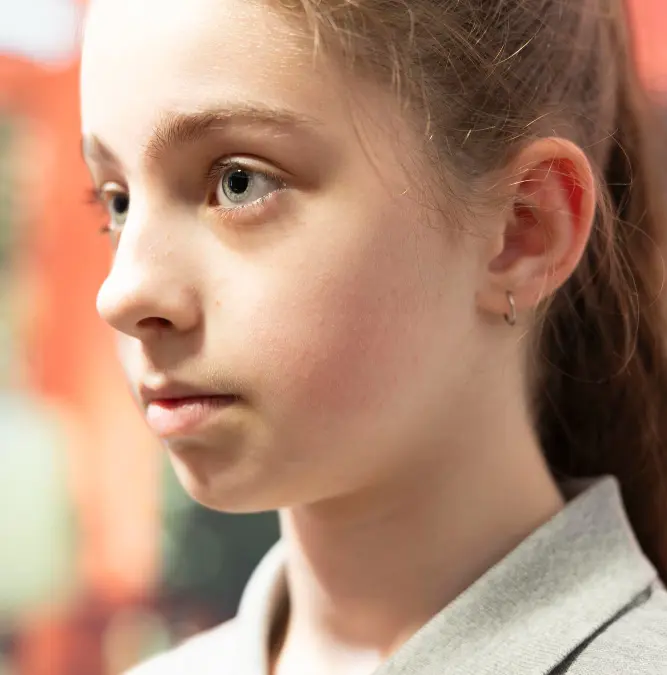
Her face was blotchy and red. Her eyelashes were wet. There were two tiny gold balls in her earlobes. The skin around them was pink and swollen.
She saw me.
“Mama,” she said. Her chin started to wobble. “Mama, ow.”
I reached out and took her from Josh.
She wrapped her arms around my neck so tight it hurt.
I didn’t say anything to my husband.
I turned around and carried our daughter down the hallway toward the kitchen.
Behind me, I heard Linda say, “Josh, hang up my coat, would you?” And then her heels clicking on the hardwood, following me.
She came around the corner into the kitchen.
She stopped.
Kate was standing by the island with her arms crossed.
Max had come in from the living room. He was standing next to his mother, holding her hand. He was wearing a little red pouch on a belt around his waist.
His EpiPen.
Linda’s smile disappeared.
Like somebody had flipped a switch.
“Hi, Mom,” Kate said.
I need to go back an hour.
Back to the photo.
My name is Hannah Brooks. I’m thirty-three. I work as a dental hygienist at a practice in Matthews, North Carolina, about twenty minutes outside Charlotte. Three days a week, so I can be home with Ellie the rest of the time.
Josh and I have been married five years. He’s an HVAC technician. He’s kind and funny and patient. He sings to Ellie in the bathtub. He makes pancakes shaped like dinosaurs on Saturday mornings.
He’s a good man.
I want to say that. Before I tell you the rest. Because it’s important to me that you understand. My husband is a good man.
He just has never once in his life told his mother no.
Ellie was two and a half that spring.
She has my brown eyes and Josh’s dimples and hair that has never really decided what it wants to be. It came in late. Fine and wispy and light brown. At two and a half, it was still short. Just past her ears. Too short for ponytails. Too short for bows to stay in.
She hated bows anyway. She’d pull them out and throw them on the floor and yell, “NO BOW.”
She also loved trucks. And dinosaurs. And mud. And her blue rain boots with frogs on them, which she wore every single day regardless of the weather.
She was perfect.
Linda didn’t think so.
Linda is Josh’s mother. She’s sixty-two. She was widowed nine years ago. Josh’s father, Frank, had a heart attack mowing the lawn. Linda lives alone in a big two-story house in Ballantyne with a white picket fence and a front porch full of rocking chairs she never sits in.
She’s very put together. Hair done every Thursday. Nails done every other Saturday. Pearls to the grocery store.
She raised two children. Josh and his older sister, Kate. She talks about it constantly.
“I raised two children, Hannah. I think I know a thing or two.”
She started on Ellie’s looks when Ellie was about eighteen months old.
At first, it was small.
“Oh, she’s so cute. When are you going to put her in some dresses?”
“She’d look so precious in pink, honey.”
“Have you tried a little headband?”
I’d laugh it off. Ellie lived in overalls and T-shirts because she spent half her life in the sandbox. I’d tell Linda that. She’d smile and say, “Well. Just a thought.”
Then it got bigger.
At Easter, Linda bought Ellie a dress. A big frilly pink one with a hoop skirt and a satin sash and a matching bonnet. Ellie wore it for exactly four minutes before she screamed and ripped the bonnet off and threw it in the dog’s water bowl.
Linda looked at me like I’d thrown it there myself.
At the Fourth of July barbecue at Linda’s house, a neighbor came over and said, “Oh, what a handsome little guy!” and patted Ellie on the head.
Linda’s face went red.
“She’s a girl,” Linda said sharply. “Her mother just doesn’t dress her like one.”
I took Ellie home early that day.
In the car, I said to Josh, “Did you hear what your mother said?”
He sighed. “She didn’t mean it like that, Han.”
“She said I don’t dress our daughter like a girl. In front of a stranger.”
“She’s just old-fashioned,” Josh said. “That’s how she is. She doesn’t mean anything by it.”
That’s how she is.
I heard that a lot over five years.
Then, about two months before the park, it started.
The earrings.
“She needs earrings, honey,” Linda said. We were at her house for Sunday dinner. Ellie was in her high chair smearing mashed potatoes in her hair. “People keep mistaking her for a little boy. It’s embarrassing. A tiny pair of gold studs. That’s all she needs.”
“Linda,” I said, “she’s two. Her hair will grow. I’m not piercing her ears because of what other people think.”
“It’s not about what other people think. It’s about her looking like what she is.”
“She’s a two-year-old who likes trucks,” I said. “That’s what she is.”
Linda didn’t say anything else that night.
But the next Sunday, she brought it up again.
And the Sunday after that.
“I had Kate’s ears pierced when she was six months old,” Linda said. “Everybody did it back then. She never even remembers it.”
“That’s great, Linda. But that’s not what I want for Ellie.”
“Why not?”
“Because it’s her body,” I said. “When she’s old enough to decide, she can decide. If she wants them, I’ll take her myself. I’ll buy her the earrings. But it’s going to be her choice.”
Linda laughed.
“Her choice,” she said. “She’s two, Hannah. She’d choose to eat crayons.”
I talked to Josh about it that night.
In bed. With the lights off.
“Josh,” I said. “Your mom keeps bringing up the earrings.”
“I know.”
“I need you to back me up. I’ve told her no five times.”
“I know, Han.”
“So you agree? No earrings? Not until Ellie asks for them herself?”
He was quiet for a while.
“Yeah,” he said. “I agree. Her body, her choice. You’re right.”
“Will you tell your mom?”
“I’ll tell her.”
I don’t know if he ever told her.
I suspect now that he didn’t.
By the end of April, it had gotten quiet.
Linda stopped bringing it up. Three Sundays in a row. Not a word about earrings.
I thought it was settled.
I thought she’d finally heard me.
So that Saturday, when she called and asked if she could take Ellie to the park, I said yes.
Freedom Park. In Charlotte. It has a big playground and a duck pond and a little train that goes around the lake.
“Josh can come too,” Linda said. “We’ll make a day of it. Give you a few hours to yourself. You deserve it, honey. You work so hard.”
It was the nicest thing she’d said to me in months.
They picked Ellie up at ten.
I packed the diaper bag. Snacks. Juice cup. Sunscreen. Her stuffed triceratops, whose name is Mr. Spikes.
“Don’t forget her jacket,” I said to Josh at the door. “It gets windy by the pond.”
“Got it.”
I kissed Ellie on the forehead. She was in her overalls and her frog rain boots.
“Bye, Mama!” she said. “Ducks!”
“Bye, baby. Feed the ducks for me.”
I stood on the porch and watched them back out of the driveway.
Linda waved from the passenger seat.
Josh didn’t look at me.
I noticed that. I didn’t think about it.
I spent the morning doing nothing.
I took a long shower. I read half a book on the back porch. I made myself a sandwich and ate it standing up at the counter in total silence.
It was wonderful.
At 11:14, my phone buzzed.
A text from Linda.
A photo.
It was Ellie.
Sitting on Josh’s lap. In a chair. In a store.
I recognized it. The bright lights. The racks of sparkly hair clips behind them. The glass case full of earrings.
It was Claire’s. At the SouthPark mall. Ten minutes from Freedom Park.
Ellie’s face was red and wet.
She was crying. Hard. Her mouth was open in a wail. Her little fists were clenched.
Josh had both his arms wrapped around her. Holding her still.
And in each of her earlobes, there was a tiny gold stud.
Under the photo, Linda had written:
See? Now she finally looks like a little girl! Josh agreed with me, too. He even held her while they did it. 💕
I don’t remember dropping my sandwich.
I just remember looking down later and seeing it on the kitchen floor. Turkey and Swiss. Upside down.
I called Josh.
It rang five times. Voicemail.
I called again. Voicemail.
I called a third time.
Voicemail.
I stood in the middle of the kitchen with the phone in my hand.
I zoomed in on the picture.
Josh’s face. He was looking down at the top of Ellie’s head. His face was strange. Tight. Like he was about to cry too.
But his arms were around her.
Holding her still.
Josh understood my stance on this. We’d talked about it. In bed. In the dark.
Her body, her choice. You’re right.
My phone buzzed again.
Linda.
You’re welcome, by the way. A thank-you would’ve been nice. 😊
I stood there with my hands shaking so hard I almost dropped the phone.
I wanted to scream.
I wanted to get in my car and drive to SouthPark and walk into Claire’s and grab my daughter and take her home and never let Linda near her again.
I wanted to call Josh and say things I could never take back.
I opened the text box.
I typed.
How DARE you. I told you NO. Five times. Six. She is MY daughter. You had no RIGHT. And Josh, if you’re reading this, I can’t even—
I stopped.
I looked at what I’d written.
I erased it.
Because I knew exactly what would happen if I sent it.
Linda would cry. Linda would call Josh in tears. Linda would say I was hysterical. That I’d overreacted. That it was just earrings, for heaven’s sake. That she was only trying to help.
And Josh would come home and say, “Han, come on. She didn’t mean anything by it. That’s just how she is.”
And everything would go back to exactly the way it was.
Until next time.
I sat down at the kitchen table.
I took a breath.
And I thought about Kate.
Kate is Josh’s older sister. She’s thirty-eight.
I’ve met her exactly four times in five years.
She lives in Raleigh. Two and a half hours away. With her husband, Marcus, and her son, Max.
She doesn’t talk to her mother.
She hasn’t for three years.
Josh told me the story when we first got married.
“Kate and Mom had a falling out,” he said. “Over something stupid. A cookie.”
“A cookie?”
“Max has a peanut allergy,” Josh said. “Mom was watching him one day. She gave him a cookie. Turned out it had peanut butter in it. He had a reaction. Kate freaked out. Said Mom did it on purpose. Said Mom never believed in allergies. Hasn’t spoken to her since.”
He shook his head.
“Mom made a mistake,” he said. “One mistake. And Kate cut her off forever. Mom cried for months. Kate’s always been dramatic.”
I believed him.
I’d met Kate at our wedding. She was quiet. Tight-lipped. She left early. She barely spoke to her mother. I’d thought she was cold.
I’d thought, poor Linda.
But now I sat at my kitchen table looking at a picture of my screaming two-year-old in a Claire’s at the mall. Held down by her father.
You could at least thank me.
And I thought about a cookie.
And I wondered.
I found Kate’s number in Josh’s phone contacts on our shared family plan. He’d never deleted it. He’d never called it either.
I almost didn’t press the button.
I pressed it.
She answered on the fourth ring.
“Hello?” Cautious. Like she didn’t recognize the number.
“Kate,” I said. “It’s Hannah. Josh’s wife.”
Silence.
“Is Josh okay?” Kate said. Her voice changed. Worried. “Is something wrong? Is it Mom?”
“Everybody’s okay,” I said. “Physically. I just—I need to ask you something. And I need you to tell me the truth.”
“Okay,” Kate said slowly.
“The cookie,” I said. “With Max. Three years ago. What really happened?”
The line went very quiet.
So quiet I thought she’d hung up.
“Why are you asking me that?” Kate said finally.
I told her.
The earrings. The two months of comments. Six times I said no. The park. Claire’s. The photo. Josh holding her.
You could at least thank me.
When I was done, Kate didn’t say anything for a long time.
Then she said, very quietly, “She told you she’d stopped, didn’t she? A few weeks before. She stopped bringing it up.”
I sat very still.
“Yes,” I said. “How did you know?”
“Because that’s what she does,” Kate said. “She gets quiet. Right before.”
Kate told me about the cookie.
Max was diagnosed with a severe peanut allergy at eighteen months. He’d had a reaction to a single bite of a peanut butter cracker at daycare. His throat swelled. His lips swelled. They used an EpiPen. He spent a night in the hospital.
Kate told her mother. Over and over.
“No peanuts. Ever. Not even a crumb. It could kill him.”
Linda didn’t believe her.
“Allergies are a modern thing,” Linda said. “Kids today are too coddled. We never had allergies when I was raising you. A little exposure is good for him. It builds up his system.”
“Mom. His throat closed up. He couldn’t breathe.”
“Oh, Katie, you’re always so dramatic. Doctors just want to sell you EpiPens.”
For a year, Kate didn’t let her mother babysit.
Then, when Max was three, Kate had a work emergency. Marcus was out of town. Her regular sitter was sick. She was desperate.
She called her mother.
“No peanuts,” Kate said, handing Max over at the door. “Nothing with peanuts. I put his EpiPen in his bag. Here’s the instructions. Please, Mom.”
“Of course, honey,” Linda said. “I’d never.”
Kate got a call from the emergency room at Atrium Health two and a half hours later.
Linda had made peanut butter cookies. From scratch. For Max.
She’d given him one. Just one. A little one. To see.
“He was fine for the first five minutes,” Linda told the ER doctor. “I thought, see? I knew it was nonsense.”
Then his face started swelling.
Then his lips turned blue.
Linda didn’t use the EpiPen. She didn’t know how. She’d never read the instructions. She called 911.
The paramedics used the EpiPen in her kitchen. Then a second dose in the ambulance.
Max spent two nights in the pediatric ICU.
“She told the doctor,” Kate said, “and I’m quoting her exactly, because I’ll never forget it as long as I live, she told him, ‘I just wanted to prove to my daughter that she’s overreacting.’”
I put my hand over my mouth.
“When I got to the hospital,” Kate said, “she was in the waiting room. And she said, ‘I’m sorry, Katie, but you have to admit, if you’d let me introduce him to peanuts slowly from the start, this never would have happened.’”
Kate’s voice cracked.
“My son was on oxygen,” she said. “In the ICU. And she was explaining to me why it was my fault.”
“Josh told me,” I said slowly, “that she made a mistake. That she didn’t know it had peanuts in it.”
Kate laughed.
It wasn’t a happy laugh.
“Of course he did,” she said. “That’s what she told him. And he believed her. He always believes her. Because believing her is easier than standing up to her.”
She paused.
“Hannah,” she said. “Did Josh tell you why I left early at your wedding?”
“No.”
“Because I tried to warn you,” Kate said. “At the reception. I pulled Josh aside. I said, ‘Watch her with your kids. Don’t leave her alone with them. Don’t trust her when she says she’s stopped.’ And Josh got angry. He said I was trying to ruin his wedding. He said I needed to leave.”
I sat at my kitchen table.
I looked at the photo of Ellie on my phone.
Screaming. Held down. Gold studs in her ears.
“She doesn’t believe us,” Kate said quietly. “That’s the thing you have to understand. Mothers. She doesn’t think we know what’s best for our own kids. She thinks she’s the only one who knows. And if you say no, she doesn’t hear no. She hears ‘not yet.’ She just waits. Until she can do it anyway. And then she wants you to thank her.”
I closed my eyes.
You could at least thank me.
“Kate,” I said. “Will you come over?”
“What?”
“Tonight,” I said. “For dinner. I’m going to invite her over. And Josh. And I want you here. With Max.”
There was a long silence.
“Hannah,” Kate said. “I haven’t been in the same room with her in three years.”
“I know.”
“I don’t know if I can.”
“I know,” I said. “I’m sorry. I shouldn’t have asked.”
More silence.
“What are you going to do?” Kate said finally.
“I’m going to thank her,” I said.
Kate didn’t say anything for a long time.
Then I heard her let out a breath.
“I’m two and a half hours away,” she said. “If I leave right now, I can be there by five-thirty.”
That’s when I sent Linda the text.
You’re right, Linda. Enjoy your walk. Ellie’s excited and now everyone can see her new earrings. I’ll prepare dinner. Come by later. I’d like to thank you properly.
Linda answered in under a minute.
I’m glad you’re finally starting to understand. I’m not as old-fashioned as you think, honey. I’ve raised children. You really should listen to me more often. We’ll be there in an hour!
Perfect, I wrote back.
Then I put my phone face down on the counter.
I went to the freezer and took out a chuck roast.
Linda’s pot roast. Her recipe. The one she taught me the first Christmas after Josh and I got married, standing at her stove, telling me I was cutting the onions wrong.
I’d make it exactly the way she liked it.
Kate and Max pulled into my driveway at 5:08.
She was in a blue Subaru with a Raleigh Children’s Museum bumper sticker. She sat in the car for almost two minutes before she got out.
When she did, I saw her hands. They were shaking.
She looked like Josh. That was the first thing I noticed. Same dark eyes. Same dimples, when she finally smiled.
Max was small for six, with curly hair and big glasses and a red pouch clipped around his waist.
“Is that your EpiPen?” I asked him.
He nodded seriously.
“I carry it everywhere,” he said. “Because I’m allergic to peanuts. If I eat one, my throat closes up and I can’t breathe. I almost died when I was three.”
He said it like he was reading it off a card. Like he’d said it a hundred times.
Kate put her hand on his curly head.
I’d checked the pot roast. I’d checked the potatoes. I’d checked the green beans.
I’d read every single label in my pantry. Twice.
“There’s nothing in this house with peanuts,” I said to Kate. “Nothing. I checked everything. I threw out a jar of peanut butter. And the trail mix. And a box of granola bars.”
Kate looked at me.
Her eyes filled up.
“Thank you,” she said.
So that’s where we were.
Linda in my kitchen doorway, with her bakery box of lemon bars, staring at her daughter.
Max holding Kate’s hand, with his little red EpiPen pouch.
Josh coming up behind his mother in the hallway. Stopping dead when he saw his sister.
And me. Holding Ellie. With her swollen pink earlobes and her wet face buried in my neck.
“Kate,” Linda said.
Her voice had gone very thin.
“What are you doing here?”
“Hannah invited me,” Kate said.
Linda turned and looked at me.
Her face was doing several things at once. Surprise. Confusion. Something sharper underneath.
“I don’t understand,” she said. “Hannah, what is this?”
“Dinner,” I said. “Like I said. Have a seat, Linda. Everybody sit.”
Nobody moved.
Then Josh spoke.
“Kate,” he said. His voice cracked. “Hey.”
“Hey, Joshie,” Kate said quietly.
“How did you—”
“Your wife called me,” Kate said. “This afternoon. She wanted to know what really happened with Max. With the cookie.”
Josh’s face went white.
He looked at me.
I looked back at him.
“Sit down,” I said. “All of you. Please.”
They sat.
I don’t know why. Maybe because I’d asked so calmly. Maybe because nobody knew what else to do.
Linda at one end of the table. The head. Where she always sits at her own house.
Josh next to her. Kate across from them. Max next to Kate, in a booster seat I’d borrowed from Ellie’s closet.
I put Ellie in her high chair next to me.
She was still whimpering. Pulling at her ears. I gently moved her hand away.
“Don’t touch, baby,” I said. “I know they hurt. Don’t touch.”
I served the pot roast.
Nobody ate.
Linda put her napkin in her lap very carefully. She folded her hands on the table.
“Well,” she said. “This is lovely, Hannah. Really. But I think I’m owed an explanation. You invite me to dinner to thank me, and then you ambush me with—”
She looked at Kate.
“With this,” she said.
“I did invite you here to thank you,” I said.
I put down the serving spoon.
I sat down.
I looked at Linda.
“Thank you, Linda,” I said.
She blinked.
“Thank you,” I said, “for showing me exactly who you are. So clearly. So completely. That I can never pretend I didn’t see it again.”
The table went silent.
Max looked from his mother to his grandmother to me.
“For two months,” I said, “you asked me to pierce Ellie’s ears. I said no. I said it six times. I counted. I told you why. I told you it was her body. That when she was old enough to choose, she could choose.”
I took a breath.
“Then you stopped asking,” I said. “Three weeks. Not a word. And I thought you’d heard me.”
I looked at Kate.
“Kate told me that’s what you do,” I said. “You get quiet. Right before.”
Linda’s mouth went tight.
“That’s ridiculous,” she said.
“And then today,” I said, “you took my two-year-old to the mall. To Claire’s. And you had them shoot holes in her ears. While she screamed. While her father held her down.”
I picked up my phone. I turned it around. I held up the photo.
Ellie. Red face. Wailing. Josh’s arms wrapped around her.
“And then you sent me this,” I said. “With a heart emoji.”
I scrolled down.
“And then this,” I said. “‘You’re welcome, by the way. A thank-you would’ve been nice.’”
I put the phone face down on the table.
“So thank you, Linda,” I said. “Thank you for making it so clear. Thank you for putting it in writing. Thank you for taking a picture.”
Linda’s face had gone red.
“I don’t have to sit here and listen to this,” she said.
“You don’t,” I said. “You can leave anytime you want. But I’m not finished. And you’re going to want to hear the rest.”
I turned to Kate.
“Kate,” I said. “Would you tell them what you told me? About the cookie?”
Kate looked down at her plate for a long time.
Max reached over and put his hand on her arm.
“It’s okay, Mommy,” he said. “You can tell.”
Kate told them.
All of it.
The diagnosis. The warnings. “Allergies are a modern thing.” The work emergency. “Of course, honey. I’d never.” The peanut butter cookies. From scratch. One little one. To see.
The blue lips. The EpiPen Linda never read the instructions for. The paramedics. The ambulance. Two doses. Two nights in the ICU.
“I just wanted to prove to my daughter that she’s overreacting.”
When Kate got to that part, Josh made a sound.
A small one. Like he’d been hit.
He was staring at his mother.
“That’s not what happened,” Linda said. Very fast. “That’s not what—Josh, you know that’s not what happened. I told you. It was a mistake. I didn’t know the cookies had peanut butter in them. They were from a bakery. The label—”
“They were from scratch, Mom,” Kate said quietly. “You made them. In your kitchen. With a jar of Jif. The paramedic saw it on the counter. It’s in the ER report. I have a copy.”
She reached into her purse.
She took out a folded piece of paper.
She put it on the table in front of Josh.
Josh unfolded it.
He read it.
His hand started to shake.
“Grandmother states she gave the patient one homemade peanut butter cookie to ‘test’ the allergy,” Josh read out loud. His voice was very quiet. “States, quote, ‘I just wanted to prove to my daughter that she’s overreacting.’ Peanut butter jar observed on kitchen counter by EMS.”
He put the paper down.
He looked at his mother.
“You told me it was a bakery,” he said. “You told me you didn’t know.”
Linda didn’t answer.
“You told me Kate was lying,” Josh said. “For three years. You told me she was being dramatic. You told me she was trying to keep your grandson from you out of spite. You cried. You cried every Christmas.”
His voice was rising.
“I told my own sister she was ruining my wedding,” Josh said. “Because she tried to warn me. And I believed you.”
“Josh, honey—”
“Did you do it on purpose, Mom?”
Linda stared at him.
“I didn’t think it would hurt him,” she said finally. “I didn’t think the allergy was real. Nobody had allergies when I was growing up. I thought Katie was being—”
She stopped.
“I was trying to help,” she said.
The table was silent.
Max was looking at his grandmother.
He’s six. He doesn’t remember her. He was three the last time he saw her. In an ambulance.
He looked at her for a long time.
Then he said, very seriously, “It was real. My throat closed up. I couldn’t breathe. My mommy cried.”
Linda looked at him.
Something moved across her face.
For just a second.
Then it was gone.
“And today,” I said.
I turned to Josh.
He was sitting there with the ER report in front of him and his face in his hands.
“Josh,” I said. “Look at me.”
He looked at me.
His eyes were red.
“We talked about this,” I said. “In bed. In the dark. I said her body, her choice. You said, ‘You’re right. I agree.’ You said you’d tell your mother.”
He didn’t say anything.
“And today you held her down,” I said. “While she screamed.”
He opened his mouth.
“Han,” he said. His voice broke. “I didn’t—that’s not—”
He stopped.
He looked at his mother.
“Mom said you changed your mind,” Josh said.
Everybody turned to look at Linda.
“At the park,” Josh said slowly. “By the duck pond. Mom said, ‘Oh, I almost forgot. Hannah texted me this morning. She changed her mind about the earrings. She wants it to be a surprise. For when you get home.’”
He swallowed.
“I said, ‘Really? She did?’” he said. “And Mom showed me her phone. A text from you. It said, ‘Ok fine. Whatever you think is best.’”
I stared at him.
“I didn’t send that,” I said.
“I know,” Josh said quietly. “I know that now.”
He turned and looked at his mother.
“Show her, Mom,” he said. “Show Hannah the text.”
Linda didn’t move.
“Mom,” Josh said. “Show her.”
Linda’s hands were in her lap.
She didn’t reach for her purse.
So I reached for mine.
I picked up my phone. I opened my text thread with Linda. I scrolled up.
I scrolled for a long time.
Past the photo. Past the heart emoji. Past three weeks of nothing. Past six times I said no.
Back to April 9th.
There it was.
Linda: I’m going to make that chicken casserole for Sunday. The one with the crunchy onions on top. Unless you’d rather do something else?
Me: Ok fine. Whatever you think is best.
I turned my phone around.
I held it up so Josh could see it.
“April ninth,” I said. “About a casserole.”
Josh stared at the screen.
Then he looked at his mother.
“You cropped it,” he said.
Linda didn’t say anything.
“You took a screenshot of a text about a chicken casserole,” Josh said. “And you cut off the top. So I’d only see ‘Ok fine. Whatever you think is best.’”
His voice was getting louder.
“And you showed it to me at the duck pond. And you told me Hannah changed her mind. And you walked me to Claire’s. And you told me to hold her.”
He stood up.
His chair scraped across the floor.
“I held her down, Mom,” he said. “She was screaming for her mama. She was looking at me. She was looking right at me. And I held her down because you told me Hannah said it was okay.”
He was crying now.
My husband. Thirty-five years old. Six-foot-one. Standing in our dining room crying.
“And I didn’t check,” Josh said. “I didn’t call Hannah. I didn’t text her. I didn’t ask. Because you showed me a screenshot. And you’re my mother. And I believed you.”
He turned to me.
“I’m so sorry, Han,” he said. “I should have called you. I should have called you. I’m so sorry.”
Linda stood up.
She was shaking.
“This is ridiculous,” she said. Her voice was high and sharp. “All of you. This is completely ridiculous. Over earrings. Earrings! Every little girl in America has her ears pierced. Kate had hers done at six months. Do you remember, Katie? You don’t even remember it. And you’re fine. You turned out fine.”
She pointed at Ellie.
“She’ll never remember this,” Linda said. “Never. In five years she’ll be thanking me. She’ll be wearing pretty earrings and looking like a little girl and nobody will be calling her a boy at the grocery store.”
“Nobody’s going to call her anything at the grocery store,” I said, “because she’s two. And she’s wearing frog boots. And she’s happy.”
“She’s not happy!” Linda said. “She looks like a boy! It’s embarrassing! For you! For Josh! For me! People look at me, Hannah! They look at me with my granddaughter and they think—”
She stopped.
The table was silent.
“They think what, Mom?” Kate said quietly.
Linda didn’t answer.
“That’s what this has always been about,” Kate said. “Isn’t it? Not Ellie. Not Max. Not what’s best for them. What people think when they look at you.”
She looked at her mother.
“You didn’t give Max that cookie because you thought it would help him,” Kate said. “You gave it to him because you couldn’t stand that I knew something about my son that you didn’t. And you couldn’t stand that I wouldn’t do what you said.”
Linda’s face crumpled.
For the first time, she looked old.
“I raised two children,” she said. “I raised you. And Josh. By myself, mostly. Your father was never home. I did everything. And you both turned out fine.”
Her voice broke.
“Why doesn’t anybody ever listen to me?” she said.
Nobody answered.
Ellie had stopped whimpering.
She was sitting very still in her high chair, looking at her grandmother with big brown eyes.
She reached up and touched her ear.
“Ow,” she said quietly. To Linda. “Gamma. Ow.”
Linda looked at her.
She looked at the tiny gold stud. The swollen, pink, angry earlobe around it.
She looked at it for a long time.
Then she picked up her purse.
She picked up her bakery box of lemon bars.
She walked out of the dining room.
Down the hallway.
The front door opened. And closed.
We heard her car start in the driveway.
We heard her back out.
She was gone.
Nobody said anything for a long time.
Then Max said, “Can I have pot roast now?”
Kate laughed.
It came out of her like a sob. She put her hand over her mouth and laughed and cried at the same time.
“Yeah, buddy,” she said. “You can have pot roast.”
I served Max a plate.
I cut Ellie’s pot roast into tiny pieces. I put it on her tray. She picked up a piece of carrot and looked at it suspiciously. Then she ate it.
Josh was still standing.
He was looking at the empty chair at the head of the table.
“Josh,” Kate said. “Sit down. Eat.”
He sat down.
He didn’t eat.
He looked at his sister across the table.
“Katie,” he said. “I’m sorry. For the wedding. For three years. For calling you dramatic. For believing her.”
His voice cracked.
“For not believing you,” he said.
Kate looked at him for a long time.
“You were a kid when Dad died,” she said quietly. “You were twenty-six, but you were a kid. And she was all you had. I understand, Joshie. I do. I just needed you to see it.”
She reached across the table. She took his hand.
“You see it now,” she said.
“I see it now,” Josh said.
Kate and Max stayed the night.
Max slept in the guest room. Kate slept on the couch. She insisted.
I sat with her in the living room until two in the morning. Drinking tea. Talking. About Linda. About Josh. About Max. About Ellie.
About growing up in that big two-story house in Ballantyne with the white picket fence.
“She was always like this,” Kate said. “My whole life. Everything had to look a certain way. My hair. My clothes. My grades. My friends. If something didn’t look right, she’d fix it. Whether I wanted her to or not.”
She looked down at her tea.
“She pierced my ears when I was six months old,” she said. “I don’t remember it. But I remember when I was eleven, I wanted to cut my hair short. Like Winona Ryder. She said no. I asked for a year. She said no every time.”
She took a sip of tea.
“Then one day I came home from school,” Kate said, “and she’d made an appointment for me. At her salon. To get a perm. She said short hair made me look like a boy.”
I closed my eyes.
“I cried in that chair for two hours,” Kate said. “And she took a picture. And put it on the refrigerator. And told everybody how cute I looked.”
Josh slept on the floor of Ellie’s room that night.
On the rug. Next to her crib. With a pillow and a blanket.
I didn’t ask him to. He just went in there after Kate and Max went to bed.
I stood in the doorway at midnight and watched him. He was lying on his side, with one arm reaching up through the crib slats. Holding Ellie’s hand while she slept.
He wasn’t asleep.
He was crying. Quietly. So he wouldn’t wake her.
I didn’t go in.
I went back to our bedroom. I lay down alone.
I didn’t forgive him that night.
I want to be honest about that.
The next morning, I called our pediatrician.
Dr. Ramos. She’s been Ellie’s doctor since the day she was born.
I sent her a picture of Ellie’s ears. Red. Swollen. A little crusty around the studs.
She called back within an hour.
“Mild irritation,” she said. “Pretty normal for a fresh piercing with a gun. Not infected yet. Keep them clean. Saline twice a day.”
“Dr. Ramos,” I said. “If I take them out. Now. What happens?”
She was quiet for a moment.
“The holes will close,” she said. “Pretty fast, at her age. A few days, maybe a week. They might leave a tiny mark. Probably not.”
“Will it hurt her?”
“Taking them out? A little pinch. Less than putting them in.”
She paused.
“Hannah,” she said gently. “Can I ask what happened?”
I told her.
She didn’t say anything for a long time.
“It’s your call,” Dr. Ramos said finally. “Medically, either choice is fine. But I’ll tell you something. I’ve been doing this twenty-two years. The thing I see most often with little ones isn’t the piercing. It’s what they remember about who held them down.”
I took them out that afternoon.
I sat on the floor of the bathroom with Ellie in my lap. Josh sat next to us.
I’d asked him to be there.
“I need you to see this,” I said.
I talked to her the whole time.
“Ellie, baby, Mama’s going to take the earrings out. Okay? They hurt you. Mama’s going to make it stop hurting. It’ll pinch for one second. Then it’ll be all done.”
She looked up at me with her big brown eyes.
“Ow?” she said.
“A tiny ow,” I said. “Then no more ow.”
I unscrewed the back of the first one. I slid it out.
She flinched. She whimpered.
Then she stopped.
She reached up and touched her ear. The empty hole.
“All done?” she said.
“One more,” I said.
I took out the second one.
She flinched again.
Then she touched both ears.
Her whole face changed.
“All done!” she said. “All done, Mama! No more ow!”
She climbed out of my lap.
She ran out of the bathroom and down the hallway in her frog rain boots, yelling, “NO MORE OW! NO MORE OW!” at the top of her lungs.
Max chased her. They both ran screaming into the living room.
Josh was sitting on the bathroom floor.
He was looking at the two tiny gold studs in my palm.
He didn’t say anything for a long time.
“She was looking at me,” he said finally. “At Claire’s. When the woman did the first ear. She was screaming ‘Mama, Mama.’ And then she looked up at me. Right at me. Like she was asking me to make it stop.”
He put his face in his hands.
“And I didn’t,” he said. “I held her tighter.”
I sat there on the bathroom floor next to my husband.
I didn’t touch him.
I wasn’t ready yet.
“You’re going to have to fix this, Josh,” I said quietly. “Not with me. With yourself. With her. With your sister. With your mother.”
“I know.”
“Thirty-five years of ‘that’s just how she is,’” I said. “It’s not okay anymore.”
“I know, Han.”
“I don’t know if I can trust you with her,” I said. “Not right now. Not alone. Not with your mother.”
He flinched.
But he nodded.
“I know,” he said.
We started counseling the next week.
A woman named Dr. Patel. In an office in Ballantyne. Ten minutes from Linda’s house. Josh pointed that out on the first drive. He laughed. It wasn’t funny.
The first session, he barely spoke.
The second session, he talked about his father.
How Frank was never home. How he traveled for work four days a week. How Linda ran everything. How when Josh was a boy, every decision in that house went through her. What he wore. What he ate. Who his friends were. What sport he played. What college he applied to.
“I never said no to her,” Josh said. “Not once. Not in my whole life. Kate did. Kate fought her on everything. And I watched what happened to Kate. Mom would get so cold. Like Kate didn’t exist. For weeks.”
He looked at his hands.
“I didn’t want to not exist,” he said. “So I just did what she said.”
Dr. Patel didn’t say anything for a while.
Then she said, “And now you have a daughter.”
Josh nodded.
“And what do you want her to learn,” Dr. Patel said, “from watching you?”
Josh started crying.
Linda didn’t call for three weeks.
Not me. Not Josh.
Then the calls started. But not from Linda.
Aunt Carol, Linda’s sister. “Hannah, honey, your mother-in-law is beside herself. She hasn’t eaten. Over a pair of earrings. Can’t you just apologize and move on?”
Linda’s best friend from church, Barbara. “She’s heartbroken, Hannah. She only wanted the best for that baby.”
A cousin I’d met once at a wedding. “Linda says you turned Josh against her. That you’ve always been jealous of their relationship.”
I didn’t argue with any of them.
I just said, “I’m sorry she’s hurting. Josh and I have made a decision. Have a good day.”
And I hung up.
Josh called his mother in the fourth week.
I wasn’t there. He did it from his truck. In the parking lot at work. He told me about it that night.
“I told her she can’t see Ellie,” he said. “Not alone. Not for now. Maybe not for a long time. Only with me or you there. At our house or the park. Never at hers.”
“What did she say?”
He was quiet.
“She said I’d been brainwashed,” he said. “She said you’d always hated her. She said Kate put me up to this. She said after everything she’d sacrificed for me, I was choosing a stranger over my own mother.”
He looked at me.
“I said, ‘She’s not a stranger, Mom. She’s my wife. And Ellie’s my daughter. And I’m choosing them.’”
I didn’t say anything.
I reached over and took his hand.
It was the first time I’d touched him since the bathroom floor.
“She hung up on me,” Josh said.
“I’m sorry.”
“No,” Josh said. “Don’t be.”
He squeezed my hand.
“It’s the first time I ever said no to her,” he said. “Thirty-five years.”
Kate and Josh talk every week now.
On Sunday nights. Sometimes for an hour. Sometimes for ten minutes.
Max and Ellie FaceTime on Wednesdays. Max shows her his Lego builds. Ellie shows him her trucks. Neither one understands what the other is saying. They both think it’s the best part of the week.
In June, we drove to Raleigh for Max’s seventh birthday party. Ellie wore her frog boots. Nobody said a word about it.
Linda wrote a letter in October.
Five months after the dinner.
It came to our house. Addressed to both of us. Handwritten. On her good stationery. Three pages.
Josh read it first.
He sat at the kitchen table for a long time after.
Then he handed it to me.
It wasn’t an apology. Not exactly.
It said she’d started seeing someone. A counselor. At her church. Barbara had recommended her.
It said the counselor had asked her to write down every time she’d done something to one of her children “for their own good” that they’d asked her not to do.
It said she’d filled eleven pages.
It said she hadn’t known.
It said, I keep thinking about her face. Ellie’s. At the table. Gamma. Ow. And I keep thinking about Max saying it was real. And I keep thinking about Katie in that salon chair. I’ve thought about that perm for twenty-seven years. I always thought I’d done her a favor.
It said, I don’t know how to be different. I’m sixty-two years old. But my counselor says it’s not too late to learn.
It said, I’m not asking you to forgive me. I’m asking if I can see my granddaughter. On your terms. Whatever they are.
I read it three times.
Then I looked at Josh.
“What do you think?” I said.
He was quiet for a long time.
“I think,” he said slowly, “she means it. Today. I don’t know if she’ll mean it next month.”
“Me neither.”
“But I think,” Josh said, “we could find out. Slowly. On our terms.”
The first visit was at a playground near our house. In November. One hour.
Josh and I were both there. On the bench. Watching.
Linda came in a plain coat. No pearls.
She brought a gift. Wrapped in brown paper.
Ellie tore it open.
It was a toy dump truck. Bright yellow. With a working bed that went up and down.
Ellie screamed with joy.
She threw her arms around Linda’s legs.
Linda stood there in the playground with her granddaughter hugging her knees, and she looked at me over Ellie’s head.
Her eyes were wet.
“The lady at the toy store asked if it was for a boy,” Linda said quietly. “I said, ‘No. It’s for my granddaughter. She likes trucks.’”
She didn’t touch Ellie’s hair once that whole hour.
She didn’t say anything about her clothes.
When Ellie fell off the slide and skinned her knee, Linda didn’t pick her up. She looked at me first.
“Can I?” she said.
I nodded.
She picked her up.
It’s been five years now.
Ellie is seven.
Her hair grew. Long. Brown. Down to the middle of her back. She wears it in a braid most days. She braids it herself now. Badly. She won’t let anybody help.
She still loves trucks. She wants to be a construction engineer. Or a paleontologist. Or both. She hasn’t decided.
She still wears overalls most days. And rain boots. Not the frogs anymore. She outgrew those. Now they’re purple with lightning bolts.
Linda sees her every other Saturday.
Sometimes with us. Sometimes alone, now. Just for a few hours. We worked up to it. Slowly. Over three years.
Linda still sees her counselor. She told me last spring she’s on page fourteen.
She and Kate are talking again. Carefully. On the phone, mostly. Kate came to Thanksgiving last year. Max came with his EpiPen.
Linda made the whole meal herself. She read every single label in her pantry.
Twice.
She showed Max. One by one. Every box. Every can.
“See?” she said. “Nothing. Nothing with peanuts. I checked.”
Max looked at her very seriously.
“Thank you, Grandma,” he said.
Linda had to go into the kitchen for a few minutes after that. She said it was the oven. It wasn’t.
In August, the week before second grade started, Ellie came into the kitchen while I was making breakfast.
She climbed up on a stool at the island. She put her elbows on the counter. She looked at me very seriously.
“Mom,” she said. “I’ve decided something.”
“Okay.”
“I want to get my ears pierced.”
I put down the spatula.
I looked at her.
“You do?”
“Yes. Olivia in my class has them. They’re little stars. I want little stars. Or maybe dinosaurs. Do they make dinosaur earrings?”
“I think they probably do.”
“Then dinosaurs,” Ellie said.
I looked at my daughter for a long time.
Seven years old. Long brown braid, badly done. Purple lightning boots. Elbows on my counter.
“It’ll hurt a little,” I said. “When they do it. A pinch. Like a shot at the doctor.”
“I know,” Ellie said. “Olivia said. I’m brave.”
“I know you are.”
“And I have to keep them clean,” Ellie said. “And turn them. And not take them out for six weeks. Olivia’s mom told me.”
“That’s right.”
“I’ve decided,” Ellie said again. Very firmly. “It’s my ears.”
I smiled.
“It’s your ears,” I said.
We went on a Saturday.
Not to the mall. Not to Claire’s. To a little piercing studio in Matthews. With a woman named Rosa who used a needle, not a gun, and had done it for twenty years and talked to Ellie the whole time like she was a grown-up.
Ellie picked the earrings herself. It took her forty-five minutes.
Tiny gold stegosauruses.
Josh was there.
Kate came down from Raleigh with Max.
And Ellie asked if Grandma Linda could come too.
I looked at Josh.
Josh looked at me.
“It’s her ears,” Josh said.
So Linda came.
She sat in a plastic chair in the corner of the studio with her hands folded in her lap. She didn’t say a word. She didn’t take a single picture.
Ellie sat up in the big chair by herself.
Rosa marked the dots on her earlobes with a purple pen. She held up a mirror so Ellie could check.
“Are those where you want them?” Rosa asked.
Ellie looked in the mirror for a long time. She moved her head left. Then right.
“Yes,” she said. “Those are good.”
Then she looked around the room.
At Kate. At Max. At her dad. At me.
At Linda in the corner.
“Mom,” Ellie said. “Can you hold my hand?”
“Of course, baby.”
I took her right hand.
Ellie looked over at the corner.
“And Grandma,” she said. “Can you hold my other one?”
Linda stood up very slowly.
She walked over to the chair.
She looked at me.
I nodded.
She took Ellie’s left hand.
Carefully. Like it was made of glass.
“Okay,” Ellie said. She took a deep breath. “I’m ready. I decided.”
Rosa did the first ear.
Ellie squeezed both our hands so hard it hurt.
She didn’t cry.
She said, “Ow,” very quietly. Then, “Okay. Next one.”
Rosa did the second ear.
Ellie squeezed again.
Then it was done.
Rosa held up the mirror.
Ellie looked at herself for a long time. At the tiny gold stegosauruses. One in each ear.
Then she smiled.
That big, dimpled smile she got from her father.
“I love them,” she said.
Linda was still holding her left hand.
She was crying. Silently. Tears running down her face.
Ellie looked up at her.
“Grandma,” she said. “Why are you crying? I’m the one who got pinched.”
Linda laughed. Through the tears.
She wiped her face with the back of her free hand.
“Because you look beautiful, sweetheart,” she said.
She stopped.
She looked at me.
Then back at Ellie.
“No,” Linda said. “That’s not why.”
She swallowed.
“Because you decided,” she said. “All by yourself. And you were so brave. And you looked exactly like you. You always did.”
Ellie thought about this.
Then she let go of my hand. And of Linda’s.
She hopped down from the chair.
She ran across the studio to Max, who’d been waiting by the door.
“Max! Max! Look! Stegosauruses!”
Linda stood by the empty chair.
She looked at me.
“Thank you, Hannah,” she said quietly.
I looked at her for a long time.
Five years.
You could at least thank me.
“You’re welcome, Linda,” I said.
And this time, I meant it.