My Mother-in-Law Asked the Military Police to Arrest Me for Impersonating a Navy Officer. Then the Admiral Opened a Sealed Folder.
Patricia was still smiling when the Military Police officer held up my identification card and turned toward her.
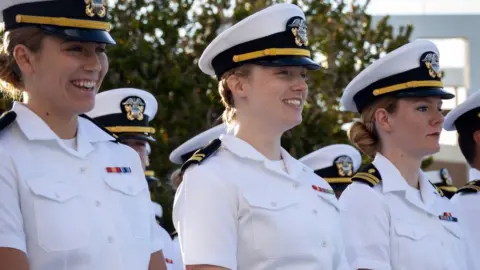
Thirty seconds earlier she had walked across a hotel ballroom full of officers and their families, pointed at my white dress uniform, and told him to arrest me for impersonating an officer. She’d said it loudly enough for three tables to hear. The string quartet in the corner had stopped in the middle of a phrase. A waiter was standing frozen beside our table with a tray of salads.
The officer was a petty officer second class, maybe twenty-five years old, with a careful haircut and a name tape that said OKAFOR. He looked at my photograph and then at my face. He looked at the ribbons on my chest and back down at the card. Then his shoulders squared, and his voice changed.
“Ma’am,” he said to Patricia, “before I answer your accusation, I need to ask you one question. Did you knowingly make this accusation against Commander Mitchell?”
Patricia’s smile slipped for the first time.
Behind her, at the head table, Rear Admiral Thomas Hollis had pushed back his chair and was standing up.
“Officer,” the admiral said, “I’d like everyone at this table to stay exactly where they are.”
My name is Rebecca Mitchell. I was forty-five years old that afternoon, a commander in the United States Navy with twenty-two years of service, and I was standing next to a centerpiece of white roses having to prove I was who I said I was. The person who’d asked me to prove it was my husband’s mother.
I’ll tell you how we got there, because it didn’t start in that ballroom. It started eight years earlier, at my wedding.
I married Daniel Mitchell when I was thirty-seven. He’s an architect, a gentle, funny man who builds libraries and fire stations for small towns, and who once drove four hours to Norfolk with a cooler of crab cakes because I’d mentioned on the phone that I missed Maryland food. I met him at a friend’s barbecue while I was home on leave. He asked me what I did, and I told him I was in the Navy. He didn’t ask anything else about it that night. He asked what kind of music I liked. I fell for him partly because of that.
His mother, Patricia, made her feelings clear the first time we met. We were at her house in Annapolis, a brick colonial with boxwoods out front. She served chicken salad on china that had belonged to her mother. Halfway through lunch she asked me when I planned to “get out.”
“I don’t have plans to get out,” I said. “I’m a lieutenant commander. I’m hoping to make commander in a couple of years.”
“Oh.” She put down her fork. “But surely once you’re married.”
“I’ll still be in the Navy once I’m married, Mrs. Mitchell.”
“Patricia, please.” She smiled. “Well. We’ll see.”
She was the widow of a dentist. She chaired the hospital auxiliary and the garden club. She liked women who hosted luncheons and arranged their lives around their husbands’ schedules, and I was not going to be one of those women. I deployed for seven months in my first year of marriage. I missed Thanksgiving twice and Christmas once. Sometimes I couldn’t tell Daniel where I was going, only when I’d be back, and sometimes I couldn’t tell him that either.
At first Patricia called my career a phase. Then she called it an excuse to avoid family obligations. By the fourth year, I started hearing from Daniel’s cousins about things she’d said at Easter and at his aunt’s seventieth birthday. She said I exaggerated my rank. She said I liked to make myself sound important. Daniel’s cousin Lisa told me at a cookout that Patricia had said, in front of a dozen people, “Rebecca’s in the Navy the way some people are in a book club. It gives her something to talk about.”
When I brought these things up with Daniel, he’d sigh and rub his forehead.
“She’s old-fashioned, Bec. My dad was gone at the office twelve hours a day for thirty years and she never had anything of her own. She doesn’t know what to do with you. Just let it go.”
So I let it go. I let it go for eight years. I’m a commander, and I’ve briefed flag officers and carried a pager at three in the morning for things that will never be in a newspaper. And I sat through Thanksgiving dinners while my mother-in-law asked me, in front of everyone, whether the Navy “actually paid me anything.”
I let it go partly for Daniel, and partly because I was tired. I also had a private reason that I’m less proud of. Some small, stubborn part of me thought that if I just kept being decent to her, someday she’d see me clearly.
The reception that October was at a hotel near the base in Norfolk where I’m assigned. It was a formal event honoring years of service, and the families who’d supported people through deployments. I was a guest of honor, though I hadn’t told my family that. I’d been told only that I was being “recognized,” in a phone call from the admiral’s aide two weeks earlier, and that I should wear dress whites and bring my family if I wished.
Daniel was invited as my guest. Patricia found out about it from him over the phone and invited herself.
“Senior officers will be there?” she’d asked him. “Admirals?”
“I think so, Mom.”
“Then I’ll come. Someone in this family should see what’s actually going on.”
Daniel told me that on the drive down. He laughed a little when he said it, as if it were a joke between us. I looked out the window at the highway and didn’t laugh.
I’d pressed my whites that morning in our kitchen. I’d checked the ribbons against the regulations twice, the way I’ve done it for twenty-two years. People who haven’t served sometimes think of the uniform as a costume. To me, each ribbon is a stretch of years and a group of sailors whose names I still remember. One of them is for a deployment in 2011 when we lost a young man named Garcia to an accident on the flight deck. I wrote his mother a letter that took me three nights to finish. I’ve never considered any of it decoration.
Patricia looked me up and down when we walked into the ballroom. She had on a navy silk dress and pearls, and her hair was done.
“Rebecca, don’t you think that’s a little much?” she said, adjusting her necklace. “Everyone else looks so elegant.”
“It’s a military reception, Patricia. This is the uniform.”
She gave a thin smile. “Well. I suppose you’d know.”
Daniel heard her. He looked at his shoes.
Our table was near the front. A captain I’d worked with for two years stopped by and shook my hand. He thanked me for getting his command through a hard stretch the previous winter. Patricia smiled warmly while he was there, and then leaned over to Daniel as soon as he walked away.
“Do they all talk like that?” she whispered. “It sounds rehearsed.”
I heard her. So did the woman at the next table, who glanced over.
I could have said something. I reminded myself the afternoon wasn’t about winning an argument with my mother-in-law. It was about the people in that room, many of whom had given more than I had, and I was not going to let Patricia make it about her.
Then Admiral Hollis came in, and people stood. He worked his way down the front tables, and when he got to ours, he shook my hand and spoke for a minute about a project I’d helped oversee. He kept it vague and professional, and I answered the same way.
Patricia watched every second of it with narrowed eyes. When he moved on, she leaned across the table.
“Rebecca, how exactly do you know that man?”
“Through work.”
“Through work,” she repeated, as if I’d said something dirty. “That’s what you always say when you don’t want to explain.”
“Some of my work isn’t appropriate for a dinner conversation.”
She laughed, sharp and loud. “How convenient.”
Daniel put his hand on her arm. “Mom. Please.”
She pulled her arm away. “No, Daniel. I’ve listened to this for eight years. Your wife disappears for months at a time and comes home with stories nobody can check, and she expects all of us to treat her like some important officer.”
Heads were turning. I felt the heat climb my neck, and I kept my voice level.
“Patricia, I’ve never asked you to believe anything without reason. My service record is real, and so is this uniform. And this is not the time or the place.”
She stood up. “Then you won’t mind proving it.”
I honestly didn’t understand what she meant until she was halfway across the room. She went straight to the MP posted by the ballroom doors, and she pointed at me.
“Officer, that woman is impersonating a Navy officer. I want her arrested.”
Petty Officer Okafor walked over without hurrying. He asked for my identification. I took the card from my pocket and handed it to him.
“You’ll see,” Patricia said to the tables around us. “I’ve been warning my son about this for years.”
And that’s how I came to be standing beside the white roses, waiting for a twenty-five-year-old petty officer to tell my mother-in-law I was real.
The admiral stepped out from behind the head table. The whole room seemed to hold its breath. Patricia turned slowly toward him, and I watched her confidence start to drain out of her face.
He looked at Okafor and then at the card in his hand, and then he spoke in a voice that carried to the back wall.
“Commander Mitchell is exactly who her identification says she is. I can personally confirm twenty-two years of honorable service.”
Patricia blinked. “But I don’t understand. She’s my daughter-in-law. She’s never told us anything important about her position.”
The admiral’s face didn’t move. “Ma’am, she’s not required to discuss her responsibilities or her assignments at your dinner table. In some cases she’s not permitted to.”
A few officers at nearby tables looked at each other.
Okafor handed my card back to me with both hands. “Commander, I apologize for the disturbance.”
“You did everything right, Petty Officer,” I told him. “Thank you.”
Patricia wasn’t finished. “Wait. You’re just going to let her walk away? I made a report. I have real concerns.”
Okafor turned toward her. He stayed polite, but there was nothing soft in his voice. “Ma’am, you made a public accusation that a commissioned officer was committing a crime, and you didn’t present any evidence.”
Daniel finally moved. He came around the table and stood between his mother and me.
“Mom,” he said. “What were you thinking?”
Patricia stared at him as if he’d slapped her. “I was protecting you! You’ve been married eight years to someone you barely know!”
I looked at my husband. I’d waited eight years to see what he’d do when his mother said something like that where he couldn’t pretend he hadn’t heard it. He opened his mouth, and for a second nothing came out.
The admiral wasn’t done either. He asked Okafor to write up the incident and to take statements from the people at the nearby tables who’d heard the accusation. Then he turned to me.
“Commander, I think your family ought to understand something about your service, if you’re comfortable sharing it.”
“There are things I can discuss, Admiral.”
He picked up the printed program from our table. It was a heavy card folded in half, with an anchor embossed on the front. We hadn’t opened it. He turned to the second page and put his finger beneath a heading I hadn’t seen yet, and under it was my name.
Patricia leaned in and read it. Her lips moved.
“Twenty-two years of distinguished service,” she said under her breath. “Leadership during critical operations.”
She didn’t have anything to add. Daniel took the program out of her hands and read it twice. I watched his jaw tighten.
“Commander Mitchell was selected to receive one of the Navy’s leadership awards tonight,” the admiral said. “Her record was reviewed personally before this ceremony. By me.”
Patricia slowly sat down in her chair.
I looked at her. I wasn’t angry yet. I think I was too tired to be angry.
“You spent eight years telling people I was pretending to be somebody important,” I said. “Today you asked the military police to arrest me for wearing a uniform I earned.”
Nobody at the table said anything.
Before I could go on, the admiral raised a hand. “Commander, there’s one more matter. It concerns the reason your name came to my desk in the first place.”
His aide, a lieutenant named Brooks, stepped forward and handed him a manila folder. It had a red sticker on the flap. The admiral broke the seal with his thumb and opened it on the tablecloth.
I could see the first page from where I stood. It was a letter on cream stationery with an engraved monogram at the top, a curling P and M.
Patricia saw it at the same moment I did. Every bit of color left her face.
“I don’t intend to read this aloud,” the admiral said quietly. He wasn’t speaking to the room now, only to our table. “I’ll tell you what it is, because I think the commander has a right to know. In the past twenty months, my command received three letters concerning Commander Mitchell. They were signed. They said she had falsified her service record and was misrepresenting her rank to her family and her community. They asked the Navy to investigate her.” He paused. “Allegations of that kind are taken seriously, Mrs. Mitchell. Each one had to be looked into.”
I stared at the letter. I knew that handwriting. Patricia had addressed every birthday card I’d ever received from her in that handwriting.
“Three,” I said.
“Three,” the admiral said. “The last came in June.”
I thought about June. I’d spent three weeks that month answering questions from a commander I didn’t know very well about records going back two decades. I had to dig out evaluations from my first ship. He’d told me it was routine. I believed him. I’d lost sleep over it anyway, the way you do when someone starts pulling at your record and won’t tell you why.
“Each review came back clean,” the admiral went on. “But the third reviewer was thorough. She read all twenty-two years, every fitness report. Then she sent me a two-page memorandum saying that in her opinion Commander Mitchell’s record was one of the finest she’d reviewed in her career. She recommended her for tonight’s award.” He closed the folder. “So in a sense, Mrs. Mitchell, you’re the reason the commander is being honored this evening.”
Patricia’s hands were shaking in her lap.
“I only wanted the truth,” she said. Her voice had gone thin.
“Ma’am,” the admiral said, “you had the truth. It was sitting across from you at Thanksgiving.”
He gave the folder back to Lieutenant Brooks and looked at me. “Commander, I’m sorry this came out in public. That wasn’t my intention. I was planning to tell you privately after the ceremony. But I won’t have you accused in front of my officers without them hearing the rest.”
“I understand, sir.”
“The ceremony is at seven.” He looked at Patricia, and then at Daniel. “I’ll leave the seating to the family.”
He walked back to the head table. After a moment the string quartet started again, a little uncertainly, and people went back to their salads and pretended not to watch us.
Daniel sat down heavily next to his mother. He looked at her for a long time.
“Three letters, Mom?”
“Daniel, I was worried.”
“You wrote to the Navy. You wrote to her commanding officer and called my wife a liar.”
“You don’t know what she’s doing when she’s gone. None of us do. She could be anybody.”
“She’s my wife!” He didn’t shout it, quite, but people at the next table looked over again. He lowered his voice. “She’s my wife. Did you ever once think about what would happen to her if they’d believed you?”
Patricia didn’t answer.
I’ll be honest about that moment, because it would be easy to leave it out. Part of me was glad. I’d waited eight years to hear him say it, and he was finally saying it.
The rest of me was looking at him and thinking, why now? Why not at Easter, or at his aunt’s birthday, or the first time she asked when I planned to get out? Why did it take a sealed folder and a rear admiral?
“I think you should go home, Mom,” Daniel said.
She looked at him in disbelief. “You’d send me home? Your mother?”
“I’ll call you a car.”
“I drove.”
“Then drive.” He stood up. “You’ve done enough.”
Patricia stood. She picked up her purse and her wrap. She looked at me, and I thought she might say something, maybe even something true. Then she looked around the room at all the white uniforms. Her face crumpled for a second. She turned and walked out through the ballroom doors past Petty Officer Okafor, who stepped aside to let her by.
Daniel sat back down. Neither of us spoke for a while. A waiter came and quietly took away Patricia’s untouched salad.
“Did you know?” Daniel asked finally. “About the investigation?”
“I knew someone was going through my record in June. I didn’t know why.”
“You didn’t tell me.”
“I didn’t think it was anything. And I didn’t want to worry you.”
He rubbed his face with both hands. “Bec, I’m so sorry.”
“For which part?”
He looked at me. I wasn’t trying to be cruel. I wanted to know.
“For all of it,” he said. “For eight years of ‘she’s old-fashioned.’ I kept thinking if I didn’t make it a fight, it would just wear itself out. It didn’t, did it?”
“No.”
“It got worse.”
“It got a lot worse, Daniel.”
He nodded slowly. He didn’t argue with me, and I was grateful for that.
The ceremony started at seven. They called eleven names before mine. There were chief petty officers with thirty years in, and a young lieutenant who’d pulled two sailors out of the water off the coast of Somalia. There was a Navy spouse who’d started a food pantry for junior enlisted families on the base and had fed four hundred people last winter. When they called her name, the whole room stood up, and so did I.
When they called mine, I walked up to the podium. The admiral read the citation. I’d never heard it before. It was three paragraphs long, and most of it was general, the way these things have to be. There was one sentence near the end about “a career marked by quiet competence in circumstances where quiet competence was the difference between success and failure.” I had to look at the back wall of the ballroom for a moment while he read it.
He pinned the medal on my uniform and shook my hand. The room applauded. I looked down at our table. Daniel was standing, clapping, with his eyes wet. The chair beside him was empty.
I’d thought I’d feel triumphant. I mostly felt sad. I’d wanted Patricia to see that, and she was somewhere on the interstate.
Afterward, while people stood around with coffee, Petty Officer Okafor found me near the dessert table.
“Commander, I’ve filed the incident report,” he said. “The admiral asked me to tell you that a copy will go in the file for tonight’s event. Mrs. Mitchell won’t be admitted to future events at this command.” He hesitated. “Is there anything else you’d like me to do?”
“No, Petty Officer. You did exactly the right thing. You checked.”
He nodded. “My grandmother says my mother is a terrible cook,” he said. “Every single holiday. My mother’s an excellent cook.” Then he turned red to the ears, as if he hadn’t meant to say it out loud, and went back to his post by the doors.
We drove home that night without talking. Daniel kept both hands on the wheel. Around Williamsburg his phone started buzzing in the cup holder, and he let it ring. It buzzed four more times before we got home. He didn’t look at it.
The next morning there were nine voicemails. Daniel listened to them at the kitchen table with his coffee going cold. I could hear Patricia’s voice coming tinny out of the speaker, sometimes crying and sometimes furious. In one message she said I’d humiliated her. In another she said she’d been ambushed. In another she said the admiral had no right to show her private letters to a table full of people. In the last one she just said, “Daniel, call your mother,” in a small voice I’d never heard her use.
He played that last one twice. Then he put the phone face down.
“I’m going to go see her,” he said. “Not today. But I have to go.”
“I know you do.”
“Will you come?”
“No,” I said. “Not this time.”
He went the following Saturday. He was gone for six hours. When he came back he sat on the back steps for a long time before he came inside. I brought him a beer and sat down next to him.
“She has a box,” he said. “In the hall closet. A shoebox. She’s been keeping things.”
“What things?”
“Printouts. Articles about women who lied about military service. Somebody in Ohio who got arrested for wearing a Marine uniform to a parade. A woman in Texas. She’d underlined stuff.” He picked at the label on the bottle. “And a list of dates. Every time you deployed. Every time you couldn’t tell us where you were. She’s had it going for eight years, Bec. In pen.”
I didn’t say anything.
“I asked her why,” he said. “She talked for two hours. Most of it was about my dad.”
Daniel’s father, Walter, was a dentist in Annapolis for thirty-five years. He died when Daniel was twenty-six. What I hadn’t known, because Daniel had never told me, was that before dental school Walter had enlisted in the Navy. He served four years in the early sixties and spent most of it on a destroyer in the Mediterranean. He met Patricia on a leave in Baltimore, and they wrote letters for two years.
“She told me he came home different,” Daniel said. “Quieter. He never talked about it. And he’d disappear sometimes, go out to the garage and just sit there. She said she spent their whole marriage feeling like there was a room she wasn’t allowed into.” He shook his head. “She said when I married you, it felt like the same thing was happening to me. Like the Navy had come back for her son.”
“That isn’t an excuse,” I said.
“No. I told her that.” He took a long drink. “I told her it wasn’t your fault Dad wouldn’t talk to her. And I told her if she wrote one more letter to anyone about you, I wouldn’t come back.”
“What did she say?”
“She cried. And then she asked if you’d tell her what the award was for.” He almost laughed. “I said I didn’t know, because you’re not allowed to tell me either.”
I sat with that for a while. I’d spent eight years thinking Patricia simply didn’t like me. It would have been easier if that were all it was. I didn’t know what to do with a lonely woman with a shoebox in her closet, still angry at a man who’d been dead nineteen years.
It didn’t change the three letters. If the first reviewer had been careless, I could have lost my clearance. A complaint like that, even an unfounded one, can stall a promotion board for a year while people sort it out. I’d been up for captain in the spring. I’d spent three weeks in June not sleeping. She had done that to me on purpose, three separate times, in her best handwriting.
And it didn’t change the eight years Daniel had spent telling me to let it go.
We started seeing a counselor in November. Her name is Dr. Ellen Price, and her office is above a pharmacy in Virginia Beach. She has a sign on her wall about how the stories we tell about our families can keep us prisoner. Daniel rolled his eyes at it the first time. By the third session, he wasn’t rolling his eyes.
It’s slow. Some sessions I come out angrier than I went in. At the fourth one, Dr. Price asked Daniel why he’d never once defended me to his mother before that night in the ballroom. He sat there for almost a full minute.
“Because I was afraid she’d be alone,” he said. “If I picked Rebecca, Mom would have nobody. So I let Rebecca carry it. Rebecca’s strong. She’s the strongest person I know.”
“So you gave the heaviest thing to the strongest person,” Dr. Price said.
“Yes.”
“How did that work out?”
He looked at me. “It didn’t,” he said.
There was money in it too, which I hadn’t expected. In December, Daniel’s cousin Lisa called me. Patricia had changed her will two years earlier. She’d added a clause putting Daniel’s share of the Annapolis house in a trust that would only pay out if he were “unmarried or married to a spouse of verified good character.” Lisa had heard it from her own mother. She thought I should know.
I told Daniel. He drove to Annapolis that weekend and asked his mother about it directly. She admitted it. She’d had her lawyer, a man named Gordon Keyes, write it up after the second letter, “in case.”
Daniel came home and told me he’d asked her to take it out. He’d told her he didn’t want the house under those terms, and that if she left the clause in, he’d sign away his share rather than have a lawyer decide whether his wife was good enough.
“Did she agree?”
“She said she’d think about it.”
“Daniel.”
“I know.” He sat down across from me. “I know, Bec. I’m not going to fight her for a house. I told her what I’d do. It’s hers to decide.”
In January a letter came to our house. It was addressed to me, in that handwriting, on that same cream paper with the P and M at the top. I left it on the kitchen counter for two days before I opened it.
It was one page. She said she’d met with Mr. Keyes and had the clause removed. She enclosed a copy of the amendment, signed and notarized, with the date stamped on it. She said she’d been wrong about me. She said she should never have written to the Navy, and that she’d been ashamed since the night of the ceremony. She didn’t say anything about Walter, or the shoebox. She didn’t say she was sorry for eight years of Thanksgivings.
At the bottom she wrote, “I would like to know you better, if you would allow it. I understand if you won’t. Patricia.”
I read it three times. Then I folded it back up and put it in my desk drawer with my old evaluations.
I haven’t answered it yet. Daniel asked me once whether I was going to. I told him I didn’t know. That’s the truth. Some days I think I will. Other days I think about June, and about standing beside the white roses while a room full of people I’d served with watched me hand over my ID, and I close the drawer.
Patricia came to Easter dinner at Daniel’s aunt’s house in April. So did I. We sat at opposite ends of a long table and passed the potatoes without incident. She asked me how work was. I said it was busy. She nodded and didn’t ask anything else. She didn’t ask whether the Navy paid me, or when I was getting out.
After dinner she was in the kitchen alone, drying the good glasses with a dish towel. I came in to put my plate in the sink. She didn’t turn around.
“Daniel tells me you’re up for captain,” she said.
“The board meets in May.”
“Is that a big step?”
“It’s a big step.”
She dried a glass and held it up to the window to check for spots. “Walter made petty officer third class,” she said. “He was very proud of it. He kept the patch in his sock drawer for forty years. I found it after he died.” She set the glass down. “I never once asked him about it.”
I didn’t know what to say. I stood there with my plate.
“Well,” she said. She hung the dish towel on the oven door. “Good luck with the board.”
“Thank you, Patricia.”
She went back out to the dining room. I rinsed my plate and put it in the dishwasher. When I came out, she was sitting next to Daniel, showing him something on her phone. She didn’t look up.
The promotion board met in May. I found out in July. I made captain. Daniel took me to dinner at the place on the water where he proposed. He cried a little over dessert, which he does. When we got home, there was a card in the mailbox.
It was a plain greeting card from a drugstore, with a sailboat on the front. Inside, in that handwriting, it said, “Congratulations, Captain. Patricia.”
I put it on the refrigerator under a magnet from the hardware store. Daniel saw it the next morning and stopped in front of the fridge with the milk in his hand.
“You put it up,” he said.
“I put it up.”
He looked at it a while longer. He didn’t say anything else, and neither did I. Then he poured his cereal, and I went to find my keys. I had to be on base by seven.