“Get out. Don’t ever come back.”
Those were the last words my father said to me before he drove away.
He said them to the windshield, not to me. His hands were tight on the steering wheel of his truck, and the heater was blowing so hard I could barely hear him. But I heard him.
The passenger door was already open. Cold air was coming in. Snow was blowing sideways across the highway in the headlights.
“Warren,” my mother said quietly from the front seat.
For one second, I thought she was going to stop him.
She didn’t.
She turned around in her seat and looked at me.
“Micah,” she said. “Just apologize. Transfer the money to your brother, and we’ll go home. That’s all you have to do.”
I was eighteen years old.
I had a backpack on my lap with my laptop in it, a soldering iron, a roll of electrical tape, and a little zippered case of screwdrivers. A phone at forty percent. Twenty-three dollars in my wallet.
I looked at my mother.
I looked at the back of my father’s head.
“No,” I said.
I got out of the truck.
The gravel on the shoulder of Highway 285 was icy. My sneakers slid on it. The wind cut straight through my hoodie.
I stood there and waited.
I really thought they’d come back. I thought it was a scare. A lesson. I thought my father would drive a hundred yards, stop, and wait for me to come running.
The truck pulled out onto the highway.
The taillights got smaller.
They didn’t stop.
I watched them until they went over a hill and disappeared.
Then I was alone on a dark road in the middle of Colorado, about a hundred and fifty miles from home, with snow in my eyelashes and my fingers already going numb.
My name is Micah Bennett.
I want to tell you how I ended up on the side of that road. And what happened after.
But first you need to understand my brother.
Derek is seven years older than me. When this happened, he was twenty-five.
He was the favorite. He’d always been the favorite. There was never any question about it in our house. Derek was the one Dad took to Broncos games. Derek was the one Mom bragged about to her friends at church. Derek was the one whose picture was over the fireplace in a big frame. His high school football picture, number 22, kneeling on one knee with a helmet.
My school picture was on the refrigerator. Under a magnet from a pizza place.
Derek wasn’t a bad guy. Not exactly. He was funny. Good-looking. He could talk to anybody. He had a smile that made people want to give him things.
And people did give him things.
Mostly my parents.
He dropped out of college after a year and a half. That was “a learning experience.”
He started a food truck that went under in eight months. That was “a learning experience” too.
He tried selling real estate. Then supplements. Then he and a friend were going to open a gym. Every one of them fell apart. And every time, my parents wrote it off.
“He’s figuring out what he’s good at,” Mom would say.
“He’s got the entrepreneur gene,” Dad would say. “Like your grandpa.”
When Derek drove up to the house in a brand-new leased BMW, Dad walked around it three times.
“Look at that,” he said. “That boy is going places.”
And when Derek announced he was starting a commercial landscaping company, Dad practically introduced him as a millionaire. At Thanksgiving. At church. At the hardware store.
“My son’s got his own company now,” he told the guy at the register at Home Depot. “Commercial contracts. Big stuff.”
The company didn’t have a single contract. I know, because I asked.
Meanwhile, I was upstairs.
I spent my teenage years in my bedroom, hunched over circuit boards.
It started when I was fifteen. I was at a garage sale in Englewood with my friend Tyler. There was a big old amplifier sitting on a card table. A Marantz 2230. Silver face. Wood case. A tag on it said BROKEN — $10.
I didn’t know what it was. I just thought it looked cool. Like something out of an old movie.
I bought it with the ten dollars I’d been saving for a pizza.
I took it home and opened it up.
Inside, it was like a little city. Tubes and capacitors and resistors and wires all laid out in rows. Dust everywhere. A smell like burnt toast.
I didn’t know anything about it.
So I learned.
I watched YouTube videos. I read old forums where retired engineers argued with each other at two in the morning. I bought a cheap multimeter and a soldering iron off Amazon. I burned myself about a hundred times. I ruined two capacitors and one of Mom’s good kitchen towels.
It took me four months.
But one night, at about one in the morning, I plugged it in, turned the knob, and music came out.
Real music. Warm and big and clear. Fleetwood Mac. From a record I’d found in the basement.
I sat on my bedroom floor and listened to the whole album.
I sold that Marantz on eBay for four hundred and fifty dollars.
I bought two more broken ones.
By the time I was sixteen, I had a name for it. Northline Audio Restoration. I made a website. I made a logo in a free design program. A little compass needle pointing north.
Collectors started finding me. Old guys, mostly. Retired guys in Arizona and Florida and Oregon who’d had a stereo in college and wanted to hear it again. Audiophiles who’d paid thousands for vintage gear and couldn’t find anyone to fix it.
They’d ship me their amplifiers and receivers and turntables. I’d fix them. I’d ship them back.
By seventeen, I had a waiting list three months long.
I missed a lot.
Homecoming. Prom. Football games. Parties. Sleep, mostly. I’d come home from school, do my homework, eat dinner, and go straight upstairs to my workbench. I’d work until two or three in the morning. Then get up at six-thirty for school.
My friends stopped inviting me places after a while. Except Tyler. Tyler would come over and sit on my bed and play video games while I soldered.
“You’re going to be a millionaire,” he told me once. “Or you’re going to go blind. One of the two.”
I saved almost everything.
Every check. Every payment. I didn’t buy new clothes or a car or anything. I put it all in the bank. In a joint account Mom had opened for me when I was fourteen, because you have to be eighteen to have your own.
I was saving for something. I didn’t know what yet. College, maybe. Electrical engineering. Or a real workshop. A storefront. Something that was mine.
Dad called it “playing with junk.”
He said it at dinner. All the time.
“How’s the junk business, Micah?”
“Still playing with your toys up there?”
“When are you going to get a real job? Derek was working at your age.”
Derek wasn’t working at my age. Derek was playing football and getting suspended for drinking at a party.
I never said that.
Mom didn’t say much about it either way. She mostly ignored it.
She only understood what it was worth when she needed it.
When I was seventeen, I logged into the joint account to check a deposit. A guy in Seattle had paid me eight hundred dollars for a Pioneer SX-1250.
The balance was lower than it should have been.
I scrolled through the transactions.
There it was. Two weeks earlier. A transfer of $1,500. To a credit card company.
I didn’t have a credit card.
I brought it up at dinner.
I was nervous. I’d rehearsed it in my head all afternoon.
“Mom,” I said. “Did you take fifteen hundred dollars out of my account?”
Mom put down her fork.
“I was helping family,” she said. Like it was obvious. “Derek’s card was maxed out. He was going to get hit with fees. It was an emergency.”
“You didn’t ask me.”
“I didn’t think I needed to.”
“It’s my money.”
Dad looked up from his pork chop.
“Hey,” he said. “You don’t get to complain. Not while you’re living under my roof. Eating my food. Using my electricity for your little projects.”
He pointed his fork at me.
“Family helps family,” he said. “That’s how it works.”
I looked at Derek.
He was sitting across from me. He was eating his mashed potatoes.
He didn’t look up.
He didn’t say thank you. He didn’t say sorry. He didn’t say anything. He just kept eating his mashed potatoes, slowly, one bite at a time, while my parents told me I had no right to be upset about my own money.
That silence hurt worse than anything Dad said.
My brother knew exactly whose money had saved him. Whose late nights and burned fingers had paid off his credit card.
And he wasn’t even willing to look at me.
My eighteenth birthday was October 9th.
I woke up early. Before anybody else in the house. I sat on my bed with my laptop and opened a new checking account at a different bank. A credit union in Lakewood. In my name. Only my name.
Then I logged into the joint account.
The balance was $50,000. Almost exactly. I’d hit it the week before. I’d been so proud.
I transferred $49,800 to the new account.
I left $200 behind.
So Mom wouldn’t notice right away. So the account wouldn’t close. So nothing would look different if she glanced at it.
My hands were shaking when I pressed the button.
I don’t know why. It was my money. I’d earned every dollar.
But it felt like I was stealing something.
Mom made me a chocolate cake that night. From a box. She stuck eighteen candles in it.
Dad gave me a card with a twenty-dollar bill in it.
Derek came over for dinner. He gave me a Broncos hat.
I don’t like the Broncos. I don’t like football at all. I’ve told him a hundred times.
I wore the hat anyway. Through dinner. To be nice.
A few weeks later, in November, Derek got engaged.
To a woman named Audrey Whitcomb.
Audrey was nice. Really nice. Blond and friendly and a little bit shy. She worked as a physical therapist. Her father, Grant Whitcomb, owned a chain of hardware stores across Colorado and New Mexico. Twenty-two of them. He was rich. Not Derek rich. Actually rich.
The engagement party was in Aspen.
At a fancy lodge. A whole weekend. Two hundred guests. A band. An ice sculpture of a swan. A champagne fountain. A fireworks show over the mountains on Saturday night.
My parents were over the moon.
“Look at this,” Dad kept saying, walking around the lodge with a glass of champagne. “Look at this. My son. Can you believe this?”
I met Grant Whitcomb at that party.
He was a big man. Sixties. White beard. A deep, slow voice. He was standing by himself at the edge of the room, away from the band, looking at an old stereo system somebody had set up in the corner for background music.
I wandered over. I couldn’t help it. Old stereos are like magnets for me.
“That’s a McIntosh,” I said. “An MC275. 1960s.”
Grant turned and looked at me.
“You know McIntosh?” he said.
“I restore vintage audio,” I said. “It’s my business.”
His whole face changed.
“I’ve got one of these at home,” he said. “My father’s. He bought it in 1964. It’s been sitting in my basement for twenty years. It hums. Bad. Every guy I’ve taken it to says it can’t be fixed. Or they want to replace everything inside it.”
“It’s probably the filter capacitors,” I said. “And maybe a tube. They hum when the caps go. You don’t need to replace everything. You just need somebody who knows what they’re doing.”
He looked at me for a long moment.
“How old are you?”
“Eighteen.”
He laughed.
“Well,” he said. “If you ever want to take a look at it, I’d pay you whatever you want.”
“I’d be happy to,” I said. “I’ll do it. I promise. After the holidays.”
He shook my hand.
It was the first time in a long time a grown-up had shaken my hand like I was a grown-up too.
At the end of that weekend, something felt off.
My parents were whispering a lot. Derek was on his phone constantly, walking out of rooms to take calls. Mom kept looking at me in a strange way.
I didn’t know what it was.
I found out on the drive home from Thanksgiving.
We went to Aunt Carol’s for Thanksgiving. Mom’s sister. She lives in Alamosa, down in the San Luis Valley. About four hours south of our house in Littleton.
Derek didn’t come. He was having Thanksgiving with Audrey’s family.
So it was just me and my parents in Dad’s truck. A big silver F-250. Dad had it for work. He’s a contractor. Drywall, mostly.
We left Aunt Carol’s at about six that night. It was already dark. Snow was starting to fall.
We’d been driving about an hour when Mom turned around in her seat.
“Micah,” she said. “We need to talk to you about something.”
I took out my earbuds.
“Okay.”
Mom looked at Dad. Dad kept his eyes on the road.
“Derek’s in a little trouble,” Mom said. “With his business. It’s nothing serious. Just a cash flow problem. Some equipment payments that came due sooner than he expected.”
“Okay,” I said slowly.
“He needs fifty thousand dollars,” Mom said. “By the end of the month.”
I didn’t say anything.
I knew where this was going. I could feel it. Like the air before a thunderstorm.
“We don’t have it,” Mom said. “Not right now. Not with your father’s work being slow this winter.”
She looked at me.
“But you do,” she said.
“No,” I said.
It came out before I even thought about it.
Mom blinked. “Micah—”
“No,” I said again. “That’s my money. I earned it. I’m saving it for school. Or a workshop.”
“It’s a loan, honey. He’ll pay it back.”
“He never paid back the fifteen hundred.”
Dad spoke for the first time.
“Watch your mouth,” he said.
His voice was low and flat. That voice. The one that meant you’d crossed a line.
“Your brother is starting a real business,” he said. “A real one. With real equipment and real employees. Not playing with junk in his bedroom. He needs help. And you’re going to help him. Because that’s what family does.”
“What equipment?” I said.
Silence.
“What equipment, Dad? What’s the money for? Specifically. I’ll look at it. If he shows me a contract, a real one, for real equipment, I’ll think about it.”
Mom and Dad looked at each other.
Neither of them answered.
“That’s what I thought,” I said quietly.
Mom turned back around. She looked out the windshield at the snow.
Then she picked up her phone. I saw her open her banking app.
I saw her check the joint account.
I saw her face change.
“Warren,” she said. Her voice was tight. “There’s only two hundred dollars in here.”
Dad didn’t say anything for a long moment.
Then he pulled over.
He didn’t slow down gradually. He just jerked the wheel and swerved onto the shoulder. The tires hit the gravel. The truck slid a little on the ice. Mom grabbed the door handle.
He threw it into park.
We sat there. The engine running. The heater blowing. The wipers going back and forth. Snow piling up on the hood.
Dad turned around in his seat and looked at me.
I’d never seen his face like that.
“Where is it?” he said.
“In my account. My own account. I’m eighteen.”
“Put it back.”
“No.”
“Micah,” Mom said. “Please. Just apologize to your father. Transfer it to Derek. And we’ll go home.”
“No,” I said.
Dad reached across Mom and shoved open my door.
The cold rushed in.
“Get out,” he said.
I thought he was joking.
I really did.
“Dad—”
“Get out,” he roared. “Get out of my truck. Don’t ever come back.”
I looked at my mother.
She looked at me.
She didn’t say anything.
She didn’t move.
So I got out.
I stood on the side of Highway 285 and watched my father’s taillights go over the hill.
I stood there for a long time. Ten minutes. Maybe fifteen. Waiting for them to come back.
They didn’t come back.
The snow was getting heavier.
I looked up and down the highway. Nothing. No houses. No lights. Just black mountains on both sides and the road going on forever.
I checked my phone. One bar. Thirty-eight percent.
I didn’t call anybody.
I didn’t know who I would call.
Tyler was at his grandmother’s in Kansas. My parents were the ones who’d left me. I didn’t have anybody else.
So I started walking.
South. Back the way we’d come. I remembered passing something. A sign. A light. About ten minutes before Dad pulled over.
I walked on the shoulder with my head down and my hands in the pockets of my hoodie. The wind came straight at me. My ears hurt. Then they stopped hurting, which was worse.
Two trucks passed me. Neither one stopped.
I walked for almost an hour.
Three miles.
And then I saw it.
A red neon sign, glowing through the snow, flickering a little on one side.
ROSIE’S. EAT.
It was a little diner. The kind you only see on old highways now. A low building with big windows and a gravel parking lot. A couple of semi trucks parked out back with their engines running.
Behind it, there was a row of small motel rooms. An old motor court. Five doors in a row, each painted a different color.
I pushed open the diner door.
The bell over it jingled.
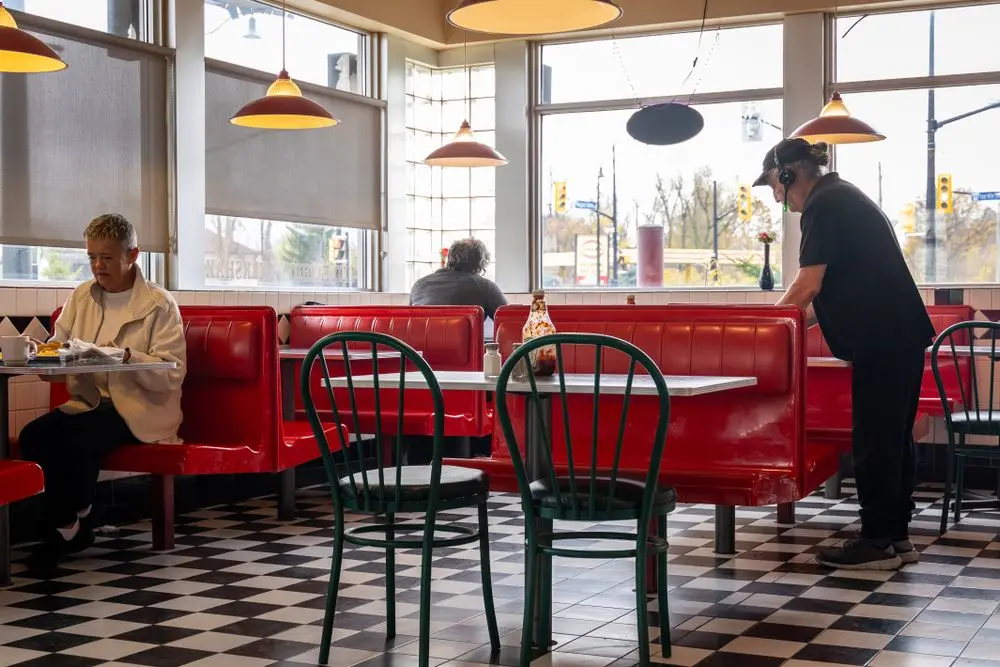
It was warm inside. So warm it hurt. It smelled like coffee and bacon and pie. There were red vinyl booths and a long counter with stools. An old jukebox in the corner with its lights off.
Two truckers sat at the counter. They looked at me.
Behind the counter, a woman was wiping down the coffee machine. She was about sixty. Short and round, with gray hair in a messy bun and reading glasses on a chain around her neck. She was wearing a flannel shirt and an apron.
She looked at me too.
“Kitchen’s closing in twenty minutes, hon,” she said. “But you can sit.”
I sat in a booth in the corner.
My hands were shaking so bad I couldn’t unzip my backpack. My fingers were white. I couldn’t feel them.
My phone buzzed.
I looked at it.
Fourteen missed calls. All from Dad.
And one text from Mom.
I opened it.
I don’t know what I expected. Are you okay? Where are you? We’re coming back.
That’s not what it said.
Where’s the money? There’s only $200!
I read it four times.
I sat there in that booth at Rosie’s diner with snow melting off my hair and dripping down my neck.
My mother had just watched my father leave me on the side of a mountain highway in a snowstorm.
And the only thing she wanted to know was where the money was.
I took a screenshot of my new account. The balance. My name. Only my name.
I sent it to her.
Then I turned off my phone.
I must have fallen asleep in the booth.
I don’t remember. I just remember waking up with a crick in my neck and gray light coming through the windows. And a cup of hot coffee sitting on the table in front of me.
The woman from behind the counter was sitting across from me in the booth.
She was holding her own cup of coffee. She was just watching me.
“Morning,” she said.
I sat up fast. “I’m sorry. I’m sorry. I didn’t mean to fall asleep. I’ll go. I’m sorry.”
“Drink your coffee,” she said.
I drank my coffee.
It was terrible. Burnt and bitter.
It was the best thing I’d ever tasted.
“I’m Rosie,” she said. “Rosie Kline. This is my place. Has been for thirty-one years.”
“Micah,” I said.
“Micah.” She nodded slowly. “You walked in here last night at nine-thirty in a hoodie and sneakers in a snowstorm, Micah. You looked like you’d seen a ghost. And you’ve been asleep in my booth for nine hours.”
I didn’t say anything.
“You hurt?”
“No.”
“In trouble with the law?”
“No.”
“Running from somebody?”
I thought about it.
“No,” I said. “Somebody ran from me.”
Rosie looked at me for a long time.
She didn’t ask anything else.
She got up. She went behind the counter. She came back with a plate. Two eggs over easy. Hash browns. Bacon. Toast with butter.
She slid it across the table in front of me.
“Eat,” she said.
While I ate, she talked.
Not about me. About her.
She told me about the diner. How her husband, Hank, built it with his brother in 1993. How Hank died six years ago. Heart attack. How she’d been running it by herself ever since.
“Things break,” she said. “That’s my problem. Everything in here’s older than you. And I can’t afford to replace any of it.”
She pointed at the cash register. A big old electronic thing from the nineties. There was a piece of masking tape on it that said BROKEN — USE CALCULATOR.
“That’s been dead since August,” she said.
She pointed at the jukebox in the corner. A big old Rock-Ola with chrome trim and colored lights. The lights were all off.
“And that was Hank’s baby,” she said. “His pride and joy. It quit three years ago. I can’t bring myself to get rid of it. But I can’t afford to get it fixed either. The guy in Salida wanted twelve hundred dollars just to look at it.”
I looked at the jukebox.
I looked at the register.
I put down my fork.
“I can fix them,” I said.
Rosie raised her eyebrows.
“You can fix them,” she said.
“Probably. The register, for sure. That’s easy. The jukebox might take longer. Depends what’s wrong. But I can probably fix it.”
“How old are you, hon?”
“Eighteen.”
“And you fix things.”
“Old audio equipment. Amplifiers. Receivers. Turntables. I’ve got a business. Northline Audio Restoration. I can show you the website.”
Rosie looked at me for a long moment.
Then she looked at the jukebox.
“I’ve got a room out back,” she said slowly. “Number four. It’s small. The heater rattles. There’s a bed and a dresser and a bathroom. The shower takes five minutes to get hot.”
She looked at me.
“You fix my register and Hank’s jukebox,” she said, “and room four’s yours. As long as you need it. I’ll feed you too. Breakfast and dinner. I’m not much of a lunch person.”
I stared at her.
“Why?” I said. “You don’t know me.”
Rosie shrugged.
“I know a kid who walked three miles in a snowstorm in sneakers,” she said. “And didn’t cry. And didn’t ask me for anything. And offered to fix my stuff before he’d even finished his eggs.”
She stood up. She picked up my empty coffee cup.
“That’s enough for me,” she said.
I fixed the register that afternoon.
It was a bad power supply. A blown fuse and a cracked solder joint. It took me forty-five minutes with the little tool kit in my backpack.
When it beeped back to life, Rosie stood there behind the counter with her hands on her hips.
“Well, I’ll be damned,” she said.
She peeled the masking tape off and threw it in the trash.
The jukebox took two weeks.
It was a 1979 Rock-Ola 464. The amplifier was shot. The mechanism that picked up the records was jammed with dust and old grease. The lights had a wiring problem somebody had tried to fix with duct tape. Probably Hank.
I ordered parts online with my own money. I had them shipped to the diner. I worked on it every night after Rosie closed, sitting on the floor in the corner with my soldering iron and a work light.
Rosie would sit at the counter doing her books and watching me.
She never asked me what happened.
Not once.
The night I finished it, I didn’t tell her.
I just waited until she was wiping down the counter. Then I dropped a quarter in the slot and pressed B7.
The lights came on first. Red and yellow and blue and green, all along the chrome.
Then the arm moved. It found the record. It lifted it. It set it on the turntable.
And Patsy Cline came out of the speakers.
“Crazy.”
Rosie dropped her dish rag.
She stood behind the counter with both hands over her mouth.
She didn’t say anything for the whole song. She just stood there and listened.
When it was over, she was crying.
“That was our song,” she said. “Mine and Hank’s. B7. He played it every night when we closed.”
She wiped her eyes with her apron.
“I haven’t heard it in three years,” she said.
I didn’t know what to say.
So I put in another quarter and played it again.
Every morning after that, Rosie slid a plate of eggs across the counter to me.
She never made a speech about it. She never said, Look how kind I’m being. She never said, You owe me.
She just put the plate down and went back to the kitchen.
I set up a workbench in room four.
On the little dresser, at first. Then on a table Rosie found in the storage shed. A real work light. Shelves made out of milk crates.
I started taking orders again. People shipped their amplifiers to Rosie’s Diner, Highway 285, Nathrop, Colorado. The UPS driver, a guy named Carlos, started calling me “the amp kid.”
I enrolled at Buena Vista High School in December.
It was the closest one. Twelve miles north. Rosie drove me there the first day and sat with me in the principal’s office while they sorted out my transcripts.
The principal, Mrs. Dominguez, asked who my guardian was.
“I’m eighteen,” I said.
“Then who’s your emergency contact?”
I looked at Rosie.
“Put me down,” Rosie said.
In January, I bought a truck.
A 1997 Ford Ranger. Rusty. Dented. A hundred and ninety thousand miles. The heater only worked on high. I paid twenty-two hundred dollars in cash to a rancher outside Salida who threw in a spare tire and a bag of beef jerky.
It was the first thing I’d ever bought that wasn’t an electronic part.
I drove it back to the diner and parked it out front. Rosie came out and walked around it three times.
“That’s a terrible truck,” she said.
“I know.”
“I love it,” she said.
I didn’t hear from my family for almost two months.
Not one call. Not one text. Not after the screenshot.
I kept my phone off most of the time. When I turned it on, there was nothing.
Then, in late January, a car pulled into Rosie’s lot.
A shiny gray Audi. Brand new. Dealer plates.
Derek got out.
I was sitting at the counter eating dinner. Meatloaf. I saw him through the window. I put my fork down.
Rosie saw my face. She came out from the kitchen and stood behind the counter with her arms crossed.
Derek came in. The bell jingled.
He was holding a big black garbage bag.
He looked around the diner like he’d walked into a cave. At the red booths. The old jukebox. The truckers at the counter.
Then he saw me.
“Micah,” he said. He smiled. That big Derek smile. “Hey, little bro.”
He walked over. He dropped the garbage bag on the stool next to me.
“Mom said to bring your stuff,” he said. “Some clothes. Your old shoes. That kind of thing.”
I looked in the bag.
My old clothes. Thrown in. Not folded. A pair of sneakers with the laces tied together. My winter coat, which would have been nice to have on the side of Highway 285 in November.
None of my tools. None of my equipment. None of the amplifiers I’d left on my workbench.
“Where’s my workbench stuff?” I said.
“Dad put it in the garage,” Derek said. “Some of it. I don’t know. He said it was junk.”
He sat down on the stool on the other side of me.
He looked at my meatloaf.
“Listen,” he said. “I didn’t just come to drop off your clothes.”
“I figured.”
“I need that fifty grand, Micah,” he said.
He said it quietly. He leaned in close so the truckers couldn’t hear.
“I’m in a real bind,” he said. “With the business. It’s not a big deal. Just a timing thing. I’ve got three excavators on order. The payments came due early. If I don’t cover them by March, I lose my deposit. And my contracts.”
“What contracts?”
“Commercial stuff. Big contracts. You wouldn’t understand.”
“Show me,” I said.
He blinked. “What?”
“Show me the contracts. And the equipment orders. The excavators. Show me the paperwork. If it’s real, if it’s actually a business thing, I’ll look at it. I’ll think about it.”
Derek stared at me.
His smile went away.
“I don’t have them with me.”
“Then email them.”
“I don’t need to show you anything,” he said. “I’m your brother. You’re supposed to help me.”
“You’re supposed to show me the paperwork,” I said. “That’s what you do with a loan. You show the paperwork.”
His face went red.
He stood up. He shoved the stool back. It scraped the floor.
“You know what your problem is?” he said. Loud now. Loud enough that the truckers turned around. “You think you’re so smart. Sitting in your little room. Playing with your electronic toys. You think that makes you better than me.”
“I don’t think I’m better than you.”
“You’re a selfish little brat,” Derek said. “Mom and Dad were right about you.”
Rosie stepped out from behind the counter.
“I think you should go now,” she said. Very calm.
Derek looked at her. A short, round sixty-year-old woman in a flannel shirt and an apron.
“Who the hell are you?” he said.
“I’m the woman whose diner you’re standing in,” Rosie said. “Go.”
He went.
He slammed the door so hard the bell fell off.
I watched his Audi spin out of the gravel lot and onto the highway.
Rosie picked up the bell off the floor.
She looked at it. Then at me.
“Your brother?” she said.
“Yeah.”
She nodded slowly.
“Well,” she said. “He’s handsome. I’ll give him that.”
I laughed.
It surprised me. It was the first time I’d laughed in weeks.
At Christmas, I got a text.
From Audrey.
Derek’s fiancée. The nice one. The physical therapist. I didn’t even know she had my number.
Hi Micah! Merry Christmas! Derek told me all about how you decided to go out on your own. That’s so brave! Your parents said they were so proud of you for choosing independence and supporting your business dream. Hope it’s going great! Hugs, Audrey
I read it in room four, sitting on my bed.
I read it about ten times.
Then I put the phone down and stared at the wall.
So that was the story.
They hadn’t left me on the side of a highway in a snowstorm. They hadn’t thrown me out of the truck because I wouldn’t give my money to Derek.
I’d chosen independence.
And they’d generously supported my business dream.
I didn’t answer her.
What would I say?
I went over to the diner. It was closed. Christmas Day. But the lights were on in the kitchen.
Rosie was in there, making a turkey. Just for the two of us.
She looked at my face.
She didn’t ask.
She just handed me a potato peeler and a bag of potatoes.
We ate at the counter. Turkey and mashed potatoes and green beans and a pumpkin pie from the grocery store in Buena Vista.
Rosie played B7 on the jukebox.
Then she played it again.
In March, the truth came out.
From the last person I expected.
It was a Tuesday night. I was in room four, finishing up a Sansui AU-717 for a guy in Tucson. My phone buzzed.
A text. From Mom.
The first one since Where’s the money?
I almost didn’t open it.
When I did, it was long. Paragraphs. Typos everywhere. Like she’d typed it fast, without thinking. Like she’d been crying.
Micah I don’t know what to do. I need you to help us. Derek is in trouble. Real trouble. He borrowed $50,000 from Grant Whitcomb last fall. Audrey’s father. He said it was for excavators for the landscaping business. Three of them. He even had Grant sign a loan agreement.
But there were never any excavators. He spent it. On the engagement party in Aspen. All of it. The lodge and the band and the fireworks. And whatever was left he lost at the casino in Black Hawk. Your father found out the week before Thanksgiving.
Grant wants it back before the wedding in June. If he doesn’t get it, he’ll call off the wedding. He’ll tell Audrey. He might take Derek to court.
That’s why we needed your money. To pay Grant back before he found out what Derek did. I know we shouldn’t have done what we did that night. Your father was so scared. We both were. We didn’t know what else to do.
Please Micah. You’re the only one who can fix this. Please.
I sat on my bed and read it.
Then I read it again.
There were never any excavators.
The engagement party.
The casino in Black Hawk.
That’s why we needed your money.
I put the phone down on the bed.
I sat there for a long time.
I’d always thought it was just favoritism. Just my parents loving Derek more than me. Just the old story. The golden child and the one who plays with junk.
I didn’t know it was this.
They hadn’t left me on the side of Highway 285 because I wouldn’t help my brother start a business.
They’d left me there because I wouldn’t help them hide what he did.
I took a screenshot of Mom’s message.
I saved it in a folder on my laptop. Next to the screenshot of Where’s the money?
I didn’t answer her.
In April, my wedding invitation came.
Rosie handed it to me with the mail. A big cream-colored envelope with gold lettering. Addressed to Mr. Micah Bennett, care of Rosie’s Diner.
It was beautiful. Heavy paper. A little dried flower pressed inside.
The honor of your presence is requested at the marriage of Audrey Grace Whitcomb and Derek Warren Bennett. Saturday, June 14th. The Broadmoor. Colorado Springs.
Tucked behind the invitation, there was a folded piece of paper.
Yellow. Lined. Torn out of a legal pad.
In my father’s handwriting.
Micah,
Your brother’s whole future depends on this wedding.
You know what you need to do. Bring the money. A cashier’s check. Made out to Grant Whitcomb. $50,000.
If you do this, you can come home.
If you don’t, don’t bother coming at all.
— Dad
I read it at the counter.
Rosie was standing on the other side, pretending to clean the coffee machine. Watching me.
I handed it to her.
She read it.
She put it down very carefully on the counter.
She didn’t say anything for a long time.
“Hon,” she said finally. “Can I ask you something?”
“Sure.”
“This Grant Whitcomb. You ever meet him?”
I thought about the engagement party in Aspen. The old McIntosh amplifier in the corner. The big man with the white beard.
I’d promised him.
After the holidays, I’d said. I’ll do it. I promise.
“Yeah,” I said. “I met him.”
“What’s he like?”
I thought about it.
“He shook my hand,” I said. “Like I was a grown-up.”
Rosie nodded slowly.
“Seems to me,” she said, “a man like that would want to know the truth.”
I called Grant Whitcomb the next morning.
I found his office number on the website for his hardware stores. Whitcomb Hardware. Twenty-two locations. Since 1971.
His assistant answered. I told her who I was. I told her I’d met Mr. Whitcomb at the engagement party. I told her about the McIntosh.
She put me on hold.
Two minutes later, a deep, slow voice came on the line.
“Micah Bennett,” Grant Whitcomb said. “The amp kid.”
“Yes, sir.”
“You promised me you’d look at my father’s McIntosh after the holidays,” he said. “It’s April.”
“I know, sir. I’m sorry. Things got—complicated.”
“I heard,” he said. “Derek told me you moved out. Started your own business. Said you wanted independence.”
There was a pause.
“I’d like to come see you,” I said. “If that’s okay. I’ll bring parts for the McIntosh. Filter capacitors. A new rectifier tube. I can do the repair right there. It’ll take a couple of hours.”
“And?” Grant said.
He’d heard something in my voice.
“And there’s something else,” I said. “Something I think you should see.”
I drove to Grant’s house in Castle Pines on a Saturday morning in late April.
Two and a half hours from Rosie’s. In my rusty Ranger with the heater stuck on high.
It was a big house. Stone and glass, on a hill, with a view of the mountains. A three-car garage. A fountain in the circle drive.
I parked my truck next to a black Mercedes and felt like a raccoon at a dinner party.
Grant opened the door himself.
He was wearing jeans and a sweater. No suit. He looked at my truck in his driveway. Then at me. Then at the box of parts in my arms.
He smiled.
“Come in,” he said. “The basement’s this way.”
The McIntosh MC275 was sitting on a workbench in his basement.
It was beautiful. Black and chrome. Big glass tubes standing up on top like a little skyline. Gold letters on the front.
“My father bought it in 1964,” Grant said. “With his first bonus. From the first store. He played Sinatra on it every Friday night until he died.”
He touched the top of it.
“It’s been sitting here twenty years,” he said. “Humming.”
I fixed it.
It took me two and a half hours. Grant sat on a stool and watched the whole time. He asked questions. Good ones. What’s that do? Why that one? How’d you learn this?
I told him. YouTube. Forums. A ten-dollar Marantz at a garage sale in Englewood.
He laughed when I told him about burning myself a hundred times.
“I cut my thumb on a box cutter the first day I worked at my dad’s store,” he said. “I was fourteen. Needed six stitches. My dad said, ‘Well, now you know how sharp it is.’”
When I was done, I plugged it in.
I turned the knob.
Grant had a record ready. Frank Sinatra. Songs for Swingin’ Lovers. 1956.
He put it on.
No hum.
Just Sinatra. Warm and big and clear. Filling the whole basement.
“You Make Me Feel So Young.”
Grant stood there with his hand on the workbench.
He didn’t say anything for the whole song.
When it was over, his eyes were wet.
“Twenty years,” he said quietly. “Twenty years I’ve been waiting to hear that.”
He looked at me.
“What do I owe you?”
“Nothing,” I said.
“Micah—”
“Nothing, sir. I promised you. I’m sorry I was late.”
He looked at me for a long moment.
“You said there was something else,” he said. “Something I should see.”
I took out my phone.
I took out the yellow piece of legal paper from my back pocket.
My hands were shaking.
“I’m not here to cause trouble,” I said. “I want you to know that. I’m not trying to hurt anybody. I’m not trying to break up the wedding. Audrey’s nice. I like Audrey.”
“Okay,” Grant said slowly.
“But I think you should know the truth,” I said. “About the money. About why I left. And I don’t think anybody else is going to tell you.”
I handed him my phone.
The screenshot of Mom’s message.
I handed him Dad’s note.
He read Mom’s message first.
Slowly. All of it. His face didn’t change.
Then he read Dad’s note.
Your brother’s whole future depends on this wedding. Bring the money. A cashier’s check. Made out to Grant Whitcomb.
Then he went very still.
He didn’t say anything for a long time.
The record had stopped. The turntable was still spinning. Click. Click. Click. The needle at the end of the groove.
“There were never any excavators,” he said finally.
“No, sir.”
“He showed me pictures. He showed me a quote from a dealer in Greeley. He had me sign a loan agreement. With a lawyer. He said he’d pay me back in eighteen months with interest. I trusted him.”
He looked at the phone again.
“The engagement party,” he said. “The fireworks. The champagne fountain. I thought his parents paid for that. I thought, how nice. How generous.”
He laughed. Short and ugly.
“I paid for my own daughter’s engagement party,” he said. “And didn’t even know it.”
He looked up at me.
“And you,” he said. “This is why you left home.”
“I didn’t leave,” I said quietly. “They left me.”
“What do you mean?”
I told him.
The drive home from Aunt Carol’s. The snow. The joint account. Two hundred dollars. Get out. Don’t ever come back. The taillights going over the hill.
Three miles. Rosie’s. Where’s the money?
When I was done, Grant Whitcomb sat down on his stool.
He put his face in his hands.
He sat there like that for a long time.
“My daughter,” he said, without lifting his head. “My daughter is going to marry into that.”
I didn’t say anything.
He lifted his head. His eyes were red.
“How old are you, Micah?”
“Eighteen. Nineteen in October.”
“Eighteen years old,” Grant said. “And they left you on the side of Highway 285. In a snowstorm. Over money. To cover for a liar.”
He shook his head.
“And you drove two and a half hours to fix my father’s amplifier for free,” he said. “And then you told me the truth. Even though it cost you.”
He stood up.
“Thank you,” he said.
He held out his hand.
I shook it.
Eight days later, my father’s car pulled into Rosie’s parking lot.
I heard it before I saw it. You couldn’t miss it. That big, rumbling, angry engine. Like a growl.
I was sitting at the counter eating breakfast. Eggs over easy. Hash browns. Rosie was behind the counter pouring coffee for two truckers named Earl and Gus who came in every Tuesday.
I turned around and looked out the window.
A cherry-red 1968 Pontiac GTO came screeching into the gravel lot.
It was spotless. Gleaming. Chrome bumpers so shiny they reflected the mountains. Whitewall tires. Not a single scratch anywhere.
My father’s car.
He’d bought it twenty-six years ago. With the money from my grandfather’s will. My mom’s dad. Before I was born. Before Derek even started kindergarten.
He’d spent twenty-six years restoring it. Every weekend. Every vacation. Every spare dollar.
He kept it in the garage under a custom cover. He washed it by hand every Saturday. He waxed it every month. He only drove it on sunny days. Never in rain. Never in snow. Never on gravel.
He’d just driven it into a gravel parking lot.
Behind it, a white SUV pulled in. Mom was driving. Derek was in the passenger seat.
Dad got out of the GTO.
He slammed the door.
He came straight for the diner.
The bell jingled. Rosie had fixed it.
“You ruined your brother’s life!” Dad shouted.
So loud that Earl and Gus both turned around on their stools.
So loud that the cook, a guy named Manny, came out of the kitchen holding a spatula.
So loud that Rosie stepped out from behind the counter.
She didn’t say anything. She just stood there. Watching him. Arms crossed.
Mom came in behind Dad. Then Derek.
Mom was already crying.
“Do you know what you did?” Dad said. He was standing over me at the counter. His face was red. His fists were clenched. “Do you have any idea what you did?”
I put down my fork.
“I told the truth,” I said.
“Grant called off the wedding,” Dad said. “He told Audrey everything. Everything. She gave Derek back the ring. In front of her whole family. At their Easter dinner.”
He was breathing hard.
“And Grant’s suing him,” he said. “For the fifty thousand. Plus interest. Plus legal fees. His lawyer says it might be fraud. Criminal fraud. Your brother could go to jail, Micah. Do you understand that? Jail.”
Mom was sobbing now.
“We raised you, Micah!” she said. “We fed you! We clothed you! You were supposed to help your brother! That’s what family does!”
I stood up.
I looked at my mother.
“If I mattered as family,” I said, “you would have come back for me that night.”
Mom stopped crying.
Just for a second. Like I’d slapped her.
“I was on the side of a mountain highway,” I said. “In November. At night. In a snowstorm. In sneakers. A hundred and fifty miles from home.”
My voice was shaking. I made it stop.
“And you didn’t come back,” I said. “You didn’t call to see if I was alive. You didn’t ask if I’d found somewhere warm. You didn’t ask anything.”
I took my phone out of my pocket. I held it up.
“You checked my bank balance,” I said.
The diner was dead silent.
Earl and Gus had turned all the way around on their stools. Manny was standing in the kitchen door with his spatula.
Rosie hadn’t moved.
Derek stepped forward.
“This is about jealousy,” he said. “That’s all this is. You’ve always been jealous of me. Since we were kids. You couldn’t stand that Mom and Dad liked me better. So you went and ruined my life on purpose.”
“I didn’t ruin your life, Derek,” I said. “You did. When you took fifty thousand dollars from Audrey’s dad and spent it on fireworks and blackjack.”
Derek’s face went white.
“I just stopped helping you hide it,” I said.
“You have the money,” Dad said.
He took a step closer to me. Close enough that I could smell his aftershave. Old Spice. The same one he’s worn my whole life.
“You have fifty thousand dollars sitting in a bank account,” he said. “Right now. You could fix all of this. Today. You could call Grant. You could pay him back. He’d drop the lawsuit. Audrey might even take Derek back.”
He jabbed his finger at me.
“You could prevent all of it,” he said. “And you won’t. Because you’re selfish.”
I didn’t answer him.
I wasn’t looking at him anymore.
I was looking past him. Through the big window of the diner. At the parking lot.
The sun had come out from behind the mountains. It was flashing off the chrome on the GTO. Off the cherry-red paint. Off the whitewall tires. The car sat there in Rosie’s gravel lot like a jewel. Spotless. Perfect.
The car he’d protected more carefully than anything in our house.
More carefully than me.
And suddenly I realized there was one question none of them wanted me to ask.
“Dad,” I said.
I pointed out the window.
“What about your car?”
The diner went completely silent.
Dad turned around.
He looked out the window at the GTO.
He turned back to me.
“What about it?” he said.
“A ‘68 GTO,” I said. “In that condition? Matching numbers? Original engine? Fully restored?”
I’d looked it up. Weeks ago. After Mom’s message. I didn’t know why at the time. I just did.
“It’s worth sixty thousand dollars,” I said. “Maybe seventy. Maybe more, to the right buyer.”
Dad didn’t say anything.
“You could sell it,” I said. “Today. You could pay Grant back. Every dollar. Plus interest. Plus his lawyer. And still have money left over.”
I looked at him.
“You could fix all of this,” I said. “Today. Couldn’t you, Dad?”
His face changed.
I watched it happen. The red went out of it. Something else came in. Something I’d never seen on my father’s face before.
He looked like a man who’d just been caught.
“That car,” Dad said slowly, “has nothing to do with this.”
“Why not?”
“Because it’s mine.”
“So was my money.”
“That’s different,” Dad said.
“How?”
“I’ve had that car for twenty-six years. I restored it with my own hands. Every bolt. Every piece of chrome. It’s my—”
He stopped.
“It’s your what, Dad?” I said.
He didn’t answer.
“You’ve had that car twenty-six years,” I said quietly. “You’ve had me eighteen.”
I looked at him.
“You left me on the side of Highway 285 in a snowstorm,” I said, “rather than sell a car.”
Nobody said anything.
Then Mom spoke.
Very quietly. Behind Dad.
“Warren,” she said.
He didn’t turn around.
“Warren,” Mom said again. “Why didn’t you sell the car?”
Dad turned around and looked at her.
Mom was standing by the door. Her face was wet. Her mascara was running. But she wasn’t crying anymore.
She was looking at him like she’d never seen him before.
“You told me we didn’t have it,” she said. “That night. In the truck. You told me there was no other way. You said, ‘The only money we can get is Micah’s.’”
She took a step closer to him.
“You never said anything about the car,” she said. “Not once. Not in five months.”
Dad opened his mouth.
Nothing came out.
Derek was staring at his father.
“Dad,” he said slowly. “Is that true? You could have—the whole time?”
Dad looked at Derek.
Then at Mom.
Then at me.
He didn’t say anything.
He turned around. He walked out the door. The bell jingled.
He stood in the parking lot next to his cherry-red GTO in the sunlight.
He put one hand on the hood. Just stood there.
Mom watched him through the window for a long time.
Then she looked at me.
“Micah,” she said. “I’m—”
She stopped.
She couldn’t finish.
She turned and went out to the SUV. She got in the driver’s seat. She sat there with her hands on the wheel.
Derek was the last one.
He stood by the counter. He looked at me. He looked at Rosie. He looked at Earl and Gus and Manny with his spatula.
His face was white.
He looked younger than I’d ever seen him. Like a little kid who’d broken something and was waiting to get yelled at.
He didn’t say anything.
He went out to the SUV and got in the passenger seat.
The GTO rumbled to life. Dad pulled out of the lot slowly. Carefully. Like he was afraid of the gravel.
The SUV followed.
I watched them go.
South first. Then they turned around at the gas station and went north. Back toward Denver.
I sat down on my stool.
My eggs were cold.
Rosie came over. She took my plate. She brought me a new one. Fresh eggs. Hot hash browns. Toast with butter.
She slid it across the counter.
She didn’t say anything.
Earl, the trucker, cleared his throat.
“Kid,” he said. “For what it’s worth. That was the best thing I’ve seen in thirty years of driving this highway.”
Gus nodded.
“I’d have sold the car,” Gus said.
I laughed.
I didn’t mean to. It just came out. Then I was laughing so hard I had to put my head down on the counter.
And then I wasn’t laughing anymore. I was crying.
Rosie came around the counter and put her hand on my back.
She left it there until I stopped.
I didn’t hear from any of them for six weeks.
I graduated from Buena Vista High School on May 31st.
It was a small ceremony. In the gym. Seventy-eight seniors in purple gowns.
When they called my name, Micah James Bennett, there was a cheer from the top of the bleachers.
Rosie. Standing up. Waving a homemade sign that said GO MICAH in purple marker.
And next to her, Earl and Gus. In their trucker hats. Clapping like crazy.
And Manny, the cook. And Carlos, the UPS driver. And Mrs. Dominguez, the principal, who’d come up from the front row to sit with them.
Nobody from my family was there.
I didn’t look for them.
I didn’t need to.
Rosie took me out to dinner afterward. To a steakhouse in Salida. She made me order the biggest steak on the menu.
“You did it, hon,” she said. “You walked three miles in a snowstorm and you did it.”
On June 2nd, Grant Whitcomb called.
“Micah,” he said. “I thought you should hear this from me.”
“Okay.”
“I got a cashier’s check this morning,” he said. “Fifty thousand dollars. Plus the interest. Plus my lawyer’s fees. Fifty-eight thousand, four hundred.”
I didn’t say anything.
“From your father,” Grant said.
I sat down on my bed in room four.
“How?” I said. But I already knew.
“He sold the car,” Grant said. “The GTO. To a collector in Scottsdale. Sixty-seven thousand dollars. He drove it down there himself last weekend. His lawyer called mine this morning.”
He paused.
“I’m dropping the lawsuit,” he said. “And I’m not going to the police. Derek doesn’t deserve it, but I’m doing it anyway. For Audrey. She doesn’t want her ex-fiancé in prison. She just wants it to be over.”
I didn’t say anything for a long time.
“Micah?” Grant said. “You there?”
“I’m here.”
“Your father asked his lawyer to pass something along,” Grant said. “He wanted me to tell you. The lawyer said it was a direct quote.”
“What did he say?”
Grant was quiet for a second.
“He said, ‘Tell Micah he asked the question nobody else would.’”
Derek came to see me in August.
Alone.
He didn’t come in the Audi. The Audi was gone. He came in an old blue Honda Civic with a cracked windshield and a dent in the passenger door.
He parked it next to my rusty Ranger.
He sat in the car for a long time before he got out.
I was in room four with the door open. Working on a Technics turntable for a guy in Montana. I saw him through the window.
I put down my soldering iron.
I went outside.
He was standing by his car. He was wearing jeans and a gray T-shirt. No sunglasses. No watch. He’d lost weight. He looked tired.
“Hey,” he said.
“Hey.”
We stood there in the gravel lot.
Neither of us said anything for a while.
“I got a job,” Derek said finally. “Landscaping. A real company. In Golden. I’m on a crew. Mowing. Planting. Digging. Eleven dollars an hour.”
He laughed. Short and tired.
“Turns out I didn’t know anything about landscaping,” he said. “Turns out you’re supposed to know something before you start a company.”
“Audrey?” I said.
He looked down at the gravel.
“She won’t talk to me,” he said. “I don’t blame her. I wouldn’t talk to me either.”
“And the gambling?”
He looked up.
“Meetings,” he said. “Gamblers Anonymous. Tuesday and Thursday nights. In a church basement in Lakewood. I’ve been going for two months.”
He swallowed.
“I’ve been gambling since I was nineteen, Micah,” he said. “Sports betting first. Then online poker. Then the casinos. Mom and Dad covered it. Every time. They’d write it off. ‘A learning experience.’”
He laughed again. It didn’t sound like a laugh.
“I learned a lot of things,” he said. “None of them good.”
I didn’t say anything.
“Dad sold the car,” Derek said.
“I know. Grant told me.”
“He cried,” Derek said. “When he handed over the keys. In Scottsdale. I went with him. He stood in this guy’s driveway and cried like a baby.”
He shook his head.
“I’ve never seen him cry,” he said. “Not once. Not even when Grandpa died.”
“Is he okay?” I asked.
I didn’t know I was going to ask it until it came out.
Derek looked at me.
“I don’t know,” he said. “He doesn’t talk much now. He goes to work. He comes home. He sits in the garage. In the empty space where the car used to be. In a lawn chair. Just sitting there.”
We stood in the gravel lot.
A truck went by on the highway.
“Micah,” Derek said.
“Yeah?”
He looked at me. Really looked at me. For the first time maybe in my whole life.
“That night at dinner,” he said. “When you were seventeen. When Mom took the fifteen hundred dollars. And you asked about it. And Dad yelled at you.”
“I remember.”
“I just sat there,” Derek said. “Eating my mashed potatoes. I didn’t look at you.”
“I remember, Derek.”
“I knew it was your money,” he said. “I knew exactly where it came from. I knew you’d been up every night until three in the morning. I could hear you. Through the wall. The soldering iron. That little fan.”
His voice cracked.
“And I didn’t say anything,” he said. “I didn’t say thank you. I didn’t say sorry. I just kept eating.”
He wiped his face with the back of his hand.
“I’m sorry, Micah,” he said. “For that. For the potatoes. For all of it. For every single thing.”
I looked at my brother.
Twenty-six years old now. Standing in a gravel parking lot in front of a cracked Honda Civic with his eyes wet.
The golden boy. The one who was going places.
“Thank you,” I said.
He looked surprised.
“For what?”
“For saying it,” I said. “I waited a long time for somebody to say it.”
He nodded.
He didn’t try to hug me. He didn’t ask me for anything.
He just got back in his car and drove away.
Mom wrote me a letter in September.
An actual letter. On paper. In an envelope. Mailed to Rosie’s Diner.
Four pages. Handwritten. I could tell she’d started over a few times. There were cross-outs. Some of the ink was smeared, like it had gotten wet.
She said she was sorry.
She said she didn’t know why she didn’t get out of the truck that night. She said she’s asked herself every day since. She said she’d always done whatever Dad said. For thirty years. She didn’t know how to do anything else.
She said she’d started seeing a counselor. A woman at their church.
She said she didn’t expect me to forgive her.
She said she’d understand if I never wanted to see her again.
At the end, she wrote:
I check the weather on Highway 285 every night now. I don’t know why. I just do. I think I’m still trying to come back for you.
I read it in room four.
I put it in my desk drawer.
I didn’t answer it.
Not yet.
That was a year ago.
The day before Thanksgiving, I drove north on Highway 285.
I don’t know why. I didn’t plan it. I was driving back from dropping off an order at the UPS store in Buena Vista, and instead of turning south toward Rosie’s, I turned north.
I drove until I found it.
The spot. The stretch of shoulder where the truck pulled over. I recognized it right away. A bend in the road. A barbed wire fence. A little stand of aspen trees on the right side, bare now.
I pulled over.
I turned off the engine.
I got out.
It was cold. Not snowing. Just cold. The sky was gray and the mountains were white on top.
I stood on the gravel where I’d stood a year before.
Eighteen years old. In sneakers. With twenty-three dollars in my wallet.
I stood there for a long time.
I wasn’t sad, exactly.
I don’t know what I was.
I thought about the taillights going over the hill. Get out. Don’t ever come back.
I thought about walking three miles in the snow.
I thought about a red neon sign flickering through the dark. ROSIE’S. EAT.
Then I got back in my truck and drove home.
Not to Littleton.
To Rosie’s.
Northline Audio Restoration has a real workshop now.
Rosie had an old storage building out behind the motor court. Hank used it for lawn mowers and spare parts. It had good bones. Concrete floor. Electrical. A big window.
I fixed it up over the summer. Insulated it. Put in shelves. Built a real workbench. Twelve feet long. With good lighting and an anti-static mat and every tool I’d ever wanted.
Over the door, I hung a sign. Wood. Hand-painted. A little compass needle pointing north.
The waiting list is five months long now. I’ve got clients in twenty-eight states. A guy in Japan. A woman in Germany who restores old radio stations.
Grant Whitcomb sends me referrals. Old hardware guys with old stereos in their basements. He calls me “the best tech in the Rockies.” He’s wrong, but I don’t argue.
I started taking electrical engineering classes online in the fall. Through Colorado State. Two classes a semester. It’s hard. I like it.
Rosie made me a deal.
“You keep your grades up,” she said, “and room four’s free forever.”
“It’s already free.”
“Well, now it’s free with a condition,” she said. “It means something now.”
I haven’t touched the fifty thousand dollars.
It’s still sitting in the credit union account in Lakewood. In my name. Only my name.
I don’t know what I’m saving it for yet. A storefront, maybe. A bigger shop. A house someday.
But I know what it’s not for.
On Thanksgiving morning, a car pulled into Rosie’s lot.
An old silver Ford pickup. A contractor’s truck. With a ladder rack and a toolbox in the bed.
Dad’s truck.
The same one.
I was in my workshop. I saw it through the big window.
I put down my soldering iron.
He got out slowly.
He looked older. Grayer. He’d lost weight. He was wearing his work jacket and jeans.
He was carrying something in his hands. Wrapped in a towel.
He stood in the gravel lot for a long time. Looking at the diner. At the motor court. At my workshop with the compass sign over the door.
Then he walked toward it.
I opened the door before he knocked.
We stood there and looked at each other.
“Micah,” he said.
“Hi, Dad.”
He held out the thing wrapped in the towel.
I took it.
I unwrapped it.
It was a car radio.
An old one. Chrome and black, with two big knobs and a little glass window with numbers behind it. AM only. A Delco. The original factory radio from a 1968 Pontiac GTO.
“I kept it,” Dad said. “When I sold the car. I told the guy in Scottsdale I’d give him a new one. A reproduction. He didn’t care.”
He looked down at the radio in my hands.
“It’s been dead since 1994,” he said. “I could never get it to work. I took it to three different shops. Nobody could fix it.”
He looked up at me.
“I thought maybe,” he said. “If you have time. I’d pay you. Whatever you charge.”
I looked at the radio.
I looked at my father.
Standing in the doorway of my workshop. Holding his hands together in front of him. Not knowing what to do with them.
The man who called my work playing with junk.
“Come in, Dad,” I said.
He came in.
He looked around. At the twelve-foot workbench. At the shelves full of parts. At the amplifiers and receivers and turntables lined up waiting. At the oscilloscope. At the little sign I’d taped to the wall that said MEASURE TWICE, SOLDER ONCE.
He didn’t say anything for a long time.
“You built all this,” he said finally.
“Yeah.”
“By yourself.”
“Rosie helped.”
He nodded slowly.
“I was wrong, Micah,” he said.
He was looking at the workbench. Not at me.
“About a lot of things,” he said. “About this. About Derek. About what family means. About that night.”
He swallowed hard.
“I drove away,” he said. “I didn’t come back. And I’ve been driving away from that ever since.”
I didn’t say anything.
I set the radio down on my workbench. I turned on the work light. I picked up a screwdriver.
“It’s probably the vibrator,” I said.
He looked at me.
“The what?”
“Old car radios from the sixties. They use a part called a vibrator. To convert the voltage. It’s like a little buzzer inside. They wear out. That’s usually why they die.”
I opened the case.
“Pull up a stool,” I said. “I’ll show you.”
He pulled up a stool.
He sat down next to me at the workbench.
It took me two hours.
He watched the whole time. He didn’t say much. Sometimes he’d ask a question. What’s that do? Why that one?
I told him.
When I was done, I hooked the radio up to a power supply on my bench. Twelve volts. Like a car battery.
I turned the knob.
There was static. Then a crackle.
Then a voice. An AM station out of Pueblo. A man reading the farm report.
Then a song.
My father sat on the stool next to me in my workshop behind Rosie’s Diner on Highway 285 and listened to his old car radio play for the first time in thirty years.
He put his hand over his mouth.
Neither of us said anything for a long time.
The song played. Something old. Something country.
Finally, Rosie knocked on the open door.
She stood there in her flannel shirt and her apron. She looked at my father. Then at me.
She didn’t ask.
“Turkey’s ready,” she said. “There’s plenty. If anybody’s hungry.”
My father looked at me.
He was asking. Without saying it. Is it okay?
I turned off the radio.
I stood up.
“Come on, Dad,” I said. “Rosie makes terrible coffee. But the turkey’s good.”
We walked across the gravel lot together to the diner.
The bell jingled when we opened the door.
Rosie had set three places at the counter.
She went over to the jukebox. She dropped in a quarter.
B7.
My father said I could never come back.
He was right. I never did.
I didn’t need to.
I’d already found my way home.