My Stepmother Told the Auctioneer to Open Dad’s Truck at $9,000 to Make Me Pay. Forty People Watched What the Men in the Seed Caps Did Next.
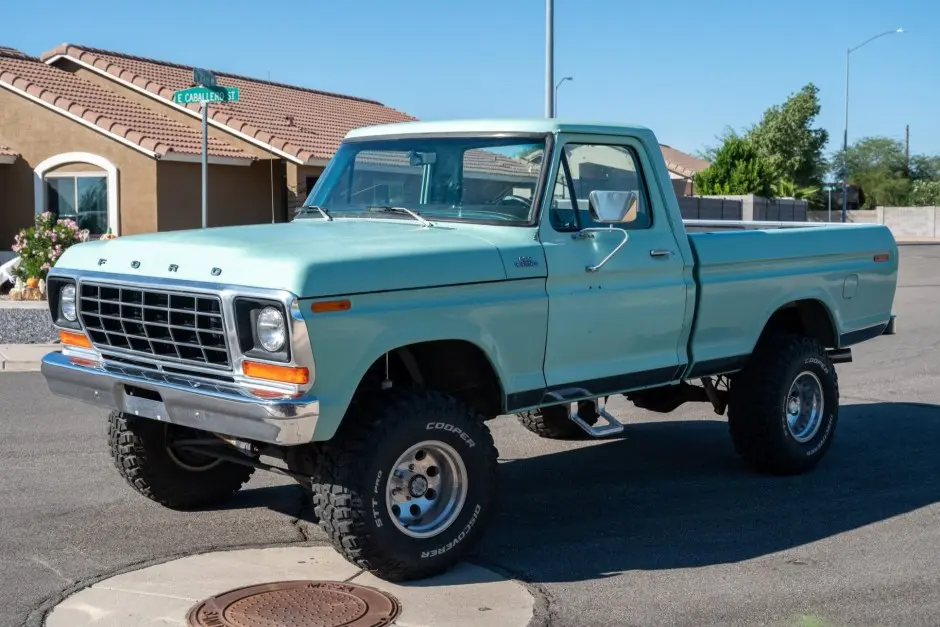
I was nine the first Saturday Dad let me ride to town in the Ford. It was a 1978 F-150, two-tone, tan over brown, with a bench seat that burned the backs of my legs in July. He’d bought it used the year I was born. He kept a tire gauge and a roll of butterscotch candies in the glove box, and he let me have one candy each way.
He parked it at an angle outside the coffee shop on the square, in the same spot every week. Then he went in and sat on the third stool from the door, and I sat beside him with a hot chocolate. There were always the same six or eight men. At some point in the morning, one of them would nod out the window and say something about that old Ford.
Dad said the same thing every time. “That one’s Cassidy’s when I’m gone.”
He said it for twenty-five years. He said it when I was nine and when I was nineteen. He said it the last Saturday in May, when I was thirty-four and he had to stop and breathe halfway through the sentence.
He died in June. It was his heart. He spent eleven days in the hospital in the city, and then he was gone, at sixty-three.
His will left everything to Charmaine, his second wife. It was two pages long, and he’d made it the year after they married. The lawyer read it to us in his office, and the Ford wasn’t mentioned anywhere. It didn’t have to be. “Everything” covered it.
It was legal. A promise made over coffee doesn’t hold up anywhere except in the people who heard it. I knew that, so I didn’t call anybody. There wasn’t anybody to call.
The sale bill came out in September. FARM AUCTION, it said, ESTATE OF WADE HOLLOWAY. It listed two tractors and a stock trailer and a welder and the hay equipment. It listed household goods. Near the bottom, in bold, it said 1978 FORD F-150, RUNS GOOD.
I read that in the break room at the vet clinic where I work, and I had to go sit in my car for a while.
I’m a vet tech. I make sixteen dollars an hour holding other people’s dogs. I had $6,200 in savings, which was two years of putting back a little every payday. I had been saving it toward a down payment on a house. I looked up what those old two-tone Fords were bringing, and it scared me. A clean one could go for nine or ten thousand.
I decided I’d go anyway. I would bid my $6,200 and not a dollar more, and if it went to a stranger, at least I’d have stood there.
The sale was the first Saturday in October, at the home place. I got there at nine and signed in at the cashier’s trailer like everyone else. Boone Tillery’s wife, Darla, was clerking. She has known me since I was in diapers. She wrote my name and my driver’s license number in her book and handed me a white card with a number on it in black marker. It was 112.
“You doing all right, hon?” she asked.
“I’m all right.”
“Well, good luck,” she said.
Boone Tillery has been the auctioneer in our county for as long as I can remember. He’s a big man with a white mustache, and he had known my dad forty years. He started at ten sharp with the small stuff on the hay wagons and worked his way across the yard.
I stood at the edge of the crowd in my green coat and watched my childhood go. The tractors sold before noon. The welder brought nearly twice what I’d have guessed. Then Boone got to the household tables, and there were Mom’s canning jars, by the box. She died when I was nineteen. I had helped her fill those jars with green beans every August of my life. They went for forty dollars a box to a woman from the next county.
I should say something about Charmaine. She had been married to Dad twelve years. She’s fifty-eight, a small, tidy woman who worked in the school cafeteria and kept his house cleaner than Mom ever had. One Christmas, after too much wine, she told me she had felt like the outsider in that house the whole time. She said it with her eyes on her plate.
I never did warm to her. That part is on me. I was twenty-two and grieving when she moved in, and I decided what she was before she’d unpacked. I was polite to her for twelve years, and that was all I ever was.
She stood by the front porch most of the day with her arms folded, watching things leave. A young man stood near her. I recognized him as her sister’s boy, Dalton, from over by the lake. He had a bidder’s card stuck in his back pocket. I never once saw him raise it.
Boone had sold everything else by two that afternoon. Then he climbed onto the back of his pickup with the microphone, and he pointed at the Ford.
It was sitting on the gravel by the machine shed. Somebody had washed it. The chrome was shining, and the bench seat had been wiped down. Dad’s cap was gone from the dash.
The crowd had thinned to about forty people. A dozen men stood in a line along the side of the truck. They wore caps and seed jackets and had their thumbs hooked in their pockets. I knew every one of them. They were men who had bought Dad’s calves for thirty years. Six of them had carried his casket.
Charmaine walked up to Boone’s pickup before he started. I was standing close enough to hear.
“Open it at nine thousand,” she said. “She wants it. She can pay like anybody else.”
Boone looked down at her for a long second. I saw his mustache move. He looked across the yard at me, and then back at her.
“It’s your sale,” he said.
He lifted the microphone.
“Folks, last item of the day. Nineteen seventy-eight Ford F-150, three-fifty-one engine, automatic. Wade drove this truck to town every week of his life, and it’ll start right up. Seller’s asking nine thousand on the Ford. Who’ll give nine?”
Nobody moved.
“Eight thousand. Who’ll give me eight?”
There was nothing. I could hear a meadowlark out in the hayfield.
Out here, somebody always throws out a low number to get a thing going. It’s a courtesy. A man will say “five hundred” on a nine-thousand-dollar truck just to give the auctioneer a place to start climbing from. I have been to a hundred farm sales, and I’ve never seen that not happen.
Nobody threw out anything.
“Seven,” Boone said. “Six. Somebody give me six on a good running Ford.”
Not one card went up. The men along the truck stood like fence posts with their hands in their pockets, every one. They were all looking at me.
I didn’t understand it. I thought she had told them something. I thought maybe they had all agreed I ought to be taught a lesson, the daughter who moved to town and never warmed to her father’s wife. I thought they were waiting to watch me go to nine and break.
My chin started to tremble. I held the card down against my green coat and stared at the gravel.
Charmaine came up closer to Boone’s tailgate. Her face was pink.
“Lower,” she said.
Boone looked down at her. He covered the microphone with his hand, but the yard was so quiet everyone heard him anyway.
“You want to pass it, Charmaine? You can pass it. We’ll put it back in the shed and no harm done.”
Forty people were watching her now. She looked at the line of men. She looked at her nephew. Dalton had taken his card out of his pocket, and he was holding it down by his leg.
“Lower,” she said again, and nodded.
Boone raised the microphone. “Five thousand. Forty-five. Forty-one hundred, folks.”
That was when I raised my card.
I don’t know why that number. It was a number I could say yes to and still buy groceries. I held the card up as high as I could reach, the way Dad taught me at my first cattle sale when I was ten. He’d told me a bidder ought to be seen. My hand shook so hard the number wobbled.
Boone pointed right at me. His voice changed.
“I’ve got forty-one hundred from number one-twelve. Do I hear forty-two?”
He looked down the line of men. There wasn’t a hand.
He looked at Charmaine. She opened her mouth and then shut it. She turned her head toward her nephew.
Dalton had the card halfway up to his belt. He looked at his aunt. Then he looked at the twelve men standing along that truck. They had turned to look at him, without any hurry. Nobody said anything to him.
He put the card back in his pocket.
That was when I noticed Emmett Riggle, at the end of the line. He was Dad’s coffee friend, seventy-four years old. He sat on Dad’s left every Saturday for as long as I can remember, and he gave me my first pocketknife. He was the only man there not looking at me or at Dalton. He was looking at Charmaine, and he didn’t look away.
Boone took a breath.
“Going once.”
The meadowlark sang again.
“Going twice.”
Charmaine’s hands were in fists at her sides.
“Sold. Forty-one hundred dollars, to number one-twelve.” He brought his hand down on the roof of his pickup. Then he said, not quite into the microphone, “And about time.”
Nobody cheered. That isn’t how men like that do things. But the line along the truck let go all at once, as though they had been holding one breath between them. Gene Pruett took off his cap and put it back on. Lloyd Asher blew his nose. One by one they walked past me on their way to their pickups, and each one touched the bill of his cap. Not one of them said a word.
I was crying by then, and I couldn’t have stopped it.
Emmett was the last. He stopped in front of me and looked at the card in my hand.
“You held it up good,” he said. “He’d have liked that.”
“Emmett, I thought you all were against me.”
He looked honestly surprised. “Against you? Sis, we talked it over at the coffee shop at six this morning. Lloyd wanted to buy it and hand you the keys. I said no. I said Wade’s girl would want to pay for it herself. I said all we needed to do was stay out of her way.” He scratched his jaw. “I didn’t figure on the nine thousand. That about ruined it.”
I laughed and wiped my nose on my sleeve.
It wasn’t over, though. I still had to pay, and Charmaine still had to sign.
There was a short line at the cashier’s trailer. When I got to the window, Darla already had my ticket written out. Forty-one hundred dollars. I wrote the check with my hand still shaking and tore it out, and she stamped the ticket PAID.
“I need the title, Charmaine,” Darla called out the door.
Charmaine was standing by the trailer steps. She had a manila folder under her arm. She didn’t open it.
“It didn’t bring what it’s worth,” she said. “I want to pass it.”
Boone had come up behind me, winding the microphone cord around his elbow. He stopped winding.
“You can’t pass it now. I asked you twice, in front of forty people. You said lower both times. It’s sold.”
“I didn’t think they’d all just stand there.” Her voice was shaking. “They did that on purpose. Every one of them. That truck’s worth nine thousand dollars, and you all know it, and you stood there with your hands in your pockets and stole it from me.”
“Nobody stole anything,” Emmett said.
He had walked over without my noticing. He stood at the bottom of the steps with his cap in his hand, and he spoke to her gently, which I had not expected.
“Charmaine, I’ve kept my mouth shut all summer. It wasn’t my place, and I thought you’d come around to it on your own. But I was in that hospital room on the ninth of June. Room two-fourteen. I was standing at the foot of the bed.”
She went very still.
“He could hardly talk,” Emmett said. “He got hold of your hand. He said, ‘See that Cass gets the Ford.’ And you said, ‘I will, Wade.’ I heard it. The nurse heard it.”
I hadn’t known that. I had been at work that day. I got there at six in the evening, and he was asleep, and he never really woke up again.
Charmaine’s eyes filled. She didn’t deny it.
“He said a lot of things in that room,” she said. Her voice had gone thin and hard. “He told me not to worry about money, Emmett. Did you hear that one? He told me the place was paid for and I’d be taken care of.” She pulled the folder out from under her arm and opened it against her chest. “There’s a note at the bank for fifty-eight thousand dollars against this farm. He borrowed it four years ago and never told me. There’s forty-one thousand owed to that hospital. We had the cheap insurance, because he said he was healthy as a horse. He left me everything. It turns out everything is owed.”
Nobody said anything. Darla had put down her pen.
“The bank gets the first of whatever comes out of today,” Charmaine said. “The farm closes on the first of November. I’m fifty-eight years old and I work in a lunchroom, and I’m moving in with my sister.” She looked at me then. It was the first time she had looked straight at me all day. “So yes. I wanted nine thousand dollars for that truck. I needed it. And yes, I wanted you to be the one to pay it. Twelve years I cooked your Christmas dinner, and you called me by my first name like I was the hired help. I wanted it to cost you something for once.”
I stood there with the PAID ticket in my hand. I’d like to tell you I said something wise. I didn’t say anything at all. She wasn’t wrong about the twelve years.
Emmett turned his cap around in his hands.
“I didn’t know about the bank,” he said quietly. “None of us did. Wade never said.” He looked over at the empty hay wagons. “I’ll tell you this much, Charmaine. Everything else you owned went high today. That welder brought double. Gene gave you eleven hundred for a stock trailer with a rotted floor. That wasn’t an accident either. Nobody here wanted to see you go without.” He nodded toward the Ford. “But that one wasn’t yours to put a price on. You told him you’d see to it. We heard him say it for twenty-five years, and I heard you say it once.”
Charmaine looked at him for a long moment. Then she took the title out of the folder and laid it on the little shelf at Darla’s window. It was in both their names. She signed the back, and she pressed so hard the pen tore the paper a little at the end of her name. She put a copy of Dad’s death certificate on top of it.
“There,” she said. She walked back to the house and shut the door.
Darla slid the title across to me. Boone cleared his throat.
“Keys are in it,” he said. “They always were.”
I drove it home that evening. It started on the second try and blew a little black smoke, and the cab smelled exactly like him. It smelled of dust and sun-cracked vinyl and butterscotch. I made it as far as the cattle guard at the end of the lane before I had to stop and put my head on the steering wheel.
When I could see again, I opened the glove box. The tire gauge was there. So was a roll of butterscotch candies with four left in it. Under the owner’s manual there was an envelope from the feed store, the kind they put your receipt in. My name was on the front in his square pencil printing.
The note inside was written on the back of a receipt for mineral blocks. It wasn’t dated. From the handwriting, he’d written it before he got bad.
“Cass. She runs rich when she’s cold. Pump it twice and wait. Don’t let anybody sell you a new carburetor. Title is in both our names because it was cheaper on the insurance. Charmaine knows it’s yours. Be decent to her. I wasn’t always fair to either one of you, trying to keep everybody happy. Dad.”
I read it by the dome light about ten times.
“Charmaine knows it’s yours.” He had trusted her to simply hand it over. He’d also told her the farm was paid for. I sat there at the cattle guard and understood that my father, whom I loved more than anyone, had left a mess for two women to find. He’d made each of us a promise that depended on the other one. He had never been able to stand an argument in his own house.
I was angry at him for about a mile. Then I ate one of the butterscotch candies.
I had $2,100 left in savings. I thought about it for most of the next week. I thought about writing Charmaine a check for the whole amount. I got as far as taking out the checkbook. I couldn’t do it. Part of that was pride, and I won’t pretend otherwise. But she had tried to make me pay, and writing that check would have felt like agreeing that she’d been right to.
I did something else. On my lunch hour I drove to the monument company in the county seat.
Mom and Dad share a stone. He bought it when she died. It’s a double, gray granite, with both their names on it and a pair of wheat stalks carved between them. His side has had his birth year on it for fifteen years, with a dash and a blank space after it. I’d been out to the cemetery twice since June, and the space was still blank.
The man at the counter looked it up. “Nobody’s ordered the date,” he said. “The widow called in July and asked the price. She said she’d have to wait.”
It was $375 to send a man out to cut eight numbers into a rock. I paid it. I asked him not to tell her who had.
I thought a good deal that week about Charmaine at that cemetery. She had stood at the grave of her husband of twelve years, in front of a stone that already had another woman’s name on it, with no room on it for hers. I had stood right next to her at the burial, and it hadn’t crossed my mind.
The last Saturday in October, I drove the Ford out to the home place. I hadn’t called ahead. A rental truck was backed up to the porch. Charmaine was coming down the steps with a lamp in each hand, and Dalton was wrestling a mattress through the door behind her.
She stopped when she saw what I was driving.
“I’ve got the day off,” I said. “And I’ve got a truck.”
She looked at me for a while. I thought she might tell me to go to hell. She would have had some right to.
“The deep freeze is the worst of it,” she said finally. “Dalton can’t lift it by himself.”
So I carried her deep freeze. I carried her sewing table and a dozen boxes of dishes. I carried the recliner she’d bought Dad for his sixtieth birthday. We made two trips to her sister’s place by the lake, forty minutes each way, with the Ford loaded to the top of the bed rails. She rode with Dalton in the rental. We worked until dark and hardly spoke.
At the end of it I was sweeping out the empty kitchen, because I didn’t know how to leave. She came and stood in the doorway.
“The monument man called me,” she said. “He said the date was done. He wouldn’t say who paid.”
I kept sweeping.
“I’d have gotten to it,” she said. “I want you to know that. I wasn’t going to leave him without a date.”
“I know you weren’t.”
She leaned on the door frame. She looked worn out, and older than fifty-eight.
“I meant what I said at the sale. About the hired help.” She folded her arms. “I felt like a renter in this house for twelve years. His first wife’s dishes. His first wife’s curtains. His daughter looking at me across the table like I’d broken in.”
I leaned the broom against the counter.
“That part’s on me,” I said. “I’ve known it a long time. I was twenty-two and I’d lost my mother, and I made up my mind about you in a week. I never looked again.”
She nodded slowly. She didn’t tell me it was all right.
“I shouldn’t have done what I did with the truck,” she said. “I was so angry at him, and he wasn’t here to be angry at. You were here.” She looked around the kitchen. “He told me the place was paid for, Cassidy. He looked me right in the face.”
“He wrote me a note,” I said. “It was in the glove box. He said he hadn’t been fair to either one of us.”
“Well,” she said. “He got that right.”
We stood there a minute longer. Then she picked up the last box from the counter, the one with the coffee maker in it, and I held the screen door for her. She got into the rental truck with Dalton. She raised her hand to me through the window as they pulled out. I raised mine.
I haven’t seen her since. She sent a card at Christmas with her sister’s address on it and her name signed at the bottom. I sent one back. I don’t know if we’ll ever be more than that to each other. I’ve quit thinking I’m the one who decides it.
The farm sold in November to a young couple from the city who want to raise goats. The bank got its money. Emmett heard that the hospital settled for a good deal less than forty-one thousand, and that there was a little left over for Charmaine. He wasn’t sure how much. I hope it was enough to matter.
I started driving the Ford to town on Saturdays. The first week, I sat in it outside the coffee shop for ten minutes before I could make myself go in. I’d parked at an angle, in his spot.
The third stool from the door was empty. They had been leaving it empty since June. Emmett was on the one to its left, where he always is. He looked up when the bell on the door rang, and he pushed the sugar down the counter to the empty place without saying anything.
I sat down. The waitress brought me coffee. Gene Pruett nodded out the window.
“That old Ford’s looking good, Cass.”
“She runs rich when she’s cold,” I said.
“Always did,” said Emmett.
When I went back out an hour later, it wouldn’t start. I cranked it and it only coughed. Three men came out of the coffee shop in their caps and stood on the sidewalk and gave me three different pieces of advice. Lloyd thought it was the plugs. Gene said flooded. Emmett said I ought to let him look at the carburetor.
I told them all thank you. Then I pumped the gas twice and waited, the way the note said to. It caught on the next try.