A Cold Plate
It was almost eight o’clock on Christmas night when I carried a slice of pecan pie up the stairs and found my stepdaughter sitting on the guest room floor in the dark.
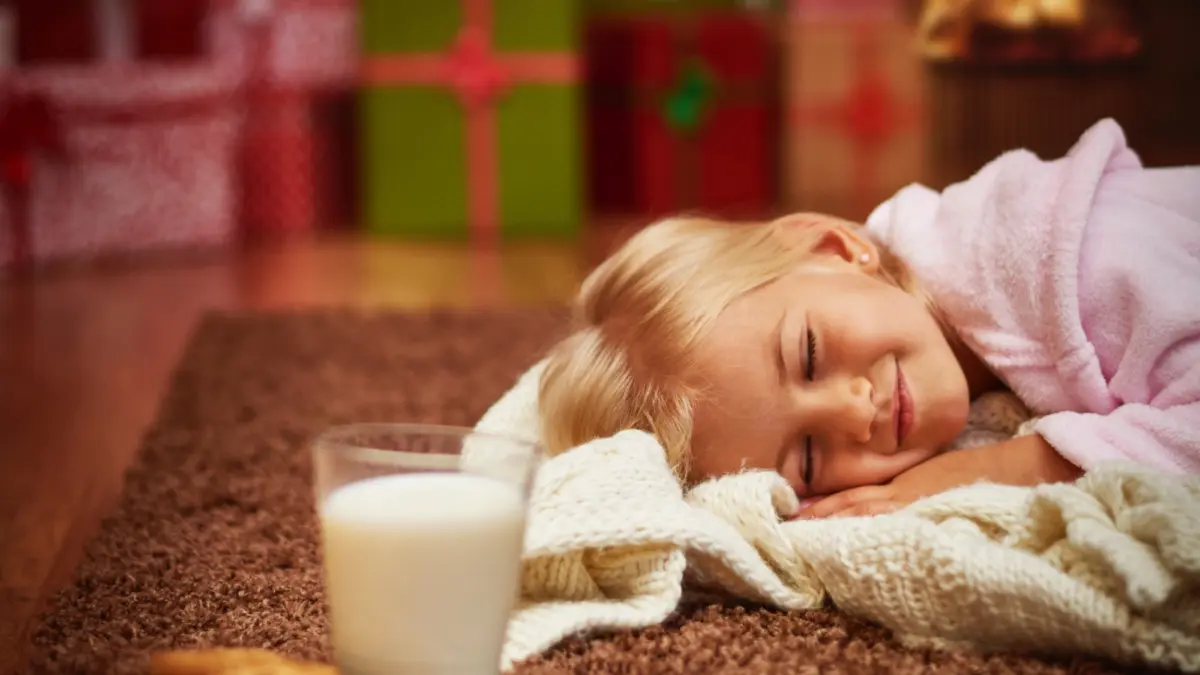
The door was halfway open. The only light came from the television on the dresser, where a cartoon reindeer was singing to nobody. My two-year-old son, Caleb, was asleep in the portable crib in the corner with his stuffed dinosaur under his chin. My husband’s niece and nephew were asleep on a quilt on the carpet, six-year-old Finn on his back with his mouth open and four-year-old Lucy curled against him like a kitten.
And Tessa was sitting cross-legged beside the bed, still wearing the green velvet dress she’d arrived in that morning.
On the nightstand beside her sat a paper plate. Turkey, mashed potatoes, green beans. Someone had brought it up hours ago. The gravy had gone thick and gray, and the potatoes had a skin on them. She hadn’t touched it.
“Hey, Julie,” she said softly, so she wouldn’t wake anyone.
“Sweetheart,” I whispered. “Why are you still up here?”
She shrugged, the way fourteen-year-olds shrug when they don’t want you to see that something matters. “Dad said to stay with them.”
“For three hours?”
Her eyes moved past me to the hallway, toward the sound of laughter drifting up from the living room. Somebody downstairs had just gotten a trivia question right, and my husband’s voice rose above the others, cheerful and loud.
I looked around the room. The wrapping paper from her new watercolor set was folded into a neat square beside her overnight bag, the way you’d fold a letter you meant to keep. Her shoes were lined up under the chair. And on the pillow behind her, right beside the small package she’d wrapped herself in brown paper with tiny hand-drawn Christmas trees, lay a twenty-dollar bill.
I picked it up. “Tessa, what’s this?”
Her cheeks went pink. “Dad left it.”
“For what?”
“For watching everybody.” She looked down at her hands. “He came up when they were finishing dinner and put it there. He said thanks for holding down the fort.”
I stared at the bill in my hand. “Did you ask him to pay you?”
She shook her head quickly. “No.”
Then she said something I would think about every night for weeks afterward.
“I didn’t even want the money,” she said. “I just wanted to have Christmas dinner.”
I set the pie down on the nightstand next to her cold plate, and I knelt on the carpet in front of her so we were eye to eye.
“You can come downstairs,” I said. “Right now. Bring your pie. I’ll stay with the kids.”
And my stepdaughter, who had lived in this house every other weekend for five years, looked at me with something I’d never seen on her face before. She looked frightened.
“Did Dad say I was allowed to?” she asked.
I didn’t understand that question that night. I understood it much later. And by then, I had started to realize how many other things I had missed.
Chapter Two: Green Velvet
My name is Julie Kessler. I’m thirty-nine years old, and I work as a dental office manager in Overland Park, Kansas, a suburb of Kansas City full of cul-de-sacs and good schools and minivans. I’ve been married to Mark for five years. We have a son, Caleb, who turned two in October and who believes that every box is a hat.
Mark also has a daughter, Tessa, from his first marriage. She was nine when I met her, a skinny, serious little girl with braces and a sketchbook she carried everywhere. She’s fourteen now, a freshman at Blue Valley Northwest, taller than me, with long brown hair she wears in a braid and the same sketchbook, or its great-grandchild, tucked under her arm.
Tessa lives mostly with her mother, Nina, in Olathe, about twenty minutes away. She spends every other weekend with us, from Friday evening to Sunday afternoon, plus one evening a week and alternating holidays. This year, Christmas Day was ours.
She’s a sweet kid. She’s a little quiet around adults, but funny when she’s comfortable, with a dry sense of humor that sneaks up on you. And she’s surprisingly patient with Caleb. When he was a baby, she would sit on the nursery floor for an hour drawing animals on a whiteboard for him while he babbled at her. He adores her. When she walks through the door on Fridays, he shrieks her name, which comes out “Tetta,” and runs at her knees.
I’ve been her stepmother for five years. I thought we had a good relationship. Not close, exactly. She’d never confided in me the way girls sometimes do with stepmothers on television. But friendly. Easy. I made sure her room was ready on her weekends, I bought the cereal she liked, I came to her art show at school in the spring.
I also thought I knew what happened in my own home.
Christmas proved otherwise.
That morning, Tessa arrived just before noon. Nina dropped her off at the curb, and I watched from the front window as Tessa got out of her mother’s car in a dark green velvet dress with a white collar, carrying her overnight bag and a small package wrapped in brown paper. She stood on the sidewalk for a moment after Nina pulled away, looking at our house, before she came up the walk.
“Is Dad here?” she asked as soon as she stepped inside.
“He’s in the garage,” I said, taking her coat. “Getting the extra folding chairs down from the rafters. Merry Christmas, honey. You look beautiful.”
She smiled, a real one, the kind that showed her new retainer. “Thanks. Mom found it at a vintage store.” Then she held up the package. Up close, I could see that the brown paper was covered in tiny Christmas trees she’d drawn by hand with green and gold ink, hundreds of them, each one a little different. “I made him something.”
“Tessa, that’s gorgeous. Even the wrapping.”
“Can I give it to him tonight? After dinner? When it’s quiet?”
“Of course,” I said.
She walked over to our tree and knelt down and placed the package carefully beneath it. Not in the pile with all the others. Off to one side, under the lowest branch, where it wouldn’t get crushed. She adjusted it twice until it sat exactly right.
Then Caleb came barreling down the hallway yelling “Tetta! Tetta!” and she scooped him up and spun him around, and he laughed so hard he got the hiccups.
Chapter Three: Presents
By four o’clock, our house was full.
Mark’s older brother, Aaron, came with his wife, Beth, and their two children, Finn and Lucy. Mark’s parents, Gene and Marilyn, drove in from Topeka with a pecan pie and a ham. Two aunts, an uncle, three cousins I could never keep straight. There were coats piled on our bed, casserole dishes covering every inch of the kitchen counter, a football game on the television that nobody was watching, and wrapping paper already scattered across the living room floor.
Mark was in his element. My husband loves a full house. He grew up in one, the oldest of three boys in a loud family in Topeka, and he moves through a crowded room the way some people move through water. He was refilling drinks, telling jokes, carrying Lucy around on his shoulders, arguing with his uncle about the Chiefs.
The children opened their presents first. That’s always been the rule in Mark’s family.
Caleb was more interested in the boxes than the toys. He put a shoebox on his head and walked into the coffee table. Finn immediately started assembling a plastic race track that took up half the living room. Lucy received a pink dollhouse with a working doorbell and insisted that every single adult come and ring it.
Tessa got a cream-colored cable-knit sweater from her grandparents. From Mark and me, she got a professional set of watercolor paints in a wooden box, with twenty-four colors and three sable brushes. I’d picked them out. Her art teacher had told me at the spring show that Tessa had real talent, and I’d spent an hour at the art store downtown choosing them.
She opened the wooden box and just looked at it for a long moment. Then she looked up at me, and her eyes were shining.
“These are the ones Ms. Ortega uses,” she said.
“I know,” I said. “I asked her.”
She looked genuinely happy. Happier than I’d seen her in months. She even let Caleb sit in her lap and tear the paper off her last gift, a gift card from her aunt, while she held his hands so he wouldn’t rip the card too.
I remember that because I took a picture. Tessa sitting on the floor in her green dress, laughing, with Caleb in her lap holding a curl of red ribbon over his head like a trophy. And behind them, on the couch, Mark, smiling, with his coffee cup in his hand.
Looking at that photograph later, nobody would have guessed anything was wrong. I certainly didn’t.
The trouble started when we began preparing dinner.
Caleb was getting tired and cranky, the way he does after a big morning with no nap. Finn and Lucy had scattered race cars and dollhouse furniture across the living room, and the adults were trying to move the couch and the coffee table so we could set up the long folding table for dinner.
Mark looked over at Tessa, who was sitting on the floor with her new paints, testing colors on a scrap of wrapping paper.
“Hey, Tess,” he said. “Why don’t you take the little ones upstairs for a while?”
She looked up from her paints. “All three?”
“Yeah. Put on a Christmas movie in the guest room. They can play up there while we get dinner sorted out down here.”
Tessa hesitated. I saw it from the kitchen doorway. Just a second.
“Can I eat with everyone first?” she asked.
“We’re not even sitting down yet,” Mark said. He nodded toward the stairs. “Come on. Give the adults a little peace.”
I was carrying a hot baking dish of sweet potatoes from the oven to the counter at the time. I heard the whole conversation. I heard her ask. But I didn’t stop what I was doing. I didn’t put down the dish. I didn’t say anything.
That was my first mistake.
Tessa gathered up Caleb’s stuffed dinosaur and his sippy cup. She helped Lucy carry her favorite doll and the little pink doorbell from the dollhouse. She asked Finn to bring his race cars. Then she picked Caleb up on her hip and herded the three of them up the stairs, Lucy holding her hand and Finn racing ahead.
I assumed she’d be back downstairs before we served dinner. I assumed someone would go get her. I assumed a lot of things.
Chapter Four: The Table
At five-thirty, everyone sat down.
Fourteen of us around two folding tables pushed end to end and covered with my mother’s white tablecloths. I was carving the turkey, refilling drinks, finding another chair for Mark’s Aunt Ruth, who’d arrived late with a Jell-O salad nobody would eat. The candles were lit. The football game was finally off. Gene said grace, a long one, and thanked God for family.
Someone asked where Tessa was. I think it was Marilyn, Mark’s mother.
Mark answered before I could.
“She’s upstairs with the kids,” he said, passing the rolls. “Said she didn’t mind watching them.”
Beth looked relieved. She’d been chasing Lucy all afternoon. “Oh, that’s sweet of her,” she said. “She’s so good with them.”
“She’s a natural,” Aaron said.
I leaned over to Mark and asked quietly if he could go get her. Just for dinner. We could bring the little ones down too, and somebody could hold Caleb.
“She’ll eat in a bit,” Mark said. “Caleb’s finally settled down. If I bring them down now, it’ll be chaos. Let’s just enjoy this.”
I glanced toward the stairs.
Then Aunt Ruth knocked over the cranberry sauce, and a red stain spread across my mother’s tablecloth, and I jumped up and went into the kitchen for club soda and towels. When I came back, the conversation had moved on to Gene’s knee replacement, and I sat down and started eating, and I didn’t ask again.
That was my second mistake.
At some point during dinner, I saw Mark get up and go into the kitchen. He came back a few minutes later. I thought he’d gone to get more ice. I didn’t know then that he’d fixed a plate and carried it upstairs and set it on the nightstand. I didn’t know he’d put a twenty-dollar bill on the pillow while he was up there.
Dinner lasted nearly an hour. Afterward, the adults moved into the living room for coffee and dessert and the Christmas trivia game Mark insists on every year. He writes the questions himself on index cards, and they’re terrible, and everybody loves it. He was having a wonderful time. So was Aaron. So was almost everybody in that house.
Around seven, I noticed that Lucy’s pink dollhouse was still sitting untouched beneath the tree. I wondered why she hadn’t come down to play with it. She’d been so excited about the doorbell.
“Shouldn’t the kids come down?” I asked Mark, between trivia questions. “Lucy hasn’t even played with her dollhouse.”
“The kids are fine,” he said, shuffling his index cards. “Tessa’s got them watching something. They’re probably asleep.”
“Shouldn’t Tessa come down, then?”
“In a minute,” he said. “Okay, next question. Uncle Ray, what was the name of the dog in It’s a Wonderful Life?”
Then his mother called us all into the kitchen to look at the lattice on her pecan pie, which she’d been perfecting for forty years, and we all stood around admiring it, and another half hour slipped away.
It wasn’t until nearly eight o’clock that I realized I hadn’t seen Tessa since she went upstairs at four-thirty. Three and a half hours.
I cut a slice of Marilyn’s pecan pie, put it on one of my good plates, and carried it up the stairs.
Chapter Five: Allowed
So there I was, kneeling on the guest room carpet in front of my stepdaughter, holding a twenty-dollar bill, while she asked me if her father had said she was allowed to come downstairs.
“Tessa,” I said slowly. “You don’t need permission to come to Christmas.”
She looked at me like I’d said something in a foreign language.
“He said to stay with them,” she said again. “He said if I came down and they followed me, it would ruin everything.” She glanced at the sleeping children. “Lucy cried for her mom twice. I didn’t want to bring her down and have her cry at the table.”
“Did you eat anything?”
She looked at the cold plate. “I wasn’t really hungry.”
That wasn’t true. I could tell by the way she looked at the pie.
“Eat this,” I said, and handed her the fork. “Right now. Then we’re going downstairs.”
She took a bite of pie. Then another. Then she ate the whole thing in about ninety seconds, sitting there on the floor in her green velvet dress, and I realized she’d probably had nothing since breakfast.
“Thank you,” she said quietly, and handed me the empty plate.
I went and got Beth from the living room and asked her to come sit with the sleeping kids. She came up the stairs and looked at the scene in the guest room, at Tessa on the floor and the cold plate on the nightstand, and her face changed.
“Oh, honey,” she said to Tessa. “Have you been up here this whole time?”
Tessa shrugged again.
“I thought you came down for dinner,” Beth said. “Mark said…” She stopped. She looked at me. Neither of us finished the sentence.
I took Tessa’s hand and walked her down the stairs. She followed me like she was walking into a principal’s office. When we came into the living room, the trivia game was still going. Mark looked up from his index cards and saw her, and for a split second, his face showed something I didn’t recognize. Not happiness. Something closer to annoyance.
“Who’s watching the kids?” he asked.
“Beth,” I said. “Tessa’s been up there for three and a half hours, Mark. She missed dinner.”
The room got a little quieter. Marilyn looked over from the couch. Aaron, in the recliner, suddenly became very interested in his coffee.
“I brought her a plate,” Mark said.
“It’s cold. She didn’t eat it.”
“Well, that’s not my fault.” He laughed, lightly, looking around the room as if inviting everyone else to laugh with him. “Tess, you should’ve eaten it. Come on, sit down, you can be on my team.”
Tessa didn’t sit down. She stood in the doorway between the hallway and the living room in her green dress with her hands clasped in front of her.
“Can I give you your present now?” she asked her father. “The one under the tree?”
Mark glanced at his index cards. “Let’s finish the game first, okay? Then you can.”
She nodded. She sat down on the floor at the edge of the room, away from everyone, with her knees pulled up.
The game went on for another forty minutes. Then the aunts started gathering their coats, and Gene and Marilyn said they needed to get back on the road to Topeka before the weather turned, and Aaron and Beth carried their sleeping children out to their car, and there was a flurry of hugs and thank-yous and Merry Christmases at the front door.
By the time the house was empty, it was nearly ten. Mark collapsed on the couch with a sigh and turned on the television.
The brown paper package with the hand-drawn trees was still under the lowest branch of the tree.
Tessa looked at it. Then she looked at her father on the couch, already half-asleep in front of a football replay. Then she went upstairs to her room and closed the door.
She never gave it to him that night.
Chapter Six: The Morning After
Nina came to pick Tessa up at noon the next day.
Tessa was packed and waiting by the front door at eleven-thirty with her overnight bag and her new watercolor box. She’d stripped the sheets off her bed and folded them, which she’d never done before. She’d also left the twenty-dollar bill on the kitchen counter, under the salt shaker, where Mark would see it.
Mark was in the garage, putting the folding chairs back up in the rafters. When Nina’s car pulled up, I called out to him that Tessa was leaving.
“Bye, Tess!” he called back through the garage door. “Love you! See you in two weeks!”
He didn’t come out.
Tessa stood in the front hallway for a moment, listening to the sound of the garage door. Then she picked up her bag and turned to go.
“Tessa,” I said. “Wait.”
She turned around.
“Your present,” I said. “For your dad. It’s still under the tree. Do you want me to give it to him?”
She looked at the tree in the living room. At the little package, still under the lowest branch. She was quiet for a long moment.
“No,” she said finally. “I’ll take it.”
She walked over and knelt down and picked it up, carefully, with both hands. She tucked it into her overnight bag between her clothes. Then she walked out the front door and down the walk to her mother’s car without looking back.
Nina got out of the car. She doesn’t usually do that. Normally she waits at the curb with the engine running. But that day, she got out and stood beside her car, and looked at her daughter coming down the walk, and then she looked up at me in the doorway. A long look. I couldn’t read it.
Then she got back in the car and drove away.
I stood in the doorway after they were gone and looked at the empty street. Then I went back into the kitchen and picked up the twenty-dollar bill from under the salt shaker. I held it in my hand for a long time.
That afternoon, while Mark watched football and Caleb napped, I sat at the kitchen table with my phone and scrolled back through every photograph I’d taken in the past year. I don’t know why. I think I was looking for something.
I found it.
In picture after picture, from every holiday and birthday and family gathering, Tessa was holding a child. Holding Caleb at his birthday party in October, while everyone else ate cake. Pushing Finn on the swing at the Fourth of July cookout at Aaron’s house, while the adults sat on the deck. Sitting on the floor with Lucy at Easter, while everyone else was at the table. Carrying Caleb on her hip at the zoo in August, while Mark and I walked ahead.
There wasn’t a single picture from the whole year of Tessa sitting at a table with the adults. Not one. In five years of being her stepmother, I’d never noticed.
Chapter Seven: What the Phone Knew
It was the Venmo notification that finally made me understand.
Two days after Christmas, Mark left his phone on the kitchen counter while he took Caleb to the park. It buzzed. I glanced at it without thinking, the way you do. The notification on the lock screen said: Aaron K. paid you $60. “Xmas babysitting, thx bro.”
I stood there in my kitchen looking at that notification for a long time.
I’ve never in five years of marriage gone through my husband’s phone. I didn’t do it that day either. I didn’t have to. I opened my own Venmo app, because Mark and I are connected on it, and I scrolled through his public transaction history, which anyone who’s his friend on the app can see.
It was all there. Months of it.
Aaron K. paid Mark $50. Saturday babysitting. Aaron K. paid Mark $50. Date night, thanks for Tess. Aaron K. paid Mark $40. Sunday afternoon. Aaron K. paid Mark $75. Overnight. Aaron K. paid Mark $60. Xmas babysitting, thx bro.
I counted them. Fourteen payments since March. Seven hundred and forty dollars.
Every one of them on one of Tessa’s weekends with us.
I sat down at the kitchen table. I thought back through the year. All those Saturdays when Mark said he’d promised Aaron we’d watch the kids. All those times Finn and Lucy showed up at our door with their pajamas and their toothbrushes, and Mark said, “Tess’ll keep an eye on them, she loves it,” and went out to the garage or the golf course or the bar on Metcalf Avenue with his brother. I’d been at work some of those Saturdays. I’d been running errands. I’d been grateful that Tessa was so good with them, and I’d never once asked if she wanted to be.
And I’d never once asked what happened to the money.
I thought about the twenty-dollar bill on the pillow. Twenty dollars out of sixty.
I picked up my phone and did something I’d never done in five years of being a stepmother. I called Nina.
Chapter Eight: Nina
She answered on the fourth ring. Cautious. “Julie?”
“Nina,” I said. “I’m sorry to bother you. Can we talk? About Tessa? Just you and me.”
There was a long silence on the line. Then she said, “I was wondering when you’d call.”
We met at a Panera on 119th Street the next afternoon, a Saturday. I’d never had a meal alone with my husband’s ex-wife. She was already there when I came in, sitting at a corner table by the window with a cup of tea. She’s forty-one, a nurse at Olathe Health, with short dark hair and Tessa’s same serious brown eyes.
I sat down across from her. Neither of us said anything for a moment.
“She came home on the twenty-sixth and went straight to her room,” Nina said finally. “She didn’t come out until dinner. When she did, she’d been crying. I asked her what happened, and she said nothing. That’s what she always says. Nothing.” Nina wrapped her hands around her tea. “Then she said, ‘Mom, can I just stay here next Christmas?’”
I closed my eyes.
“She’s been asking to skip weekends at your house since summer,” Nina said quietly. “Not every one. Just some. She makes up reasons. A project. A friend’s birthday. I let her, sometimes. I thought it was just being fourteen.” She looked at me. “In September, she told me something. She said, ‘At Dad’s house, I’m the babysitter. Not the daughter.’ She said it like a joke. She laughed. But she wasn’t joking.”
I told her about Christmas. All of it. The upstairs room. The three and a half hours. The cold plate. The twenty-dollar bill on the pillow. Did Dad say I was allowed to?
Nina’s face didn’t move while I talked. When I got to the twenty dollars, she put her tea down.
Then I told her about the Venmo payments. Fourteen of them. Seven hundred and forty dollars.
Nina sat back in her chair. She looked out the window for a long time.
“How much of it did Tessa get?” she asked.
“I don’t know,” I said. “Twenty dollars at Christmas. I don’t know about the rest.”
“I know,” Nina said. “She’s never mentioned getting paid. Not once.” She shook her head slowly. “He’s charging his brother for his daughter’s time. And keeping it.”
We sat there in silence.
“There’s something else you should know,” Nina said finally. “Something Tessa told me in October. She said she heard Mark on the phone with his mother. Telling Marilyn that it was nice having Tess around on weekends because she was ‘built-in childcare.’” Nina’s voice cracked a little. “She said, ‘Mom, I think that’s the only reason Dad still wants me to come.’”
I put my hand over my mouth.
“Julie,” Nina said. “I’m not saying this to blame you. You’ve always been kind to her. She says so. She likes you.” She took a breath. “But I’ve been talking to a lawyer. In November. About changing the parenting plan. In Kansas, the judge has to listen to what a kid Tessa’s age wants. And she wants fewer weekends at her dad’s. Or none.”
“Does Mark know?”
“Not yet,” Nina said. “I was waiting until after Christmas. I wanted to give him one more chance.” She looked at me across the table. “I guess he had it.”
Chapter Nine: The Package
I confronted Mark that night, after Caleb was in bed.
I didn’t plan what I’d say. I just sat down across from him at the kitchen table with my phone open to his Venmo history and the twenty-dollar bill, which I’d kept, and I laid them both on the table between us.
He looked at the phone. He looked at the bill. He looked at me.
“You went through my Venmo?”
“It’s public, Mark. Anyone you’re friends with can see it.” I pointed at the screen. “Seven hundred and forty dollars. Fourteen times. All on Tessa’s weekends.”
He leaned back in his chair. “So? Aaron pays me to watch his kids. That’s normal. Family helps family.”
“You didn’t watch his kids,” I said. “Tessa did.”
“We all did. It’s our house.”
“Mark.” I kept my voice level. “How much of that seven hundred and forty dollars did Tessa get?”
He didn’t answer.
“Twenty dollars at Christmas,” I said. “Did she get anything else?”
He looked down at the table. “She’s fourteen. She doesn’t need seven hundred dollars.”
“She needed a seat at the table,” I said. “On Christmas. She asked you. I heard her ask you. ‘Can I eat with everyone first?’ And you sent her upstairs for three and a half hours, and then you went up there and put a twenty on her pillow like she was a hotel maid.”
His face went red. “That’s not fair.”
“She asked me if she was allowed to come downstairs, Mark. In our house. Your daughter asked if she had permission to come to Christmas.”
He stood up from the table. He walked to the sink and stood with his back to me, gripping the edge of the counter. For a long time, he didn’t say anything.
“Nina called me,” I said quietly. “I mean, I called her. We met yesterday. She’s talking to a lawyer. About changing the parenting plan. Tessa told her she’s the babysitter here, not the daughter. And that she thinks that’s the only reason you still want her to come.”
He turned around. His face had gone white.
“That’s not true,” he said. “That’s not true, Jules. I love her. She’s my kid.”
“Then why does she think it?”
He opened his mouth. Then he closed it. He sat back down at the table, slowly, like an old man.
“When I was her age,” he said finally, “I watched Aaron and Danny every single weekend. My parents both worked. Dad at the rail yard, Mom at the hospital. Every Saturday, every Sunday. I didn’t go to a single football game in high school. I changed diapers and made mac and cheese and broke up fights.” He rubbed his face. “That’s just what you did. The oldest one helps. I never thought twice about it.”
“Did you like it?”
He was quiet for a long time.
“No,” he said. “I hated it. I hated every second of it.”
“Then why would you do it to her?”
He didn’t have an answer. He just sat there at the kitchen table, staring at the twenty-dollar bill.
Then I did something I’d been planning since I left the Panera. I got up and went into the hallway, to my purse, and took out the brown paper package with the hand-drawn Christmas trees.
Nina had given it to me at the restaurant. Tessa had left it on her desk at her mother’s house, she said. She’d told Nina to throw it away. Nina couldn’t do it. She’d brought it to me in a grocery bag.
“Tessa wanted to give you this,” I said, and set it on the table in front of him. “On Christmas night. When it was quiet. She waited all day. You told her to wait until after the game. Then everyone left, and you fell asleep.”
Mark looked at the package. At the hundreds of tiny Christmas trees she’d drawn, each one different.
He unwrapped it slowly. Inside was a small handmade book. Sixteen pages of heavy watercolor paper, folded and stitched together with green thread, with a cover she’d painted herself. It said, in careful hand-lettering: Christmas With Dad.
He opened it.
Each page was a painting. A watercolor, small and careful and beautiful, with a date written underneath in Tessa’s handwriting.
The first one was from when she was three. Mark lying on the living room floor of their old house in Lenexa with a tiny girl in a red nightgown sitting on his chest, both of them laughing. The next one: Mark carrying her on his shoulders through the lights at the Country Club Plaza, when she was four. Mark and Tessa building a lopsided gingerbread house. Mark asleep on a couch with a Santa hat on and a little girl drawing on his arm with a marker. Mark and Tessa at a Christmas Eve service, holding candles. Year after year after year.
Then the paintings changed. Year nine, the year of the divorce, she’d painted two Christmas trees side by side, one at her mother’s and one at her father’s, with a little girl standing between them. Year ten, her first Christmas with me in the picture, she’d painted all four of us. Year twelve, baby Caleb in her arms.
The last page was this year. Christmas Day.
She’d painted our dining room. The long table with my mother’s white tablecloths. The candles. The turkey. Gene and Marilyn and Aaron and Beth and the aunts and the cousins. Me, at one end, carving. And Mark, at the head of the table, laughing.
And in the chair beside him, a girl with a long brown braid in a green velvet dress, sitting at the table. Laughing too.
Underneath, in her careful handwriting, it said: This year. I hope.
She’d painted it before Christmas. Before she came over that morning. She’d painted the dinner she wanted to have, the seat she wanted to sit in, and she’d wrapped it in paper covered with hand-drawn trees, and she’d waited all day to give it to him.
And she’d spent that dinner upstairs, on the floor, with a cold plate and three sleeping children.
My husband sat at the kitchen table and looked at that last page for a long time. Then he closed the little book and put both his hands over his face. And he cried. Quietly, at first. Then not quietly at all.
Chapter Ten: Aaron
Mark didn’t sleep that night. I heard him downstairs at two in the morning, and again at four. When I came down at six, he was sitting at the kitchen table in yesterday’s clothes with the little book open in front of him and his phone in his hand.
“I need to fix this,” he said. His eyes were red. “I don’t know how. But I need to fix it.”
“Start with the money,” I said.
He drove to Aaron’s house that Monday after work. He asked me to come. I left Caleb with a neighbor and rode with him in silence to Leawood, where Aaron and Beth have a big stone house on a corner lot.
Aaron answered the door in his work clothes, holding a beer. He was surprised to see us. “Hey, bro. What’s up?”
Mark held out his phone with the Venmo history on the screen. “I need to talk to you about this.”
They talked on Aaron’s back deck in the cold for an hour. I sat in the kitchen with Beth, who made coffee and didn’t say much. Through the window, I could see the two brothers, both in their coats, Aaron with his arms crossed, Mark with his hands in his pockets. At first, Aaron was laughing. Then he wasn’t. Then he was arguing. Then he sat down hard on a deck chair and put his head in his hands.
When they came back inside, Aaron’s face was gray.
“I didn’t know,” he said to me. “Julie, I swear to God, I didn’t know Tessa wasn’t getting the money. I thought Mark was giving it to her. I thought that’s what it was for.” He looked at his brother. “I’d never have kept doing it. I thought I was paying her. I thought it was like her first job.”
Beth had gone very still at the kitchen counter.
“And Christmas,” Aaron said, quieter. “I didn’t know she was up there the whole time. Mark said she didn’t mind. I just figured she’d come down when she was ready.” He shook his head. “I never even went up to check on my own kids.”
Beth set her coffee cup down. “Neither did I,” she said. “I went up there at eight because Julie asked me to. That was the first time.” Her voice cracked. “I sat in that room with Finn and Lucy asleep on the floor, and that cold plate on the nightstand, and I thought, what kind of mother doesn’t check on her kids for four hours on Christmas? I knew they were fine. Because Tessa had them. I didn’t think about Tessa at all.”
Aaron took out his phone. He opened his Venmo. He typed for a minute. Then he turned the screen around and showed Mark.
Aaron K. paid Tessa Kessler $740. “For every time. Should’ve been you all along. Sorry, kiddo.”
“I already paid you,” Aaron said to his brother. “Now I’m paying her. You can do whatever you want with what I gave you before.” He looked at Mark. “But I think you know what you should do with it.”
Mark drove home in silence. When we got there, he went upstairs to our bedroom and sat on the edge of the bed with his laptop for a long time. When he came down, he showed me the screen.
He’d opened a 529 education savings account through the state of Kansas, in Tessa’s name, for college. He’d put in seven hundred and forty dollars. The full amount Aaron had paid him. Then he’d set up an automatic monthly deposit of a hundred dollars.
“For art school,” he said quietly. “If she wants it. Ms. Ortega told Julie she’s good enough.” He swallowed. “I never once asked her what she wanted to do after high school. Did you know that? Five years. I never asked.”
Chapter Eleven: The Table for Two
Mark asked Nina if he could take Tessa to dinner. Just the two of them. Not on his weekend. Not at our house. Somewhere else.
Nina said she’d ask Tessa. Tessa said no.
Mark took it harder than I expected. He sat in the car in the driveway for twenty minutes after Nina texted him. Then he came inside and asked if he could write Tessa a letter instead. A real one, on paper, the way she’d made him a real book.
It took him three nights. He wrote it at the kitchen table after Caleb was in bed, with the little watercolor book open beside him, crossing out and starting over. I didn’t read it. He didn’t offer, and I didn’t ask. He mailed it to Nina’s house on a Friday.
Nina called me the following Wednesday.
“She read it four times,” Nina said. “She cried. Then she painted for two hours. Then she came out of her room and said she’d have dinner with him.” Nina paused. “On one condition. She wants to pick the restaurant. And she wants it to be just the two of them. No Caleb. No you. No Aaron’s kids. Nobody to watch.”
“That’s fair,” I said.
“I thought so too,” Nina said.
She picked a little Italian place in downtown Olathe called Mama’s, with red-checkered tablecloths and a waiter who’d worked there since the eighties. Mark wore his good shirt. He came home at nine-thirty and sat down on the couch beside me without saying anything for a long time.
“She asked me why,” he said finally. “Why I sent her upstairs. Why I never let her stay at the table.”
“What did you tell her?”
“The truth,” he said. “That I didn’t see her. That I saw a fourteen-year-old who was good with kids and I used it, because it was easy, because it was what my parents did with me. That I didn’t think about what she wanted. That I thought because she never complained, she didn’t mind.” He shook his head. “She said, ‘Dad, I never complained because I was scared if I did, you wouldn’t want me to come anymore.’”
He was quiet for a long moment.
“She said that’s why she asked Julie if she was allowed to come downstairs,” he said. “Because she thought if she came down and the kids followed her and ruined dinner, I’d be mad. And she thought if I got mad enough, I’d tell her mom she didn’t have to come every other weekend.” He put his face in his hands. “She’s been afraid for a year that I’d stop wanting her. And I’ve been paying my brother’s babysitter with her time.”
I put my hand on his back.
“She gave me terms,” he said, after a while. He almost laughed. “She’s fourteen and she gave me terms. Like a lawyer.”
“What were they?”
He counted them off on his fingers. “No babysitting Finn and Lucy. Ever. Unless she offers. If she offers, she gets paid directly, by Aaron, at whatever she thinks is fair. When she’s at our house, Caleb is our job, not hers. She can play with him when she wants to, because she loves him, but she’s not in charge of him.” He took a breath. “She sits at the table. Every holiday. Every Sunday dinner. Every meal. Beside me.”
“Those are good terms,” I said.
“And she wants to come every other weekend,” he said, and his voice broke. “She told Nina to call the lawyer and stop. She said she wants to keep coming. As long as I keep the terms.”
Chapter Twelve: This Year
Mark kept the terms.
He kept them on Valentine’s Day, when Aaron called asking if Tess could watch Finn and Lucy so he and Beth could go out, and Mark said no, and then went and watched them himself. He kept them at Easter, when he put Tessa’s chair beside his at the head of the table and asked her to say grace, which she did, red-faced, in four words. He kept them every other weekend, when Caleb woke up at six in the morning screaming for pancakes, and Mark got up and made them instead of knocking on Tessa’s door.
Tessa started coming downstairs on her own. At first she’d hover in the doorway of the kitchen, the way she had on Christmas night, waiting. Then she stopped waiting. She’d come in and sit at the counter while I made dinner, sketching in her book, telling me about her art class and a boy named Ethan who she insisted she did not have a crush on.
In March, she entered a watercolor in the Johnson County high school art show. A painting of Caleb asleep in his crib, with his stuffed dinosaur under his chin. It won second place in the freshman division. Mark took the afternoon off work and drove to the show at the community college in Overland Park, and he stood in front of that painting for twenty minutes. When Tessa came up beside him, he put his arm around her shoulders and didn’t say anything.
She told me later that it was the first time he’d ever come to one of her art shows.
In June, Aaron hired her to watch Finn and Lucy for a week while Beth was out of town. Tessa offered. She named her price, twelve dollars an hour. Aaron paid it directly, every evening, into her own Venmo account. She put most of it in her college fund.
In August, she started asking me to teach her to cook. Not because she had to. Because she wanted to be in the kitchen.
And then it was Christmas again.
Tessa arrived just before noon. Nina dropped her off, and this time, Nina got out of the car and walked her to the door and came inside for a cup of coffee, and stood in our kitchen talking with me for half an hour while Mark wrestled Caleb into his Christmas sweater. Before she left, she hugged Tessa at the door and then, unexpectedly, hugged me too.
By four o’clock, the house was full again. Gene and Marilyn. The aunts. Aaron and Beth and Finn and Lucy. Coats on the bed and casserole dishes on the counter and wrapping paper everywhere.
The children opened their presents first. Caleb, now three, wore a box on his head and walked into the coffee table again. Finn built another race track. Lucy got a dollhouse family to go with her dollhouse.
When the adults started moving furniture for dinner, Caleb started to fuss, and Finn and Lucy started fighting over a race car. I saw Aaron glance toward the stairs, the old reflex. I saw him catch himself.
Mark stood up from the couch.
“Okay,” he said. “I’ve got the little ones. Aaron, you’re with me. We’re taking them upstairs for a movie until dinner’s ready. Then everybody comes down. Everybody.”
Aaron looked at him. Then he laughed, a little embarrassed, and stood up too. The two brothers herded three small children up the stairs, Mark carrying Caleb on his hip and Aaron holding Lucy’s hand.
Tessa was sitting on the living room floor with her sketchbook. She watched them go. Then she looked over at me in the kitchen doorway, and she smiled. A real one.
“Want to help me with the gravy?” I asked.
She closed her sketchbook and stood up. “Yeah,” she said. “I do.”
At five-thirty, everyone sat down. All of us. The kids came down from upstairs in a pack, Caleb on Mark’s shoulders and Lucy holding Aaron’s hand. Fourteen adults and three children around two folding tables pushed end to end, with my mother’s white tablecloths, which I’d finally gotten the cranberry stain out of.
Mark sat at the head of the table. And in the chair beside him, in a dark green velvet dress that was a little short on her now, sat Tessa. Gene said grace, a long one, and thanked God for family. Mark held his daughter’s hand while he did.
Halfway through dinner, Mark stood up and tapped his glass with his fork. The table went quiet.
“I have to give somebody something,” he said. “I was supposed to get it last year. I didn’t. I was too busy to see what was right in front of me.”
He reached under his chair and brought out a package. Wrapped in brown paper, covered in hand-drawn Christmas trees. Not as good as Tessa’s. Lopsided and smudged, in green and gold marker. He’d spent two evenings on it at the kitchen table, swearing under his breath.
He set it in front of Tessa.
She looked at it. Then at him. Then she unwrapped it, slowly.
It was the little watercolor book. Christmas With Dad. Her own book, with the green thread binding. But it was thicker now. He’d taken it to an art supply store in Kansas City and had them add more pages, blank ones, heavy watercolor paper, stitched in with the same green thread. Forty more pages.
She turned to the last page she’d painted. Last year. The dining room table, the candles, a girl in a green velvet dress sitting beside her father, laughing. This year. I hope.
Underneath, in Mark’s blocky handwriting, he’d added two words.
This year.
And on the next page, the first new blank one, he’d written in pencil at the very bottom: Next year. Your seat’s already saved.
Tessa looked at that page for a long time. The whole table was quiet. Marilyn had her napkin pressed to her mouth. Beth was crying. Aaron was looking at his plate.
Then Tessa closed the book and turned to her father. She put her arms around his neck, right there at the table, in front of everybody, and held on. Mark held her too. He didn’t say anything. He didn’t have to.
After dinner, the adults moved into the living room for coffee and pie and the terrible trivia game. Mark handed out the index cards. Tessa sat on the couch beside him, on his team. They lost badly, and she laughed so hard at one of his questions that she had to put her face in a pillow.
Around eight o’clock, I went upstairs to check on Caleb, who’d fallen asleep in the portable crib in the guest room. The door was halfway open. The television was off.
On the nightstand, where a cold paper plate sat a year ago, there was nothing at all. Just the lamp, and a stuffed dinosaur, and a small framed photograph I’d put there that morning.
It was the picture I took on Christmas Day the year before. Tessa sitting on the floor in her green dress, laughing, with Caleb in her lap holding a curl of red ribbon over his head. And Mark behind them on the couch, smiling.
Nobody looking at it would have guessed anything was wrong. That’s why I keep it there. To remind myself how easy it is to miss the most important thing in a room, even when you’re the one holding the camera.
I went back downstairs. My husband was at the head of the coffee table, reading a trivia question in a ridiculous voice. My stepdaughter was beside him, laughing. My son was asleep upstairs, watched over by no one but his own dreams.
And for the first time in six years of Christmases, everyone who belonged at that table was sitting at it.