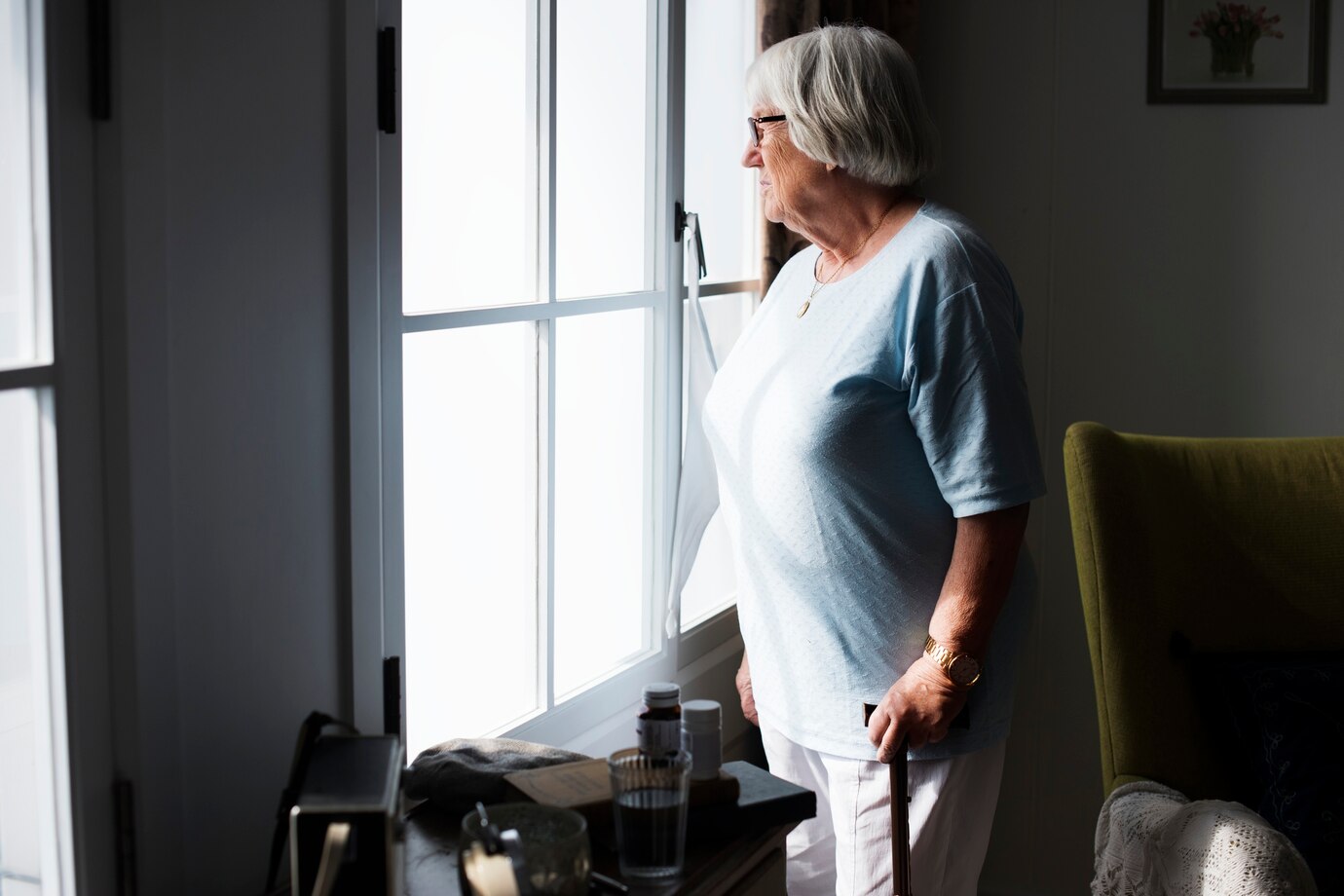
I started getting ready at five, which was too early, but at seventy-seven everything takes longer than you plan for. The navy dress had been hanging on the closet door since Tuesday. I pressed it, then pressed it again, and I stood in front of the bedroom mirror smoothing the front of it with both hands. Benjamin’s dinner was at seven. It was the first dinner in the new townhouse, the one at Ashford Commons with the white trim and the two-car garage, and I had been looking forward to it for about three weeks.
It was raining a little, tapping at the kitchen window. I’d made tea and forgotten to drink it. The kettle clicked once on the stove as it cooled. I had my purse on the table, and next to it a bottle of the red wine Thomas used to like, with a ribbon on the neck that I’d tied and retied. The kitchen smelled like lemon polish because I’d done the table that afternoon for no reason at all, since nobody was coming here.
The pearl earrings were sitting on the mantel in their little dish, next to Thomas’s photograph. He gave them to me for our fiftieth anniversary, two years before he died. I picked up the silver frame for a second, the way I do, and it was cold. Beside it was the townhouse brochure Benjamin had mailed me back in March, thick glossy paper, smiling couples on a patio, a floor plan on the back page with a ground-floor bedroom circled in blue pen.
“For you too, Mom,” he had told me on the phone when it arrived. “That downstairs room has its own bath. No stairs. We’re thinking long term.”
I believed him. I wrote the check for the down payment the same week.
My phone buzzed on the table at 6:18.
“Mom, the plans have changed.”
I thought he meant the time. I thought maybe Genevieve was running behind with the food, or they wanted me at 7:30 instead. I had my hand on the back of the kitchen chair, starting to get up to find my reading glasses, when it buzzed again.
“You weren’t invited. My wife doesn’t want you there.”
I sat back down. There was a taste in my mouth like I’d bitten a spoon. The clock on the stove said 6:20, and I read the two messages over and over, looking for the way they could be a mistake. Maybe he’d meant them for someone else. Maybe there was a third message coming that would explain. I watched the screen for the three little dots, and they didn’t come.
He had invited me, of course. He’d called on the first of the month, a Sunday, and said, “Seven o’clock on the twenty-first, Mom, put it on the calendar.” It was on the calendar. I could see it from where I sat, in my own handwriting, with a little star.
Genevieve has never raised her voice at me in the twelve years I’ve known her. She doesn’t need to. Whatever she wants to say to me comes out pleasantly, over a nice table, in a way she can take back later. Two summers ago we were at a café downtown, the three of us, and I’d paid, the way I always paid. She had a fourteen-dollar coffee with some kind of foam on it. She stirred it and smiled at Benjamin and said, “Your mother makes people uncomfortable. She means well, but still.” She said it as if I were across town instead of across the table.
I laughed. That’s what bothers me most now. It was a small polite laugh, the kind I’ve been producing my whole life so that nobody would have to feel awkward on my account, and Benjamin laughed too, and we all went on with our coffee.
I got up from the kitchen chair and went to the desk in the front room. It was my mother’s desk, a secretary with a drop front and a deep bottom drawer that sticks in wet weather. I had to jerk it twice. Inside, under the tax returns, was a green hanging folder with a white label that said BENJAMIN in Thomas’s block capitals. He started that folder in 1994. I’d kept it up after he died, though I’m not sure I ever asked myself why.
It smelled like old paper does, dust and ink. I carried it to the kitchen table and opened it next to the wine.
The oldest things were at the back. There were tuition statements from his four years at the university, and the canceled check for his first car. In front of those was a letter from a collections agency in 2009 about a credit card of his that Thomas had paid off without telling me until afterward. He and Genevieve got married in 2014, and the wedding receipts were all there, the venue and the flowers and a string quartet. After the wedding the folder got thicker.
There was the mortgage on their first house. Benjamin had come to us in 2016 and said they were a little short each month, just until his commission structure changed, and Thomas set up an automatic payment of $1,200 from our checking account. The commission structure never changed that I heard of. The payment went to $1,800 in 2019 and $2,400 after Thomas died. Their health insurance was in there too, and the car insurance on both vehicles. The country club was $640 a month, which Genevieve had explained was really a business expense, because that was where Benjamin met clients.
I found the preschool invoice for my granddaughter, $2,800, with a sticky note in my own handwriting that said “one time.” It hadn’t been one time. Nora is ten now and goes to St. Anne’s, and I’d been paying that tuition every month for six years. I found the $6,400 for the roof repair on the old house, which Genevieve had promised me on the telephone would be “just temporary, Marian, we’ll square up in the spring.” That was the spring of 2021.
I added it up once, in January, when I was doing my taxes. For that year alone it came to $93,600. I remember looking at the number on the adding machine tape and thinking that it couldn’t be right, and then checking it, and then putting the tape in the folder and closing the drawer. I didn’t say anything to anyone. My daughter Serena would have had plenty to say, and I didn’t want to hear it.
At 6:47 the phone buzzed again. I snatched it up, I’m ashamed of how fast.
It was Nora, on the tablet she’s allowed to use for an hour after homework. “Grandma, are you coming?”
I looked at those four words until my eyes stung. She would have been in her room, probably in the dress with the yellow collar, listening to the doorbell and counting who came in. Nobody would have told her anything. They’d have let her wonder, and then at some point Genevieve would have said that Grandma wasn’t feeling well.
I wrote back, “Not tonight, sweetheart. I love you.”
She sent a heart, and then a picture of her cat.
I thought about calling Wesley. He’s Thomas’s younger brother, he lives forty minutes away, and he would have gotten in his truck. I thought about calling Serena in Denver, where it was still afternoon. I had my thumb over her name. But I knew what either call would turn into, an hour of me crying and someone else being angry on my behalf, and in the morning I’d feel a little better and nothing would be different.
So I picked up the landline, the yellow one on the kitchen wall, and I dialed the number on the back of my bank card.
The after-hours line at First National put me through to a young woman with a soft Southern voice. She asked me to verify my identity. I gave her my birth date. I gave her Thomas’s middle name, which was Everett. I gave her the last four digits and the security phrase, which is the name of a dog we had in 1975.
“Thank you, Mrs. Kelley. How can I help you this evening?”
“I have a number of automatic payments coming out of my checking and savings. I want to stop them.”
“All right. Which authorizations would you like us to cancel?”
“All of them connected to Benjamin Kelley.”
There was a short silence. Then I heard her typing, quick and light, and it went on for some time.
“Ma’am, I’m showing quite a few. I can place a hold on everything scheduled to go out tonight and tomorrow, but to cancel them permanently you’ll need to sign in person at your branch. Would you like me to do the hold and make a note for the branch manager?”
“Yes. Please. I’ll be there when they open.”
“May I ask, Mrs. Kelley, is anyone pressuring you to make this change? I’m required to ask.”
I almost laughed. “No, dear. Nobody’s pressuring me. It’s the other way around.”
She gave me a confirmation number and I wrote it on the back of the brochure, right across the patio and the smiling couples. My voice had stayed steady the whole call, and I was a little surprised at it. When I hung up, it was 7:03. The dinner would have started. Genevieve would have been carrying something out on the big white platter I gave her for Christmas.
I picked up the cell phone and wrote to my son. “Then you and your wife can start paying your own way.”
I pressed send before I could tidy it up into something nicer. Then I held the button on the side until the screen went black, and I took off the pearl earrings and put them back in their dish. I hung the navy dress in the closet. I ate a piece of toast standing at the counter, and I went to bed at 8:30 and lay there listening to the rain until well after midnight.
The branch opens at eight. I was in the parking lot at 7:40 with the green folder on the passenger seat, watching a teller unlock the doors. By 8:11 I was sitting across the desk from Clara Whitmore, and the folder was open between us.
Clara has been at First National for longer than I’ve banked there, and I’ve banked there twenty-two years. She opened Thomas’s first retirement account when he rolled over his pension from the plant. She helped me with the paperwork after the funeral, the death certificate copies, the survivor benefit, the life insurance check that I carried in my purse for nine days because I couldn’t stand to deposit it. She sent a peace lily to the house. It’s still alive, in the front room.
She had the note from the night line already up on her screen. She read it, and then she looked at me, and I was grateful there was no pity in her face. She only looked like she was paying attention.
“Are you certain, Mrs. Kelley?” she asked gently.
I put both hands flat on her desk. They’re an old woman’s hands now, blue veins and spots, and my wedding ring slides around on my finger. “Yes,” I said.
“Then let’s see exactly what we’re dealing with.”
She typed for a minute and sent something to the printer behind her. It came out slowly, one sheet after another. There were eight pages. She squared them on the desk and turned her monitor so I could see it too, rows of names and amounts and dates.
The mortgage company for the new townhouse was right at the top, $3,150 a month, which had started in April. I knew about that one. I knew about the insurance and the club and St. Anne’s. But the list kept going down the screen. The electric company was on there, and the gas, and the water and sewer for an address I didn’t live at. So were two cell phone lines and a lease payment on Genevieve’s car that I had no memory of agreeing to. There was a meal delivery service and a gym, and four different television subscriptions and a wine club.
“I didn’t authorize half of these,” I said.
“Some of them you did, on paper, years ago. Some were added online.” Clara touched a line with the cap of her pen. “Benjamin has had view-and-pay access to your checking since 2018. You and Mr. Kelley signed that form together. It lets him add a payee.”
I remembered the form. Thomas had been in the hospital for his knee, and Benjamin had said it would make it easier for him to help us with the bills.
“And this one?” I pointed at a line near the bottom of page six. It said BGK HOLDINGS LLC, $1,500, on the fifth of every month.
Clara pulled it up. “That’s a transfer to a business checking account at another bank. It started in March of last year. Do you know what it is?”
“No. He’s never mentioned any business to me.”
She didn’t say anything to that. She scrolled to the bottom and read me the total, which was one hundred seventy-four recurring payments and scheduled transfers. Some were monthly and some quarterly, and a few were annual. I felt heat come up into my face, and for a moment I took it for embarrassment, but that wasn’t quite it. For the first time I was seeing the whole of it on one screen, after years of only seeing a piece at a time.
“There’s something else I ought to show you,” Clara said. She opened another window. “This is your savings and the brokerage account together. When Mr. Kelley passed, eight years ago, the combined balance was a little over four hundred and ten thousand, including the life insurance. As of this morning it’s a hundred and thirty-eight.”
I looked at that for a while. I get Social Security and Thomas’s survivor pension, about $3,900 a month between them, and I own my house outright. I have never thought of myself as someone who needed to worry. But I’m not too old to do the arithmetic, and at this rate the money would have been gone in about three years.
“It rarely happens overnight,” Clara said quietly.
“No,” I said. “It never does.”
She printed the cancellation forms. There were a lot of initials. She revoked Benjamin’s access to the account and had me choose a new online password, which I wrote on a card and put in my wallet. She put a note on my file that any new payee had to be approved by me in person. The last form was a single page, and the only sound in her office was my pen on it.
“What about the eighty-five thousand in March?” I asked. “The check I wrote for the down payment.”
“That cleared, Mrs. Kelley. That’s not something I can pull back.” She hesitated. “Do you have anything in writing about what that money was for?”
“I have a brochure with a bedroom circled on it.”
“You might show that to an attorney,” she said. “I can’t advise you. But you might.”
I drove home with the eight pages in the folder. The rain had stopped and the gravel in my driveway was dark and shiny. I put the kettle on and took down my wedding china, the cups with the gold rim that have been in the top cabinet since about 1990. I’ve always drunk my tea from a chipped blue mug and kept the good ones for company. That morning I took down a gold one and washed the dust out of it.
I turned my cell phone back on while the tea steeped. It shook in my hand for nearly a minute. There were nineteen missed calls, most of them from Benjamin after ten at night. Three were from Genevieve, and she has not telephoned me directly since the roof.
The text messages started out hot and got colder. “Seriously, Mom?” at 7:05. “You’re going to do this tonight, with people here?” at 7:09. Then at 10:40, “Call me. We need to talk about what you think you’re doing.” There was one from Genevieve at 6:50 that morning, all in complete sentences, saying she was sorry if there had been a miscommunication about the guest list and that she hoped I wouldn’t make a rash decision that would affect Nora.
I didn’t answer any of them. I sat at the kitchen table with the good cup and the folder, and I watched the clock. At exactly 11:26 the phone lit up with a message from the bank, one of the alerts Clara had set up for me. A payment to the electric company for the townhouse had been declined. Two minutes later the wine club was declined. Then the gym came through, and the car lease after it. They kept coming for most of an hour, and somewhere in the middle of them Benjamin called four times in a row.
Around a quarter past twelve I heard tires on the wet gravel.
I pulled the front curtain back an inch. It was Benjamin’s gray SUV. Genevieve got out of the passenger side first, in a cream-colored coat without a mark on it, her mouth pressed into a line. Benjamin came around from the driver’s side holding his phone, and his face had no color in it at all. He’s fifty-one. In that light he looked older than his father did at that age.
Then the back door opened, and I set my teacup down on the table very slowly.
It was Wesley. He was in his barn jacket and his good cap, and he climbed out of the back seat the careful way he does since his hip, holding the door frame. He looked at my house, and then he looked at the ground. I hadn’t called him the night before. But somebody had.
I opened the door before they could knock. I wasn’t going to have them standing on my porch ringing the bell like salesmen.
“Mom,” Benjamin said. “Thank God. Are you all right?”
“I’m fine. Wesley, what are you doing here?”
Wesley took his cap off. He’s seventy-four, three years younger than me, and he has Thomas’s ears and Thomas’s way of standing with his weight on one leg. “Ben called me at seven this morning, Marian. Said you’d had some kind of episode. Said you’d been confused on the phone and shut off all your accounts and wouldn’t answer.” He turned the cap in his hands. “I told him I’d come see for myself.”
“Well, come in and see.”
They came into the kitchen. Genevieve didn’t take her coat off. She looked at the folder on the table, and the eight pages, and the gold-rimmed cup, and I watched her take stock of all of it in about two seconds. She sat down across from me and folded her hands.
“Marian, first, I want to apologize for last night. There was a mix-up. We had Benjamin’s managing partner and his wife, and the table only seats eight, and I think Benjamin worded it very badly.”
“He said you didn’t want me there.”
“I’d never say that.”
“He wrote it down, Genevieve. I have it on my phone.”
Benjamin pulled out a chair and sat, and stood up again. “Mom, can we not do this? The mortgage bounced. The actual mortgage, on the house. I got an email from the lender an hour ago. Nora’s school called Gen’s cell about the tuition draft. Do you understand what you did?”
“I understand it better than I did yesterday. I spent the morning at the bank.”
“Which is the problem,” Genevieve said, in her soft reasonable voice. She opened her handbag and took out a manila envelope. “This is exactly what we’ve been worried about. You went down there alone, upset, and made major financial decisions in a state. Anyone can see that’s not safe. We’ve thought for some time that you need help managing things.”
She slid some papers out of the envelope and turned them to face me. The heading across the top said Durable Power of Attorney. My name was typed in already, and Benjamin’s under it as agent. There were little yellow flags where I was supposed to sign.
“We have a notary who can come to the house this afternoon,” she said. “It’s very standard. It just lets Benjamin handle the banking so you don’t have to be burdened with it. Wesley agrees it’s sensible. Don’t you, Wesley?”
Wesley had been standing by the refrigerator. He came over and looked at the paper, and then at Benjamin.
“You didn’t tell me about any paper,” he said. “You told me she was confused.”
“She is confused, Uncle Wes. Look at what she did.”
“She looks about as confused as a tax auditor.” He pulled out the chair next to mine and lowered himself into it. “Marian, what’s in the folder?”
I pushed the eight pages over to him. He was an insurance adjuster for thirty-five years and he reads a column of figures the way other people read the funnies. He went through the first page with his finger. He went through the second. On page three he made a small noise in his throat. By page six he’d stopped using his finger and was just staring.
“A hundred and seventy-four,” I told him. “Ninety-three thousand six hundred dollars, this year. And the savings is down to a hundred and thirty-eight from four-ten.”
“Since Tom died?”
“Since Tom died.”
Wesley set the pages down. He took his glasses off and rubbed the bridge of his nose. He asked very quietly, “Ben, what’s BGK Holdings?”
Benjamin looked at his wife. It was only for a second, but I saw it, and Wesley did too.
“It’s nothing. It’s an LLC we set up for tax purposes. For Gen’s design consulting.”
“Fifteen hundred a month of your mother’s money, into a company she’s never heard of.”
“She agreed to help us get it started.”
“I did not,” I said. “I’d remember that. I remember the dog we had in 1975, Benjamin.”
Genevieve put her hand on the power of attorney and drew it back an inch toward herself, as if she might want it again later. “I think we’re getting off track. Nobody’s denying that Marian has been generous. We’re grateful. But a family arrangement that’s been in place for years can’t just be switched off overnight with no warning. People have made commitments based on it. We closed on a house based on it.”
“Whose names are on the deed to that house?” I asked.
She blinked. “I’m sorry?”
“The deed. I gave you eighty-five thousand dollars for the down payment in March. Benjamin told me there’d be a room for me on the ground floor. I’ve got the floor plan with his pen on it. So I’d like to know whose names are on the deed.”
Nobody said anything, and I could hear the refrigerator running. Benjamin studied the tabletop. It was the same look he had at nine years old when he’d broken the neighbor’s window, and it went right through me, the way it always has.
“It’s in both our names,” he said finally. “Mine and Gen’s. That’s how the lender wanted it. And the downstairs room, Mom, we had to make that Gen’s office. For the business. It’s not that there’s no room for you. It’s just not the right time.”
“When were you going to tell me?”
“I was going to. At some point.”
“Were you going to tell me at the dinner?”
He didn’t answer that. Genevieve stood up and buttoned her coat, though it was already buttoned.
“I think we should all take a breath,” she said. “Marian, I’m going to be honest with you, because I respect you. If you go through with this, things are going to get very hard for us very quickly. And when things are hard, there’s less time for visits. Nora has a lot of activities. I’d hate for her to lose her grandmother over money.”
Wesley’s chair scraped. “Now hold on.”
“I’m only describing the reality.”
I looked at my daughter-in-law. I had spent twelve years being afraid of that exact sentence. I’d paid for a roof and a club membership and six years of private school so that I would never have to hear it. And she had finally said it, here in my kitchen, with my teacup sitting between us.
“She texted me last night,” I said. “She asked if I was coming. So I think Nora will work out for herself who’s missing and why. She’s a bright girl.” My voice shook a little then, the first time all day. “Take your paper with you, Genevieve. I’m not signing it.”
“Mom.” Benjamin’s eyes were wet. “We can’t make the mortgage. I’m telling you plainly. We’ll lose the house.”
“Then you bought the wrong house.”
It was a harder thing than I’d ever said to him, and I saw it land. He opened his mouth and closed it. Genevieve picked up the manila envelope and walked out of my kitchen without a word, and after a moment he followed her. I heard the SUV doors, and the engine, and the gravel.
Wesley was still sitting at my table. They’d driven off without him.
“Well,” he said. “I guess you’re giving me a ride home.”
I started to laugh and it turned into crying halfway through, and he sat there and let me do it. He didn’t pat my hand. He’s never been that sort of man, and neither was his brother. When I was finished he got up and filled the kettle and found himself the chipped blue mug.
“I’ll say one thing and then I’ll shut up,” he said, with his back to me. “Tom started this. He couldn’t tell that boy no. And you kept it going eight years on your own, Marian. Nobody held a gun on you.”
“I know that.”
“All right. I just didn’t want you thinking it was all her.”
He was right, and I didn’t like it. We drank our tea, and I drove him home that afternoon in the Buick, forty minutes each way, and we talked about his tomatoes.
Serena called that night. Wesley had telephoned her before I’d even backed out of his driveway. She was quiet while I told it, which isn’t like her, and at the end she said, “Mom, I’ve been waiting for this phone call since Dad’s funeral.” Then she gave me the name of an attorney, a woman she’d gone to school with who does estates and elder law in the next county over.
Her name is Harriet Boone, and her office is in an old brick house with a wheelchair ramp. I went the following Thursday. I brought the green folder, the eight pages, the brochure, and my will, which Thomas and I had signed in 2011 and which left everything in equal halves to Benjamin and Serena.
Ms. Boone is around sixty and wears her glasses on a beaded chain. She spent a long time on the brochure. She turned it over and looked at the blue circle around the bedroom, and my confirmation number scrawled across the patio.
“Is there anything else about the eighty-five thousand? Emails, a card, a text message?”
I showed her my phone. There was one from Benjamin on March 9th that said, “Got the check, Mom. You have no idea what this means. Can’t wait to show you your room.”
She read it twice. “That’s something. I’m not going to promise you what it’s worth. He’ll say it was a gift, and a judge may well agree, because mothers give sons money every day of the week. But I’d like to send a letter. Sometimes a letter is enough to start a conversation about paying it back.”
“And if it isn’t?”
“Then you decide whether you want to sue your son. I wouldn’t decide that today.”
We did the will instead. That part I was sure about. Serena’s half stayed the same. Benjamin’s half I asked her to put into a trust for Nora, for school and college, with Serena as trustee, so that nobody else could touch it. Ms. Boone asked if I wanted to leave Benjamin anything directly. I thought about it for a good while and said his father’s watch and the fishing gear. She wrote that down without comment. I signed a new power of attorney too, naming Serena, and a health care directive, and her secretary notarized all of it at a little table by the window. The whole thing cost me $2,200. It was the first big check I’d written in years that was for something of my own.
The letter went out the first week of December. I don’t know yet what will come of it.
I do know a few things, mostly secondhand. The country club membership lapsed in November. I know because a woman from my church whose husband still belongs told me she hadn’t seen Genevieve at the holiday luncheon. Benjamin made the December mortgage payment somehow. Wesley thinks he borrowed against his retirement account, which is a foolish thing to do at fifty-one, but it’s his to be foolish with. Nora is still at St. Anne’s through the end of the school year. I paid the spring tuition myself, directly to the school, one check. Ms. Boone raised an eyebrow at that and I told her it wasn’t the child’s doing.
Genevieve has not spoken to me. I understand from Serena that I’m being described to people as unwell.
Benjamin called on a Tuesday evening, about three weeks after the day in the kitchen. He didn’t say hello.
“I got your lawyer’s letter.”
“I thought you might have.”
“Eighty-five thousand dollars, Mom. Where do you think I’m going to get that?”
“I don’t know, Benjamin. I never knew where I was going to get it either, I just got it.”
He breathed into the phone for a while. I could hear a television behind him, and a dishwasher. He told me I’d humiliated him in front of his uncle. He told me Genevieve cried for two days. Then his voice went ragged and he said, “I didn’t write that text. The second one. She was standing right there and she said either I sent it or she would.” He seemed to think that made it better.
“You pressed the button, though,” I said.
“Yeah.” It was almost too quiet to hear. “I did.”
Neither of us knew what to say after that. He asked if I was eating all right. I said I was. He said he had to go.
But on the second Sunday in December his SUV pulled into my driveway at two in the afternoon, and only two people got out of it. Nora ran up the porch steps in a puffy purple coat with her tablet under her arm. Benjamin stayed by the car with his hands in his pockets.
“She wanted to see you,” he called. “I’ll come back at five.”
“You can come in, you know.”
“Not today, Mom.” He looked up at the house for a second, at the front window. “Maybe next time.”
I don’t know if there will be a next time for him. There might be one for her. Nora and I made the sugar cookies with the almond in them, Thomas’s mother’s recipe, and she got flour on the tablet and on the cat pictures and all down the front of her sweater. She asked me why I didn’t come to the dinner. I told her there’d been a disagreement between grown-ups and that it had nothing to do with her. She thought that over while she pressed a star cutter into the dough.
“Mom said you were sick.”
“Do I look sick?”
She studied me very seriously. “You look regular.”
At five the horn sounded twice in the driveway. I wrapped a dozen cookies in foil for her and zipped her coat, and I stood at the door until the taillights turned onto the road.
Then I went back in and washed the two gold-rimmed cups we’d had our cocoa in, and I set them in the dish rack next to the sink.