“Keep it down or get out!”
The man across the aisle said it loud enough for half the cabin to hear.
He’d slammed his magazine shut first. A copy of Golf Digest. It made a sound like a slap. Then he turned in his seat, leaned across the aisle toward us, and said it.
Keep it down or get out.
On an airplane. Thirty-four thousand feet over Nebraska.
The whole row went quiet.
People looked up from their phones. A woman in front of us turned around in her seat to see what was happening. Somebody behind us sighed. A long, loud sigh. Like they agreed with him. Like they’d been waiting for somebody to say it.
I felt my face go hot. All the way up to my hairline.
“I’m sorry,” I said. Quietly. “We’re trying not to bother anyone.”
He rolled his eyes.
“Trying?”
His voice got even louder.
“You’ve been talking nonstop since takeoff,” he said. “Nonstop. An hour. Some of us paid for a peaceful flight.”
I wanted to argue.
I had a whole speech ready. It was right there on my tongue. You don’t know anything about us. You don’t know why I’m talking. You don’t know what she’s been through.
But I bit it back.
Because Mom reached under the armrest between us and squeezed my hand.
Her fingers were ice cold. They’d been ice cold since we boarded.
“It’s okay,” she whispered.
I looked at her.
At her gray face. At the little beads of sweat along her hairline, under the soft blue knit cap she wears now because her hair hasn’t grown back right. At her other hand, gripping the armrest on the window side so hard her knuckles had gone white.
“No,” I whispered back. “It’s not.”
My name is Abby Lindqvist. I’m thirty-one.
My mom is Evelyn. She’s fifty-seven.
Eight months ago, she was diagnosed with acute myeloid leukemia. AML. A blood cancer. The doctor at Barnes-Jewish Hospital in St. Louis sat us down in a little room with a box of tissues on the table and said the words, and my mom, who had never once in my entire life cried in front of me, put her face in her hands and didn’t move for ten minutes.
She spent the next six months going in and out of the hospital.
Chemotherapy. Three rounds. The kind where they keep you in the hospital for a month at a time because your immune system is gone and a cold could kill you. She lost her hair. She lost thirty pounds. She lost the feeling in her toes. She got an infection in her blood in February and spent nine days in the ICU, and the doctors told me to call my aunt in Seattle and tell her to get on a plane.
My aunt got on a plane.
Mom pulled through.
And in April, after the third round, they did a bone marrow biopsy. And the leukemia was gone.
Remission.
“For now,” the oncologist said. Dr. Chen. A small woman with big glasses who’d become, over six months, sort of a member of the family. “We’ll watch it very closely. Every month. AML can come back. But for now, Evelyn, it’s gone.”
For now.
Mom held onto those two words like they were a rope and she was hanging off a cliff.
This trip was her idea.
I want to be clear about that. Because I’d never have suggested it. Not in a million years.
My mom doesn’t fly.
She never has. Not once, in my whole life. Not for my college graduation in Boston. She took a train. Twenty-six hours. Not for my cousin’s wedding in Phoenix. She drove. Twenty hours, with my dad, in his Buick. Not for my dad’s funeral in Minneapolis, where he grew up and wanted to be buried. She drove that too. Eight hours. By herself. With his urn in the passenger seat, buckled in.
“I just don’t like it,” she’d say, whenever anybody asked. “I don’t trust it. Something that heavy shouldn’t be in the sky.”
So when she called me in May, two weeks after Dr. Chen said remission, and said she wanted to fly to Seattle to see her sister, I thought I’d heard her wrong.
“Fly?” I said. “Mom. You don’t fly.”
“I know,” she said.
“You took a train to Boston.”
“I know, Abigail.”
“Why now?”
She was quiet on the phone for a long time.
“Because I might not get another chance,” she said.
I didn’t argue after that.
I didn’t know how.
She insisted on booking her own ticket.
I wanted to do it. I’d already looked up flights. St. Louis to Seattle. Nonstop. Four hours.
“No,” she said. “I’ll do mine. You do yours. Then you can call and get us seats together.”
“Mom, it’s easier if I just—”
“Abigail,” she said. In her voice. The one she used when I was fourteen and trying to sneak out. “I’ll do mine.”
So she did. I don’t know how. She did it on the phone. I heard her in the kitchen, talking to the airline for almost an hour. Reading numbers off a piece of paper.
When she was done, she came into the living room and handed me a sticky note with her confirmation code on it.
“There,” she said. “Now get us seats.”
I booked the window seat for her.
Row 18. A on her side. B for me, in the middle. I didn’t care about the middle seat. I just wanted to be next to her.
I picked the window because my mom has always loved clouds.
I don’t know where that comes from. She hates flying. But she loves clouds. When I was little, we’d lie in the backyard on an old quilt on summer afternoons and look up at them. She’d point.
“That one’s a rabbit.”
“That one’s a ship.”
“That one’s a teapot. See the spout?”
She could name every type. Cumulus. Stratus. Cirrus. Cumulonimbus, the big thunderhead ones. She knew them all. I never asked how. I just thought she’d read about them in a book.
The morning of the flight, she was terrified.
She didn’t say so. My mom never says so. But I could see it.
She woke up at four. I heard her in the kitchen. She made coffee and didn’t drink it. She put on her good slacks and her soft blue sweater and the blue knit cap my aunt Joan had made her and then sat at the kitchen table for an hour with her hands folded, staring at nothing.
In the car on the way to Lambert Airport, she didn’t say a word.
At security, her hands were shaking so badly she dropped her ID twice.
At the gate, she sat very straight in the plastic chair with her purse in her lap and stared out the big window at the planes.
“You okay?” I asked.
“I’m fine,” she said.
She wasn’t fine. Her lips were white.
When they called our group, she stood up.
And then she just stood there.
At the gate. Holding her boarding pass. Not moving. People were going past us in line. A man bumped her with his rolling bag and said sorry. She didn’t seem to notice.
“Mom?”
She was staring at the jet bridge. At the dark tunnel going down to the plane.
“Mom. We don’t have to. We can go home. We can drive to Seattle. I’ll take the week off. We’ll drive.”
She shook her head. Slowly.
“No,” she said. “I’m doing this.”
She took a deep breath.
Then she walked to the gate agent and held out her boarding pass.
The gate agent, a young woman with a sleek ponytail, scanned it. The machine beeped. The gate agent looked at the screen. Then she looked at my mother. For a second longer than she needed to.
“Have a good flight, Mrs. Lindqvist,” she said.
Something in how she said it. I didn’t know what. I noticed it and I didn’t know why.
On the plane, Mom sat down in 18A.
She buckled her seatbelt. Then she unbuckled it. Then she buckled it again and pulled it so tight it dug into her stomach.
She looked out the window. At the ground crew. At the luggage carts. At the little orange vests.
Then she gripped both armrests.
And she didn’t let go for the next hour.
So I talked.
That’s all I could think to do. When I was a kid and I was scared of thunderstorms, Mom would sit on the edge of my bed and talk. About anything. About nothing. About what we’d have for breakfast. About the neighbor’s dog. About a book she was reading. Just talking. Just so I’d hear her voice and not the thunder.
So I did that.
I pointed out the planes on the tarmac. “Look, Mom, that’s a Southwest. They’re the ones that paint their planes funny colors.”
I made little jokes. “If the pilot sounds like he’s from Texas, we’re fine. Pilots from Texas never crash. Everybody knows that.”
She almost smiled.
I asked if she wanted water. If she wanted the window shade up or down. If she wanted my sweater. If she wanted a mint.
When we started rolling down the runway, she shut her eyes. Her lips were moving. I think she was praying.
I kept talking.
“Here we go, Mom. We’re going faster. Faster. Okay. Okay. Wheels are up. We’re in the air. We’re doing it.”
When we broke through the clouds, I nudged her.
“Mom,” I said. “Open your eyes. Look.”
She opened her eyes.
She turned her head toward the window.
And her whole face changed.
Outside the window, the clouds were spread out underneath us like a white ocean. Bright and lumpy and endless, all the way to the horizon. The sun was shining on top of them. The sky above was the deepest blue I’d ever seen.
Mom stared at it.
She let go of the armrest on the window side. She put her hand flat against the plastic window. Like she was touching it.
“Stratocumulus,” she whispered.
“What?”
“Those,” she said. Not looking away. “Underneath us. Stratocumulus. Low and lumpy. See how they’re in rows? Like a field after it’s been plowed?”
“How do you know that?”
She didn’t answer.
She just kept looking.
Every few minutes after that, she’d whisper something.
“Those up there are cirrus. Mares’ tails. That means the weather’s going to change tomorrow.”
“See that big one way off to the left? That’s building. That’ll be a thunderhead by this afternoon. Cumulonimbus.”
“I’d forgotten how bright it is up here. I’d forgotten.”
I whispered back. I asked questions. She answered them.
It was the most she’d talked in months.
We weren’t loud. I swear we weren’t loud. We were whispering. Leaning toward each other. Heads almost touching.
But I guess, to somebody across the aisle, it sounded like nonstop chatter.
“Keep it down or get out!”
He was maybe fifty. Heavy. Gray hair cut short. A navy quarter-zip sweater with a little logo on it from some golf club. Expensive watch. Wireless earbuds sitting on his tray table that he hadn’t been using.
He’d been sighing for about twenty minutes. Loudly. Turning pages in his magazine with a snap. Shifting in his seat. I’d noticed. I’d tried to whisper more quietly.
Apparently it wasn’t quiet enough.
Mom squeezed my hand under the armrest.
“It’s okay,” she whispered.
But her face had gone gray again. The peace from the clouds was gone. She’d turned away from the window. She was gripping the armrest again.
And I was so angry I could barely see.
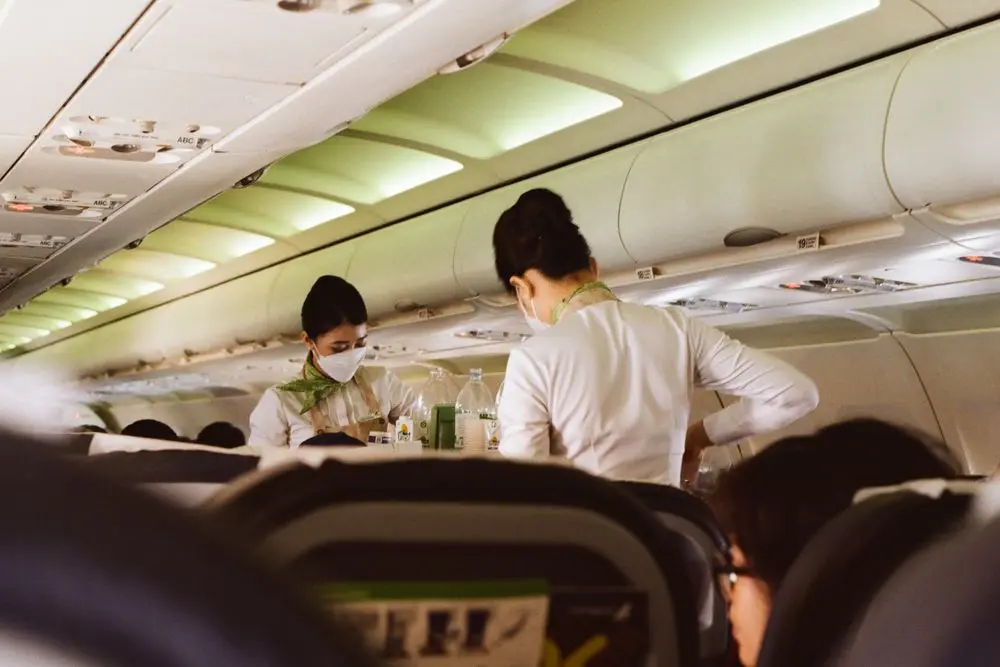
A flight attendant had noticed.
She was coming down the aisle with the drink cart. She stopped it two rows up and came over. Mid-forties, maybe. Dark hair pulled back in a tight bun. Navy uniform. A gold pin on her lapel shaped like wings. Her name tag said PRIYA.
“Is everything all right here?” she said.
Before I could open my mouth, the man pointed at us.
His finger right at my face.
“They’ve been talking the entire flight,” he said. “The entire flight. An hour. I’ve asked nicely—”
“You didn’t ask nicely,” I said.
“—and they won’t stop. Either move them or make them be quiet. I have a presentation to prepare for. I’m not paying four hundred dollars to listen to somebody’s mother narrate the weather.”
The woman in front of us turned around and looked at him.
Then at us.
She didn’t say anything. But I saw her look at my mom’s knit cap. At her gray face. At her hand on the armrest.
She turned back around.
Priya looked at me.
Then she looked at my mom.
And something in her face changed.
I saw it happen. I was watching her.
She looked at my mother for a long moment. At the cap. At her thin hands. At her white knuckles.
I thought she was going to ask us to move. I thought she was going to say, “Ma’am, I’m going to have to ask you to keep your voices down.”
She didn’t.
She crouched down next to my mother’s seat. Right in the aisle. So she was at eye level with her.
“Ma’am,” she said softly. “May I see your boarding pass? Just for a moment?”
Mom looked confused.
She looked at me. I shrugged. I didn’t understand either.
Mom reached into the seat-back pocket in front of her. She’d tucked her boarding pass in there, next to the safety card. She pulled it out. She handed it to Priya.
Priya looked at the boarding pass.
At the top. Name. Flight number. Seat. Group.
Then her eyes moved down.
To something printed at the very bottom. In small type. Below the barcode. Where nobody ever looks.
And she stopped.
I watched her face.
It changed. All at once. Like she’d been slapped. Her eyebrows went up. Her lips parted.
She read it again.
Then she looked at my mother.
Really looked at her. At her face. At her hands. At the blue knit cap.
Then, slowly, she turned her head and looked toward the front of the plane.
Toward the closed cockpit door.
She didn’t say anything for several seconds.
The man across the aisle leaned back in his seat with a satisfied little smirk. He crossed his arms. He thought he’d won. He thought we were about to be moved to the back of the plane, next to the bathrooms.
Priya stood up.
She held onto Mom’s boarding pass.
She walked to the galley at the front of our section, where there was a phone on the wall. The intercom phone. The one that goes to the cockpit.
She picked it up.
And in a voice that was much quieter than before, she said:
“Captain. It’s Priya. I think you need to come out here. Right now.”
The man across the aisle frowned.
“What’s going on?” he said. “Why is she calling the captain? Is that necessary?”
Nobody answered him.
I looked at my mom.
She looked just as confused as I was. More, maybe. She was staring at Priya at the front of the cabin, holding her boarding pass.
“Mom?” I whispered. “What’s on your boarding pass?”
She didn’t answer.
But her face had gone white. Whiter than it had been all morning.
Whiter than it was in February, in the ICU.
The cockpit door opened.
I’d never seen a cockpit door open on a flight before. You don’t, anymore. Not since 2001. It’s always locked. Always.
But it opened.
And the captain stepped out.
He was maybe forty. Tall. Dark hair going gray at the temples. Clean-shaven. A white shirt with four gold stripes on each shoulder. A navy tie. A face that looked serious and kind at the same time.
Priya met him in the little galley at the front. She held out my mother’s boarding pass. She said something to him I couldn’t hear.
He took it.
He looked at the bottom of it.
And then he looked up. Down the aisle. Toward Row 18.
Toward the window seat.
He started walking.
Down the narrow aisle. Past Row 10. Row 12. Row 14. People turned their heads to watch him go by. Some of them looked worried. Why is the captain out here? Is something wrong with the plane?
He didn’t look at any of them.
He was looking at my mother.
He got to Row 17.
And he stopped walking.
His face changed completely.
I’ll never forget it. I’ve tried to describe it to people since and I can’t do it right.
It was like watching somebody see a ghost. And then realize the ghost is somebody they’ve been looking for their whole life.
His mouth opened. Nothing came out. His hand, the one holding the boarding pass, started to shake.
He was staring at my mother.
And my mother was staring back at him.
That’s when I realized.
There was something on Mom’s boarding pass she’d never told me.
Something she’d never told anybody.
And suddenly the angry man across the aisle and his Golf Digest and his four-hundred-dollar ticket were the least important thing happening on that plane.
“Evelyn?” the captain said.
His voice cracked on the name.
“Evelyn Hart?”
Hart.
That was my mother’s maiden name. Before she married my dad. Before she was Evelyn Lindqvist.
Nobody had called her that in thirty years.
My mother didn’t say anything.
She just sat there in 18A with her hand flat against the window, staring up at the captain.
Then, very slowly, her face crumpled.
The captain knelt down.
In the aisle. In his white shirt with the four gold stripes. Right next to her seat, where Priya had crouched a minute before.
He was crying. A grown man. A captain. In uniform. In front of a hundred and forty passengers.
“It’s me,” he said. “Evelyn. It’s me. It’s Danny.”
He held up his hand. His left hand.
There was a scar on the back of it. Long and white and puckered. A burn scar.
“Danny Whitfield,” he said. “Seat 9C. Flight 409. I was seven.”
My mother made a sound I’d never heard her make.
Not in the oncologist’s office. Not in the ICU. Not at my father’s funeral.
Something low and broken. Like something tearing.
She took her hand off the window.
She reached out.
And she touched the scar on the back of the captain’s hand.
“Danny,” she whispered. “Little Danny. With the Batman backpack.”
The captain nodded. He couldn’t talk.
He put his other hand over hers.
They stayed like that. In the aisle of Row 18. Her hand on his scar. His hand on hers.
Across the aisle, the man in the golf sweater had stopped smirking.
He was staring at them.
“What’s going on?” he said. To nobody. To everybody. “What is this?”
The captain didn’t look at him.
But Priya did.
She was standing in the aisle behind the captain. She looked at the man in the golf sweater for a long moment.
Then she held up my mother’s boarding pass. So he could see the bottom of it.
“Read it,” she said quietly.
He leaned across the aisle. He squinted.
I leaned over too. I hadn’t read it either. Mom had booked it herself.
At the very bottom, below the barcode, in small capital letters, it said:
FARE BASIS: LIFETIME COMP — FLT 409 CREW — AUTH 1991
PRIORITY: ALL CABINS — SVC RECOGNITION
I didn’t understand.
I looked at my mother.
“Mom,” I said. “What’s Flight 409?”
My mother looked at me.
With the captain’s hand still on hers.
Thirty-one years. My whole life. And I’d never seen that look on her face.
“I’m sorry, Abby,” she said. “I should have told you. A long time ago.”
Here’s what I found out.
On that plane. Over Nebraska. In Row 18.
In 1991, my mother was twenty-three years old.
She wasn’t a woman who was afraid to fly.
She was a flight attendant.
She worked for an airline called Heartland Air. A small regional airline based out of Kansas City. They flew turboprops and little jets all over the Midwest. Kansas City to Omaha. Omaha to Denver. Denver to Wichita.
Heartland Air doesn’t exist anymore. It merged in 1997 with a bigger airline. Which merged with another one. Which merged with the one we were flying on that day.
I’d never heard of it. My mother never once said its name.
She’d been a flight attendant for two years. She loved it. Loved it.
“I loved the sky,” she said. On the plane. With the captain kneeling next to her. “I loved the clouds. I learned all their names. I had a little book. I’d sit on my jump seat on the way down and look out the window and name them.”
She looked at the window.
“I wanted to fly forever,” she said.
On October 19, 1991, she was working Heartland Air Flight 409. Kansas City to Denver. A forty-four-seat jet. A Thursday afternoon. Thirty-eight passengers.
One of them was a seven-year-old boy named Danny Whitfield.
An unaccompanied minor. Flying alone. To his grandmother’s house in Denver.
“My parents were getting divorced,” the captain said. Still kneeling in the aisle. “It was bad. Really bad. They sent me to my grandma’s for two weeks to get me out of the house. I’d never been on a plane. I was terrified.”
He looked at my mother.
“She sat with me,” he said. “Before takeoff. She wasn’t supposed to. She was supposed to be doing her safety check. But she saw me crying in 9C, and she came and sat down in the empty seat next to me. And she said—”
His voice broke.
“She said, ‘Do you want to know a secret? The clouds have names. I’ll teach you all of them.’”
My mother closed her eyes.
“She taught me cumulus,” the captain said. “And stratus. And cirrus. She drew them on a napkin. She gave me a little pair of plastic wings to pin on my Batman backpack.”
He reached up. With his free hand. To the lapel of his uniform.
Pinned there, next to his captain’s wings, was a little pair of plastic wings. Old. Faded. The gold paint almost all worn off. The kind they used to give kids on airplanes in the eighties and nineties.
“I’ve worn them on every flight,” he said. “For nineteen years. Since I got my first job as a pilot.”
Forty minutes into Flight 409, over western Kansas, the left engine caught fire.
My mother told it in pieces. On the plane. Then later, in Seattle. Then later, in our kitchen in St. Louis, over many nights.
I’m going to tell it the way she told me. In the end. All of it together.
There was a bang. Then a shudder. Then the whole plane tipped left.
Smoke started coming into the cabin. Gray, then black. From the vents.
The captain came on the intercom. A man named Captain Lyle Brennan. He sounded calm. He said they had an engine problem. He said they were going to make an emergency landing. He said the flight attendants would prepare the cabin.
“There was no airport,” my mother said. “Not close enough. He put it down in a wheat field. Outside a town called Colby, Kansas.”
She was strapped into her jump seat at the back of the plane when it hit the ground.
“It was so loud,” she said. “You can’t imagine how loud. And it kept going. Bouncing. Sliding. Through the wheat. For what felt like a mile.”
When it stopped, the left wing was on fire.
The cabin was full of smoke.
“I couldn’t see,” my mother said. “I couldn’t see my hand in front of my face. But I knew where everybody was. I’d done the safety check. I’d counted. Thirty-eight. I knew where they all were.”
She got up out of her jump seat.
She started shouting.
“Release seatbelts! Get out! Leave everything! Come this way!”
The way they’re trained. Over and over. Until it’s automatic.
The front exit was blocked. Jammed. The other flight attendant, a woman named Carol Yates, was trying to open it. It wouldn’t move.
The right overwing exit was the only way out. On the side away from the fire.
My mother got it open.
She started pushing people out of it. One after another. Onto the wing. Down to the wheat.
“Go! Go! Go!”
“I counted,” she said. “Every person who went out that window. I counted out loud. One. Two. Three. All the way to thirty-four.”
She stopped.
“Four were missing,” she said.
Three of them were up front. With Carol. Carol got the front door open finally, with help from the first officer, and got them out.
The fourth one was Danny.
“Seat 9C,” my mother said. “He wasn’t moving. He’d unbuckled his belt like I’d told everybody. But he’d frozen. He was just sitting there. In the smoke. Holding his Batman backpack.”
She looked at the captain. Kneeling in the aisle.
“You were so small,” she said.
She went back in for him.
Through the smoke. Up the aisle. Crawling on her hands and knees, because the air was clearer near the floor. Feeling for the seat numbers on the armrests with her fingers.
9C.
She found him. She grabbed him. She picked him up.
She carried him back down the aisle toward the overwing exit.
“The fire had gotten to the cabin by then,” my mother said. “From the left side. Through the wall. There was a part of the aisle where it was coming through. Where the plastic was melting.”
She held out her hands. Palms up.
I’d seen those scars my whole life. On both her palms. White and shiny and tight. Running up the insides of her wrists.
“A kitchen fire,” she always said, when I asked as a kid. “When I was young. A grease fire. Stupid.”
“I put him on my hip,” my mother said. “And I put my hands over his head. To protect his face. And I went through it.”
The captain held up his left hand again. The one with the scar on the back of it.
“This is where her hand was,” he said. “Over my head. On the back of my hand. When we went through. The fire came through her fingers onto my hand.”
He looked at my mother’s palms.
“She took most of it,” he said. “I only got a little.”
She got him to the window. She handed him out to a man standing on the wing. A passenger. A farmer from Goodland named Ed, she found out later. He took Danny and jumped down into the wheat.
Then my mother climbed out after him.
Thirty seconds later, the cabin filled with fire.
Everybody lived.
All thirty-eight passengers. Both flight attendants. Both pilots.
Every single person on Flight 409 walked away from that wheat field.
“They called it a miracle,” my mother said. “In the newspapers. The Miracle in the Wheat. Captain Brennan got an award. Carol got an award. I got an award.”
She looked down at her palms.
“I was in the burn unit at the University of Kansas for five weeks,” she said. “Skin grafts on both hands. They didn’t think I’d be able to close my fingers again. I did. Eventually.”
Heartland Air gave lifetime travel passes to every crew member on Flight 409. Free flights. Any seat. Anywhere they flew. Forever. To honor them.
They gave the same passes to every passenger.
“Every time they merged with somebody, the passes carried over,” the captain said. “I know. I checked. When I got hired here in 2006, I went to HR and asked. They’re still honored. All of them. Even now.”
My mother never used hers.
Not once.
“I couldn’t,” she said. “I tried. In 1992. A year after. I went to the Kansas City airport with my pass. I got all the way to the gate. And I couldn’t walk down the jet bridge. I stood there and shook. I smelled smoke that wasn’t there. I heard that bang.”
She looked out the window. At the clouds.
“I quit Heartland that month,” she said. “I never flew again. I met your father the next year. At a church picnic. He asked me where I worked. I said, ‘Nowhere right now.’ He never asked what I used to do.”
She looked at me.
“I never told him,” she said. “Twenty-eight years of marriage. I never told him.”
I couldn’t say anything.
My mother. My quiet, careful mother. Who took a train to Boston. Who drove eight hours with my father’s ashes buckled into the passenger seat.
Who knew the names of all the clouds.
“Why didn’t you tell me?” I whispered.
She looked at me for a long time.
“Because I didn’t want to be that woman anymore,” she said. “The one from the newspaper. The one in the burn unit. The one who woke up screaming. I wanted to be your mother. Just your mother.”
She reached over with her free hand. She touched my face. Her scarred palm against my cheek.
“I wanted to be somebody who was afraid of flying,” she said. “Because that’s simpler than being somebody who used to love it.”
“I looked for you,” the captain said.
My mother turned back to him.
“For twenty years,” he said. “Since I was a teenager. I wrote to Heartland. They wouldn’t give out your address. I wrote to the newspapers. Nobody knew where you’d gone. I looked for Evelyn Hart in every phone book in Missouri and Kansas.”
“I married,” my mother said. “I became Lindqvist.”
“I didn’t know,” the captain said. “I didn’t know you’d married. I thought—”
He stopped.
“I thought maybe you’d died,” he said quietly. “From the burns. I thought maybe you never got better. I didn’t know.”
He reached into his shirt pocket.
He took out his wallet. He opened it. He took something out from behind his pilot’s license.
A napkin.
A tiny, yellowed, folded-up cocktail napkin. With the old Heartland Air logo on it. A little red heart with wings.
He unfolded it. Very carefully. Like it might fall apart.
On it, in faded blue ink, were drawings. Clouds. Puffy ones. Flat ones. Wispy ones. With words written next to them in a young woman’s handwriting.
CUMULUS — fluffy, fair weather!
STRATUS — flat, gray, like a blanket
CIRRUS — wispy, high up, “mares’ tails”
And at the bottom:
For Danny — the clouds will always tell you where you are. — Evelyn
My mother put her hand over her mouth.
“You kept it,” she whispered.
“I’ve kept it for thirty-four years,” the captain said. “I had it in my backpack when we crashed. It was the only thing I saved. I took it out of my backpack on the wheat. Ed the farmer thought I was crazy.”
He folded it back up. Very carefully.
“I learned all the clouds,” he said. “Every single one. I became a pilot because of you. Because you told me the sky wasn’t scary. That it had names. That if you knew the names, you’d never be lost.”
He smiled. Through the tears.
“I’m the captain of this plane,” he said, “because of a napkin.”
The whole cabin was silent.
I looked around.
The woman in front of us had turned all the way around in her seat. She was crying. The man next to her had his hand over his mouth. Two teenage girls in Row 19 had their phones out, but they weren’t filming. They were just holding them.
Priya was standing in the aisle with my mother’s boarding pass pressed against her chest. Crying.
Even the flight attendant pushing the drink cart up front had stopped. She was just standing there, holding a can of ginger ale.
And across the aisle, the man in the golf sweater was sitting very, very still.
He’d uncrossed his arms. His Golf Digest was on the floor.
He was staring at my mother.
At her blue knit cap. At her scarred palms.
His face had gone white.
The captain had to go back to the cockpit.
He told us that. Gently. “I can’t stay out here. My first officer’s flying, but I need to be up there. Regulations.”
He stood up. He wiped his face with the back of his scarred hand.
“Will you be here when we land?” he said. “Please. Don’t get off right away. Let everybody else go first. I want to—”
He stopped.
“Please,” he said.
“I’ll wait,” my mother said.
He looked at me for the first time.
“You’re her daughter,” he said.
“Abby.”
“Abby.” He held out his hand. I shook it. The one with the scar. “Thank you for bringing her.”
“She brought herself,” I said. “She booked it herself. She wouldn’t let me.”
The captain looked at my mother.
“You used the pass,” he said. “After thirty-four years.”
“First time,” my mother said.
“Why now?”
My mother looked at me.
Then she pulled off her blue knit cap.
Her hair underneath was thin and gray. Patchy. Short. Growing back in uneven tufts after the chemo.
“Because I’ve been sick,” she said. “Leukemia. I almost died in February. They thought I would. And I lay there in the ICU and thought, I’m going to die without ever seeing the clouds again. From above. The way I used to.”
She put the cap back on.
“So I called the airline,” she said. “And I read them my pass number off a piece of paper I’d kept in my jewelry box for thirty-four years. And I asked if it was still good.”
She almost laughed.
“The woman on the phone put me on hold for twenty minutes,” she said. “Then she came back and said, ‘Mrs. Lindqvist, it’s still good. And I just want to say. Thank you.’”
The captain didn’t say anything.
He just stood there in the aisle of Row 18, looking at my mother.
Then he leaned down. And he kissed her on the forehead. Right on the edge of her blue knit cap.
“Welcome back to the sky, Evelyn,” he said.
Then he turned and walked back up the aisle to the cockpit.
A few minutes later, the intercom crackled.
Ding.
“Ladies and gentlemen, this is your captain speaking. Captain Daniel Whitfield.”
His voice was steady now. Calm. The voice pilots use.
But I could hear something under it.
“I’d like to take a moment,” he said, “to tell you a little story. If you’ll let me.”
He told it.
Over the intercom. To a hundred and forty passengers. Over Nebraska.
He didn’t use my mother’s name. He didn’t point out her seat. He just told it.
A seven-year-old boy flying alone. Terrified. A young flight attendant who sat down next to him and drew clouds on a napkin. An engine fire. A wheat field in Kansas. Smoke so thick you couldn’t see. A woman who crawled back up the aisle on her hands and knees to find him. Who put her hands over his head and carried him through the fire.
“Every single person on that plane walked away,” he said. “Thirty-eight passengers. Because of her. And because of three other crew members who did their jobs perfectly on the worst day of their lives.”
He paused.
“That flight attendant never flew again,” he said. “Until today.”
The whole cabin was silent.
“She’s sitting on this airplane,” Captain Whitfield said. “Right now. Somewhere in the main cabin. Her first flight in thirty-four years. And she’s been very sick this year. And she got on this plane anyway.”
His voice cracked a little.
“I’m not going to tell you where she’s sitting,” he said. “She’d hate that. She was always very private. But I want you all to know that you’re sharing the sky with a hero today. And so am I.”
Another pause.
“That’s all,” he said. “Thank you for flying with us. We’ll be beginning our descent into Seattle in about two hours. The weather in Seattle is fifty-eight degrees and stratocumulus.”
Click.
Somebody started clapping.
I don’t know who. Somewhere in the back.
Then somebody else.
Then the whole cabin.
A hundred and forty people. Clapping. On an airplane. For somebody they couldn’t see.
My mother put her face in her hands.
She didn’t look up. She didn’t stand. She didn’t wave.
She just sat there in 18A with her scarred palms over her face and cried.
I put my arm around her.
The woman in front of us reached back over her seat. She didn’t say anything. She just put her hand on my mother’s shoulder. And left it there.
The man across the aisle didn’t clap.
I noticed.
He sat there in his golf sweater with his hands in his lap, staring at the seat back in front of him.
He didn’t put his earbuds in. He didn’t pick up his magazine.
He just sat there.
About twenty minutes later, he leaned across the aisle.
“Excuse me,” he said.
Quietly. So quietly I almost didn’t hear him.
I turned and looked at him.
He wasn’t looking at me. He was looking at my mother. She’d fallen asleep. Finally. With her head against the window. With the clouds going by outside.
“Is that her?” he said. “The one he was talking about?”
I looked at him for a long time.
“Yes,” I said.
He closed his eyes.
“I’m sorry,” he said. “I’m—I didn’t know.”
“No,” I said. “You didn’t.”
“I thought you were just—” He stopped. “I don’t know what I thought. I thought you were being rude. I thought you were one of those people who talks on planes.”
“I was talking because she was terrified,” I said. “She hasn’t been on a plane in thirty-four years. Her hands were shaking. She was praying during takeoff. I was talking so she’d hear my voice and not the engines. That’s all.”
He didn’t say anything.
“She’s been in the hospital for six months,” I said. “She almost died in February. She has leukemia. She’s in remission. For now. That’s what the doctor said. For now.”
I looked at my mother. Asleep against the window.
“This might be the only flight she ever takes,” I said. “And she wanted to see the clouds.”
The man put his face in his hands.
He sat like that for a long time.
When he lifted his head, his eyes were red.
“My dad,” he said. “He died last year. Pancreatic cancer. Four months. I didn’t fly home to see him.”
He looked down at his hands.
“I had a deal closing,” he said. “A big one. I kept saying I’d go next week. Next week. And then he was gone.”
He swallowed.
“I’m flying to Seattle for another deal,” he said. “Today. That’s my presentation. That’s what I was so angry about. I needed to concentrate.”
He laughed. It wasn’t a real laugh.
“I’ve been angry for a year,” he said. “At everybody. At everything. I yell at waiters. I yell at my wife. I yelled at a woman with leukemia on an airplane.”
He looked at my mother again.
“I’m so sorry,” he said.
I didn’t know what to say.
So I didn’t say anything.
But after a minute, I reached into my bag. I took out the bag of peppermints I’d brought for Mom. I held it across the aisle.
He looked at it.
Then he took one.
“Thank you,” he said.
His name was Richard. He was a commercial real estate broker from Clayton, Missouri.
We talked for the rest of the flight. Quietly. Whispering. Leaning across the aisle.
He told me about his father. A mailman for thirty years. Who used to take him fishing at Lake of the Ozarks.
I told him about mine. An accountant. Who loved terrible puns and wanted his ashes buried in Minneapolis next to his parents.
Nobody told us to keep it down.
When we landed in Seattle, everybody got off.
Slowly. Row by row. Like normal.
Except that almost every single person who walked past Row 18 stopped. Just for a second.
The woman who’d been sitting in front of us leaned down and kissed my mother’s cheek.
An old man in a VFW cap stopped and saluted her. Right there in the aisle.
The two teenage girls from Row 19 shyly asked if they could take a picture with her. My mother said yes. They put their arms around her.
A little boy, maybe six, stopped with his mother. He looked at my mom for a long time.
“Are you the hero?” he said.
My mother looked at him.
“No, sweetheart,” she said. “I’m just somebody who knows the names of clouds.”
Richard was one of the last to leave.
He stood up. He got his bag out of the overhead bin. He stood there in the aisle.
Then he leaned down toward my mother.
“Ma’am,” he said. “I’m the one who yelled at you. Earlier. I’m sorry. I’m very sorry.”
My mother looked up at him.
She studied his face for a long time.
“You lost somebody,” she said.
He went still.
“How did you—”
“I can tell,” my mother said. “I’ve seen it a lot this year. In hospital waiting rooms. People who are angry at everything. Because they’re sad and they don’t know where to put it.”
She reached up. She touched his hand. With her scarred palm.
“Go call your wife,” she said. “Tell her you’re sorry too.”
Richard didn’t say anything.
He just nodded.
Then he walked off the plane.
When the cabin was empty, the cockpit door opened.
Captain Whitfield came out.
He walked down the aisle. All the way to Row 18.
He knelt down again. Next to my mother’s seat.
He didn’t say anything for a while.
Then he reached up. To his lapel.
And he unpinned the little plastic wings. The old, faded ones. The ones with the gold paint worn off.
He held them out to my mother.
“These are yours,” he said.
My mother looked at them.
“No,” she said. “Danny. No. I gave those to you.”
“You gave them to a scared seven-year-old,” the captain said. “So he’d be brave.”
He put them in her scarred palm. He closed her fingers over them.
“Now you’re the one who’s scared,” he said. “So you take them. You be brave.”
My mother looked at the little wings in her hand.
Then she looked at him.
“I’ll give them back,” she said. “When I’m better.”
The captain smiled.
“That’s a deal,” he said.
He walked us off the plane himself.
Through the jet bridge. Into the terminal at Sea-Tac.
At the end of the jet bridge, my aunt Joan was waiting. She’d come to the gate. I don’t know how. You’re not supposed to be able to anymore. Priya told me later the captain called ahead and arranged it.
Aunt Joan saw her sister walk out of that jet bridge. On her own feet. Holding a captain’s arm.
She burst into tears.
My mother and her sister held each other for a long time in the terminal.
People walked around them. Rolling suitcases. Coffee cups.
Then my mother pulled back and looked at Aunt Joan.
“Joanie,” she said. “I flew.”
“I know you did, Evie.”
“I flew,” my mother said again. “And I saw the clouds.”
We were in Seattle for ten days.
My mother slept a lot. She was tired. Dr. Chen had warned us she would be.
But every afternoon, she’d sit on Aunt Joan’s back porch in Ballard with a blanket over her knees and look up at the sky.
“Stratocumulus,” she’d say. “Altostratus. Oh, look. Cirrocumulus. Mackerel sky. That’s rare.”
I’d sit next to her and she’d teach me.
Thirty-one years. And I’d never asked.
On the fifth night, she told me the rest.
We were sitting at Aunt Joan’s kitchen table after everybody else had gone to bed.
She told me about the burn unit. Five weeks. The skin grafts. The physical therapy. Learning to close her fingers again. Learning to hold a fork. Learning to write.
She told me about the nightmares. For years. Waking up smelling smoke. Waking up with her hands over her face.
She told me about the jet bridge in 1992. Standing there shaking. Turning around and walking out of the airport.
She told me about meeting my father at a church picnic in 1993. How he didn’t ask what she used to do. How relieved she was.
“I never wanted to be her again,” she said. “The woman in the newspaper. I wanted to be ordinary. I wanted to be safe.”
“Were you happy?” I asked. “Being ordinary?”
She thought about it for a long time.
“I was happy,” she said. “Your father. You. Our house. I was very happy.”
She looked out the kitchen window. At the dark sky over Ballard.
“But I missed the clouds,” she said.
We flew home to St. Louis on a Sunday.
Captain Whitfield wasn’t flying that day. But he’d called the airline. He’d talked to somebody.
When we got to the gate at Sea-Tac, the gate agent looked at my mother’s boarding pass. And smiled.
“Mrs. Lindqvist,” she said. “You’ve been upgraded. Both of you. First class. Row 2.”
My mother looked at me.
“Danny,” she said.
“Probably,” I said.
She took the window seat.
When we broke through the clouds over Puget Sound, she didn’t grip the armrest.
She put her hand flat against the window.
And she smiled.
The next three months, my mother flew four more times.
Once to Kansas City. To meet Carol Yates, the other flight attendant from Flight 409. Carol was seventy-two now. A retired schoolteacher in Overland Park. They hadn’t seen each other since 1992.
They sat in Carol’s kitchen and held hands across the table and didn’t say anything for a long time.
Once to Colby, Kansas. To the wheat field.
It was just a field. Wheat, gold, waving in the wind. A small stone marker at the edge of the road that I’d never have noticed if we weren’t looking for it. HEARTLAND AIR FLIGHT 409 — OCTOBER 19, 1991 — ALL SOULS SAVED.
My mother stood at the edge of the field for a long time.
Then she walked out into the wheat. Up to her waist. With her arms out, touching the tops of it with her scarred palms.
She stood out there in the middle of it.
She looked up at the sky.
Cumulus. Fair weather.
Once to Denver. To meet Danny’s grandmother. Ninety-four years old. In a nursing home in Lakewood. She’d been waiting at Stapleton Airport in 1991 when the plane didn’t come.
She held my mother’s face in both her hands and cried.
“You brought him back to me,” she said. “You brought my baby back.”
And once to Seattle again. In September. For Aunt Joan’s birthday.
In October, on the nineteenth, Dr. Chen called.
The monthly bone marrow biopsy.
My mother was sitting at our kitchen table in St. Louis. I was standing at the counter.
She put the phone on speaker.
“Evelyn,” Dr. Chen said. “It’s still gone. Six months of remission. Clean. No sign of it.”
My mother closed her eyes.
“For now,” she said.
“For now,” Dr. Chen said. “But Evelyn. Six months is good. Six months is very good. Every month after this gets better.”
My mother hung up.
She sat there at the kitchen table for a long time.
Then she got up. She went to her bedroom. She came back with something in her hand.
The little plastic wings. The old faded ones. With the gold paint worn off.
She’d kept them on her nightstand. Every night. For four months.
She set them on the kitchen table.
She picked up the phone.
“Who are you calling?” I said.
“Danny,” she said.
He picked up on the second ring.
“Evelyn?”
“It’s October nineteenth,” my mother said.
He was quiet.
“I know,” he said.
“Thirty-four years,” my mother said. “Exactly.”
“I know.”
“I’m still in remission,” my mother said. “Six months. Dr. Chen just called.”
Danny didn’t say anything for a long time.
I heard him breathe.
“Evelyn,” he said finally. His voice cracking. “That’s—oh my God. That’s—”
“I have something of yours,” my mother said. “I told you I’d give it back. When I was better.”
She picked up the little wings.
“Where are you flying next?” she said.
Danny was flying St. Louis to Denver on November 2nd.
My mother and I were on it.
Row 9. Seat C.
She asked for it specifically. The gate agent didn’t ask why.
Before takeoff, the cockpit door opened.
Danny came out. He walked down the aisle. To Row 9.
My mother stood up. In the aisle.
She held out her hand. Palm up. Scarred.
The little plastic wings were sitting in the middle of it.
“I’m better,” she said. “For now.”
Danny looked at the wings.
Then he looked at my mother.
He took them. He pinned them back on his lapel. Right next to his captain’s wings. Where they belonged.
Then he put his arms around her. Right there in the aisle of Row 9. In front of everybody.
Nobody on that plane knew what was happening.
Nobody clapped. Nobody filmed. Nobody understood.
It was just a pilot hugging an older woman in a blue knit cap in the aisle before takeoff.
That was fine.
That’s how my mother wanted it.
He went back to the cockpit.
We sat down. 9C and 9D.
My mother buckled her seatbelt. Not too tight.
The plane pushed back. Taxied. Turned onto the runway.
The engines roared.
My mother didn’t grip the armrest.
She didn’t close her eyes.
She didn’t pray.
She leaned forward, past me, to look out the window.
And when we broke through the clouds over Missouri, into the bright blue, with the white spread out underneath us like an ocean, she smiled.
“Cumulus,” she said. “Fair weather.”
A minute later, the intercom crackled.
Ding.
“Ladies and gentlemen, this is your captain speaking. Captain Daniel Whitfield.”
He didn’t tell the story this time. He just did the normal announcements. Altitude. Flight time. Weather in Denver.
And then, at the end, he added one more thing.
“For those of you in window seats,” he said, “if you look down right now, you’ll see some beautiful cumulus clouds underneath us. Fluffy. White. Fair weather.”
He paused.
“Somebody taught me that a long time ago,” he said. “She said the clouds will always tell you where you are.”
Another pause.
“Enjoy the view, folks,” he said.
Click.
My mother leaned her head against my shoulder.
She was still looking out the window.
“I used to sit right about here,” she said quietly. “On my jump seat. On the way down. And name them.”
“Name them now,” I said.
So she did.
All the way to Denver.
She named every single cloud we passed. Cumulus. Altocumulus. Cirrus. A little stratus over Kansas. One building cumulonimbus way off to the south that she said would be a storm in Oklahoma by suppertime.
She whispered them. Leaning toward the window. Her scarred hand flat against the glass.
And across the aisle, a woman with a toddler on her lap leaned over and listened.
And behind us, an old man put down his newspaper.
And in front of us, a teenage boy took out one earbud.
Nobody told her to keep it down.