“Get out, Olivia.”
Derek leaned across me and pushed open the passenger door. Cold air came rushing into the car.
I stared at him. I was sure I’d heard him wrong.
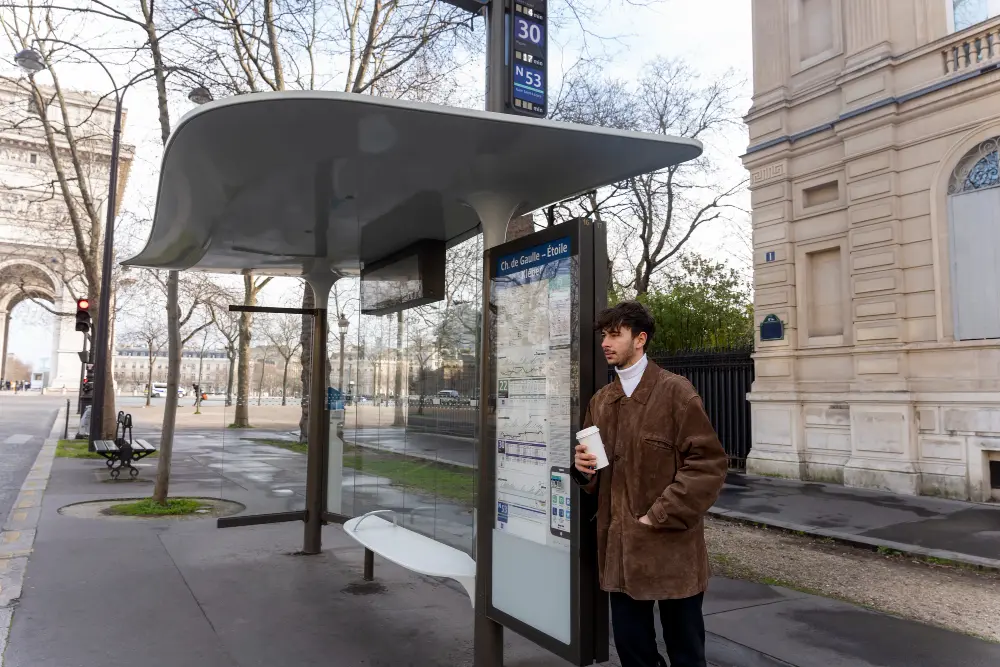
We were parked beside a broken-down bus shelter on a street I’d never seen before. The sidewalk was cracked. The metal bench under the shelter was orange with rust. Across the street there was an old liquor store with bars over the windows and a sign that said CLOSED in a way that looked permanent.
I didn’t know where we were. We’d been driving for forty minutes after we left the house, and I’d been crying most of that time, staring out the window, not watching where we went.
“Derek,” I said. “What’s happening? Why are we stopping here?”
He didn’t answer.
He reached over and grabbed my handbag out of my lap.
He unzipped it.
He took out my wallet. He took out my debit card. My credit card. The library credit union card I almost never used. He took the thirty-two dollars I had in the little side pocket, the money I’d been setting aside a few dollars at a time from my lunch money for three weeks.
Then he reached into the pocket of my jacket and took my phone.
He put all of it in the cupholder between us.
He dropped my empty handbag back in my lap.
“You need to understand what money is worth,” he said. Very calm. Very cold. “Let’s see how well you manage without mine.”
My eyes filled up. I couldn’t see him clearly anymore.
“Derek, please.”
“Once you’ve figured out how to get home,” he said, “and learned to apologize properly, maybe we can have a conversation.”
He looked at the open door.
“Out,” he said.
I got out.
I don’t know why. I could have fought. I could have refused. I could have held onto the seat and screamed.
But I’d been married to Derek Hale for six years, and somewhere in those six years I’d stopped fighting about anything.
I got out of the car and stood on the cracked sidewalk with my empty purse.
He reached over and pulled the door shut.
And he drove away.
I stood there and watched his silver Acura go down the street. I watched his brake lights at the stop sign. I watched him turn right.
Then he was gone.
My name is Olivia Hale. I was thirty-one years old that October.
I’m a library assistant at the Westbrook branch of the Hamilton County Public Library, in Cincinnati. I check out books. I run the Tuesday morning story time for toddlers. I help old men print their boarding passes and help teenagers find books about sharks for their science projects.
I make about thirty-four thousand dollars a year.
Every single dollar of it went into our joint checking account. Derek set it up that way when we got married.
“It’s simpler,” he said. “One account. One budget. I’ll handle the bills. You won’t have to worry about any of it.”
I thought that was sweet. At the time.
The fight that morning was about eighty dollars.
My mother had hip replacement surgery the week before. At Christ Hospital. She’s sixty-three. She lives alone in a little brick duplex in Norwood. She was going to be stuck in bed for at least a month.
Her birthday was on Thursday.
So on Tuesday, after work, I went to the Target on Ridge Road. I bought her a blanket. A soft gray fleece one with little white stars on it. And three paperback mysteries, the kind she likes, with old ladies who solve murders in English villages.
Eighty-one dollars and twelve cents. With tax.
I put it on the credit card. Our credit card. The one Derek checks every single morning on his phone while he drinks his coffee.
He found it Saturday morning.
I was making pancakes. He came into the kitchen with his phone in his hand and stood there.
“What’s this?”
“What’s what?”
He held up the phone. “Target. Eighty-one dollars. Tuesday.”
“Oh,” I said. “That was Mom’s birthday present. The blanket and the books. I told you.”
“You didn’t tell me.”
“I did, Derek. Tuesday night. At dinner. I said I got Mom a blanket.”
“You said you were going to get Mom a blanket,” Derek said. “You didn’t say you spent eighty-one dollars.”
It went on from there.
It always went on from there.
The groceries. Why did I buy the name-brand cereal when the Kroger brand was a dollar cheaper? Why did I fill up the gas tank at the Shell instead of the Speedway, which was three cents cheaper a gallon? Why did I need new running shoes when my old ones still had soles?
“I’m trying to save for our future, Olivia,” he said. “Our house. Our kids. And you keep doing this. You keep spending like we’re made of money.”
“It was eighty dollars,” I said. “For my mother. Who just had surgery.”
“It’s always eighty dollars,” Derek said. “Every week. Eighty here. Forty there. It adds up. Do you understand that? Do you understand how money works?”
I said I was sorry.
That’s what I always did. I said I was sorry. I said I didn’t think. I said I’d be more careful. I said I’d return the blanket.
He didn’t want me to return the blanket.
“Get your coat,” he said. “We’re going for a drive.”
I thought we were going to my mother’s. I thought maybe he’d calmed down. I thought he was going to drive me to Norwood so I could give her the present and he’d sit in the car like he always did.
We didn’t go to Norwood.
We drove for forty minutes. Down I-75. Off at some exit I didn’t recognize. Through neighborhoods that got grayer and emptier the longer we drove.
And then he stopped at a bus shelter on a street I’d never seen.
And told me to get out.
I sat down on the rusted bench eventually.
I didn’t know what else to do.
I didn’t know where I was. I didn’t know which way was home. I couldn’t call anybody. I didn’t have a single dollar.
I sat there with my empty purse in my lap and my hands folded on top of it.
A bus came.
The Number 64. It stopped right in front of me. The doors opened with a hiss.
The driver looked at me. A heavy-set older man with a gray beard.
“You getting on, ma’am?”
I shook my head.
He looked at me a moment longer. Then the doors closed and the bus pulled away.
Another bus came. Forty minutes later.
Same thing. The doors opened. People got off. Somebody got on. The driver looked at me.
I shook my head.
I couldn’t afford a ticket. A dollar seventy-five. I didn’t have a dollar seventy-five.
And I was too ashamed to say why.
How do you say it? My husband took all my money and left me here to teach me a lesson. Who says that out loud? To a bus driver?
Hours went by.
I don’t know exactly how many. I didn’t have my phone. I didn’t have a watch. I just watched the light change.
The afternoon sun moved across the cracked sidewalk. Across the bars on the liquor store windows. Across a weedy lot next to it where somebody had dumped an old mattress.
It got colder. It was October. The wind came down the empty street and went right through my thin jacket.
Every time somebody walked by, my heart started pounding. A man in a hoodie. Two teenage boys on bikes. An old man walking a dog that was mostly gray.
Nobody bothered me. Nobody even really looked at me.
But I was so scared.
And I kept wondering if Derek was coming back.
I kept looking down the street at the corner where he’d turned. Waiting for his silver Acura to come around it.
He’d done things like this before. Not this bad. Never this bad. But he’d left me places. At a restaurant once, when I ordered dessert. I had to call my mother to come get me. At a gas station on the way to his parents’ house in Dayton, because I said something about his mother he didn’t like. He came back after twenty minutes. He said he was just driving around the block to cool off.
So I kept watching the corner.
And a small, frightening part of me kept thinking:
I don’t want him to come back.
That thought scared me more than the street did.
Then I heard a sound.
Tap. Tap. Tap.
Gentle. Steady. Coming down the sidewalk toward the shelter.
I looked up.
An elderly woman was walking toward me. Slowly. She was tall and thin, with white hair cut very short and neat. She was wearing a long camel-colored wool coat that looked expensive and a silk scarf in deep blue.
She had dark sunglasses on. Even though the sun was going down.
And she was holding a long white cane. Sweeping it gently back and forth in front of her on the sidewalk. Tap. Tap. Tap.
She found the edge of the shelter with her cane.
She felt along it. She found the bench. She tapped the bench twice, gently, to see where it was.
Then she sat down. Right next to me. Not touching. Just a foot or so away.
She folded her hands on top of her cane.
She didn’t say anything.
Neither did I.
We sat there for a while. Maybe five minutes.
The wind blew. A plastic bag went tumbling down the street.
Then the woman turned her head toward me.
“You’ve been crying for quite a while,” she said. “Haven’t you, sweetheart?”
I wiped my cheeks fast with both hands.
“I’m all right,” I said.
She smiled. A small, knowing smile.
“My eyes may not work anymore, dear,” she said. “But there’s nothing at all wrong with my hearing. You’ve been sniffling since I turned the corner. A block away.”
I don’t know why that did it.
Maybe it was her voice. Low and calm and a little bit dry, like a grandmother in an old movie. Maybe it was that she didn’t sound sorry for me. She just sounded like she knew.
Maybe it was that nobody had asked me if I was okay in a very long time.
Something inside me cracked open.
“My husband left me here,” I whispered. “He took my money. And my phone. And he drove away.”
Her face changed.
I was watching for sympathy. For the soft, sad look people give you.
That’s not what I saw.
Her mouth went thin. Her jaw went tight. Her hands closed around the top of her cane.
It was anger. Quiet. Steady. Unmistakable.
“He did that,” she said, “on purpose?”
I nodded.
Then I remembered she couldn’t see me.
“Yes,” I said.
And then all of it came out.
I didn’t mean for it to. I’d never told anybody. Not my mother. Not my friend Jess at the library. Not anybody.
But I sat on that rusty bench in the cold next to a blind woman I’d never met and told her everything.
The eighty-one dollars. The blanket with the little white stars. The paperback mysteries.
The joint account. How my paycheck went in, and Derek decided where it went out. How I had to ask him for money for lunch. How he checked every receipt. How he called it a budget.
How he didn’t like my friends. How he’d say things about them. Jess is a bad influence. Rachel only calls when she wants something. Your mother is always trying to get between us. How, one by one, I stopped seeing them. Because it was easier than the fights.
How I’d learned to say I was sorry for things I didn’t do. Just to make the fight stop. Just to make the house quiet again.
How I’d started to believe I really was bad with money. Bad with everything. That I really did need him to handle things. That without him I’d fall apart.
She didn’t interrupt.
Not once.
She just sat there with her hands folded on her cane, her face turned toward me, listening.
When I finally stopped talking, the street had gone dark. The single streetlight above the shelter flickered on with a buzz.
She was quiet for a long time.
Then she asked me one question.
“What are you planning to do,” she said, “when you get home?”
I looked down at my hands.
“I suppose I’ll apologize,” I said. “Promise to be more responsible.”
She lifted her chin.
“Olivia,” she said.
I hadn’t told her my name. I realized later I must have said it somewhere in the story. Derek said, “Get out, Olivia.” I’d told her that part.
“Olivia,” she said. “Listen to me very carefully.”
I listened.
“Buying groceries,” she said, “is not reckless spending. Buying a blanket and some books for your mother, who has just had her hip replaced, is not reckless spending. It’s what a decent daughter does.”
She paused.
“Taking away your money,” she said, “cutting you off from your friends, and leaving you somewhere you don’t know with no way home, as a punishment, is something else entirely.”
She turned her face toward me.
“That’s controlling behavior,” she said. “That’s what it’s called. It has a name.”
Controlling.
That word hit me harder than anything Derek had ever said to me.
For six years I’d called it other things. Concern. He’s just worried about money. Responsibility. He’s just good with numbers. Even love. He just wants to take care of me.
I’d never once called it that.
And here was a stranger, on a rusty bench in a neighborhood I’d never seen, saying it so plainly it was like she’d turned on a light in a dark room.
“I don’t know where else I could go,” I said.
It came out so small.
The woman reached over. She found my hand. Her fingers were thin and dry and cool. She held on.
“Then perhaps,” she said, “it’s time you learned you have more choices than your husband wants you to believe.”
Before I could answer, a car came around the corner.
A long black sedan. A Mercedes. So clean and so polished that it reflected the streetlight and the dark sky and the bars on the liquor store windows, all at once.
It pulled up right in front of the bus shelter and stopped.
A man got out of the driver’s side. Maybe sixty. Tall, with gray hair and a gray mustache, in a perfectly tailored charcoal suit. He walked around the back of the car and opened the rear door.
“Mrs. Wilmington,” he said.
The woman stood up. She steadied herself with her cane.
“Thank you, Thomas,” she said. “You’re right on time.”
“I’m always right on time, ma’am.”
“You’re always eight minutes late,” she said. “I can count.”
Thomas almost smiled.
Then she turned back toward me.
“I suppose,” she said, “I should introduce myself properly. My name is Catherine Wilmington.”
I stared at her.
The name didn’t mean anything to me. Not then.
But the car meant something. And the suit. And the way Thomas stood there holding the door, very straight, like a man who’d been holding that door for a long, long time.
Catherine leaned down toward me. Close. So only I could hear.
“Olivia,” she said. “When we get into that car, I’d like you to pretend you’re my granddaughter.”
I blinked.
“Your granddaughter? Why?”
She smiled.
“Because your husband,” she said, “assumed he’d left you completely alone.”
Her voice went firm.
“He was mistaken.”
Thomas cleared his throat.
“Mrs. Wilmington,” he said. Carefully. “Should I be concerned that you’re arranging something unusual?”
Catherine laughed. A short, dry laugh.
“Not at all, Thomas,” she said. “I’d simply like you to meet Alexandra. My granddaughter. She’ll be staying with us for a while.”
Thomas looked at me.
Something passed across his face. Something I didn’t understand. Not then.
A kind of flinch. Very small. At the name.
Then it was gone.
He nodded politely.
“Welcome, Miss Alexandra,” he said.
I looked at that long black car.
Then I looked back down the dark empty street. At the corner where Derek had turned right and disappeared.
He wasn’t coming back.
I finally knew it. Sitting there under that buzzing streetlight.
He wasn’t coming back, and I didn’t want him to.
For the first time that whole afternoon, my hands stopped shaking.
I stood up.
I took Catherine’s arm.
And I got into the car.
Her house was in Indian Hill.
I’d heard of Indian Hill. Everybody in Cincinnati has heard of it. It’s where the very rich people live. Big houses on big lots behind big trees. Horse farms. Long driveways.
I’d never been there. Not once.
Thomas drove through a pair of tall iron gates that opened by themselves. Up a long driveway lined with old oak trees. Their leaves were gold and red in the headlights.
And there was the house.
It was white. Huge. Two stories with tall white columns across the front, like a house in a movie about the South. Lights glowing in every window.
Inside, there was a front hall with a marble floor so shiny I could see myself in it. A chandelier hanging from the ceiling two stories up. A staircase curving up the wall to the second floor.
I stood in the doorway and couldn’t move.
A woman came hurrying down the hall. Sixties, round, with gray curls and an apron over a navy dress. Reading glasses pushed up on her head.
“Mrs. Wilmington! You’re late! I was starting to worry—”
She stopped.
She saw me.
“Margaret,” Catherine said. “This is my granddaughter. Alexandra. She’ll be staying with us.”
Margaret looked at me.
The same thing happened to her face that happened to Thomas’s. That little flinch. At the name.
Then she looked at Catherine.
Then back at me. At my red eyes. At my thin jacket. At my empty handbag.
Something in her face softened.
“Well,” Margaret said. “Alexandra. You look frozen half to death, honey. Come with me. I’ll get the blue room ready.”
The blue room was on the second floor.
It was bigger than the apartment Derek and I shared. Not exaggerating. Our apartment in Westwood is about seven hundred square feet. This room was bigger.
Soft blue walls. A big bed with a white comforter and about twelve pillows. A window seat looking out over the back lawn. A fireplace. Its own bathroom with a clawfoot tub.
Margaret turned down the bed. She laid out a nightgown, flannel, with little blue flowers. She put a pair of slippers by the bed.
“Those were—” she started.
Then she stopped.
“Those should fit you,” she said instead. “Bathroom’s right through there. Take a hot bath. Dinner’s in forty minutes.”
Thomas brought me soup.
He knocked on the door twenty minutes later. He had a tray. A bowl of chicken soup with little noodles. A grilled cheese sandwich cut into triangles. A cup of tea.
He set it on the table by the window.
“Mrs. Wilmington thought you might want something warm before dinner,” he said.
“Thank you, Thomas.”
He started to leave. Then he stopped at the door. He turned around.
“Miss,” he said. Not Alexandra. Just Miss. “Are you all right?”
I didn’t know how to answer that.
“I don’t know,” I said.
Thomas nodded slowly.
“That’s an honest answer,” he said. “Mrs. Wilmington likes honest answers.”
Dinner was in a dining room with a table that could seat twenty.
Just the two of us. At one end. Catherine at the head. Me on her right.
Margaret served roast chicken and green beans and little round potatoes with rosemary. Catherine ate neatly. She knew exactly where everything was on her plate. Margaret had put it in the same places every night for ten years, she told me later. Chicken at six o’clock. Vegetables at two. Potatoes at ten.
And while we ate, Catherine told me who she was.
Wilmington Industries.
I knew that name. Everybody in Cincinnati knows that name. They make industrial valves and pumps. The kind that go in power plants and water treatment plants and big factories all over the world. There’s a huge brick building with their name on it down by the river, and their name is on a wing of the art museum, and a building at UC, and half the hospital in Clifton.
Catherine’s grandfather started it. In 1919. In a little machine shop in a neighborhood called Lower Price Hill.
Catherine took it over in 1982, when her father died. She ran it for twenty-six years. She was one of the first women to run a company that big in Ohio. Maybe the first.
“Men used to call me Mrs. Valve,” she said. “Behind my back. They thought I didn’t know.”
“Did you?”
“Of course I knew,” Catherine said. “I bought a few of their companies. I kept the name.”
She’d sold the company in 2008. She’d lost her sight ten years ago. Macular degeneration, then glaucoma on top of it. It went slowly, then all at once.
“It was the worst year of my life,” she said. “For about six months, I didn’t leave my bedroom. I thought my life was over. I thought, what am I if I can’t see? I can’t read. I can’t drive. I can’t look at a balance sheet.”
She took a sip of water.
“Then I got bored,” she said. “Which was worse. So I learned to use a cane. I learned to read Braille. Badly. I learned to listen.”
She turned her face toward me.
“You’d be amazed,” she said, “what you can hear when you stop looking.”
“Can I ask you something?” I said.
“Of course.”
“What were you doing at that bus stop?”
Catherine was quiet for a moment.
“That neighborhood is Lower Price Hill,” she said. “My grandfather’s first shop was on that corner. Where the liquor store is now. Before that, it was a bakery. Before that, a shoe repair.”
She folded her napkin.
“I go every Saturday,” she said. “Thomas drops me off at the corner of Eighth and State. I walk the three blocks to that bus stop. And I sit there for an hour. And I think about where I came from.”
She smiled a little.
“And every Saturday,” she said, “Thomas picks me up eight minutes late.”
“I’ve been doing it for ten years,” she said. “Since I lost my sight. And in ten years, nobody has ever sat at that bus stop crying.”
She reached across the table. She found my hand. Her fingers were cool.
“Until you,” she said.
“You’re not incapable, Olivia,” Catherine said. “You need to hear that. Somebody has spent six years convincing you that you are.”
I looked down at my plate.
“I don’t know how to do anything without him,” I said. “He’s done everything. The money. The bills. The car insurance. I don’t even know our bank password.”
“You know how to run a library story time,” Catherine said. “For twenty toddlers. Every Tuesday.”
I looked up.
“You told me,” she said. “At the bus stop. I remember everything. Twenty toddlers, on a carpet. With puppets.”
“That’s different.”
“Is it?” Catherine said. “I ran a company with four thousand employees for twenty-six years. I’d rather do that than twenty toddlers with puppets. You are clearly more capable than I am.”
I laughed. I didn’t mean to. It just came out.
Catherine smiled.
“There she is,” she said.
The next morning, Catherine introduced me to her attorney.
Her name was Ruth Calloway. She was about sixty. Short, sharp, with silver hair in a bob and bright red reading glasses. She’d been Catherine’s lawyer for thirty years.
She came to the house at nine o’clock. She sat at the dining room table with a laptop and a legal pad and a cup of Margaret’s coffee.
“Okay, Olivia,” she said. “Tell me everything. From the beginning. And don’t leave anything out because you think it doesn’t matter. Everything matters.”
I told her everything.
It took two hours.
When I was done, Ruth took off her red glasses and rubbed her eyes.
“Your paycheck,” she said. “Every two weeks. Direct deposit. Into the joint account.”
“Yes.”
“And you don’t have access to that account.”
“I have a debit card,” I said. “Had. But Derek changed the online password two years ago. He said I kept forgetting it. He said it was easier if he just kept it.”
“And your name is on the account?”
“I think so.”
“You think so.”
“I’m—yes. I’m almost sure. We opened it together. At Fifth Third. After the wedding.”
Ruth wrote something on her legal pad.
“Okay,” she said. “Then you have every legal right to see every penny in it. And every penny that went out of it.”
By lunchtime, Ruth had made some phone calls.
By three o’clock, she had the statements. Six years of them. Printed out. In a stack two inches thick.
By evening, she’d gone through all of them.
She called me into the library. Catherine’s library. A room with bookshelves from floor to ceiling, which Catherine couldn’t read anymore, and a fireplace, and two leather chairs.
Catherine was sitting in one of the chairs. Ruth was sitting in the other with the stack of statements in her lap.
“Sit down, Olivia,” Ruth said.
I sat on the edge of the hearth.
Ruth didn’t say anything for a moment.
“Olivia,” she said. “How much do you think you and Derek have in savings?”
“About forty thousand dollars,” I said. “That’s what he told me. In February. He showed me on his phone. He said we were almost there. Almost enough for a down payment on a house.”
Ruth looked at Catherine.
Catherine didn’t move.
“Olivia,” Ruth said. “There’s eleven thousand dollars in that savings account.”
I stared at her.
“That’s not right,” I said. “He showed me. In February. On his phone.”
“I’m sure he did,” Ruth said. “There was forty-one thousand in it in February. Then, starting in March, there’s a withdrawal. Every two weeks. Twelve hundred dollars. Transferred to an account at a different bank. In Derek’s name only.”
She turned the pages.
“March. April. May. June. July. August. September. Every two weeks. Like clockwork.”
She looked at me.
“Same days your paycheck goes in,” she said.
I couldn’t breathe.
“There’s more,” Ruth said. Quietly. “Do you want me to keep going?”
Catherine reached out. She found my shoulder. She left her hand there.
“Keep going,” I said.
There were restaurant charges on the credit card. The one Derek checked every morning on his phone. The one he’d yelled at me about for eighty-one dollars at Target.
The Precinct. A steakhouse downtown. Two hundred and thirty dollars. A Tuesday in April.
Jeff Ruby’s. Three hundred and twelve dollars. A Thursday in June.
Boca. Four hundred and five dollars. A Friday in August.
Every one of them on a night Derek had told me he was working late at the dealership.
And there were hotel charges.
The Cincinnatian Hotel. Downtown. Six times since March.
Ruth had called the hotel. She hadn’t gotten much. Hotels are careful. But she’d gotten one thing.
Every reservation was for two guests.
I sat there on the edge of the fireplace with the statements in my lap.
I read the numbers over and over until they stopped looking like numbers. Until they were just black marks on white paper.
Eighty-one dollars. For my mother. For a blanket with little white stars.
Four hundred and five dollars at Boca. On a Friday night in August. When he told me he was working late.
Catherine’s hand was still on my shoulder.
“Sometimes, sweetheart,” she said quietly, “the truth is exactly what we need to find our courage again.”
I didn’t cry.
I thought I would. I’d been crying for days.
But I didn’t.
I sat there and looked at those statements and felt something I hadn’t felt in a very long time.
I felt angry.
The next few days were strange.
I stayed in the blue room. I slept in the flannel nightgown with the little blue flowers. Margaret made me breakfast every morning. Eggs and toast and fruit. She watched me eat. She wouldn’t let me leave the table until I finished.
I called in sick to the library. Ruth told me to. “Don’t go anywhere he knows you’ll be,” she said. “Not yet.”
I called my mother from Catherine’s house phone. I told her I was okay. I told her I was staying with a friend. I didn’t tell her anything else. Not yet. She was in bed with a new hip. I didn’t want to scare her.
“Did Derek give you my present?” Mom asked. “He said you were sending it.”
I closed my eyes.
“Not yet, Mom,” I said. “Soon.”
And every night, after dinner, I read to Catherine.
It started the second night. We were in the library. Catherine was in her leather chair. I was on the floor by the fire.
“Olivia,” Catherine said. “You work in a library. Do you read out loud well?”
“I read to toddlers twice a week.”
“Can you read to a cranky old woman?”
I laughed. “Probably.”
She pointed toward the bookshelves. Somehow she pointed right at the right shelf.
“Third shelf,” she said. “Fourth book from the left. Green cover. I haven’t heard it in ten years.”
It was Persuasion. Jane Austen.
I read her two chapters that night. She sat with her eyes closed behind her dark glasses and a little smile on her face.
The third night, I read four chapters.
By the fifth night, we were almost done.
On the fourth night, I asked her about Alexandra.
I’d been wondering since the bus stop. Since Thomas flinched. Since Margaret flinched. Since the flannel nightgown that “should fit.” Since the slippers.
I closed the book.
“Catherine,” I said. “Who’s Alexandra?”
She didn’t answer for a long time.
The fire popped. Somewhere in the house, a clock chimed nine.
“My granddaughter,” Catherine said finally.
“Your real granddaughter?”
“My real granddaughter,” she said. “My son’s daughter. My son, Peter, died when she was twelve. A boating accident on Lake Erie. Her mother remarried and moved to Arizona. Alexandra came to live with me. She was fourteen.”
She was quiet for a moment.
“She lived in the blue room,” Catherine said. “For eight years.”
“What happened?” I asked.
Catherine took off her dark glasses.
I’d never seen her without them. Her eyes were pale blue. Cloudy. Looking at nothing.
“I happened,” she said.
“She fell in love at twenty-two,” Catherine said. “With a musician. A guitar player. A sweet boy with long hair and no money and no plans. I hated him on sight. Back when I still had sight.”
She almost smiled.
“I told her if she married him, she’d get nothing,” Catherine said. “No trust fund. No allowance. No help. Nothing. I cut off her credit cards. I took her car. I told her she could come back when she was ready to be sensible.”
She turned her blind eyes toward the fire.
“I thought I was teaching her about money,” she said. “About responsibility. About the real world.”
I didn’t say anything.
I couldn’t.
Because I’d heard those words before. Five days ago. In a silver Acura, parked by a rusty bus stop.
You need to understand what money is worth. Let’s see how well you manage without mine.
“She married him anyway,” Catherine said. “In a courthouse in Nashville. She sent me a postcard. That’s the last I heard from her.”
“When was that?”
“Eleven years ago,” Catherine said. “She’s thirty-three now. I don’t know where she lives. I don’t know if she’s still married. I don’t know if she has children. I don’t know anything.”
Her voice cracked.
“I lost my sight a year after she left,” Catherine said. “And I’ve always thought, that’s fair. That’s exactly fair. I didn’t see her. So I don’t get to see anything.”
She put her glasses back on.
“So when I sat down next to you at that bus stop,” she said, “and you told me your husband took your money to teach you a lesson. To make you understand what it’s worth.”
She took a breath.
“I knew exactly who he was,” she said. “Because I was him. Eleven years ago. I was exactly him.”
“Why did you call me Alexandra?” I asked.
Catherine was quiet for a long time.
“Because I wanted to say her name out loud,” she said finally. “In this house. To somebody who needed me. Just once.”
She turned toward me.
“And because I wanted a second chance,” she said. “To do it right this time.”
On the fifth day, Catherine told me about the gala.
“The Children’s Hospital Gala,” she said at breakfast. “Saturday night. At the Hilton Netherland Plaza. It’s the biggest fundraiser in the city. Every year.”
“You’re going?”
“I go every year,” Catherine said. “Wilmington Industries built the cardiac wing. In 1998. My husband died of a heart attack that year. So I go.”
She buttered her toast. She knew exactly where the butter was.
“I’m on the list of honorary chairs,” she said. “So is half the city. Bankers. Lawyers. Doctors. Car dealers.”
I put my fork down.
“Car dealers,” I said.
“Pratt Automotive Group,” Catherine said. “They’re one of the sponsors this year. Gold level. Their name’s on the program.”
Derek worked for Pratt Automotive. At the Pratt Acura on Colerain Avenue. He’d been there four years. He was the assistant sales manager.
“Derek’s going to be there,” I said.
“Ruth made a call,” Catherine said. “Pratt has a table. Ten seats. Derek Hale is listed. Seat four.”
She took a bite of toast.
“And seat five,” she said, “is listed as Brenda Pratt.”
I knew Brenda Pratt.
I’d met her twice. At the dealership Christmas party. And at a cookout at Derek’s coworker’s house.
She was the general manager of the Pratt Acura. Derek’s boss. Late thirties. Blond, very thin, very tan, with a laugh like a car alarm. She’d shaken my hand at the Christmas party and called me “Derek’s little wife.”
She was married to Gordon Pratt. The owner. Of all six Pratt dealerships. He was sixty-two. She was his second wife.
“Brenda Pratt,” I said.
“Ruth asked the Cincinnatian Hotel one more question,” Catherine said. “Whose credit card was used to hold the reservations. Before Derek paid at checkout.”
She set down her toast.
“It was a Pratt Automotive corporate card,” she said. “Under Brenda Pratt’s name.”
I sat there at the breakfast table.
I didn’t feel anything for a while. I just sat there.
“I don’t think I can face him,” I said finally.
Catherine reached across the table. She found my hand.
“You won’t be facing him,” she said. “Not as the frightened woman he left at that bus stop.”
She squeezed my hand.
“You’ll walk into that ballroom,” she said, “as the woman he never believed you could become.”
I didn’t want to.
I want to be honest about that. I spent three days trying to talk Catherine out of it.
“Why do I have to go at all? Ruth has everything. The statements. The hotel. She’s filing for divorce on Monday. Why do I need to see him?”
“You don’t need to see him,” Catherine said. “He needs to see you.”
“Why?”
“Because right now,” Catherine said, “he thinks you’re somewhere crying. He thinks you’re at your mother’s, or at a friend’s, or in a motel somewhere. He thinks in a week or two you’ll run out of options and come crawling home and apologize properly.”
She turned her face toward me.
“He thinks you’re nothing without him,” she said. “He needs to see that he was wrong. And so do you.”
On Friday, Margaret took me shopping.
To Saks, in Kenwood. Catherine’s credit card. Catherine’s instructions.
“Something green,” Catherine had said. “Emerald. With her coloring, it should be emerald.”
“How do you know my coloring?” I asked.
“Margaret told me,” Catherine said. “Dark hair. Hazel eyes. Fair skin that blushes when she’s nervous. Which is always.”
The dress was emerald green silk. Floor-length. Simple. Long sleeves, a scoop neck, and a skirt that moved like water when I walked.
I stood in front of the mirror in the dressing room at Saks and didn’t recognize myself.
Margaret stood behind me with her hand over her mouth.
“Oh, honey,” she said. “Oh, honey. Look at you.”
I looked.
For the first time in six years, I thought I looked beautiful.
I tried to give it back. I told Margaret it was too much. Four hundred dollars. I couldn’t. Derek would—
I stopped.
Derek would what?
Derek wasn’t there. Derek was never going to look at a receipt of mine again.
Margaret watched me figure it out. In the mirror.
“There you go,” she said quietly.
That Saturday evening, I stepped out of Catherine’s car in front of the Hilton Netherland Plaza in my emerald green dress.
It was cold. Clear. The kind of October night where the air smells like leaves and woodsmoke even downtown.
There were cameras at the entrance. Photographers from the Enquirer and the Business Courier and a couple of local TV stations. Flashes going off every second. Bright white.
People turned to look at the car.
And when Thomas helped Catherine out of the back seat, in her black velvet coat and her silver hair and her dark glasses, I heard the whispers start.
“That’s Catherine Wilmington.”
“She hasn’t been out in public in years.”
“Who’s that with her?”
Thomas took Catherine’s left arm.
I took her right.
We walked into the Netherland Plaza together. Through the lobby, with its Art Deco murals and its gold ceilings. Up the grand staircase. Into the Hall of Mirrors.
I’d never been inside the Hall of Mirrors.
It’s a ballroom. Built in the 1930s, modeled after the one at Versailles. Mirrors on every wall. Gold everywhere. Chandeliers hanging from a painted ceiling.
Four hundred people. In tuxedos and gowns. Champagne glasses. A string quartet playing in the corner. Round tables with white tablecloths and centerpieces of white roses.
Everyone in Cincinnati who mattered.
And there, near the bar, was Derek.
He was standing with a group of men in tuxedos. Holding a glass of champagne. Laughing at something.
And standing right next to him, with her hand on his arm, was Brenda Pratt.
She was wearing a red dress. Very tight. Very low. She was laughing too. Her car alarm laugh. I could hear it from across the room.
Derek looked comfortable.
Relaxed.
Happy.
Like a man who’d left his wife at a bus stop with no money five days ago and hadn’t thought about it once.
Then he looked up.
Across the room.
And saw me.
His smile disappeared.
All at once. Like somebody had wiped it off his face with a towel.
The champagne glass slipped out of his fingers.
It hit the marble floor and shattered. Glass everywhere. Champagne splashing on Brenda’s red dress.
She jumped back. “Derek! What the—”
He wasn’t listening to her.
He was staring at me.
“Olivia?” he said.
He came toward us.
Fast. Pushing through the crowd. Bumping into a man in a tuxedo, who spilled his drink. Not stopping to apologize.
“Olivia,” he said. Louder. “Where have you been?”
People turned.
The men he’d been standing with. A table of women in sequins. The waiters with their silver trays. The string quartet stopped playing in the middle of a piece.
The Hall of Mirrors went quiet.
Derek stopped right in front of me.
He looked at my dress. At my hair, which Margaret had pinned up with little pearl pins. At Catherine on my arm.
“Where have you been?” he said again. Lower now. Hissing. “I’ve been worried sick. Your mother’s been calling. I’ve been driving around looking for you for five days.”
He reached for my arm.
Catherine stepped forward.
Right between us. With her white cane in one hand and Thomas on her other arm.
Her dark glasses hid her eyes. But her voice was clear and cold and carried to every corner of that ballroom.
“You must be Olivia’s husband,” she said.
Derek blinked.
“Who are you?”
Catherine didn’t answer that.
“The man,” she said, “who thought that leaving his wife at a bus stop in Lower Price Hill, with no money and no phone, would teach her a lesson.”
The ballroom went dead silent.
Four hundred people. And not one sound.
And for the first time in our marriage, Derek was the one who looked afraid.
“I don’t know what you’re talking about,” Derek said.
He said it fast. Too fast. He looked around at the people watching. He smiled. That smile. The one he uses on customers.
“I’m sorry, ma’am,” he said to Catherine. “I think there’s been some kind of misunderstanding. My wife has been under a lot of stress lately. Her mother had surgery. She’s been very emotional. She’s not always—”
He looked at me.
“She’s not always well,” he said.
I felt it.
That old feeling. Six years of it.
The feeling where Derek says something, and everybody believes him, and you stand there and wonder if maybe he’s right. Maybe you are crazy. Maybe you are the problem. Maybe you should just say you’re sorry.
I felt it rising up in my chest.
I opened my mouth.
And I almost said it.
I’m sorry.
Catherine squeezed my arm.
Just once. Hard.
I looked at her.
She didn’t say anything. She didn’t need to.
I closed my mouth.
Then I opened it again.
“I’m well, Derek,” I said.
My voice shook. I didn’t care.
“I’m very well,” I said. “For the first time in six years.”
Derek stared at me.
“You left me at a bus stop,” I said. “On Saturday. On State Avenue. You took my wallet and my thirty-two dollars and my phone. You told me I needed to understand what money was worth.”
I took a breath.
“Because I spent eighty-one dollars,” I said. “On a blanket for my mother. Who just had her hip replaced.”
Somebody gasped. One of the women at the sequin table.
Derek’s face had gone red.
“Olivia,” he said. Through his teeth. “Not here.”
“Yes, here,” I said.
“I understand what money is worth now, Derek,” I said. “I learned a lot this week.”
I looked at him.
“I learned that we don’t have forty thousand dollars in savings,” I said. “We have eleven. Because twelve hundred dollars of my paycheck has been going into an account in your name every two weeks since March.”
Derek’s face went from red to white.
“I learned,” I said, “that you spent four hundred and five dollars at Boca on a Friday night in August. When you told me you were working late.”
I looked past him.
At Brenda Pratt. Standing by the bar. In her red dress with champagne on it.
“I learned you’ve stayed at the Cincinnatian Hotel six times since March,” I said. “Reservations for two.”
Brenda’s face changed.
Everybody turned to look at her.
And then a voice said, from somewhere behind Brenda:
“Six times?”
A man stepped forward.
Sixty-two. Big. Heavy. With a white crew cut and a red face and a tuxedo that strained across his stomach. I’d seen him at the Christmas party, standing at the head of the room giving a speech about record sales.
Gordon Pratt.
He looked at his wife.
“The Cincinnatian?” he said. “Six times?”
Brenda didn’t say anything.
“The corporate card,” Gordon said slowly. Like he was working it out. “The Cincinnatian charges on the corporate card. You told me those were for out-of-town clients.”
He looked at Derek.
“Assistant sales manager,” he said. “That’s what you are. Isn’t it? At the Colerain store.”
Derek didn’t answer.
Nobody in the Hall of Mirrors said anything.
The string quartet sat in the corner with their bows in the air.
A waiter stood frozen with a tray of crab cakes.
Gordon Pratt looked at Brenda for a very long time.
Then he looked at Derek.
Then, finally, he turned and looked at me.
“Ma’am,” he said quietly. “I apologize. On behalf of my company.”
He turned back to Derek.
“Don’t come in Monday,” he said.
Then Gordon Pratt turned around and walked out of the Hall of Mirrors.
He didn’t look back at his wife.
Brenda stood there for a second.
Then she grabbed her clutch off the bar and hurried after him. Her heels clicking on the marble floor. “Gordon! Gordon, wait—”
The doors swung shut behind her.
Derek stood alone in the middle of the ballroom.
Four hundred people looking at him.
He looked at me.
I’d never seen that look on his face before. Six years. Never once.
He looked small.
“Olivia,” he said. Quietly. “Please. Come home. We’ll talk. We’ll figure this out. I’ll put the money back. Every penny. I swear. It was a mistake. It was all a mistake.”
He took a step toward me.
“You can’t do this without me,” he said. “You know you can’t. You don’t even know our bank password.”
I looked at him.
“I know it now,” I said.
Ruth Calloway had found it on Wednesday. It was Derek’s mother’s maiden name and his birthday. She’d laughed when she found it.
“They always use their mother,” she said.
Derek stared at me.
“I filed for divorce yesterday,” I said. “Ruth Calloway is my attorney. You’ll be served on Monday.”
“Olivia—”
“And I opened my own bank account on Thursday,” I said. “At the library credit union. My next paycheck goes there. Not to you.”
I took Catherine’s arm again.
“Goodbye, Derek,” I said.
We turned around.
Thomas and Catherine and me.
And we walked away from him. Across the Hall of Mirrors. Past the round tables with the white tablecloths. Past four hundred people in tuxedos and gowns.
Behind us, the string quartet started playing again.
I didn’t look back.
In the car, on the way home, I shook for twenty minutes straight.
My teeth chattered. My hands wouldn’t stop. Thomas turned the heat all the way up. It didn’t help.
Catherine sat next to me in the back seat. She didn’t say anything. She just held my hand.
When we pulled through the iron gates, I finally stopped shaking.
“I almost said I’m sorry,” I said. “Back there. When he said I wasn’t well. I almost apologized.”
“I know,” Catherine said. “I felt it in your arm.”
“Why didn’t I?”
Catherine was quiet for a moment.
“Because you didn’t do anything wrong,” she said. “And for the first time in six years, you knew it.”
The divorce took four months.
It should have taken less. Derek fought. Of course he did.
He hired a lawyer. A loud one, with a billboard on I-71. The lawyer said I’d been brainwashed by a senile rich woman. He said Catherine Wilmington was manipulating me to get back at her own family. He said I’d abandoned the marriage.
Ruth Calloway took that lawyer apart in a deposition in about forty-five minutes.
“Mr. Hale,” Ruth said. With her red glasses on. With the statements in a stack in front of her. “Please explain to me why your wife needed to apologize for eighty-one dollars at Target. While you were spending four hundred and five dollars at Boca. On a Friday. With your boss.”
Derek didn’t have an answer.
His lawyer asked for a recess.
We settled in February.
I got the eleven thousand in savings. And the twenty-nine thousand he’d moved to his own account. Every penny. Ruth made sure. With interest.
He kept the Acura. He kept the furniture. He kept the big TV.
I didn’t want any of it.
He called me, at first.
From blocked numbers. Late at night. At the library.
Sometimes he was angry. “You ruined my life. You know that? Gordon fired me. Nobody in this city will hire me. Every dealership in Cincinnati knows.”
Sometimes he cried. “I miss you, Liv. I’m sorry. I’m so sorry. Please come home.”
Sometimes he was cruel. “You’ll never make it. Thirty-four thousand a year? In this economy? You’ll be back. You’ll come crawling back. And I won’t take you.”
I hung up every time.
After three weeks, Ruth got a protective order. He stopped calling.
I want to be honest.
There were days I almost picked up.
There were nights, in those first weeks, when I lay in the blue room and thought about calling him. Thought about the old apartment. The routine of it. Not having to make any decisions. Somebody else deciding everything. How easy that was.
That’s the thing nobody tells you. How easy it is. To be controlled. How restful.
One night in November, I actually picked up Catherine’s house phone. I dialed his number. Seven digits.
I sat there on the edge of the bed with my thumb over the last one.
Then I heard something.
Tap. Tap. Tap.
Coming down the hall.
Catherine knocked on my door. Very gently.
“Olivia?” she said through the door. “Are you awake? I can’t sleep. We never finished Persuasion.”
I put the phone down.
I went down to the library.
I read her the last three chapters of Persuasion. The part where Captain Wentworth writes Anne the letter. “You pierce my soul. I am half agony, half hope.”
When I finished, Catherine was crying behind her dark glasses.
“That’s the best part,” she said. “That’s always been the best part.”
“Why?”
“Because she waited eight years,” Catherine said. “And she thought it was too late. And it wasn’t.”
I moved out of the blue room in January.
Catherine didn’t want me to. Margaret didn’t want me to. Even Thomas didn’t want me to. He said the house would be too quiet.
But I had to.
“I can’t stay here forever,” I told Catherine. “In a room bigger than my old apartment. With a woman who pays for my dresses. I just got out of one life where somebody else paid for everything and decided everything. I can’t do it again. Even if you’re kind about it.”
Catherine was quiet for a long time.
“You’re right,” she said finally.
“I’m sorry.”
“Don’t be,” Catherine said. “That’s the smartest thing anybody’s said to me in ten years.”
She smiled.
“Alexandra said almost exactly the same thing to me,” she said. “Eleven years ago. I didn’t listen.”
I rented a one-bedroom apartment in Norwood. Two streets over from my mother’s duplex. Six hundred and seventy-five dollars a month.
I paid the first month’s rent and the security deposit myself. Out of my own savings. From my own account. At the library credit union.
I signed the lease with my own name. In my own handwriting.
Olivia Bennett.
My maiden name. I took it back in the divorce.
The apartment was small. One window in the living room. A kitchen the size of a closet. A radiator that clanked all night.
I loved it.
I bought a couch at a thrift store on Montgomery Road for sixty dollars. A table and two chairs for forty. I painted the bedroom blue. The same blue as the blue room.
I bought groceries. Name-brand cereal. Because I wanted it.
I bought running shoes. New ones.
And I didn’t show a single receipt to anybody.
My mother got her present on her birthday.
Well. Four months late.
I brought it to her duplex the first Sunday in February. In the original Target bag. The gray fleece blanket with the little white stars. The three paperback mysteries with the old ladies solving murders in English villages.
My mother was up and walking by then. With a cane. She opened the bag at her kitchen table.
She held up the blanket.
“Oh, Livvy,” she said. “It’s beautiful.”
Then she looked at me. Really looked at me.
“Derek told me you were sending this,” she said. “In October. He said you’d mailed it.”
“He took it, Mom,” I said. “Along with everything else. It was still in the car. Ruth got it back in the settlement. Along with my phone.”
My mother put the blanket down.
She looked at me for a long time.
“I knew,” she said quietly. “Livvy. I knew. For years. I knew something was wrong.”
“You never said anything.”
“Every time I tried,” my mother said, “you’d defend him. And then you wouldn’t call for a month. So I stopped trying. I thought, if I keep pushing, I’ll lose her completely.”
She reached across the table and took my hand.
“I should have kept pushing,” she said.
I told her everything that day.
The bus stop. Catherine. The blue room. The statements. The Hall of Mirrors.
My mother listened with her mouth open.
“Catherine Wilmington,” she said when I was done. “The Catherine Wilmington? The valve lady?”
“The valve lady.”
My mother shook her head slowly.
“I worked at Christ Hospital for thirty years,” she said. “In the cafeteria. You know that. The cardiac wing has her name on it. Wilmington Heart Center. I walked under that sign every day.”
She looked at me.
“I’d like to meet her,” my mother said. “I’d like to thank her.”
Catherine and my mother met at the bus stop.
That was Catherine’s idea.
“Saturday,” she said. “Eight and State. Bring your mother. I’ll be on the bench.”
So I did. The second Saturday in February. I drove my mother there in a used Honda Civic I’d bought in January. With my own money. From a guy in Mount Washington who didn’t try to sell me an extended warranty.
Catherine was already sitting on the bench. In her camel coat and her blue scarf. With her cane across her knees.
My mother sat down next to her.
The two of them sat on that rusty bench in Lower Price Hill for two hours. Talking. About Christ Hospital. About hip replacements. About daughters.
At one point, I heard my mother laugh. A big laugh. I hadn’t heard her laugh like that since my dad died.
Thomas picked them up eight minutes late.
Every Saturday after that, I went to the bus stop.
Not every Saturday with my mother. Sometimes just me.
I’d park the Civic around the corner. I’d walk the three blocks to the corner of Eighth and State. Catherine would already be there. On the bench. With her cane.
I’d sit down next to her.
And I’d read to her.
Persuasion. Then Pride and Prejudice. Then Jane Eyre. Then, when she got tired of nineteenth-century women being rescued by men, Agatha Christie.
“Better,” she said. “Miss Marple doesn’t need anybody.”
Sometimes people would get off the bus while I was reading. They’d look at us. A young woman reading out loud to a blind old woman on a rusty bench in front of a closed liquor store.
Nobody ever said anything.
But one Saturday in March, an old man got off the Number 64. He stood there for a while, listening. Then he sat down on the end of the bench. And stayed for the rest of the chapter.
The next Saturday, he came back. With his wife.
By April, there were six of us.
In March, I asked Catherine about Alexandra.
We were on the bench. I’d just finished a chapter of Murder at the Vicarage.
“Have you ever tried to find her?” I asked.
Catherine didn’t answer right away.
“Ruth found her,” she said finally. “Years ago. Not long after she left. She was in Nashville. Ruth gave me an address.”
“Did you write to her?”
“No.”
“Why not?”
Catherine turned her face toward the street.
“Because I was afraid,” she said. “That she wouldn’t write back. And then I’d know for sure.”
I thought about that for a long time.
Then I thought about something Lily, a teenager at the library, told me once. About her uncle. About a letter she’d been afraid to send.
“You can’t read anymore,” I said. “Can you write?”
“Not well,” Catherine said. “My handwriting was never good. Now it’s terrible. I can’t see the lines.”
“I can,” I said.
Catherine turned toward me.
“I write very neatly,” I said. “Library cards. Overdue notices. Story time sign-up sheets.”
I took out a notebook from my bag.
“You talk,” I said. “I’ll write.”
It took us three Saturdays.
Catherine would talk. I’d write it down. Then I’d read it back to her. And she’d say, “No, that’s wrong, that’s not what I mean,” and we’d start over.
The fourth Saturday, I read it back to her.
She sat on the bench with her hands on her cane and listened to the whole thing.
When I finished, she didn’t say anything.
Then she nodded.
“That’s it,” she said. “That’s what I mean.”
I don’t want to tell you everything that was in that letter. It’s hers.
But I’ll tell you the first line. And the last.
The first line said:
Alexandra — I was wrong. About Jamie. About money. About what love is. I have been wrong for eleven years and I’m sorry.
And the last line said:
The blue room is still yours. If you ever want it. Or if you don’t. Either way, I’d like to hear your voice. Mine’s still the same. My eyes aren’t. — Grandmother
Ruth found a current address. Alexandra was in Asheville, North Carolina, now. Not Nashville.
I mailed the letter on a Tuesday. From the post office in Norwood. With a stamp I paid for myself.
Nothing happened for three weeks.
Every Saturday, Catherine sat on the bench and didn’t say anything about it. And I didn’t ask.
But I could tell. She was listening for something.
Then, on the fourth Saturday, in May, I came around the corner at Eighth and State.
And there were two people on the bench.
Catherine. In her camel coat. With her cane.
And next to her, a woman about my age. Thirty-three. Tall and thin like Catherine. With short dark hair. In jeans and a flannel shirt.
She was holding Catherine’s hand.
They were both crying.
I stopped at the corner.
I didn’t want to interrupt.
But Catherine heard me. Of course she did. Footsteps on the sidewalk, from a block away.
“Olivia,” she called. “Is that you?”
“It’s me.”
“Come here,” Catherine said. “Come meet my granddaughter.”
I walked up to the bench.
The woman stood up. She wiped her face with the sleeve of her flannel shirt.
“You’re Olivia,” she said. “You wrote the letter.”
“Catherine wrote it,” I said. “I just held the pen.”
Alexandra looked at me for a long time.
“She told me,” Alexandra said. “On the phone. About the bus stop. About your husband. About the money.”
She looked down at her grandmother on the bench.
“She said you were the reason she finally wrote,” Alexandra said. “She said she heard herself in you. In what happened to you. She said she couldn’t pretend anymore that she’d done the right thing.”
Then Alexandra did something I didn’t expect.
She hugged me.
Right there on the sidewalk in Lower Price Hill. In front of the closed liquor store.
“Thank you,” she said into my shoulder. “Thank you for giving her back to me.”
Catherine sat on the bench with her face turned toward us. Crying behind her dark glasses.
“Thomas is going to be eight minutes late,” she said. “I can feel it.”
Alexandra is married to Jamie. The guitar player. They’ve been married eleven years. They have a little boy, Peter, named after Catherine’s son. He’s six. He plays the drums.
Jamie teaches music at a middle school in Asheville. Alexandra is a pediatric nurse.
They never had much money.
“We never needed it,” Alexandra told me later. Sitting in Catherine’s kitchen. Drinking Margaret’s coffee. “That’s the thing Grandmother never understood. We were fine. We were happy. We just wanted her to be happy for us.”
They come up from Asheville once a month now.
Alexandra sleeps in the blue room. Peter sleeps in the window seat. He says it’s a fort.
Catherine taught Peter to play chess. By feel. She knows where every piece is by touching it.
Peter beats her about half the time.
“He cheats,” Catherine says.
“I don’t cheat, Great-Grandma,” Peter says. “You just can’t see.”
Catherine laughs so hard she has to take off her glasses and wipe her eyes.
It’s October again now.
A year since the bus stop.
I still work at the Westbrook library. They made me story time coordinator in June. I run three story times a week now. Tuesday, Thursday, and Saturday morning.
Saturday afternoon, I go to the bus stop.
Last Saturday, I parked the Civic around the corner like always.
I walked the three blocks to Eighth and State.
Catherine was already there. On the bench. In her camel coat. With her cane.
And six other people. The old man from the Number 64 and his wife. A woman from the apartments down the street with her two kids. A teenage boy with headphones around his neck who pretends he isn’t listening but comes every single week.
I sat down next to Catherine.
I opened the book. And the Then There Were None. We were on chapter nine.
Before I started reading, the Number 64 pulled up.
The doors opened with a hiss.
The driver looked out at all of us. The same driver as a year ago. The heavy-set older man with the gray beard.
He looked at me.
I don’t think he remembered. I don’t think he recognized the girl who sat on this bench all afternoon a year ago and shook her head every time he stopped.
“You folks getting on?” he said.
I reached into my coat pocket.
I took out my wallet. My own wallet. Brown leather. I bought it at a shop in Hyde Park in March. With my own money.
I took out two dollars.
I stood up.
“Not today,” I said. “But I’d like to buy a ticket anyway.”
The driver looked at me.
“For who?”
I looked back at the bench. At Catherine with her cane. At the old man and his wife. At the kids. At the teenager with the headphones.
“For whoever sits here next,” I said, “and can’t afford one.”
The driver looked at me for a long moment.
Then he took the two dollars.
He printed a ticket. He handed it to me.
“Number 64,” he said. “Good for one ride. Anywhere on the line.”
I walked over to the bus shelter.
There’s a little metal frame on the side of it where the schedule goes. It’s cracked. The plastic cover is half gone.
I tucked the ticket into the corner of the frame. Where you’d see it if you were sitting on the bench. If you were crying. If you were looking down at your hands.
Then I took a pen out of my bag. And a library sticky note.
And I wrote on it. In my neat library handwriting.
You have more choices than you think.
I stuck it on the ticket.
I sat back down on the bench.
Catherine had heard all of it. Of course she had.
She didn’t say anything.
She just reached over and found my hand. Her fingers were cool and thin and dry.
She held on.
“Chapter nine,” she said. “Go ahead. I’ve been waiting all week.”
I opened the book.
And I read out loud, on a rusty bench in Lower Price Hill, in front of a closed liquor store, on a cold October afternoon, to a blind woman who used to own half the city and six strangers who had nowhere better to be.
Across the street, the sun was going down. The light was gold on the bars of the liquor store windows.
Nobody was waiting for a silver Acura to come around the corner.
Nobody was waiting to be rescued.
We were just sitting there, together, listening to a story.
Thomas came to pick Catherine up at six-oh-eight.
Eight minutes late.
Right on time.