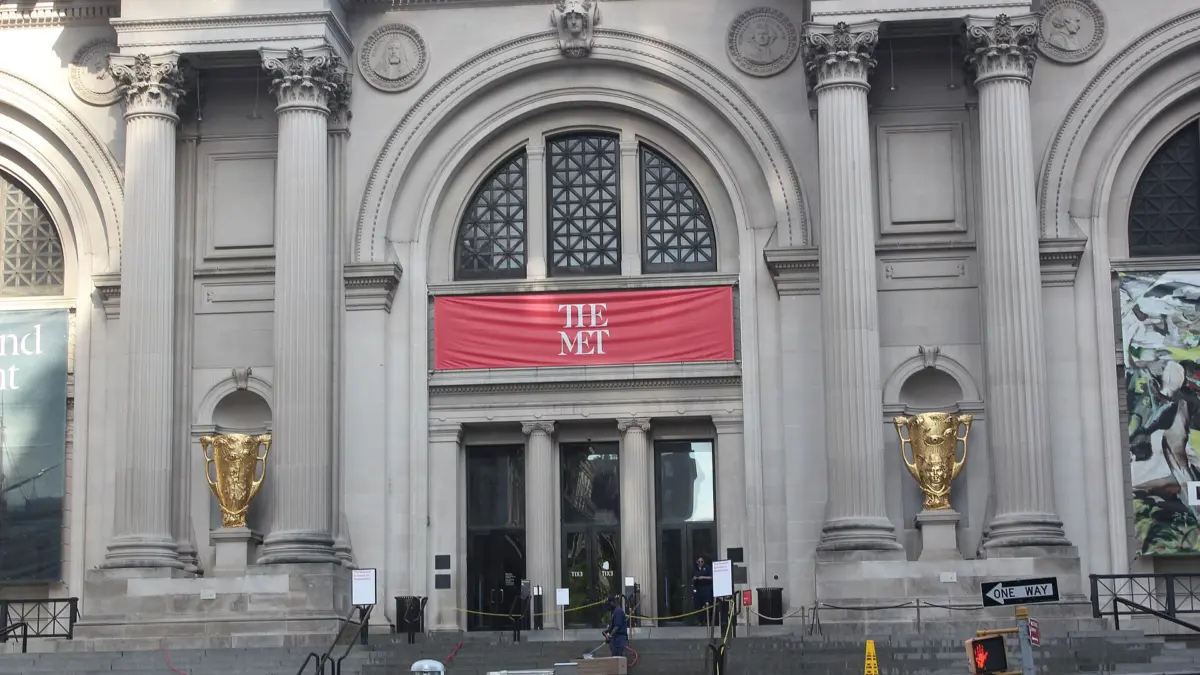
In 1948, a ticket to the first Costume Institute fundraiser cost $50. The evening was a midnight supper organized by fashion publicist Eleanor Lambert, and it was built to pay for a young department at the Metropolitan Museum of Art. By 2026, Fortune reported, a single ticket had reached $100,000. The event, now known everywhere as the Met Gala, is the most photographed night in fashion. Underneath the cameras, though, the basic idea has not changed: it is a benefit, and the money goes to the museum.
The Department Behind the Party
The Costume Institute began life outside the Met. It started as the Museum of Costume Art, an independent organization formed in 1937 and led by Irene Lewisohn, who had founded the Neighborhood Playhouse on the Lower East Side. In 1946 the collection joined the Metropolitan Museum of Art and became The Costume Institute.
It grew again in 2009, when the Brooklyn Museum transferred its own costume collection to the Met. Today the Met describes the department’s holdings as more than 33,000 objects covering several centuries of dress and accessories. Because textiles are fragile, the collection is not on permanent public view.
In May 2014 the department’s renovated home reopened as the Anna Wintour Costume Center, with the exhibition “Charles James: Beyond Fashion” as its first show.
That is the reason the gala exists. The Met has said the benefit’s proceeds give The Costume Institute its primary source of annual funding for exhibitions, publications, acquisitions and operations. The department pays its own way largely through one night a year.
From Society Supper to Cultural Event
For its first two decades, the benefit moved around New York, with dinners held at venues such as the Waldorf Astoria. Lambert ran it through that period and promoted it heavily to the city’s social circles.
The big shift came with Diana Vreeland. After years at Harper’s Bazaar and as editor in chief of Vogue, she became special consultant to the Costume Institute in 1972, a role she held until her death in 1989. Her exhibitions were theatrical and ambitious: “The World of Balenciaga” in 1973, “The Glory of Russian Costume” in 1976 and “Vanity Fair” in 1977, among others. Her 1983 show on Yves Saint Laurent was the first the Met devoted to a living designer.
Vreeland also changed who came to the party. She opened the evening to reporters and photographers and invited artists, musicians and film stars alongside the society regulars. The press followed, and the gala became a story in its own right.
Anna Wintour and the Modern Format
Anna Wintour of Vogue became chair of the benefit in 1995. Under her leadership it grew into the tightly produced evening the public knows now, held on the first Monday in May with a co-chair lineup that usually mixes film, music, sport and fashion.
Attendance is by invitation, and Wintour is widely reported to have the final say on the guest list. The fundraising has grown along with the guest list’s fame. The Art Newspaper reported that the 2025 gala raised $31 million, a record at the time. A year later, Fortune reported, the 2026 gala raised $42 million, with tables bought by companies including Amazon, Meta, OpenAI and Snapchat at $350,000 each.
Why the Exhibition Comes First
Here is the part most viewers get backwards. The red carpet does not set the theme. The exhibition does.
Each year the Costume Institute’s curator in charge, Andrew Bolton, develops the spring exhibition, and the museum signs off on it. The gala is the opening celebration for that show. Once the exhibition is settled, a separate dress code is announced for guests. The dress code is meant to be a looser prompt than the scholarly exhibition, so designers have room to interpret it.
A few recent examples show how the two pieces relate:
- 2024: The exhibition “Sleeping Beauties: Reawakening Fashion” looked at fragile garments from the collection, and the dress code was “The Garden of Time.”
- 2025: “Superfine: Tailoring Black Style,” co-curated by Bolton and Barnard College professor Monica L. Miller, drew on Miller’s 2009 book “Slaves to Fashion: Black Dandyism and the Styling of Black Diasporic Identity.” The dress code was “Tailored for You,” and the co-chairs were Colman Domingo, Lewis Hamilton, A$AP Rocky, Pharrell Williams and Anna Wintour.
- 2026: “Costume Art” opened the museum’s new Condé M. Nast Galleries, a space of nearly 12,000 square feet next to the Great Hall, with nearly 400 objects drawn from across the Met’s collection. The gala took place on May 4, 2026, with Beyoncé, Nicole Kidman, Venus Williams and Wintour as co-chairs, and the dress code was “Fashion Is Art.”
- 2027: On November 5, 2026, the Met announced “extraORDINARY: Fashion and the Poetics of the Everyday,” a show built around ordinary clothes such as jeans, T-shirts and puffer coats, and humble materials such as paper, plastic and metal. The gala is set for Monday, May 3, 2027. As of mid-November 2026, the co-chairs and dress code had not been announced.
Explaining the 2026 show, Bolton said, “I wanted to focus on the centrality of the dressed body within the Museum,” as reported by CBS News New York. Of the 2027 exhibition, he said, “I want visitors to leave looking differently at the clothes they arrived in,” as quoted by W Magazine.
What Happens After the Carpet
The arrivals on the museum steps get most of the attention, but guests then move inside for a private preview of the exhibition, a cocktail hour and a dinner served in the museum’s Temple of Dendur. The show itself usually opens to visitors a few days later and runs for months. “Costume Art,” for instance, opened to the public on May 10, 2026.
That gap between gala night and public opening is the real logic of the event. The photographs travel around the world in hours, and they bring people to Fifth Avenue for the rest of the year. The most visited exhibition in the Met’s history is a Costume Institute show: “Heavenly Bodies: Fashion and the Catholic Imagination” drew 1,659,647 visitors in 2018, across the Fifth Avenue building and The Met Cloisters, according to the museum.
Seeing the Clothes Yourself
For the millions of people who will never receive an invitation, the exhibition is the part of the Met Gala that is open to everyone. “Costume Art” is on view at The Met Fifth Avenue through January 10, 2027. “extraORDINARY” is scheduled to open on May 9, 2027, and run through January 9, 2028.
Since the collection is too delicate to stay on display, these spring shows are the main chance to see its pieces in person. Lambert’s $50 supper was a modest start, but the plan was the same one the museum follows now: put fashion in front of people, then use that attention to fund the department that preserves it.