The first book is always the same: The Little Engine That Could. It arrives in a plain padded mailer with a baby’s name printed on the label, and for families enrolled in Dolly Parton’s Imagination Library, it is the start of a monthly ritual. A new picture book, chosen for the child’s age, lands in the mailbox every month until the fifth birthday. The family never pays a cent. Multiply that one mailbox by millions of homes in five countries and you start to see how far an idea from a single county in East Tennessee has traveled.
A promise she made at home
Parton launched the Imagination Library in 1995 through the Dollywood Foundation, the charity she set up in 1988. The first books went to children in Sevier County, Tennessee, where she grew up as one of 12 children in a family she described as “dirt poor,” as the Associated Press recounted.
The reason was personal. Her father left school early to work on the family farm and never learned to read or write, and Parton created the program in his honor. She wrote that “He was the smartest man I have ever known,” Education Week noted. Putting books in children’s hands early, before reading could turn into a struggle, was her way of answering that.
The rules are simple. Any child from birth to age five can be enrolled where a local program exists, regardless of family income. One book a month means a baby signed up at birth can collect 60 books before starting school. The program also offers bilingual and braille titles.
Sixty books, start to finish
The shelf a child builds has a shape to it. It opens with that little engine and closes, in the month the child turns five, with Look Out Kindergarten, Here I Come!, a send-off timed for the start of school. Every book in between is matched to the child’s age.
Those titles are picked by committees of educators and librarians, and nearly all of them come from Penguin Random House, Fortune reported. The matching matters more than it might seem. Beth Phillips, a professor of educational psychology at Florida State University, told Education Week that knowing which books suit a child’s age is not something every parent can take for granted. She also pointed out that the books belong to the child, so they can be read again and again. “Young children love hearing the same stories over and over again,” she said.
From one county to five countries
The program did not stay local for long. According to the Imagination Library’s own timeline, it had mailed its millionth book by 2003, and a national replication effort was already under way. The program went statewide across Tennessee in 2004, crossed into Canada in 2006 and the United Kingdom in 2007, then reached Australia in 2013 and the Republic of Ireland in 2019.
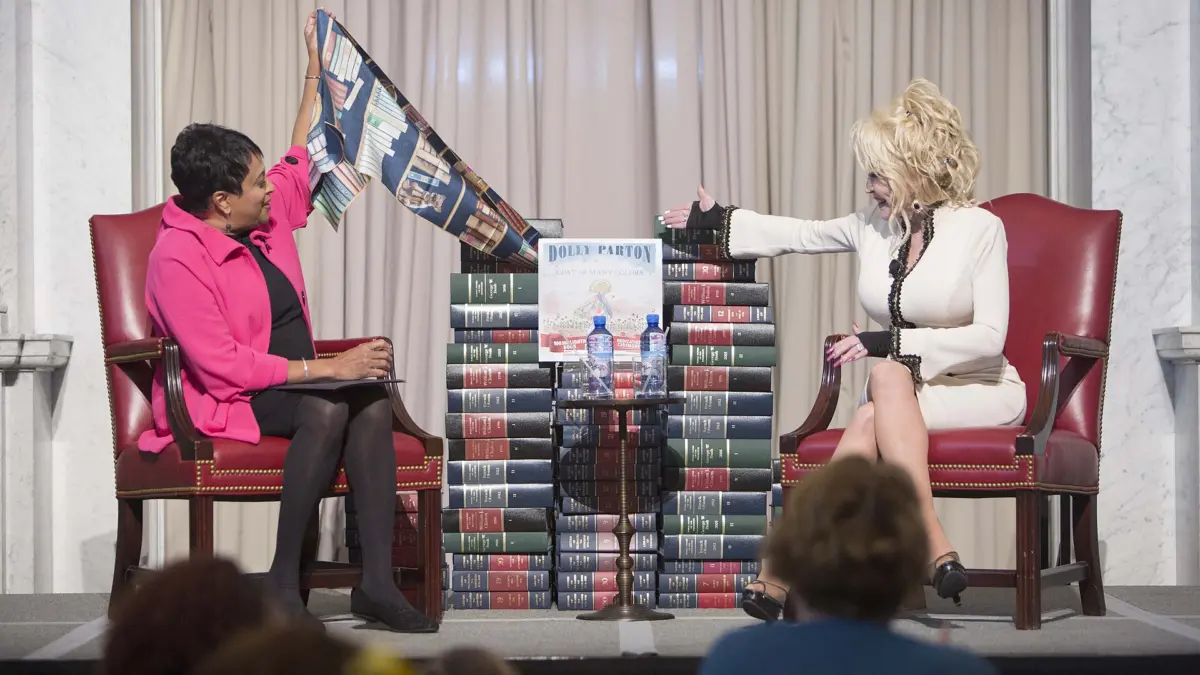
The milestones kept coming. The program presented its 25 millionth book in 2010, and by 2016 it was sending one million books a month. Its 100 millionth book was dedicated to the Library of Congress in 2018. Three years later, the Library of Congress gave it the David M. Rubenstein Prize, which came with $150,000. The 200 millionth book arrived in 2023, and the program celebrated its 30th anniversary in 2025.
Who pays for all those books
Families never pay, but somebody does. The Dollywood Foundation covers overhead, runs the ordering system and negotiates the price of the books. Local partners, from public libraries and school districts to civic clubs and, in some places, state governments, pay for the books and the postage in their area. According to Fortune, that local share works out to $2.60 a month per enrolled child.
That model explains why coverage looks different from one map to the next. Some states fund statewide programs, while elsewhere a county library keeps the books coming. In Jeannette, Pennsylvania, the public library started its program with 10 enrolled children and has grown to more than 300, Education Week reported, handing out over 1,400 books along the way. WSMV reported in 2026 that the program was no longer available in Missouri or Maine after state funding was cut. Each local program depends on someone choosing to keep paying for it.
For parents, the practical step is short. The Imagination Library website lets families check whether a program serves their area and sign up from there. For anyone who wants to help, the local partner listed for their community is the place to start.
The numbers, as of 2026
The headline figure crossed a big line in late 2025: more than 300 million free books gifted since 1995, according to the program. By the time of Parton’s death in August 2026, the total had passed 332 million, Fortune reported. As of 2026, more than 3 million books go out every month around the world, and about one in six children under age five in the United States is enrolled, according to WSMV.
The international programs have grown into sizable operations of their own. The Canadian program announced in May 2026 that it had marked 20 years and 5 million books. The Australian program reached 2 million books in December 2025. In the United Kingdom, the Dollywood Foundation UK’s 2024 annual report put its total at more than 6 million free books.
The library after Dolly
Dolly Parton died on August 25, 2026, at age 80, the Associated Press reported. The Imagination Library featured prominently in the tributes that followed, and her family asked that people donate to the program in lieu of flowers.
Support had already been coming from famous fans. In July 2026, the AP reported that Taylor Swift and Travis Kelce included Dolly Parton’s Imagination Library among 20 charities that shared a $26 million donation.
The program continues under Dollywood Foundation president Jeff Conyers. “Our responsibility now is to care for what she entrusted to us,” he told Education Week. Somewhere this month, a mail carrier is dropping off a padded envelope with a child’s name on it, and the shelf in that house is one book taller.