My mother’s text came on a Sunday afternoon while I was at the grocery store, standing in front of the avocados.
“Dinner Tuesday. 6:30. Your father needs to talk to you. Don’t be late.”
There was no “hi,” and no “how are you.” My mother doesn’t text like a mother. She texts like an executive assistant scheduling a disciplinary meeting. I stood there in the King Soopers produce section holding an avocado and reading it three times, and I felt that old tight feeling come up in my chest, the one I’ve had since I was about nine years old.
I texted back, “Is everything okay?”
She didn’t answer.
My name is Emma Whitford. I’m twenty-nine years old. I live in a one-bedroom apartment on the north side of Colorado Springs, off Briargate, with a view of Pikes Peak if you lean out over the balcony railing far enough. I’m a senior data analyst for a health insurance company. Mostly I build models that predict which claims are likely to be fraudulent, which is funny in a way I didn’t appreciate until later. I have a master’s degree in statistics from CU Boulder that I paid for myself, with loans I finished paying off last year. I’ve never been arrested, never been charged with anything, never even gotten a speeding ticket. I’m the kind of person who comes to a complete stop at stop signs at two in the morning when nobody’s around.
I’ve been engaged for eight months to a man named Caleb Hayes. He’s thirty-one, and he’s an officer with the Colorado Springs Police Department, five years on the job, assigned to patrol out of the Gold Hill division. We met at a friend’s barbecue two years ago. He was the only person there who didn’t make fun of me for bringing a spreadsheet to plan the potluck. He said it was the most organized potluck he’d ever been to. We’re getting married in June at a little lodge up in Woodland Park. We’ve been saving for it for a year and a half. We’ve also been saving for a down payment on a house. Between the two of us, we’d put away a little over $41,000 in a joint savings account at Ent Credit Union. I knew the number down to the cent. I’m a data analyst.
My parents live in Colorado Springs too, on the west side, in a big two-story stucco house on a quiet street in the Broadmoor area, with a three-car garage and a view of Cheyenne Mountain. My father is Richard Whitford. He’s sixty-two. He used to own a commercial roofing company that he sold in 2016. Now he describes himself as “semi-retired” and “in investments,” which as far as I can tell means he plays golf at the Country Club of Colorado and talks about the stock market at dinner. My mother is Diane. She’s sixty. She’s on the board of a women’s charity luncheon and has never worked a paying job in my lifetime.
And then there’s my older sister, Lauren. She’s thirty-three. She’s married to a man named Brandon Pike, who has had more business ideas than anybody I’ve ever known and has finished none of them. There was a food truck, and a franchise of some protein smoothie chain. Most recently it was a CrossFit gym in Monument that he opened in 2023 and closed in 2025. They live in a townhouse in Castle Rock. They have no kids. They take a lot of vacations.
I want to explain something about my family, because nothing that happened makes sense otherwise.
Lauren has always been treated like something precious. She was the first baby, and the pretty one, and the one who cried easily. Whenever Lauren wanted something, my parents found a way to get it for her. A car at sixteen, a brand-new Jeep Wrangler. Out-of-state tuition at the University of Arizona. A wedding at The Broadmoor hotel that cost more than most people’s houses. When she and Brandon got into trouble with money, which was often, my parents paid.
I was treated like the family’s emergency savings account. I was the responsible one, the boring one, the one who didn’t need anything. When I was sixteen, I got a job at a frozen yogurt place and bought my own used car. When I wanted to go to college, my father told me I was smart enough to get scholarships. I did get them, partial ones, and took loans for the rest. When I graduated with my master’s, my mother said, “Well, now you’ll be able to help your sister.”
And I did help. That’s the part I’m most ashamed of. I helped for years. I gave Lauren $2,000 when Brandon’s food truck needed a new generator. I gave her $3,500 when they were behind on their mortgage in 2021. I paid for her plane ticket home from Cancún in 2022 when her credit card got declined at the airport. I never got any of it back. Every time I said no, my parents made me feel like I’d committed a crime. My mother would stop speaking to me for weeks. My father would call and tell me in a very calm voice that he was disappointed in the person I’d turned into.
So when the text came about Tuesday dinner, I knew it was about money. I just didn’t know how much.
I went. Of course I went. That’s what I always did.
When I pulled into my parents’ circular driveway that Tuesday at 6:28, Lauren’s white Range Rover was already there. Brandon leased it in 2024 when the gym was still open. I knew they were three months behind on the payments, because Lauren had told me in October, crying, on the phone.
The dining room table was set like a photograph from a home design magazine. There was a white linen tablecloth and the good china with the gold rims, and tall white candles in silver holders. There was a centerpiece of white roses and eucalyptus my mother had obviously gotten from the florist that afternoon. There was a roast chicken on a platter in the middle of it all, with little roasted potatoes around it.
Lauren was already crying when I walked in. She was sitting on one side of the table in a cream sweater with her mascara running. Brandon was sitting next to her, staring down at his untouched plate. He didn’t look up when I came in.
My father was sitting in his usual seat at the head of the table. My mother was at the other end. My seat was set across from Lauren and Brandon. I sat down.
Nobody said anything for a minute. My mother passed me the potatoes. I took some, to be polite.
“Your sister is having financial problems,” my father said.
He said it the way he’d say it was going to snow tomorrow. Calm. Matter-of-fact. Like it was weather, and the only reasonable thing to do about weather was to put on a coat.
“How much does she want?” I asked.
My father didn’t flinch at the word want. “Fifteen thousand dollars.”
I put my fork down.
“Fifteen thousand?”
“Brandon had some setbacks with the gym,” my mother said. “There are some debts. Some people he owes. They need it by the end of the week.”
“What people?” I asked.
Brandon finally looked up. His face was gray. “It’s complicated,” he said.
“I’m a data analyst, Brandon. I can do complicated.”
“Emma,” my father said sharply.
Lauren started crying harder. “I knew she’d be like this,” she said to my mother. “I told you she’d be like this.”
My mother reached across the table and patted Lauren’s hand. Then my mother’s eyes moved slowly to my left hand, resting on the white tablecloth. To my engagement ring. It was a small round diamond on a plain gold band, the ring Caleb had saved up for for a year on a police officer’s salary.
“Family should come before a wedding, Emma,” my mother said.
I sat there for a moment. Then I explained, very calmly, that Caleb and I had been saving for a year and a half for our wedding and for a down payment on our first house. I explained that the money wasn’t just mine, it was ours, and that it was in a joint account. I explained that I wasn’t going to destroy our future to cover another crisis caused by Lauren and Brandon that nobody would even explain to me.
“I’m sorry,” I said. “But no.”
The room went very quiet. The candles flickered.
My father slowly set down his napkin. He pushed his chair back from the table. He stood up. He’s a big man, six-foot-two, with silver hair and a tan from golf, and he’s always been able to fill a room just by standing up in it.
“You do not refuse this family,” he said, “without consequences.”
I looked up at him. I’d heard him say things like that before. I thought he meant guilt. I thought he meant long, angry voicemails from my mother, or another three-month stretch of silence, or not being invited to Christmas. I’d survived all those things before.
“Okay,” I said. I stood up too. I picked up my purse. “Thank you for dinner, Mom.”
I drove home. I didn’t cry until I got to the I-25 on-ramp at Bijou.
When I got home, I told Caleb everything. He was sitting on our couch in sweatpants with his feet up, watching a hockey game, and he muted it and listened to the whole thing without saying a word. When I was done, he was quiet for a while.
“Your dad said ‘without consequences’?” he asked.
“Yes.”
“Those were his exact words?”
“Yes.”
Caleb looked at me for a long moment. He has very steady brown eyes. “Em,” he said. “I don’t want to scare you. But I’ve been doing this job for five years. When a man like your father says something like that, he usually means something specific.”
“Like what?”
“I don’t know yet,” he said. “Just be careful. Keep your phone charged. Text me when you’re leaving work.”
I thought he was being dramatic. I loved him for it, but I thought he was being a cop.
Two nights later, on Thursday, I was driving home from work on Interstate 25.
My office is in a big glass building off Interquest Parkway, at the far north end of the city. I’d stayed late finishing a model for a presentation on Friday morning. It was about ten after eight, and it was dark, and cold, the way Colorado gets in December. I was in the right lane going about sixty-three in my white 2014 Honda Civic, listening to a podcast, thinking about whether we had any eggs at home.
I saw the lights in my rearview mirror first. Red and blue, coming up fast behind me. I moved over toward the shoulder to let them pass.
They didn’t pass.
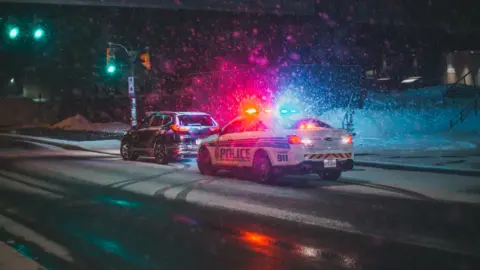
One cruiser came up alongside me and then cut in hard in front of me and slowed down. Another one pulled up right behind my bumper. A third one came up on my left side. I had no choice. I put on my blinker and pulled over onto the shoulder near the Woodmen Road exit and stopped. The cruiser in front of me stopped at an angle across the shoulder, blocking me in. The one behind me stopped with its spotlight pointed straight through my rear window.
Red and blue lights flashed through all my windows, filling the inside of the car. I could see them reflected on my hands on the steering wheel.
Then a voice boomed out of a loudspeaker.
“Driver of the white Honda. Turn off the engine. Throw the keys out of the window. Keep your hands where we can see them.”
My whole body went cold.
I did exactly what they said. I turned off the car. I rolled down the window with shaking fingers. I took the keys out of the ignition and dropped them out the window. They hit the pavement with a jingle. Then I put both hands on top of the steering wheel and held them there.
Cold air rushed in through the open window. It was maybe twenty-five degrees out. I could hear the traffic going by on the interstate, cars slowing down to stare. I could hear the crackle of police radios.
Nobody came toward my car. The officers stayed where they were, behind their cruisers, behind the open doors. I could see the shapes of them in the glare of the headlights, crouched, with their hands near their belts. They were watching me like I might do something violent at any second.
I sat there with my hands on the steering wheel and my heart pounding so hard I could hear it. I tried to think of what I’d done. Had I been speeding? Was my registration expired? I’d renewed it in August. I knew I had. I’d paid it online. $167.43.
None of it made any sense. Somebody had convinced the police that I was dangerous.
Then one of the officers came out from behind the cruiser parked in front of me. He walked forward into the beam of his own headlights, slowly, with one hand raised, palm out.
I recognized him instantly. The way he walked, with his left shoulder a little lower than his right. The shape of his head.
It was Caleb.
My fiancé.
His shift had started at four that afternoon. He’d texted me at seven to ask if I wanted him to pick up Thai food on his dinner break. I’d said yes, pad see ew.
He walked right up into the headlights where everybody could see him. Then he turned his head and spoke loudly and clearly, back toward the other officers, making sure every body camera on that shoulder recorded him.
“She’s my fiancée,” he said. “Emma Whitford. I know her. Let’s lower the response while we confirm the ownership information.”
There was a long pause. Then a sergeant’s voice called back, “Copy, Hayes. Go ahead. Go slow.”
Caleb walked up to my open window and crouched down beside it so his face was level with mine. His eyes moved quickly over everything. My face, my hands on the wheel, the empty passenger seat, my work bag on the floor, the back seat. I knew what he was doing. He was checking that I was okay. He was also checking, for the body camera, that there was nothing dangerous in the car.
“Em,” he said quietly. “Are you hurt?”
“No.”
“Okay. Keep your hands where they are for one more minute, okay? I know. I’m sorry.”
“Caleb, what’s happening?”
He looked at me. And then he asked a question that told me he already had a pretty good idea who was behind it.
“Emma,” he said. “What did your family do?”
Caleb knew my parents. He’d been to Christmas at their house, and Easter, and my mother’s sixtieth birthday party at the country club. He’d watched them smile warmly for the family photographs on the front steps, and he’d watched my father lean over to me afterward and say quietly, “You could at least pretend to be happy, Emma.” He’d seen how they treated Lauren like something made of glass, and me like something you kept in a drawer for emergencies. He understood all of it.
“Your license plate was flagged about ten minutes ago,” Caleb said, low. “Stolen vehicle. The caller reported that the car had been taken without permission, and that the driver was mentally unstable, hostile, possibly aggressive, and might try to flee if approached. That’s why there are four cars here. That’s why they had you throw your keys out.”
“Who called?” I said.
His jaw tightened. His expression went very hard.
“Your father,” he said.
I sat there with my hands on the steering wheel.
Here’s the thing about that car. I bought it when I was eighteen, from a Honda dealership on Academy Boulevard. It was a 2014 Civic, two years old at the time, white, with 22,000 miles on it. It cost $14,900. I had a frozen yogurt job and no credit history at all, so the dealership wouldn’t give me a loan on my own. My father co-signed the financing agreement. That was the only thing he did. He signed one piece of paper at a desk in the dealership finance office, and then he went home.
I made every single payment myself, $289 a month, for five years. I paid for the insurance. I paid the registration every year. I paid for the new tires, the brakes, and the timing belt, and the windshield when a rock cracked it on I-25. I made the final installment myself, in 2020, when I was twenty-three, and the bank mailed me the title. Then I went to the El Paso County DMV and had the title reissued, and the current title lists only one owner.
Me. Emma Whitford.
My father hadn’t had anything to do with that car for six years. But he knew the make and the model and the license plate. He knew his name had once been on the original loan. And he’d taken that old connection and used it to call the police and invent an emergency. He’d described his own daughter as unstable and aggressive and likely to run, on purpose, so that armed officers would surround her on the side of an interstate in the dark.
“Why would he do this?” Caleb asked me quietly.
I glanced at the clock on my dashboard. It said 8:14 p.m.
“Because I refused to give Lauren fifteen thousand dollars,” I said.
Caleb closed his eyes for just a second. When he opened them, something in his face had changed. I’d never seen him look that way before.
“Okay,” he said. “Okay. Stay right here.”
Another officer ran my license and my registration and pulled up the title record from the state database on the computer in his cruiser. It took about four minutes. It showed exactly what I said it would. One registered owner. Emma Whitford. No liens. No co-owners. Title issued in 2020.
They canceled the stolen vehicle alert right there on the side of the road. The sergeant, an older man named Sergeant Morales with a gray mustache, came over to my window himself and apologized. He said they’d treat the false report “appropriately.” He asked if I wanted to make a statement. I said yes. He asked if I was okay to drive. I tried to answer him, and I realized my hands were shaking so hard on the steering wheel I couldn’t even grip it.
“I’ll have Officer Gutierrez drive your car home for you,” Sergeant Morales said gently. “Hayes, go with her. You’re off the clock as of now. I’m putting you on personal leave for the rest of the shift.”
So a young officer named Gutierrez drove my Honda back to our apartment on Briargate, and Caleb drove me in his patrol car, and I sat in the front seat of a police cruiser for the first time in my life and stared out the window at the lights of the city and didn’t say anything.
When we got up to our apartment, Caleb closed the door behind us and locked it. He locked the deadbolt and the chain, which he never does. He stood there with his hand on the doorknob for a second.
And that’s when my phone vibrated in my coat pocket.
I took it out. It was a notification from the credit monitoring app on my phone. I’d signed up for it two years ago through my credit card. I’d never once gotten an alert from it.
“ALERT: A new credit inquiry has been made in your name. Short-term personal loan application. Lender: QuickFund Financial. Amount requested: $15,000. If you did not authorize this inquiry, take action immediately.”
Fifteen thousand dollars. The same amount.
Caleb read it over my shoulder. He went still.
“Freeze your credit,” he said. “Right now. All three bureaus. Tonight. Don’t wait.”
I sat down on our couch, still in my coat. I opened my laptop. My hands were still shaking, but it’s my job to work with data, and when I’m looking at data, my hands always steady. I logged in to Equifax, then Experian, then TransUnion. I froze my credit at all three, one after another. Then I pulled my full credit reports from all three bureaus.
When the complete reports loaded, my fingers went numb on the keyboard.
My credit report should have shown a credit card with a $5,000 limit that I pay off every month, my student loans, paid in full and closed in 2025, and my old car loan, paid in full and closed in 2020. That was all. That’s my whole financial life.
But there were three other accounts on it that I’d never seen before in my life.
The first was a home equity line of credit, a HELOC, a loan secured by a house. It had been opened in March 2023 with First National Bank of Colorado. The credit limit was $200,000, and the current balance was $187,340.
The second was a small business loan, opened in June 2023 through an online lender called Meridian Business Capital. It was for $85,000, for “fitness facility equipment and buildout.” The current balance was $78,922.
The third was a private refinancing agreement, opened in January 2025 with a private lender in Denver I’d never heard of. The current balance was $36,225.
I added them up in my head. I’m fast at that.
“Three hundred and two thousand, four hundred and eighty-seven dollars,” I said out loud.
Caleb was standing behind the couch, reading over my shoulder. He didn’t say anything.
Every one of those accounts was connected to the same mailing address. It wasn’t my apartment, and it wasn’t any address I’d ever lived at.
It was my parents’ address. The big stucco house on the west side, by the Broadmoor.
“Fitness facility equipment,” Caleb said quietly. “Brandon’s gym.”
“June 2023,” I said. “That’s when it opened.”
I sat there staring at the screen. I couldn’t make my brain work. It was like looking at a spreadsheet full of numbers that didn’t add up. Somebody had been borrowing money in my name for almost three years, and the bills had been going to my parents’ house, where I’d never see them.
Before I could even begin to understand what I was looking at, my phone rang.
It was my father.
I looked at the screen. “DAD.” I looked up at Caleb.
Caleb took out his own phone. He opened the recording app and pressed the red button and set the phone down on the coffee table next to mine. Colorado is a one-party consent state for phone recordings. Caleb told me that later. You can record a phone call as long as one person on the call knows about it. He nodded at me.
I answered and put it on speaker.
My father didn’t ask whether the police had hurt me. He didn’t ask whether I was okay, or whether I was home, or whether they’d pointed guns at me. He didn’t apologize.
“Transfer the fifteen thousand,” he said. “Tonight. To Lauren’s account. Then I’ll call the police back and tell them the car’s been returned and we can clear up this misunderstanding.”
“It’s already cleared up,” I said. “The car is in my name, Dad. They checked. You falsely reported my car as stolen. You told the police I was dangerous. There were four police cars. They made me throw my keys out the window.”
“You left me no choice,” he said.
“And the loans?” I said. “The ones opened in my name? The HELOC? The business loan? Three hundred and two thousand dollars, Dad?”
The line went completely silent.
I could hear him breathing. Five seconds. Ten.
Then his voice changed. It went very cold and very calm, the voice he used when I was a teenager and I’d done something he decided was unforgivable.
“You’re exhausted, Emma,” he said. “You’re stressed about the wedding, and you’re confused. You’ve been confused for a long time. Your mother and I have been worried about you. Do not make claims you cannot prove.”
He hung up.
I sat on the couch with the phone in my hand. I didn’t cry. I didn’t throw anything. I picked up Caleb’s phone and stopped the recording. Then I saved it, and emailed it to myself, and uploaded it to my Google Drive, and texted it to Caleb, so it was in four places.
“Okay,” I said.
Caleb stood there looking at me. “Em,” he said. “I can’t be involved in this. Officially. You know that, right? You’re my fiancée. If I touch this case, his lawyer will throw out everything I touch.”
“I know.”
“I’m calling my lieutenant,” he said. “Right now. I’m going to recuse myself, in writing. And I’m going to get this to somebody who can actually do something with it. Tonight.”
He did. He called his lieutenant at nine-fifteen at night, at home, and explained everything. By ten o’clock, he’d sent a written memo recusing himself from anything involving my family. By ten-thirty, his lieutenant had called a detective in the department’s Financial Crimes Unit, a woman named Detective Renee Castellanos, at her house.
And before midnight, Detective Castellanos had received everything. The credit alert from QuickFund, and all three credit reports with the three accounts I’d never opened. The recording of my father’s phone call, and a scan of my vehicle title. Sergeant Morales had already flagged the body camera footage from the traffic stop on I-25 and attached it to the case file as evidence of a false report.
She called me at 11:52 p.m.
“Ms. Whitford,” she said. Her voice was low and gravelly, like somebody who’d been working since six in the morning. “I’ve been doing this job for nineteen years. I want you to listen to me very carefully. Don’t talk to your parents again. Don’t talk to your sister. Don’t answer their calls. Don’t respond to texts. Write down everything. Save everything. Can you do that?”
“Yes,” I said. “I do that for a living.”
“Good,” she said. “Then you’re going to be a very good witness.”
At 8:30 the next morning, I got another call. It was from a woman named Margaret Ostrowski, a senior fraud investigator with First National Bank of Colorado, the bank that held the HELOC in my name. She said Detective Castellanos had contacted her bank’s fraud department overnight. She asked if I’d be willing to come to a private meeting at their downtown branch on Tejon Street at nine o’clock that morning.
“Detective Castellanos will be joining us,” she said. “And Ms. Whitford, I should tell you. We’ve also asked the co-signers listed on the original application to attend. Your parents.”
“They’ll be there?”
“They agreed to come in voluntarily,” Margaret Ostrowski said. “Your father said he’d be happy to clear up what he called a family misunderstanding.”
I called my boss and told him I wouldn’t be in. Caleb drove me downtown. He couldn’t come into the meeting, because of the recusal, so he sat in the bank lobby in his civilian clothes, in a gray hoodie, with a cup of coffee from the Starbucks across the street. He squeezed my hand before I went in.
“Whatever’s in there,” he said, “you already know more than they do. Remember that.”
A bank employee led me up to a conference room on the third floor. It had a long table, gray carpet, and a big window that looked out over Acacia Park.
My parents were already sitting inside.
Lauren was sitting next to them. Her eyes were swollen and red, like she’d been crying all night. Brandon wasn’t there.
My father was wearing his finest suit. It was the charcoal one he wore to funerals and to the country club’s annual dinner. He’d had his hair cut. My mother was sitting very straight, in a camel coat with a silk scarf, holding her Louis Vuitton handbag tightly in her lap with both hands.
My father smiled when he saw me come in. It was his big public smile, the one he used in family photos.
“Emma,” he said warmly, like nothing had happened. “There she is.”
I didn’t answer. I sat down at the far end of the table, as far away from them as I could get.
Margaret Ostrowski was sitting at the head of the table. She was in her fifties, with short gray hair and wire-rimmed glasses and a navy blazer. She had a thick manila folder in front of her.
My father turned to her before anybody else could speak. He leaned forward with his elbows on the table and his hands folded, the way he used to do with roofing clients.
“Ms. Ostrowski,” he said. “Thank you for taking the time. I want to be straightforward with you. My daughter has been under tremendous stress lately because of her upcoming wedding. She’s marrying a police officer. It’s been a lot for her. She’s misunderstood a private financial arrangement within our family. That’s all this is. She agreed to all of this years ago, and she’s simply forgotten.”
Margaret Ostrowski didn’t say anything. She just looked at him over her glasses for a long moment.
Then she opened the thick folder and set it down on the table.
My father’s smile faltered, just a little.
Inside were several loan applications, all with my name typed at the top. My Social Security number. My date of birth. They listed my employer and my salary, correctly. There was the HELOC application from First National, and the Meridian business loan application. There was the private refinancing paperwork.
And there was one more document, right on top. It was a notarized durable power of attorney. It was dated February 2023. It gave Richard Whitford full authority to act on my behalf in all financial and real estate matters. It had my name typed at the bottom, and a signature on the line above it.
I’d never seen it before in my life.
Margaret Ostrowski took out a blank sheet of white paper from the back of the folder and slid it across the table to me, with a pen.
“Ms. Whitford,” she said. “Would you please write your full legal signature on this page? Just as you normally would.”
I picked up the pen. I signed my name. Emma Claire Whitford, the way I’ve signed it ten thousand times, with the big loop on the E and the little hook at the end of the d.
Margaret Ostrowski picked up the paper and laid it down on the table right next to the signature on the power of attorney. She turned them both around so everybody at the table could see them side by side.
They were clearly different. The one on the power of attorney was slanted the wrong direction, to the left. My signature slants right. The E had no loop. The d had no hook. The middle name was spelled “Clare,” without the i.
Even I could see it, and I’m not a handwriting expert. You didn’t need to be.
My mother slowly turned her head and looked at my father.
“Richard,” she whispered.
It was the first word she’d said. Her voice sounded like a stranger’s.
My father didn’t look at her. He leaned forward again, toward Margaret Ostrowski.
“She authorized us,” he said. “Years ago. She signed it at the house, at the kitchen table, I remember it. She was in a hurry. Her signature was probably sloppy. She simply doesn’t remember.”
“Mr. Whitford,” Margaret Ostrowski said. “The notary who notarized this document is named on the stamp. Carla Benning. We called her this morning. She’s a notary at a UPS Store on Academy Boulevard. She keeps a journal, as Colorado notaries are required to. According to her journal, on February 9th, 2023, she notarized a power of attorney for a woman identifying herself as Emma Whitford. The woman presented a Colorado driver’s license.” She looked at me. “Ms. Whitford, where were you on February 9th, 2023?”
I didn’t even have to think. I keep a calendar of everything.
“Austin, Texas,” I said. “At a data science conference. For four days. My company sent me. I have the hotel receipt and the boarding passes. I presented a paper there on the 9th.”
Margaret Ostrowski made a note.
Lauren had started crying again, very quietly, next to my mother. My father still wouldn’t look at anybody.
That’s when the conference room door opened behind me.
A woman came in. She was in her late forties, in a dark pantsuit, with a gold detective’s badge clipped to her belt. Her black hair was pulled back in a tight bun. She was carrying another thick stack of papers under her arm, folders and printouts and what looked like copies of county property records with stamps on them.
“Detective Renee Castellanos, Colorado Springs Police,” she said, to the room. She nodded at me. “Ms. Whitford.” She nodded at my father. “Mr. Whitford. We spoke on the phone this morning.”
My father’s face had started to change color.
Detective Castellanos set her stack of papers down on the table next to Margaret Ostrowski and pulled out a chair and sat down. She didn’t say anything else. She looked at Margaret Ostrowski.
Margaret Ostrowski turned to the very last page in her folder. It was a single sheet. It looked like a copy of an official county document, with a seal and a recording stamp from the El Paso County Clerk and Recorder in the upper right corner.
She slid it across the table and placed it directly in front of me.
“Ms. Whitford,” she said quietly. “Before we discuss the forged loan applications, there’s something you need to know. Something your parents apparently haven’t told you.” She paused. “You need to know who legally owns the property your parents are living in.”
My father’s face went completely pale.
I looked down at the paper.
It was a beneficiary deed. That’s a kind of deed you can record in Colorado that transfers a house to somebody automatically when you die, without going through probate. It had been signed and recorded in 2017. The property address was my parents’ address, the big stucco house on the west side by the Broadmoor.
The grantor, the person who owned the house and signed the deed, was Eleanor J. Whitford.
My grandmother. My father’s mother.
And the beneficiary, the person who would get the house when she died, was me. Emma Claire Whitford. With an i. Spelled correctly.
I read it twice. Then I looked up at my father.
“Grandma Nell owned the house?” I said.
He didn’t answer.
I remembered. My grandmother, Nell, lived with my parents for the last four years of her life. She had Parkinson’s. My parents had told everybody they’d taken her in out of love, to care for her. She lived in the downstairs bedroom off the kitchen, and she watched Jeopardy every night at 6:30 with the volume all the way up, and every time I visited she’d hold my hand and say, “You’re my sensible girl, Emmie. You’re the sensible one.” She died in March 2019, when I was twenty-two.
At her funeral, my father had told me she’d left everything to him and my mother. He said she didn’t have much. He said there wasn’t a will worth talking about.
“I don’t understand,” I said. “That’s your house. You bought that house. You’ve lived there since I was in high school.”
“Your grandmother bought it,” Detective Castellanos said quietly. “In 2011. With cash, from the sale of her own house in Pueblo after your grandfather died. She paid $640,000 for it. The deed was always in her name alone. Your parents moved in with her in 2015. After your father sold his roofing business.” She tapped the paper. “In 2017, she recorded this beneficiary deed, leaving the house to you. When she passed in March 2019, ownership of that property transferred to you, by law, automatically. That house is yours, Ms. Whitford. It has been for almost seven years. You’ve owned it since you were twenty-two.”
I just sat there.
“The county assessor’s office has been sending the property tax statements to that address,” the detective went on, “in your name. Somebody’s been paying them. About $4,100 a year.” She looked at my father. “And in March 2023, a month after that power of attorney was notarized, somebody used it to take out a home equity line of credit against that property. In your name. Since you’re the legal owner. Two hundred thousand dollars against your house. That’s the HELOC on your credit report.”
My mother made a sound. It was small and terrible.
She turned in her chair, all the way around, and looked at my father.
“Richard,” she said. “You told me Nell left the house to us. You told me. You showed me papers.”
My father finally spoke. He didn’t look at any of us. He looked at the window, at Acacia Park.
“She was sick,” he said. “She didn’t know what she was doing. She had Parkinson’s. She was confused. That deed should never have been allowed. That house was supposed to be ours. I took care of her for four years. I put her in that bedroom and brought her meals, and Emma visited twice a month. And my mother leaves the house to Emma? To the sensible one?” He laughed, a short, ugly laugh. “I wasn’t going to let a sick old woman’s mistake throw us out of our own home.”
“So you kept it from me,” I said. “For seven years.”
He didn’t answer.
“And then you forged my name,” I said, “and borrowed against my house. For Brandon’s gym.”
“For your sister,” my father said. “For your sister, Emma. Family takes care of family. You never understood that. You never once understood that.”
Next to my mother, Lauren had gone completely white. She was staring at our father like she’d never seen him before.
“Dad,” she said. Her voice shook. “You told me that money was from your investments. You told me you’d taken it out of your portfolio. You said it was a gift. For the gym. You said it was your money.”
He didn’t look at her either.
“I didn’t know,” Lauren said. She turned to me, and for the first time in my life, she looked at me like we were the same age. “Emma, I swear to God. I didn’t know any of this. I didn’t know about the house. I didn’t know he used your name.”
“Then what was the fifteen thousand for?” I asked her.
She was crying so hard she could barely talk. “Brandon,” she said. “He’s been gambling. Online. Sports betting, on his phone. Since the gym closed. He owes money to somebody. Some guy in Denver. A loan. He’s been getting phone calls. Dad said he’d take care of it. Dad said you’d help.” She put her face in her hands. “Dad said you always help.”
Detective Castellanos was writing in her notebook.
Margaret Ostrowski closed her folder.
“Mr. Whitford,” Detective Castellanos said. She said it very calmly. “I’m going to need you to stay here for a little while longer. We have some questions. I’d advise you that you have the right to an attorney before you answer them. And Mrs. Whitford, Ms. Pike, I’m going to need to speak with each of you separately as well.”
My father turned and looked at me then. All the color was gone from his face. He looked much older than sixty-two.
“Emma,” he said. “You can stop this. You can tell them you signed it. You can tell them you forgot. You’re my daughter.”
I stood up. I picked up my purse.
“You told me last night not to make claims I couldn’t prove,” I said. “I’m not making any claims, Dad. I’m just showing them my signature.”
Then I walked out of the conference room and down the hall and took the elevator to the lobby, where Caleb was sitting in his gray hoodie with his coffee gone cold. He stood up when he saw my face. I walked into his arms and stood there in the middle of the First National Bank of Colorado lobby on Tejon Street, and for the first time since the flashing lights on I-25, I cried.
It’s been four months.
My father was charged in El Paso County District Court in January. The charges were forgery, identity theft, theft of more than $100,000, and false reporting to authorities, for the stolen car call on I-25. His attorney, a man from a big firm in Denver, has filed a lot of motions. His trial isn’t scheduled until September. Detective Castellanos says it probably won’t go to trial. She says most people facing evidence like that end up taking a plea agreement. I don’t know yet whether he will. I don’t ask.
The notary at the UPS Store, Carla Benning, told the detective she remembered the woman who came in on February 9th, 2023. She said the woman was in her fifties or sixties, with highlighted hair and a camel coat, and had shown her a driver’s license that was “a little scratched up.” Detective Castellanos says they’re still investigating who that woman was, and whose license it was. My mother has not been charged. She has a lawyer. She hasn’t spoken to me since that morning in the bank. I’ve heard from Lauren that she’s staying with a friend from her charity luncheon in Monument. I don’t know if she was the woman at the UPS Store. Part of me thinks I’ll never know.
Lauren left Brandon in February. She filed for divorce. She’s living in a little apartment in Castle Rock now and working at a dental office, at the front desk, her first real job since she was twenty-four. She called me in March and asked if we could get coffee. We met at a Starbucks halfway, in Monument. She cried the whole time. She told me she’d been jealous of me her whole life, because I could take care of myself and she never learned how. I told her I’d been jealous of her my whole life, because she never had to. We didn’t fix anything. But we’re having coffee again next week.
The three fraudulent accounts took weeks to remove from my credit reports. I spent hours on the phone, filing identity theft reports with the Federal Trade Commission and police report numbers with all three bureaus. I sent certified letters to all three lenders. First National Bank of Colorado finally closed the HELOC as a fraudulent account in February, after their own internal investigation. Margaret Ostrowski called me herself to tell me. Meridian Business Capital and the private lender in Denver are still fighting about it. Their lawyers keep sending letters. Caleb and I hired an attorney, a woman named Joanne Kirsch who specializes in identity theft and real estate, and she’s handling it. She charges $325 an hour. We had to use some of our wedding money for her retainer. Our wedding is still in June. It’s smaller now. We cut the guest list from 110 to 45, and we switched from the lodge in Woodland Park to the backyard of Caleb’s parents’ house in Fountain. Caleb’s mother is making the cake.
And then there’s the house.
According to the El Paso County Clerk and Recorder, I’ve legally owned a four-bedroom stucco house on the west side of Colorado Springs, with a three-car garage and a view of Cheyenne Mountain, for almost seven years. Joanne Kirsch says it’s mine free and clear, except for whatever’s left to be settled about the fraudulent HELOC that was recorded against it, which the bank has agreed to release. She says it’s worth somewhere around $1.1 million today. She says I can do whatever I want with it.
My father is still living in it. He moved back in after he was released on bond. Joanne says I can start the legal process to have him removed, and that, given everything, a court would almost certainly let me. She drafted the notice for me in February. It’s sitting in a folder on my kitchen counter, unsigned.
I haven’t decided yet. Caleb says there’s no hurry. He says whatever I decide, he’ll be standing next to me when I do it.
Last Sunday, I drove over to the west side by myself. I didn’t go in. I parked across the street from the house and sat in my white Honda Civic for a while with the engine off. The big stucco house looked the same as always. The lawn needed mowing. There was a light on in the kitchen, and I could see a shape moving behind the curtains. I couldn’t tell who it was.
I looked at the downstairs window off the kitchen, the one that used to be Grandma Nell’s room. The blinds were closed. I thought about her sitting in there in her recliner with the TV turned all the way up for Jeopardy, holding my hand, calling me her sensible girl.
Then I started the car and drove to King Soopers, because we were out of eggs. I stood in front of the avocados for a long time, picking through them, until I found two that were ripe.