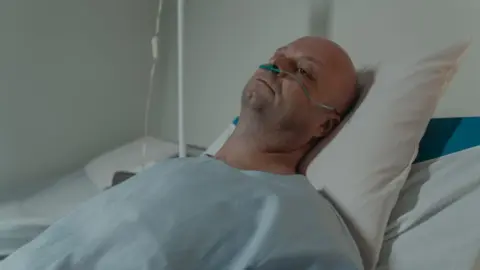
“Grandma, let the professionals work. Go sit in the waiting room and look at a magazine.”
The young doctor said it loud enough for the whole emergency department to hear. He said it with one hand on my shoulder, steering me backward out of the treatment bay where my husband was lying on a gurney with the left side of his face sliding down like warm candle wax.
I’m eighty years old. I have white hair and arthritis in both knees and I was wearing my good camel coat over a sweater with a turkey on it, because it was Thanksgiving night and my granddaughter had given me that sweater and I’d promised to wear it. I suppose I looked like what he thought I was. A confused old woman who’d driven her confused old husband to the hospital because he had a bellyache from too much pie.
“Doctor,” I said. “He’s having a stroke.”
“Ma’am, I’ll be the judge of that.”
“His left arm is drifting. His speech is slurred. His face is drooping on the left side. It started at six-forty-two. I looked at the clock on the stove.”
The doctor smiled at me. It wasn’t a nice smile. It was the smile you give a child who has just told you very seriously that there’s a monster in the closet.
“Did you go to medical school?” he asked me.
“No.”
“Then let me do my job.” He turned to the young nurse beside him, a girl with a ponytail who couldn’t have been older than twenty-four. “Get her out of the bay, please. And get him an EKG and some Maalox. It’s Thanksgiving. Every old man in Brown County ate too much turkey tonight and thinks he’s dying.” He looked back at me. “He’ll be fine, Grandma. It’s indigestion. We’ll get to him.”
He walked away. His name tag said DR. T. BRIGGS, M.D. — RESIDENT. He couldn’t have been more than twenty-nine.
The young nurse put her hand on my arm, gently. “Ma’am,” she said. “I’m sorry. You’ll have to wait outside.”
I looked past her at my husband. Arne was lying on that gurney looking at me. His eyes were scared. He was trying to say something. It came out as a mush of sounds. His right hand was reaching for me. His left hand was lying on the blanket like it belonged to somebody else.
I looked up at the clock on the wall over the nurses’ station. It was seven-thirty-one.
Forty-nine minutes since it started.
I should tell you who I am, before I tell you what I did.
My name is Helen Sorensen. I was born in 1946 on a dairy farm outside Aberdeen, South Dakota. I went to nursing school at Presentation College because it was the only place a farm girl could get an education for free if she promised to work for the Sisters for two years afterward. I graduated in 1967. In 1968, I joined the Army Nurse Corps, because my little brother Leif had been drafted and sent to Vietnam, and I thought if I went too, I might somehow be able to keep him safe.
I couldn’t keep him safe. He was killed near Hue in February of 1968, before I ever got there. I went anyway.
I served thirteen months at the 24th Evacuation Hospital at Long Binh. I learned more about emergency medicine in those thirteen months than in all the years before or since. I learned to triage forty boys coming in off the helicopters at once. I learned to tell in ten seconds who was going to live and who wasn’t. I learned to stay calm when everybody around me was screaming. I learned that the most important thing in an emergency is time, and that the person who knows the patient best is usually the one you should listen to first.
I came home in 1969 and married Arne Sorensen, who I’d known since the fourth grade, and who had waited for me. We moved to Aberdeen. I got a job as a nurse at the hospital there, St. Luke’s, in what they called the emergency room back then, which was two beds and a supply closet.
I worked in that emergency room for thirty-nine years.
I became charge nurse in 1977. Director of emergency nursing in 1985. In 1991, when the hospital decided to build a real emergency department, a modern one, they put me on the planning committee. I spent four years on it. I went to Minneapolis and Omaha and Denver to look at how other hospitals did it. I wrote half the protocols. I helped raise the money, going door to door to farmers and businessmen across six counties.
And in 1994, after I’d seen too many people in our part of South Dakota die or end up in nursing homes because nobody recognized a stroke fast enough, I wrote the first stroke alert protocol in the state. It was eleven pages long. It said that any nurse, any family member, anybody at all who saw the signs of a stroke could trigger an alert, and the whole team would come running, and the clock would start. Every minute counted. That’s what I wrote at the top of the first page. Every minute counts.
I retired in 2008. I was sixty-two. There was a big party in the hospital cafeteria with a sheet cake and a slideshow. And at the end of the party, the hospital president stood up and told everybody that the board had voted unanimously to name the new emergency department after me. They’d already had the letters made.
The letters are brass. Eight inches tall. They’re mounted on the wall directly above the nurses’ station in the emergency department of St. Luke’s Regional Medical Center, Aberdeen, South Dakota.
THE HELEN SORENSEN EMERGENCY DEPARTMENT.
That young doctor walked under them every night.
But I’m getting ahead of myself.
Thanksgiving had been at our house. It’s always at our house. Our daughter Kristin came from Sioux Falls with her husband and their two girls, and our son Erik came from Bismarck with his wife and their boy. Eleven of us around the table, with the leaf in. Arne carved the turkey like he has every year since 1970, with his father’s bone-handled carving knife.
He was fine at dinner. He was more than fine. He told the story about the time the cows got out on the highway in 1974 and he had to herd them back with the pickup, and he told it so well that our granddaughter Annika laughed until milk came out of her nose. He had two helpings of my sweet potatoes and a slice of pumpkin pie and a slice of apple.
At six-thirty, everybody was in the living room watching the football game. I was in the kitchen doing dishes. Arne came in to get a cup of coffee.
He was standing at the coffeepot with his back to me. He said, “Helen, where’d you put the—”
And he stopped.
I turned around. He was holding the coffee cup in his right hand, and his left hand was hanging at his side, and the cup was tipping, and coffee was running down the front of the cabinet.
“Arne?”
He turned to look at me. The left side of his face was wrong. His mouth was pulled down on that side, like someone had hung a weight on it.
“Hel—” he said. “Helen, I— the—”
The words came out tangled. Like a radio between stations.
I looked at the clock on the stove. Six-forty-two.
I’ve seen a thousand strokes. I wrote the protocol. And for about three seconds, standing in my own kitchen with coffee running down my cabinet, I couldn’t move.
Then thirty-nine years of training took over.
“Arne, smile at me,” I said. He tried. Half his face smiled. “Raise both arms.” He tried. The left one rose about four inches and drifted back down. “Say ‘You can’t teach an old dog new tricks.'” He tried. It came out wrong. Mushy, slurred.
“Kristin!” I called into the living room. My voice was calm. That’s the thing they teach you. Your voice stays calm no matter what. “Kristin, get your father’s coat. And mine. We’re going to the hospital. Now.”
Kristin came running. Erik came running behind her. Everybody came running. The grandkids were crying. Annika was in the doorway in her socks, her face white.
“Mom, should we call an ambulance?” Erik said.
I looked out the kitchen window. It had been snowing since four o’clock. Big, heavy flakes. The kind that stick. The ambulance service in Aberdeen is good, but on Thanksgiving night in a snowstorm, I knew it would be twenty minutes just to get to us, and another fifteen back. The hospital is eight minutes from our house if you drive it the way I used to drive it at the end of a double shift.
“No,” I said. “I’ll drive him. Erik, you call the ER and tell them we’re coming. Tell them it’s a stroke alert. Tell them onset six-forty-two. Tell them Helen Sorensen said so.”
Erik called. I don’t know who he talked to, or what they told him. I found out later that the clerk who answered had started that week and didn’t know who Helen Sorensen was, and wrote “possible chest pain, elderly male, wife driving” on a sticky note and stuck it on the computer screen and went back to her sandwich.
Kristin and Erik got Arne into the front seat of my Buick. I drove. I don’t drive fast anymore. I drove fast that night. I drove through two red lights on Sixth Avenue with my hazard lights on and my hand on the horn, and I didn’t care who saw me.
We pulled up under the ambulance canopy at seven-oh-four. Twenty-two minutes. I got Arne into a wheelchair myself. Kristin was right behind me in her car.
And then we waited.
We waited at the triage desk while a girl in a cardigan asked me for Arne’s insurance card. I told her he was having a stroke. She said everyone needed to be triaged. I said I knew that, I wrote the triage protocol. She looked at me like I was confused and asked me to have a seat.
It was Thanksgiving night. The waiting room was full. A man with a cut hand from carving the turkey. A teenage boy who’d broken his wrist playing football in the snow. A little girl with a fever. A drunk man asleep in the corner. Two of the triage nurses were out sick, I found out later. Everybody was doing three jobs.
I sat in a plastic chair with Arne in the wheelchair next to me, holding his good hand. Kristin stood behind us with her hands on his shoulders. I watched the clock over the triage desk. Seven-oh-nine. Seven-twelve.
Across from us, a young mother was rocking the little girl with the fever. The girl was maybe three, flushed and limp, with her eyes half closed. The mother kept touching her forehead and looking at the triage desk and then back at her daughter. She was crying without making any sound.
I watched that little girl for a minute. Her breathing was fast but even. Her lips were pink. She turned her head when a door banged.
“Honey,” I said to the mother. “When did you last give her Tylenol?”
The mother looked at me, startled. “Four o’clock. At my mother-in-law’s.”
“Is she drinking?”
“A little. Apple juice.”
“Wet diapers?”
“One. At dinner.”
“She’s going to be all right,” I said. “She’s sick, but she’s going to be all right. She’s watching the door when it bangs. That’s a good sign. Keep giving her little sips of juice. They’ll get to her.”
The young mother stared at me. “Are you a nurse?”
“I used to be,” I said.
She started to cry harder, but it was the good kind. She said thank you about six times. Beside me, Arne made a sound. I looked at him. The right side of his mouth was smiling. He squeezed my hand. He couldn’t say it, but I knew what he meant. He’d been watching me do that for fifty-five years.
The clock said seven-sixteen.
At seven-nineteen, they took Arne back to a treatment bay. Bay four. At seven-twenty-six, Dr. Briggs came in.
He was tall and good-looking and very tired, and he’d been working since noon on a holiday, and I want to be fair to him. I’ve worked plenty of holidays myself. I know what it does to you.
He looked at Arne for about forty-five seconds. He listened to his heart. He asked him to squeeze his hands, and Arne squeezed with his right hand, and with his left he barely moved his fingers.
“How old is he?” Dr. Briggs asked the nurse with the ponytail.
“Eighty-two.”
“What’d he eat today?”
“Doctor,” I said. “He’s having a stroke. Onset was six-forty-two. You’re inside the window for tPA, but not for long. He needs a CT scan right now and a stroke alert called.”
That’s when he turned around and looked at me. Up and down. My white hair. My turkey sweater. My camel coat with the snow melting on the shoulders.
“And you are?”
“His wife.”
“Okay. And you’re a doctor?”
“I’m a nurse. Retired.”
“Retired.” He smiled that smile. “From where? Did you used to give out flu shots at the Walmart?” The nurse with the ponytail looked at the floor. “Ma’am, I appreciate you watching Grey’s Anatomy, but this is a real hospital. He’s eighty-two, he ate an enormous meal, and he’s tired. Half of what you’re describing is just old age. We’ll get some labs, we’ll get an EKG, and I’ll put him on the list for a CT. It’s Thanksgiving. The list is long.”
“How long?”
“Couple hours, maybe.”
“In a couple of hours,” I said, “he’ll be out of the window, and the part of his brain that’s dying right now will be dead. He’ll never use that arm again. He may never talk again.”
That’s when Dr. Briggs put his hand on my shoulder and started steering me backward.
“Grandma,” he said, loud, so that the whole hallway could hear. “Let the professionals work. Go sit in the waiting room and look at a magazine.”
Behind him, at the nurses’ station, a phone was ringing and nobody was answering it. A monitor was beeping. People in the hallway had stopped and were looking at us. A respiratory therapist with a cart. A man in a security uniform. The girl in the cardigan from triage had come back to see what the fuss was.
The young nurse with the ponytail said, “Ma’am, I’m sorry. You’ll have to wait outside.”
I looked at Arne. I looked at the clock. Seven-thirty-one.
I looked at Dr. Briggs.
Then I looked over his shoulder at the wall above the nurses’ station. The wall he had his back to. The wall he’d walked under every shift for however long he’d been there, without ever looking up.
You can’t see those brass letters very well from inside the treatment bays. You can only see them from the hallway. From where I was standing.
There was something else in my coat pocket. I’d put it there without thinking, out of habit, the way I’d done every working day for thirty-nine years. My old badge. The hospital doesn’t use those kind anymore; now it’s all cards that you swipe. But when I retired, they let me keep mine. It’s laminated, with a picture of me at fifty-five, and a magnetic strip on the back, and it says HELEN SORENSEN, RN — DIRECTOR, EMERGENCY SERVICES in blue letters. It doesn’t open anything anymore. I just keep it in my coat. Arne says I’m sentimental. He’s right.
I didn’t take it out. Not yet.
Instead, I stood up very straight, the way the Army taught me, and I took Dr. Briggs’s hand off my shoulder, and I gave it back to him.
“Doctor,” I said. “I’ll go sit down in just a moment. But first, I want you to do one thing for me.”
He sighed. “What?”
“Turn around,” I said, “and read me the name on that wall.”
He looked at me like I’d lost my mind. He started to say something.
And that’s when Gloria came around the corner.
Gloria Weisz has been a nurse at St. Luke’s for thirty-four years. She’s the night charge nurse in the emergency department now. I hired her in 1991, when she was twenty-eight and fresh out of the nursing program in Brookings and so nervous she threw up in the supply closet on her first night. I held her hair. I trained her. I wrote her recommendation for charge nurse in 2009, a year after I retired. I hadn’t seen her in maybe four years. She was holding a stack of charts and a cup of coffee, coming around the corner from the break room, looking down at her charts.
She looked up and saw the crowd in the hallway. She saw Dr. Briggs. She saw the nurse with the ponytail.
Then she saw me.
The charts slid out of her arms and hit the floor. Papers went everywhere. The coffee went everywhere. Gloria just stood there in a puddle of coffee with her mouth open and her hands at her sides.
“Mrs. Sorensen?” she said.
Dr. Briggs turned and looked at her. “Gloria? You know this woman?”
Gloria didn’t answer him. She was looking past me, into bay four. At Arne. At his face.
And then Gloria Weisz, who I once held over a toilet in a supply closet, looked straight at that young doctor, and I watched something come into her face that I’d last seen in a mirror at Long Binh in 1968.
“How long ago did it start?” she said to me. Not to him. To me.
“Six-forty-two,” I said.
She looked up at the clock on the wall. She didn’t even have to do the math.
She walked straight past Dr. Briggs like he was a coat rack, picked up the phone at the nurses’ station, and dialed four numbers.
“This is Weisz, charge nurse, ED,” she said into it. Her voice was perfectly calm. “Stroke alert. Bay four. Onset eighteen-forty-two. Eighty-two-year-old male. Left-sided weakness, facial droop, aphasia. I need CT now. I need neuro now. I need pharmacy to start mixing alteplase. Now.”
She hung up.
Overhead, the speakers crackled. A woman’s calm, recorded voice came over the whole hospital. “Stroke alert. Emergency department. Stroke alert. Emergency department.”
I’d recorded that message. In 1994. They’d kept my voice.
Dr. Briggs stood there in the hallway. He turned slowly toward the nurses’ station. Toward Gloria, and the phone, and the wall above them.
And for the first time, he looked up.
THE HELEN SORENSEN EMERGENCY DEPARTMENT.
Eight-inch brass letters.
He looked at those letters for a long time. Then he looked at me. I watched the color drain out of his face, from the top down, like water out of a sink.
I didn’t say anything. I took my old badge out of my coat pocket and held it up so he could see it. Then I put it back.
Then the doors at the end of the hall banged open and the stroke team came running.
They got Arne to CT at seven-forty. The scan showed a clot in a big artery on the right side of his brain, just like I knew it would. They had the clot-busting drug in his arm by eight-oh-six. One hour and twenty-four minutes after the clock on my stove said six-forty-two. Inside the window. Not by much. But inside.
The neurologist on call that night was a woman named Dr. Patel, who’d come to St. Luke’s from Chicago six years ago. She’d never met me. But she’d read my protocol. She told me later it was still the best one she’d ever seen at a rural hospital, and that she’d taken it with her to two conferences.
By ten o’clock, Arne could lift his left arm off the bed. By midnight, he could squeeze my hand with it. Not hard. But he could squeeze. And at two in the morning, when I was dozing in the chair beside his bed in the neuro unit, I woke up to him saying my name.
“Helen,” he said. Clear as a bell.
I opened my eyes.
“You drove,” he said. His speech was still a little thick. But it was words. Real words. “You ran the red light on Sixth Avenue.”
“Two of them,” I said.
“I saw.” The right side of his mouth smiled. The left side tried. “You haven’t driven like that since 1974.”
“The cows,” I said.
“The cows,” he said, and closed his eyes, and went back to sleep.
I sat there holding his hand until the sun came up.
Dr. Briggs came to see me at seven in the morning, at the end of his shift. He’d changed out of his scrubs. He was wearing jeans and a Minnesota Twins sweatshirt and he looked about nineteen. He stood in the doorway of Arne’s room and didn’t come in.
“Mrs. Sorensen,” he said. “Can I talk to you?”
I went out into the hall. We stood by the window at the end of the corridor. It had stopped snowing. The whole town was white and quiet under a pink sky.
“I’m sorry,” he said. “I don’t know what else to say. I’m sorry.”
“I know you are.”
“I said—” He stopped. “I said things to you that I’d never say to—” He stopped again. “I said things I’d never want anybody to say to my grandmother.”
“No,” I said. “You wouldn’t.”
“Gloria told me. Everything. Vietnam. The protocol. The building.” He ran his hand through his hair. “She told me she’d write me up. She said she’d go to the residency director, and to the CMO, and if they didn’t do anything she’d go to the board. She said she’d quit before she let me work another shift in your department.” He swallowed. “She means it.”
“Gloria always means it,” I said. “That’s why I hired her.”
He looked out the window. His eyes were wet.
“Your husband,” he said. “If you hadn’t been there. If you’d been any other wife. I’d have sent him to the waiting room with Maalox, and in two hours—” He didn’t finish.
“I know,” I said.
“I keep thinking about all the other ones. The ones whose wives weren’t you.”
“Good,” I said. “Keep thinking about them.”
He looked at me.
“Can I tell you something, Dr. Briggs?” I said. “Something I learned at an evac hospital outside Saigon when I was twenty-two years old?”
He nodded.
“The person who knows the patient best is usually the one you should listen to first,” I said. “Not because they’re right. Sometimes they’re wrong. But because they’re the only one in the room who knew what that man looked like yesterday. You didn’t. You met him forty-five seconds before. I’ve been looking at his face since the fourth grade.”
He was crying now. Quietly. Standing by the window in his Twins sweatshirt.
“Am I going to lose my residency?” he asked.
I thought about that for a long time. I thought about Gloria, and the hospital president, and the board. I thought about what Arne would say, which was that the boy was tired and it was a holiday and everybody makes mistakes. Arne’s always been softer than me.
And I thought about all the doctors I’d worked with over thirty-nine years. The good ones and the bad ones. The bad ones were never the young ones who made mistakes. They were the old ones who never once admitted they had.
“I’ll talk to Gloria,” I said. “And the CMO. I’ll tell them I don’t want you fired.”
He looked at me like he couldn’t believe it.
“But I’m going to ask for something,” I said.
“Anything.”
“I want you to spend two weeks working triage. Not as a doctor. Shadowing the triage nurses. Twelve-hour shifts. Nights. Holidays if they come up. I want you to sit at that front desk and listen to every single wife and husband and daughter and son who walks in that door and tells you what’s wrong with the person they love. And I want you to write down what they say before you look at the chart.”
He nodded. He couldn’t talk.
“And one more thing,” I said. “Every shift, when you walk in, I want you to look up.”
The meeting was the second week of December, in the conference room on the fourth floor that used to be the old pediatric ward. The hospital’s chief medical officer was there, Dr. Halvorsen, who I’d known since he was a medical student rotating through my department in 1989 and couldn’t start an IV to save his life. The residency director was there, on a video screen from Sioux Falls. Gloria was there in her scrubs, straight off a night shift, with her arms crossed.
And I was there, in my camel coat. Not the turkey sweater.
Dr. Halvorsen read the incident report out loud. Gloria had written it. It was four pages long and every word of it was true. When he got to the part about “Grandma, let the professionals work,” he stopped reading and took his glasses off and rubbed his eyes.
“Helen,” he said. “I’m so sorry. On behalf of the whole hospital. In your own department.”
“It’s not my department anymore, Paul,” I said. “It’s Gloria’s.”
Gloria uncrossed her arms.
“I want him gone,” she said. “I’m sorry, Mrs. Sorensen. I know what you’re going to say. But I’ve been doing this thirty-four years, and I’ve seen what happens when a doctor like that doesn’t get stopped early. He gets older and he gets louder and somebody dies.”
“I know,” I said. “You’re right.”
“Then why—”
“Because he came to see me at seven in the morning,” I said. “In a Twins sweatshirt. And he cried. And he asked about the other ones. The ones whose wives weren’t me.” I looked at Gloria. “The ones who get louder never ask about the other ones.”
Gloria looked at me for a long time. Then she sighed, and uncrossed her arms all the way.
“Two weeks of triage,” she said. “Nights. And I pick the holidays.”
“That’s all I’m asking,” I said.
He did the two weeks. Gloria told me about it. She said he was terrible at it the first three nights, impatient and fidgety, and by the end of the second week, the triage nurses were bringing him cookies. She said that on his last night, a woman came in with her husband and said, “He’s not right, he’s just not right, I can’t tell you what it is,” and Dr. Briggs sat down next to her and said, “Tell me what he looked like this morning,” and listened to her for ten minutes, and then ordered a CT that found a bleed nobody else would have caught.
Gloria said he looked up at the letters every single shift. She said sometimes he saluted them, when he thought nobody was looking.
The young mother with the feverish little girl found me, too. She came up to the neuro unit two days after Thanksgiving with a plate of pumpkin bars wrapped in foil. Her daughter had an ear infection and a bad virus, and was fine, and was home eating popsicles. The mother had asked the triage nurse who I was. The triage nurse had pointed at the wall.
“I sat under your name for two hours,” she said, “and I didn’t even see it.”
“Nobody does,” I said. “That’s all right. It’s not there to be seen.”
Arne came home from the hospital eleven days after Thanksgiving. He walks with a cane now, and his left hand is weak, and sometimes the words come out slow when he’s tired. But he talks. He laughs. He carved the turkey this year at Thanksgiving, with his father’s bone-handled knife, using his right hand and with Erik holding the platter steady. It took him a long time. Nobody minded.
Annika, our granddaughter, wrote a paper about me for her sophomore English class. She called it “The Woman on the Wall.” She got an A. She’d never known about Vietnam. Most of the family hadn’t. I don’t talk about it much. Leif’s picture is on my dresser, in his uniform, nineteen years old. Annika asked me about it for the paper, and I told her more than I’ve told anybody in fifty years.
In March, I got a letter in the mail from the University of South Dakota medical school, where Dr. Briggs finished his residency. It was an invitation. Every year, the graduating class picks one person to speak to them at their white coat ceremony, about what it means to take care of people. That year, the class had voted for me. The letter said one of the residents had nominated me. It didn’t say which one.
I didn’t need it to.
I spoke for eleven minutes. Same as the protocol: eleven pages, eleven minutes. I told them about Long Binh and the helicopters and Leif. I told them about the stroke clock. I told them to listen to the wives. I told them to look up.
Dr. Briggs was sitting in the third row. He’s at a hospital in Rapid City now. When I finished, he was the first one standing up.
Arne was sitting in the front row, in his good suit, with his cane between his knees. When I came down off the stage, he took my hand with his left hand. His weak one. He held on as tight as he could.
“Helen,” he said. “You still drive too fast.”
“I know it,” I said.
He didn’t let go.