“Watching the game Ma. Call you tomorrow.”
That’s the text my son sent me at 9:03 on Thanksgiving night. It came after I’d called him three times. He’d declined all three. I know he declined them, because each one rang exactly once and went to his voicemail, and I’ve had a cell phone long enough to know what that means.
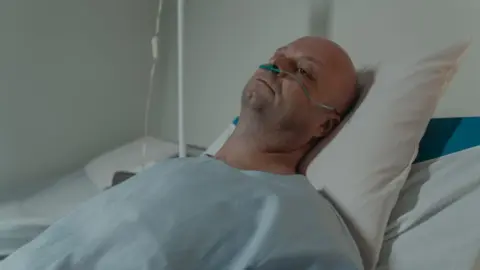
I read that text lying flat on my back on the sheet of ice at the bottom of my own back steps, with my left hip broken and the freezing rain coming down on my face.
I’m going to tell you the whole thing. Some of it I’m not proud of. Some of it I’m very proud of. But none of it is about me, really. It’s about a fifteen-year-old boy named Jaylen and a dog named Pepper and a blue folder on my kitchen table.
My name is Beverly Hollis. Most people call me Bev. I’m eighty-one years old. I live in Zanesville, Ohio, on Linden Avenue, in a little yellow brick house that my husband Dale and I bought in 1971 for nineteen thousand dollars. Two bedrooms, one bath, a basement that floods in April, a kitchen with the same green linoleum we put down in 1983. Dale died in 2019. Prostate cancer. He was a mail carrier for thirty-four years, and he planted every tree on this lot, and he built the back steps himself out of concrete the summer of 1975, six steps down from the kitchen door to the yard, with no railing, because Dale didn’t believe in railings. He said a railing was a crutch.
I’ve climbed up and down those steps maybe fifty thousand times.
We have one son. Craig. He’s fifty-five now. He’s the sales manager at a Chevrolet dealership out on Maple Avenue, and he’s good at it. He can sell anybody anything. He married Melanie in 1996, and they have two kids, Brooke and Tanner. Brooke is twenty-four and works for an insurance company in Columbus. Tanner is twenty-one and goes to Ohio University down in Athens, mostly, when he goes.
Craig and Melanie live in a big new house in a subdivision called Cedar Run, about fifteen minutes from me. Five bedrooms. Three-car garage. A pond with a fountain in it in the front of the subdivision. Dale and I loaned them thirty thousand dollars for the down payment on that house in 2008, when the market went bad and the bank wanted more money down than they had. We took it out of our savings at Muskingum Valley Savings. Dale wrote out a little paper about it, a promissory note, and Craig signed it. He paid us back about four thousand of it over the next couple of years. Then he stopped. Dale never brought it up. Dale said family’s family.
I’m telling you that so you understand. Not so you feel sorry for me.
This past spring, Craig started bringing up the house.
Not his house. Mine.
“Mom, this place is too much for you,” he’d say. “The yard. The basement. Those steps. You’re going to fall and break your neck one of these days.”
“I’m fine, honey.”
“You’re eighty-one.”
“I know how old I am.”
In April, he brought a friend of his over, a realtor named Jim Pruett who sells houses out of an office by the Colony Square mall, to “just take a look.” Jim walked through my house with a tape measure and a clipboard and took pictures of my kitchen with his phone, and on his way out he said, “Bev, you’d be looking at about two-fourteen, two-twenty, as is.”
Two hundred and fourteen thousand dollars. For a house we paid nineteen thousand for. I didn’t know what to say.
Then in June, Craig brought me a glossy brochure for a place called Ashford Place. It’s a senior apartment building out by the bypass. It has a dining room and a little chapel and a bus that takes you to Kroger on Tuesdays. A one-bedroom apartment is thirty-nine hundred dollars a month.
“Mom, you’d love it,” Craig said. “You’d have friends. You wouldn’t have to cook.”
“I like to cook.”
“You’d have people looking in on you.”
“I have people looking in on me,” I said. “I have you.”
He looked at me then. And he said, “Mom, I can’t be running over here every five minutes.”
I didn’t say anything. He hadn’t been running over every five minutes. He’d been coming over about once a month, usually when he wanted something.
But here’s what I did. I want to tell you this part honestly, because it matters later.
I thought about it. All summer. I thought about how Dale and I always said the house would go to Craig. It’s the only thing we really have. Dale’s pension stopped when he died, except for the little survivor’s part. I have my Social Security and about sixty-one thousand in savings and that house. That’s it. That’s everything we ever built. I figured Craig was going to get it anyway, when I’m gone. And I thought, what if I made it easy for him? What if I made it so he never had to go through probate court, or lawyers, or any of that?
So in October, I went downtown to see Phil Abernathy.
Phil has been our lawyer since 1988. He did our wills. He’s got an office on Main Street, across from the old Weller Theater, up a narrow flight of stairs with a brass rail, and he’s seventy-four now himself and still goes in every day in a bow tie. I told him what I wanted.
He said, “Bev, what you’re talking about is a transfer-on-death designation affidavit. It’s a form. You sign it, you get it notarized, and then you record it with the county recorder. When you pass, the house goes straight to whoever you named. No probate. And you keep the house while you’re living. You can change your mind any time until then.”
“That’s what I want,” I said.
“Who’s the beneficiary?”
“Craig.”
Phil looked at me over his glasses for a long moment. He’s known Craig since Craig was in high school. He knew about the thirty thousand. Dale had told him.
“All right, Bev,” he said. “I’ll draw it up.”
I signed it in his office on October 21st. His secretary notarized it. Phil put it in a blue folder for me, along with a copy of the deed, and a little cover letter explaining everything, and he said, “Now you just take that over to the recorder’s office at the courthouse, and pay the fee, and it’s done.”
I didn’t take it to the recorder’s office.
I took it home. I put it on my kitchen table. And I decided I was going to give it to Craig at Christmas, in a card, the way his father would have wanted. I bought the card at the Hallmark store. A nice one, with a picture of a little house in the snow with a light on in the window. I wrote in it, in my best handwriting:
Craig — Your father and I always meant for you to have it. Now you’ll never have to worry. Merry Christmas. Love, Mom.
I put the card in the blue folder with the papers. I wrote CRAIG on the front of the folder in black marker. And I left it on the corner of my kitchen table, under the napkin holder shaped like a rooster, where I’d see it every day and smile.
It was still sitting there on Thanksgiving.
I hosted Thanksgiving this year. I’ve hosted every Thanksgiving since 1974. I had a twenty-two-pound turkey from the Kroger on Maple, and I made my mother’s sage dressing, and mashed potatoes with real butter, and green bean casserole, and sweet potatoes with the little marshmallows because Tanner likes them, and two pumpkin pies and one pecan. I started cooking at five in the morning. I’m eighty-one and it takes me longer than it used to.
Craig and Melanie got there at two-thirty. Brooke drove over from Columbus. Tanner came with his parents and spent the whole day on his phone.
It wasn’t a bad day. I want to be fair. It was a normal day. Craig carved the turkey and said it was a little dry. Melanie said my gravy had lumps in it, which it did, a little. Brooke helped me with the dishes. She’s always been the one who helps with the dishes.
About six o’clock, while we were having pie, Craig brought up Ashford Place again.
“Mom, I talked to the lady over there last week. They have a unit opening up in January. A corner one. With a view of the garden.”
“Craig, not today.”
“Mom, every time I bring it up, you say not today.”
“Because it’s Thanksgiving.”
“Mom. Look at those back steps.” He pointed at the kitchen door. “No railing. Concrete. Ice on them half the winter. You’re going to fall.”
“Your father built those steps.”
“Dad’s been gone six years!”
Melanie put her hand on his arm. “Craig.”
“No, Mel. Somebody has to say it.” He turned to me. “If you’d sell this place, we wouldn’t have to drive over here every holiday and worry about you.”
Brooke said, “Dad. That’s not fair.”
“Stay out of it, Brooke.”
I didn’t say anything. I looked over at the blue folder on the corner of the table, under the rooster napkin holder, with his name on it. He’d been sitting three feet from it all afternoon. He never looked at it once.
At 7:30, Craig looked at his watch and stood up.
“We gotta go, Mom. The night game starts at 8:20.”
Craig is in a fantasy football league with some guys from the dealership. They each put in a hundred dollars at the beginning of the season, and whoever wins gets six hundred. He’d told me about it at dinner. He said he had two of his players in the night game, and if they did well, he’d be in first place.
“You can watch it here,” I said. “I’ve got a TV.”
“Mom, your TV is from 2006.”
So they left. Melanie took a plate of leftovers. Tanner took the pecan pie. Brooke hugged me at the door and whispered, “I’m sorry, Grandma,” and I said, “For what, honey?” and she just squeezed my hand.
Brooke drove back to Columbus at eight. She had to work on Friday. She was the last one to leave.
Then it was just me, and the dishes, and the leftovers, and a big black trash bag full of turkey bones and potato peels and paper plates. The garbage cans are out back by the alley. Dale always took the trash out. Since he died, I take it out. Every night after supper. Down the six back steps.
It had started to rain about seven. A light, cold rain. I’d heard it on the kitchen window while we were having pie. The weatherman on Channel 10 had said it might turn to freezing rain overnight. I didn’t think about it.
At about 8:40, I put on my cardigan, the blue one with the pockets, and I put my cell phone in the pocket the way Brooke always tells me to, and I picked up the trash bag, and I opened the back door.
I didn’t turn on the porch light. I don’t know why. I’d done it a thousand times in the dark.
I stepped down onto the first step, and it wasn’t concrete under my foot anymore. It was glass.
I don’t remember falling. I remember the trash bag going up in the air. I remember the sound my hip made when it hit the bottom step, which was like a branch snapping off a tree in a storm. And then I was lying on my back on the concrete at the bottom of the steps, with turkey bones all around me, and the rain coming down on my face, and a pain in my left hip so big I couldn’t breathe around it.
I lay there for a while. I don’t know how long. A minute. Five. I tried to sit up. I couldn’t. I tried to roll over. I screamed. I’d never screamed like that in my life, not even having Craig.
The back of my house faces the alley. On one side is a chain-link fence, and on the other side of it is the Brooks family’s yard. On the other side is a garage. Behind the alley is a parking lot for a Methodist church that’s empty at night. Nobody heard me scream.
I got my phone out of my cardigan pocket. My hands were shaking so hard I nearly dropped it on the ice.
I want to tell you why I didn’t call 911. I’ve been asked that by a lot of people since. The doctor asked me. The social worker at the hospital asked me. Phil Abernathy asked me.
I didn’t call 911 because I didn’t think it was that bad. I thought I’d sprained something. I thought, if Craig comes over, he can help me up, and help me inside, and I’ll put some ice on it, and I’ll be fine in the morning. And an ambulance costs money. My neighbor Lois had to call one last winter and the bill was eighteen hundred dollars. I didn’t want to be a bother. I didn’t want the whole street to see the ambulance lights.
I wanted my son.
I called Craig at 8:44. It rang once and went to his voicemail. “Hi, you’ve reached Craig Hollis at Maple Avenue Chevrolet—”
I hung up. I called again at 8:51. It rang once. Voicemail.
I lay there. The rain was coming down harder now, and it was freezing on my coat. I could feel it in my hair. I was so cold. I called a third time at 9:02. It rang once. Voicemail.
At 9:03, the text came.
Watching the game Ma. Call you tomorrow.
I looked at those words on the little bright screen in the dark.
Six words. My son.
My phone said 7% in the corner. I’d forgotten to charge it. With all the cooking. It was so cold out there that the number was going down while I watched it. Six percent. Five.
I pushed the 9 and the first 1. And the screen went black.
I pushed the button on the side. I pushed it again. Nothing. It was dead.
I lay there in the dark at the bottom of Dale’s steps with the dead phone on my chest.
I’m not going to tell you everything I thought about for the next hour. Some of it I don’t remember. I know I prayed. I know I talked to Dale out loud. I told him he should have put in a railing. I know I tried to crawl, once, toward the gate in the fence, and I got about two feet and the pain made everything go white and sparkly and I think I passed out for a little while.
When I came to, the rain had stopped and it was very quiet. Every branch on Dale’s maple tree was coated in ice, and when the wind blew, they clicked together like glass beads.
And then I heard a dog barking.
It was Pepper. Pepper is the Brookses’ dog, next door. She’s a little black-and-white mutt with one ear that stands up and one that flops over. The Brooks family moved in next door two years ago. Marcus and Angela and their two boys, Jaylen and DeShawn. Marcus is a union electrician. Angela carries mail, the same route Dale used to have, which we figured out the first week and laughed about. Jaylen mows my lawn in the summer for twenty dollars and shovels my walk in the winter for ten. He’s fifteen. A tall, skinny, quiet boy who plays trumpet in the marching band at Zanesville High and always says “Yes, ma’am.”
Pepper was barking at the fence. Barking and barking, the high, frantic way dogs bark when something’s wrong. I heard a back door open next door. I heard a boy’s voice.
“Pepper. Pepper, hush. What is it? It’s a cat. Come on.”
Pepper kept barking.
I tried to call out. My voice didn’t work right. It came out like a croak.
“Jaylen.”
The barking stopped. Then I heard him again, closer, at the fence.
“Hello?”
“Jaylen. Honey. It’s Mrs. Hollis.”
I heard the chain-link rattle. I heard him come over the top of it. He didn’t go around to the gate. He just came right over the fence in the dark, and he slipped on the ice when he landed, and he caught himself, and then he was there, kneeling over me with his phone flashlight in my face.
“Ms. Hollis? Ms. Hollis! Oh my God.”
“My hip,” I said. “I think I broke my hip.”
“Don’t move. Don’t move, okay?” He was already dialing. I heard him talking to the 911 operator, in a voice that was shaking but very clear. “My neighbor fell. She’s eighty-one. She’s on her back by her steps. She says she broke her hip. She’s really cold. 1428 Linden Avenue. In the back. Yes ma’am. Yes ma’am. I’ll stay with her.”
Then he took off his coat. It was a big puffy black coat with ZANESVILLE BLUE DEVILS MARCHING BAND on the back. He laid it over me. He was in a T-shirt underneath, in the freezing cold, with ice on everything.
“Jaylen, you’ll freeze.”
“I’m okay, Ms. Hollis.”
He yelled toward his house, “MOM! MOM! COME HERE!” Then he looked down at me and he touched my hand, and I saw his face change.
“Your hands are like ice,” he said. “Ms. Hollis, how long have you been out here?”
“Since about twenty to nine.”
He looked at his phone. It was 10:07.
“That’s— that’s an hour and a half,” he said. His voice cracked. He was only fifteen. “Didn’t you call anybody? Why didn’t anybody come?”
And that’s when I broke.
I’d been holding it together out there for an hour and a half. On the ice. In the dark. Talking to Dale. But when that boy knelt there in his T-shirt and asked me why nobody came, I started to cry, and I couldn’t stop.
“I called my son,” I said. “Three times. He was watching the football game.”
Jaylen didn’t say anything for a second. He just looked at me with his phone light shining up on his face.
Then he said, “Okay,” very quietly. And he took my hand in both of his and held it to warm it up, and he didn’t let go until the ambulance came.
Angela came running out in her bathrobe and slippers. She took one look at me and ran back inside and came out with an armload of blankets. Marcus came after her. They put the blankets on me and around me, and Angela got down on the ice and put my head on her lap. She kept saying, “We got you, Miss Bev. We got you.”
“Jaylen,” Angela said. “Go in her house and get her purse and her pills. They’ll want to know what she takes.”
“There’s a list,” I said. “On the refrigerator. Under the magnet from Myrtle Beach.”
Jaylen ran up the back steps. He slipped twice. He went in my kitchen. I heard him in there, opening things. He was in there maybe two minutes.
When he came back out, he had my purse, and the list off the refrigerator, and my pill organizer, and the afghan from the back of my couch. And he had a funny look on his face. He didn’t say anything. He just put the afghan over me on top of everything else.
I didn’t know then what he’d seen on my kitchen table. I found out later.
The ambulance came at 10:19. Two paramedics, a man and a woman. They were very gentle with me. They said it was probably a hip fracture, and they put me on a board, and it hurt worse than anything has ever hurt me in my life, worse than childbirth, worse than the gallbladder. They carried me up the side yard to the street because they couldn’t get the stretcher down the icy steps. The whole street was out on their porches by then, in their bathrobes, watching the lights. Exactly what I hadn’t wanted. I didn’t care anymore.
Angela rode with me in the ambulance. Jaylen and Marcus followed in their car. Angela held my hand the whole way to the hospital and talked to me about Dale’s old mail route, about the dog on Putnam Avenue that still chases her truck, the grandson of the dog that used to chase Dale’s.
In the emergency room, a nurse asked me who my emergency contact was.
I said, “My son. Craig Hollis.”
Angela looked at me.
The nurse called him. I heard her on the phone, outside the curtain. She called him twice. He didn’t answer. She left a message.
Then Angela said, “Miss Bev, do you have anybody else?”
“My granddaughter,” I said. “Brooke. She’s in Columbus. Her number’s in my address book. In my purse.”
Angela found it. She called Brooke at 11:20 at night.
Brooke was in the emergency room at 12:31. She’d driven sixty miles in the freezing rain in her little Honda in an hour and ten minutes. She came through the curtain with her hair wet and her coat buttoned wrong and she put her arms around me on that hospital bed and cried into my neck.
“Grandma. Grandma, I’m so sorry. I should’ve stayed.”
“You had to work, honey.”
“I don’t care about work.”
She sat with me all night. She didn’t sleep. She called her father four more times. He didn’t pick up. At about two in the morning, she sent him a text, and she showed it to me. It said: GRANDMA FELL. SHE BROKE HER HIP. SHE’S AT THE HOSPITAL. CALL ME.
He didn’t answer that either. He’d gone to bed, I guess. The night game went late.
They did surgery on Friday morning. They put in a metal pin and a plate. The surgeon was a young woman named Dr. Patel who said I was “very tough for my age,” and I said, “Honey, I’m very tough for any age,” and she laughed.
When I woke up from surgery, Brooke was there, and Angela was there, and Jaylen was there. He was sitting in the chair by the window in his marching band coat, doing his geometry homework. He looked up when I opened my eyes, and he smiled.
“Hi, Ms. Hollis.”
“Hi, Jaylen. Shouldn’t you be in school?”
“It’s the day after Thanksgiving. There’s no school.”
“Oh,” I said. “That’s right.”
Brooke came and sat on the edge of my bed. She said her dad had texted her back finally, at 9:12 that morning. She showed me. It said: Saw you called. What’s up?
What’s up.
She’d called him then and told him. She said he’d gotten quiet on the phone. She said he said he’d be right over.
He got there at 11:15.
I heard him in the hallway before I saw him. He was talking loud to a nurse at the desk. “Hollis. Beverly Hollis. I’m her son.” Then he came through the door in his dealership fleece with the Chevy bowtie on it, with Melanie behind him holding a bunch of grocery store carnations.
He stopped in the doorway when he saw the room. Brooke on my bed. Angela in one chair. Jaylen in the other one, with his geometry book.
“Mom,” he said. “Jesus. Are you okay?”
“I broke my hip, Craig.”
“I know. Brooke told me.” He came over and kissed me on the forehead. I could smell his aftershave. “Mom, why didn’t you call 911? Why were you out there in the first place? In the ice? In the dark?”
“I was taking out the trash.”
“At nine o’clock at night? Mom. This is exactly what I’ve been telling you.” He turned to Melanie. “Didn’t I say this? Didn’t I say she was going to fall on those steps?”
“You said it,” Melanie said.
Then he looked at Angela and Jaylen. He looked at them like they were furniture somebody had put in the wrong room.
“I’m sorry,” he said. “Who are you?”
“Angela Brooks,” Angela said. “We live next door to your mother.”
“The neighbors,” I said. “Jaylen found me. Pepper heard me. Their dog. Jaylen came over the fence.”
“Oh,” Craig said. “Well. Thanks. Thank you.” He reached for his wallet. “Let me give you something for your trouble.”
“Put your wallet away, Craig,” I said.
He looked at me, surprised. He put it back in his pocket.
“Mom, okay. Listen.” He pulled the other chair over, the one Brooke had been sitting in all night, and sat down next to my bed, and leaned in close. He used his sales voice. I know that voice. He’s been using it on me since he was sixteen and wanted to borrow the car. “Mel and I talked about it on the way over. This is the wake-up call. You can’t go back to that house. Not with those steps. Not by yourself.”
“Craig.”
“When you’re done with rehab, you’re going to Ashford Place. I’ll call the lady on Monday. That corner unit in January. We’ll get the house cleaned out and listed with Jim in the spring.” He took my hand. “It’s the right thing, Mom. I know you don’t want to hear it. But it’s the right thing.”
“Dad,” Brooke said. “You didn’t answer the phone.”
He didn’t look at her.
“Not now, Brooke.”
“She called you three times. She was on the ice for an hour and a half. If Jaylen hadn’t—”
“I said not now.” He turned back to me and squeezed my hand. “Mom. This isn’t up for discussion anymore. Okay? I’m sorry. But it’s not.”
I looked at my son. I looked at him for a long time. He had his father’s chin, and his father’s eyes, and none of his father’s anything else.
“Understood,” I said.
He nodded. He let out a breath like he’d won something.
I turned my head on the pillow.
“Jaylen, honey,” I said. “Did you bring it?”
Jaylen looked at me. Then he reached down into his backpack, next to his geometry book, and he took out a blue folder. It had CRAIG written across the front of it in black marker.
He’d taken it off my kitchen table on Thursday night, when he went in for my pills. He told me later. He said he saw his name on the folder—not his name, Craig’s name—and the card sticking out of it, with the little house in the snow, and he said he just had a feeling. He said he didn’t know why. He said he didn’t read it. He said he just didn’t think anybody should be able to walk into my house while I was in the hospital and pick it up.
He’d told me about it that morning, after surgery, while Brooke was down at the coffee machine. He’d been so worried I’d be mad at him.
I wasn’t mad at him.
“Would you give it to my son, please?” I said.
Jaylen stood up. He walked around the bed. He held out the blue folder to Craig.
Craig looked at it. At his name on the front.
“What’s this?” he said.
“Open it,” I said.
He took it. He opened it. The Christmas card slid out first, onto his lap. The little house in the snow with the light on. He opened the card and read what I’d written. Your father and I always meant for you to have it. Now you’ll never have to worry.
Then he picked up the papers underneath it. I watched him read the first page. His lips moved a little while he read. Dale’s lips used to do that.
Transfer on Death Designation Affidavit. Grantor: Beverly A. Hollis. Property: 1428 Linden Avenue, Zanesville, Ohio. Transfer on Death Beneficiary: Craig D. Hollis.
He looked up at me.
“Mom,” he said. “Is this— is this the house?”
“It was going to be your Christmas present,” I said.
Melanie came over and looked over his shoulder. She read it too. She put her hand over her mouth.
“You were giving me the house?” Craig said. His voice had gone very small. “Mom. You were— Mom, I didn’t know.”
“I know you didn’t, honey. You were sitting three feet from it all afternoon on Thursday. I kept waiting for you to look at it.”
He looked down at the papers. Then at the card. Then up at me again.
“Phil Abernathy drew it up for me in October,” I said. “I signed it. It’s notarized. All I had to do was take it to the courthouse and record it. I was going to do that the week before Christmas. So it would be all done when you opened the card.”
“Mom—”
“Give it back to me, please.”
He didn’t move.
“Craig,” I said. “Give me the folder.”
He handed it to me. His hands were shaking. I took the papers out of it, all of them, Phil’s cover letter and the affidavit and the copy of the deed. They were a little bit damp at the corners from Jaylen’s backpack.
And I tore them in half.
It hurt to do it. My shoulder hurt, and the IV pulled in my arm, and I’d just had surgery. But I did it. I tore them in half, and then I put the halves together and tore them again, and I put the pieces back in the folder and closed it and laid it on my lap.
Nobody in that room said a word.
“Phil told me I can change my mind anytime until I record it,” I said. “So I’ve changed my mind.”
“Mom,” Craig said. “Mom, please. I’m sorry. I didn’t know you were hurt. I thought you were calling about the leftovers.”
“I called you three times, Craig.”
“I know—”
“I’ve never called you three times in your life. Not when your father was dying. Not ever.” My voice was getting thin. Brooke put her hand on my shoulder. “You knew something was wrong. You just had two players in the night game.”
He put his face in his hands. Melanie stood behind him with the carnations.
“We’ll talk about it,” he said into his hands. “Later. When you’re feeling better. We’ll talk about the house.”
“No, honey,” I said. “We won’t.”
That was eleven months ago. I’ll tell you how it all came out, as best I can, because a lot of it hasn’t come out at all yet.
I was in rehab for nineteen days at a place called Willow Haven out on the north side, learning to walk again with a walker and then a cane. Medicare paid for most of it. The ambulance bill came to eighteen hundred and forty dollars. Medicare paid most of that too. I paid the rest out of my savings. It came to about three hundred and sixty dollars, and I didn’t mind paying it one bit.
Craig came to Willow Haven twice. He brought flowers both times. He didn’t bring up Ashford Place again, and he didn’t bring up the house. He was very polite. He asked how the physical therapy was going. He talked about the Browns. I think he was waiting for me to say something about the folder. I didn’t.
Brooke came every weekend. Every single one. She drove sixty miles each way.
Angela Brooks came every day after her mail route, in her uniform, and sat with me for half an hour, and we watched Jeopardy. She knows more of the answers than I do.
When I got out of rehab, the week before Christmas, I went home to Linden Avenue. Not to Ashford Place. Home.
When Brooke pulled into my driveway, I saw it right away. There was a railing on the back steps. A black iron railing, both sides, top to bottom, bolted right into Dale’s concrete. And on every step there was a strip of that black gritty tape, the kind they put on the steps at the swimming pool.
Marcus Brooks had put it in. On a Saturday, with Jaylen helping. He wouldn’t take a dime for it. He said he had the iron left over from a job. I don’t think that’s true.
I stood at the bottom of those steps with my cane and looked at that railing for a long time.
“Dale,” I said out loud. “It’s not a crutch. It’s a railing.”
Brooke laughed. Then she cried. Then we went inside.
The first week of January, Brooke drove me downtown to see Phil Abernathy again. We had to take the elevator in the building next door and go across on the second floor, because I couldn’t do his stairs yet. Phil met us in the hallway in his bow tie.
“Bev,” he said. “I heard.”
“I tore up your papers, Phil.”
“I heard that too.” He smiled. “Best thing I ever drew up that got torn.”
I signed a new transfer-on-death affidavit that day. This one, I took straight to the Muskingum County Recorder’s office in the courthouse myself, with Brooke, and I paid the fee, and I stood there and watched the clerk stamp it. The house goes to Brooke. She doesn’t know that yet. She thinks we went to the courthouse to pay my property taxes. She’ll find out someday. I hope a long time from now.
I also did one more thing. I had Phil set up something called a 529 plan. It’s a college savings account. I put fifteen thousand dollars in it out of my savings at Muskingum Valley. The beneficiary is Jaylen Marcus Brooks. It’s for college, or trade school, or whatever he decides. Angela cried when I told her. Marcus didn’t say anything for a while, and then he went out on my back porch and stood there by his railing.
Jaylen just said, “Ms. Hollis, you didn’t have to do that.”
“I know I didn’t,” I said. “Neither did you.”
He’s a junior now. He wants to be a paramedic. He’s already signed up for the EMT class at the career center next fall. He still mows my lawn. I still pay him twenty dollars. He tried to stop taking it after the college thing, and I told him if he didn’t take it I’d get the Kowalczyk boy from across the street to do it, and the Kowalczyk boy runs over my tulips. So he takes it.
Craig and I talk on the phone on Sundays. Short calls. He asks how my hip is. I tell him. He tells me about the dealership. He came for Easter and he was very nice to me, and he took out the trash himself, down the steps, holding onto Marcus’s railing.
He hasn’t asked about the house. Not once. I don’t know if he thinks I’ll change my mind back someday, or if he’s just afraid to ask. I haven’t told him about the new papers. I suppose he’ll find out the same way Brooke will.
He did one thing I’ll mention. In March, a check came in the mail from him for five thousand dollars. No note. Just the check. On the memo line, in his handwriting, it said Dad’s loan.
I don’t know what that means, exactly. It’s still twenty-one thousand short. But I put it in my savings, and I didn’t call to thank him, and he didn’t call to ask if I got it.
Pepper still barks at the fence every evening when I take out the trash. I’ve started taking it out at six instead of nine, with the porch light on. When Pepper barks, I say, “I’m okay, Pepper. I’m okay.” And she stops. And I hold onto the railing all the way down.