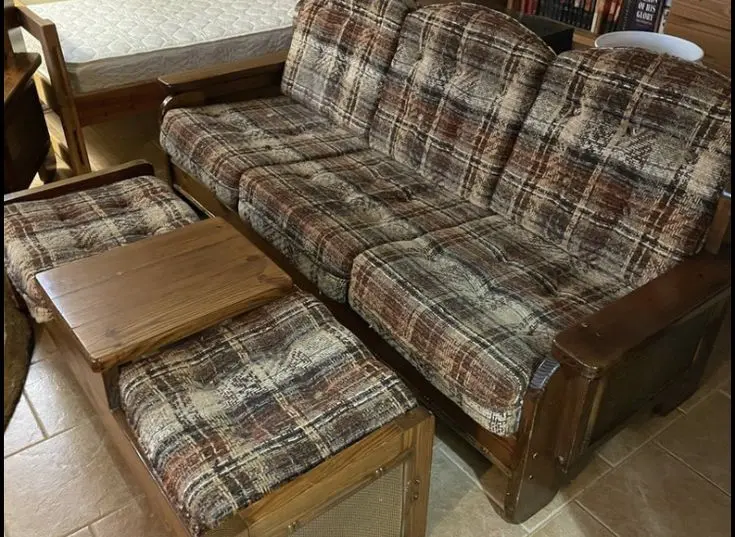
The couch was the color of a paper grocery bag that had been left out in the rain. That’s how I described it to Arthur once, about fifteen years into our marriage, and he laughed so hard he had to sit down on it.
“See?” he said, patting the cushion beside him. “It’s so comfortable it makes you laugh.”
“It’s so ugly it makes me want to cry.”
We bought it in 1994 from a furniture store on Brown Street in Dayton that has since become a vape shop. It was on clearance, marked down from five hundred dollars to two hundred and twenty, because it was a floor model and a kid had spilled grape juice on one arm. Arthur flipped the cushion so the stain was on the bottom and said nobody would ever know. Thirty years later, the grape juice stain was the least of that couch’s problems.
The middle cushion sagged so badly that sitting in the center felt like sinking into a hole in the ground. The right armrest had three patches on it, each one sewn by Arthur in a slightly different shade of brown corduroy, because the fabric store kept discontinuing the color. The springs creaked like an old barn door when you sat down. And getting up off it required a particular rocking motion, back and then forward and then up, that made me feel about twice my age.
“Arthur,” I’d say, maybe once a month for twenty years, “we’re buying a new couch.”
He’d just pat the cushion next to him.
“This one makes you sit closer to me, Mon.”
“That’s because the springs are trying to swallow us alive.”
And he’d laugh and reach for my hand and pull me down next to him, and the middle cushion would sink, and we’d slide toward each other until our shoulders touched. And I’d stop complaining, at least until the next month.
Arthur was my husband for thirty-six years. He was an appliance repairman for Sears for thirty-one of them, until Sears closed all the service centers in Ohio, and then he went into business for himself out of our garage, fixing washers and dryers and refrigerators for half the West Side. He could repair almost anything. And unfortunately, he believed that absolutely everything deserved to be repaired.
If a kitchen chair wobbled, he took it apart and glued it. If a drawer stuck, he planed it down with the little hand plane he kept on a pegboard in the garage. If the toaster quit, he’d sit at the kitchen table on a Saturday morning with its insides spread out on a dish towel, humming to himself. He never bought a new anything until he’d tried every possible way to bring the old one back to life. Our refrigerator was from 1991. Our washing machine was from 1987. He used to say they don’t make them like that anymore, and the thing is, he was right.
That old couch was no exception. Every couple of years, he’d flip it over on its back in the living room and cut open the black fabric on the bottom and go in there with his tools, tightening springs and adding new webbing and stuffing in foam from the craft store. Then he’d sew the bottom closed again by hand, with a big curved upholstery needle and heavy brown thread, and flip it back over, and sit down in it, and announce that it was good for another ten years.
Then, in April, Arthur died.
It was a heart attack. He was sixty-four. He was out in the garage on a Tuesday afternoon working on the Hendersons’ dryer, and when I went out at four o’clock to tell him supper would be at six, he was lying on the concrete floor next to it with a screwdriver still in his hand. The paramedics said it was quick. They always say that. I’ve decided to believe them.
And suddenly, the couch I’d complained about for twenty years became the only place in the house where I could sleep.
I couldn’t make myself go into our bedroom at night. The bed was too big. His side was too empty. His reading glasses were still on his nightstand on top of a Louis L’Amour paperback with a grocery receipt marking his page. So I slept on the couch. I’d curl up on his end, the left end, under the old green afghan his mother crocheted in 1979, with the TV on all night long, turned down low. Old westerns, mostly, because that’s what he liked. Sometimes I’d wake up at three in the morning with a John Wayne movie going and reach over into the empty space beside me before I remembered.
The springs would creak. The middle cushion would sag. And I’d lie there on his side in the dark and cry until I fell asleep again.
That went on for six months.
Our daughter Aurora finally decided she couldn’t stand it anymore.
She came by on a Sunday afternoon in October, like she does most Sundays, with a bag of groceries I hadn’t asked for. She’s twenty-nine. She lives in an apartment in the Oregon District downtown and works as a physical therapist at Miami Valley Hospital. She found me on the couch at two in the afternoon in my bathrobe, with the afghan and the remote and a cold cup of coffee on the end table.
She set the groceries down on the kitchen counter, came back into the living room, and stood there looking at me with her arms folded.
“Mom,” she said. “You can’t keep sleeping out here.”
“I’m comfortable, honey.”
She looked at the couch. At the sag in the middle and the three brown patches.
“You complained about that thing for half my childhood,” she said. “I literally remember you calling it ‘the swamp.'”
“People change.”
Aurora has her father’s dry sense of humor and my stubborn streak, which is not always the best combination. She sat down next to me on the couch, and the middle cushion sagged, and we both slid toward each other until our shoulders touched. She took my hand.
“Mom. Dad wouldn’t want you sleeping out here with the remote digging into your back.”
I almost smiled. I’d actually woken up that morning with the remote under my hip, and a bruise to prove it.
Then she said something that stayed with me.
“You don’t have to keep everything exactly the way he left it, Mom. You’re allowed to change things. He’d want you to.”
I didn’t say anything. But that night, after she’d gone home, I sat on the couch for a long time with my laptop on my knees, and I opened up Facebook Marketplace.
I took three pictures of the couch with my phone. I tried to find an angle where the sag didn’t show. There isn’t one.
“Brown corduroy sofa, 3 cushions. Older but sturdy. Recently re-sprung. Some wear. Pickup only, West Dayton. $40.”
I nearly deleted the listing three times before I hit post. It felt strange and wrong to put a price on something Arthur had spent so many years fixing. Forty dollars. It seemed like an insult. But I knew Aurora was right. I couldn’t spend the rest of my life keeping every single thing exactly where he’d left it just because it reminded me of him.
I hit post. Then I closed the laptop and sat there on the couch in the dark with my hand on the patched armrest until I fell asleep.
By the next morning, I had eleven messages. Most of them were from people asking if it was still available, which is the only thing anybody ever says on Facebook Marketplace. One man offered me twenty-five dollars and asked if I’d deliver it to Kettering. I didn’t answer him.
But one message was different.
“Hi, my name is Josh. I’m going through a divorce and I’ve been trying to furnish my new apartment for me and my daughter. We don’t have a couch yet. We’ve been watching cartoons sitting on the floor. If it’s still available, could we come look at it this afternoon? Thank you.”
I read it three times. Then I wrote back. “Come at two.”
He came at two o’clock on the dot in an old blue Ford pickup with a bad muffler. He had a friend with him, a big, quiet guy with a red beard named Liam, and a little girl about six years old with two crooked pigtails and a pink jacket with a unicorn on the back.
Josh was maybe thirty-two, thin and tired-looking, with a polite way of talking that made me think his mother had raised him right. He stood in my front doorway and shook my hand.
“Thank you for letting us come, ma’am. This is Emma.”
Emma didn’t say anything to me. She walked straight past me into the living room, looked at the couch for about one second, and climbed right up onto the cushions in her sneakers.
“Emma,” Josh said. “Shoes.”
She didn’t hear him. She bounced. The springs creaked. Then she lay down on her back right in the middle, where the cushion sags the most, and she sank down into it like a stone dropping into a pond.
“Daddy!” she said. “Look! It’s like a nest!”
Josh came over and looked down at her, and then, after a second, he sat down on the couch next to her. The middle cushion sagged even more under his weight. Emma slid toward him and ended up tucked against his side, and she started to laugh.
“Daddy, look! We both fit!”
Josh looked up at me, and he smiled. It was a tired smile, but it was real.
“I’ve been furnishing our apartment since my divorce,” he said. “It’s taking a while. She’s been with me every other weekend since July, and we’ve been watching cartoons on the floor on a beach towel.”
I looked at that little girl in her unicorn jacket, sunk down in the middle of Arthur’s couch, laughing up at her father.
“Then it’s yours,” I said.
He stood up and pulled two twenties out of his wallet and held them out to me. I took them. Then I looked at Emma again, and I handed one of the twenties back to him.
“Here,” I said. “Buy her something nice. A treat for her new couch.”
Josh looked surprised. “Ma’am, you don’t have to…”
“Take it before I change my mind,” I said.
He took it. He put it back in his wallet very carefully, like it was more than twenty dollars.
“Thank you,” he said quietly. “Really.”
Liam and Josh lifted the couch together. It took them a minute to figure out how to angle it through the front door. Arthur had always said it came in through the back door, which was wider, but I didn’t want to tell them that and have to watch them carry it through the kitchen. They tipped it up on one end and walked it slowly out onto the porch, with Emma running alongside them giving directions.
I stood in the doorway and watched them carry it down the porch steps.
When they got to the bottom step, I almost called them back. I opened my mouth. I actually had the words ready. Wait. Never mind. I changed my mind. I’m sorry.
I didn’t say them. I stood there with my hand on the doorframe and watched them lift Arthur’s couch up into the bed of that old blue pickup, and strap it down with two orange ratchet straps, and drive away down our street with the muffler rattling. Emma waved at me out the back window the whole way to the corner.
I went back inside. The living room looked enormous without the couch in it. There was a big rectangle on the carpet where it had stood for thirty years, a darker brown than the rest, with four little dents where the feet had been. Three pennies, a dried-up ballpoint pen, and one of Arthur’s guitar picks were lying on it. He’d quit playing guitar in 1996.
I picked up the guitar pick and put it in my pocket. Then I vacuumed up the rectangle.
That night, for the first time in six months, I slept in our bed.
I slept on my own side. I left his side empty, with his reading glasses still on the nightstand. I lay there for a long time looking at the ceiling. And then, sometime after midnight, I fell asleep, and I didn’t wake up until seven-thirty in the morning.
I thought that was the end of it.
Then, at nine-fifteen the next morning, the doorbell rang.
It was Josh.
He was standing on my porch alone this time, in a work jacket with “Dayton Freight” stitched on the chest. He was holding something against his chest with both hands, a flat, rectangular package wrapped in old brown paper and so much packing tape that it had gone yellow and brittle. He looked uncomfortable. He looked like he hadn’t slept.
“Ma’am,” he said. “I’m sorry to bother you. I think you should have your money back.”
I stood there in my bathrobe with my coffee cup.
“Did the couch break already?”
“No, ma’am. No, the couch is great. Emma slept on it last night.” He swallowed. “But I found something inside it.”
He held out the package.
My name was written across the front of it, in black marker, in big blocky capital letters.
MONICA.
I’d know that handwriting anywhere. I’d been reading it on grocery lists and birthday cards and notes on the refrigerator for thirty-six years. It was Arthur’s.
My husband had been gone for six months.
I stood there in the doorway and stared at it, and for a long time I couldn’t make myself understand what I was looking at.
“What is that?” I finally said.
Josh shook his head slowly.
“I was hoping you could tell me.”
I let him into the kitchen. I don’t remember asking him to come in. I just remember that suddenly we were both standing in my kitchen, and he was setting the package down very gently on the kitchen table, next to the stack of mail I’d been ignoring for a month. The estate paperwork from the lawyer. A letter from the Sears pension office about my survivor benefits that I hadn’t opened. The death certificates, six copies, in a manila envelope from the funeral home.
“Emma dropped a pencil down between the cushions last night,” Josh said. “She was drawing on the couch, and it slipped down into the crack, and she cried, because it was her favorite pencil, the one with the cat on it. So after she went to sleep, I flipped the couch over on its back to get it out from underneath.”
I nodded. I knew exactly what he’d seen.
“The fabric on the bottom was all sewn shut by hand,” he said. “Big stitches. Like somebody’d been in there a lot of times.”
“Arthur,” I said. “My husband. He repaired that couch constantly. Every few years he’d open it up and fix the springs and sew it back shut.”
“That’s what I figured,” Josh said. “But one of the seams looked different. Newer. The thread was a different color. Darker. It was down at the end, under the left side.”
The left side. Arthur’s side.
“So I cut it open,” Josh said. “Just to look. And this was taped to the bottom of the frame. Inside, up under the springs.”
He put both his hands flat on the table.
“Ma’am, I have to tell you something. I opened the wrapping on one end. I didn’t know what it was. I thought maybe it was money, or something valuable, and I thought you’d want to know. I read the first couple lines before I realized it was private. I’m sorry. I stopped reading as soon as I understood.”
I looked at him, then at the package, then at him again.
He reached into his wallet and took out the twenty-dollar bill I’d given back to him and set it on the table next to the package.
“Emma loves the couch,” he said. “She says it’s a nest. But if you want it back after you see what’s in there, I’ll bring it right over. Today. Me and Liam.”
I looked at the twenty on the table. I thought about Emma lying in the middle of that couch, sunk into the sag, laughing up at her dad.
I picked up the twenty and folded it and put it back in his hand.
“Keep the couch, Josh,” I said. “She needs somewhere to watch her cartoons.”
He nodded slowly. He stood there in my kitchen a minute longer, like he didn’t know what else to say. Then he said, “I hope it’s something good, ma’am,” and he let himself out the front door.
I heard his truck start up in the street. I heard the muffler rattling all the way to the corner.
Then I sat down at the kitchen table, and I looked at the package with my name on it for a long time.
When I finally picked it up, it was heavier than it looked. The tape had gone so brittle that it cracked when I touched it. I got the kitchen scissors out of the drawer by the stove and carefully cut through the tape on one side, and then the other, and peeled back the brown paper.
Inside was a thick stack of paper, maybe three inches thick. It was lined notebook paper and printer paper and a few pages from a yellow legal pad, all mixed together, all held together with three thick rubber bands that broke as soon as I tried to slide them off.
On top was a single sheet, folded once, with my name on it again.
I unfolded it.
The first thing I noticed was the date written at the top in the corner.
June 14.
My hands went still.
June 14 was Maisie’s birthday.
Maisie was our first daughter. She was born on June 14, thirty-three years ago, at Miami Valley Hospital, with a hole in her heart that the doctors didn’t find until she was three weeks old. She had her first surgery at six weeks, at Children’s in Cincinnati, and her second at five months. She lived to be eight months and four days old. She died in January, in the hospital, in the middle of the night, with Arthur holding one of her hands and me holding the other.
She would have been thirty-three this year.
Under the date, in Arthur’s blocky capital letters, he had written one sentence.
“I COULDN’T TELL YOU THIS WHILE I WAS ALIVE.”
I sat down very slowly. I was already sitting, I think. I don’t remember. I just remember feeling like I was sitting down very slowly, and very far.
“Arthur,” I said out loud, to the empty kitchen. “What did you do?”
I set the folded letter aside. I couldn’t read the rest of it yet. I picked up the next page.
There was a title on it, written in the middle of the page and underlined twice.
THE LIFE WE DIDN’T GET.
And under that, a smaller heading.
Maisie’s Fifth Birthday.
I sat and stared at the words.
For thirty-three years, Arthur and I had tried to make some kind of peace with all the birthdays Maisie never got to have. Her first birthday was the worst. I spent the whole day in bed, and Arthur sat on the floor beside it reading the newspaper out loud to me just so there’d be a sound in the room. After that, it got easier, or at least quieter. We’d go to the cemetery at Woodland on June 14 every year and put a little bunch of daisies on her stone, and we’d stand there for a while, and then we’d go home and not talk about it.
We’d learned to live with the empty place she left in our family. I don’t think either of us ever stopped missing her. But we didn’t say her name much. It was easier not to.
And here was Arthur, imagining every birthday she might have had.
I turned the page.
The first chapter was about a five-year-old girl who refused to wear matching socks.
“Nobody can see them inside my shoes,” Maisie argued.
“They’ll know,” her mother said.
“Then they shouldn’t be looking,” said Maisie.
I laughed out loud in my empty kitchen. It surprised me. It was the first time I’d laughed in a long time.
Arthur had given her my stubbornness. Of course he had.
In his story, Maisie wanted a chocolate cake for her fifth birthday. A plain chocolate cake with chocolate frosting. Arthur went to the bakery at Kroger and bought one, but the only chocolate cake they had left was decorated with fresh raspberries all over the top. Maisie hated raspberries. She stood on a chair at the kitchen table in her party dress with her arms folded and refused to eat a single bite until her father picked off every last raspberry with his fingers, one by one, while the whole birthday party watched.
Then I got to a sentence that stopped me cold.
“Monica watched our daughter blow out five candles. For once, she didn’t have to wonder what this birthday might have looked like.”
I set the pages down on the table.
Arthur had imagined a birthday that never happened. He’d imagined Maisie at five years old, standing on a chair in our kitchen in front of a chocolate cake with five candles, and me standing there watching her blow them out. He’d imagined it so I wouldn’t have to wonder.
I picked the pages back up and kept reading.
At eight, Maisie learned to ride a bicycle in the alley behind our house. She crashed into the Kowalskis’ trash cans twice and got right back on.
At twelve, she decided she wanted to be a veterinarian, after she found a hurt robin in the backyard and nursed it in a shoebox on her dresser for a week.
At sixteen, she brought home a boy that Arthur couldn’t stand, because the boy kept calling him “buddy.” “Hey, buddy. Nice to meet you, buddy. Great house, buddy.”
I laughed again. Arthur hated that word. He used to say nobody under the age of fifty should ever call a grown man “buddy.”
“Oh, Arthur,” I whispered.
But the farther I read, the more uneasy I felt.
He hadn’t written just a few little memories or one imagined birthday. He’d written a whole life for our daughter. There were school dances and science fairs and fights about curfew. There was a Christmas when she was fourteen and got the flu and threw up on the presents. There was her first car, a used Honda Civic with a cracked windshield that Arthur fixed himself. There was the day she left for Ohio State, and her first apartment in Columbus with a radiator that clanked all night. There was even her wedding.
It went on and on. There were hundreds of pages.
How long had he been writing this? How many years? And why on earth had he never said one word to me about it?
I picked up the whole stack and carried it into our bedroom.
Arthur’s desk is a big old oak rolltop that sits beside the window, the one he used for his business paperwork. I’d barely opened it since he died. I couldn’t make myself. When I rolled up the top, everything was exactly the way he’d left it. His calculator. A cup of pens from the hardware store. His reading glasses, the second pair, the ones he kept for work.
In the first little drawer, his spare batteries were lined up in neat rows by size, double-As next to triple-As next to the nine-volts. That was Arthur.
In the second drawer, there were three spiral notebooks, the cheap kind from the drugstore.
I opened the first one. It was full of dates and notes in his handwriting. The first entry was from twelve years ago.
“Maisie learns to swim. Y pool. Scared of deep end.”
I turned the pages.
“First terrible haircut. Cuts her own bangs with kitchen scissors, age 7.”
“Monica teaches her to drive. Parking lot at Kettering Field. Monica yells. Maisie yells back.”
“Breaks her arm at 10. Monkey bars. Doesn’t cry until she sees her mother.”
There were twelve years of notes like that in those three notebooks. He’d been keeping track of every imagined milestone, planning every chapter, writing them down in order, one after another, for twelve years. And I’d never known. Twelve years of evenings, sitting next to me on that couch, with the TV on, with his notebook in his lap. I’d always thought he was doing his invoices.
Near the back of the third notebook, I found an entry dated about two years ago.
“Hid manuscript in couch. Need courage to show Monica.”
And under it, a sentence he’d underlined three times.
“Don’t make her perfect.”
That surprised me more than anything else.
Arthur hadn’t imagined some perfect little angel who never argued or never made mistakes or always did what her parents told her. He’d given Maisie a personality all her own. She was stubborn and funny and difficult and sometimes completely unreasonable. She fought with her mother about socks and with her father about boys. She broke her arm on the monkey bars and ran up a two-hundred-dollar phone bill calling a pen pal in Ireland.
He’d imagined her as a real person.
I sat on the edge of our bed and picked up the manuscript again and found the chapter about her wedding.
Maisie was standing in front of the mirror in a bedroom in our house, in her wedding dress, while I stood behind her fastening the long row of little buttons up her back.
“Mom,” she said. “You’re making that face.”
“What face?”
“The one you make when you’re trying not to cry.”
I put my hand over my mouth.
I didn’t know I had a face like that. Arthur had noticed. Thirty-six years, and he’d noticed I had a face I make when I’m trying not to cry, and he’d never told me, and he’d put it in a book about a daughter who never grew up.
I sat there for a long time imagining the scene he’d written. Maisie in a wedding dress. Me with my shaking fingers on those buttons.
All those evenings on the couch, while I complained about the springs and the sagging cushion and the patched armrest and the grape juice stain, he’d been sitting right there next to me imagining Maisie growing up.
And then a different thought came into my head, and it wouldn’t leave.
What about Aurora?
Our other daughter. Our living daughter. She was born two years after we lost Maisie, and she’d grown up right in front of us, in this house. She’d had real birthdays and real school years and real first dates and real fights about curfew. She’d broken her real arm on real monkey bars at Westwood Elementary, the left one, in third grade.
Had Arthur written anything about her?
I flipped through the manuscript faster. Maisie at twenty. Maisie at twenty-two. Maisie’s wedding. Maisie’s apartment. Maisie. Maisie. Maisie.
I didn’t see Aurora’s name anywhere.
I sat there on the edge of the bed with that stack of paper in my lap, and something cold and terrible settled in my chest.
Thirty years. He’d spent twelve years writing a whole imagined life for the daughter we lost, and not one page for the daughter we had.
I grabbed my car keys off the dresser.
I needed to understand. I needed to know why my husband had spent so many years writing about one daughter and had left the other one completely outside those pages.
Aurora opened her apartment door in sweatpants and a Dayton Flyers sweatshirt, holding a bowl of cereal.
“Mom? What’s wrong?”
I held up the manuscript.
“Your father wrote something I never knew about.”
She looked at the stack of paper in my arms. Then she stepped aside.
“Come in. I’ll make coffee.”
“Please don’t make that expensive stuff you made me last time.”
“It’s regular coffee, Mom.”
“It tasted like burnt toast.”
“That’s what coffee tastes like when it isn’t Folgers.”
She laughed and went into her little galley kitchen. I put Arthur’s manuscript down on her kitchen table.
She came back and set two mugs down and saw the title page right away.
“The Life We Didn’t Get,” she read out loud. “Dad wrote this?”
“He did.”
She sat down across from me and turned a few pages, reading the chapter headings.
“Maisie’s fifth birthday. Maisie learns to ride a bike.” She looked up at me. “It’s about Maisie?”
“It’s about what her life might have been,” I said. “If she’d lived. Her whole life. He started it twelve years ago. I found it hidden inside the couch.”
“The couch you sold?”
“The boy who bought it found it. He brought it back this morning.”
Aurora didn’t say anything for a while. She turned the pages slowly. She read for a long time, maybe twenty minutes, while her coffee got cold. I sat across from her and watched her face.
When she finally looked up, her eyes were wet.
“I wish he’d shown me,” she said.
“Why?”
“Because I would’ve liked to know more about her.”
I reached across the table for her hand.
“Honey, Maisie was gone before you were born. We didn’t get to know very much about her either. She was eight months old.”
“I wasn’t asking you to change that, Mom.”
“Then what are you asking?”
Aurora closed the manuscript and put both her hands flat on top of it.
“Why was it always so hard to talk about her?”
I frowned. “We talked about Maisie.”
“Not really, Mom.”
I wanted to argue with her. I had the words ready. Of course we did, we went to the cemetery every year, we kept her picture, we told you about her. But Aurora kept going before I could say them.
“When I was six, I found her picture in Dad’s dresser drawer. Remember?”
I remembered.
It was the only good picture we had of Maisie, taken by a nurse at Children’s two weeks before she died. She was wearing a little yellow onesie with ducks on it, and she was holding onto Arthur’s index finger with her whole tiny fist. Arthur kept it in his top dresser drawer under his socks, face down.
“You told me she was my sister,” Aurora said. “And then you took it out of my hand and put it back in the drawer, and shut the drawer.”
“I didn’t want to upset you, honey.”
“I was six, Mom. I wasn’t upset. I just wanted to know if she looked like me.”
“Your father and I did the best we could.”
“I know you did. I know.” Aurora’s voice was getting tight. “But I’m trying to tell you what it felt like, and you keep telling me why you did it.”
I looked away, out her kitchen window at the brick wall of the building next door.
Then I stood up.
“I should go.”
“Mom. Please don’t leave just because we’re disagreeing.”
But I was already picking up my purse. I was already picking up Arthur’s manuscript off her table and holding it against my chest.
“I’ll call you,” I said.
I wasn’t ready to hear any more. I walked out of her apartment and down the stairs and out to my car, and I drove away.
Halfway home, on Third Street, I pulled into the parking lot of a closed-down Rite Aid and turned off the engine and sat there.
I kept thinking about Aurora at six years old, sitting on the floor of our bedroom with that picture of Maisie in her lap.
“Would she have played with me?” she’d asked me.
“Probably, sweetheart,” I’d said.
And then I’d taken the picture out of her hands and put it back in the drawer, face down, under her father’s socks, and shut the drawer. Because I thought I was protecting her from something too sad for a six-year-old to understand.
Now I sat in that Rite Aid parking lot and wondered for the first time in twenty-three years what she’d understood from my silence instead.
I took out my phone and called her.
She picked up on the first ring. “Mom?”
“I shouldn’t have walked out,” I said. “I’m sorry.”
She was quiet.
“I didn’t like hearing that your father and I made you feel shut out,” I said. “That’s the truth. I didn’t want to hear it. So I left.”
“I wasn’t trying to hurt you, Mom.”
“I know you weren’t. But I’d like to hear the rest of it. If you’ll tell me.”
“Are you sure?”
“Come for dinner tomorrow night. We’ll talk. Properly.”
There was a pause on the line.
“Okay,” she said. “I’ll come.”
I hung up and looked at Arthur’s manuscript sitting on the passenger seat next to me, with its broken rubber bands.
I wasn’t finished reading it. But I couldn’t keep reading my husband’s words about one daughter while I wasn’t listening to the other one.
Aurora came at six o’clock the next evening carrying a pie in a box from the Dorothy Lane Market.
“I brought pie,” she announced at the door. “Apple.”
“I made chicken.”
“Good,” she said, walking past me into the kitchen. “I was worried you’d serve the manuscript.”
I laughed and took her coat.
I’d made Arthur’s favorite, the chicken and dumplings from my mother’s recipe. We ate at the kitchen table, at our same old places, with Arthur’s chair empty at the end. For a while, we talked about nothing. Her work at the hospital, a patient she had, an old farmer recovering from a hip replacement who flirted with all the therapists. The leak under my bathroom sink that I’d been ignoring because Arthur always fixed the leaks.
Then, partway through dinner, I put my fork down.
“Tell me what you remember,” I said. “About Maisie. About how it was, growing up.”
Aurora looked surprised. “Honestly?”
“Especially honestly.”
She thought about it for a long time.
“I remember Dad going quiet every June,” she said finally. “Like, for a whole week. He’d go out in the garage after supper and not come in until I was in bed. And I remember you not looking at the photo albums. The ones in the hall closet. I’d get them out sometimes to look at baby pictures, and you’d leave the room.”
I nodded.
“I couldn’t look at them,” I said. “Sometimes. Maisie’s in the first two.”
“I figured that out when I got older. I didn’t know it when I was little.”
“What did you think when you were little?”
Aurora pushed a dumpling around her plate with her fork. She didn’t look at me.
“Sometimes I thought you wished our family had turned out different,” she said quietly. “That you were sad all the time because you got me instead of her.”
I reached across the table and grabbed her hand.
“Aurora. No. Your father and I never, ever wished you away. Not for one second.”
“I believe you, Mom. I do. I’m just telling you what it felt like when I was a kid.”
“Then why didn’t you ever ask us?”
“Because every time I said Maisie’s name, you looked so sad,” she said. “Your whole face would change. So I stopped saying it.” She swallowed. “I drew a picture of the four of us once. In second grade. Mom and Dad and me and Maisie, with a little halo over her head. I worked on it for a whole week. And then I threw it away in the trash can at school before I brought it home. Because I thought it would make you cry.”
Her words hit me harder than anything I’d read in Arthur’s manuscript.
I’d stayed quiet all those years because I thought I was protecting her.
And she’d stayed quiet all those years because she thought she was protecting me.
“I’m sorry,” I said. “I’m so sorry, honey.”
Aurora squeezed my hand back.
“I just wish we’d talked about her more,” she said. “That’s all. I wish I knew more about her.”
I looked over at Arthur’s manuscript, sitting on the counter by the toaster where I’d left it.
“There’s something I can’t figure out about your father’s book,” I said.
“What?”
“Why he spent twelve years writing about the life Maisie never had. And nothing about you.”
Aurora was quiet. She looked over at the manuscript, too.
“Maybe he wanted to know her,” she said finally. “Like I did. Maybe that was the only way he could. By making her up.” She paused. “And maybe that’s how he got through it. Writing her a whole life so she’d have one somewhere.”
I’d never thought of it like that.
After dinner, I walked her to the door. She put on her coat and stood on the porch for a minute.
“Can I read the rest of it?” she asked. “When you’re done?”
“Of course you can.”
“And Mom?”
“Yes?”
“I don’t need you to have all the answers. I never did. I just wanted you to talk to me.”
I hugged her tight on the porch.
“That’s lucky,” I said into her hair, “because I’m running short on answers.”
That night, I got back into our bed with Arthur’s manuscript and my reading glasses, and I picked up where I’d left off.
I read about Maisie leaving for college at Ohio State, and calling home in tears three weeks later because she’d put a red sweater in the washer with all her white clothes and now everything she owned was pink. Arthur had written himself driving to Columbus that Saturday with a bottle of bleach and teaching her to sort her laundry on the floor of her dorm room.
I turned the page, expecting another chapter about Maisie’s imagined life.
But the heading was different.
Aurora’s First Bicycle.
I frowned. I flipped back a page, then forward again. This wasn’t part of Maisie’s story.
I started to read.
“Aurora was seven when Monica decided she was ready to ride without training wheels.”
I remembered that afternoon. It was a Saturday in April. Arthur wanted to wait another year. He thought she wasn’t ready. I insisted she could do it.
Aurora fell twice in the driveway before she finally made it all the way across, wobbling, from the garage to the street.
Arthur described me running beside her down the driveway, holding onto the back of her seat, shouting encouragement. “Pedal, baby! Pedal! Keep pedaling! Don’t look down, look where you’re going!”
Then came the moment when I let go of the seat, and Aurora didn’t know I’d let go, and she kept going all the way to the end of the driveway by herself. When she got to the end, she put her feet down and turned around on the bike and looked back up the driveway.
“Did you see me, Daddy? Did you see?”
And Arthur had written:
“I saw her. And I saw Monica laughing as she ran after our girl, with her hair coming out of her ponytail. I hadn’t seen Monica laugh like that since before we lost Maisie. Seven years. I’d forgotten what it sounded like.”
I put the page down on the bedspread.
Then I turned to the next one.
The Birthday Cake Disaster.
Aurora was ten. She’d wanted to bake her father a birthday cake all by herself, from scratch, without any help from me. She’d gotten the salt and the sugar mixed up. She’d put in two cups of salt.
Arthur had written about sitting at the kitchen table on his forty-fourth birthday while his daughter set a lopsided chocolate cake in front of him with forty-four candles stuck in it, and how proud she’d looked. He took a big bite. Then he took a second bite, so she wouldn’t see his face. He finally put his fork down and said, “Aurora, honey. Did we use the white stuff from the blue canister or the white stuff from the white canister?”
I laughed until my eyes watered. I’d forgotten that. I’d completely forgotten that.
I turned to the next page.
The Day Monica Sang Again.
Aurora was about eleven. She’d been making up silly words to an old Beatles song while she dried the dishes, something about a dog named Lucy in the sky with diamonds, and I’d started singing along at the sink without even realizing it. Arthur had come in from the garage and stood in the kitchen doorway listening to the two of us, and we never noticed him there.
“I’d forgotten how much I missed hearing Monica sing,” he’d written. “She used to sing all the time when we were first married. In the car. In the shower. She stopped after Maisie. I don’t think she knows she stopped. But Aurora got her singing again. Our girl brought it back.”
I stopped reading.
I sat there in bed with my hand over my mouth.
The first half of Arthur’s manuscript was the life Maisie never had. The second half was the life we’d actually lived, with Aurora.
He hadn’t forgotten about her at all. He’d been writing about both his daughters, all along. I just hadn’t gotten far enough to see it.
I kept turning pages. Aurora losing her first tooth in a caramel apple at the county fair. Aurora’s high school graduation, when Arthur cried so hard in the bleachers that the man next to him offered him a hankie. Aurora’s first day at work at the hospital, when she called him at lunch to tell him she’d helped an old man walk for the first time since his stroke. Aurora at Thanksgiving at twenty-six, telling him she was proud of him.
The very last pages weren’t a chapter. They were a letter, written on yellow legal paper, folded in half and tucked into the back of the stack.
It was addressed to me.
“Monica,
“I was afraid you’d read the beginning and think I wanted that life more than the one we had. I didn’t.
“I wanted Maisie to grow up. God help me, I wanted it so bad. I wanted to hear her argue about homework and complain about my cooking and slam her bedroom door at me. I wanted to walk her down the aisle.
“But I never once wished Aurora away. When she was born, I loved her for exactly who she was. Not because she could take Maisie’s place. Nobody could take anybody’s place.
“I wrote about Maisie because I wanted to imagine the things we missed. I wrote about Aurora because I never wanted to forget the wonderful things we had. And I wrote about you because, even when we couldn’t talk about everything, I loved the life we made together. All of it. Even the bad years. Even the couch.
“I wish I’d been brave enough to show you. I kept thinking I’d show you next June. Then the next one.
“Arthur.”
I put the letter down on my lap.
For a long moment, I couldn’t move.
I remembered Arthur walking up and down our hallway at two in the morning with Aurora as a newborn, bouncing her on his shoulder, singing songs he was making up as he went because he’d forgotten every lullaby he’d ever known. “Go to sleep, little Aurora, your daddy’s tired, your mama’s tired, the dog is tired.” We didn’t even have a dog.
“You sure loved making a fool of yourself for her,” I whispered.
He’d never been choosing one daughter over the other. He’d been trying to hold on to two different kinds of love at the same time. The life he’d wished Maisie could have lived, and the life he’d been lucky enough to share with Aurora. He’d found a way to remember both of his girls.
And somehow, in all those pages, he’d found a way to remember me, too.
I touched the last line with my fingertip.
“You could’ve shown me, you stubborn man,” I said out loud. “You could’ve just shown me.”
Then I remembered walking out of Aurora’s apartment when she’d tried to tell me something painful. I’d done the exact same thing Arthur did. I’d kept quiet when talking was too hard.
I picked up my phone off the nightstand and called her, even though it was almost eleven o’clock.
“Mom?” she said sleepily. “Is everything okay?”
“Everything’s okay. Can you come over tomorrow?”
“Sure. Why?”
“There’s something in your father’s book I want you to read.”
“Did you find something else?”
“I found something about us,” I said. “About you.”
Aurora was quiet on the line for a long moment.
“I’ll come after lunch,” she said.
She came at one o’clock. I had coffee ready, the Folgers. She made a face and drank it anyway.
I’d separated the second half of the manuscript from the first, and I handed it to her across the kitchen table without saying anything. I sat there and watched her read. I watched her read about her bicycle in the driveway, and her salt cake, and me singing at the sink. I watched her laugh at the cake part, and then cover her mouth. I watched her read about her own graduation, with Arthur crying in the bleachers.
Then she got to his letter.
When she was finished, she sat there with the yellow pages in her hands for a long time. Then she wiped her cheeks with the back of her hand.
“He remembered all of that?” she said. “The salt? He remembered the salt?”
“Apparently your father remembered a lot more than either one of us gave him credit for.”
She smiled through her tears.
Then she looked up at me.
“Mom. Do you think he wished Maisie was here instead of me?”
I got up and came around the table and sat down in the chair right next to her, the chair that was Arthur’s, and I put my arm around her shoulders.
“No, sweetheart,” I said. “He wished both his girls were here.”
Aurora leaned her head against my shoulder. We sat like that for a while.
Then I picked up the very last chapter in the stack, the one I hadn’t let myself read yet. I’d saved it.
“There’s one more,” I said.
Aurora looked at the heading.
The Day You Came Home.
“Is that about me being born?” she asked. “Did Dad really remember that day so clearly?”
“He forgot where he parked the car at the hospital that morning,” I said. “We walked around the parking garage for forty-five minutes with you in your car seat.”
Aurora laughed.
I turned the page.
“But I think he remembered everything else,” I said.
She pulled her chair closer to mine, and we started to read together.
A week later, on a Saturday, Aurora drove me to the Value City Furniture out on Miller Lane.
“You need something to sit on, Mom,” she said in the car. “You can’t watch TV standing up in the living room for the rest of your life.”
We walked up and down the rows for an hour. Leather ones, sectionals, recliners with cup holders built into the arms. A salesman named Kevin followed us around asking if we were finding everything okay.
Finally I sat down on a plain gray one near the back. It cost four hundred and ninety-nine dollars. The cushions were firm and flat, and the springs didn’t make a sound, and when I sat down, nothing sank.
Aurora sat down next to me. We were about two feet apart. Neither one of us slid anywhere.
“Well?” she said.
I sat there a minute.
“It’s too far apart,” I said.
Aurora looked at me, and she started to laugh. Kevin the salesman came over to see what was so funny, and she couldn’t stop laughing long enough to tell him, and then I started laughing too.
We bought it anyway. They delivered it the following Thursday. It sits in the living room now, right where the old one used to be, on the rectangle of carpet that’s still a little darker than the rest.
On Sunday nights, when Aurora comes over, we sit on it together and watch old westerns, and we sit right in the middle.