I wasn’t supposed to be home until Sunday.
The training at Memorial Medical Center in Springfield was scheduled for five days, Monday through Friday, with a wrap-up session Saturday morning for the night-shift staff. I’d been doing these trainings for almost three years, traveling to hospitals all over Illinois to teach nurses and respiratory therapists how to use new ventilators and how to wean patients off them safely. I’m a respiratory therapist. I’ve been one for nineteen years. I know lungs the way a mechanic knows engines.
But on Wednesday afternoon, the hospital’s education coordinator came into the classroom looking apologetic. A flu outbreak had hit two of their units, and they were pulling all their staff to cover shifts. The rest of the training was postponed until January.
“I’m so sorry,” she said. “You came all this way.”
“It’s fine,” I said. “Honestly, it’s fine.”
I didn’t tell her that I’d been watching my phone all week like it was a bomb.
I packed up my teaching mannequin and my laptop and the boxes of handouts and loaded them into the back of my Subaru in the hospital parking garage. Then I sat in the driver’s seat for a minute with the engine off and opened the app on my phone one more time.
It was a smart plug app. The kind people use to turn their Christmas lights on and off from their phones. A month earlier, I’d bought one at the Home Depot for twenty-two dollars and plugged it into the outlet behind my father’s recliner, and then plugged my father’s oxygen concentrator into it.
I told my brother it was to track the electricity. I said I wanted to see how much the machine cost to run, since I was the one paying the electric bill. That part was true. I just didn’t tell him the other reason.
The app kept a log. A little bar graph, one bar for every hour, showing when the device was drawing power and when it wasn’t.
For the past nine days, there was a gap in the bars every night. It started around eight o’clock. It ended around two in the morning. Six hours. Every single night.
My father has severe COPD. Chronic obstructive pulmonary disease. He worked forty-one years at the Caterpillar plant in East Peoria, mostly in the foundry, breathing in metal dust and smoke before anybody wore masks for it. He smoked for thirty of those years, too, which he’ll be the first to tell you. His lungs are scarred and stiff and full of damaged air sacs that can’t move oxygen into his blood the way healthy lungs do. He’s on oxygen twenty-four hours a day, at two liters a minute, through a thin plastic tube that runs from the machine by his chair to his nose.
Without it, his oxygen level drops. And with lungs like his, it doesn’t drop slowly.
When I’d first seen the gap in the bar graph, I called my brother.
“Oh, that’s probably a glitch,” Wolcott said. “Those cheap plugs are junk. Everything’s fine here, Marg. Dad’s fine.”
“Okay,” I said.
I didn’t believe him. But I’d learned a long time ago, in nineteen years of working in hospitals, that you don’t confront anybody until you’ve seen it with your own eyes. People can explain away a graph. They can’t explain away what’s in front of you.
So I sat in the hospital parking garage in Springfield on a Wednesday afternoon with my training canceled, and I didn’t call anybody to tell them I was coming home early. I just started the car and pulled out onto Interstate 55 heading north, and then onto 155 toward Peoria.
It’s about an hour and a half. The sun went down somewhere around Lincoln, and by the time I crossed the Illinois River on the Murray Baker Bridge, it was full dark.
I should explain how we got here.
My father’s name is Anselm Brodeur. He’s seventy-nine years old. He was born in a little town called Spring Valley, up the river, the son of a coal miner, and he moved to Peoria at nineteen to work at Caterpillar because that’s where the work was. He married my mother, Rosalie, in 1968. They bought a little two-bedroom brick house on the West Bluff, on a street called Moss Avenue, for nineteen thousand dollars in 1971. They raised two kids in it. Me, and my brother Wolcott, who’s seven years younger than I am.
My mother died eleven years ago. Breast cancer. After that, it was just Dad in that little brick house with her rose bushes and her recipe box and her good china in the cabinet that nobody ever used.
Four years ago, Dad took out a home equity loan to pay for some things. A new roof. A new furnace. And, I found out later, about eleven thousand dollars he lent to Wolcott for a business idea that never happened. Dad’s pension and his Social Security weren’t enough to cover it all, especially once his COPD got bad and his medical bills started piling up. He got behind on the payments. He didn’t tell anybody.
Three years ago, in November, I stopped by on a Sunday and found a letter from his bank on the kitchen table. It was a notice of default. In bold type, it said that if the past-due amount wasn’t paid within thirty days, the bank would begin foreclosure.
My father was sitting in his recliner across the room with his oxygen on, pretending to watch the Bears game.
“Dad,” I said, holding up the letter. “What is this?”
He didn’t look at me. “It’s nothing. I’m handling it.”
“Dad. They’re going to take the house.”
He looked at me then, and his face crumpled the way I’d only seen it crumple once before, at my mother’s funeral.
“It’s your mother’s house, Margie,” he said. “Her roses are out there.”
I’d been saving for twenty years. I’m divorced, no kids. I live in a condo near the hospital where I work, OSF Saint Francis, in a building with an elevator and a doorman who calls me Miss Brodeur. I’d put away money from every paycheck since I was twenty-four years old. I had a little over a hundred and eighty thousand dollars in savings and investments that I was planning to retire on someday.
The payoff on Dad’s loans was ninety-four thousand, three hundred and twelve dollars.
I talked to a lawyer, a woman named Diane Okafor who’d handled my divorce and who I trusted more than anybody I knew. Diane laid it out for me in plain English in her office downtown. I could pay off the loan. But if I did, and the house stayed in Dad’s name, the money was basically gone, and if Dad ever needed to go into a nursing home, Medicaid could come after the house to pay for his care.
The other option was that Dad could transfer the house to me, and I’d pay off the loan, and it would be mine, with an agreement that he could live there for the rest of his life.
Dad didn’t like it at first. He’s proud. But when Diane explained it to him, sitting at his kitchen table on Moss Avenue with all the papers spread out, he finally nodded.
“As long as I never have to leave,” he said.
“You’ll never have to leave, Dad,” I said. “I promise.”
He signed the deed in December. Diane had it notarized and recorded at the Peoria County Recorder of Deeds on December 19th. I wired the bank ninety-four thousand dollars the same week. I kept a copy of the recorded deed in a fireproof box in my condo, and another copy in my desk at work.
We didn’t tell Wolcott.
That was Dad’s choice, and I went along with it. Wolcott had borrowed eleven thousand dollars from Dad that he’d never paid back, and Dad didn’t want him to feel bad about the house. And honestly, I think Dad was embarrassed. He’d lost the house, in a way. His daughter had bought it out from under him to save it. He didn’t want his son to know.
“Let’s just keep it between us, Margie,” he said. “Wolcott doesn’t need to know my business.”
So we kept it between us.
Then, about eighteen months ago, my job started sending me on the road more. The hospital system had started a program to train smaller hospitals all over central Illinois on new equipment, and they asked me to lead it. It meant two or three weeks a month away from Peoria. It meant a raise, too, a good one.
But Dad couldn’t be alone anymore. His COPD had gotten worse. He couldn’t carry groceries or do laundry without getting so short of breath he’d have to sit down for twenty minutes. He’d fallen twice in the bathroom. He needed somebody in the house.
That’s when Wolcott called.
My brother is thirty-five years old. He’s never held a job longer than eighteen months. He’s worked at the Menards, at a car wash, at a call center, at a GameStop. He’s smart, and he’s funny, and he can be very sweet when he wants to be, and he’s spent most of his adult life between apartments. Two years ago, he married a woman named Yvaine who he met online playing some kind of video game. She’s thirty-two and does something with makeup tutorials on the internet that I’ve never fully understood.
“Marg, listen,” he said on the phone. “Yvaine and I are about to lose our place. Our landlord’s selling the building. What if we moved in with Dad? We could take care of him. Make his meals, do his laundry, drive him to his doctor appointments. You’d be free to travel. He’d have family with him all the time.”
I thought about it for a long time.
“You’d have to really take care of him, Wolcott,” I said. “Not just live there. His oxygen has to be on all the time. His medications. His appointments with Dr. Patel.”
“We’ll watch him,” Wolcott said. “I promise. You just keep working.”
So they moved in. They took the second bedroom, the one that had been mine growing up. They paid no rent, because there was no rent to pay, as far as they knew. I paid the electric bill, the gas bill, the water bill, the internet, the property taxes, and the homeowner’s insurance, all from my own checking account, automatically every month. I dropped off groceries every Sunday I was in town, and when I wasn’t, I ordered them from the Hy-Vee to be delivered.
For a while, it seemed fine.
Dad sounded happy on the phone. Wolcott cooked spaghetti on Wednesdays. Yvaine painted Dad’s fingernails once, as a joke, and he laughed about it for a week.
Then, last spring, Dad started sounding different on the phone.
He was out of breath. He’d stop in the middle of sentences. He sounded tired all the time, even in the mornings.
“Are you using your oxygen, Dad?”
“Yeah, yeah,” he’d say. “Mostly.”
“Mostly?”
“How’s Springfield, Margie? You eating?”
He’d change the subject. Every time.
When I was home, he seemed okay. Thin, maybe. Quieter. But okay. The machine was always on when I came over. The tube was always in his nose. Wolcott and Yvaine were always there, smiling, making coffee, talking about how well Dad was doing.
I’m a respiratory therapist. I know what a COPD patient sounds like when they’re getting enough oxygen and when they aren’t. On the phone, at night, my father didn’t sound like he was getting enough oxygen.
So I bought the smart plug.
I pulled onto Moss Avenue at four minutes after nine.
The street was quiet. The big old trees were mostly bare, and a few leaves were blowing across the road in the headlights. Dad’s little brick house was the fourth one from the corner. The porch light was off. The front windows were dark, except for a strange blue and white flickering light coming from the living room.
Wolcott’s car was in the driveway, an old black Honda Civic with a cracked bumper. I parked on the street behind it.
I let myself in with my key. The front door opens right into the living room. The air inside was hot and stuffy and smelled like pizza and something else, something electric, like a hot computer.
The overhead light was off. The only light in the room came from an enormous TV screen that hadn’t been there the last time I visited. It was at least sixty-five inches, propped up on a stand where my mother’s curio cabinet used to be. On the screen, men in camouflage were running through a burned-out city, shooting at each other. The sound was loud, booming explosions and gunfire.
My brother was sitting in the corner of the room in a big black gaming chair, the kind with racing stripes and a high back. He had a headset on, with a microphone in front of his mouth, and he was yelling into it.
“Go left! Left! He’s on the roof!”
Next to his chair, on the floor, was a computer tower about the size of a suitcase, with glass sides and blinking rainbow lights inside it and fans spinning so loud I could hear them over the TV.
A thick black power cord ran from the back of the computer tower to the outlet in the wall behind my father’s recliner.
My father’s oxygen concentrator was sitting silent on the floor next to the recliner. It’s a beige plastic box about the size of a small suitcase, on wheels. Its little green power light was off. Its power cord was lying on the carpet beside it, unplugged, coiled loosely like a dead snake.
The smart plug I’d installed a month ago was lying on the carpet too. Somebody had pulled it out of the wall.
And my father was in his recliner, two feet away.
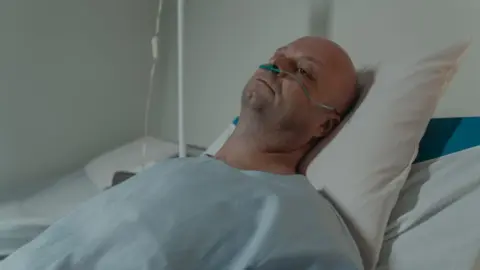
He was sitting up, leaning forward a little, with both hands gripping the armrests. His face was gray. Not pale. Gray, the color of old dishwater. His lips were blue. I could see it even in the flickering light from the television. His shoulders were up around his ears, and his chest was moving fast, fast and shallow, the way a dog pants on a hot day. I could hear him breathing from across the room, a wet, whistling sound.
The clear plastic tube was still in his nose. It ran down across his chest and onto the floor and into the side of the silent machine.
Nothing was coming through it.
“Dad!”
I dropped my bag on the floor and crossed the room.
He turned his head toward me, slowly. It seemed to take him a long time. His eyes were cloudy.
“Margie,” he wheezed. His voice was just a breath, with no sound behind it. “You’re early.”
Wolcott pulled off his headset. He looked at me over the back of his gaming chair, and for just a second, before he got his face under control, he looked like a teenager caught sneaking in after curfew.
“Whoa, Marg,” he said. “You didn’t say you were coming.”
My brother’s wife walked in from the kitchen. Yvaine was wearing pajama pants and an oversized sweatshirt, with her hair piled up on top of her head in a claw clip, and she was holding a glass of red wine. She stopped in the kitchen doorway and looked at me with an expression that wasn’t surprise. It was annoyance.
“Oh,” she said. “Hey, Marguerite.”
“Why is his machine unplugged?”
Yvaine shrugged. She actually shrugged, with her glass of wine in her hand.
“That machine costs us ninety dollars a month on the electric bill,” she said. “We only have two outlets in this room, and the other one’s for the TV. Wolcott needs his computer for his streams. Your dad can breathe air like everyone else for a few hours.”
“He has COPD. He can’t.”
“Oh, please.” She rolled her eyes and took a sip of wine. “He’s fine. He’s just being dramatic for you. He does this every time you call. Wheeze, wheeze.”
I didn’t argue with her.
I walked over to the wall behind my father’s recliner, got down on my knees, and pulled the computer’s power cord out of the outlet.
The rainbow lights inside the computer tower died. The fans spun down. On the giant screen, the men in camouflage froze in the middle of their burned-out city and then disappeared, and the screen went black.
“Hey!” Wolcott shouted, throwing his headset down on the floor. “Hey! I was in the middle of a match! Marg, what the hell!”
I picked up the oxygen concentrator’s power cord and plugged it into the wall. I reached up and turned the dial on the front of the machine. The green light came on, and the machine started to hum and click, the way it does, a low steady rhythm like a heartbeat.
It takes about a minute for a concentrator to get up to full flow when it’s been off. I didn’t have a minute. I knew that.
I went to my work bag where I’d dropped it on the floor and dug through it. I always carry a pulse oximeter, the little gray clip you put on your fingertip that measures how much oxygen is in your blood. It’s habit. Every respiratory therapist I know has one in their bag or their car.
I clipped it onto my father’s index finger.
A healthy person’s oxygen saturation is above 95 percent. For my father, with his lungs, his doctor and I had agreed his target was 88 to 92. Below 88, he’s in trouble. Below 80, he’s in danger.
The little screen blinked to life.
Then 69.
Then 66.
“Dad,” I said. “Dad, look at me.”
His eyes rolled back. His head fell against the back of the recliner.
And his hand slid off the armrest and hung down beside the chair, limp.
I’ve done this hundreds of times. I’ve stood at the bedside of more people with failing lungs than I could ever count. And none of that training mattered for about two seconds, because this was my father.
Then it all came back at once, like a switch flipped.
“Wolcott,” I said. “Call 911. Right now.”
He just stood there by his gaming chair with his mouth open.
“NOW, Wolcott!”
He fumbled his phone out of his pocket.
I put two fingers on the side of my father’s neck. His pulse was there, fast and thready, around a hundred and twenty. He was still breathing, fast and shallow, but breathing. I leaned close to his face and said his name loud, and rubbed my knuckles hard against his breastbone. His eyelids fluttered. A groan came out of him. He was still in there.
I didn’t lay him down. With his lungs, lying flat would make it harder for him to breathe. I pushed the lever on the side of the recliner to bring the footrest down and sat him up as straight as I could, and I held his shoulders forward, so his chest could open.
The concentrator was humming now. I could feel the flow at the end of the tube against the back of my hand. I checked the tube from his nose all the way to the machine. No kinks. I turned the flow dial up from two liters to four.
With some COPD patients, you have to be careful about giving too much oxygen, because their bodies get used to running on high carbon dioxide. But a saturation in the sixties is a fire, and you put the fire out first. I knew what I was doing. I’d do it in a hospital, and I was going to do it in his living room.
“Dad,” I said. “Dad, it’s Margie. I’m here. Breathe with me. In through your nose. Out through your mouth, like you’re blowing out a candle. Slow. Come on. You know how to do this.”
His eyes opened a crack.
“In,” I said. “Slow. Out, like a candle.”
His lips pursed. He blew out, weakly.
“Good,” I said. “That’s good. Again.”
Behind me, I could hear Wolcott on the phone with the dispatcher, his voice high and panicky. “Yeah, my dad, he’s on oxygen and he, I don’t know, he passed out, he’s breathing I think, yeah, 1418 Moss Avenue, yeah, please hurry.”
I looked down at the pulse oximeter.
Then 70.
Then 74.
“Keep breathing, Dad. In through your nose.”
Yvaine was still standing in the kitchen doorway with her glass of wine.
“Is he okay?” she said. She sounded uncertain now. “He was fine an hour ago. He was watching TV. He was fine.”
I didn’t answer her. I didn’t look at her.
My father’s hand moved. His fingers twitched against the side of the recliner. He opened his eyes all the way and looked at me, and they were clearer.
“Margie,” he whispered.
“I’m here, Dad.”
“I’m sorry, honey.”
“Don’t talk. Just breathe. Blow out the candle.”
The ambulance got there in seven minutes. I heard the siren coming up from Main Street and saw the red lights bouncing off the front windows. I went to the door and opened it and stepped out onto the porch.
Two paramedics came up the front walk with a stretcher between them and a big orange bag. I knew one of them. Her name was Teresa Galvan, and she’d brought patients into our emergency department at Saint Francis a hundred times.
“Marguerite?” she said, surprised. “Is this your dad?”
“Seventy-nine-year-old male, severe COPD, on two liters home oxygen continuous,” I said. It came out of my mouth the way it always does at work, fast and flat. “His concentrator was unplugged for an unknown period, at least an hour, possibly several. I found him at nine-oh-four, sat of sixty-six, cyanotic, tachypneic, briefly unresponsive to voice, responsive to pain. I restarted his concentrator and bumped him to four liters. He’s back up to eighty. Heart rate about one-twenty.”
Teresa looked at me for one second. Then she nodded.
“Got it,” she said, and went past me into the house.
They worked fast. They switched him from his home tubing to their portable oxygen tank, hooked him up to their heart monitor, took his blood pressure. They checked his blood sugar. They listened to his lungs. Teresa’s partner, a young guy with a shaved head, kept asking him questions. What’s your name, sir? Do you know where you are? Do you know what day it is?
“Anselm Brodeur,” Dad wheezed. “My house. Wednesday.”
“Good job, Mr. Brodeur.”
By the time they lifted him onto the stretcher, his oxygen was at 86.
Wolcott was standing in the corner by his dead computer, rubbing the back of his neck. Yvaine had finally put down her wine glass on the kitchen counter.
As they were wheeling Dad toward the front door, Teresa stopped beside me. She looked at the computer tower on the floor with its power cord lying beside it, and at the silent smart plug lying on the carpet, and at the giant black TV. Then she looked at me.
She didn’t say anything. She didn’t have to.
“I’m riding with him,” I said.
“I figured,” she said.
I followed them out the door without looking back at my brother.
They took him to the emergency department at Saint Francis. My own hospital. The charge nurse that night was a woman I’d trained with fifteen years ago, a tall, calm nurse named Bev Kowalski, and when she saw me walk in beside the stretcher, she didn’t say anything. She just put a hand on my back and steered me to a chair in the corner of Trauma Room 3 while they worked on him.
They drew blood from his wrist to check the oxygen and carbon dioxide levels in his arteries. I knew what the result would be before it came back. His carbon dioxide was very high, and his blood was too acidic. His lungs had been fighting so hard for so many hours to pull in oxygen that they’d gotten exhausted and stopped clearing out carbon dioxide.
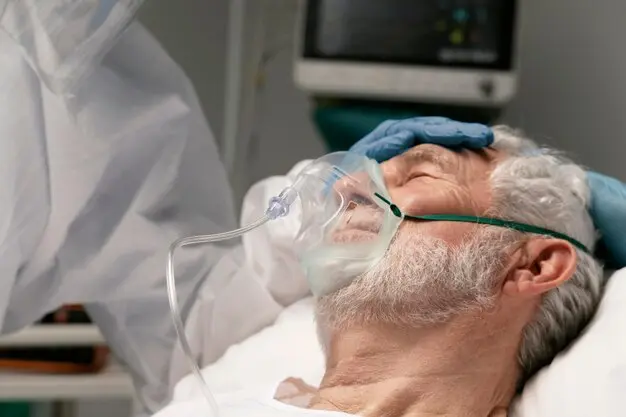
They put him on BiPAP, a mask that fits tight over the nose and mouth and pushes air in with every breath, to help his tired lungs do their job. They admitted him to the intensive care unit.
The ICU doctor that night was Dr. Ramirez, a quiet man about fifty with a gray beard who I’d worked with for years. He came and found me in the family waiting room around one in the morning.
“Marguerite,” he said, sitting down next to me on the vinyl couch. “He’s stable. His gases are already improving on the BiPAP. I think he’s going to be okay.”
I let out a breath I felt like I’d been holding for four hours.
“But I need to ask you something,” Dr. Ramirez said. “The paramedics’ report says his oxygen concentrator had been unplugged. Do you know how long?”
I took out my phone and opened the smart plug app and showed him the bar graph. The gap in the bars, every single night, from eight p.m. to two a.m., for nine days in a row. Tonight’s gap started at 7:52.
He looked at it for a long time.
“Who lives with him?” he asked.
“My brother. And his wife.”
Dr. Ramirez nodded slowly.
“You know I have to call the social worker,” he said. “And she’ll have to make a report.”
“I know,” I said. “I want her to.”
The hospital social worker came to see me at seven-thirty that morning, while I was sitting in the chair beside my father’s ICU bed watching him sleep under the BiPAP mask. Her name was Joanne Pettit. She was about sixty, with short gray hair and reading glasses and a cardigan with pockets full of pens. She’d been a social worker at Saint Francis for twenty-six years.
She sat down in the other chair and opened a notebook.
“Marguerite,” she said. “Tell me everything.”
I told her everything. The house. Wolcott and Yvaine moving in. Dad sounding short of breath on the phone. The smart plug, the bar graph, the nine nights in a row. Walking in last night and finding the computer plugged in where the oxygen machine should be. What Yvaine said, word for word. “That machine costs us ninety dollars a month on the electric bill. He can breathe air like everyone else.”
Joanne wrote it all down without interrupting me.
When I was done, she put down her pen.
“Illinois has a program called Adult Protective Services,” she said. “It’s run through the Department on Aging. When we have reason to believe an older adult is being abused or neglected by a caregiver, we’re required to report it. A caseworker will be assigned. They’ll talk to your father, and to you, and to your brother and his wife. They’ll look at the home.”
“Okay.”
“It isn’t a criminal investigation,” Joanne said. “Not by itself. Their job is to make sure your father is safe. But if they find something serious, they can refer it to law enforcement.”
“I understand.”
She looked at me over her reading glasses for a long moment.
“You’re very calm,” she said.
“I’m a respiratory therapist,” I said. “I spend all day being calm while people can’t breathe.”
She almost smiled. “Who pays the electric bill at the house?”
“I do.”
“So the ninety dollars a month…”
“Comes out of my checking account,” I said. “Automatically. On the fifteenth of every month. To Ameren Illinois. They’ve never paid a penny of it.”
Joanne wrote that down too, and underlined it.
My father woke up a little after nine. They’d taken the BiPAP mask off and put him back on a regular nasal cannula at three liters, and his oxygen was holding at 91. His color was better. He was still weak, so weak he could barely lift his arm, but his eyes were clear.
He looked at me sitting by his bed, and his chin started to wobble.
“Margie.”
“Hi, Dad.”
“I’m so sorry, honey.”
“You don’t have anything to be sorry for.”
“I should’ve told you.” His voice was thin and raspy. “On the phone. I should’ve told you what they were doing.”
I pulled my chair closer to the bed and took his hand. It was cold, and his fingernails still had a faint bluish tint at the base.
“How long, Dad?”
He closed his eyes.
“Since summer,” he said. “Since they got the big computer. Wolcott does his game shows at night. The streaming, he calls it. People watch him play on the computer and send him money. He needed the outlet.”
“There are other outlets in the house, Dad.”
“Yvaine said the breaker trips if they use the kitchen ones. And the bedroom ones are for her lights. Her makeup lights.” He opened his eyes. “At first it was just an hour or two. She said I’d be fine for an hour or two. And I was, kind of. I’d sit real still and breathe slow. Then it got longer.”
“Did you ever tell them you couldn’t breathe?”
“Sure. Sometimes.” He looked away. “Yvaine would say I was being a baby. Wolcott would say, just a little longer, Dad, I’m almost done with this round. And then he’d play another one.”
I didn’t say anything. I couldn’t.
“Why didn’t you call me?” I asked finally. “I call you every single night.”
He was quiet for a long time.
“Because he’s my son, Margie,” he said. “And I didn’t want you to hate him. And I didn’t want them to leave. And I didn’t want to be alone.”
I put my forehead down on the bed rail next to his hand, and for the first time since Springfield, I cried.
Wolcott and Yvaine came to the hospital that afternoon.
I was in the hallway outside the ICU, getting a coffee from the machine, when I saw them come off the elevator. Wolcott was wearing a hoodie and jeans, and he looked like he hadn’t slept. Yvaine was in a black puffer coat and full makeup, carrying a little bouquet of grocery store carnations wrapped in cellophane.
Wolcott saw me and stopped. Yvaine didn’t. She walked right up to me with her flowers.
“Marguerite,” she said. “How is he? We’ve been worried sick.”
“He’s alive,” I said.
“Oh, thank God.” She pressed her hand to her chest. “We brought him flowers. Can we go in and see him?”
“No.”
Her face changed. “Excuse me?”
“The ICU is limiting his visitors,” I said. “To me. I’m his health care power of attorney.”
That was true. Dad had signed it at Diane Okafor’s office the same day he signed the deed.
Yvaine’s eyes narrowed. “We live with him. We take care of him. We’re his family too.”
“You unplugged his oxygen so your husband could play video games,” I said, “and when I walked in, you were drinking a glass of wine and his lips were blue. His oxygen was sixty-six. Do you know what sixty-six means, Yvaine? It means another twenty minutes and he’d have had a cardiac arrest in his recliner while Wolcott was yelling at somebody on a headset to go left.”
Some people in the hallway stopped and looked at us. A nurse pushing a medication cart slowed down.
Yvaine’s face went red under her makeup.
“That is not what happened,” she said. “He was fine. He was watching TV. He does the wheezing thing for attention. He’s done it for months. And anyway, it’s our house too. We pay for things.”
“What things?”
“The electric,” she said. “The internet. Groceries.”
“I pay the electric,” I said. “Ameren Illinois, auto-pay from my checking account, the fifteenth of every month. I pay the internet. I pay the gas, the water, the trash, the property taxes. I order your groceries from the Hy-Vee and have them delivered to the front door. You’ve never paid a dollar for that house, Yvaine. Not one.”
She opened her mouth and closed it again.
Then she said the thing I’d been waiting for.
“Well, it doesn’t matter,” she said. “It’s going to be Wolcott’s house anyway. When Anselm passes, it goes to his kids. Wolcott’s going to inherit half, and you can’t kick him out of his own father’s house. So you can stop acting like you own the place.”
Wolcott was standing behind her, by the elevator. I watched his face. He looked at the floor.
“I do own the place,” I said.
She laughed. “Sure you do.”
I took out my phone. I keep a photo of everything important. It’s a habit from the hospital. You never know when you’ll need a document and you won’t be anywhere near your file cabinet. I scrolled back to a photo from three years ago and turned the screen around and held it up in front of her face.
It was the first page of the deed, with the blue stamp of the Peoria County Recorder of Deeds in the corner. Recorded December 19th, three years ago. The property address: 1418 Moss Avenue. The grantor: Anselm J. Brodeur. The grantee: Marguerite R. Brodeur.
Yvaine read it. I watched her read it twice. The color slowly drained out of her face, from her forehead down.
“What is this?” she said.
“It’s the deed to my house,” I said. “Dad was three months behind on a home equity loan. The bank was about to foreclose. I paid off ninety-four thousand dollars and change, and he signed the house over to me so he’d never lose it. He has the right to live there for the rest of his life. Nobody else does.”
Yvaine turned around and looked at her husband.
“Wolcott,” she said. “Did you know about this?”
Wolcott was still looking at the floor.
“No,” he said quietly. Then he looked up at me. “You bought Dad’s house? Why didn’t anybody tell me?”
“Because Dad was ashamed,” I said. “Because he’d lent you eleven thousand dollars for that T-shirt business you never started, and he didn’t want you to feel bad that it was part of why he got behind. He asked me to keep it between us. So I did.”
Wolcott’s face crumpled.
“I didn’t know,” he said. “Marg, I swear, I didn’t know about the loan. I didn’t know about the bank.”
“And the oxygen machine?” I asked. “Did you know about that?”
He didn’t answer.
“Did you know you were unplugging your father’s oxygen every night for six hours, Wolcott?”
“I didn’t think…” His voice broke. “Yvaine said he’d be fine. She said he was exaggerating. She said the doctors always overdo it with old people. And he’d just sit there, he didn’t complain that much, and the streams were finally making money, Marg. Like, real money. Two hundred bucks a night sometimes. I thought I’d finally found something that worked.”
“He’s your dad,” I said.
“I know.”
“He taught you to ride a bike in the alley behind that house.”
“I know, Marg.”
“His lips were blue.”
Wolcott put both hands over his face and started to cry, right there in the hallway outside the ICU at Saint Francis, with nurses and visitors walking around him.
Yvaine didn’t cry. She dropped the grocery store carnations into the trash can next to the coffee machine.
“This is insane,” she said. “I’m not doing this. Wolcott, let’s go.”
She walked back to the elevator and pushed the button. When it came, she got on and turned around and looked at her husband, who was still standing in the hallway with his face in his hands.
“Wolcott,” she said. “Now.”
He didn’t move.
The elevator doors closed on her.
My brother and I stood in the hallway for a long time without saying anything. Then he wiped his face on the sleeve of his hoodie.
“Can I see him?” he asked. “Please, Marg? Just for a minute?”
I thought about it. I thought about my father in the ICU bed saying, “He’s my son, Margie. I didn’t want you to hate him.”
“Five minutes,” I said. “And I’m coming in with you.”
He stood at the foot of Dad’s bed. He didn’t go any closer. Dad opened his eyes and looked at him for a long time.
“Hi, Dad,” Wolcott said. His voice cracked.
“Hey, bud.”
“I’m sorry, Dad. I’m so sorry.”
Dad didn’t say it was okay. He didn’t say anything. He just looked at his son with his tired, watery eyes. Then he lifted his hand an inch off the blanket, and Wolcott came around the side of the bed and took it.
They stayed like that for the whole five minutes. Neither of them said another word.
Diane Okafor came to see me at the hospital the next day on her lunch hour. She’s in her sixties now, still practicing, with an office above a bank on Main Street downtown. She sat in the family waiting room with me and drank bad hospital coffee out of a styrofoam cup and listened to the whole thing.
“Okay,” she said when I finished. “Here’s where you stand.”
She explained it the way she always does, slowly, in plain English. The house was mine. The deed was recorded. Wolcott and Yvaine had no lease, paid no rent, and had no ownership interest of any kind. But they’d been living in the house for eighteen months, and in Illinois, you can’t just change the locks on people who’ve been living somewhere, even if they never paid rent. There’s a process, Diane said, and if I skipped any of it, they could turn it around on me.
“I’ll draw up a written notice for them to leave,” she said. “We’ll have it served properly. If they’re out by the date on the notice, that’s the end of it. If they’re not, we file in Peoria County court, and a judge orders them out. It takes some time. But it’s the right way to do it.”
“How long?”
“Depends on them,” she said. “If they fight it, a couple of months. If they’re smart, thirty days.”
“Dad can’t go back there while they’re in the house.”
“No,” Diane agreed. “He can’t. What’s the plan for him when he’s discharged?”
I’d been thinking about that all night in the chair by his bed.
“He comes home with me,” I said. “To my condo. Until they’re out.”
“And your job? All the traveling?”
“I already called my director this morning,” I said. “I’m stepping back from the training program. I’ll go back to working in our ICU here. Regular shifts. Home every night.”
Diane looked at me over her coffee cup.
“That’s a big pay cut, Marguerite.”
“Eleven thousand a year,” I said. “I did the math. Dad’s worth eleven thousand a year.”
The Adult Protective Services caseworker came to see Dad on his fourth day in the hospital, after he’d moved out of the ICU to a regular room on the fifth floor. Her name was Shonda Harris. She was about forty, with braids pulled back in a bun and a soft voice, and she sat with my father for almost an hour with the door closed while I waited in the hallway.
When she came out, she sat down next to me on the bench by the elevators.
“Your father’s a very sweet man,” she said.
“He is.”
“He kept telling me it wasn’t that bad. That his son didn’t mean it.”
“I know. He told me the same thing.”
“He also told me they’d been taking his Social Security.”
I turned and looked at her.
“What?”
“He gets about sixteen hundred a month,” Shonda said, checking her notes. “Deposited to his checking account at Commerce Bank. He said that last spring, his daughter-in-law started handling his debit card. To buy his groceries and pay for his prescriptions, she told him. He said he gave her the PIN.”
I felt sick.
“I buy his groceries,” I said. “His prescriptions are covered by his Medicare plan. His copays come to maybe forty dollars a month.”
Shonda nodded slowly. “I’ll need to look at his bank statements. With his permission. Can you help me get them?”
That evening, I sat with Dad and his laptop on the tray table across his hospital bed, and we logged into his Commerce Bank account together. He didn’t know his password. Yvaine had changed it. We had to call the bank and go through the security questions, with him on speakerphone answering in his raspy voice, to get it reset.
The statements went back two years. For the first six months after Wolcott and Yvaine moved in, Dad’s account looked the way it always had. His Social Security came in. A few small checks went out. The balance slowly grew. He’d had about nine thousand dollars in there.
Then, starting in April, there were debit card charges. Lots of them. Amazon, two or three times a week. Ulta Beauty. Sephora. A store called Micro Center, which I’d never heard of, in the Chicago suburbs, for $1,847.62. Steam Games. DoorDash, almost every night. A Best Buy charge for $1,399.99 in July. That was the giant TV.
There was a cash withdrawal at the ATM at the Kroger on Sterling Avenue almost every week. Two hundred dollars. Sometimes three hundred.
His balance as of that day was forty-one dollars and sixteen cents.
My father looked at the screen for a long time. Then he closed the laptop.
“Margie,” he said quietly. “Was there nine thousand dollars?”
“There was, Dad.”
“That was for my funeral,” he said. “I was saving it. So you wouldn’t have to pay.”
I didn’t say anything. I couldn’t.
Shonda took copies of everything the next day. Two weeks later, she told me she’d referred the case to the Peoria County State’s Attorney’s Office, to the unit that handles financial exploitation of the elderly. A detective from the Peoria Police Department called me the following week and asked me to come in and give a statement.
I went. I told him everything I’d told Joanne and Shonda and Diane. He wrote it all down. He asked to see the smart plug’s bar graph and took screenshots of it. He asked for copies of Dad’s bank statements and the deed and my Ameren bills showing I’d paid the electricity every month.
“What happens now?” I asked him.
“That depends on what the State’s Attorney decides,” he said. “These cases take time.”
Diane’s notice to vacate was served on Wolcott and Yvaine at the house on Moss Avenue the Friday after Dad went into the hospital. A sheriff’s deputy delivered it at ten in the morning, Diane told me. Yvaine answered the door in her bathrobe.
They had thirty days.
Yvaine called me that night. I almost didn’t answer. Then I did.
“You can’t do this,” she said. No hello. “You can’t just throw us out on the street. Where are we supposed to go?”
“I don’t know, Yvaine.”
“We have nowhere to go. We have no money. Wolcott’s streaming equipment is all there.”
“Then you’ll want to pack it carefully.”
“This is because of the computer thing? Seriously? One mistake?”
“It wasn’t one mistake,” I said. “It was nine nights that I can prove, and probably a lot more. And it wasn’t the computer thing. It was my father’s oxygen. And his funeral money.”
There was a silence on the line.
“He gave me that card,” Yvaine said finally. “He told me to buy what we needed. He wanted us to have it. He said so.”
“He gave you that card to buy his groceries,” I said. “Which I was already buying. You bought a seventy-inch TV and a two-thousand-dollar computer and about eight hundred dollars’ worth of makeup with it.”
“He never complained.”
“No,” I said. “He never complained. He never complained about not being able to breathe, either.”
She hung up on me.
Dad came home from the hospital on a Thursday, nine days after I found him. Home to my condo. I’d set up my guest room for him with a hospital bed I rented from a medical supply company on War Memorial Drive, and a new oxygen concentrator that the supply company delivered and set up. Medicare covers the rental on those, which most people don’t know. I’d plugged it into an outlet with nothing else on the circuit, and I’d put a strip of red electrical tape across the outlet cover with “OXYGEN ONLY” written on it in black marker.
I also plugged a backup tank in the corner, a big green steel cylinder on a little cart. Just in case.
He sat on the edge of the hospital bed that first afternoon and looked around the little guest room. At the window looking out over the river. At the framed photograph of my mother I’d put on the nightstand.
“This is nice, Margie,” he said. “Real nice.”
“It’s just until they’re out, Dad. Then you can go home.”
He nodded. He was quiet for a while.
“Is Wolcott going to be okay?” he asked.
I sat down next to him on the bed.
“I don’t know, Dad.”
“Is he going to jail?”
“I don’t know that either.”
“I don’t want him to go to jail, Margie.”
“I know you don’t.”
“He’s a good boy,” Dad said. “Underneath. He was always a good boy. He just never knew what to do with himself. And that woman…” He stopped. “That woman, I don’t know about.”
I didn’t say anything. There wasn’t anything to say.
Wolcott and Yvaine moved out of the house on Moss Avenue on day twenty-eight, two days before the deadline. I found out from Mrs. Pettibone, the old lady across the street, who called me at work.
“There’s a U-Haul in front of your father’s house,” she said. “And a lot of yelling.”
I drove over after my shift. The U-Haul was gone. The house was empty and quiet and smelled like old pizza and stale air. Wolcott’s gaming chair was gone, and the giant TV, and the computer with the rainbow lights. They’d taken the microwave, too, which was mine, and a set of Mom’s good towels from the linen closet.
They’d left a lot of trash. Empty pizza boxes in the kitchen. Energy drink cans on every windowsill. Clothes hangers all over the bedroom floor.
On the living room wall, behind where my father’s recliner had been, somebody had pulled the outlet cover off and left it hanging by one screw.
I stood in the middle of my mother’s living room for a long time. Then I went out to my car and got the box of trash bags I’d brought and started cleaning.
It took me three weekends to get the house ready for Dad. I had a locksmith come out and change all the locks. I had an electrician named Dave come out and look at the wiring. He found that there was no reason the kitchen breaker would trip, and nothing wrong with the bedroom outlets either. Yvaine had made that up. While he was there, I had him put in a dedicated circuit and a new outlet behind the recliner, just for the oxygen. It cost four hundred and sixty dollars. Dave put a little label on it that said “Medical Equipment, Do Not Unplug” without my even asking.
I hired a home health aide, a retired nurse named Gloria Fontenot, to come every weekday from eight in the morning until four in the afternoon. She was sixty-three, with a big laugh and a Louisiana accent, and she brought her own lunch and her own crossword puzzles. Dad’s Medicare doesn’t cover it. I pay her out of my own pocket. It comes to about twenty-two hundred dollars a month.
I come over every evening after my shift at the hospital, at four-thirty, and stay until bedtime. On weekends, I sleep in my old bedroom, the one Wolcott and Yvaine had.
Dad moved back home the first week of December. I picked him up at my condo with his portable oxygen tank and drove him across the river to Moss Avenue. When we pulled into the driveway, he looked at the little brick house for a long time without getting out of the car.
“Her roses are all cut back,” he said.
“Gloria and I did it. For the winter.”
He nodded. “She’d like that.”
He walked into the house slowly, on my arm, and stood in the doorway of the living room. His recliner was back in its corner. The new outlet was behind it with Dave’s little label. The concentrator was humming. My mother’s curio cabinet was back where it belonged, where the big TV had been, with her good china inside it.
He sat down in his recliner. I plugged his tubing into the concentrator and put the cannula on his face. He leaned back and closed his eyes and breathed in through his nose.
“That’s better,” he said.
The State’s Attorney’s Office called me in February.
They’d decided to file charges against Yvaine, for financial exploitation of an elderly person. Over eighteen months, she’d taken a little more than eleven thousand dollars out of Dad’s account. The assistant state’s attorney, a young woman named Ms. Tran, told me the case would probably end in a plea agreement, with probation and a court order to pay back what she took.
“And Wolcott?” I asked.
There was a pause on the line.
“We looked very carefully at your brother,” Ms. Tran said. “The debit card was always in his wife’s possession. The ATM footage we were able to get shows her, not him. On the oxygen machine, it’s a harder question. We spoke to your father at length. He was very clear that he didn’t want his son charged.”
“I know he was.”
“We’re not going to file against your brother at this time,” she said. “But I’ll be honest with you, Ms. Brodeur. It was a closer call than he probably knows.”
I didn’t tell Wolcott that. I didn’t talk to Wolcott at all that winter.
He started calling Dad in January. Dad told me. He called once a week, on Sundays, around noon. They didn’t talk long. Dad said Wolcott was working at a warehouse in Pekin, unloading trucks. He said he’d left Yvaine. He was living in a rented room above a bar on Adams Street and taking the bus to work because the Honda had been repossessed.
“He asked if he could come visit,” Dad said one evening in February, while I was making him a grilled cheese sandwich.
I flipped the sandwich over in the pan.
“What did you tell him?”
“I told him I’d ask you.”
I stood at the stove for a long time.
“It’s your house, Dad,” I said finally. “You get to decide who visits.”
“It’s your house, Margie.”
“It’s my name on the paper,” I said. “It’s your house.”
He was quiet. Then he said, “I’d like to see him.”
Wolcott came on a Saturday afternoon in March. Gloria wasn’t there on weekends, so it was just me. He took the bus from downtown and walked the last six blocks up the hill. I saw him through the front window coming up Moss Avenue in a thin jacket with his hands jammed in his pockets, and I watched him stop at the bottom of the front walk and stand there for almost a full minute before he came up the steps.
I opened the door before he could knock.
He looked thinner. Older. He’d shaved his beard.
“Hey, Marg,” he said.
“Wolcott.”
“Thanks for letting me come.”
“Dad wanted you to.”
He nodded. He didn’t try to hug me.
I let him in. Dad was in his recliner with his oxygen on, the concentrator humming behind him on its new outlet. Wolcott stood in the doorway of the living room and looked at the wall behind the recliner. He looked at the little label Dave the electrician had put on the outlet. “Medical Equipment, Do Not Unplug.”
He looked at it for a long time.
Then he walked over and sat down on the couch across from Dad.
“Hey, Dad.”
“Hey, bud.”
I went into the kitchen and made coffee and stayed in there. I could hear them talking in low voices, the way men talk when they don’t know how to say what they mean. The Cubs were on the radio, a spring training game from Arizona. Dad asked about the warehouse. Wolcott asked about the hospital. Neither of them said anything about the oxygen machine or the debit card or the TV or the nine thousand dollars.
After about an hour, Wolcott came into the kitchen. He stood by the counter while I rinsed out the coffee pot.
“Marg,” he said.
“Yeah.”
“I’m going to pay it back. The money from Dad’s account. Whatever the court doesn’t make Yvaine pay. I’ll pay it.”
“You make fourteen dollars an hour, Wolcott.”
“I know. It’ll take a while.” He reached into his jacket pocket and pulled out an envelope and set it on the counter. “That’s two hundred. I’ll bring more.”
I looked at the envelope. Then I looked at my brother.
“Okay,” I said.
He nodded. He went back out to the living room. From the kitchen I heard him say, “See you next Saturday, Dad,” and heard Dad say, “Bring a Cubs hat next time, it’s almost opening day,” and then the front door opened and closed, and through the kitchen window I watched my brother walk back down Moss Avenue toward the bus stop.
I put the envelope in the drawer by the stove. I didn’t open it.
That night, after Dad went to bed, I sat in his recliner for a while in the dark living room. The concentrator hummed in the corner. Clicking. Humming. Clicking. A low, steady rhythm, like a heartbeat.
I opened the smart plug app on my phone. I’d put it back on the concentrator when Dad moved home. Just in case. The little bar graph glowed on the screen. Solid bars, every hour, every night, for three months.
I sat there looking at it until I fell asleep.