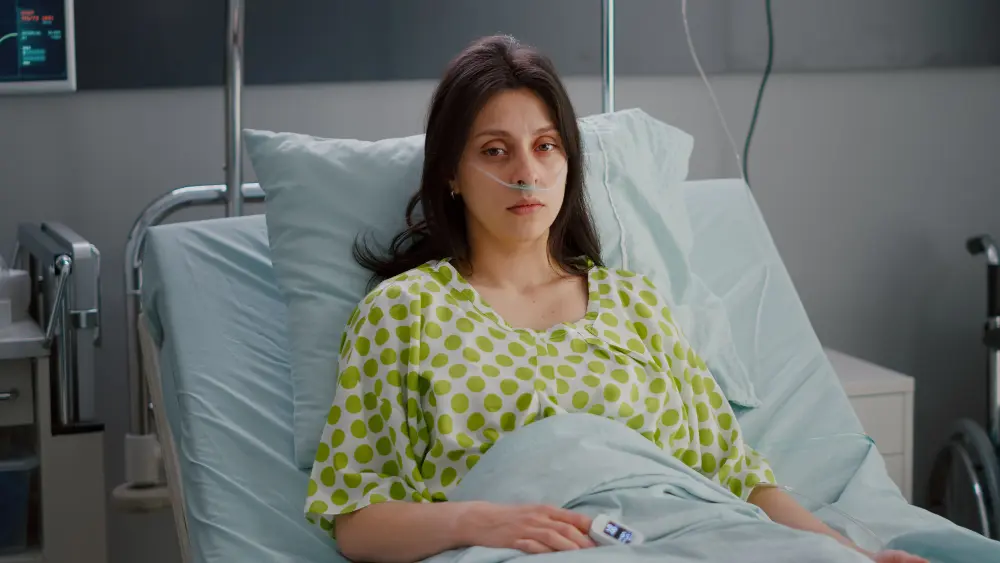
The first thing I saw when my eyes opened was a red dot.
It was a sticker, about the size of a dime. It sat in the top right corner of the clipboard hanging at the foot of my bed.
I’m a high school geometry teacher. In my classroom, a red dot on a paper means an assignment is overdue. I’ve stuck thousands of them on homework.
I didn’t know what one meant in an intensive care unit.
I would find out.
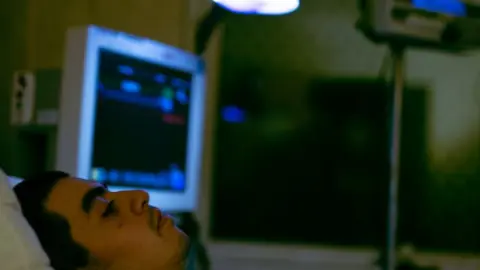
The room was dim. Machines beeped beside me. There was a tube in my nose and an IV in my left hand and a heavy, pulling ache across my stomach, like someone had sewn me shut with fishing line.
I tried to move my legs. They didn’t move. They were wrapped in something hard.
I tried to say something. Nothing came out.
The door slid open, and a nurse came in carrying a plastic water pitcher.
She was in her fifties, maybe. Short and solid, with gray streaks in her dark hair and reading glasses pushed up on her head. Her badge said DENISE ALVAREZ, RN.
She looked at me.
She stopped.
The pitcher froze in the air halfway to the tray table.
She didn’t look at me the way you’d look at a patient who was getting better. She looked at me like I’d climbed out of a grave.
“Oh my God,” she said quietly. “Oh my God. You’re awake.”
She set the pitcher down so fast that water slopped over the side.
Then she did something strange.
She walked straight to the foot of my bed. She picked up the clipboard. She hooked her thumbnail under the edge of the red sticker and peeled it off.
She crushed it in her fist.
“What was that?” I rasped.
My throat felt like gravel. Like I’d swallowed a handful of sand.
Denise looked at me. Her jaw was tight.
“Something that never should have been put there,” she said. “I’m getting Dr. Patel. I want him standing in this room when he sees you’re awake.”
She walked out.
She was still holding the crushed red dot in her fist.
Dr. Patel came ten minutes later.
He was tall and thin, about forty-five, with dark circles under his eyes like he hadn’t slept in a week. He pulled a little rolling stool up beside my bed and sat down. He folded his hands.
“Laura,” he said. “Can you hear me okay?”
I nodded.
“Do you know where you are?”
“Hospital,” I whispered.
“St. Luke’s. In Greer. You’ve been here eleven days.”
Eleven days.
“Do you remember what happened?”
I thought about it.
I remembered driving. Early. Still dark. The highway. Route 14, on my way to school. I’d had a stack of quizzes to grade before first period.
I remembered headlights.
Coming at me. On my side of the road.
Then nothing.
“A crash,” I said.
Dr. Patel nodded.
“A truck crossed the median and hit your car head-on,” he said. “You had severe internal bleeding. A ruptured spleen. Damage to your liver. Both legs broken. We did emergency surgery. Then two more surgeries after that.”
He paused.
“Clinically, you’re going to make a full recovery,” he said. “It’ll take time. Months. Physical therapy. But you’re going to walk again. You’re going to be okay.”
I let out a breath. It hurt.
“But there’s something you need to know,” he said.
He looked at Denise, who was standing by the door with her arms crossed.
“About the red dot?” I asked.
Dr. Patel took a long breath.
“About thirty minutes after the ambulance brought you in,” he said, “a man arrived. He said he was your father. Ralph Hawkins.”
My stomach went cold.
“He said he was your legal guardian,” Dr. Patel said. “Your decision-maker. And when our trauma team told him you needed emergency surgery right away, he refused to consent.”
I stared at him.
The machine beside me beeped. Steady. Then a little faster.
“He refused,” I said. “To save me?”
“I was standing three feet away, Laura.”
It was Denise. Her voice was shaking.
She came over to the bed. Her eyes were wet, but she was angry. Really angry. I could see it in her hands.
“He looked our lead surgeon right in the eye,” she said. “He looked at you on that table. And he said, ‘Let her go. We won’t pay for the surgery.’”
Ten words.
Let her go. We won’t pay for the surgery.
I lay there with those words in my head.
My father didn’t cry when he said them. Denise told me later that he didn’t even raise his voice. He said it the way he’d say it in a budget meeting. Cut that line. We won’t fund it.
“Did you listen to him?” I whispered.
“Of course not,” Denise said.
She leaned down closer to me.
“Your insurance card was in your purse,” she said. “Right in the front pocket. Full coverage through the school district. A zero-dollar deductible. We told him that, Laura. The second he walked in the door. We told him the surgery wouldn’t cost him a single penny.”
She straightened up.
“He knew,” she said. “He knew it wouldn’t cost him anything.”
My breathing went shallow. The monitor started beeping faster. Denise glanced at it and put her hand on my shoulder.
“Easy,” she said. “Easy. Breathe.”
“It wasn’t about money,” Dr. Patel said quietly.
He looked down at his folded hands.
“He’s not your legal guardian,” he said. “You’re thirty-eight. You don’t have a guardian. He had no documents. Nothing. Under the law, in an emergency like yours, we can treat you without consent. So we called our on-call attorney and went ahead.”
He paused.
“But it took time,” he said. “He made a scene. He threatened to sue. He demanded our administrator. He insisted you’d told him you’d never want to be kept alive on machines. He got one of our residents to flag your chart for comfort care while we sorted it out.”
He looked at the foot of my bed. At the empty corner of the clipboard.
“That’s what the red dot means,” he said. “Comfort care only. No heroic measures. Let her go.”
I closed my eyes.
“How long?” I said. “How long did it take you to sort it out?”
Dr. Patel didn’t answer right away.
“Forty-one minutes,” he said.
“You lost a lot of blood in those forty-one minutes,” Denise said. “A lot.”
Then Dr. Patel said something else.
“After he signed the refusal,” he said, “he walked out into the hallway. He made a phone call. Denise and I were right by the nurses’ station. We heard him.”
I opened my eyes.
“What did he say?”
Denise answered.
She said it exactly the way she’d heard it. Like she’d been saying it to herself for eleven days so she wouldn’t forget.
“He said, ‘It’s happening. Execute the inheritance clause. Before nine tomorrow morning. Before the board votes.’”
The room went completely silent.
Just the machines. Beep. Beep. Beep.
I lay there and looked at the ceiling tiles.
I’m a geometry teacher. I count things. I counted the ceiling tiles. Twelve across. Fourteen down. One hundred and sixty-eight. One of them had a little brown water stain in the corner shaped like Florida.
And while I counted, something in my chest changed.
The shock went out of me. Slowly. Like water running out of a bathtub.
What was left behind was very cold, and very still.
In my family, I was never really a daughter.
I was a line on a balance sheet. A negative one.
My father is Ralph Hawkins. He’s the president and CEO of Robinson Manufacturing. They make industrial valves and pump parts at a big brick plant on the east side of Greer, Michigan. Six hundred employees. Publicly traded. A small company, but a real one.
It wasn’t his company to start with.
It was my grandfather’s.
Walter Robinson started it in 1961 in a garage behind his house with two lathes and a borrowed truck. My mother, Brenda, was his only child. She married my father in 1982. Ralph was a young salesman with a nice smile and a good handshake.
My grandfather never liked him. He never said so. He didn’t have to.
When Grandpa retired, he made my father president. Because Brenda asked him to. Because Ralph was family. Because there wasn’t anybody else.
He told me years later it was the worst decision of his life.
I have a brother. Blake. He’s thirty-five. Three years younger than me.
Blake was the one who was going to build the dynasty. That’s what my mother always said. She said it at every Thanksgiving. Every Christmas. Every birthday dinner at the country club.
She had a particular sigh she did before she said it. Long. Slow. Through her nose. Like the whole world was very tiring.
“Laura is the one who costs,” she’d say. “Blake is the one who will build.”
I knew where that came from.
When I was eleven, I got sick. Kidney disease. A rare kind. I spent most of sixth grade in a hospital in Ann Arbor. Dialysis three times a week. Two surgeries. A transplant when I was twelve.
It was very expensive.
My parents never let me forget it.
“Do you know what you cost this family?” my father said to me once. I was fifteen. I’d asked for money to go on a school trip to Washington, D.C. Four hundred dollars. “Do you have any idea? Your hospital bills ate up half of everything we had.”
I didn’t go on the trip.
I didn’t take a dime from them after that. Not one.
I went to Central Michigan on scholarships and loans. I waited tables at a Big Boy for four years. I got my teaching certificate. I’ve taught geometry at Greer High School for fourteen years.
I drive an eight-year-old Subaru. I live in a little two-bedroom bungalow on Elm Street with a sagging porch and a lilac bush by the front door. I grade papers at my kitchen table with a red pen.
I don’t go to the country club.
I see my parents at Thanksgiving and Christmas and nowhere else. My mother does her sigh. My father asks if I’m still “playing teacher.” Blake talks about golf.
And there’s one more thing.
The thing my father has wanted for fourteen years.
When my grandfather died, when I was twenty-four, he left most of his estate in a trust.
He left me twenty-four percent of the voting shares of Robinson Manufacturing.
My parents together own twenty-seven percent. The rest is spread out among the public. Pension funds. Mutual funds. Regular people with retirement accounts.
Twenty-four plus twenty-seven is fifty-one.
A majority.
My grandfather knew exactly what he was doing.
He left a letter with his lawyer. For me. I read it the day after his funeral, sitting in the lawyer’s office in my black dress.
Laura,
Your father will want these shares. He’ll want them badly. Don’t give them to him.
The plant is six hundred families. It’s the town. Ralph doesn’t see that. He sees a number.
You see people. I know, because I watched you in that hospital in Ann Arbor. Every nurse, every orderly, every kid down the hall. You knew all their names.
I’m trusting you with the names.
Love,
Grandpa
So I kept the shares.
My father asked me for them. Then he asked again. Then he demanded. Then he stopped speaking to me for most of a year.
I kept them.
The trust has a few rules. Grandpa wrote them. I’ve read them a hundred times.
One rule is that I can’t sell the shares or give them away until I’m forty.
Another rule is that if I die before I turn forty, without children, my shares go to my mother.
I’m thirty-eight.
I don’t have children.
That’s the inheritance clause.
Execute it before nine tomorrow morning. Before the board votes.
I didn’t know what vote.
Not yet.
But lying in that ICU bed, counting ceiling tiles, I understood the most important part.
My father didn’t refuse my surgery because of money.
He refused it because if I died that morning, my twenty-four percent would pass to my mother. And he’d have a majority.
And something was happening at nine o’clock the next morning that he needed a majority for.
“Denise,” I said. “Do I still have my phone?”
She looked at me.
Then at Dr. Patel.
“It’s in your purse,” she said. “We charged it. You’ve got a lot of messages.”
“Can I have it?”
She hesitated.
“You need to rest, Laura. You just woke up.”
“I know,” I said. “I’m not going to call anybody. Not yet. I just need to see something.”
She brought me my purse.
I couldn’t hold the phone very well. My right hand was weak. My left had the IV in it. Denise held it up in front of my face for me.
Forty-seven missed calls.
Most from numbers I didn’t know. A few from my friend Meg, who teaches English across the hall from me. Two from my principal.
None from my parents.
Not one. In eleven days.
There were emails too.
I scrolled.
Most were from school. Get well cards from my students, scanned and sent by Meg. One from a girl named Destiny in my fourth-period class who’d drawn a picture of a triangle with a smiley face and written GET WELL SOON MS. HAWKINS, YOU’RE THE HYPOTENUSE OF MY HEART.
I almost laughed. It would have hurt too much.
And one email from an address I knew.
Eleanor Vance.
Eleanor is seventy-four years old. She was my grandfather’s lawyer for thirty years. Then she was his friend. When he died, she became the trustee of my trust. She’s also on the board of Robinson Manufacturing. The lead independent director.
She’s the only person on that board my father has never been able to charm.
Her email was dated nine days earlier. Two days after the crash.
Laura —
I’ve just learned about your accident. I’ve been trying to reach you. The hospital won’t tell me anything because I’m not family.
Your father called an emergency board meeting for the morning after your crash. 9 a.m. To approve the sale of the company to Kessler Capital. He told the board he had the votes.
The meeting didn’t happen. His lawyers withdrew the agenda at 8:15 that morning without explanation.
It’s been rescheduled for next Friday.
I don’t know what’s going on. But I don’t like it. Please call me the moment you can.
— E.
Kessler Capital.
I knew that name.
They’re a private equity firm in Chicago. They buy companies like ours. Small. Old. Family-run. They cut costs. They sell off pieces. They move production to Mexico or China.
They’d tried to buy Robinson Manufacturing three years ago. My father wanted to sell. I said no. My twenty-four percent made it impossible.
The plant would close. Six hundred families.
The names.
My father had been racing the clock that morning.
If I died before nine a.m., my shares would go to my mother. He’d have fifty-one percent. The sale would go through.
And I didn’t die.
So his lawyers pulled the agenda at 8:15.
I lay back on my pillow.
“Denise,” I said. “When is next Friday?”
She looked at the calendar on the wall.
“It’s Monday today,” she said. “So. Four days.”
On the fourth afternoon after I woke up, the door to my room slid open.
“My girl!”
The voice boomed down the quiet ICU hallway. Rich and warm and loud. The way it sounds at company Christmas parties and Rotary Club lunches.
My father walked in carrying the biggest flower arrangement I’ve ever seen. Lilies and roses and orchids and some kind of tall tropical thing with orange spikes. It was so big he had to turn sideways to fit through the door.
My mother came in behind him. She was wearing a cream-colored coat and her pearls. Her face was arranged into something sad and holy. Like a woman in a painting at church.
“Look at you,” my father said.
His voice caught. His eyes filled with tears. Right on cue.
He set the flowers on the windowsill. They blocked half the light.
He came to the bed. He leaned over the rails. He hugged me, carefully, around the shoulders. He smelled like sandalwood cologne and cigars.
“God was watching over us, Laura,” he said into my hair. “When they told us about the crash, I thought my heart was going to burst right out of my chest.”
I didn’t hug him back.
I couldn’t, really. My arms were weak. But I wouldn’t have anyway.
The warmth lasted exactly three seconds.
Then he pulled back.
The tears were gone. Just like that. Like someone had turned off a faucet. His eyes went flat and sharp.
Behind him, my mother slid the glass door closed. She pulled the curtain across it.
My father opened his leather briefcase.
He took out a thick stack of papers held together with a black binder clip.
He dropped it on my legs. On the hard casts. I felt the weight of it through the plaster.
“I need you to be sharp right now, Laura,” he said.
His voice was low. Very low. So low the heart monitor was almost louder.
“The accident report came in,” he said. “The truck that crossed the median into your lane. It was a company truck. A Robinson truck.”
He paused.
“Blake was driving,” he said.
I stared at him.
“Blake?”
“Six-fifteen in the morning,” my father said. “Coming back from somewhere he shouldn’t have been. He’d been drinking. He fell asleep at the wheel.”
His jaw tightened.
“If this goes public,” he said, “our stock collapses. Kessler walks away. And your brother’s future is destroyed.”
He took a heavy gold fountain pen out of his coat pocket. He unscrewed the cap.
He put it in my right hand. My weak hand. He closed my fingers around it.
“Sign this,” he said. “It’s a statement. It says you crossed the center line first. That you lost control. Ice on the road. Blake swerved to avoid you.”
My throat was dry.
“Dad,” I said. “There wasn’t any ice. It was October.”
“Sign it, Laura.”
“I was in my lane.”
He leaned down close to my face.
“I paid the bills that saved your life when you were eleven,” he said. “Remember? Every dialysis. Every surgery. The transplant. Half of everything we had.”
He didn’t blink.
“It’s time you settled the tab,” he said.
My stitches throbbed across my stomach. My legs ached under the casts. The pen was heavy in my hand.
And a very strange stillness came over me.
I’d been Ralph Hawkins’s daughter for thirty-eight years. I’d never once seen him as clearly as I saw him right then. Standing over my hospital bed with a gold pen and a lie.
“You were here,” I said quietly. “That morning. Weren’t you, Dad? The morning they brought me in.”
His smile stuttered.
Just for half a second. A tiny flinch at the corner of his mouth. Most people would never have noticed it.
I noticed. I grew up watching for that flinch. It’s the face he makes when somebody at the dinner table asks him a question he doesn’t want to answer.
“I was beside myself, sweetheart,” he said smoothly. He waved his hand. “Total chaos. That emergency room was a disaster. Incompetent doctors. Nurses screaming at each other.”
He smiled.
“But look at you,” he said. “Survived against all the odds. A true Hawkins.”
My mother came over to the bed.
She leaned down and pressed her cheek against my forehead. Her skin was dry and cool and smelled like face powder.
“We’ve been praying for you every day,” she murmured. “Every single day, Laura.”
I didn’t feel it. I didn’t feel anything. I was watching my father.
He pulled the vinyl chair over to the bed. He sat down.
He took the statement off my legs. He set it on the tray table.
Then he opened his coat. He took out a black leather clipboard.
“Okay,” he said. “Forget the statement for now. We’ll deal with that tomorrow. Now that the fog’s clearing, there’s some routine housekeeping we need to handle.”
His voice changed again.
It went soft. Velvety. Conspiratorial. I’d heard him use it on the phone with bankers. On board members he was trying to bring around. On my mother, when he wanted something.
“You’re going to be in bed for months, Laura,” he said. “You can’t take care of anything. Your bills. Your house. Your insurance. Your accounts. It’s too much.”
He held out the clipboard.
“I had our corporate lawyers draw this up,” he said. “A durable power of attorney. Financial. Property. Medical. The whole umbrella. Just sign the bottom line, and your old man takes care of every headache.”
I looked down at it.
The heading was in bold black letters.
GENERAL DURABLE POWER OF ATTORNEY AND ASSIGNMENT OF ALL EQUITABLE INTERESTS.
I’m not a lawyer.
But I’m a geometry teacher. I know how to read a proof. I know how to follow a line of logic from one step to the next and see where it ends up.
All Equitable Interests.
That meant the trust. That meant my shares. That meant my vote.
It wasn’t help.
It was surrender.
He’d come to my hospital bed four days after I woke up. Eleven days after he stood in the emergency room and said Let her go.
And he’d brought me a document that would hand him everything Grandpa left me.
Wrapped up in a father’s concern.
“My head’s still spinning from the morphine, Dad,” I whispered.
I nudged the clipboard. Gently. Toward the far edge of the tray table. Out of his reach.
“Leave it,” I said. “I’ll read it when the nurse comes to change my IV.”
The warmth went out of his face.
Completely. Like breath fogging off a window.
His jaw went hard. His eyes narrowed down to slits.
“Laura,” he said. “This can’t wait.”
“Why not?”
“Because the—” He stopped. “Because the plant’s lenders—”
He caught himself.
“Your personal creditors,” he said. “Your personal creditors need this signed by Friday at noon.”
“I don’t have any personal creditors, Dad,” I said. “I paid off my car two years ago. I have a mortgage on my house. That’s it. Seven hundred and eighty-two dollars a month. I’ve never been late.”
He didn’t say anything.
“So whoever needs this by Friday at noon,” I said, “can wait until Friday at noon.”
I didn’t blink.
Neither did he.
His knuckles went white around the gold pen.
The silence stretched out between us. Just the heart monitor. Beep. Beep. Beep. Steady and calm and not caring about any of it.
My mother stood by the curtain. She didn’t move.
Then my father stood up.
He leaned over the bed rail. Close. So close I could feel his breath against my ear. Warm and smelling like coffee and cigars.
He whispered.
“Sweetheart,” he said. “Do you honestly think that surgeon showed up in time by luck?”
I went cold all over.
“Forty-one minutes,” he whispered. “That’s how long it took them to get past me. Forty-one minutes, Laura. You were bleeding the whole time.”
His lips were almost touching my ear.
“Sign the paper,” he said. “Before I decide who gets to walk into this room next.”
He straightened up.
He smiled at me. That big warm Rotary Club smile.
He buttoned his coat. He picked up his briefcase.
“Think about it, sweetheart,” he said, loud enough for anyone outside the curtain to hear. “No pressure. Your mother and I will come back tomorrow.”
My mother pulled the curtain back. She slid the door open.
She didn’t look at me.
They walked out.
The huge flower arrangement sat on the windowsill, blocking the light.
I lay there shaking.
I couldn’t stop. My hands. My shoulders. My teeth. Everything.
The heart monitor was beeping fast. Faster. A little alarm started chiming.
Denise came in at a run.
She looked at the monitor. Then at me.
“Laura. What happened? What’s wrong?”
I couldn’t talk at first.
I just held up my phone.
It had been under my blanket. Under my right hand. The whole time.
I’d started recording when I heard my father’s voice in the hallway.
My Rotary Club father. Booming. My girl!
I didn’t plan it. Not really. I just knew. The way you know a storm is coming when the air changes. I’d slid my right hand under the blanket and found the phone and pressed the red button with my thumb.
It had been running the whole time.
Twenty-two minutes and fourteen seconds.
Denise took the phone out of my hand.
She looked at the screen.
She looked at me.
“Did he—” she said.
I nodded.
“Everything,” I said. “The truck. Blake. The statement. The power of attorney.”
I swallowed.
“And what he whispered,” I said. “At the end.”
Denise didn’t say anything for a moment.
Then she went to the window. She picked up the enormous flower arrangement.
She carried it out of the room and dropped it in the big gray trash bin in the hallway.
She came back. She sat down on the stool where Dr. Patel had sat.
“Tell me,” she said.
I told her.
When I was done, she was very quiet.
Then she said, “I’m calling security. Right now. And hospital administration. And I’m putting you on a privacy hold. No visitors. Nobody gets in this room unless your name is on the list.”
“Can you do that?”
“Watch me,” Denise said.
She picked up the phone on the wall.
Then she stopped. She turned around.
“Laura,” she said. “What else do you need?”
I looked at the clock over the door.
6:38 p.m.
I thought about Eleanor Vance’s email. Rescheduled for Friday.
I thought about my father saying, Friday at noon.
I thought about him leaving. Not going home. Going somewhere. With his briefcase. With his gold pen.
I’d checked the company’s website that morning. On my phone. I check it sometimes. I’m a shareholder.
There was an investor notice I’d missed. Posted two days ago.
Robinson Manufacturing Board of Directors — Special Session. Thursday, 7:00 p.m. Eastern. Teleconference. Agenda: Approval of Definitive Merger Agreement with Kessler Capital Partners, subject to shareholder vote Friday.
Thursday.
Today was Thursday.
He’d come to my hospital room to get my signature twenty-two minutes before his board meeting.
If I’d signed, he’d have walked into that meeting with fifty-one percent.
“Denise,” I said.
My voice was steady. Steadier than it had been since I woke up.
I looked at my purse on the corner table.
“Hand me my phone,” I said. “My father’s board meeting starts in twenty minutes.”
I called Eleanor Vance at 6:41 p.m.
She picked up on the second ring.
“Laura?” she said. Her voice was sharp and clear. Seventy-four years old and still the sharpest person I know. “Laura, is that you? My God. Are you all right?”
“I’m okay, Eleanor. I’m awake. I’m going to be okay.”
I heard her let out a long breath.
“I’ve been calling that hospital for two weeks,” she said. “They wouldn’t tell me anything. Your father put a block on—”
“I know,” I said. “Eleanor, listen. I need to tell you something. Before your meeting at seven.”
There was a pause.
“How do you know about the meeting?”
“It’s on the website.”
Another pause.
“Go ahead,” Eleanor said.
I told her everything.
The red dot. Let her go. We won’t pay for the surgery. The zero-dollar deductible. Forty-one minutes.
The phone call in the hallway. Execute the inheritance clause. Before nine. Before the board votes.
Blake. The company truck. Drinking. Six-fifteen in the morning.
The statement. Ice on the road in October.
The power of attorney. All equitable interests. Friday at noon.
And what he whispered in my ear.
Do you honestly think that surgeon showed up in time by luck?
When I was done, Eleanor didn’t say anything for a long time.
So long I thought the call had dropped.
“Eleanor?”
“I’m here,” she said.
Her voice was different now. Very quiet. Very cold.
“Do you have the recording?” she said.
“Yes.”
“The whole thing?”
“Twenty-two minutes.”
“Can you send it to me? Right now?”
“Yes.”
“And the nurse. The one who heard him in the emergency room. And the doctor. Would they be willing to speak to the board? Tonight?”
I looked up at Denise.
She was standing by the bed. She’d heard every word.
She didn’t even hesitate.
“Tell her yes,” Denise said. “And tell her I’ll get Dr. Patel. He’s still in the building.”
“Yes,” I said to Eleanor.
“Okay,” Eleanor said. “Here’s what’s going to happen.”
I want to be clear about something.
I didn’t do what happened next. Not really.
I made one phone call. That’s all.
Everything after that was Eleanor Vance. And Denise Alvarez. And Dr. Patel. And eight other people on a board of directors who’d spent years being charmed and bullied and lied to by my father, and who finally had a reason to stop pretending.
At 7:00 p.m., the special session of the Robinson Manufacturing board of directors began. By teleconference.
My father opened the call from his home office. Eleanor told me later he sounded like a man about to win.
“Good evening, everyone,” he said. “Thank you for making time on short notice. As you know, we’re here to finalize the Kessler agreement ahead of tomorrow’s shareholder vote. I’m pleased to report that I’ve secured—”
“Ralph,” Eleanor said. “Before we begin. A point of order.”
She asked to go into executive session. That’s when the independent directors meet without the CEO.
He objected.
She had the votes.
He was dropped from the call.
Then Eleanor played them the recording.
All twenty-two minutes and fourteen seconds.
Eight board members. Two lawyers. Sitting in their homes and offices around Michigan and Illinois and Ohio, listening to my father stand over my hospital bed and tell me to settle the tab.
Then Denise spoke.
She stood in the hallway outside my room with her phone pressed to her ear and told them what she heard in the emergency room. Let her go. We won’t pay for the surgery. Execute the inheritance clause. Before nine. Before the board votes.
Then Dr. Patel spoke. He told them about the forty-one minutes. About the false claims of guardianship. About the comfort-care flag. About the hospital’s legal team, which had already opened an internal review and contacted the county prosecutor’s office two days ago.
I didn’t know that part.
Dr. Patel told me afterward. He sat on the edge of the stool and rubbed his face.
“I should have told you,” he said. “I wanted you stronger first. We’d been waiting for you to wake up. Our lawyers wanted your statement.”
And then the board’s general counsel spoke.
A man named Harold Fenwick. He’d been with the company eighteen years. He was very quiet on the call. Eleanor said she thought he was going to be sick.
He told them that three weeks ago, the company’s safety department had flagged a problem. A company truck had been logged out of the fleet yard at 4:52 a.m. on the morning of October 14th. It came back on a flatbed at 8:30 a.m., with the front end crushed.
The driver listed on the log was Blake Hawkins.
The log had been deleted from the system two days later.
On my father’s authorization.
Harold Fenwick had kept a copy.
“I didn’t know what to do with it,” he said on the call. “Ralph is—Ralph was my boss. I have three kids in college.”
He paused.
“I’m sorry,” he said. “I should have come forward sooner.”
The board voted at 8:47 p.m.
Seven to one.
The one was a golf buddy of my father’s from the country club.
They removed Ralph Hawkins as President and Chief Executive Officer of Robinson Manufacturing, effective immediately.
They removed him as Chairman of the Board.
They suspended all his authority to act on the company’s behalf. His access to company accounts, systems, and buildings.
They revoked his use of the company residence. That’s the big old Robinson house on Lakeview Drive where my parents live. Grandpa built it in 1958. The company has owned it since 1985. My father had lived in it rent-free for thirty-five years.
They referred everything to outside counsel and law enforcement.
And they voted unanimously, eight to zero, even the golf buddy, to terminate negotiations with Kessler Capital.
Eleanor called me at 9:15 p.m.
“It’s done,” she said.
I was lying in the dark. Denise had turned the lights down. The privacy hold was on my door. There was a security guard sitting in a chair in the hallway. A big, quiet man named Leonard who’d brought a crossword puzzle book.
“What happens now?” I said.
“Now,” Eleanor said, “Harold Fenwick drives to the house on Lakeview Drive with two security officers and a letter. Tonight. And tomorrow morning, at seven, there’s going to be a press release.”
She paused.
“Laura,” she said. “Your grandfather would be proud of you.”
I didn’t say anything. I couldn’t.
“He’d also tell you to get some sleep,” Eleanor said. “So do that.”
I didn’t sleep.
I lay there in the dark and thought about my father.
I thought about him opening his front door at ten o’clock at night and finding Harold Fenwick standing there with two security guards and a letter.
I thought about him reading it.
I wondered if his smile stuttered.
At 7:00 a.m., the press release went out.
Robinson Manufacturing announced the immediate removal of its President, CEO, and Chairman, Ralph Hawkins, following an internal review. The company announced it had ended discussions with Kessler Capital. It said it was cooperating fully with law enforcement. It named Eleanor Vance as interim Chair.
The stock dropped eleven percent before lunch.
By the end of the week, it was back up four.
By eight in the morning, my father had lost his job, his title, his company car, his corporate credit cards, his office, and his house.
By nine, he’d lost the deal he’d been chasing for three years.
By ten, two detectives from the Greer Police Department were sitting in my hospital room with a tape recorder, asking me to start from the beginning.
I want to be honest about the next few weeks.
They were awful.
My father didn’t go quietly. Of course he didn’t.
He hired lawyers. Three of them. Expensive ones from Detroit. They sent letters to the hospital, the board, the police. They said the recording was illegal, which it wasn’t. Michigan lets you record a conversation you’re part of. They said I was confused from the morphine, which I wasn’t. They said Denise Alvarez was a disgruntled employee with a grudge, which she wasn’t.
They said my father was a grieving parent who’d panicked in the emergency room and said things he didn’t mean.
My mother called the hospital fourteen times. She left messages at the nurses’ station. Denise wrote them all down.
Laura, please call me.
Laura, your father is under so much stress.
Laura, you’re destroying this family.
Laura, how could you do this to your brother?
I didn’t call her back.
Blake came to see me three weeks later.
I was out of the ICU by then. In a regular room on the fourth floor. My legs were still in casts. I’d started physical therapy. A woman named Tasha came every morning and made me bend my knees until I cried.
I was sitting up in bed grading quizzes. Meg had brought them from school. My sub was a retired teacher named Mr. Albrecht who apparently couldn’t explain the Pythagorean theorem without drawing a picture of a baseball diamond.
Leonard knocked on the door.
“Ms. Hawkins,” he said. “There’s a man here. Says he’s your brother. He’s not on the list. He says he’ll wait as long as he has to.”
I sat there with my red pen in my hand.
“Is he alone?” I said.
“Yes, ma’am.”
“Is he sober?”
Leonard looked over his shoulder. Then back at me.
“Looks like it,” he said. “Looks like he’s been crying, though.”
I put the pen down.
“Let him in,” I said. “But stay in the room.”
My brother looked terrible.
He’d lost weight. His face was gray and puffy. He’d grown a beard, a patchy one, the kind men grow when they stop caring. He was wearing a sweatshirt and jeans. Not his usual golf polo and khakis.
He stood in the doorway for a long time.
He looked at my legs. The casts. The IV pole. The scars on my hands from the windshield glass.
Then he started crying.
“I’m sorry,” he said. “Laura. I’m so sorry. I’m so sorry. I’m so sorry.”
I didn’t say anything.
Leonard stood by the window with his crossword puzzle book. Not reading it.
Blake sat down in the chair by the bed. The one my father sat in. He put his face in his hands.
“I don’t remember it,” he said. “The crash. I don’t remember any of it. I was at a party in Lansing. A client thing. I had—a lot. I shouldn’t have driven. I know that. I know that.”
He looked up at me.
“I woke up in my own bed at eleven in the morning,” he said. “And Dad was standing there. And he said, ‘Don’t say anything. To anybody. I’ll handle it.’”
“Did you know it was me?” I said. “That you hit?”
He didn’t answer.
He looked down.
“Blake.”
“He told me that night,” Blake said. “He said it was you. He said you were hurt bad. He said you might die.”
He wiped his face with his sleeve.
“He said if you died,” Blake said, “it would solve everything.”
The room went completely silent.
Leonard put down his crossword book.
“I threw up,” Blake said. “When he said it. In the kitchen sink. Mom was standing right there. And she just—handed me a towel.”
I closed my eyes.
“I’ve been drinking since,” Blake said. “Every day. I haven’t been sober since the night of the crash. Until three days ago.”
He looked up at me.
“The police came to see me,” he said. “On Monday. They had the truck log. The one Dad deleted. Harold Fenwick gave it to them.”
He swallowed.
“I told them,” he said. “Everything. That I was driving. That I’d been drinking. That Dad told me to keep my mouth shut. That he had somebody at the yard swap out the truck’s dashcam. I told them all of it.”
I opened my eyes.
“Why?” I said.
Blake looked at me for a long time.
“Because you could have signed it,” he said. “Dad told me about the statement. Ice on the road. He said you’d sign it for me. Because you always do what you’re supposed to do.”
His voice cracked.
“And you didn’t,” he said. “You lay there with two broken legs and a ruptured spleen, and you told him no.”
He shook his head.
“I’ve never told him no in my life,” he said. “Not once. Thirty-five years. I don’t even know how.”
He was crying again.
“I’m going to prison,” he said. “My lawyer says probably. Two years, maybe. Maybe more. Operating while intoxicated causing serious injury. It’s a felony.”
He looked at me.
“I deserve it,” he said. “I know I do. I just wanted you to hear it from me. That I’m sorry. And that I told the truth.”
I didn’t forgive him that day.
I want to be honest about that.
I lay in my hospital bed and looked at my little brother. Thirty-five years old. Crying in a hooded sweatshirt. The one who was going to build the dynasty.
I thought about the headlights coming at me on Route 14. On my side of the road.
I thought about the forty-one minutes.
I thought about him throwing up in the kitchen sink. And my mother handing him a towel.
“Blake,” I said finally.
He looked up.
“Go to meetings,” I said. “AA. Every day. Get sober. Stay sober.”
He nodded.
“Go to prison if you have to,” I said. “Do your time.”
He nodded again.
“And when you get out,” I said, “if you’re still sober, you can come see me. And we’ll talk.”
He stared at me.
“That’s it?” he said.
“That’s it. For now.”
He stood up.
He stood by the bed for a moment. Like he wanted to hug me. Like he wasn’t sure if he was allowed.
He wasn’t. Not yet.
He seemed to understand that.
He nodded one more time. And he left.
Leonard picked up his crossword puzzle book.
He looked at me over the top of it.
“Ma’am,” he said quietly. “For what it’s worth. I think you did right.”
Blake pleaded guilty in February.
Operating while intoxicated causing serious impairment of a body function. That’s what Michigan calls it. He got two years in state prison. And five years of probation after that.
He went in on a Monday.
He wrote me a letter that first week. Two pages, on lined paper. He said he’d been to six meetings. He said the coffee was terrible. He said he was sorry.
He’s written every week since.
My father was charged in March.
Not with attempted murder. The prosecutor said there wasn’t enough to prove that. You can’t convict a man for wishing his daughter dead. You can’t convict a man for delaying surgery, even by forty-one minutes, when the doctors went ahead anyway.
But you can convict him for other things.
Tampering with evidence. The truck log. The dashcam.
Obstruction of justice.
Witness intimidation. That was the whisper. Before I decide who gets to walk into this room next. On a recording. Twenty-two minutes and fourteen seconds.
And making false statements to a medical provider. Claiming to be my guardian.
His Detroit lawyers fought it for seven months.
In October, a year after the crash, he took a plea deal.
Eighteen months in county jail. Three years of probation. A fine. And a lifetime ban from serving as an officer or director of any public company. The SEC added that last part on its own.
I went to his sentencing.
I didn’t have to. Eleanor told me I didn’t have to. Denise told me I didn’t have to.
I went anyway.
I walked into that courtroom on crutches. My legs still weren’t right. They might never be all the way right. Tasha said I’d always have a little limp.
I sat in the second row.
My father sat at the defense table in a gray suit. He looked smaller. Older. His hair had gone completely white.
When the judge asked if anybody wanted to make a statement, I stood up.
I didn’t plan to. But I did.
I walked up to the podium on my crutches. I looked at the judge. Then at my father.
“When I was eleven,” I said, “I was very sick. I almost died. I needed a kidney transplant.”
My father didn’t look at me.
“My whole life,” I said, “my parents told me I cost this family. My father told me he paid every bill. Half of everything they had.”
I took a breath.
“After my grandfather died,” I said, “his lawyer gave me a box of his papers. I didn’t open it for years. I opened it last month. In the hospital.”
My father looked up.
“Inside,” I said, “there were receipts. From the hospital in Ann Arbor. From 1997 and 1998. Every single dialysis. Every surgery. The transplant.”
I looked at my father.
“My grandfather paid them,” I said. “All of them. Out of his own pocket. Three hundred and eighty-two thousand dollars.”
The courtroom was very quiet.
“There was a note,” I said. “In his handwriting. Paper-clipped to the last receipt.”
I’d memorized it. I’d read it so many times.
Brenda and Ralph don’t need to know this came from me. Let them think they did it. Maybe it’ll make them love her more.
My father’s face didn’t change.
But his hands, on the defense table, went very still.
“You never paid for anything, Dad,” I said. “You never paid for my life. Not when I was eleven. And not when I was thirty-eight, lying on a table in the emergency room, when it wouldn’t have cost you a single penny.”
I put my hands on the podium.
“I don’t owe you a tab,” I said. “I never did.”
I went back to my seat.
My father didn’t look at me again.
My mother wasn’t at the sentencing.
She’d left him in June.
Eleanor told me. She heard it from someone at the country club. My mother had moved into a condo in Grand Rapids. She’d filed for divorce. She’d hired her own lawyer.
She didn’t call me.
Not that month. Not the next.
She called in September.
I almost didn’t answer. I was in my classroom after school, grading. I saw her name and sat there with my red pen in my hand and let it ring four times.
On the fifth ring, I picked up.
“Laura,” she said.
She sounded old. Tired.
“Hi, Mom.”
Neither of us said anything for a long time.
Then she said, “I knew about your grandfather. Paying the bills. I always knew.”
I didn’t say anything.
“Your father never knew,” she said. “I never told him. I let him think he’d done it. I let him say it to you. Over and over. For twenty-six years.”
She was quiet.
“I don’t know why,” she said. “I think it was easier. If you were the one who cost, then nobody had to look at anything else.”
“Did you know?” I said. “In the emergency room? What he was doing?”
There was a very long silence.
“I was in the car,” she said finally. “In the parking garage. He told me to wait in the car. He came out forty-five minutes later and said, ‘It’s done. Either way, it’s done.’”
She took a breath.
“I didn’t ask what he meant,” she said. “I never asked him anything. For forty years.”
I sat in my empty classroom.
The sun was going down outside the windows. The light was coming in gold across the desks. Somebody had left a calculator on the floor by the third row.
“Mom,” I said. “Why are you calling?”
She didn’t answer right away.
“I don’t know,” she said. “I think I wanted to hear your voice. I think I wanted you to know I’m sorry. Even though sorry doesn’t mean anything. Even though it’s thirty-eight years too late.”
I thought about it for a long time.
I thought about her dry cheek against my forehead in the ICU. Her pearls. Her sigh.
Laura is the one who costs.
“I’m not ready, Mom,” I said. “To see you. I don’t know when I will be.”
“I understand.”
“Maybe someday.”
“Okay.”
“But you can call,” I said. “Once a month. If you want. And we’ll see.”
She was quiet.
“Thank you, Laura,” she said.
It was the first time in my life I’d heard her say thank you to me.
I went back to school in January. Three months after the crash.
On crutches. Then a cane. Then nothing. Just a little limp.
My students had decorated my classroom. Streamers. A banner across the whiteboard that said WELCOME BACK MS. HAWKINS!!! in bubble letters. Destiny, from fourth period, had drawn a giant triangle with a smiley face and written underneath it:
YOU ARE STILL THE HYPOTENUSE OF OUR HEARTS.
I stood in the doorway and cried.
Twenty-eight teenagers stared at me in horror.
“Ms. Hawkins,” said a boy named Marcus in the front row. “Are you okay? Do you need the nurse?”
“I’m fine,” I said. “I’m fine. Open your books to chapter seven.”
I still have my twenty-four percent.
I’ll turn forty this year. After that, I can do whatever I want with the shares.
I’m not going to sell them.
Eleanor asked me to join the board in the spring. I said no at first. I’m a geometry teacher. I don’t know anything about industrial valves.
“You don’t have to know about valves,” Eleanor said. “We have engineers for that. We need somebody who knows the names.”
So I said yes.
I go to board meetings four times a year. I sit at the end of the table in my cardigan and my sensible shoes. I don’t say much. But when somebody brings up a plan to cut costs by closing a line, or moving production out of state, I ask one question.
“How many families?”
The company hired a new CEO in July. A woman named Rachel Okonjo. She came up through the plant. She started on the floor at nineteen running a lathe. She knows half the workers by their first names.
Kessler Capital never came back.
The plant is still open. Six hundred and twelve employees now. They hired a second shift in September.
Denise Alvarez came to my house for dinner in November.
A year and a month after the red dot.
I made lasagna. She brought wine. We sat at my kitchen table on Elm Street. The same table where I grade papers. Where I graded papers the night before the crash, before I drove out on Route 14 in the dark with a stack of quizzes on the passenger seat.
After dinner, Denise reached into her purse.
She took out a small white envelope.
She slid it across the table to me.
“I’ve been carrying this around for a year,” she said. “I didn’t know whether to give it to you. Or throw it away.”
I opened the envelope.
Inside was a crumpled little red sticker. About the size of a dime. Creased and wrinkled from being crushed in a nurse’s fist.
I looked at it for a long time.
Comfort care only.
Let her go.
“I’m sorry,” Denise said. “Maybe I shouldn’t have—”
“No,” I said. “I’m glad you kept it.”
I didn’t throw it away.
I didn’t frame it either. That seemed strange.
I put it in the top drawer of my desk at school. In the back. Under my box of red pens.
Every day, I stick red dots on homework.
Little round stickers. A whole roll of them. I buy them at Staples. In my classroom, a red dot means a paper is late. That’s all. Turn it in tomorrow. I’ll take five points off. You’ll be fine.
Sometimes, after the kids leave, I open that top drawer.
I look at the crumpled one in the back.
Then I close the drawer, and I go back to grading.
In my classroom, a red dot means an assignment is overdue.
Nothing more.
I’ve made sure of that.