The first time the school called about my daughter’s hair, I was standing in the cereal aisle at Kroger with a box of Cheerios in each hand.
It was a Monday in October, a little after one. I work three days a week at a dental office in Dayton, doing the billing, and Mondays are my day off. I saw the school’s number on my phone and put both boxes in the cart without looking at which ones they were.
“Mrs. Carter? This is Diane in the front office at Hillcrest Elementary. Lily’s fine. Nobody’s hurt. Mr. Hayes asked if you could come in when you get a chance. She’s been sitting with him.”
“Sitting with him why?”
There was a little pause. “I think he’d like to talk to you about it in person.”
I left the cart by the deli counter with the cereal in it. I’m still a little sorry about that.
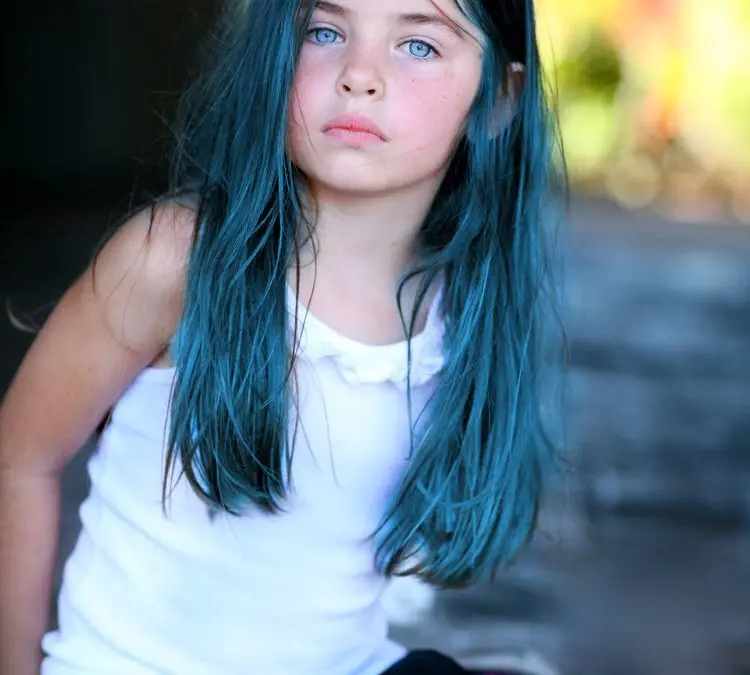
Lily is eight. She’s my only child. She’s in third grade, she reads faster than I do, and she’s been asking to dye her hair blue since she was five. Every birthday and Christmas she’d ask, and every time I said “when you’re older.” Over the summer my husband, Mike, finally said, “Rach, what’s older? It’s hair. It grows.” I didn’t have an answer for him.
So on the Saturday before, Lily and I went to Walgreens and bought a jar of semi-permanent dye for $14.99. It was a shade called Blue Lagoon, and the label promised it would wash out in four to six weeks. We put a trash bag over her shoulders in the bathroom and wore the plastic gloves that came in the box. We stained the grout around the tub, and Mike still hasn’t forgiven me for it. When it was done, Lily stood on the toilet lid to see herself in the mirror and didn’t say anything for a whole minute.
Then she said, “I look like me.”
On Sunday she painted her nails black with a bottle of polish she’d been saving from her cousin Ava’s sleepover. She wore Mike’s old denim jacket around the house all afternoon, the one from before we were married. It comes to her knees, and she rolls the sleeves up four times.
Mike’s a lineman for the electric company. On Sunday night he got called down to Florida with a crew for hurricane cleanup. He kissed Lily goodbye in her bedroom and told her she looked like a rock star. He’d be gone at least ten days.
When I got to Hillcrest that Monday, Lily was sitting on the bench outside the principal’s office. She had the jacket zipped all the way up to her chin and her backpack in her lap, and she was staring at her shoes. Her face was blotchy. She’d been crying and had stopped, which with Lily is worse than crying.
She saw me and didn’t get up.
Mr. Hayes came out of his office. He’s maybe forty, tall, with the kind of tie you buy in a three-pack. I’d met him exactly once, at the open house in August.
“Mrs. Carter. Thanks for coming. Lily, can you sit tight for a minute?”
Inside his office he didn’t sit down, so I didn’t either.
“I want to say first that Lily isn’t in trouble,” he said. “Mrs. Collins sent her down this morning because there was some disruption in the classroom around her appearance. I talked to her about the dress code. I wanted to give you a heads-up.”
“What kind of disruption?”
“Some of the other students were reacting to her hair.”
“Reacting how?”
He chose his words. “Making comments.”
“What comments?”
“I wasn’t in the room, Mrs. Carter. Mrs. Collins felt it was getting out of hand, and she thought it would calm down faster if Lily came to the office for a while.”
“How long has she been sitting on that bench?”
He looked at the clock on the wall. “Since about ten-fifteen.”
It was ten after two.
“She’s been out of class for four hours,” I said. “Because other kids made comments about her.”
“She had lunch in the office. Diane sat with her.”
I took Lily home. She didn’t say anything in the car. When we got in the house, she went straight to her room and shut the door. I stood in the hall for a while. Then I knocked and went in. She was lying face down on her bed with the jacket still on.
“Do you want to tell me what happened?”
She told me into her pillow, in pieces. A boy named Tyler had called her a witch before the bell even rang. Some kids laughed. Then a girl said blue hair was ugly. Somebody said she looked like a monster from a movie. Somebody else said her nails were creepy and she was a weirdo. Mrs. Collins was doing the morning math warmup. Lily said Mrs. Collins looked at her, at her hair, and then said, “Okay, everybody, eyes up here.” That was all.
It didn’t stop. At recess, Tyler and two other boys followed her around the playground making witch noises. When they came back inside, it started again during spelling. Lily said she told Tyler to stop it and he said, “Make me, monster.” She stood up from her desk. That’s when Mrs. Collins came over.
“What did Mrs. Collins say?”
Lily turned her head on the pillow. “She said, ‘Lily, your appearance is becoming a distraction. Why don’t you go down and see Mr. Hayes for a little while until everyone settles down.'”
“In front of everybody?”
“Yeah.”
“And what did Tyler do?”
“He said, ‘See? Even Mrs. Collins thinks you look bad.'”
I sat on the edge of her bed. I’ve never wanted to drive somewhere and yell at a grown woman so badly in my life.
“Sweetheart, did Mr. Hayes ask you who said those things?”
“No. He asked if I knew what a dress code was. He showed me a paper with rules on it.”
“Was there a rule about blue hair on it?”
She thought about it. “He didn’t say.”
I took the evening to calm down before I did anything. I’ve learned that much in thirty-six years. I called Mike in Florida at nine o’clock, when he got off the truck. He listened to all of it with generators roaring in the background.
“Four hours?” he said.
“Four hours on a bench.”
“I’m going to be honest, Rach. I want to come home and drive over there.”
“You’re in Tallahassee.”
“I know where I am.”
I made Lily macaroni and cheese for dinner, the kind from the box she likes. She ate about four bites. I sent an email to Mrs. Collins and Mr. Hayes at 9:40 that night. I’d rewritten it three times so it wouldn’t say anything I’d regret. I asked for a meeting first thing Tuesday to discuss what happened in class and why my daughter had been removed when other children were the ones being unkind. I didn’t get an answer that night.
At bedtime, Lily had a bath. She’d been in there a while. When she came out in her pajamas, her nails were black again. The polish had chipped at school because she’d picked at it all afternoon on the bench, and now it was all fresh and shiny.
“You redid them,” I said.
“Yeah.”
I thought that was a good sign. I thought it meant she was bouncing back and that she liked how she looked and wasn’t going to let a few kids change it. I kissed the top of her blue head and told her I was proud of her. I tucked her in and said we’d talk to the school in the morning and fix it.
I didn’t ask why she’d redone them. I didn’t think to ask.
I also didn’t notice, until later, that she’d taken the box of fabric markers out of the craft cabinet in the laundry room. I keep them for when she decorates tote bags for her grandma. They were back on the shelf in the morning, but in the wrong order. She’d put the black one in the slot where the red goes.
On Tuesday morning she came to breakfast in the denim jacket, zipped to her chin. It was sixty-eight degrees out.
“Aren’t you going to be hot?”
“No.”
“You can take it off in class, you know. You don’t have to hide.”
“I’m not hiding,” she said, and ate her toast.
I drove her to school. I’d planned to walk her in and wait in the office for Mr. Hayes. But Diane at the front desk said he was in a meeting with the district until nine-thirty and would call me the minute he was out. Lily said, “Mom, just go,” in a tone I’ve learned means she’ll fall apart if I make a scene. So I kissed her and left. I sat in the parking lot for ten minutes and then drove home.
At 10:35 my phone rang. It was Mr. Hayes himself this time.
“Mrs. Carter, I think you’d better come in. Lily’s okay. She’s in her classroom. But something’s happened, and I think you need to see it.”
I was there in eleven minutes. Diane didn’t even ask me to sign in. She just pointed down the hallway toward room 14.
The classroom door was open. The other kids had gone to the library with an aide. Mrs. Collins was standing near the whiteboard with her hand over her mouth. Mr. Hayes was by the window. Another teacher I didn’t know was standing in the doorway, looking like she wasn’t sure whether to stay.
And my daughter was standing next to her desk, with her fists at her sides. She wasn’t wearing the jacket. It was on the floor.
Lily was pointing at Mrs. Collins when I came in.
“You made me feel like monsters look like me,” she said.
Mrs. Collins’s hand dropped. “No, Lily. I never said that. I didn’t say that.”
Lily’s chin was trembling. “You didn’t stop them.”
Nobody said anything after that.
I looked at my daughter and then at Mr. Hayes. He was holding a folded sheet of notebook paper. Across the top, somebody had written in thick black marker. I knew that handwriting. The S’s were backward.
I stepped closer and read it.
THINGS PEOPLE SAID ABOUT ME YESTERDAY
Underneath was a list. WITCH. MONSTER. WEIRDO. UGLY. CREEPY. At the very bottom, separate from the others, it said: Mrs. Collins — “Your appearance is becoming a distraction.”
I looked at Lily. “Where did you get this?”
“I made it.”
“When?”
“Last night.”
That was when I saw her shirt.
She was wearing a plain white T-shirt, one from the three-pack I buy at Target. It wasn’t plain anymore. Across the front, in black fabric marker, in big uneven letters, she had written every word from the list. WITCH ran along the top. MONSTER was across her stomach and WEIRDO under that. UGLY was right in the middle of her chest.
She turned around without being asked. Across the back, in larger letters, she’d written: IF THESE WORDS ARE DISTRACTING WHY WEREN’T THE PEOPLE SAYING THEM?
She’d gone over that line twice. The marker had bled into the cotton.
Now I understood why the room was the way it was. Lily had walked into school that morning wearing what people had said to her.
I didn’t know whether I was proud of her or furious or scared. I think it was some of all three. I’m not sure I’ve sorted it out since.
“Mrs. Carter,” Mr. Hayes said. “We need to talk about what happened.”
“Yes,” I said. “We do.”
I went straight to Lily first and crouched down. “Are you okay?”
She nodded.
That nod didn’t mean anything. An eight-year-old will tell you she’s okay while she’s coming apart right in front of you.
“Did anybody touch you?”
“No.”
“Did anybody threaten you?”
“No.”
“Did you get in trouble?”
She looked past me at Mrs. Collins. “She told me to put my jacket back on.”
“I asked her to cover the shirt,” Mrs. Collins said quickly. “The language was upsetting the other students.”
I stood up. “The language?”
Mrs. Collins looked at me. “The words.”
“The words they called her yesterday.”
Her face changed. “Yes.”
“So yesterday,” I said, “those words weren’t bad enough to take the children who were saying them out of class. But today, when Lily writes them on a T-shirt, they’re inappropriate for school.”
“Mrs. Carter,” Mr. Hayes started.
“No. I’d like her to answer.”
Mrs. Collins wiped her eyes with the side of her hand. She’s in her fifties, gray-blond, with reading glasses on a beaded chain. She’d taught for nineteen years. She’d been Lily’s teacher for six weeks.
“I handled yesterday badly,” she said.
That stopped me. I’d walked in there ready for a fight and some excuses, and I hadn’t expected her to admit anything.
“I thought I was calming things down by taking Lily out of the room,” she said.
“You took out the child who was being picked on.”
“I know.”
“And told her that how she looked was the problem.”
“I know.”
Lily was watching her. Mrs. Collins came across the room slowly and crouched down so her face was at Lily’s height. Her knees cracked.
“I was wrong, Lily.”
Lily didn’t answer.
“When the other kids started saying things about your hair,” Mrs. Collins said, “I should have stopped them. Right then. I should have told them that’s not how we talk to people in this room.”
Lily looked at the floor.
“I thought if I sent you to the office for a little while, everyone would settle down.”
“It made them think they were right,” Lily whispered.
Mrs. Collins closed her eyes. “Yes. It did.”
She started crying harder then. She wasn’t making a show of it. It was the embarrassed kind of crying a grown-up does when a child says something too true to argue with.
“Tyler said, ‘See? Even Mrs. Collins thinks you look bad,'” Lily said.
Mrs. Collins looked sick. “I didn’t know he said that.”
“You didn’t ask.”
Nobody said anything for a long moment. The teacher in the doorway quietly backed out and closed the door behind her.
I turned to Mr. Hayes. “Why was Lily sitting outside your office for four hours yesterday?”
He let out a breath. “Because Mrs. Collins sent her down.”
“And what did you do?”
“I talked to her.”
“About what?”
“About the dress code.”
I laughed out loud. “Her hair?”
“Yes.”
“Do you have a rule against blue hair?”
He hesitated. “No.”
“Black nail polish?”
“No.”
“A jacket?”
“No.”
“So she didn’t break any rule.”
“No.”
“Then why was she the one getting questioned?”
He looked down at the paper in his hand. “Because it came to me as a classroom disruption. When a student’s sent down for a disruption, I look at what the student was doing.”
“My daughter’s body isn’t a disruption.”
“I agree.”
“Do you?”
He nodded. “After reviewing what happened, yes.”
That phrase made my teeth hurt. After reviewing. As if it had taken an investigation to work out that calling an eight-year-old a monster was worse than blue hair.
He handed me the list. “She gave me this when I came in this morning. She took it out of her sleeve.”
I looked at Lily. “Tell me exactly what happened.”
She took a breath, and then she told me.
She’d come into class with the jacket zipped. Mrs. Collins saw the blue hair right away and looked uncomfortable but didn’t say anything. For the first hour nobody said anything either. Then during reading groups, Tyler whispered something to the boy next to him, and a couple of kids laughed. Lily ignored them. She said she’d decided in the car to ignore them until the right time.
At 10:10, Mrs. Collins told the class to take off their coats and jackets because the room was warm. Somebody had turned the heat up too high, and the windows were steaming. Lily raised her hand.
“Do I have to?”
“Yes, sweetheart,” Mrs. Collins said. “You can’t wear a heavy jacket all day.”
So Lily stood up and unzipped it and took it off.
She said the whole class went silent. A girl named Sophie said, “Whoa.” Mrs. Collins came around her desk and saw the front of the shirt, and then Lily turned and she saw the back.
“Lily, put your jacket back on, please.”
“Why?”
“Because that shirt isn’t appropriate for school.”
That’s when Lily pulled the folded list out of her sleeve, where she’d been keeping it all morning, and held it up.
“These were appropriate yesterday,” she said.
The teacher from next door, Mr. Ruiz’s aide, was passing in the hall and heard the voices. She came in, and then someone called the office, and then Mr. Hayes came. The aide took the other kids to the library.
There hadn’t been any screaming. Nobody hit anybody. There was just one eight-year-old girl standing beside her desk wearing every insult the adults hadn’t stopped.
I looked at the shirt again. “Lily, did you make this yourself?”
She nodded.
“With what?”
“Your fabric markers.”
Of course she had. The black one in the red slot.
“Why didn’t you tell me?”
She shrugged. “You were already mad.”
“At you?”
“No. At them.”
“Honey, you can tell me things even if I’m already mad.”
“I know,” she said.
I wasn’t sure she did. Then I asked the question I should have asked the night before.
“Why did you paint your nails black again?”
She looked at me. “Because they said they were ugly.”
I’d thought the polish meant she was confident and happy with herself. It wasn’t quite that. She’d sat in that bathtub and fixed every chipped nail so that nobody at school could decide for her what she was allowed to look like. Then apparently she’d decided the grown-ups needed it spelled out for them on a T-shirt.
“We’ve called the parents of the students involved,” Mr. Hayes said.
“How many?”
“Four children made repeated comments yesterday. Mrs. Collins and I spent the first hour this morning talking to the class.”
“Repeated.”
He nodded.
Mrs. Collins sat down on one of the tiny classroom chairs. She looked exhausted. “I should have written it down right away,” she said. “Every comment. I should have called you yesterday.”
“Yes,” I said.
“I didn’t.”
“Why not?”
She thought about it for a long time. Then she said something I respected more than any excuse.
“Because I saw the hair first.”
I frowned.
“When Lily walked in yesterday morning,” she said, “I looked at her and thought, that’s going to be a problem today. Before anybody had said a word. I’d already decided it.” She looked at Lily. “I was expecting trouble, and when it came, I took it out on the person I’d been expecting it from.”
I don’t think she was being cruel. She’d seen bright blue hair and black nails and a jacket down to the knees, and some part of her had marked Lily as the trouble before the class even reacted. When the class did react, she treated Lily as the cause of it.
“Thank you for saying that,” I said.
She nodded. “It doesn’t make it better.”
“No. But thank you.”
Mr. Hayes asked Lily whether she wanted to go home for the rest of the day. She shook her head right away.
“You’re sure?” I said. “You don’t have to prove anything to anybody.”
“I’m not,” she said. She looked at Mrs. Collins. “I want to stay.”
I understood. If she went home again, it would be the same as the bench. She’d be the one leaving.
She put the jacket back on, but she left it unzipped. Mrs. Collins didn’t say a word about it.
Before I left, I asked Mr. Hayes what was going to happen to the other four. He walked me down to his office and closed the door and told me. It wasn’t anything dramatic, and I hadn’t expected it to be. They were eight. Their parents had been called that morning. They’d lose recess for a week and sit with the school counselor, Ms. Patel, for what he called restorative conversations. I didn’t totally know what that meant, and I didn’t totally trust it. Tyler was being moved to the other side of the room, away from Lily’s desk.
“I’ve also asked Ms. Patel to do a lesson with the whole class,” he said. “About teasing, and appearance. And about what the word ‘distraction’ actually means.” He rubbed his forehead. “I’ve asked her to do one with the staff, too. I’ve been in education fifteen years and I sat there yesterday reading that girl the dress code. I’m not proud of that.”
I was worried the lesson would embarrass Lily more. I asked her that night. She wanted it.
“Just don’t make everybody stare at me,” she said.
Ms. Patel handled it better than I could have hoped. Lily told me about it on Thursday, and I’ve thought about it a lot since. Ms. Patel didn’t make Lily stand up in front of the room and explain why bullying is wrong. She didn’t turn her into some brave little example for everybody. She didn’t even say her name.
She wrote two sentences on the whiteboard. “Someone looks different. Someone makes fun of the difference.” Then she turned around and asked the class which one of those was the problem.
Lily said most of the kids got it right away.
Tyler didn’t, or pretended not to. He raised his hand and said, “But if Lily didn’t have blue hair, nobody would’ve said anything.”
Ms. Patel walked over to his desk. Tyler wears glasses, thick ones with blue plastic frames.
“Tyler,” she said, “if I took your glasses off your face and laughed at you because you couldn’t read the board, would your eyes be causing the problem? Or would I?”
Tyler went red and didn’t say anything else for the rest of the lesson.
Lily was smiling when she told me that. “Ms. Patel is scary,” she said.
“Good scary or bad scary?”
“Very good scary.”
Mrs. Collins called me at home that Tuesday evening. I almost didn’t answer, and then I did.
“I owe you an apology too,” she said.
“You apologized to Lily. That’s who you owed it to.”
“Not enough. I’m not finished.”
I didn’t say anything.
“I’ve been teaching nineteen years,” she said. “I thought that meant I could tell which situations were going to blow up. I thought I’d earned that.”
I said, before I could stop myself, “Sometimes all experience does is make you faster at being wrong.”
There was a pause on the line. I felt bad. A little.
“That’s fair,” she said.
She told me she’d spent the afternoon trying to work out why Lily’s hair had bothered her so much. She grew up in a strict home outside Cincinnati, she said, with a father who was a deacon. Her older sister came home from a sleepover at fifteen with a purple streak in her hair. Their father cut it out with kitchen scissors at the dining table. Mrs. Collins was ten. Dyed hair, in her house, meant you were in trouble, or about to be. So did dark nail polish, and so did a boy’s jacket on a girl.
“None of that has anything to do with Lily,” she said. “I know that. But it was all still sitting in my head somewhere. I took a grown-up meaning and put it on an eight-year-old. And then I punished her for the trouble I’d decided she was going to cause.”
“Yes,” I said.
“Can I tell you something embarrassing?”
“Sure.”
“When she took off that jacket, the first thing I thought was, that shirt is disrespectful.”
I laughed once. “Of course you did.”
“Then I read the back,” she said. “And I didn’t have an answer for it. I still don’t.”
I didn’t either. I told her so, and we hung up a few minutes later. Afterward I stood in the kitchen with the phone in my hand for a while.
Wednesday morning, Lily came to breakfast in the shirt. She’d taken it out of the laundry basket.
“No,” I said.
She looked shocked. “Why?”
“Because you made your point. Everybody heard it.”
“But—”
“And because you’re eight, and I’m your mother, and I don’t want you walking around school with ‘ugly’ written across your chest. Even if you’re the one who wrote it.”
She thought about that. “Can I wear the jacket?”
“Obviously.”
“Black nails?”
“Obviously.”
“Blue hair?”
“That’s attached to your head, Lily. I think we’re stuck with it.”
She smiled for the first time in two days. She went and changed into her shirt with the cat on it.
When we got to school, Tyler and a woman I didn’t know were standing by the office door. I felt myself go stiff. The woman saw us and walked over.
“I’m Melissa,” she said. “Tyler’s mom.”
“Rachel.”
She looked embarrassed. She had on scrubs, and I found out later she’s an X-ray tech at Miami Valley Hospital and had come in on her way to a twelve-hour shift. “I wanted to apologize,” she said. “In person.”
I looked at Tyler. He was studying the floor tiles very hard.
“He told me what he said,” Melissa said. “All of it. Including the part about Mrs. Collins.” She shook her head. “We don’t talk like that at home. I want you to know that.”
I almost said the usual thing, that kids pick it up somewhere. But I’m not sure that’s true. Children don’t need grown-ups to teach them every cruel thing. Sometimes they find out on their own that making people laugh at someone feels like power.
“Tyler has something to say,” Melissa said.
He mumbled, “Sorry.”
“Try again. Look at her.”
He looked up at Lily. “I’m sorry I called you a witch. And a monster.”
Lily crossed her arms. She looked at him for a long time.
“Okay,” she said.
She didn’t say she forgave him, and she didn’t tell him it was fine. She said okay. I liked that.
“Is there anything else you’d like him to apologize for?” Melissa asked her.
Lily thought. “For saying blue is stupid.”
Tyler looked honestly offended. “I said blue hair was stupid. Not blue.”
“Still,” said Lily.
His mother closed her eyes. “Tyler.”
“Sorry.”
Lily nodded once, and we went inside.
That should have been the end of it, and mostly it was. The four boys lost their recess for a week. Two of their parents called me, and one didn’t. Lily came home from school with nothing much to report for a while, which is how you can tell an eight-year-old is all right.
Then something happened over the next few weeks that I didn’t expect.
A girl in Lily’s class named Grace started wearing the glasses she’d been refusing to wear since August, purple ones she’d picked out herself. A boy named Marcus showed up one morning with pink shoelaces. His mother told me at pickup he’d wanted them since summer and had been afraid the other boys would laugh. Another girl stopped wearing long sleeves to hide a birthmark on her arm. It’s shaped a little like Ohio, and Lily told me that with great admiration.
I was nervous about that, honestly. I didn’t want Lily turned into a poster for being yourself. She hadn’t been trying to start anything. She was eight and she liked blue.
I think kids watch what the grown-ups around them allow. Once the school had said, out loud, that looking different didn’t make you the problem, a few of them relaxed.
Mrs. Collins changed too. A month later, the class had Favorite Color Day. Lily wore blue from head to toe, naturally. Mrs. Collins showed up with one streak of washable purple in her hair, right in the front, where you couldn’t miss it.
Lily came home horrified.
“Mom.”
“What?”
“Mrs. Collins dyed her hair.”
“Okay.”
“Purple.”
“Okay.”
“Purple, Mom.”
I started laughing. “What’s wrong with purple?”
“It doesn’t match her.”
I put down the dish towel and looked at my daughter.
“Interesting,” I said.
She understood immediately. “No.”
“Oh, yes.”
“Mom.”
“So we’re judging people’s hair now?”
“I didn’t say it was bad!”
“You said it didn’t match her.”
“That’s different.”
“Is it?”
Lily rolled her eyes so hard her whole head went with them. “You’re so annoying.”
“That’s correct.”
She decided by bedtime that Mrs. Collins looked “kind of cool.” I never told Mrs. Collins it had taken her four hours to get there.
The blue faded after about six weeks, just like the label said. It went to a sort of seafoam green, and then to a pale gray-blue at the ends. Mike got home from Florida in time to see the green and said she looked like the Statue of Liberty, which she loved. I assumed she’d want to dye it again right away. I’d already priced a second jar.
She didn’t ask. One morning while I was braiding it she said, “I think I want pink next time.”
“Fine,” I said.
“Maybe after summer.”
“Also fine.”
That surprised me more than anything. The blue hair had become such a big deal to everybody else that I’d forgotten what it was to her. It was hair. She hadn’t been making a statement or trying to pick a fight with the school. She was an eight-year-old girl who liked the color blue. The grown-ups and the other kids had attached everything else to it.
Mrs. Collins never became Lily’s favorite teacher. That would be too neat, and it wouldn’t be true. Lily still says her favorite was Mrs. Okafor in first grade, who had a class guinea pig. But Lily trusted her again, slowly, over the winter. By spring she was coming home talking about the book they were reading out loud after lunch, and the volcano experiment that made Tyler’s table smell like vinegar for a week. School went back to being school. I cared about that more than whether anybody learned a lesson.
I still don’t know what I think about Mr. Hayes. He did what he said he’d do. At the parent-teacher conference in March, he stopped me in the hall and told me the staff had sat through Ms. Patel’s training, all of them, and that the district was rewriting the language in the dress code section of the handbook. I said thank you. I meant it. I also still think about Lily on that bench for four hours, and I’m not sure I’ll stop.
I kept the shirt. She outgrew it by summer. It’s folded in a plastic tub in the hall closet with her school pictures and her birthday cards and the drawings I can’t throw away. Every once in a while I take it out.
The words on the front have faded in the wash. Somebody threw it in with the towels by mistake, and I’m fairly sure it was Mike. The line on the back is still darker than the rest, because she went over it twice.
When I first saw her come home crying on that Monday, I thought the worst of it was that a teacher had sent her out of the room. I was wrong about that. Sitting on that bench with her jacket zipped up to her chin, she had started to believe that if she wanted people to be nice to her, she’d have to be easier to look at. She’d decided overnight that she wasn’t going to believe it, with a box of fabric markers in the laundry room while I was on the phone with her father.
Last week she came into the kitchen holding a box of hair dye. It was pink. It was a shade called Flamingo Rush, and she’d bought it with her own allowance at Walgreens while I was in the pharmacy line.
“It’s after summer,” she said.
It was the second week of September. I looked at the box, and then at her, and then at the grout around the bathtub, which is still a little blue.
“Go get a trash bag,” I said. “And your father’s not going to be happy about the bathroom.”