My Son Texted That His In-Laws “Matter More” Than I Do at Christmas. By That Night I Had Moved $430,000 Where He Couldn’t Touch It.
I had four dozen snickerdoodles cooling on the kitchen counter that Tuesday morning. They were Brad’s favorite, made with extra cinnamon, the way I’ve made them since he was in grade school. The presents were already wrapped and stacked in the hall closet. I’d texted him twice that month to make sure about Christmas, and both times he had written back, “Yeah, Mom. We’ll be there.”
My phone buzzed against the sugar canister. I wiped my hands on my apron and picked it up.
“Don’t wait for us at Christmas. We’re going to Carol’s parents. They matter more than you do.”
I read it standing up. Then I sat down at the kitchen table and read it again. He could have written that they’d rather spend the day there, and he hadn’t. He had put it as plainly as a person can. They matter more than you do.
I’m sixty-eight years old. My name is Margaret Harrison, though my late husband always called me Maggie. Robert and I bought this house forty years ago, and I have lived in it alone since he died three years back. I’d made a routine for myself. I have coffee on the porch in the morning, I volunteer at the library on Tuesdays and Thursdays, and I cook Sunday dinner for my only son and his wife whenever they can make it.
Lately they hadn’t been making it often. It had come on slowly. Brad used to call every few days. Then it was once a week, and then every two weeks. When he did call, I could hear Carol in the background, and he sounded stiff, as if he were reading from a card. “Mom, we can’t make it Sunday” had become the thing he said most.
I told myself it was normal. He was thirty-four and building a career in real estate. Carol worked in marketing. Young people are busy.
Then the requests started.
“Mom, could you help us with the down payment on the new car? Just fifteen thousand. We’ll pay you back.”
I said yes. Between Robert’s life insurance and our savings, I could afford it.
“Mom, Carol’s student loans are killing us. Could you help? Maybe twenty thousand?”
I said yes again. I couldn’t see what the money was for if I didn’t use it to help my child.
“Mom, we’re redoing the kitchen. The contractor needs thirty thousand up front.”
That time I hesitated. I said it seemed like a lot in six months. Brad’s voice went tight. “We wouldn’t ask if we weren’t desperate. Mom, please.” So I went to the bank and transferred it.
After that the calls nearly stopped. When I phoned him, Carol picked up. “He’s busy, Margaret. He’ll call you back.” He didn’t.
At Thanksgiving he told me Carol’s parents were hosting. I texted him that morning to say happy Thanksgiving. He answered two days later with a thumbs-up, and that was all. I ate a store-bought turkey breast by myself, in front of the parade I’d recorded.
So I had put everything I had into Christmas. When Brad was little, the two of us used to stay up until midnight decorating the tree, and Robert would fall asleep in his chair with tinsel on his sweater. I thought if I could just get him in this house on Christmas Day, we would find our way back.
I sat at that table for twenty minutes with my coffee going cold. My thumbs hovered over the phone. I wanted to call him and ask what I had done wrong.
What stopped me was Robert. Near the end, when the cancer had worn away his patience for nonsense, he took my hand in the hospital bed and said, “Maggie, people show you who they are. Believe them the first time.”
My son had just shown me.
I didn’t call him, and I didn’t cry yet. I went to the desk in the den, opened my laptop, and logged in to the bank.
There were three accounts I had kept for Brad over the years, all of them in my name. Robert and I opened the first one the week Brad was born. We put in $100 a month without ever missing, even the year Robert was laid off. There was an investment account we’d added when Brad was ten, and a money market account after that. I looked at the total at the bottom of the screen. It was $347,000, saved over thirty-four years.
I opened a new account with only my name on it, and I moved every cent. My hands were perfectly steady.
Then there was the joint checking account. Brad had talked me into that one two years earlier. “For emergencies, Mom. If something happens to you, I need to be able to pay your bills.” It had $83,000 in it, and he had a debit card and full access. I transferred all of that as well. The next morning, before the bank had been open ten minutes, I was sitting across from the branch manager, a kind man named Mr. Okafor, signing the papers to close it for good.
That made $430,000, and my son could no longer reach any of it.
My heart was pounding by then. I sat back in Robert’s desk chair and wondered what I had just done.
To calm myself, I opened a spreadsheet. I have always been the bookkeeper in this family. I went back through eighteen months of statements and typed it out line by line. There was $15,000 for the car and $20,000 for the student loans. There was $30,000 for a kitchen I had never once been invited to see. There was $10,000 in April, for taxes he said, and $12,000 in June for medical bills he never explained.
It came to $87,000 in a year and a half. He hadn’t repaid a dollar of it, and I couldn’t remember him ever saying thank you.
I felt sick. The money mattered less to me than what it meant. I thought about Brad’s wedding five years ago, and how charming Carol had been, calling me Mom and holding my arm for the photographs. And I remembered a moment at the reception that I had pushed out of my mind. I had been coming out of the ladies’ room, and I heard her talking to her sister by the coat rack.
“Brad’s loaded, you know. His mom’s sitting on Robert’s whole estate.”
I had told myself it was the champagne talking.
That’s when the tears came, hot and angry. I cried for the baby I had walked the floor with, and for the boy who’d stood on a kitchen chair to help me roll cookie dough. I cried because I didn’t know if that boy had turned into this man or if I had simply never seen him clearly.
When I was finished, I washed my face. I felt clearer than I had in months. I went back to the computer and looked up attorneys who handled estates and elder law. I printed every text message and every bank statement. By midnight I had it all in a blue folder with tabs.
My phone buzzed once more before I went to bed. It was Brad.
“See you soon.”
I don’t know what he meant by it. Maybe he was coming by before the holiday to smooth things over. He didn’t know yet about the accounts. I put the phone face down on the nightstand.
On Wednesday morning I sat in the office of Patricia Thornton, attorney at law. She was about fifty, with reading glasses on a chain and a tidy desk. I walked her through all of it, from the first loan to the text message.
“You did the right thing moving that money,” she said. “But we need to move quickly on the rest. Is your son an authorized user on any of your credit cards?”
“One. The Visa.”
“We’ll call from here and have him removed. Do you have life insurance?”
“Yes. Brad is the sole beneficiary.”
“Did you ever sign a power of attorney?”
I had. After Robert’s funeral, Brad had driven me to a lawyer’s office and I’d signed whatever was put in front of me.
Patricia went through the blue folder page by page. Her face got darker as she read.
“Mrs. Harrison, I’m going to be direct with you. This is financial exploitation. He and his wife have been taking your assets on a system.”
“Can I get the eighty-seven thousand back?”
“I doubt it. You would have to prove they were loans, and there’s nothing in writing. What we can do is stop the next eighty-seven.” She ticked it off on her fingers. “We rewrite your will and take him off as executor and beneficiary. We revoke the power of attorney today. And from now on, you document everything.”
“He’s still my son,” I said. It came out smaller than I intended.
“I’m not telling you to punish him. I’m telling you to protect yourself. You have a right to keep what’s yours.” She took off her glasses. “He texted ‘see you soon.’ When he finds those accounts empty, he will come to your house. Don’t let him in if you don’t feel safe, and don’t meet with him alone.”
I pulled into my driveway at noon. A silver BMW was parked at the curb, and Brad was standing on my front walk.
My hands shook a little as I texted my neighbor Helen. “Brad is here. If you hear shouting, please come over.”
She answered in seconds. “I’m watching from the kitchen. Say the word.”
He turned when my car door shut. His face was flushed and his jaw was tight.
“Mom.” He planted himself between me and the porch steps. “What the hell did you do?”
“I don’t know what you mean.”
“The accounts. The college fund, the investment account, the savings. They’re all gone.”
“They aren’t gone. I moved them.”
“You moved three hundred thousand dollars without telling me?”
“I didn’t need to tell you. It’s my money.”
“It’s my money! You saved it for me!”
“I saved it for your future,” I said. “I didn’t picture a future where you’d tell me I don’t matter.”
Something flickered across his face. I think it was guilt. Then a car door slammed, and Carol’s voice carried up the driveway.
“Brad, did you ask her yet?” She came up the walk in a camel coat as if she held the deed. “Margaret, we need to talk.”
“There’s nothing to talk about.”
She stepped in front of me. “You just stole three hundred thousand dollars from your son.”
“I didn’t steal anything. That money was always mine.”
“You promised it to him. It’s his inheritance. You can’t just take it back.”
“I can, and I did.”
I started around her. Brad caught my arm above the elbow. He wasn’t rough, but his grip was firm enough to stop me.
“Mom, what’s going on with you? This isn’t like you.”
“Let go of me.”
He let go. I had never used that voice with him in his life.
“You want an explanation? I’m tired of being used. Eighty-seven thousand dollars in eighteen months. The car, the student loans, the kitchen, the taxes, the medical bills. How much of it have you paid back?”
Neither of them answered.
“And then you send me a message saying Carol’s parents matter more than I do. So yes, I put my money where only I can get at it. Apparently I can’t trust my own son.”
Brad rubbed his forehead. “The message was harsh. I apologize. But closing the accounts is extreme. Let’s go inside and talk like adults.”
“You’re not coming into my house. Not today.”
Carol’s eyes narrowed. “You’re being ridiculous, Margaret. We’re family.”
“Family doesn’t treat each other the way you two have treated me.”
“Oh, please. You’ve been playing the victim for months. Do you have any idea how exhausting it is?”
“Get off my property. Both of you.”
“Fine.” She grabbed Brad’s sleeve. “But you’ll regret this. That money should be Brad’s. We need it.”
“Why?” I asked. I surprised myself with how calm I sounded. “Why do you need it so badly? This was never about student loans, was it? What did you do with all that money?”
Carol went white. Brad looked off down the street toward the Hendersons’ mailbox. Standing there on my own front walk, I understood there was something much bigger underneath this.
“Go,” I said quietly. “Don’t come back until you’re ready to tell me the truth.”
I watched the BMW pull away. Then my knees gave out. I got inside and locked the door and slid down it until I was sitting on the hall floor with my purse in my lap. Helen let herself in the back with her key five minutes later. She found me there and made tea without asking a single question.
On Thursday I signed the new will. Everything was divided between Robert’s sister, Jean, and four charities he and I had always given to. Brad’s name appeared in it once, in the paragraph that left him out.
“It takes effect right now,” Patricia said, and her assistant notarized my signature.
Sunday morning my phone rang from a number I didn’t know.
“Mrs. Harrison? This is Detective Morris with the county sheriff’s office, financial crimes. I’m calling about a fraud investigation involving your son, Bradley Harrison.”
He was in my living room twenty minutes later. He was a man in his forties with tired eyes and a wedding ring, and he took the chair Robert used to sit in.
“Mrs. Harrison, were you aware that your son and his wife filed for bankruptcy seven months ago?”
I stared at him. “No.”
“They listed debts of just over six hundred thousand dollars. The court appointed a trustee to go through their finances. That’s routine.”
I couldn’t make that number mean anything. It was more than this house is worth.
“The trustee found irregularities. There were large deposits that were never disclosed.” He opened a folder on my coffee table. Inside were Brad’s bank statements, with lines highlighted in yellow. I recognized the amounts before I read the dates. They were my $15,000 and my $20,000 and my $30,000.
“He didn’t report any of this to the court,” the detective said. “Hiding money in a bankruptcy is fraud, and it’s a federal matter. I’m helping the trustee’s office put the local pieces together.”
“I didn’t know,” I said. My stomach was turning. “I swear to you, I had no idea.”
“I believe you. That’s why I’m sitting here and not somebody else.” He took out a pen. “I need a record of every transfer you made to him. And I need to know what reasons he gave you.”
I told him about the student loans and the kitchen and the medical bills. He wrote it all down. When I got to the contractor, he looked up.
“Did you ever see this kitchen?”
“I was never invited.”
He nodded slowly. “One more thing. Did you recently close several accounts your son had access to?”
“On Tuesday.”
“Then you probably saved yourself from losing a great deal more. A trustee can go after joint assets. It’s also possible your son intended to empty that checking account before anybody found it.” He stood up and buttoned his jacket. At the door he stopped.
“Mrs. Harrison, you did nothing wrong. Parents help their children. Your son took advantage of that, and that’s on him.”
Monday afternoon the doorbell rang. Through the peephole I saw Carol by herself on the porch, holding a small wrapped box. I didn’t open the door.
“Margaret, I know you’re in there. I brought a peace offering. Your favorite chocolates.” Her voice was syrupy. “Brad has been miserable all weekend. Don’t let one bad text message ruin everything. Family forgives.”
I stood in my own front hall with my hand over my mouth and said nothing. After about five minutes, I watched the sweetness drain out of her face. She set the box down hard on the mat and left.
They were a grocery-store brand, with the price sticker still on the bottom. They were nothing like the ones from the shop downtown that she always claimed to know I loved.
I had lunch that week with my library friends, Helen and Susan and Dorothy. I told them enough of it. Susan put her fork down halfway through.
“My daughter tried something like this five years ago,” she said. “I cut her off completely. It was the best decision I ever made. She did come back and apologize, eventually. She had to hit bottom first.”
“What if Brad doesn’t come back?” I whispered.
Helen reached over and covered my hand. “Then he doesn’t. Margaret, you can’t set yourself on fire to keep somebody else warm. Not even your child.”
I started crying right there over my chicken salad. The three of them moved their chairs in around me so the other tables couldn’t see.
The following Wednesday evening, a week before Christmas, I was hanging ornaments on a little four-foot tree when the bell rang again. This time both of them were on the porch. I opened the door and stood square in the doorway.
“Mom, please. Just hear us out,” Brad said. “Five minutes.”
“You can have five minutes out here.”
Carol had a speech ready. I could hear the rehearsing in it. “We came to apologize. The text was cruel, and we see that now. We want to start over. We’ll come for Christmas. We’ll spend the whole day with you.”
“In exchange for what?”
She blinked. “What?”
“This doesn’t sound like an apology to me. It sounds like a negotiation. You found the accounts closed and you need them open again.”
“That’s not—”
“I spoke to Detective Morris.”
Brad’s face lost all its color. “You talked to the police?”
“They came to me. About your bankruptcy. About six hundred thousand dollars in debt you never mentioned. About the money of mine you hid from the court.”
“We were desperate!” Carol’s voice cracked, and her calm went with it. “Creditors calling every single day. We were drowning, Margaret.”
“So you lied to me.”
“We did what we had to do.”
I looked at my son. He was staring at the porch boards.
“Brad. Look at me. Did you ever love me? Or was I just a bank account?”
When he raised his head, his eyes were wet. “I was ashamed,” he said. “I didn’t want you to know how badly I’d screwed up. So I took your money and told myself it was temporary. I’m so sorry, Mom.”
I very nearly believed him. I wanted to. Then Carol spoke.
“This is all very touching. But if you testify against Brad, he could go to federal prison. Is that what you want? To destroy your own son’s life?”
“I didn’t destroy anything,” I said. “Brad did that when he lied to a court. He’ll have to face what comes of it.”
She took a step toward me, and her face twisted. “You selfish— You’re sitting on Robert’s whole fortune while we’re losing everything!”
“Leave. Both of you. If you’re still on this porch in ten seconds, I’m calling the police.”
Brad took her by the arm. “Let’s go.” She was still arguing when the car doors closed.
I locked the door and checked every window in the house. Then I left a message for Detective Morris and called Patricia at home.
“They came back? Margaret, I want you in my office at nine. We’re filing for a protective order. They’re under federal investigation and they’re desperate and angry. People in that state can be dangerous.”
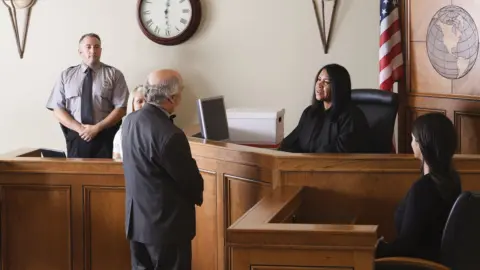
The hearing was the Monday before Christmas. I sat beside Patricia in a courtroom that smelled of floor wax. Brad and Carol came in with a sharp-looking attorney who tried right away to get a delay.
The judge was a gray-haired woman named Rodriguez. “No. We’re proceeding.”
Patricia laid it out in order. She covered the transfers, the accounts and the text message, and the two visits to my home. “Mrs. Harrison has also been contacted by authorities investigating bankruptcy fraud allegations against her son.”
Brad’s attorney stood. “Your Honor, this is a family disagreement blown out of proportion. My client loves his mother. He simply wants to reconcile.”
“Is that so?” Judge Rodriguez turned to Brad. “Mr. Harrison, did you send your mother a text message saying, and I’m quoting, ‘They matter more than you do’?”
“I was upset. I didn’t mean—”
“Did you accept approximately eighty-seven thousand dollars from her over eighteen months?”
“Yes.”
“Did you repay any of it?”
He didn’t answer.
“Did you file for bankruptcy seven months ago, and did you report that money to the court?”
“No, but I didn’t think I had to. It was a gift, not a loan.”
“A gift,” the judge said. “And yet when your mother closed her own accounts, you went to her home to tell her that money belonged to you.”
Carol leaned forward. “Your Honor, may I speak? Margaret is being vindictive. She’s upset that we chose to spend Christmas with my family. This whole thing is revenge.”
“Mrs. Harrison,” the judge said to her, “did you go to your mother-in-law’s home last Wednesday and call her selfish?”
Carol’s mouth opened. “That was taken out of context.”
“Did you use the word or didn’t you?”
“Yes.”
The judge looked at me. “Mrs. Harrison, would you like to add anything?”
I stood up. My legs held.
“I loved my son. I gave him everything I had to give, and all I asked for was respect and honesty. He lied to me. When I finally protected myself, he and his wife came to my house twice to frighten me into changing my mind.” I looked at Brad, and he wouldn’t look back. “I don’t want to punish him, Your Honor. I want to feel safe in my own home.”
Judge Rodriguez wrote for a moment.
“I’m granting the order. Mr. and Mrs. Harrison are to have no contact with Margaret Harrison for one year. They will stay at least five hundred feet from her home, her vehicle, and the library where she volunteers.”
The gavel came down. Brad put his head in his hands. I walked out past him with Patricia at my elbow.
“You did beautifully in there,” she said.
“I only told the truth.”
Outside the air was cold and clean, and there were wreaths on every lamppost. My phone buzzed. It was Helen, asking how it went.
I typed, “I won.” Then I stood on the courthouse steps for a while. It didn’t feel much like winning.
I spent Christmas Day at Helen’s with her grandchildren and a ham. I took the snickerdoodles, which I’d put in the freezer and couldn’t bring myself to throw away. Her grandson ate nine.
Patricia called three weeks later, on a gray January morning.
“The federal prosecutor has formally charged Brad. Three counts of bankruptcy fraud. He’s facing up to five years.”
“And Carol?”
“She’s named as a co-conspirator. But she’s cooperating in exchange for immunity. She’ll testify against him.”
I wasn’t surprised. I was sitting at the kitchen table with my coffee, and I found that I wasn’t anything at all. I felt very still.
“The trustee has seized the house,” Patricia went on. “They’ll be out next month. Margaret, there’s something else. Brad tried to reach you four times last week through other people. He wants to know if you’ll help with his legal fees.”
“What did you tell them?”
“That there’s a court order, and any further contact would be reported.”
The house went on the market in February. Helen showed me the listing on her tablet. I looked through all twenty-two photographs. The kitchen had the same oak cabinets and the same almond countertops it had the day they bought it.
February brought other news too. Carol filed for divorce and moved back in with her parents. She gave an interview to a local news website about escaping a toxic marriage, and by the end of it you’d have thought she was the one who had been robbed. Brad was renting a cheap apartment across town and working two jobs. He had a public defender.
In March I ran into Carol’s mother, Linda, in the cereal aisle at the grocery store. She blocked my cart with hers.
“He’s your son, Margaret. How can you stand by and watch him lose everything?”
“He took a great deal from me first, Linda. My money and my trust, and some of my dignity. He made his own choices.”
“You’re heartless.”
“No,” I said. “I’m putting myself first, for once.” I wheeled around her. My hands were shaking on the cart handle all the way to the checkout.
The trial was in April and lasted three days. I didn’t go. I couldn’t have sat in that room. Patricia called me each evening. There were bank records, and there were emails in which Brad discussed keeping assets out of the trustee’s sight. Carol took the stand on the second day and described conversations in which he’d talked about using his mother’s money without reporting it.
The jury was out four hours. They found him guilty on all three counts.
He was sentenced to three years in federal prison and ordered to pay restitution he didn’t have. Patricia said that with good behavior he would likely serve a good deal less.
“How do you feel?” she asked.
“Like it’s over,” I said. Then I went out and weeded the front beds until dark, because I didn’t know what else to do with myself.
In May a letter came, forwarded through Patricia’s office so it wouldn’t violate the order. It was seven pages on lined paper, in the cramped handwriting I used to check on spelling tests.
He told me what the money had been for. It was gambling. It had started with a sports app on his phone, twenty dollars on a football game. Then it was online casinos in the middle of the night. After that he took out credit cards to cover the losses, and a second mortgage to cover the credit cards. He wrote about the panic. He wrote that Carol had pushed him to keep asking me, and in the next line he wrote that he was a grown man and nobody had made him dial the phone.
On the last page he asked for forgiveness. He didn’t ask for money.
I read it three times at the kitchen table. Then I put it in the drawer of Robert’s desk and didn’t answer it. Maybe someday I would. I wasn’t ready to that day.
Summer came, and my life had changed in ways I hadn’t planned on. Helen brought me into her book club, which is eight smart, irreverent women who rarely finish the book. Dorothy and I signed up for watercolor classes on Saturday mornings. I am not good at it.
Susan talked me into volunteering at the women’s shelter downtown. I teach a class there on Wednesday nights about money. I show them how to read a bank statement and why you keep an account in your own name. The first night, a woman younger than Brad asked me how I knew so much about being taken advantage of. I told her I’d had expensive lessons.
In June I finally took the trip to Maine that Robert and I had talked about for twenty years. I rented a cottage on the coast for five days and ate lobster rolls on a rock by myself, and I was happy the whole time. I’ve also had coffee a few times with a retired teacher named Frank, from the library. It’s nothing serious. He has never once asked about my son or my finances, and I like him for that.
I heard about Brad through the grapevine. He’d been moved to a minimum-security facility and was working in the prison library, of all places. I laughed out loud when I heard that, and then I had to sit down.
Carol went to Arizona. She posted photographs of resort pools and cocktails. Helen’s hairdresser has a sister who works at that resort, and according to her, Carol was carrying the cocktails. Linda told Helen in the post office that Carol had stopped speaking to her own parents after the trial.
In August there was a second letter. It was short.
“Mom, I don’t expect you to respond. I’ve been sober from gambling for six months. I go to GA meetings twice a week. I understand now what I did to you. You deserved better. I hope you’re happy.”
I put it in the drawer with the first one.
I turned sixty-nine in September. Helen threw me a surprise party with the book club and half the street. There was cake and champagne, and somebody gave me a mug that said WORLD’S OKAYEST PAINTER. I laughed until I cried. That night I sat on the porch alone with a glass of wine and thought about Robert, and about what he’d have made of all this. I think he would have closed the accounts faster than I did. I also think he’d have answered the letters by now. I don’t know which of us would be right.
In October, Carol was arrested in Arizona for writing bad checks on closed accounts. Helen told me over the fence. I waited to feel something about it, and nothing came.
In November, Brad’s probation officer telephoned. Brad was being released in December, earlier than anyone expected, for good conduct. He was going to Cleveland to live with Robert’s brother, who’d agreed to take him in and had found him work at a warehouse.
The last letter came a week after that call. It was a single page.
“I won’t bother you anymore, Mom. I’m moving to Uncle Dave’s in Ohio. I’m sorry for everything. Please be happy.”
His uncle’s address was written at the bottom. He hadn’t asked me to use it.
I read it once, standing at the desk. I opened the drawer and laid it on top of the other two. I looked at the three of them for a minute.
I haven’t changed the will. The protective order runs out next month, and Patricia has asked whether I want to renew it. I told her I’d think about it.
I closed the drawer and got my coat. Helen was waiting at the diner on Maple, and I was already ten minutes late.
“You all right?” she asked when I slid into the booth. “You’ve got a look.”
“I’m fine,” I said. I picked up the menu. “Is the soup still chicken noodle on Tuesdays?”