My Husband Brought His Mistress and Their Newborn to His Mother’s Will Reading. Then the Lawyer Read Her Letter.
The last real conversation I had with my mother-in-law was in a hospital room in February. She had sent the nurse out and asked me to shut the door.
Margaret Caldwell was seventy-four, and thinner than I had ever seen her. She was sitting up against the pillows with her hair done. She put her hand over mine on the blanket, which she had done maybe twice in eleven years.
“Claire,” she said. “If a Caldwell man ever disappoints you, do not confuse your silence with nobility.”
I thought it was the medication talking. I said something soothing and poured her some water. She gave me the look she gave caterers who brought the wrong wine, and she let it drop.
She had always frightened me a little. She was elegant and exact, and she could silence a dinner table without raising her voice. For years I believed she only put up with me. It took me a long time to understand that she simply watched everything. She noticed when I switched from red wine to tea at family dinners, in the months when I was trying not to cry in public over another of Ethan’s long, unexplained absences. She never said a word about it. But the next time I came, there was a pot of the tea I liked already on the table.
She wasn’t always kind to me, but she never stopped paying attention.
There had been other odd moments that winter. At Thanksgiving she asked me to stay after lunch and help her “organize.” She had me make copies of our household documents, the insurance and the tax returns and the papers on our house, and told me to keep a set somewhere Ethan didn’t go. I asked her why. She said, “Because one of you should know where things are, and it isn’t going to be him.”
She died on the ninth of April. Ethan cried at the funeral, and I held his hand through it. I’m telling you that so you’ll understand what kind of fool I still was two weeks later, when I walked into the law offices of Harlan & Pierce.
The conference room was too cold. It smelled of coffee and carpet cleaner. There was a long mahogany table under fluorescent lights, and a framed print of the St. Louis skyline hung a little crooked on the far wall. I remember wanting to straighten it.
Then I saw Ethan. He was sitting in one of the leather chairs, completely at ease, in the navy suit I had helped him pick out for a charity gala the fall before. His wedding ring was on his hand.
A woman was sitting beside him. She was about thirty, with her hair pinned up in loose curls, and she wore a pale blue wrap dress. In her arms was a newborn in a gray knitted blanket, sound asleep.
I stopped in the doorway. I didn’t decide to. My legs simply quit.
Ethan looked up. I had prepared myself, over the past year, for shame on his face if this day ever came. There wasn’t any. He looked mildly irritated, as if I’d come late to a meeting and he expected me to make it awkward. He laid one hand on the arm of the woman’s chair.
She smiled at me. It was a patient smile. She seemed to think everything had already been settled and I just hadn’t been told.
“You brought a baby,” I heard myself say. My voice was thin and dry.
“He’s Ethan’s,” she said. She said it the way you’d mention that it was raining.
I held on to the back of a chair. There had been whispers inside my marriage all year. There were late nights and changed passwords. Once I caught a perfume on his collar that wasn’t mine. Every time I asked, he had an answer. I was imagining things. I was stressed about his mother. He’d said it so often and so reasonably that I had started to doubt my own eyes.
And here was the proof, asleep in a gray blanket. Her name, I would learn in about four minutes, was Lauren Whitaker.
Ethan finally spoke. His tone was flat. “We didn’t want you hearing it from someone else.”
A laugh came out of me before I could stop it. It was sharp and ugly. “At your mother’s will reading,” I said. “How thoughtful.”
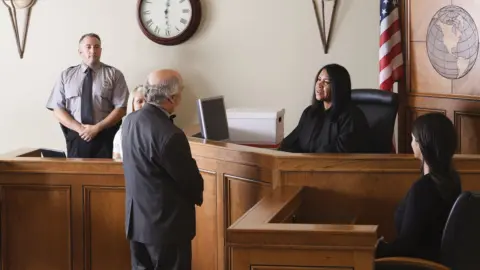
The door opened behind me. James Harlan came in with a leather folder under his arm. He’s a silver-haired man in pinstripes who has spent forty years watching family money bring out the worst in people. He paused for half a second when he saw the baby, and then his face smoothed over again.
“Mrs. Caldwell,” he said to me, gently. He nodded at the other two. “Thank you all for coming. Margaret requested that all named parties be present.”
So Lauren had been named. Margaret had known she existed and had asked for her to be in this room. I sat down across from my husband because I didn’t trust my knees. My purse hit the table harder than I meant it to.
Under the shock, I felt something else stir. It was curiosity. Margaret Caldwell had never done one thing by accident in her life.
Harlan opened the folder. “The late Margaret Caldwell executed her last will and testament on March third of this year. She also left a personal statement, which she directed me to read aloud before the distributions.”
At the word “distributions,” Ethan leaned back in his chair. I knew that posture. It was how he sat when a waiter was bringing something he’d already decided was his.
Harlan unfolded a single sheet. He read more slowly now.
“To my daughter-in-law, Claire. If you are hearing this, then Ethan has finally shown you who he really is.”
Ethan sat up. Lauren blinked.
“That means the time has come for you to see what I have done, so that you never again mistake patience for powerlessness.”
I didn’t move. I’m not sure I breathed.
“I was not a perfect mother. I loved my son in ways that let him believe charm could stand in for character. I bear responsibility for that. But I am his mother. I am not his accomplice.”
Lauren shifted in her seat. The smile was gone.
“Claire, by now you have suffered enough indignity in silence. I knew about Lauren. I knew about the apartment in Clayton. I knew about the lies told over charity dinners and business trips and visits to my own hospital room. I knew because weak men repeat themselves, and the women who clean up after them hear everything.”
“This is inappropriate,” Ethan said, too fast.
Harlan didn’t look up. “With respect, your mother anticipated that objection. She instructed me to continue without interruption.”
I sat there with my hands in my lap while the last six months rearranged themselves in my head. I thought of the copies she’d had me make at Thanksgiving, and the hand over mine in the hospital. She hadn’t been confused. She had been briefing me, and I’d been too slow to hear it.
“So I have arranged my estate accordingly,” Harlan read.
Ethan leaned forward. “My mother was sick. She wasn’t in her right mind at the end.”
I almost laughed again. Margaret on her worst day could have run rings around him.
“She anticipated that as well,” Harlan said mildly. “The estate file contains two independent medical evaluations, a video record of the signing, and notarized statements from the witnesses, all made within seventy-two hours of the will.”
The color left Ethan’s face slowly, starting at the forehead. Lauren looked to him for reassurance and didn’t get any.
Harlan went back to the page. “To my son, Ethan. If your mistress is sitting beside you while this is read, then one question has been answered. You did, in fact, mistake audacity for intelligence.”
Ethan muttered something under his breath.
“And to the woman beside him, holding a child who did not ask to be born into deceit. Let me say plainly what I suspect no one has told you. Being close to a man’s weakness is not the same as winning.”
Lauren flinched. It was tiny, but I saw it. The baby stirred and made a small fussing sound, and she bounced him without seeming to notice she was doing it. She looked different to me then. She’d walked in sure of herself, and now she looked like someone who had come to the wrong party.
Harlan set the letter aside and picked up the will.
“Mrs. Caldwell leaves her jewelry collection to the Saint Louis Museum of Decorative Arts. Her residence on Lindell Boulevard, with the contents listed in Schedule Three, passes to the Caldwell Family Foundation.”
“And the company shares?” Ethan cut in. His voice was strained. He hadn’t even waited to hear whether she’d left him her wedding ring.
“We’re getting there,” Harlan said. He was polite about it. It occurred to me that James Harlan might have been waiting twenty years for permission to dislike my husband.
He turned a page.
“The voting shares in Caldwell Industrial Holdings, which were previously expected to pass to Ethan Caldwell, do not pass to Ethan Caldwell.”
Nobody made a sound.
“Mrs. Caldwell leaves her controlling interest in Caldwell Industrial Holdings, sixty-two percent, including all voting and governance rights, to Claire Caldwell, subject to the conditions in Section Eleven.”
Ethan was on his feet. His chair scraped back and hit the wall. “That’s impossible.”
Harlan slid a thick, tabbed packet across the table to him. “It’s quite possible. It is, in fact, binding.”
Ethan looked at me as though I had pulled a trick on him. It wasn’t betrayal on his face. He looked astonished. In eleven years it had never once crossed his mind that I might end up on the winning side of anything. I understood then that he had enjoyed underestimating me.
“What conditions?” Lauren asked. Her voice was thin.
Harlan folded his hands. “Claire inherits on the condition that Ethan Caldwell is permanently removed from any executive position, any board seat, and any access to the company’s accounts or to the family trusts.”
“She can’t run that company,” Ethan said.
“Your mother disagreed.” Harlan passed a second packet across, to me this time. “Over the past eighteen months she arranged for a transition. Corporate counsel, outside advisors, and two directors have been briefed. She also left a memorandum for the board.” He put on his glasses. “I’m quoting. ‘Claire has more judgment in one quiet hour than Ethan has shown in ten polished years.'”
I pressed my lips together. I could hear her voice in it, dry as paper. I had kept the books for the family foundation for six years, and before that I’d worked in hospital finance. Margaret used to go over my quarterly reports with a pencil. I had always assumed she was looking for mistakes.
Ethan was staring at me. For the first time since I’d known him, he looked afraid.
Lauren cleared her throat. “And what about Ethan’s son?”
“Mrs. Caldwell established a separate trust for the child,” Harlan said. “Two million dollars, to cover his education, his healthcare, and his housing. It is administered by independent trustees.”
Lauren’s shoulders came down an inch in relief.
“Neither Ms. Whitaker nor Mr. Caldwell has any direct access to those funds.”
The relief went out of her face almost before it had settled. She wasn’t quick enough to hide it. I saw it, and so did Ethan. The two of them looked at each other, and I think it was the first honest look they’d exchanged all morning.
Ethan dragged a hand through his hair. “This is insane. I’m her son.”
“That’s a biological fact, yes,” Harlan said.
He picked up the letter again. “There’s a further passage. ‘If Ethan protests on the grounds of blood, remind him that an inheritance is not a prize for being born. A family business is not an heirloom watch. It is a responsibility, and it belongs with the person least likely to use it as a mirror.'”
He turned to the last page. His voice changed, and I braced myself.
“‘For the past eleven months I have employed forensic accountants to review certain irregularities at Caldwell Industrial Holdings and certain personal expenditures connected to them. Their findings are enclosed.'”
Ethan went completely still.
“‘The review found expenses routed without authorization, misuse of the company housing allowance, and vendor retainers redirected to pay for undisclosed personal property. That includes an apartment in Clayton, leased at $4,200 a month through a limited liability company controlled by Ethan Caldwell.'”
Lauren had gone white. I had known about the affair in my bones for a year, and I’d half suspected an apartment. Hearing it read out in that language turned it into something else. He hadn’t only cheated on me. He had been stealing from his mother’s company to do it. The total, I learned later, was a little over $1.3 million.
Harlan laid a sealed envelope on the table and rested two fingers on it.
“A summary has gone to the chair of the board’s audit committee, as it had to. The complete file is in my keeping. Mrs. Caldwell’s instructions are that it be released in full to outside counsel and to the authorities if Ethan Caldwell attempts to contest this estate, interfere with the succession, intimidate Claire Caldwell, or dispose of marital assets he hasn’t disclosed.” He let that sit. Then he said, almost kindly, “In simpler terms, she built a dead man’s switch.”
Nobody spoke. Even the baby was quiet.
Ethan sat down very slowly. He looked across the table at me.
“Did you know?”
“No,” I said. It was the truth. That seemed to rattle him more than if I’d planned the whole thing.
Lauren shifted the baby up onto her shoulder. “This is vindictive,” she said.
Harlan regarded her over his glasses. “No, Ms. Whitaker. Vindictive would have been leaving nothing for the child.”
He slid one more document toward me. “There is also the matter of your home. Eight months ago Mrs. Caldwell purchased the property from the holding company Ethan had placed it in. The deed has been recorded in your name alone.”
That was my house, the one Ethan had refinanced two years ago. Every time I asked why the title looked different, he called it “complicated.” I had been quietly getting ready to lose it. Margaret had seen that coming too.
Ethan swore. “She had no right.”
Harlan opened his mouth, but I got there first.
“No,” I said. “You had no right.”
My voice was steady. I was as surprised as anyone.
“You lied to me for over a year. You moved money. You hid property. You let me sit beside you and grieve your mother while you were setting up another household twenty minutes away. And then you brought your girlfriend and your baby here this morning, because you thought I’d be too broken to pay attention to the details.”
Lauren started to speak. I didn’t let her.
“And you sat there expecting to watch me fall apart so you could start measuring for curtains. Please don’t insult me by telling me this was about love.”
“I never pretended anything,” she said.
It was the most honest thing anyone had said to me all year. “No,” I said. “You didn’t.”
The baby whimpered. Some stubborn part of me ached for him. None of this was his doing. Margaret had understood that. She’d protected him with one hand and taken everything away from his parents with the other.
Harlan cleared his throat. “One last item. Margaret asked that I give you this personally.”
It was a small velvet box. For a strange second I thought it would be jewelry. Inside was a brass key and a folded card in her upright handwriting.
“Claire. The drawer in my dressing room vanity. Left side, second keyhole. Take what is yours before Ethan remembers it exists. M.”
“What drawer?” Ethan said sharply.
Harlan ignored him. “Mrs. Caldwell had her dressing room sealed the day she died. Dolores has instructions to admit you and no one else.”
I signed where he told me to sign. I don’t remember much of it. When I stood up, my whole body felt hollow and buzzing.
The four of us rode down in the same elevator, and it was the longest forty seconds of my life. The walls were mirrored. I could see us from every side. I was in my funeral dress. Ethan was beside me, and Lauren stood with the baby. The lawyer held a folder thick enough to change all our lives.
When the doors opened in the lobby, Ethan said, “Claire.”
For eleven years I had turned at once when he said my name like that. This time I let him wait.
When I did look at him, he had put on a softer face. He was trying out vulnerability to see whether it still worked on me. “Let’s not do this here. We should talk privately.”
Behind him, Lauren went rigid. It wasn’t the suggestion that bothered her. It was the tone. She knew that voice. I suppose she’d thought he’d made it up for her.
“We have never once talked privately,” I told him. “You’ve only lied to me in smaller rooms.”
He had no answer. I had never before seen him without one.
I drove straight to Lindell Boulevard. Dolores, who kept Margaret’s house for thirty-one years, opened the front door before I reached it. She pulled me into a hug that smelled of starch and lemon oil.
“I’m so sorry, honey,” she said into my hair. “And I’m so glad you came first.”
She had been told to expect me first. Margaret had thought of that as well.
The dressing room was upstairs, a sunny room lined with cream cabinets and silk scarves and rows of perfume bottles. The vanity sat under three tall mirrors. I had sat at it once, the morning of my wedding, while Margaret fastened her mother’s pearls around my neck and told me to stand up straight.
There was a second keyhole in the left-hand drawer panel, hidden under the lip. My hands were shaking. The key turned with a soft click.
There were three things in the drawer. I found a thick envelope, a small hard drive, and a leather journal.
I opened the envelope first. It held photographs, and none of them were lurid. Margaret would never have stooped to that. There was Ethan going into a building in Clayton, on different days and in different coats, across what must have been months. There was Ethan with Lauren on a restaurant patio on an afternoon he’d told me he was in Chicago. Behind the photographs were copies of company transfers, a lease, and a report from a private investigator.
On top was a note.
“Claire. Proof is a mercy when a woman’s intuition has been made to feel like madness. Men like Ethan survive by wearing women down into doubting themselves. Do not doubt yourself again.”
I sat down on the little velvet stool and cried. I wasn’t crying over him. I was crying over the year I’d spent making myself smaller and stupider so I could keep the peace with a liar. Margaret had watched me do it. She hadn’t offered me comfort. She had gathered evidence. I think it was the most loving thing she ever did for anyone.
The journal began with medication schedules and reminders for Dolores. A few pages in, it changed. She had written about Ethan as a boy, bright and polished and praised too soon. She wrote about a signature he’d forged at sixteen and a car accident at nineteen that she had paid to make go away. She listed promotions she’d given him and knew he hadn’t earned.
Then there were entries about me.
“Claire sees patterns. She notices who is speaking and who is performing. She will survive him, if she stops trying to save him.”
I laughed out loud, with tears running down my face, alone in a dead woman’s closet.
The hard drive held board files and audit summaries, and one video. It was labeled FOR CLAIRE ONLY. I carried the laptop to the window seat and pressed play.
Margaret appeared in her sitting room chair, wrapped in a cream shawl. She was gaunt, but her eyes hadn’t changed.
“If you are watching this, then Ethan has done exactly what I expected, and I am dead, which is irritating.”
I laughed again. I couldn’t help it.
“I am not leaving you a gift, Claire. A gift can be declined. I am leaving you a position. For years you have underestimated your own leverage, because you confuse kindness with passivity. Stop it.” She adjusted the shawl. “The board knows more than Ethan thinks. Two directors are waiting for your call, and their numbers are in the file. The chief financial officer will test you. Let him. Then replace him if he blinks.”
She looked off to the side for a moment, and then back into the camera.
“One more thing. Do not punish the child for his parents. But do not let his parents use him as a key, either. Sentiment is the preferred crowbar of selfish people.”
The screen went dark.
I stayed at her house that night. Dolores brought up a tray of tea without being asked. At the door she turned around.
“She loved you, you know. In her own strange, scary way.”
“I’m starting to believe that,” I said.
The next morning the war started. By nine the board had been formally notified. By ten I was on a video call with two directors, the company’s outside lawyers, and a transition consultant Margaret had apparently hired six months before she died. My phone kept lighting up on the desk beside me. Ethan sent three messages in two hours. The first was pleading and the third was furious. Lauren sent one, about how the baby deserved stability and “adult cooperation.” I answered none of them.
At noon the company put out a short statement about a change in leadership. By evening, Ethan’s lawyer had sent a letter saying his client intended to challenge the will. Harlan replied within twenty minutes. I never saw what he attached. The following afternoon, Ethan’s lawyer wrote again to request “a pause pending further review.”
I hired my own attorney that week. Her name is Elise Monroe. She’s a small, compact woman who doesn’t waste words. She sat at Margaret’s dining table and went through the forensic summary with a pen. When she finished, she tapped the pen once on the page.
“He thought he was hiding an affair,” she said. “What he was actually doing was assembling a fraud case, with receipts.”
We filed for divorce within days.
Ethan made one more try. He turned up unannounced at my house just after sunset, about a week later. I should have stayed inside. I went out onto the front terrace and stood with my arms crossed.
“Claire,” he said. “I made mistakes.”
I waited. He waited too. He seemed to think that sentence ought to do the work by itself.
“Is this the part where I’m supposed to help you with the wording?” I asked.
His jaw tightened. “You don’t understand what my mother did. She destroyed everything.”
“She didn’t destroy anything, Ethan. She wrote it down.”
“You think you can run Caldwell Industrial? That board will eat you alive.”
“Then I’ll learn to bite back.”
He took a step toward me and softened his voice. “Lauren doesn’t matter.”
He heard it a second after I did. I watched him realize that he’d almost certainly said those words to her about me.
“I mean, it wasn’t supposed to happen like this,” he said.
“It happened exactly the way you built it,” I said. “You just never imagined your mother was building something too.”
He stood there a little longer. Then he walked back to his car. He didn’t seem to have anything left to say.
The weeks after that were brutal. I learned a great deal in them. At my first board meeting, an older director began explaining capital structures to me inside of six minutes. I let him finish. Then I asked him three questions about the company’s debt covenants that I’d pulled from Margaret’s files and stayed up two nights to understand. The table went very quiet. Nobody explained anything to me after that unless I asked.
The chief financial officer did test me. He sent over a set of projections with the bad news tucked into a footnote on page forty. I found the footnote. He blinked, and I replaced him by the end of the quarter.
I’d be lying if I said I slept. I lost eleven pounds that summer. My friend Naomi came over every Thursday with takeout and made me eat it in front of her.
The saddest part of all of it was the baby. I could see how he was going to be used in the fight. A gossip columnist wrote that I might try to “punish the affair child” by tying up his trust. I authorized one sentence in reply. “The child is innocent and will remain protected.” I never said another public word about him, and I never will.
By late autumn, the first quarterly results under my name came in ahead of expectations. They weren’t spectacular, but they were solid, and the expenses were clean for the first time in years. I approved a plant modernization that Ethan had stalled because it would have made his numbers look bad for two quarters. I promoted two women into jobs they should have held a decade earlier.
I missed Margaret at odd moments. I missed her when a director was patronizing and I wanted one of her remarks to cut him off at the knees. Sometimes I’d walk past her dressing room and half expect to hear silk rustling. One night I found an entry in the journal dated a month before she died.
“Claire still thinks gentleness disqualifies her from command. It does not. It only means that if she learns to use power, she may do less damage with it than the rest of us did.”
I closed the book and cried for a long time. She had seen me more clearly than I’d ever seen myself. It turned out she’d been sure of me for years, and I hadn’t known it.
The divorce was final in January. Ethan lost more than he’d expected and less than he deserved. His board seat was gone, and so was his access to the company’s accounts. I don’t know what became of the sealed file. Harlan has never said and I’ve never asked. Ethan never contested the will.
Lauren stayed with him for a while. Then she didn’t. I heard she moved back to Kansas City with the baby. I took no pleasure in it. The trustees send me a one-page report every year, because Margaret arranged it that way, and each year I read that the boy is healthy and enrolled somewhere good. I’m glad of it.
That spring the company held its annual foundation gala at the museum downtown. For ten years I’d gone to that event on Ethan’s arm and smiled at people who looked past me. This time I stood at the podium. I wore a black silk gown that Margaret had once looked up and down and called “the first dress you’ve owned that looks like you own the room instead of apologizing to it.”
I kept the speech short. I announced an expansion of the trade apprenticeship program, and a maternal health partnership in Margaret’s name. People clapped, and it sounded like they meant it. I stepped down and found that my hands weren’t shaking.
When I got home there was a package on the step with no return address. Inside was an antique silver baby rattle, polished bright, and a note in Ethan’s handwriting.
“My mother bought this years ago. She meant it for my first child. I thought maybe you should have it. I don’t know why.”
I didn’t know why either. I turned it over in my hands for a while. It was engraved with a C. I never answered him. I took the rattle to Lindell Boulevard, which belongs to the foundation now, and put it in the vanity drawer next to the journal. Then I locked the drawer. I couldn’t have told you what I meant by doing that.
Three years have gone by. The company has grown, and I’ve gotten better at the work. I’ve also learned to laugh again. I do it at Naomi’s kitchen table and at Dolores’s outrageous opinions about St. Louis society. Dolores retired with a pension Margaret set up, and she comes to my house for dinner every other Sunday.
Last Sunday, in late May, Dolores and I drove out to the cemetery. I brought lilies, and a copy of the quarterly report. Margaret would have pretended not to care about it and then demanded every figure.
Dolores waited in the car with the air conditioning on. I knelt down and laid the flowers against the stone.
“Well,” I said. “You were right about almost everything. It’s deeply annoying.”
I told her the apprenticeship program had placed its four-hundredth graduate. I told her the board still has one idiot on it, and that she’d predicted which one. I told her the plant in Granite City came in under budget.
Then I said something I hadn’t been able to say out loud for three years.
“You saved me.”
It was a warm, still day, and my voice sounded small in the open air. I stayed there a few minutes. I set the quarterly report under the lilies, where the groundskeeper would find it and wonder.
As I stood up, I saw a man coming along the path with a stroller. My heart skipped. It wasn’t Ethan. It was a young father I’d never seen before, bending to fix the sunshade over a toddler in red shoes. He nodded at me, and I nodded back.
Dolores had the window down when I got to the car.
“You tell her about the idiot?” she asked.
“I told her.”
“Good. Now take me to lunch. I’ve been thinking about a patty melt since Kingshighway.”