“If there is a combat pilot on board, please identify yourself immediately.”
The captain’s voice crackled through the dark cabin of Atlantic Meridian Flight 117. Then it was gone, and there was only the hum of the engines.
Nearly three hundred people froze.
It was 2:14 in the morning, New York time. The plane was cruising at thirty-five thousand feet over the middle of the North Atlantic. It was a Boeing 777 on its way from JFK to London Heathrow, a little more than halfway there.
Most people had been asleep.
They weren’t anymore.
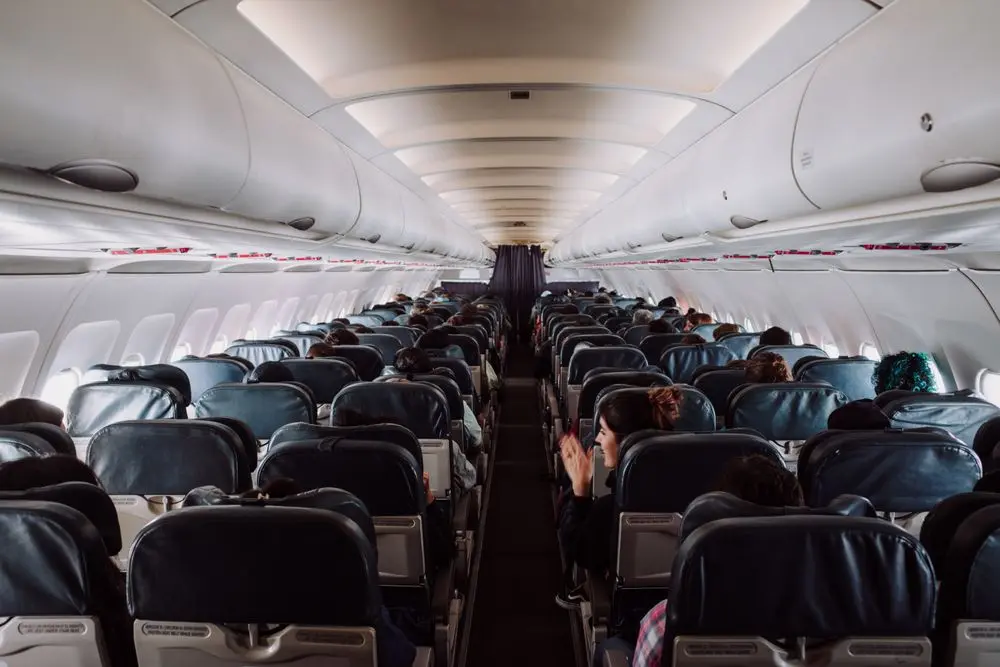
The reading lights clicked on one by one up and down the aisles, like popcorn.
In row 12, a teenage boy pulled out one earbud and said, “Wait, what?”
In row 15, an older woman gripped her husband’s hand so hard he winced.
In row 22, a baby started crying, and her mother bounced her and whispered, “Shh, shh, it’s okay, it’s okay,” in the voice of someone who was not sure it was okay at all.
Someone near the back said, “Did he say combat?”
Someone else said, “Why would they need a combat pilot?”
Nobody had an answer.
The announcement came again.
“Ladies and gentlemen, this is your captain speaking.”
His voice sounded different now. It wasn’t the warm, easy voice that had welcomed them aboard at JFK and joked about the tailwind. It was flat. Tight. Like a man speaking through his teeth.
“We are experiencing a technical issue that requires immediate assistance. If anyone aboard has military pilot experience, particularly combat or fighter experience, please contact a member of the cabin crew. Please remain in your seats with your seatbelts fastened. Thank you.”
Click.
The cabin fell silent.
In seat 8A, by the window, a woman in a dark green sweater opened her eyes.
Her name was Mara Dalton.
Nobody on board knew that.
To the man beside her in 8B, a heavyset salesman from New Jersey named Gary who’d spent the first hour of the flight telling her about his divorce, she was just a tired, quiet woman who’d stopped answering him and gone to sleep with her face against the window.
To the flight attendants, she was the polite passenger in 8A who’d turned down dinner and asked only for water and a blanket.
To everybody else, she was nobody.
That was exactly how she wanted it.
She’d picked the overnight flight on purpose. Fewer people. Darker cabin. Nobody talks to you on an overnight flight, if you’re lucky. Nobody looks at you twice.
She’d picked the window seat so she could lean her head against the wall and close her eyes and not have to see anybody.
She’d picked the green sweater because it was the only thing she owned that felt like armor.
It wasn’t hers, originally. It was too big in the shoulders. The cuffs were frayed. There was a small coffee stain near the hem that would never come out.
It had belonged to someone else.
She was thirty-nine years old. She taught physics at a public high school in Fort Collins, Colorado. She lived alone in a small house with a big dog named Biscuit and a garden she mostly let go to weeds. She ran six miles every morning before the sun came up. She didn’t go to parties. She didn’t date. She didn’t talk about her past.
Her students knew her as Ms. Dalton, the teacher who could explain Newton’s third law using a basketball and a skateboard and somehow make it interesting. The one who never raised her voice. The one who always seemed a little bit somewhere else.
They didn’t know she’d once been Captain Mara Dalton, United States Air Force.
They didn’t know that for eleven years she’d flown F-16s.
They didn’t know about the two deployments. The Distinguished Flying Cross in a drawer in her closet. The nights over places she still wasn’t allowed to name, doing things she still wasn’t allowed to talk about.
They didn’t know about Leo.
Almost nobody did anymore.
She’d walked away from all of it five years ago.
She’d resigned her commission. She’d moved to a town where nobody knew her. She’d gotten a teaching certificate. She’d bought a dog.
She’d decided she was done being the person people looked at when things went wrong.
And now she sat in seat 8A with her eyes open, listening to the silence of three hundred frightened people.
She knew that silence.
She knew the way the air changed. The way people stopped breathing quite so deeply. The way a voice on a radio could go flat and tight when a man was trying very hard not to sound scared.
She’d heard it in her own headset more times than she wanted to remember.
A flight attendant came hurrying down the aisle from the front of the plane.
Young. Maybe thirty. Dark hair pulled back tight. Her name tag said PRIYA. She was walking fast, looking left and right at the passengers, scanning faces. Her own face was pale and very focused.
She stopped at row 6. She bent down and said something to a man in a suit. He shook his head.
She moved on. Row 7. A young couple. They shook their heads.
Mara closed her eyes again.
It’s not your job, she told herself.
It hasn’t been your job for five years.
There are three hundred people on this plane. Somebody else will stand up. There’s always an airline pilot deadheading home. There’s always some retired Navy guy in first class who’ll be thrilled to help.
Let somebody else do it.
You’ve done enough.
She thought about Leo.
She thought about the last time she’d been the person everybody depended on.
She thought about how that had turned out.
She pulled the blanket up to her chin.
“Ma’am?”
Mara opened her eyes.
The flight attendant was standing right next to her row. She was looking past Gary, straight at Mara.
Mara didn’t know why. Maybe it was because she was the only person in the row who wasn’t staring around in confusion. Maybe it was the way she was sitting. Maybe it was something in her face.
She’d been told before that she had a face that people noticed in a crisis. Leo used to say it. “You get this look, Dalton. Like a cat that just heard a can opener.”
“Ma’am,” Priya said carefully. Her voice was low and steady, but her hands were shaking a little. She was holding a small notepad, and the paper was trembling. “The captain is looking for anyone with combat pilot experience. Do you know if anyone here might be able to help?”
Something in her eyes did it.
Mara had seen that look before. On the face of a young airman on a flight line at three in the morning, holding a clipboard, trying very hard to be brave while the whole world was on fire around him.
This wasn’t routine.
This wasn’t a passenger who’d fainted, or a smoke detector in the lavatory, or a bad weather diversion.
Something was seriously wrong.
Mara looked around the cabin.
Across the aisle, a mother in her twenties was holding a baby against her chest. The baby had stopped crying and was staring up at the reading lights with huge dark eyes. The mother was staring at Mara.
In the row ahead, an elderly couple were holding each other’s hands so tight their knuckles were white. The woman’s lips were moving. Praying, maybe.
Behind her, a little boy of maybe eight was standing up on his seat, looking over the headrest, until his father pulled him gently down.
Everyone was staring forward. At the front of the plane. At the closed curtain. At the cockpit door they couldn’t see.
Uncertain. Frightened. Waiting for somebody to tell them it would be all right.
And in that moment, Mara realized something she’d been avoiding for five years.
She’d left the military.
She’d left the jets and the uniforms and the medals in the drawer.
But she had never stopped being who she was.
She took a slow breath.
“I’m a pilot,” she said quietly.
Priya leaned closer. The engines were loud. “I’m sorry?”
Mara sat up straighter. She pushed the blanket off her lap.
“I’m a combat pilot,” she said. Calm. Firm. Loud enough this time. “United States Air Force. I flew F-16s.”
Whispers spread through the cabin like wind through a field.
Heads turned. People leaned out into the aisle to look at her.
Gary, in 8B, stared at her with his mouth open.
“You’re kidding,” he said. “You told me you were a teacher.”
“I am a teacher.”
“You said you taught physics!”
“Physics is how planes fly, Gary.”
Across the aisle, in 8C, an older man with white hair and a Marine Corps cap reached over and gently squeezed her arm.
His hand was shaking.
“Thank God,” he whispered.
Relief washed across Priya’s face so fast and so completely that for a second Mara thought she might cry.
She didn’t.
“Please,” Priya said urgently. “Come with me. Right now.”
Mara unbuckled her seatbelt.
She stood up. She had to step over Gary’s knees. He pulled them in so fast he banged them on the tray table.
She stepped into the aisle.
Three hundred faces were watching her.
She didn’t look at any of them.
She followed Priya toward the front of the plane.
They walked fast. Through the business class cabin, where people were sitting up in their lie-flat seats, blinking in the dim light. Past a galley, where another flight attendant, an older man with a gray beard, was holding a phone to his ear and talking low and fast.
“Who’s he talking to?” Mara asked.
“The captain,” Priya said. “That’s Tom. He’s our purser. The lead.”
“What’s going on?”
Priya didn’t slow down.
“The first officer collapsed,” she said.
Mara’s stomach dropped.
“When?”
“About forty minutes ago. He said he had a headache. Then he said he couldn’t feel his left hand. Then he couldn’t talk right. The captain called us up. We got him out of the seat.”
“Is he alive?”
“He’s alive. There’s a doctor with him. A neurologist. We found her in row 3. Lucky. She says it looks like a stroke.”
They came around the corner into the forward galley.
On the floor, on a pile of airline blankets, lay a man in a white pilot’s shirt with the epaulets still on the shoulders. Three gold stripes. Early forties. Dark skin. An oxygen mask over his face. His eyes were open but unfocused. The left side of his face was drooping.
A woman in her fifties in a cardigan and reading glasses was kneeling beside him, holding his wrist, talking to him in a calm, low voice. “Daniel. Daniel, can you squeeze my hand? Good. Good. Now the other one. Try for me.”
Daniel’s right hand squeezed.
His left hand didn’t move.
“That’s First Officer Okafor,” Priya said quietly. “Daniel. And that’s Dr. Fischer.”
The doctor looked up at Mara.
“Are you the pilot?”
“I’m a pilot.”
“Then go,” the doctor said. “He needs you more than I do.”
Mara looked down at Daniel Okafor.
His eyes found hers. They were scared. He tried to say something. It came out slurred and wrong.
Mara knelt down for one second. She put her hand on his right shoulder.
“I’ve got your seat,” she said. “Okay? You just do what the doctor says.”
His eyes held hers.
Then, very slightly, he nodded.
Priya was already at the cockpit door. She picked up the interphone on the wall beside it.
“Captain, it’s Priya. I have her. Air Force. F-16.”
A pause.
Then a heavy metallic click as the door unlocked.
The cockpit of a Boeing 777 is not the cockpit of an F-16.
Mara knew that before she walked in. She’d known it the moment she said yes.
An F-16 is a single seat, a bubble canopy, a sidestick under your right hand, and a hundred tons of thrust strapped to your back. It’s built to turn and climb and fight. It’s built for one person.
A 777 is a big, calm, wide-bodied airliner the size of a building. It’s built to carry three hundred people across an ocean while they sleep. It’s built for two.
And right now, it only had one.
The cockpit was dark except for the glow of the screens and the instruments.
Too dark.
That was the first thing she noticed.
On the right side, the first officer’s side, the big display screens were black. Completely dead. Just dark glass reflecting the instrument lights.
On the left side, the captain’s displays were working. Mostly. One of them was flickering.
And in the left seat, gripping the control yoke with both hands, was a big, broad-shouldered man in his late fifties. Gray crew cut. Short-sleeved white shirt with four gold stripes. His jaw was clenched so tight Mara could see the muscle jump.
He was hand-flying the airplane.
At thirty-five thousand feet. In the middle of the night. Over the North Atlantic.
That was the second thing she noticed.
He didn’t turn his head.
“Name,” he said.
“Mara Dalton. Former captain, United States Air Force. Eleven years in the F-16. Twenty-two hundred hours. Two combat deployments. Weapons School graduate.”
“When did you last fly?”
“Five years ago.”
A pause.
“Anything at all since then?”
“No, sir.”
Another pause.
“Well,” he said. “You’re what I’ve got. Sit down. Strap in. Put on the headset. Don’t touch anything until I tell you.”
She slid into the right seat.
It was still warm. Daniel’s coffee was in the cup holder. His reading glasses were on the side console. A photograph was tucked into the edge of the window frame. A smiling woman and two little girls on a beach.
Mara looked at it for half a second.
Then she buckled the five-point harness. She found the headset hanging on its hook. She put it on.
The world went quiet and close, the way it always did. Radio static. The soft hiss of the intercom. The captain’s breathing.
It felt like coming home.
She hated how much it felt like coming home.
“Ray Holloway,” the captain said. “Twenty-two years with this airline. Before that, twelve years Air Force. I flew KC-135s.”
“Tankers.”
“I gave gas to people like you.”
“Then I owe you a few drinks.”
He almost smiled. Almost.
“Here’s what we’ve got, Dalton,” he said. “Listen close, because I’m only going to say it once, and I’m going to say it fast.”
He told her.
Forty-three minutes ago, Daniel had collapsed. Ray had called the cabin crew, gotten him out of the seat, and turned the plane around toward the nearest suitable airport.
That was supposed to be the worst of it.
It wasn’t.
Eighteen minutes ago, while Ray was alone in the cockpit, an electrical failure had hit.
The right engine’s generator had dropped offline. Then something had gone wrong in the system that was supposed to switch the power over. Half the airplane’s electrical system had gone with it. The right side displays. The autopilot. The autothrottle. Half the radios. A bunch of other systems Ray was still figuring out.
And somewhere in the middle of it, the center hydraulic system had started losing pressure.
“The autopilot won’t come back,” Ray said. “I’ve tried everything. Every checklist. Every reset. It’s gone. The autothrottle’s gone. I’ve been hand-flying for eighteen minutes, and I’ve got about two and a half hours until I can get this thing on the ground.”
“Two and a half hours of hand-flying.”
“Two and a half hours of hand-flying, alone, at night, with half my instruments dark, while trying to run every checklist in the book, talk to air traffic control on the one radio I’ve got left, plan a diversion, dump fuel, and figure out what’s going to work and what isn’t when I put the gear down.”
He finally glanced at her.
His eyes were bloodshot. His forehead was wet.
“I can do one of those things,” he said. “Maybe two. I can’t do all of them.”
“Why combat?” Mara said. “Why not just ask for any pilot?”
“Because the last time I asked a cabin for a pilot, I got a dentist with a Cessna license who froze solid the minute he saw the panel,” Ray said. “This isn’t a nice day with everything working. This is a broken airplane at night with things failing one after another. I need somebody who’s flown with half the jet dark and people shooting at her and still managed to think straight. I need somebody who doesn’t panic.”
He looked back at his instruments.
“Do you panic, Dalton?”
Mara thought about it.
She thought about a night over the desert, nine years ago, when her own displays had gone dark and the warning lights had lit up like a Christmas tree and something had been coming up at her from the ground.
She thought about another night. Five years ago. Over the mountains in Nevada. Weather. The radio. Leo’s voice.
“Not until afterward,” she said.
Ray nodded slowly.
“That’ll do,” he said.
“Where are we going?” Mara asked.
Ray pointed at the one navigation display that was still working on his side.
“Lajes,” he said.
Mara went very still.
“Lajes Field?”
“Terceira Island. The Azores. About seven hundred and sixty miles southeast. Long runway, almost eleven thousand feet. Full emergency services. U.S. Air Force still has a detachment there. Portuguese Air Force runs the field.”
He glanced at her.
“You know it?”
“I was stationed there,” Mara said slowly. “Six months. 2014. Transit support. We used to bring jets through on the way to Europe.”
Ray stared at her for a second.
Then he laughed. A short, rough, disbelieving laugh.
“Well, now I know God’s got a sense of humor,” he said.
“What’s the weather?” Mara said.
The smile went off his face.
“That’s the other thing,” he said.
There was a front moving across the Azores. Rain. Low clouds. Winds from the southwest, gusting.
“Crosswind’s about twenty-two knots,” Ray said. “Gusts to thirty. Could get worse by the time we get there.”
Mara knew Lajes. She knew that wind. She knew how it came off the ocean and over the cliffs at the end of the runway and did strange, ugly things right at the moment you were trying to put the wheels down.
“Why not Shannon?” she said. “Ireland. It’s a bigger airport. Better weather, maybe.”
“Twelve hundred miles. Another hour and a half. Daniel doesn’t have an hour and a half. The doctor said every minute matters with a stroke. And I don’t have another hour and a half in my arms either.”
He flexed his fingers on the yoke.
“And Gander’s behind us, with worse weather. Lajes is closest. Lajes is it.”
Mara nodded.
“Okay,” she said. “Then let’s go to Lajes.”
The first thing Ray had her do was the radio.
He showed her the one radio panel that still worked. He showed her the frequency. He gave her their call sign.
“Shanwick Oceanic,” she said into the headset. “Atlantic Meridian One-One-Seven. Mayday, mayday, mayday.”
Her voice came out steady. Clear. The way she’d been trained a thousand years ago. It surprised her.
A calm Irish voice came back, faint and crackly. “Atlantic Meridian One-One-Seven, Shanwick, go ahead.”
She told them.
First officer incapacitated. Medical emergency. Electrical failure. Loss of autopilot. Hydraulic issue. Diverting to Lajes. Two hundred and eighty-seven passengers, fourteen crew. Estimated arrival two hours twenty minutes.
The Irish voice was quiet for a second.
Then: “Atlantic Meridian One-One-Seven, Shanwick copies all. Cleared direct Lajes. Descend at your discretion. Santa Maria Oceanic will take you shortly. We’re notifying Lajes now. They’ll have everything waiting for you.”
A pause.
Then: “Good luck, One-One-Seven.”
Ray let out a long breath.
“Okay,” he said. “Good. That’s one thing.”
Then the checklists.
There’s a book for everything on an airliner. Every failure. Every warning. Every combination. Pages and pages of steps, written by engineers who’d thought very hard about what could go wrong.
Daniel’s copy was in the side pocket. Mara pulled it out. It was a thick binder with tabs. ELECTRICAL. HYDRAULICS. FLIGHT CONTROLS.
The words were different from the F-16 checklists she’d known. The switches had different names. The systems worked differently.
But a checklist is a checklist.
“Read it to me,” Ray said. “Every step. Out loud. I’ll tell you which switch. You touch it only when I say so.”
“Got it.”
She found the page. Electrical. Generator Off.
“Step one,” she read. “Generator control switch, affected side. Off.”
“That one.” He pointed with his chin. “Third from the left. Under the guard.”
She found it. Her hand hovered.
“Confirm,” she said. “Right generator control switch. Off.”
“Confirm.”
She flipped it.
Nothing exploded.
“Step two.”
They worked through it.
Page after page. Step after step. Her voice. His voice. Her hand on the switch. His confirmation.
It was slow. It was careful. It was exactly the kind of tedious, precise work that keeps people alive.
Some of it worked. They got one of the radios back. They got a little more power to the cabin.
Some of it didn’t. The autopilot stayed dead. The right side displays stayed dark.
And the hydraulic pressure kept slowly dropping.
“Center system,” Mara said, reading the numbers off the display. “It’s down to about a third. Still dropping.”
“How fast?”
She watched it for a full minute. She counted in her head.
“Slow,” she said. “But steady. It’s leaking somewhere.”
Ray swore quietly.
“That’s flaps,” he said. “And part of the landing gear. And some of the steering.”
“Can you lower the gear without it?”
“There’s a backup. An alternate system. Electric. And gravity. It’ll come down.” He paused. “The flaps are the problem. Alternate flaps are slow. Real slow. And we might not get all of them.”
“So a fast landing.”
“Fast,” Ray said. “Real fast. In a crosswind. At night. In the rain.”
He looked at her.
“You’ve landed fast before,” he said.
“I’ve landed at a hundred and fifty knots on a runway half that long,” Mara said. “In a jet that weighed thirty thousand pounds. Not seven hundred thousand.”
“Physics is physics.”
“Physics is physics,” she agreed. “That’s what I tell my students.”
They’d been flying for twenty-five minutes when Ray’s arms started to shake.
Mara saw it first in the yoke. A small tremor. Then a little drift. The nose wandered up two degrees. The wings rolled slightly to the left.
Ray corrected. Too hard. The plane wobbled.
In the cabin behind them, somewhere, somebody screamed.
“Captain,” Mara said quietly.
“I’m fine.”
“You’ve been hand-flying for forty-three minutes.”
“I said I’m fine.”
“Your arms are shaking, Ray.”
He didn’t answer.
He corrected again. Smoother this time. But she could see the sweat running down the side of his face. She could see his jaw.
“How long since you slept?” she asked.
“I don’t know. Twenty hours. Maybe more. I had a sick kid at home this week.”
“Ray.”
“I’ve got it.”
Mara looked at him.
She’d seen this before too. A pilot who’d been in the seat too long. Who’d been holding everything together by willpower alone. Who was so focused on not letting go that he couldn’t see he was about to.
She’d been that pilot.
Five years ago. Over Nevada.
“Ray,” she said. “Let me take it.”
He turned his head and looked at her for the first time in ten minutes.
“You’ve never flown a 777.”
“I’ve flown things that were a lot harder to fly than a 777. Cruise. Straight and level. Hold heading, hold altitude. That’s all. Just long enough for you to shake out your arms and drink some water. Five minutes.”
“If something happens—”
“If something happens, you’re right there. You take it back. I’ll let go so fast you won’t even feel it.”
He didn’t say anything.
She watched him think about it. A big man with four gold stripes on his shoulders and three hundred lives behind him. Thirty-four years of flying. Proud. Stubborn. Exhausted.
“Five minutes,” he said finally.
“Five minutes.”
“Okay,” Ray said. “Hands on the yoke. Feet on the rudder pedals. Feel it with me first.”
She put her hands on the right side yoke. Her feet on the pedals.
It was enormous compared to the little sidestick she was used to. Heavy. Big. She could feel the plane through it. A soft vibration. A living thing.
“Feel it?”
“I feel it.”
“Heading one-four-five. Flight level three-five-zero. Airspeed about four-ninety true. Don’t chase the needles. Small corrections. Smaller than you think. She’s big. She’s slow to react. She’ll go where you point her. Just give her time.”
“Got it.”
He took a breath.
“Your airplane,” he said.
“My airplane,” Mara said.
Ray took his hands off the yoke.
For a second, nothing happened.
The plane just flew.
Mara held it. Small corrections. A finger’s pressure. A breath on the rudder. Watching the attitude indicator on Ray’s display, leaning slightly to see it. Watching the altitude. The heading.
Small corrections. Smaller than you think.
She remembered a flight instructor saying that to her at nineteen, in a little Cessna 172 over the Colorado plains. Her very first lesson.
Small corrections, Dalton. The plane wants to fly. Let it.
Ray leaned back in his seat.
He shook out his hands. He rolled his shoulders. He rubbed his face with both hands for a long time.
He picked up a water bottle from the side console and drank the whole thing without stopping.
Then he looked over at her.
She was flying. Steady. Calm. Heading 145. Flight level 350.
“Well,” Ray said quietly. “Huh.”
“Tell me about the F-16,” he said after a minute.
It was the voice of a man who needed something to think about besides the shaking in his arms.
Mara kept her eyes on the instruments.
“What do you want to know?”
“Why’d you quit?”
She didn’t answer right away.
The plane hummed. The radio crackled faintly. Somewhere far below them, the dark ocean.
“I had a wingman,” she said finally.
His name was Captain Leo Reyes.
Call sign Saint, because he’d been an altar boy until he was fifteen and still went to Mass every Sunday, even on deployment, even when it meant getting up at five a.m. to find a chaplain.
He was from San Antonio. He had a big laugh and terrible taste in music and a habit of eating sunflower seeds in the cockpit, which was against about twelve regulations. He’d married a British woman named Claire he’d met on an exchange program at RAF Lakenheath. They had a little boy named Sam.
He and Mara had come up together. Same class at pilot training. Same squadron. Same two deployments.
He was her best friend.
He was the closest thing to a brother she’d ever had.
“Training mission,” Mara said. “Nevada. Nellis. Night. Four-ship. I was flight lead.”
Ray didn’t say anything. He waited.
“Weather came in,” she said. “Faster than forecast. Way faster. We were in the mountains. I called the mission off. I called us back to base. I made the decisions. That’s the flight lead’s job.”
She swallowed.
“We had to come through a pass,” she said. “In the clouds. I led us through. The other three followed. We were spread out. Instrument flying. Everybody in the soup.”
She stopped.
The plane flew. Heading 145. Flight level 350.
“Leo’s jet hit the side of the mountain,” she said. “About four miles from the pass.”
Ray closed his eyes.
“They said it was spatial disorientation,” Mara said. “In the clouds. At night. Sometimes your body lies to you. Your inner ear tells you you’re level when you’re turning. You trust your gut instead of your instruments. It happens to the best pilots.”
“It does,” Ray said quietly.
“The investigation said it wasn’t my fault. They said I made every right call. They said there was nothing I could have done.”
She was quiet for a long time.
“I was on the radio with him,” she said. “Right before. He said, ‘I’m good, Dalton. I’m right behind you.’”
Ray didn’t say anything.
There wasn’t anything to say.
“I flew for three more months,” Mara said. “Then one morning I walked into my commander’s office and handed him my resignation.”
“Why?”
“Because every time I got into the jet, I could hear him. ‘I’m right behind you.’ And I couldn’t stand being the one in front anymore. Being the one everybody followed. Being the one who was supposed to get everybody home.”
She took a breath.
“So I moved to Colorado. And I became a teacher. And I stopped being the one anybody depended on.”
Ray looked at her.
At her hands steady on the yoke. At the plane flying straight and level and true, heading 145, flight level 350, with three hundred people asleep or praying behind them.
“How’s that working out for you?” he said.
Mara laughed.
She didn’t mean to. It just came out. A short, surprised laugh. The first one in a long time.
“About as well as you’d think,” she said.
At 2:58 a.m., they crossed into Santa Maria Oceanic airspace.
At 3:10, they started the fuel dump.
The 777 was too heavy to land safely. Full of fuel for London. Hundreds of thousands of pounds of it. If they tried to land at that weight, on a short-flap approach, at high speed, in a crosswind, the brakes might not stop them in time.
So they dumped it.
Ray flipped the switches. Mara read the checklist. Out the windows, in the dark, two pale ghostly streams of fuel trailed off the wingtips and vanished into the night air.
It took almost twenty minutes.
In the cabin, Priya came on the PA and explained it calmly to the passengers. “What you’re seeing out the windows is completely normal and safe. We’re simply making the aircraft lighter for landing.”
Mara heard it through the cockpit door. She thought Priya was doing a very good job of sounding like she believed it.
Ray took the airplane back at 3:22.
They’d traded twice more by then. Five minutes for her. Twenty for him. Five for her. His arms were steadier. He’d eaten a granola bar Priya brought up. He’d drunk two more bottles of water.
“How’s Daniel?” Mara asked when Priya came in.
Priya hesitated.
“Dr. Fischer says he’s stable,” she said. “But he’s not getting better. She says he needs a hospital. Soon.”
“Tell her we’re forty minutes out,” Ray said.
“I’ll tell her.”
Priya turned to go.
Then she stopped. She looked at Mara.
“The passengers want to know who you are,” she said.
Mara didn’t look up from the checklist.
“Tell them I’m a teacher,” she said.
They started the descent at 3:31.
Down through the clouds. Down into the weather.
At thirty thousand feet, it got bumpy. At twenty thousand, it got rough. At fifteen thousand, the rain started. Hard. Hammering against the windshield like gravel.
At ten thousand, the turbulence hit for real.
The plane dropped.
Not far. Maybe a hundred feet. But it felt like a mile. Mara’s stomach went up into her throat. The harness bit into her shoulders. In the cabin, people screamed. Things fell. A drinks cart somewhere crashed against a wall.
Ray fought it. Hands tight on the yoke. Feet working the pedals. The plane bucked and shuddered and rolled and came back level.
“Nice,” Mara said quietly.
“Don’t jinx it.”
“Lajes Approach,” Mara said into the radio. “Atlantic Meridian One-One-Seven. Descending through niner thousand. Request vectors ILS runway one-five.”
A voice came back. American. Young. Calm. Southern accent.
“Atlantic Meridian One-One-Seven, Lajes Approach, radar contact. Turn right heading one-eight-zero, descend and maintain five thousand. Expect ILS runway one-five. Winds two-three-zero at two-four, gusting three-four.”
Mara closed her eyes for one second.
Twenty-four knots. Gusting thirty-four.
Almost a straight crosswind.
“Copy, heading one-eight-zero, descend and maintain five thousand, ILS one-five. Atlantic Meridian One-One-Seven.”
Then the voice came back, a little different.
“One-One-Seven, Lajes. We’ve got the whole field ready for you. Fire trucks, ambulances, the works. Medical team standing by for your first officer. Whatever you need, you just ask.”
A pause.
“And One-One-Seven, I’m told your copilot tonight is Air Force?”
Mara looked at Ray. He shrugged.
“Affirmative,” she said. “Former F-16. Was stationed at Lajes in ‘14.”
Another pause. Longer.
“Captain Dalton?” the voice said.
Mara stared at the radio.
“Who is this?” she said.
“Staff Sergeant Tyler Mobley, ma’am. I was an airman first class on the transient alert crew in ‘14. You brought a jet in on one engine in a crosswind like this one. Everybody in the tower said you’d never make it. You greased it.”
Mara didn’t say anything.
“Good to have you back, ma’am,” Mobley said. “We’ll bring you home.”
Ray looked over at her.
“You greased one on one engine in this crosswind?”
“It was a lot lighter than this one.”
“Still.”
“Still,” Mara said. And for some reason her eyes were stinging.
At five thousand feet, they started the landing checklist.
Gear first.
“Alternate gear,” Ray said. “Here goes nothing.”
Mara read the steps. Ray flipped the switches.
They heard it. A deep, heavy clunk somewhere under them. A groan of metal. Then another clunk. Then the whoosh of wind as the gear swung down into the airstream.
Three green lights.
Left main. Right main. Nose.
Down and locked.
“Thank you, Jesus,” Ray said.
Then the flaps.
“Alternate flaps,” Mara read. “Arm switch, on. Selector, extend.”
Ray flipped the switches.
Nothing happened.
Then, very slowly, the flap indicator started to move.
One. Pause. Five. Pause.
It stopped at fifteen.
They waited. A minute. Two minutes.
It didn’t move.
“That’s it,” Ray said. “Fifteen. That’s all we’ve got.”
Mara did the math in her head.
Fifteen degrees of flaps instead of thirty. On a plane that weighed about four hundred and fifty thousand pounds even after the fuel dump.
“Approach speed,” she said. “About one seventy-five?”
Ray checked his card. “One seventy-eight.”
A normal landing in a 777 is about one forty.
They’d be coming in almost forty knots fast. In a crosswind. In the rain. At night. On an eleven-thousand-foot runway with the ocean at both ends.
“Long runway,” Mara said.
“Long runway,” Ray agreed. “Thank God for the Air Force.”
At 3:52 a.m., they turned onto the final approach.
“One-One-Seven, Lajes. Cleared ILS runway one-five. Winds two-three-zero at two-six, gusting three-six.”
Worse.
“Cleared ILS one-five, One-One-Seven.”
Ray had the airplane.
He would fly. She would watch everything else. Call out the altitude. The speed. The glidepath. The centerline. Be his eyes on the numbers while his eyes were on the windshield.
They’d briefed it twice. Exactly who would say what. Exactly when.
“If it’s unstable,” Mara said, “if we’re not stable at five hundred feet, I’m calling a go-around.”
“I know.”
“And you’ll go.”
Ray didn’t answer right away.
“I’ll go,” he said.
The ILS needles came alive on Ray’s display. The localizer, for the left and right. The glideslope, for up and down.
Mara watched them.
“Localizer alive,” she said. “Glideslope alive.”
The plane started down.
Two thousand feet.
The rain was so heavy she couldn’t see anything out the windshield except gray and water and darkness. The wipers slammed back and forth. They didn’t help.
The turbulence was constant. Shaking. Jolting. The plane sliding sideways in the wind, then catching, then sliding again.
Ray’s hands were tight on the yoke. He was crabbing hard into the wind. The nose of the plane pointed way off to the right of the runway, so the wind wouldn’t push them off to the left. Mara could feel how much he was fighting it.
“On localizer,” she called. “On glideslope. Speed one eighty.”
Fifteen hundred feet.
“On localizer. Slightly high. Speed one eighty-two.”
Ray eased the nose down.
A gust hit them. Hard. The right wing dropped. The plane slid left. Ray caught it.
“Left of localizer,” Mara called. “One dot. Speed one seventy-four. Sink rate high.”
He corrected. Too much. The plane slid right.
“Right of localizer. One dot.”
One thousand feet.
And then Ray’s display flickered.
It went dark.
Just for a second.
Then it came back.
Then it went dark again.
“Ray,” Mara said.
“I see it.”
The display came back. Flickered. Came back.
On the side console, the small standby instruments glowed. A little attitude indicator, the size of a coaster. A little altimeter. A little airspeed indicator. Battery-powered. The last backup.
“Standby instruments are good,” Mara said. “Attitude good. Altitude nine hundred. Airspeed one seventy-six.”
The main display flickered again. Came back. Showed the ILS needles for a second.
Way off.
“Two dots left,” Mara said. “Two dots high.”
Ray was fighting it. She could see it in his arms. In his face. Trying to fly the plane in the turbulence and the rain while the screen in front of him kept blinking on and off like a dying light bulb. Trying to look at the standby instruments, which were small and off to the side and nothing like what he was used to. Trying to find the runway that he couldn’t see.
“Eight hundred,” Mara said. “Two dots left. Sink rate high. Speed one sixty-nine.”
“I’ve got it.”
“Seven hundred. Still two dots left.”
“I’ve got it.”
He didn’t have it.
She knew it.
She’d known it the way she’d known it five years ago, in the clouds over Nevada, when Leo’s voice said I’m right behind you, and something in his voice had been wrong, and she hadn’t said anything.
She hadn’t said anything.
She’d told herself the investigation was right. That there was nothing she could have done. That it was his inner ear, his body lying to him in the dark.
But there had been a moment.
One moment, a second or two, when she’d heard something in his voice. And she’d thought about asking. Saint, check your attitude. Check your instruments.
And she hadn’t.
Because he was a good pilot. Because she didn’t want to seem like she didn’t trust him. Because she was busy flying her own jet.
“Six hundred,” she said. “Two and a half dots left. Sink one thousand two hundred. Speed one sixty-five. Ray, this is unstable.”
“I can save it.”
“Five hundred.”
“I can save it, Dalton.”
The display went dark again.
And stayed dark.
“GO AROUND,” Mara said.
Loud. Sharp. The voice of a flight lead.
“GO AROUND, Ray. Go around. Go around. Now.”
For one second, he didn’t move.
One terrible second.
She saw his hands tighten on the yoke. She saw him think about pushing on, about trying to find the runway in the dark, about being the captain who didn’t need to go around.
Then something in his face changed.
“Going around,” he said.
He pushed the throttles forward. All the way. Both engines roared. The whole plane shook.
He pulled back on the yoke. The nose came up.
“Positive rate,” Mara called, watching the standby altimeter. “Climbing. Four-eighty. Five hundred. Five-fifty.”
“Gear up?”
“No. Leave it down. We might not get it back. Leave the flaps at fifteen. Just climb.”
“Copy.”
The plane climbed.
Out of the gusts near the ground. Up into the rain. Up into the clouds.
Six hundred feet. Eight hundred. A thousand. Two thousand.
Behind them, in the cabin, nearly three hundred people felt the engines roar and the floor tilt back and the ground fall away under them, and many of them, Mara learned later, thought it was the end.
“Lajes,” Mara said into the radio. “Atlantic Meridian One-One-Seven, going around. Unstable approach. Lost primary flight display. Request vectors for another approach.”
“One-One-Seven, Lajes, copy go-around. Fly runway heading, climb and maintain three thousand. Take your time, ma’am. We’ve got all night.”
At three thousand feet, in the clouds, the plane leveled off.
Ray sat with his hands on the yoke. Breathing hard. His shirt was soaked through.
The display in front of him was still dark.
He looked at it. Then at the little standby instruments on the console. The size of coasters.
Then at Mara.
“I almost didn’t go,” he said quietly.
“I know.”
“I wanted to save it.”
“I know.”
“You were right.”
Mara didn’t say anything.
She looked down at her hands. They were shaking now. Finally. For the first time all night.
“I didn’t say anything,” she said.
Ray looked at her.
“Five years ago,” she said. “Over Nevada. I heard something in his voice. Leo’s. I heard something wrong. And I didn’t say anything.”
She swallowed hard.
“I wasn’t going to do that again,” she said.
Ray was quiet for a long moment.
Then he reached over and put his big hand on her shoulder. Just for a second.
“Thank you,” he said.
“Okay,” Ray said. “Here’s the problem.”
He tapped the dark screen in front of him.
“My display’s gone. The right side’s been gone the whole time. I’ve got the standbys and that’s it. And they’re on your side of the console. You can see them better than I can.”
He looked at her.
“You’ve flown on standby instruments before.”
“In an F-16. With a sidestick.”
“But you’ve done it.”
“I’ve done it.”
Mara understood where he was going before he said it.
“No,” she said.
“Dalton.”
“You’re the captain. You’re type rated. You’ve got twenty thousand hours in this airplane.”
“And I can’t see the instruments.”
“I’ll call them for you. Like before.”
“Like before,” Ray said, “when I almost put us in the ocean.”
They looked at each other.
“I can’t land a 777,” Mara said quietly.
“I’m not asking you to land it,” Ray said. “I’m asking us to do it together.”
He explained.
He would fly. His hands on the yoke. His feet on the pedals. His feel for the airplane, thirty-four years of it.
But she would be his eyes. Fully. Not just calling out numbers. Telling him exactly what to do. Like a controller talking a pilot down. Like a flight lead talking a wingman through the weather.
Left two degrees. Pitch down one. Hold that. Good.
“You tell me what to do,” Ray said. “And I’ll do it. I won’t argue. I won’t think. I’ll just do it. Until we see the runway lights. Then I’ll take it from there.”
Mara looked at him.
A big, stubborn, proud man with four gold stripes on his shoulders. Asking her to tell him how to fly his own airplane.
She knew what that cost him.
“Okay,” she said.
“Lajes,” she said into the radio. “One-One-Seven. We’ve lost our primary displays. We’ll be flying on standby instruments. Request a PAR approach.”
There was a short pause.
A PAR. Precision Approach Radar. A military thing. Old-fashioned. A controller on the ground watches the plane on a special radar screen and talks the pilot down, step by step, every few seconds, all the way to the runway.
Hardly anybody used them anymore.
Lajes still had one.
Mara knew, because she’d flown one there in 2014.
“One-One-Seven,” Mobley said, and she could hear him smiling. “Affirmative. PAR available. I’ll be your controller. Turn left heading zero-six-zero, maintain three thousand.”
So that’s how they did it.
Three people. One on the ground, watching a radar screen. One in the right seat, watching the little standby instruments, translating. One in the left seat, flying.
“One-One-Seven, turn left heading one-three-five. Begin descent. Slightly left of course, correcting.”
“Left of course,” Mara said to Ray. “Come right two degrees. Pitch down. Sink seven hundred.”
He did it.
“On course. Slightly above glidepath.”
“On course. Little high. Pitch down a hair. Good. Hold that.”
He held it.
“Two miles from touchdown. On course. On glidepath.”
“Two miles. On course. On glidepath. Speed one seventy-nine. You’re doing great, Ray.”
The turbulence hit again. A gust. The plane rolled right. Ray caught it.
“Drifting right of course,” Mobley said.
“Right of course. Come left three degrees. Left three. Good. Hold. Hold. Stop. That’s it.”
“Mile and a half. On course. Slightly below glidepath.”
“Little low. Pitch up a half. Just a half, Ray. Speed one seventy-six. Good.”
The rain was hammering the windshield.
Mara’s eyes went back and forth. The little attitude indicator. The altimeter. The airspeed. Ray’s hands. The window. The attitude indicator.
Small corrections. Smaller than you think.
“One mile. On course. On glidepath.”
“One mile. On course. On glidepath. Looking good, Ray. Looking good.”
“Approaching decision height.”
Mara looked up from the instruments.
Out the windshield.
Rain. Darkness. Gray.
Nothing.
“Half a mile. On course. On glidepath.”
Nothing.
Mara’s heart was pounding so hard she could feel it in her ears.
“Keep it coming,” she said. “On course. On glidepath. Keep it coming.”
And then she saw them.
Through the rain. Through the dark.
Lights.
Two long rows of white lights, stretching away into the distance. And in the middle, a line of white lights running straight down the center. And at the front, a bar of green.
The runway.
“RUNWAY IN SIGHT!” she shouted. “Twelve o’clock! Runway in sight!”
“I see it!” Ray said. “I’ve got it! My airplane!”
“Your airplane!”
He flew it.
She watched him do it. All thirty-four years of flying, every hour of it, in his hands.
He held the crab into the wind until the last possible second. Then, just before the wheels touched, he kicked the rudder. The nose swung around, straight down the runway. He dipped the right wing into the wind.
“Fifty,” Mara called. “Forty. Thirty. Twenty. Ten.”
The right main gear hit first.
Hard. A big, heavy, jarring thud. The whole plane shook.
Then the left main.
Then the nose.
Ray pulled the thrust reversers. The engines roared backward. He stood on the brakes.
The plane shuddered and shook and fought.
The runway lights flashed past the windows. Faster than any landing Mara had ever felt in an airliner. A hundred and sixty knots. A hundred and forty. A hundred and twenty.
The end of the runway was coming. She could see the red lights. And past them, the dark.
The ocean.
“Come on,” Ray said through his teeth. “Come on, come on, come on, baby.”
A hundred knots.
Eighty.
Sixty.
The red lights were close now. Too close.
Forty.
Twenty.
The plane stopped.
It stopped with twelve hundred feet of runway left in front of it.
The cockpit went completely silent.
Just the rain on the windshield. And the engines spooling down. And their breathing.
Out the window, red and blue lights were flashing everywhere. Fire trucks. Ambulances. Racing toward them down the taxiway.
Ray took his hands off the yoke.
He put them in his lap.
He sat there.
Then he put his head back against the headrest and closed his eyes.
“Atlantic Meridian One-One-Seven,” Mara said into the radio, and her voice cracked right in the middle of it. “On the ground. Runway one-five. Request fire and rescue. Medical for the first officer.”
“One-One-Seven,” Mobley said.
His voice was thick.
“Welcome home, ma’am.”
Behind them, through the cockpit door, through the walls, through everything, came a sound.
It started small. Just a few voices.
Then more.
Then all of them.
Nearly three hundred people.
Cheering.
Mara put her face in her hands.
And there, in the right seat of a Boeing 777 on a wet runway in the middle of the Atlantic Ocean, at 4:17 in the morning, for the first time in five years, she cried.
Ray didn’t say anything.
He just reached over and put his hand on her back. And left it there.
They got Daniel off first.
The ambulance crew came up the stairs that the fire trucks pushed against the forward door. They carried him out on a stretcher. Dr. Fischer went with them, still holding his hand, still talking to him in her calm, low voice.
As they carried him past the cockpit door, Daniel’s eyes found Mara’s.
He tried to smile. Half his face did.
He lifted his right hand. A thumbs up.
Mara gave it back.
Then came the passengers.
Down the stairs, into the rain, onto buses that the Portuguese Air Force had sent. One by one. Some crying. Some laughing. Some silent.
Mara stayed in the cockpit until the end.
She told herself it was to help Ray with the paperwork. The truth was she couldn’t make herself walk down that aisle with everybody looking at her.
Priya came up to get her.
“They won’t leave,” she said.
“Who won’t?”
“Some of them. They’re waiting at the bottom of the stairs. In the rain. They want to see you.”
Mara shook her head.
“I’m not—”
“Ma’am,” Priya said. “With respect. You have to.”
So she went.
She walked down the empty aisle in her green sweater. Past row 8. Her blanket was still crumpled in 8A. Gary’s newspaper was still on the floor.
She walked to the front door and stood at the top of the stairs.
The rain was coming down sideways. The fire truck lights were flashing red and blue across everything.
And at the bottom of the stairs, maybe forty people were standing in the rain.
The young mother was there, with her baby wrapped up in an airline blanket.
The elderly couple, holding each other up.
The little boy and his father.
Gary, soaking wet, his hair plastered to his head.
And the white-haired man with the Marine Corps cap.
When she came down the stairs, nobody said anything for a moment.
Then the old Marine stepped forward.
He was maybe eighty. He stood up very straight. Straighter than he’d probably stood in twenty years.
And he saluted her.
Mara stopped on the last step.
She hadn’t been saluted in five years.
She hadn’t saluted anyone in five years.
She stood there in the rain in a dead man’s green sweater, with her hair stuck to her face and her eyes red.
And slowly, she raised her hand to her forehead.
And returned it.
The old man’s chin trembled.
“Walter Pruitt,” he said. “Third Marine Division. Vietnam. Sixty-eight and sixty-nine.”
“Mara Dalton. Fifty-fifth Fighter Squadron.”
“I know what you did up there,” Walter said. “I heard the engines. When you went back up.”
“That was the captain.”
“I’ll bet it wasn’t all the captain,” Walter said.
The little boy stepped forward.
He was holding something. A drawing. On the back of an airline menu. In crayon.
It was an airplane. A big one. With a stick figure in the window. The stick figure had long brown hair and a green shirt.
Underneath, in careful eight-year-old letters:
THANK YOU FOR FLYING THE PLANE.
“I made it during the scary part,” the boy said. “When it was bumpy. My dad said it would help me not be scared.”
“Did it help?”
“A little,” the boy said. “Mostly I was still scared.”
Mara laughed. She took the drawing.
“Me too,” she said.
Then Gary came up.
He was soaking wet. He looked like a drowned bear.
“I talked to you about my divorce for an hour,” he said miserably. “An hour. You were sitting there the whole time, a fighter pilot, and I was telling you about how my wife took the boat.”
“It sounded like a nice boat.”
“It was a really nice boat,” Gary said.
And then he hugged her. Big and wet and awkward.
The rest of it happened fast.
Hotel rooms in the town of Praia da Vitória. A replacement plane, flown in from London the next afternoon. Airline officials. Investigators from three countries. The FAA. The Portuguese aviation authority. The British.
And reporters.
Somebody on the plane had posted something. Then somebody else. By noon, it was everywhere.
FORMER FIGHTER PILOT HELPS LAND CRIPPLED JET OVER ATLANTIC.
WHO IS THE WOMAN IN SEAT 8A?
Mara wouldn’t talk to any of them.
She sat in her hotel room with the curtains closed and turned off her phone.
Ray knocked on her door that evening.
He’d showered. He’d slept. He looked ten years younger.
He was holding two bottles of beer.
“I owe you a drink,” he said. “Since you wouldn’t take the tanker gas.”
They sat on the little balcony and watched the rain stop over the harbor.
“Daniel’s going to be okay,” Ray said. “The hospital in Angra called. It was a stroke. A clot. They got him the medicine in time. The doctor said another hour, it would’ve been a different story. He’s already moving his left hand. He’s got a long road. But he’s going to be okay.”
Mara closed her eyes.
“Good,” she said. “That’s good.”
“His wife’s flying out tomorrow. She wants to meet you.”
“Ray—”
“She wants to meet you, Dalton. You’re going to let her.”
They sat for a while.
“The investigators found the problem,” Ray said. “A wiring harness. Behind a panel in the electrical bay. It chafed through. Shorted out. Took half the power system with it. Then something in the bus tie relay failed. Then the hydraulic line, which turns out to be a separate problem entirely. A bad fitting. Just bad luck all at once.”
“Swiss cheese,” Mara said.
“Swiss cheese,” Ray agreed. “All the holes lined up.”
He took a long drink of his beer.
“I’m going to say something,” he said. “And you’re not going to like it.”
“Go ahead.”
“The airline’s going to want to talk to you. The chief pilot already called me. They want to offer you a job. Training. First officer, to start. They’ll pay for the type rating. Everything.”
Mara didn’t say anything.
“I’m not saying take it,” Ray said. “I’m just saying you should know it’s there.”
She looked out at the harbor.
At the little white houses climbing up the hill. At the fishing boats rocking in the water. At the long gray runway in the distance, where a big 777 was sitting with its doors open and a crowd of mechanics swarming over it.
“I don’t know,” she said.
“That’s fair.”
“I’ve got a class of juniors. They’ve got their final project in three weeks. Bottle rockets.”
Ray laughed.
“Bottle rockets,” he said.
“They’re very serious about it.”
He finished his beer.
He stood up.
At the door, he stopped.
“You said you couldn’t stand being the one in front anymore,” he said. “The one everybody followed.”
Mara looked at him.
“I’ve been flying for thirty-four years,” Ray said. “And I’ll tell you something I’ve learned. Being the one in front isn’t about never losing anybody. It’s about being willing to say ‘go around’ when it counts. Even when you’re scared. Even when it’s hard.”
He looked at her.
“You said it, Dalton. When it counted. You said it.”
He left.
She flew to London two days later.
On the replacement plane. Coach. Seat 23F.
The flight attendants recognized her. Priya and Tom were working the flight. They’d asked to be assigned to it.
They tried to move her up to first class.
She said no.
They brought her champagne anyway. And a plate of cookies. And a note, signed by the whole crew, that just said: THANK YOU, 8A.
She slept the whole way.
She didn’t dream.
The memorial service was in a small church in Richmond, on the edge of London.
Five years. Five years since Leo’s jet hit the mountain in Nevada.
Mara had been invited every year.
Every year, she’d said no.
Every year, she’d sent flowers and a card and told herself she’d go next year.
This year, Claire had called her.
“Sam’s asking about you,” she’d said. “He’s ten now. He’s asking about his dad. About the flying. I don’t have answers for him, Mara. You do.”
So Mara had bought a ticket.
The overnight flight. Seat 8A.
And here she was.
She stood outside the church for a long time.
Then the door opened, and Claire came out.
She was older. Thinner. Her blond hair was cut short. But she was the same. She was still Claire.
They looked at each other.
“You came,” Claire said.
“I came.”
“I saw the news.”
Mara closed her eyes.
“Of course you did.”
Claire walked down the steps.
She looked at Mara’s sweater.
The green one. Too big in the shoulders. Frayed at the cuffs. The coffee stain near the hem.
“You still have it,” Claire said softly.
“I wear it every time I fly.”
It was Leo’s.
His old squadron sweater. He’d worn it on every deployment. Every cold morning on every flight line. He’d spilled coffee on it in Kandahar and refused to throw it away.
Claire had mailed it to Mara a month after the funeral. With a note that said: He’d want you to have it. He said you were always cold.
Claire put her arms around her.
Mara held on.
They stood there on the church steps for a long time. Neither of them said anything.
Then Claire stepped back. She wiped her eyes.
“There’s someone who wants to meet you,” she said.
He was standing in the doorway.
A ten-year-old boy in a navy blazer that was a little too big. Dark hair. Brown eyes. A big, wide face.
Leo’s face.
Mara’s breath caught.
“Sam,” Claire said. “This is Mara. Your dad’s wingman.”
Sam looked at her.
“You were on the news,” he said.
“I was.”
“You landed a plane. A big one. With the screens broken.”
“The captain landed it. I just helped.”
Sam thought about this.
“Mum says you were with my dad,” he said. “When he crashed.”
The air went out of Mara’s chest.
Claire put a hand on her son’s shoulder. “Sam—”
“It’s okay,” Mara said.
She knelt down on the church steps so she was the same height as him.
“I was,” she said. “I was his flight lead. That means I was in front. And he was right behind me.”
Sam looked at her with Leo’s eyes.
“Was it your fault?” he said.
Claire made a small sound.
Mara didn’t look away.
Five years. Five years she’d been asking herself that question. In the dark. On her runs at five a.m. In the middle of explaining Newton’s third law to a room full of sixteen-year-olds.
She thought about the radio in Nevada. I’m right behind you.
She thought about the radio over the Azores. GO AROUND. Go around. Now.
“No,” she said. “It wasn’t. It was the weather, and the dark, and something that happens sometimes to really good pilots. Your dad was a really, really good pilot.”
She swallowed.
“But I wish I’d said something,” she said. “Right before. I heard something in his voice. And I didn’t say anything. And I’ve been sorry about that every day for five years.”
Sam looked at her for a long time.
“Would it have helped?” he said. “If you said something?”
“I don’t know,” Mara said. “I’ll never know. Maybe not.”
She took a breath.
“But the other night, on that plane, I heard something in the captain’s voice. And this time I said something. And we went around. And we tried again. And everybody got home.”
Sam was quiet.
Then he said, “So you learned something. From my dad.”
Mara stared at him.
She’d never thought of it that way.
Five years, she’d thought of Leo as the thing she’d failed. The mistake she carried. The reason she’d stopped.
She’d never once thought of him as the reason she’d known what to say.
“Yeah,” she said. Her voice cracked. “Yeah, Sam. I learned something from your dad.”
Sam nodded. Like that settled it.
Then he said, “Can you teach me to fly someday?”
Claire laughed. A wet, surprised laugh.
“He’s been asking since he was four,” she said. “I keep telling him to wait.”
Mara looked at the boy.
At Leo’s face. Leo’s eyes. Leo’s stubborn chin, set exactly the way Leo set it when he’d made up his mind about something.
“Your dad was the best pilot I ever flew with,” she said. “Ask your mum. If she says yes, then yes. When you’re old enough. I’ll teach you.”
Sam grinned.
It was Leo’s grin.
That was eight months ago.
Daniel Okafor is walking again. He sends Mara a text every month with a picture of himself doing something new. Holding a coffee cup with his left hand. Tying his own shoes. Pushing his daughters on a swing. Last month, the picture was him sitting in a flight simulator, grinning, with his left hand on the throttles.
The text said: COMING FOR MY SEAT BACK, DALTON.
Ray Holloway retired in the spring. Thirty-five years of flying. His last flight was JFK to London. The crew asked Mara to be in the jump seat.
She said yes.
When they landed at Heathrow, Ray came on the PA one last time.
“Ladies and gentlemen, this is your captain. I want to thank you for flying with us today. And I want to thank my wife, and my kids, and my crew. And one more person. She knows who she is.”
He paused.
“Go around when it counts, folks,” he said. “Even when you’re scared.”
Nobody on the plane knew what he meant.
Mara did.
Walter Pruitt, the old Marine, sends her a Christmas card every year now. Gary sends her a lot more than that. Mostly updates about the boat. He got it back in the end.
The little boy with the crayon drawing, whose name turned out to be Owen, wrote her a letter in the summer. He’s decided to be a pilot.
His drawing hangs on the wall of her classroom in Fort Collins. Right above the whiteboard. Her students ask about it all the time.
She tells them the truth now.
She didn’t take the airline job.
She thought about it for a long time. She talked to Ray about it. She talked to Claire about it.
In the end, she decided she liked teaching physics to sixteen-year-olds. She liked the bottle rockets. She liked watching a kid’s face light up the moment they finally understood why things fall.
But she did something else.
She joined the Civil Air Patrol in Colorado.
Volunteer flying. Search and rescue. Little single-engine Cessnas, over the mountains, looking for lost hikers and downed planes.
She got her medical renewed. She got current again. She flies every other weekend.
The first time she climbed into the left seat, she sat there for a long time with her hands on the yoke.
Then she pushed the throttle forward.
And every summer now, she flies to London.
Overnight flight. Window seat.
Claire picks her up at the airport. Sam is waiting in the back seat, eleven now, then twelve, getting taller every year. Talking the whole way home about airplanes.
And once a summer, Mara takes him up.
A little rented Piper at a flying club outside London. Sam in the left seat. Mara in the right. His feet barely reaching the pedals.
He’s good. He’s a natural.
He has his father’s hands.
The last time they flew, Sam was banking the little plane in a slow, careful circle over the green fields of Surrey. The sun was setting. The light was gold on everything.
He was concentrating so hard his tongue was sticking out of the corner of his mouth.
Leo used to do that too.
“Small corrections,” Mara said quietly. “Smaller than you think. The plane wants to fly. Let it.”
Sam nodded. He eased the yoke. The wings came level.
“How’m I doing?” he said.
Mara looked at him.
At the boy in the left seat with his father’s face. At the gold light on the fields below. At her own hands, resting in her lap, in the frayed cuffs of a green sweater that was too big in the shoulders.
“You’re doing great, Sam,” she said. “I’m right here.”
And she meant it.